
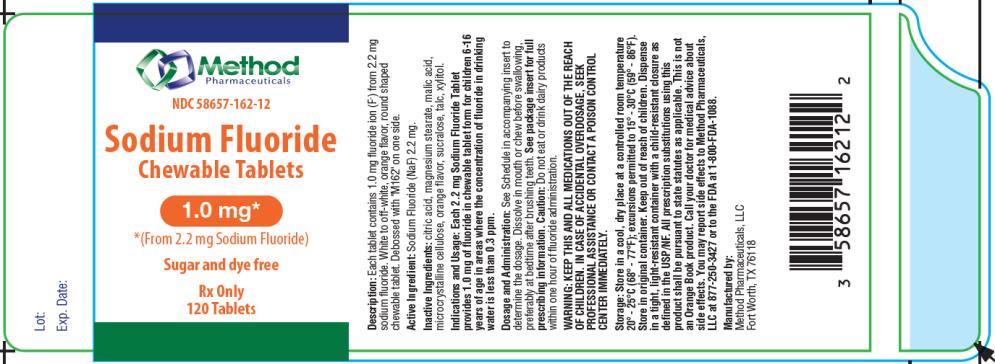
Sodium Fluoride Chewable 1 mg Tablet, 120-count — NDC 58657-162-12 (Billing 58657-0162-12)
This is a package of 120 tablets of Sodium Fluoride Chewable 1 mg Tablet from Method Pharmaceuticals, LLC, marketed since Aug 2018 and currently FDA-listed; retail pharmacies pay about $0.0722 per tablet (NADAC). It is this product's only package size.
NDC database record
One package, one record: these facts belong to NDC 58657-162-12 alone.
- Record
- FDA NDC Directory package listing · Human prescription drug
- Code segments
- 58657 labeler · 162 product · 12 package
- Package marketed since
- Aug 17, 2018
- Sample package
- No — commercial package
- Listing certified through
- Dec 31, 2026
- Billing quantity
- 120 EA per package
- Barcode (UPC)
- 0358657162122, 0358657160128, 0358657161125, 0358657161101
- Medicaid fills, this package
- 22,827 prescriptions in the last four reported quarters
- FDA record last changed
- Jul 24, 2026
Identity & classification
Regulatory identifiers FDA, NLM and CMS codes for this package
Drug-database identifiers Medi-Span GPI and First Databank GCN / HICL / AHFS classification
- GSN (GCN sequence number): 002623
- GCN: 07512
- GPI-14 (Medi-Span): 79300020000515
- HICL (First Databank): 001127
- AHFS class code: 34:04.00.00
- RxCUI (RxNorm): 198215
Where does this data come from?
- FDA openFDA NDC Directory · synced Oct 8, 2026
- FDA label on DailyMed · label index refreshed Oct 8, 2026
- RxNorm (NLM RxNav) · catalog refreshed Oct 1, 2026
- Medi-Span GPI (licensed)
- First Databank (licensed) · refreshed Oct 8, 2026
RxNorm drug class
This medicine belongs to the Caries prophylactic agents class.
Where does this data come from?
- RxClass (NLM) · catalog refreshed Oct 1, 2026
Clinical
This is a chewable tablet form of sodium fluoride taken by mouth. Sodium fluoride is commonly used to help strengthen tooth enamel and reduce the risk of tooth decay. This product is marketed without an approved FDA application and is classified as an unapproved drug.
Patient education
Supplement & herbal interactions
Where does this data come from?
- MedlinePlus (NLM) · refreshed Oct 8, 2026
- FDA label on DailyMed · label index refreshed Oct 8, 2026
Ask a licensed pharmacist directly — free, answered by our team.
Pricing
A drug doesn't have one price. Each row is a different public payment system, and none is what you'd pay at the counter — that depends on your insurance. The ⓘ on each row explains what it measures.
| Price system | Per ea | Per package |
|---|---|---|
| Retail pharmacies payNADAC · weekly | $0.072 | $8.66 / 120 tablets |
| Medicaid paysCMS SDUD · 12 mo | $0.1635 | $19.62 / 120 tablets |
| Medicare drug plans payPart D · quarterly | No Part D plan price is available for this NDC in our data. | |
Where does this data come from?
- CMS NADAC weekly file · file of Oct 7, 2026
- CMS ASP pricing files · refreshed Sep 20, 2026
- CMS Medicaid State Drug Utilization Data · through Q1 2026
- CMS Part D plan pricing files · refreshed Sep 24, 2026
- VA National Acquisition Center price file
Packaging — all sizes for this product
| Package NDC | Description | Marketing start | Marketing end | Status |
|---|---|---|---|---|
| 58657-0162-12 You're viewing this Main listing | 120 TABLET in 1 BOTTLE | 2018-08-17 | — | Active |
Therapeutic equivalents
| Product | Labeler | Pack | NADAC/unit | TE | Status | Price vs. this |
|---|---|---|---|---|---|---|
| Sodium Fluoride Chewable 1 mgthis 58657-0162-12 | Method | 120 tablets | $0.072 | — | Availability likely | — |
| Fluoride 1 mg 75826-0165-20 | WINDER | 120 tablets | $0.072 | — | Availability likely | — |
| Sodium Fluoride Chewable 1 mg 63629-1133-01 | Bryant | 120 tablets | — | — | FDA listed | — |
| Sodium Fluoride Chewable 1 mg 71335-2724-01 | Bryant | 120 tablets | — | — | FDA listed | — |
| Sodium Fluoride Chewable 1 mg 72162-1654-02 | Bryant | 120 tablets | — | — | FDA listed | — |
Where does this data come from?
- FDA openFDA NDC Directory · synced Oct 8, 2026
- FDA Orange Book · refreshed Oct 3, 2026
- CMS NADAC weekly file · file of Oct 7, 2026
Availability & generic status
We did not find an FDA-approved generic match for this exact strength, form and route.
Where does this data come from?
- FDA Orange Book · refreshed Oct 3, 2026
What it looks like
Where does this data come from?
- FDA label on DailyMed · label index refreshed Oct 8, 2026
Inactive Ingredients / Excipients
Inactive ingredients, also called excipients, are components of the drug product other than the active ingredient. They may include fillers, dyes, coatings, preservatives, flavors, or other formulation ingredients.
💡 Tap an ingredient (hover on desktop) to see what it is and why it’s used.
-
UNII 2968PHW8QP
A weak organic acid derived from citrus fruits or made through fermentation. It works as a buffer to control pH, a preservative to extend shelf life, and a flavoring agent in medications.
-
UNII 70097M6I30
Magnesium stearate is a salt made from magnesium and stearic acid, a fatty substance. It's used in tablets and capsules as a lubricant and glidant to help ingredients flow smoothly during manufacturing and prevent sticking.
-
UNII 817L1N4CKP
Malic acid is a naturally occurring organic acid found in fruits. It works as a buffer and flavor agent to maintain the medicine's pH balance and add tartness to the product.
-
UNII OP1R32D61U
Microcrystalline cellulose is a purified form of cellulose, a natural fiber from plant sources. It acts as a binder and filler in tablets and capsules, helping hold ingredients together and give the medicine its shape and size.
-
UNII 96K6UQ3ZD4
Sucralose is a synthetic sweetener made from sugar. It's added to medicines to improve taste without adding calories, helping make bitter or unpleasant-tasting drugs easier to take.
-
UNII 7SEV7J4R1U
A powder made from a naturally occurring mineral. In medicines, talc works as a glidant and anti-caking agent, helping tablets and capsules flow smoothly during manufacturing and preventing clumping.
-
UNII VCQ006KQ1E
Xylitol is a naturally occurring sugar alcohol derived from plants. It's used in medicines as a sweetener, bulking agent, and to improve taste, especially in liquid formulations and chewable tablets.
7 inactive ingredients listed in the exact product block matched to this NDC.
Where does this data come from?
ingredient classCode="IACT" elements from the exact product block matched by this NDC. Label-section narrative from DailyMed / the openFDA label index is shown separately when available.- FDA label on DailyMed · label index refreshed Oct 8, 2026
- FDA openFDA NDC Directory · synced Oct 8, 2026
Inactive ingredient FAQ
Are inactive ingredients the same for every manufacturer?
Why might an inactive ingredient be missing?
Can inactive ingredients matter?
Manufacturer & labeler
More NDCs from Method Pharmaceuticals, LLC labeler code 58657
- Sodium Chloride Normal Salt 1 g Tablet NDC 58657-118-01
- Sodium Chloride 1 g Tablet NDC 58657-119-01
- Magnesium Oxide 400 mg Tablet NDC 58657-120-12
- Folic Acid 1 mg Tablet NDC 58657-151-01
- Sodium Fluoride Chewable .25 mg Tablet NDC 58657-160-12
- Sodium Fluoride Chewable .5 mg Tablet NDC 58657-161-10
- Multivitamin with Fluoride .ALPHA.-TOCOPHEROL ACETATE, DL-, ASCORBIC ACID, CYANOCOBALAMIN, FOLIC ACID, NIACIN, PYRIDOXINE, RIBOFLAVIN, SODIUM FLUORIDE, THIAMINE MONONITRATE, VITAMIN A and VITAMIN D 2500 [iU]/1; 60 mg; 400 [iU]/1; 15 [iU]/1; 1.05 mg; 1.2 mg; 13.5 mg; 1.05 mg; 300 ug; 4.5 ug Tablet, Chewable NDC 58657-163-01
- Multivitamin with Fluoride .ALPHA.-TOCOPHEROL ACETATE, DL-, ASCORBIC ACID, CYANOCOBALAMIN, FOLIC ACID, NIACIN, PYRIDOXINE, RIBOFLAVIN, SODIUM FLUORIDE, THIAMINE MONONITRATE, VITAMIN A and VITAMIN D 2500 [iU]/1; 60 mg; 400 [iU]/1; 15 [iU]/1; 1.05 mg; 1.2 mg; 13.5 mg; 1.05 mg; 300 ug; 4.5 ug Tablet, Chewable NDC 58657-164-01
- Multivitamin with Fluoride .ALPHA.-TOCOPHEROL ACETATE, DL-, ASCORBIC ACID, CYANOCOBALAMIN, FOLIC ACID, NIACIN, PYRIDOXINE, RIBOFLAVIN, SODIUM FLUORIDE, THIAMINE MONONITRATE, VITAMIN A and VITAMIN D 2500 [iU]/1; 60 mg; 400 [iU]/1; 15 [iU]/1; 1.05 mg; 1.2 mg; 13.5 mg; 1.05 mg; 300 ug; 4.5 ug Tablet, Chewable NDC 58657-165-01
- M-Natal Plus Vitamin A, Vitamin C, Vitamin D, Vitamin E, Thiamine, Riboflavin, Niacin, Vitamin B6, Folic Acid, Vitamin B12, Calcium, Iron, Zinc, Copper 4000 [iU]/1; 120 mg; 400 [iU]/1; 22 [iU]/1; 1.84 mg; 3 mg; 20 mg; 10 mg; 1 mg; 12 ug; 200 mg Tablet NDC 58657-170-01
- RELGAABI Gabapentin 200 mg Capsule NDC 58657-231-01
- RELGAABI Gabapentin 300 mg Capsule NDC 58657-233-01
Where does this data come from?
- FDA openFDA NDC Directory · synced Oct 8, 2026
- Drugs@FDA
Full prescribing information FDA SPL
🎯 Indications and Usage ▾
INDICATIONS AND USAGE For once daily self-applied systemic use as a dental caries preventive in pediatric patients. It has been established that ingestion of fluoridated drinking water (1 ppm F¯) during the period of tooth development results in a significant decrease in the incidence of dental caries. Sodium Fluoride Chewable Tablets were developed to provide systemic fluoride for use as a supplement in pediatric patients from age 3 years to age 16 years and older living in areas where the drinking water fluoride contents does not exceed 0.6 ppm F¯.
⏱️ Dosage and Administration ▾
DOSAGE AND ADMINISTRATION (for dosage see table) Dissolve in the mouth or chew before swallowing, preferably at bedtime after brushing teeth. See schedule below to determine dosage.
⛔ Contraindications ▾
CONTRAINDICATIONS Fluoride 1.0 mg Tablets are contraindicated when the fluoride content of drinking water is >0.3 ppm F¯ and should not be administered to pediatric patients under 6 years. Fluoride 0.5 mg Tablets are contraindicated when the fluoride content of drinking water is more than 0.6 ppm F¯ and should not be administered to pediatric patients under age 6 when the fluoride content of drinking water is 0.3 ppm F¯ or more or to pediatric patients under age 3 years. Fluoride 0.25 mg Tablets are contraindicated when the fluoride content of drinking water is more than 0.6 ppm F¯ and should not be administered to pediatric patients under age 3 years when the fluoride content of drinking water is 0.3 ppm F¯ or more.
Do not administer Sodium Fluoride Chewable Tablets (any strength) to pediatric patients under age 3 years. Sodium Fluoride Chewable Tablets (any strength) are not indicated for use in adults.
⚠️ Warnings ▾
WARNING Prolonged daily ingestion of quantities greater than the recommended amount may result in various degrees of dental fluorosis in pediatric patients under age 6 years, especially if the water fluoridation exceeds 0.6 ppm. Read directions carefully before using. This product, as all chewable tablets, is not recommended for children under age 3 due to risk of choking. Keep out of the reach of infants and children.
🤒 Adverse Reactions ▾
ADVERSE REACTIONS Allergic rash and other idiosyncrasies have been rarely reported.
🤰 Pregnancy ▾
Pregnancy Teratogenic Effects Pregnancy Category B It has been shown that fluoride crosses the placenta of rats, but only 0.01% of the amount administered is incorporated in fetal tissue. Animal studies (rats, mice, rabbits) have shown that fluoride is not a teratogen. Maternal exposure to 12.2 mg fluoride/kg of body weight (rats) or 13.1 mg/kg of body weight (rabbits) did not affect the litter size or fetal weight and did not increase the frequency of skeletal or visceral malformations.
Epidemiological studies conducted in areas with high levels of naturally fluoridated water showed no increase in birth defects. Heavy exposure to fluoride during in utero development may result in skeletal fluorosis which becomes evident in childhood.
🧒 Pediatric Use ▾
Pediatric Use The use of Sodium Fluoride Chewable Tablets as a caries preventive in pediatric age groups 3 years to 16 years is supported by evidence from adequate and well controlled studies on fluoride supplementation from birth through adolescence.
🧓 Geriatric Use ▾
Geriatric Use Sodium Fluoride Chewable Tablets (any strength) are not indicated for use in geriatric patients.
🧬 Clinical Pharmacology ▾
CLINICAL PHARMACOLOGY Sodium Fluoride acts systemically (before tooth eruption) and topically (post-eruption) by increasing tooth resistance to acid dissolution, by promoting remineralization, and by inhibiting the cariogenic microbial process.
📦 How Supplied / Storage and Handling ▾
HOW SUPPLIED Each tablet contains 0.25 mg Fluoride from 0.55 mg Sodium Fluoride. White to off-white, orange flavor, round-shaped chewable tablet. Debossed with "M160" on one side.
NDC 58657-160-12 (120 count). Each tablet contains 0.5 mg Fluoride from 1.1 mg Sodium Fluoride. White to off-white, orange flavor, round-shaped chewable tablet.
Debossed with "M161" on one side. NDC 58657-161-12 (120 count). NDC 58657-161-10 (1,000 count).
Each tablet contains 1.0 mg Fluoride from 2.2 mg Sodium Fluoride. White to off-white, orange flavor, round-shaped chewable tablet. Debossed with "M162" on one side.
NDC 58657-162-12 (120 count).
⚠️ Precautions ▾
PRECAUTIONS General Please refer to the CONTRAINDICATIONS , WARNINGS and OVERDOSAGE sections for overdosage concerns. Use in pediatric patients below the age of 3 years is not recommended by current American Dental Associations and American Academy of Pediatrics guidelines. Carcinogenesis, Mutagenesis, Impairment of Fertility In a study conducted in rodents, no carcinogenesis was found in male and female rats treated with fluoride at dose levels ranging from 4.1 to 9.1 mg/kg of body weight.
Equivocal evidence of carcinogenesis was reported for male rats treated with 2.5 and 4.1 mg/kg of body weight. In a second study, no carcinogenesis was observed in rats, males or females, treated with fluoride up to 11.3 mg/kg of body weight. This dose is at least 400 times greater than the recommended daily dose of Sodium Fluoride Chewable Tablets.
Fluoride ion is not mutagenic in standard bacterial systems. It has been shown that fluoride ion has potential to induce chromosome aberrations in cultured human and rodentcells at does much higher than those to which humans are exposed. In vivo data is conflicting.
Some studies report chromosome damage in rodents while other studies using similar protocols report negative results. Potential adverse reproductive effects of fluoride exposure in humans has not been adequately evaluated. Adverse effects on reproduction were reported for rats, mice, fox, and cattle exposed to 100 ppm or greater concentrations of fluoride in their diet or drinking water.
Other studies conducted in rats demonstrated that lower doses of fluoride (5 mg/kg of body weight) did not result in impaired fertility and reproductive capabilities. This dose is approximately 200 times greater than the recommended daily dose of Sodium Fluoride Chewable Tablets. Pregnancy Teratogenic Effects Pregnancy Category B It has been shown that fluoride crosses the placenta of rats, but only 0.01% of the amount administered is incorporated in fetal tissue.
Animal studies (rats, mice, rabbits) have shown that fluoride is not a teratogen. Maternal exposure to 12.2 mg fluoride/kg of body weight (rats) or 13.1 mg/kg of body weight (rabbits) did not affect the litter size or fetal weight and did not increase the frequency of skeletal or visceral malformations. Epidemiological studies conducted in areas with high levels of naturally fluoridated water showed no increase in birth defects.
Heavy exposure to fluoride during in utero development may result in skeletal fluorosis which becomes evident in childhood. Nursing Mothers It is not known if fluoride is excreted in human milk. However, many drugs are excreted in human milk and caution should be exercised when Sodium Fluoride Chewable Tablets are administered to a nursing woman.
Reduced milk production was reported in farm raised fox when the animals were fed a diet containing a high concentration of fluoride (98-137 mg/kg of body weight). No adverse effects on parturition, lactation, or offspring were seen in rats administered fluoride up to 5 mg/kg of body weight. This dose is at least 200 times greater than the recommended daily dose of Sodium Fluoride Chewable Tablets.
Geriatric Use Sodium Fluoride Chewable Tablets (any strength) are not indicated for use in geriatric patients. Pediatric Use The use of Sodium Fluoride Chewable Tablets as a caries preventive in pediatric age groups 3 years to 16 years is supported by evidence from adequate and well controlled studies on fluoride supplementation from birth through adolescence.
🍼 Nursing Mothers ▾
Nursing Mothers It is not known if fluoride is excreted in human milk. However, many drugs are excreted in human milk and caution should be exercised when Sodium Fluoride Chewable Tablets are administered to a nursing woman. Reduced milk production was reported in farm raised fox when the animals were fed a diet containing a high concentration of fluoride (98-137 mg/kg of body weight).
No adverse effects on parturition, lactation, or offspring were seen in rats administered fluoride up to 5 mg/kg of body weight. This dose is at least 200 times greater than the recommended daily dose of Sodium Fluoride Chewable Tablets.
📄 Carcinogenesis, Mutagenesis, Impairment of Fertility ▾
Carcinogenesis, Mutagenesis, Impairment of Fertility In a study conducted in rodents, no carcinogenesis was found in male and female rats treated with fluoride at dose levels ranging from 4.1 to 9.1 mg/kg of body weight. Equivocal evidence of carcinogenesis was reported for male rats treated with 2.5 and 4.1 mg/kg of body weight. In a second study, no carcinogenesis was observed in rats, males or females, treated with fluoride up to 11.3 mg/kg of body weight.
This dose is at least 400 times greater than the recommended daily dose of Sodium Fluoride Chewable Tablets. Fluoride ion is not mutagenic in standard bacterial systems. It has been shown that fluoride ion has potential to induce chromosome aberrations in cultured human and rodentcells at does much higher than those to which humans are exposed.
In vivo data is conflicting. Some studies report chromosome damage in rodents while other studies using similar protocols report negative results. Potential adverse reproductive effects of fluoride exposure in humans has not been adequately evaluated.
Adverse effects on reproduction were reported for rats, mice, fox, and cattle exposed to 100 ppm or greater concentrations of fluoride in their diet or drinking water. Other studies conducted in rats demonstrated that lower doses of fluoride (5 mg/kg of body weight) did not result in impaired fertility and reproductive capabilities. This dose is approximately 200 times greater than the recommended daily dose of Sodium Fluoride Chewable Tablets.
📚 References ▾
REFERENCES 1. Accepted Dental Therapeutics, Ed. 40, American Dental Association, Chicago, 399-402 (1984).
2. J. Jakush, New Fluoride Schedule Adopted, ADA News, 12, 14 (May 16, 1994).
3. Aasenden, R., and Peebles, T.C. "Effects of Fluoride Supplementation From Birth on Dental Caries and Fluorosis in Teenaged Children", Arch. Oral, Biol., 23, 111–115 (1974).
4. Hamber, L. "Controlled Trial of Fluoride Vitamin Drops for Prevention of Caries in Children", Lancet, 1, 441-442 (1971). 5.
Hennon, D.K. Stookey, G.K. and Veiswanter, B.B. "Fluoride-Vitamin Supplements: Effects on Dental Caries and Fluorosis When Used in Areas with Suboptimum Fluoride in the Water Supply", JADA, 95, 965-971 (1977). Dispense in a tight, light-resistant container with a child-resistant closure as defined in the USP/NF.
Warning: Keep this and all medications out of the reach of children. In case of accidental overdose, seek professional assistance or contact a poison control center immediately. All prescription substitutions using this product shall be pursuant to state statutes as applicable.
This is not an Orange Book product. Manufactured by: Method Pharmaceuticals, LLC Fort Worth, TX 76118 Rev. 07/2018
📄 Package Label / Principal Display Panel ▾
PRINCIPAL DISPLAY PANEL NDC 58657-160-12 Sodium Fluoride Chewable Tablets 0.25 mg 120 Tablets Rx Only 0.25-120
PRINCIPAL DISPLAY PANEL NDC 58657-161-12 Sodium Fluoride Chewable Tablets 0.5 mg 120 Tablets Rx Only 0.5mg-120
PRINCIPAL DISPLAY PANEL NDC 58657-161-10 Sodium Fluoride Chewable Tablets 0.5 mg 1000 Tablets Rx Only 0.5mg-1000
PRINCIPAL DISPLAY PANEL NDC 58657-162-12 Sodium Fluoride Chewable Tablets 1.0 mg (From 2.2 mg Sodium Fluoride) 120 Tablets Rx Only 1mg-120
Medicaid utilization & spend
About this NDC listing & data coverage
Listed without an FDA application
This product's marketing category indicates it is marketed without an approved FDA application (no NDA, ANDA, or BLA on file). Having an NDC does not by itself establish FDA approval — the NDC Directory is a listing system, not an approval decision. Approval-linked data such as Orange Book therapeutic-equivalence ratings therefore does not apply.
What data is (and isn’t) available for this NDC — tap to expand
| NDC identity (package / product / labeler codes) | ✓ Available |
| Labeler | ✓ Available |
| Product & package description | ✓ Available |
| Marketing category & status | ✓ Available |
| Active ingredient / dosage form / route | ✓ Available |
| FDA label (SPL via DailyMed) | ✓ Available |
| Package photos | ✓ Available |
| Inactive ingredients (structured) | ✓ Available |
| NADAC pharmacy acquisition price (CMS) | ✓ Available |
| Orange Book / therapeutic-equivalence data | — Not published for this NDC Applies only to products approved under an NDA/ANDA; many listings are out of scope. |
| HCPCS J-code billing crosswalk | — Not published for this NDC Most self-administered / retail products have no J-code — that is normal. |
| Medicaid utilization (CMS SDUD) | ✓ Available |