
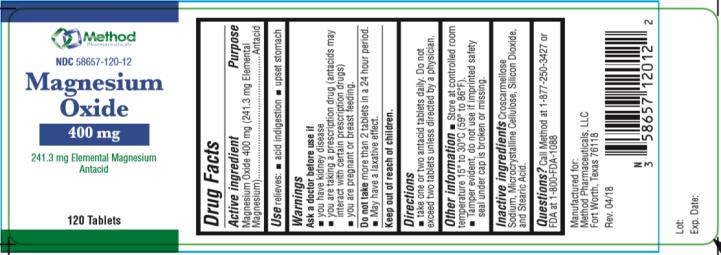
Magnesium Oxide 400 mg Tablet, 120-count — NDC 58657-120-12 (Billing 58657-0120-12)
This is a package of 120 tablets of Magnesium Oxide 400 mg Tablet from Method Pharmaceuticals, LLC, marketed since Jul 2018 and currently FDA-listed; retail pharmacies pay about $0.0346 per tablet (NADAC). It is this product's only package size.
NDC database record
One package, one record: these facts belong to NDC 58657-120-12 alone.
- Record
- FDA NDC Directory package listing · Human OTC drug
- Code segments
- 58657 labeler · 120 product · 12 package
- Package marketed since
- Jul 25, 2018
- Sample package
- No — commercial package
- Listing certified through
- Dec 31, 2026
- Billing quantity
- 120 EA per package
- Barcode (UPC-A, from the NDC)
- 3 5865712012 2
- Medicaid fills, this package
- 34,321 prescriptions in the last four reported quarters
- FDA record last changed
- Oct 8, 2026
Identity & classification
Regulatory identifiers FDA, NLM and CMS codes for this package
Drug-database identifiers Medi-Span GPI and First Databank GCN / HICL / AHFS classification
- GSN (GCN sequence number): 078687
- GCN: 45064
- GPI-14 (Medi-Span): 48400020000310
- HICL (First Databank): 000609
- AHFS class code: 56:04.00.00
- RxCUI (RxNorm): 198741
Where does this data come from?
- FDA openFDA NDC Directory · synced Oct 8, 2026
- FDA label on DailyMed · label index refreshed Oct 8, 2026
- RxNorm (NLM RxNav) · catalog refreshed Oct 1, 2026
- Medi-Span GPI (licensed)
- First Databank (licensed) · refreshed Oct 8, 2026
RxNorm drug class
This medicine belongs to the Magnesium compounds class.
Where does this data come from?
- RxClass (NLM) · catalog refreshed Oct 1, 2026
Clinical
- It's used to relieve acid indigestion and upset stomach. Some products, like Magnesium Oxide 400mg, are also used as a magnesium supplement. Check which use your product is labeled...
- For antacid use, the labels say 1 tablet twice a day or as directed by your doctor. For supplement use, the directions vary by product, from 1 tablet daily to 1 to 2 tablets daily....
- The dietary supplement tablet suggests taking it preferably with food. The other labels don't give a food instruction, so follow what's on your package or what your prescriber tell...
- The main one is a laxative effect, meaning looser or more frequent stools. If that bothers you or you're using more than the label allows, check in with your doctor or pharmacist.
Patient education
Supplement & herbal interactions
Where does this data come from?
- MedlinePlus (NLM) · refreshed Oct 8, 2026
- FDA label on DailyMed · label index refreshed Oct 8, 2026
Ask a licensed pharmacist directly — free, answered by our team.
Pricing
A drug doesn't have one price. Each row is a different public payment system, and none is what you'd pay at the counter — that depends on your insurance. The ⓘ on each row explains what it measures.
| Price system | Per ea | Per package |
|---|---|---|
| Retail pharmacies payNADAC · weekly | $0.035 | $4.15 / 120 tablets |
| Medicaid paysCMS SDUD · 12 mo | $0.2027 | $24.32 / 120 tablets |
| Medicare drug plans payPart D · quarterly | No Part D plan price is available for this NDC in our data. | |
Where does this data come from?
- CMS NADAC weekly file · file of Oct 7, 2026
- CMS ASP pricing files · refreshed Sep 20, 2026
- CMS Medicaid State Drug Utilization Data · through Q1 2026
- CMS Part D plan pricing files · refreshed Sep 24, 2026
- VA National Acquisition Center price file
Packaging — all sizes for this product
| Package NDC | Description | Marketing start | Marketing end | Status |
|---|---|---|---|---|
| 58657-0120-12 You're viewing this Main listing | 120 TABLET in 1 BOTTLE | 2018-07-25 | — | Active |
Therapeutic equivalents
| Product | Labeler | Pack | NADAC/unit | TE | Status | Price vs. this |
|---|---|---|---|---|---|---|
| Magnesium Oxide 400 mg 00603-0209-22 | Endo | 120 tablets | $0.035 | — | Availability likely | — |
| Magnesium Oxide 400 mg 24689-0132-01 | APNAR | 120 tablets | $0.035 | — | Availability likely | — |
| Magnesium Oxide 400 mgthis 58657-0120-12 | Method | 120 tablets | $0.035 | — | Availability likely | — |
| Magnesium Oxide 400 mg 69367-0298-20 | Westminster | 120 tablets | $0.035 | — | Availability likely | — |
| Magnesium Oxide 400 mg 81033-0027-01 | Kesin | 1000 tablets | $0.035 | — | Availability likely | — |
| Magnesium Oxide 400 mg 10135-0786-62 | Marlex | 120 tablets | — | — | FDA listed | — |
| Magnesium Oxide 400 mg 50090-7432-00 | A-S | 120 tablets | — | — | FDA listed | — |
| Magnesium Oxide 400 mg 54738-0973-12 | Richmond | 120 tablets | — | — | Discontinued | — |
| Magnesium Oxide 400 mg 63629-1126-01 | Bryant | 120 tablets | — | — | Discontinued | — |
| Magnesium Oxide 400 mg 63629-9420-01 | Bryant | 120 tablets | — | — | FDA listed | — |
| Magnesium Oxide 400mg 400 mg 69168-0174-06 | Allegiant | 120 tablets | — | — | FDA listed | — |
| Magnesium Oxide 400 mg 71335-1960-01 | Bryant | 60 tablets | — | — | FDA listed | — |
| Magnesium Oxide 400 mg 71610-0172-60 | Aphena | 90 tablets | — | — | FDA listed | — |
| Magnesium Oxide 400 mg 71610-0182-60 | Aphena | 90 tablets | — | — | FDA listed | — |
| Magnesium Oxide 400 mg 72162-1648-04 | Bryant | 120 tablets | — | — | FDA listed | — |
| Magnesium Oxide 241.3 mg/1000mg 84447-0001-12 | Belleview | 120 mg | — | — | FDA listed | — |
Where does this data come from?
- FDA openFDA NDC Directory · synced Oct 8, 2026
- FDA Orange Book · refreshed Oct 3, 2026
- CMS NADAC weekly file · file of Oct 7, 2026
Availability & generic status
We did not find an FDA-approved generic match for this exact strength, form and route.
Where does this data come from?
- FDA Orange Book · refreshed Oct 3, 2026
Inactive Ingredients / Excipients
Inactive ingredients, also called excipients, are components of the drug product other than the active ingredient. They may include fillers, dyes, coatings, preservatives, flavors, or other formulation ingredients.
🧪 Avoiding an ingredient? See Magnesium Oxide inactive ingredients by manufacturer: every current product's list side by side, so you can ask your pharmacy for the version that does not list it.
💡 Tap an ingredient (hover on desktop) to see what it is and why it’s used.
-
UNII OP1R32D61U
Microcrystalline cellulose is a purified form of cellulose, a natural fiber from plant sources. It acts as a binder and filler in tablets and capsules, helping hold ingredients together and give the medicine its shape and size.
-
UNII M28OL1HH48
Croscarmellose sodium is a plant-based substance derived from cellulose. It acts as a disintegrant, helping tablets and capsules break down quickly in the digestive system so the medicine can be absorbed.
-
UNII ETJ7Z6XBU4
Silicon dioxide is a naturally occurring mineral used as a glidant and anti-caking agent. It helps powder ingredients flow smoothly and prevents clumping during manufacturing and storage.
-
UNII 4ELV7Z65AP
Stearic acid is a fatty acid derived from plant or animal sources. It acts as a binder and lubricant in tablets and capsules, helping them hold together and flow smoothly during manufacturing.
4 inactive ingredients listed in the exact product block matched to this NDC.
Label-section wording can be broader than the structured product block and may mention additional formulation ingredients.
Where does this data come from?
ingredient classCode="IACT" elements from the exact product block matched by this NDC. Label-section narrative from DailyMed / the openFDA label index is shown separately when available.- FDA label on DailyMed · label index refreshed Oct 8, 2026
- FDA openFDA NDC Directory · synced Oct 8, 2026
Inactive ingredient FAQ
Are inactive ingredients the same for every manufacturer?
Why might an inactive ingredient be missing?
Can inactive ingredients matter?
Manufacturer & labeler
More NDCs from Method Pharmaceuticals, LLC labeler code 58657
- Sodium Chloride Normal Salt 1 g Tablet NDC 58657-118-01
- Sodium Chloride 1 g Tablet NDC 58657-119-01
- Folic Acid 1 mg Tablet NDC 58657-151-01
- Sodium Fluoride Chewable .25 mg Tablet NDC 58657-160-12
- Sodium Fluoride Chewable .5 mg Tablet NDC 58657-161-10
- Sodium Fluoride Chewable 1 mg Tablet NDC 58657-162-12
- Multivitamin with Fluoride .ALPHA.-TOCOPHEROL ACETATE, DL-, ASCORBIC ACID, CYANOCOBALAMIN, FOLIC ACID, NIACIN, PYRIDOXINE, RIBOFLAVIN, SODIUM FLUORIDE, THIAMINE MONONITRATE, VITAMIN A and VITAMIN D 2500 [iU]/1; 60 mg; 400 [iU]/1; 15 [iU]/1; 1.05 mg; 1.2 mg; 13.5 mg; 1.05 mg; 300 ug; 4.5 ug Tablet, Chewable NDC 58657-163-01
- Multivitamin with Fluoride .ALPHA.-TOCOPHEROL ACETATE, DL-, ASCORBIC ACID, CYANOCOBALAMIN, FOLIC ACID, NIACIN, PYRIDOXINE, RIBOFLAVIN, SODIUM FLUORIDE, THIAMINE MONONITRATE, VITAMIN A and VITAMIN D 2500 [iU]/1; 60 mg; 400 [iU]/1; 15 [iU]/1; 1.05 mg; 1.2 mg; 13.5 mg; 1.05 mg; 300 ug; 4.5 ug Tablet, Chewable NDC 58657-164-01
Where does this data come from?
- FDA openFDA NDC Directory · synced Oct 8, 2026
- Drugs@FDA
FDA label — Drug Facts FDA SPL
🎯 Indications and Usage ▾
Use relieves: ■ acid indigestion ■ upset stomach
⏱️ Dosage and Administration ▾
Directions take one or two antacid tablets daily. Do not exceed two tablets unless directed by a physician.
⚠️ Warnings ▾
Warnings Ask a doctor before use if you have kidney disease you are taking a prescription drug (antacids may interact with certain prescription drugs) you are pregnant or breast feeding. Do not take more than 2 tablets in a 24 hour period. May have a laxative effect. Keep out of reach of children.
📦 Storage and Handling ▾
Other information Store at controlled room temperature 15° to 30°C (59° to 86°F). Tamper evident, do not use if imprinted safety seal under cap is broken or missing.
🧪 Active Ingredient ▾
Active ingredient Magnesium Oxide 400 mg (241.3 mg Elemental Magnesium)
🧪 Inactive Ingredients ▾
Inactive ingredients Croscarmellose Sodium, Microcrystalline Cellulose, Silicon Dioxide, and Stearic Acid.
🎯 Purpose ▾
Purpose Antacid
📄 Ask a Doctor Before Use If ▾
Ask a doctor before use if you have kidney disease you are taking a prescription drug (antacids may interact with certain prescription drugs) you are pregnant or breast feeding. Do not take more than 2 tablets in a 24 hour period. May have a laxative effect.
📄 Keep Out of Reach of Children ▾
Keep out of reach of children.
📄 Questions or Comments ▾
Questions? Call Method at 1-877-250-3427 or FDA at 1-800-FDA-1088 Manufactured for: Method Pharmaceuticals, LLC Fort Worth, Texas 76118 Rev. 04/18
📄 Package Label / Principal Display Panel ▾
Principal Display Panel NDC 58657-120-12 Magnesium Oxide 400 mg 241.3 Elemental Magnesium Antacid 120 Tablets label