
Home › NDC Lookup › Ingredients › Sodium Bicarbonate › 00536-1046-10
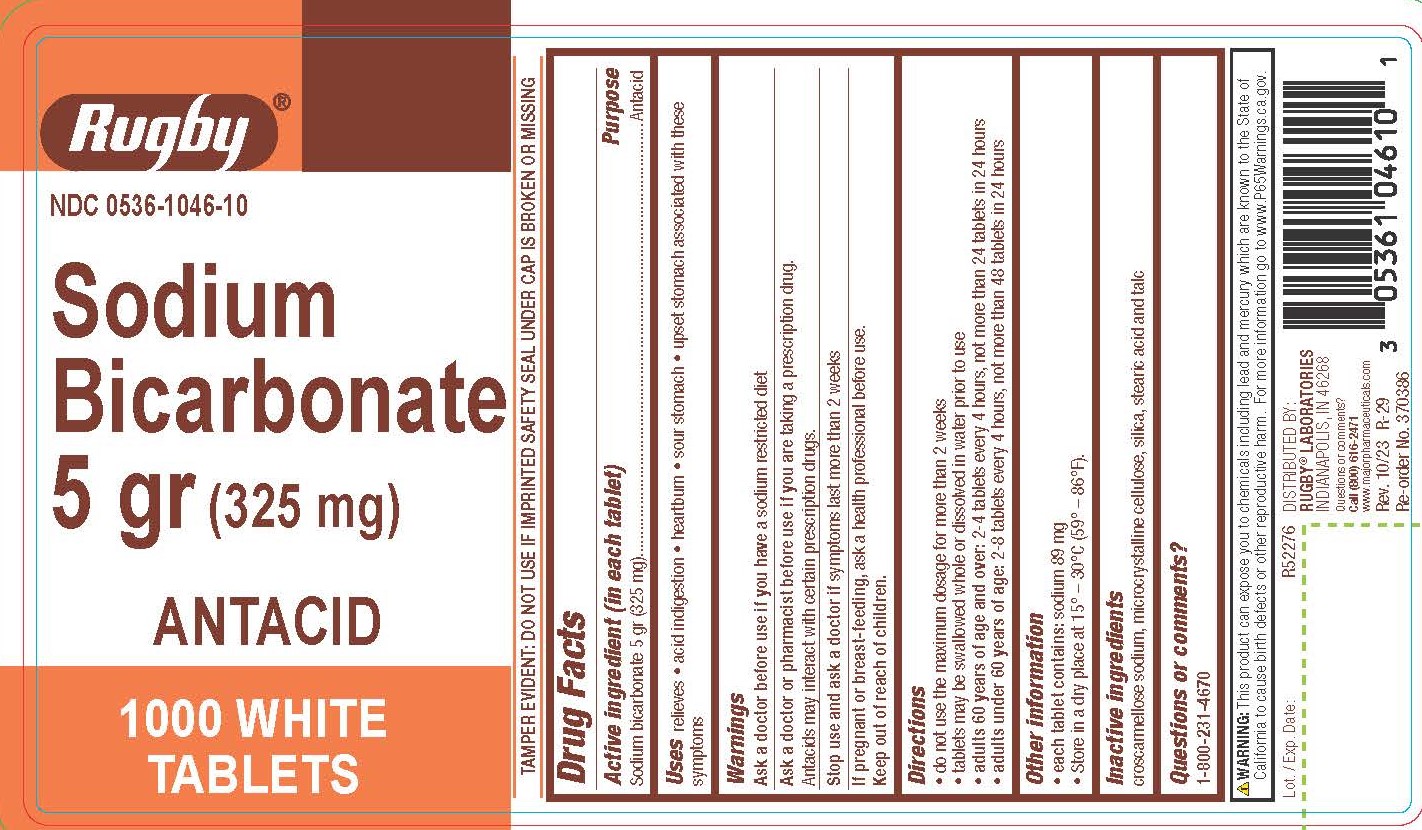
Sodium Bicarbonate Antacid 325 mg Tablet, 1,000-count — NDC 00536-1046-10 package photo
Label image from the product's FDA listing (DailyMed) — may show a different pack size or an older label revision.

Sodium Bicarbonate Antacid 325 mg Tablet, 1,000-count — NDC 0536-1046-10 (Billing 00536-1046-10)

by Rugby Laboratories · 1000 TABLET in 1 BOTTLE

This is a package of 1,000 tablets of Sodium Bicarbonate Antacid 325 mg Tablet from Rugby Laboratories, marketed since Mar 2015 and currently FDA-listed; retail pharmacies pay about $0.0147 per tablet (NADAC). It is this product's only package size.

NDC 00536-1046-10
🏷️ FDA NDC (as labeled) 0536-1046-10 billing pads the labeler segment with a zero
OTC On market Non-controlled ⇄ Compare with another NDC
🗂️ FDA directory synced Oct 1, 2026 · this listing last changed Jul 24, 2026 · sources: openFDA · FDA label (DailyMed) · FDA Orange & Purple Book · First Databank · CMS NADAC, ASP, Medicare & Medicaid · RxNorm
📋 All sources & update times →

NDC database record

One package, one record: these facts belong to NDC 0536-1046-10 alone.

Record
FDA NDC Directory package listing · Human OTC drug
Code segments
0536 labeler · 1046 product · 10 package
Package marketed since
Mar 25, 2015
Sample package
No — commercial package
Listing certified through
Dec 31, 2026
Billing quantity
1,000 EA per package
Barcode (UPC)
0305361046101
Medicaid fills, this package
8,040 prescriptions in the last four reported quarters
FDA record last changed
Jul 24, 2026
⚠️
Other active recalls for Sodium Bicarbonate (different manufacturers) — 5 · tap to view
These affect other manufacturers’ products for the same ingredient — not necessarily the exact NDC on this page.
Class II · Aug 4, 2025 — Lack of Assurance of Sterility. (PFIZER INC) · FDA recall D-0591-2025
Class II · Jul 30, 2025 — Failed Impurities/Degradation Specifications: out of specification results for arsenic in the impurities tested. (Exela Pharma Sciences LLC) · FDA recall D-0620-2025
Class II · Mar 7, 2025 — Lack of Assurance of Sterility (Exela Pharma Sciences LLC) · FDA recall D-0303-2025
Class I · Dec 21, 2023 — Presence of Particulate Matter; identified as glass (Pfizer Inc.) · FDA recall D-0234-2024
Class I · Oct 18, 2023 — Presence of Particulate Matter: Silicone (Exela Pharma Sciences LLC) · FDA recall D-0116-2024
Each entry is an official FDA enforcement report — look up any recall number in the FDA recall database ↗

Identity & classification

Regulatory identifiers FDA, NLM and CMS codes for this package

FDA NDC (as labeled) 0536-1046-10
Product NDC 0536-1046
11-digit billing NDC 00536104610
NCPDP billing unit EA — each (per item)
RxCUI 198859
UNII 8MDF5V39QO
UPC 0305361046101
Application # M001
SPL Set ID e73b5871-4a87-4473-ab00-5e5395be017d
Established class (EPC) Osmotic Laxative
Mechanism of action Osmotic Activity
Physiologic effect Increased Large Intestinal Motility; Inhibition Large Intestine Fluid/Electrolyte Absorption
DEA schedule Non-controlled
Marketing category OTC MONOGRAPH DRUG
Marketing status On market
FDA listing status Listed (active directory)
Marketing start 2015-03-25
Route ORAL
Dosage form TABLET
Substance SODIUM BICARBONATE

Drug-database identifiers Medi-Span GPI and First Databank GCN / HICL / AHFS classification

GPI-14 48200010000310
GPI class Sodium Bicarbonate
GCN Seq No 002659
GCN 07852
HICL code 000523
Ingredient (HICL) Sodium Bicarbonate
HIC1 code D
Therapeutic class — broad (HIC1) Biliary System/Gastro-Intestinal System
HIC2 code D4
Therapeutic class — intermediate (HIC2) Drugs Acting Principally On The Alimentary Tract
HIC3 code D4B
Therapeutic class — specific (HIC3) Antacids
AHFS code 56:04.00.00
AHFS class Antacids And Adsorbents
FDB label name SODIUM BICARB 325 MG TABLET
FDB brand name Sodium Bicarbonate
Legend status O — Over-the-counter (OTC) drug or device
Quick answers
  • GSN (GCN sequence number): 002659
  • GCN: 07852
  • GPI-14 (Medi-Span): 48200010000310
  • HICL (First Databank): 000523
  • AHFS class code: 56:04.00.00
  • RxCUI (RxNorm): 198859
Why two NDCs? The FDA registers this code as 0536-1046-10 — a 4-4-2 layout, and that's what's printed on the package and shown on DailyMed. For insurance claims, every NDC is standardized to a uniform 11-digit 5-4-2 format by adding a zero to the labeler segment → 00536-1046-10. Same drug, same package — only the format differs.
Where does this data come from?
Identifiers from the FDA openFDA NDC Directory and Structured Product Labeling; RxCUI from RxNorm (NLM); GPI from Medi-Span; GCN / HIC / AHFS / legend from First Databank.

RxNorm drug class

This medicine belongs to the Salt solutions class.

Drug family (ATC) Salt solutions, Electrolyte solutions
Where does this data come from?
Therapeutic classes from RxNorm RxClass (U.S. National Library of Medicine) — Established Pharmacologic Class (FDA), ATC drug family (WHO) and mechanism of action, matched by this product’s RxCUI.

Clinical

Label name SODIUM BICARB 325 MG TABLET Ingredient Sodium Bicarbonate
📖 What it is MedlinePlus · NLM

Sodium bicarbonate is an antacid used to relieve heartburn and acid indigestion. Your doctor also may prescribe sodium bicarbonate to make your blood or urine less acidic in certain conditions. This medication is sometimes prescribed for other uses; ask your doctor or pharmacist for more information.

Read the full MedlinePlus article ↗
📗 Our plain-language guide HelloPharmacist
  • It depends on the product. By mouth, it relieves heartburn, sour stomach and acid indigestion. On the skin, some products ease itching from insect bites and poison ivy. The injecti...
  • Labels for products like Rapidol and De La Cruz Sodium Bicarbonate Antacid say to dissolve it completely in water and drink it. It can be repeated every couple of hours up to a dai...
  • Don't use the maximum dose for more than 2 weeks unless a doctor tells you to. If your symptoms last longer than 2 weeks, stop and see your doctor.
  • Antacids can interact with some prescription drugs. Please check with me or your doctor before using it if you take any.
📖 Read our full Sodium Bicarbonate guide →
4
Nutrient depletion considerations

Sodium Bicarbonate (OTC Drug) may be associated with lower levels of 4 nutrients — worth a chat with your pharmacist, not a cause for alarm.

An association is not a deficiency. Educational only — don't start or stop anything without professional guidance.
Where does this data come from?
Plain-language summary from MedlinePlus (U.S. National Library of Medicine); supplement & herbal interactions and nutrient depletion data from the Natural Medicines database; our full guide is HelloPharmacist editorial content.

Pricing

A drug doesn't have one price. Each row is a different public payment system, and none is what you'd pay at the counter — that depends on your insurance. The ⓘ on each row explains what it measures.

Price systemPer eaPer package
Retail pharmacies payNADAC · weekly $0.015 $14.70 / 1000 tablets
Medicaid paysCMS SDUD · 12 mo $0.0772 $77.20 / 1000 tablets
Medicare drug plans payPart D · quarterly No Part D plan price is available for this NDC in our data.
NADAC price history (per ea) — tap or hover for the price & month
Nov 2023 Feb 2026 May 2026 Sep 2026 $0.015 $0.013
▲ Up 10% over the last 11 months.
Where does this data come from?
NADAC (National Average Drug Acquisition Cost) is the CMS weekly pharmacy-acquisition-cost survey — what pharmacies pay. ASP (Average Sales Price) is the CMS Medicare Part B drug-payment file, published quarterly. Medicaid pays is computed by us from CMS State Drug Utilization Data (total reimbursed ÷ units, trailing 12 months) — gross of rebates and inclusive of dispensing fees, so it reflects what Medicaid paid, not an acquisition cost. Medicare drug plans pay is the median negotiated point-of-sale unit cost across plans listing this NDC in the CMS quarterly Prescription Drug Plan pricing files, before rebates. The VA pays is the federal contract price (FSS, and the statutory Big 4 ceiling where listed) from the VA National Acquisition Center pharmaceutical price file. All are free public government data; each measures a different payer, so the figures are not directly comparable.

Packaging — all sizes for this product

Package NDCDescription Marketing startMarketing endStatus
00536-1046-10 You're viewing this Main listing 1000 TABLET in 1 BOTTLE 2015-03-25 — Active

Therapeutic equivalents

ProductLabelerPackNADAC/unitTEStatusPrice vs. this
Sodium Bicarbonate Antacid 325 mgthis 00536-1046-10 Rugby 1000 tablets $0.015 — Availability likely —
Sodium Bicarbonate Antacid 325 mg 54738-0035-03 Richmond 1000 tablets — — FDA listed —
Sodium Bicarbonate 5 gr 325 mg 55681-0072-02 TWIN 200 tablets — — FDA listed —
Sodium Bicarbonate 5 gr 325 mg 55681-0307-02 TWIN 200 tablets — — FDA listed —
Sodium Bicarbonate 5 gr (325 mg) 70369-0002-01 CitraGen 1000 tablets — — FDA listed —
About this product: other versions of the same ingredient, strength and form are listed above, least expensive first, with FDA equivalence ratings where available.
Where does this data come from?
Equivalents are other NDCs of the same ingredient, form and route from the openFDA NDC Directory, ranked least-expensive-first by NADAC. Therapeutic-equivalence (AB) ratings come from the FDA Orange Book; biologics use the FDA Purple Book for biosimilar & interchangeable status.

Availability & generic status

🏛️
2015
On the market since
Mar 2015
📍
2026
Currently FDA-listed
11 years listed
🔒
·
No generic listed yet
brand only
ℹ️No FDA-approved generic found

We did not find an FDA-approved generic match for this exact strength, form and route.

Where does this data come from?
Patents and exclusivity from the FDA Orange Book (small-molecule drugs), refreshed from public FDA data. Generic launch timing is an estimate, not a guarantee.

What it looks like

Color white
ShapeRound
ImprintCPC76
Size1 mm
ScoringNot scored
One label can cover several strengths, so colors may be combined — always confirm a loose pill against the dispensed prescription label or a pharmacist.
Where does this data come from?
Physical description (imprint, shape, color, scoring, coating) from this product’s FDA Structured Product Labeling (SPL), mirrored from DailyMed / openFDA.

Inactive Ingredients / Excipients

Inactive ingredients, also called excipients, are components of the drug product other than the active ingredient. They may include fillers, dyes, coatings, preservatives, flavors, or other formulation ingredients.

💡 Tap an ingredient (hover on desktop) to see what it is and why it’s used.

  • UNII OP1R32D61U
    Microcrystalline cellulose is a purified form of cellulose, a natural fiber from plant sources. It acts as a binder and filler in tablets and capsules, helping hold ingredients together and give the medicine its shape and size.
  • UNII M28OL1HH48
    Croscarmellose sodium is a plant-based substance derived from cellulose. It acts as a disintegrant, helping tablets and capsules break down quickly in the digestive system so the medicine can be absorbed.
  • UNII ETJ7Z6XBU4
    Silicon dioxide is a naturally occurring mineral used as a glidant and anti-caking agent. It helps powder ingredients flow smoothly and prevents clumping during manufacturing and storage.
  • UNII 4ELV7Z65AP
    Stearic acid is a fatty acid derived from plant or animal sources. It acts as a binder and lubricant in tablets and capsules, helping them hold together and flow smoothly during manufacturing.
  • UNII 7SEV7J4R1U
    A powder made from a naturally occurring mineral. In medicines, talc works as a glidant and anti-caking agent, helping tablets and capsules flow smoothly during manufacturing and preventing clumping.

5 inactive ingredients listed in the exact product block matched to this NDC.

The official label also statescroscarmellose sodium, microcrystalline cellulose, silica, stearic acid, and talc

Label-section wording can be broader than the structured product block and may mention additional formulation ingredients.

Where does this data come from?
Data sourced from official FDA Structured Product Labeling (SPL) via DailyMed — ingredient classCode="IACT" elements from the exact product block matched by this NDC. Label-section narrative from DailyMed / the openFDA label index is shown separately when available.

Inactive ingredient FAQ

Are inactive ingredients the same for every manufacturer?
No. Inactive ingredients can differ by manufacturer, dosage form, strength, and package / product version.
Why might an inactive ingredient be missing?
Some SPLs do not provide a complete structured inactive-ingredient list, and older or unusual labels may only include the information in narrative text.
Can inactive ingredients matter?
Yes. They can matter for allergies, intolerances, dyes, gluten / lactose concerns, preservatives, and formulation differences — but confirm with a pharmacist or the manufacturer when it’s clinically important.

Manufacturer & labeler

LabelerRugby Laboratories
FDA applicationM001 (OTC MONOGRAPH DRUG)
Labeler code00536
First marketedMar 2015
Product typeHuman Otc Drug
Portfolio149 products on file
The labeler markets the product; the application holder owns the FDA approval. They’re often the same company but can differ (e.g. a repackager or an authorized generic). A mailing address / phone appears here when the manufacturer includes it in the product’s FDA label (not all do).
Where does this data come from?
Labeler, application holder and registered establishment from the FDA openFDA NDC Directory and Drugs@FDA; address/contact from the product’s FDA label.

FDA label — Drug Facts FDA SPL

The complete FDA label for this product — the official Drug Facts labeling, verbatim, section by section. Jump with a chip, search within the label, or expand everything.
🎯 Indications and Usage 13 words ▾

Uses relieves acid indigestion heartburn sour stomach upset stomach associated with these symptoms

⏱️ Dosage and Administration 63 words ▾

Directions do not use the maximum dosage for more than 2 weeks tablets may be swallowed whole or dissolved in water prior to use adults 60 years of age and over: 2-4 tablets every 4 hours, not more than 24 tablets in 24 hours adults under 60 years of age: 2-8 tablets every 4 hours, not more than 48 tablets in 24 hours

⚠️ Warnings 64 words ▾

Warnings Ask a doctor before use if you have a sodium restricted diet Ask a doctor or pharmacist before use if you are taking a prescription drug. Antacids may interact with certain prescription drugs. Stop use and ask a doctor if symptoms last more than 2 weeks If pregnant or breast-feeding , ask a health professional before use. Keep out of reach of children.

🧪 Active Ingredient 13 words ▾

Drug Facts Active ingredient (in each tablet) Sodium bicarbonate 5 gr (325 mg)

🧪 Inactive Ingredients 11 words ▾

Inactive ingredients croscarmellose sodium, microcrystalline cellulose, silica, stearic acid, and talc

🎯 Purpose 2 words ▾

Purpose Antacid

📄 Ask a Doctor Before Use If 12 words ▾

Ask a doctor before use if you have a sodium restricted diet

📄 Ask a Doctor or Pharmacist Before Use If 21 words ▾

Ask a doctor or pharmacist before use if you are taking a prescription drug. Antacids may interact with certain prescription drugs.

📄 Stop Use and Ask a Doctor If 13 words ▾

Stop use and ask a doctor if symptoms last more than 2 weeks

🤰 If Pregnant or Breast-Feeding 11 words ▾

If pregnant or breast-feeding , ask a health professional before use.

📄 Keep Out of Reach of Children 6 words ▾

Keep out of reach of children.

📄 Other Information 21 words ▾

Other information each tablet contains: sodium 89 mg Store in a dry place at 15º - 30ºC (59º - 86º F)

📄 Questions or Comments 4 words ▾

Questions or comments? 1-800-231-4670

📄 Package Label / Principal Display Panel 15 words ▾

Rugby NDC 0536-1046-10 Sodium Bicarbonate 5 gr (325 mg) ANTACID 1000 WHITE TABLETS Rugby Label

Source: FDA Structured Product Labeling, mirrored from DailyMed / openFDA. Prefer the government’s original formatting? View this label on DailyMed ↗

Medicaid utilization & spend

📍 This exact package only: Medicaid data is reported per full 11-digit NDC — labeler, product and pack size — so every number here is for this package alone, not the drug overall. Other pack sizes report separately.
💊 Pharmacy benefit only: These are Medicaid outpatient pharmacy claims, billed by NDC. They exclude the medical benefit — clinic- or hospital-administered drugs billed under HCPCS J-codes — so drugs used mostly that way (e.g. Avastin, Lucentis, Keytruda) can look low or missing here. That’s expected, not an error.
📅 Q1 2025 – Q1 2026 · 5 quarters of data
ⓘ The newest quarter is usually incomplete when first published; states restate recent quarters in later CMS releases, so the latest figures typically revise upward. State coverage-policy changes can also shift quarter-to-quarter totals.
Prescriptions last 4 qtrs
8K
Units reimbursed last 4 qtrs
706.7K
Gross reimbursed last 4 qtrs
$54.6K
Avg / prescription
$6.79
Avg / unit
$0.0772
Latest quarter Q1 2026
1.9KRx
Medicaid pays / ea
$0.0772
gross reimbursed
vs
NADAC / ea
$0.0147
acquisition cost
=
Spread
+$0.0625
+425% vs cost
What Medicaid paid per ea (before rebates; includes the pharmacy’s dispensing fee) compared with NADAC — the average price pharmacies pay to buy the drug. A positive spread means Medicaid reimbursed more than the purchase price, before manufacturer rebates.
Fee-for-service vs managed care ⓘ
42% FFS 58% MCO
Fee-for-service · 3,394 Rx Managed care · 4,646 Rx
State Medicaid map
Alaska: no data reported AK Maine: 6,227 units · 446 per 100k residents ME Washington: no data reported WA Idaho: no data reported ID Montana: no data reported MT North Dakota: no data reported ND Minnesota: 32,879 units · 573 per 100k residents MN Wisconsin: 32,084 units · 543 per 100k residents WI Michigan: 37,514 units · 374 per 100k residents MI New York: no data reported NY Vermont: 1,458 units · 225 per 100k residents VT New Hampshire: no data reported NH Oregon: 23,005 units · 543 per 100k residents OR Nevada: 7,269 units · 228 per 100k residents NV Wyoming: no data reported WY South Dakota: no data reported SD Iowa: no data reported IA Illinois: 32,171 units · 256 per 100k residents IL Indiana: 68,749 units · 1,002 per 100k residents IN Ohio: 40,284 units · 342 per 100k residents OH Pennsylvania: 83,886 units · 647 per 100k residents PA New Jersey: 26,958 units · 290 per 100k residents NJ Massachusetts: 25,277 units · 361 per 100k residents MA California: 142,193 units · 365 per 100k residents CA Utah: no data reported UT Colorado: no data reported CO Nebraska: 15,952 units · 806 per 100k residents NE Missouri: no data reported MO Kentucky: 29,592 units · 654 per 100k residents KY West Virginia: no data reported WV Virginia: 24,953 units · 286 per 100k residents VA Maryland: 1,447 units · 23.4 per 100k residents MD Connecticut: no data reported CT Rhode Island: no data reported RI Arizona: 30,601 units · 412 per 100k residents AZ New Mexico: 2,117 units · 100 per 100k residents NM Kansas: no data reported KS Arkansas: 933 units · 30.4 per 100k residents AR Tennessee: no data reported TN North Carolina: no data reported NC South Carolina: 3,780 units · 70.4 per 100k residents SC Delaware: no data reported DE Oklahoma: no data reported OK Louisiana: no data reported LA Mississippi: no data reported MS Alabama: no data reported AL Georgia: no data reported GA D.C.: no data reported DC Hawaii: no data reported HI Texas: 37,352 units · 122 per 100k residents TX Florida: no data reported FL
Units reimbursed · per 100k residents
23.41,002
gray = no data reported ⓘ
Colors are per 100,000 residents, so big states don’t automatically dominate. Tap or hover a state for its actual totals.
Tap or hover a state
…for its Medicaid breakdown
🏆 Top states by units · per 100k residents
1 Indiana 1,002 /100k
2 Nebraska 806 /100k
3 Kentucky 654 /100k
4 Pennsylvania 647 /100k
5 Minnesota 573 /100k
6 Oregon 543 /100k
7 Wisconsin 543 /100k
8 Maine 446 /100k
National units — by quarter
💵 About the dollar figures: “reimbursed” is what Medicaid paid pharmacies before confidential manufacturer rebates, so the program’s real net cost is lower than these numbers. Fee-for-service and managed-care claims are combined unless split above. Source: CMS State Drug Utilization Data; per-100k rates use 2023 Census population estimates.

Medicare Part D spend CMS · PART D · 2026 (Q1)

Medicare Part D (outpatient prescription) spending for Sodium Bicarbonate (matched by generic name) — the program that covers self-administered drugs. 9 manufacturers.
⚠️ Drug-level data: CMS publishes Part D spending by drug, not by NDC — these figures combine every manufacturer, strength and package size sold under the name Sodium Bicarbonate. That’s a different level of aggregation than the Medicaid card above, which is specific to this exact 11-digit NDC (pack size included), so the two aren’t directly comparable.
Period
Total Part D spend
$136.8K
Claims incl. refills
2.2K
Beneficiaries
722
Spend / beneficiary
$189.50
Spend / claim
$61.05
Trend by period
💵 About the dollar figures: spending is what Part D plans paid before confidential manufacturer rebates, so the program’s real net cost is lower. A blank patient count means fewer than 11 people — CMS hides counts that small to protect privacy. Source: CMS Medicare Quarterly Part D Spending by Drug (data.cms.gov), updated quarterly.

Reported adverse events (FAERS)

Read carefully: FAERS reports are voluntary and unverified. Counts are not incidence, do not establish causation, are subject to reporting bias, and cannot be used to compare one drug to another. Shown for signal context only. Reports for Sodium Bicarbonate Antacid (this brand).

Top reported reactions

Acute Kidney Injury1,696
Diarrhoea1,444
Renal Failure1,374
Nausea1,181
Anaemia1,110
Death1,061
Dyspnoea1,029

Reporter sex

23,110 reports

Serious outcomes

Hospitalization12,116
Death4,265
Life-threatening2,329
Disabling726
Reports over time (by year) — tap or hover for the count & year
2019 2021 2023 2026 1,934 0
Most recent year is provisional (FAERS lags ~3 months).
Where does this data come from?
Adverse-event reports from the FDA Adverse Event Reporting System (FAERS) via openFDA. FAERS reports are voluntary and unverified — counts are not incidence and don’t establish causation.
For educational and professional reference only — not medical advice. Pricing reflects published NADAC and CMS ASP (free public data) and may differ from your acquisition cost; always verify before billing or dispensing.