
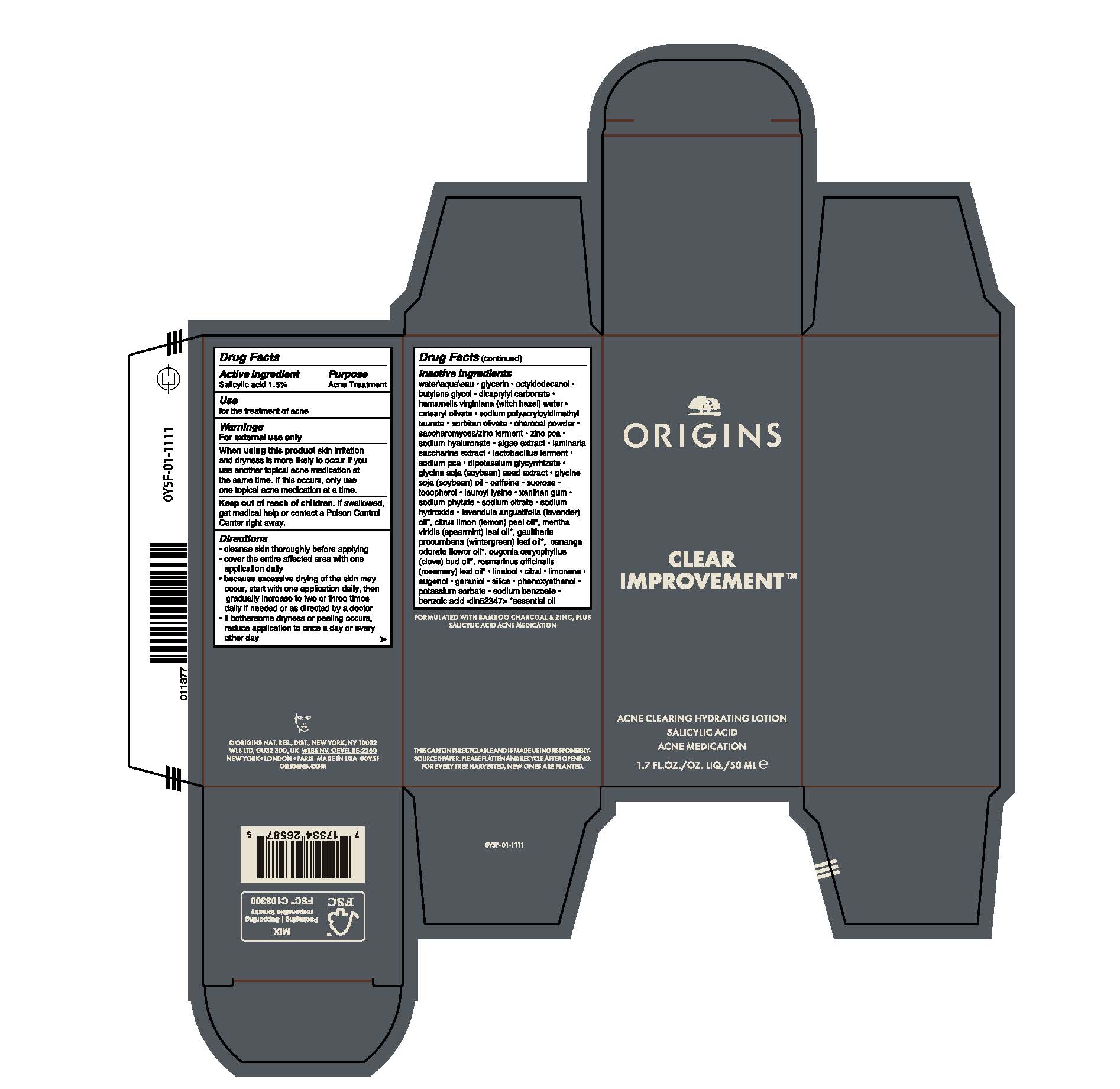
CLEAR IMPROVEMENT ACNE CLEARING HYDRATING LTN SALICYLIC ACID 15 mg/mL Lotion — NDC 59427-117-01 (Billing 59427-0117-01)
This is a package of CLEAR IMPROVEMENT ACNE CLEARING HYDRATING LTN SALICYLIC ACID 15 mg/mL Lotion from ORIGINS NATURAL RESOURCES INC., marketed since Feb 2024 and currently FDA-listed. It is the main listing for this product, which comes in 3 package sizes.
NDC database record
One package, one record: these facts belong to NDC 59427-117-01 alone.
- Record
- FDA NDC Directory package listing · Human OTC drug
- Code segments
- 59427 labeler · 117 product · 01 package
- Package marketed since
- Feb 5, 2024
- Sample package
- No — commercial package
- Listing certified through
- Dec 31, 2026
- Barcode (UPC-A, from the NDC)
- 3 5942711701 4
- FDA record last changed
- Jul 24, 2026
Identity & classification
Regulatory identifiers FDA, NLM and CMS codes for this package
- RxCUI (RxNorm): 422997
Where does this data come from?
- FDA openFDA NDC Directory · synced Oct 8, 2026
- FDA label on DailyMed · label index refreshed Oct 8, 2026
- RxNorm (NLM RxNav) · catalog refreshed Oct 8, 2026
- Medi-Span GPI (licensed)
- First Databank (licensed) · refreshed Oct 8, 2026
RxNorm drug class
This medicine belongs to the Salicylic acid and derivatives class.
Where does this data come from?
- RxClass (NLM) · catalog refreshed Oct 8, 2026
Clinical
Topical salicylic acid is used to help clear and prevent pimples and skin blemishes in people who have acne. Topical salicylic acid is also used to treat skin conditions that involve scaling or overgrowth of skin cells such as psoriasis (a skin disease in which red, scaly patches form on some areas of the body), ichthyoses (inborn conditions that cause skin dryness and scaling), dandruff, corns, calluses, and warts on the hands or feet. Topical salicylic acid should not be used to treat genital warts, warts on the face, warts with hair growing from them, warts in the nose or mouth, moles, or b...
Read the full MedlinePlus article ↗- It is used in a facial routine for acne-prone and oil-prone skin. The routine includes a cleanser, serum, toner and emulsion. Salicylic acid helps loosen and shed dead skin cells.
- Use the cleanser morning and evening, and the serum in the morning after cleansing. Use the toner in the evening on dry skin, and the emulsion at night after cleansing. Avoid your...
- Mild stinging, burning, itching, dryness and extra peeling can happen. If dryness or peeling bothers you, try using the serum or toner every other day. If it gets excessive, stop a...
- It is best not to. Using another topical acne medication at the same time makes irritation and dryness more likely. If you get irritated, use only one at a time.
Patient education
Supplement & herbal interactions
Where does this data come from?
- MedlinePlus (NLM) · refreshed Oct 8, 2026
- FDA label on DailyMed · label index refreshed Oct 8, 2026
Ask a licensed pharmacist directly — free, answered by our team.
Pricing
A drug doesn't have one price. Each row is a different public payment system, and none is what you'd pay at the counter — that depends on your insurance. The ⓘ on each row explains what it measures.
| Price system | Per g | Per package |
|---|---|---|
| Retail pharmacies payNADAC · weekly | Not in the retail survey — common for institutional, discontinued, or low-volume packs. | |
| Medicaid paysCMS SDUD · 12 mo | No recent Medicaid claims on file for this NDC — rare and low-volume NDCs are suppressed in the public data. | |
| Medicare drug plans payPart D · quarterly | No Part D plan price is available for this NDC in our data. | |
Where does this data come from?
- CMS NADAC weekly file
- CMS ASP pricing files · refreshed Sep 20, 2026
- CMS Medicaid State Drug Utilization Data · refreshed Oct 9, 2026
- CMS Part D plan pricing files · refreshed Sep 24, 2026
- VA National Acquisition Center price file
Packaging — all sizes for this product
| Package NDC | Description | Marketing start | Marketing end | Status |
|---|---|---|---|---|
| 59427-0117-01 You're viewing this Main listing | 1 BOTTLE in 1 CARTON / 50 mL in 1 BOTTLE | 2024-02-05 | — | Active |
| 59427-0117-02 59427-117-02 | 15 mL in 1 BOTTLE | 2024-02-05 | — | Active |
| 59427-0117-03 59427-117-03 | 5 mL in 1 BOTTLE | 2024-02-05 | — | Active |
Pack size FAQ
What quantity is in this package?
What NDC number is used to bill for this package of CLEAR IMPROVEMENT ACNE CLEARING HYDRATING LTN SALICYLIC ACID 15 mg/mL Lotion?
Therapeutic equivalents
Where does this data come from?
- FDA openFDA NDC Directory · synced Oct 8, 2026
- FDA Orange Book · refreshed Oct 3, 2026
- CMS NADAC weekly file
Availability & generic status
We did not find an FDA-approved generic match for this exact strength, form and route.
Where does this data come from?
- FDA Orange Book · refreshed Oct 3, 2026
Inactive Ingredients / Excipients
Inactive ingredients, also called excipients, are components of the drug product other than the active ingredient. They may include fillers, dyes, coatings, preservatives, flavors, or other formulation ingredients.
🧪 Avoiding an ingredient? See Salicylic Acid Topical inactive ingredients by manufacturer: every current product's list side by side, so you can ask your pharmacy for the version that does not list it.
💡 Tap an ingredient (hover on desktop) to see what it is and why it’s used.
-
UNII 2P3VWU3H10
Activated charcoal is a highly porous carbon material processed to increase its surface area. It's used in medicines as an absorbent to help bind and remove unwanted substances in the digestive system.
-
UNII 8SKN0B0MIM
Benzoic acid is a naturally occurring organic acid used as a preservative in medicines and foods. It helps prevent bacterial and fungal growth to extend shelf life and maintain product stability.
-
UNII 3XUS85K0RA
Butylene glycol is a clear liquid derived from petroleum or plants that acts as a humectant, solvent, and preservative booster in medicines. It helps keep formulations stable, dissolve active ingredients, and maintain moisture in topical products.
-
UNII 3G6A5W338E
Caffeine is a natural stimulant compound commonly extracted from coffee beans and tea leaves. In medicines, it serves as an active booster in pain relievers and cold products to enhance alertness and improve the effectiveness of other ingredients.
-
UNII 8YOY78GNNX
A fragrant essential oil derived from ylang-ylang tree flowers. It's used as a flavoring and fragrance agent to improve the taste or scent of medicines.
-
UNII 58B69Q84JO
A plant-derived emulsifier made from olive oil and fatty alcohols. It helps blend oil and water ingredients together and stabilizes the product's texture in creams, lotions, and similar formulations.
-
UNII T7EU0O9VPP
Citral is a natural oil compound found in lemon and citrus plants. It's used in medicines as a flavoring agent and to add pleasant lemon or citrus scent to the product.
-
UNII 578389D6D0
Clove oil is an essential oil derived from clove plant buds. It's used in medicines as a flavoring agent and for its mild preservative properties to help maintain product stability.
-
UNII 609A3V1SUA
A silky liquid derived from caprylic acid that acts as an emollient and solvent in formulations. It helps dissolve active ingredients and improves the spreadability and feel of lotions, creams, and topical products.
-
UNII 3T8H1794QW
Eugenol is a natural oil extracted from clove and other plants. It's used in medicines as a flavoring agent and to provide a mild anesthetic effect in topical products, particularly in dental formulations.
-
UNII L837108USY
Geraniol is a natural fragrant compound found in plants like roses and lemons. It's used in medicines as a flavoring agent and to improve the taste or aroma of the product.
-
UNII PDC6A3C0OX
Glycerin is a clear, thick liquid derived from plant oils or fats. It acts as a humectant to retain moisture, a sweetener, and a solvent in medications.
-
UNII CA2Y0FE3FX
A salt derived from licorice root extract, used as a flavoring agent and sweetener. It may also help soothe and protect mucous membranes in throat lozenges and cough products.
-
UNII NT00Y05A2V
A liquid extract from witch hazel plant leaves and twigs. It's used in topical products as an astringent agent and to help deliver other active ingredients into the skin.
-
UNII YSE9PPT4TH
Hyaluronate sodium is a natural carbohydrate that holds moisture. It's used in medicines as a lubricant, thickener, and moisture-retaining agent to improve texture and delivery of the active ingredient.
-
UNII 113171Q70B
Lauroyl lysine is a compound made by combining an amino acid (lysine) with a fatty acid (lauric acid). It works as a glidant and lubricant to help powder particles flow smoothly during manufacturing and tablet compression.
-
UNII ZBP1YXW0H8
A fragrant oil extracted from lavender plants, used as a flavoring and scent agent in medicines to improve taste and aroma.
-
UNII I9GRO824LL
Lemon oil is a natural fragrant extract from lemon peel. It's used in medicines as a flavoring agent to mask unpleasant tastes and improve how the medicine tastes to patients.
-
UNII GFD7C86Q1W
A natural oil extracted from citrus peels, (+)-limonene is used as a flavoring agent and solvent in medicines. It helps dissolve active ingredients and provides a lemon or orange taste.
-
UNII D81QY6I88E
Linalool is a natural fragrant oil found in plants like lavender and citrus. It's used in medicines as a flavoring agent and to mask unpleasant tastes or smells.
-
UNII LAV5U5022Y
Methyl salicylate is a naturally derived liquid compound commonly found in wintergreen plants. In medicines, it's used as a flavoring agent and penetrating solvent to help distribute active ingredients evenly throughout topical products.
-
UNII 461N1O614Y
A synthetic oily liquid used as an emollient and solvent in medications. It helps dissolve active ingredients and improves how the medicine spreads or absorbs through the skin.
-
UNII HIE492ZZ3T
Phenoxyethanol is a synthetic preservative and antimicrobial agent used to prevent bacterial and fungal growth in medicines and cosmetic products, extending shelf life and maintaining product safety.
-
UNII K2P8K2558N
A red marine microalga used as a natural colorant in medications and supplements. It provides red to purple coloring to tablets, capsules, and other formulations.
-
UNII 1VPU26JZZ4
Potassium sorbate is a salt derived from sorbic acid, a naturally occurring preservative. It prevents growth of mold, yeast, and some bacteria, extending the medicine's shelf life.
-
UNII 8LGU7VM393
Rosemary leaf oil is a natural aromatic oil extracted from rosemary plants. It's used in medicines as a flavoring agent and preservative to help protect the product from spoilage.
-
UNII 68CMP2MB55
A brown seaweed extract used as a thickener and stabilizer in liquid medicines and suspensions. It helps maintain consistent texture and prevents ingredients from separating.
-
UNII ETJ7Z6XBU4
Silicon dioxide is a naturally occurring mineral used as a glidant and anti-caking agent. It helps powder ingredients flow smoothly and prevents clumping during manufacturing and storage.
-
UNII OJ245FE5EU
Sodium benzoate is a salt derived from benzoic acid, a preservative. It's added to medicines to prevent growth of bacteria, fungi, and other microorganisms that could spoil the product.
-
UNII 1Q73Q2JULR
Sodium citrate is a salt derived from citric acid. It works as a buffer to maintain the medicine's pH level and may also help improve taste or act as a preservative in the formulation.
-
UNII 55X04QC32I
A strong alkaline chemical used to adjust and maintain the pH balance of liquid medicines. It helps keep the medicine stable and ensures it stays effective during storage.
-
UNII NG5NG5733T
A synthetic polymer derived from acrylic acid and taurine. It functions as a suspending agent and emulsifier, helping keep ingredients evenly distributed and preventing separation in liquid or semi-solid medicines.
-
UNII 469OTG57A2
Sodium pyrrolidone carboxylate is a synthetic polymer derived from pyrrolidone chemistry. It functions as a solubilizer and binder in medications, helping dissolve poorly water-soluble drugs and hold tablet ingredients together.
-
UNII MDL271E3GR
Sorbitan olivate is an emulsifier derived from sorbitol and olive oil. It helps blend water and oil ingredients together to maintain consistent texture and appearance throughout the medicine.
-
UNII L7HT8F1ZOD
A plant-based oil extracted from soybeans. It's used as an emulsifier and lubricant to help mix ingredients evenly and prevent sticking during tablet or capsule manufacturing.
-
UNII 241ATL177A
Soybean oil is a natural plant oil derived from soybean seeds. It's used in medicines as a solvent and carrier to help dissolve or suspend active ingredients and improve how the body absorbs them.
-
UNII C3M81465G5
Spearmint oil is a natural flavoring extract from spearmint plants. It's added to medicines to improve taste and mask bitter flavors, making medications easier to take.
-
UNII C151H8M554
A natural sugar derived from sugar cane or sugar beets. It's used as a sweetener, filler, and binder to improve taste, add bulk, and help hold tablet or capsule ingredients together.
-
UNII R0ZB2556P8
Tocopherol is a form of vitamin E derived from plant oils. It acts as an antioxidant in medicines to prevent oils and fats from breaking down and spoiling during storage.
-
UNII 059QF0KO0R
Water is a liquid solvent that dissolves and mixes ingredients together in liquid medicines, syrups, and injections. It helps distribute the active drug evenly throughout the product.
-
UNII TTV12P4NEE
Xanthan gum is a thickening and stabilizing ingredient made from fermented corn or other sugars. It's added to medicines to improve texture, prevent separation of liquids and solids, and help the product stay consistent.
-
UNII C32PQ86DH4
Zinc PCA is a zinc salt of pyroglutamic acid, a naturally occurring amino acid derivative. It's used in medications as a skin-conditioning agent and to help maintain product stability and texture in topical formulations.
42 inactive ingredients listed in the exact product block matched to this NDC.
Label-section wording can be broader than the structured product block and may mention additional formulation ingredients.
Where does this data come from?
ingredient classCode="IACT" elements from the exact product block matched by this NDC. Label-section narrative from DailyMed / the openFDA label index is shown separately when available.- FDA label on DailyMed · label index refreshed Oct 8, 2026
- FDA openFDA NDC Directory · synced Oct 8, 2026
Inactive ingredient FAQ
Are inactive ingredients the same for every manufacturer?
Why might an inactive ingredient be missing?
Can inactive ingredients matter?
Manufacturer & labeler
More NDCs from ORIGINS NATURAL RESOURCES INC. labeler code 59427
- CLEAR IMPROVEMENT PORE CLEARING MOISTURIZER Salicylic acid 10 mg/mL Lotion NDC 59427-015-01
- ORIGINS GINZING ENERGY-BOOSTING TINTED MOISTURIZER BROAD SPECTRUM SPF 40 OCTINOXATE, OCTISALATE, OCTOCRYLENE, TITANIUM DIOXIDE, and ZINC OXIDE 75 mg/mL; 20 mg/mL; 20 mg/mL; 30 mg/mL; 30 mg/mL Liquid NDC 59427-016-01
- DR. ANDREW WEIL FOR ORIGINS MEGA-BRIGHT SPF 30 SKIN TONE CORRECTING oil FREE MOISTURIZER BROAD SPECTRUM SPF 30 HOMOSALATE, OCTISALATE, AVOBENZONE, and OCTOCRYLENE 50 mg/mL; 50 mg/mL; 30 mg/mL; 27 mg/mL Cream NDC 59427-112-01
- DR ANDREW WEILS FOR ORIGINS MEGA-DEFENSE ADVANCED DAILY UV DEFENDER BROAD SPECTRUM SPF 45 TITANIUM DIOXIDE and ZINC OXIDE 63 mg/mL; 40 mg/mL Lotion NDC 59427-113-01
- PLANTSCRIPTION SPF 25 POWER ANTI AGING BROAD SPECTRUM 25 AVOBENZONE, HOMOSALATE, OCTISLATE, and OCTOCRYLENE 30 mg/mL; 50 mg/mL; 45 mg/mL; 28 mg/mL Cream NDC 59427-114-01
- GINZING SPF 30 DAILY MOISTURIZER AVOBENZONE,HOMOSALATE,OCTISALATE,OCTOCRYLENE 70 mg/mL; 30 mg/mL; 70 mg/mL; 45 mg/mL Cream NDC 59427-116-01
- CLEAR IMPROVEMENT BLACKHEAD CLEARING MASK TO SCRUB SALICYLIC ACID 10 mg/mL Liquid NDC 59427-118-01
- GINZING SPF 40 ENERGY-BOOSTING TINTED MOISTURIZER BROAD SPECTRUM SPF 40 SHEER TINT RELEASE HOMOSALATE,OCTINOXATE,OCTISALATE, AND ZINC OXIDE 65 mg/mL; 33 mg/mL; 45 mg/mL; 80 mg/mL Liquid NDC 59427-119-01
Where does this data come from?
- FDA openFDA NDC Directory · synced Oct 8, 2026
- Drugs@FDA
FDA label — Drug Facts FDA SPL
🎯 Indications and Usage ▾
Use for the treatmenet of acne
⏱️ Dosage and Administration ▾
Directions Cleanse skin throughly before applying Cover the entire affected area with one application daily Because excessive drying of the skin may occur, start with one application daily, then gradually increase to two or three times daily if needed or as directed by a doctor. If bothersome dryness or peeling occurs, reduce application to once a day or every other day
⚠️ Warnings ▾
Warnings For External use only When using this product skin irritattion and dryness is more likely to occur if you use another topical acne medication at the same time. If this occurs, only use one topical acne medication at a time. Keep out of reach of children If swallowed, get medical help or contact a poison control center right away.
🧪 Active Ingredient ▾
Active Ingredient Salicylic Acid 1.5%
🧪 Inactive Ingredients ▾
Inactive Ingredients water\aqua\eau,glycerin,octyldodecanol,butylene glycol,dicaprylyl carbonate,hamamelis virginiana (witch hazel) water,cetearyl olivate,sodium polyacryloyldimethyl taurate,sorbitan olivate,charcoal powder,saccharomyces/zinc ferment,zinc pca,sodium hyaluronate,algae extract,laminaria saccharina extract,lactobacillus ferment,sodium pca,dipotassium glycyrrhizate,glycine soja (soybean) seed extract,glycine soja (soybean) oil,caffeine,sucrose,tocopherol,lauroyl lysine,xanthan gum,sodium phytate,sodium citrate,sodium hydroxide,lavandula angustifolia (lavender) oil*, citrus limon (lemon) peel oil*, mentha viridis (spearmint) leaf oil*, gaultheria procumbens (wintergreen) leaf oil*, cananga odorata flower oil*, eugenia caryophyllus (clove) bud oil*, rosmarinus officinalis (rosemary) leaf oil*,linalool,citral,limonene,eugenol,geraniol,silica,phenoxyethanol,potassium sorbate,sodium benzoate,benzoic acid <iln52347> * essential oil
🎯 Purpose ▾
Purpose Acne Treatment
📄 When Using This Product ▾
When using this product skin irritattion and dryness is more likely to occur if you use another topical acne medication at the same time. If this occurs, only use one topical acne medication at a time.
📄 Keep Out of Reach of Children ▾
Keep out of reach of children If swallowed, get medical help or contact a poison control center right away.
📄 Package Label / Principal Display Panel ▾
ORIGINS CLEAR IMPROVEMENT ACNE CLEANSING HYDRATING LOTION SALICYLIC ACID ACNE MEDICATION
1.7FL.OZ./OZ.LIQ/50ML Principal Display Panel
Medicare Part D spend CMS · PART D · 2026 (Q1)
Reported adverse events (FAERS)
Top reported reactions
Age at onset
Reporter sex
Serious outcomes
Where does this data come from?
About this NDC listing & data coverage
What data is (and isn’t) available for this NDC — tap to expand
| NDC identity (package / product / labeler codes) | ✓ Available |
| Labeler | ✓ Available |
| Product & package description | ✓ Available |
| Marketing category & status | ✓ Available |
| Active ingredient / dosage form / route | ✓ Available |
| FDA label (SPL via DailyMed) | ✓ Available |
| Package photos | ✓ Available |
| Inactive ingredients (structured) | ✓ Available |
| NADAC pharmacy acquisition price (CMS) | — Not published for this NDC CMS publishes NADAC only for NDCs reported in its retail-pharmacy survey. |
| Orange Book / therapeutic-equivalence data | — Not published for this NDC Applies only to products approved under an NDA/ANDA; many listings are out of scope. |
| HCPCS J-code billing crosswalk | — Not published for this NDC Most self-administered / retail products have no J-code — that is normal. |
| Medicaid utilization (CMS SDUD) | — Not published for this NDC CMS reports utilization only for NDCs with Medicaid claims above its privacy threshold. |