
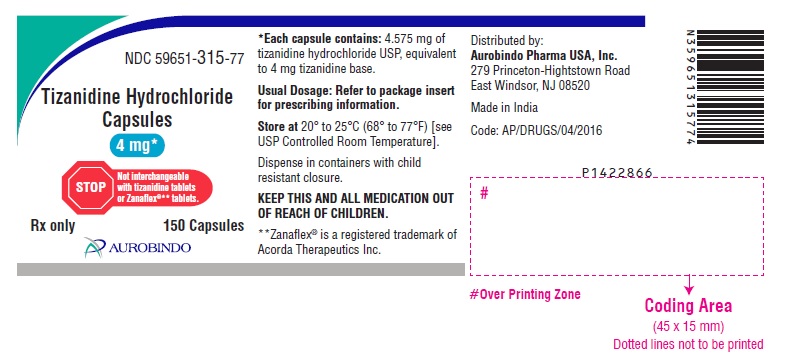
Tizanidine Hydrochloride 4 mg Capsule, 150-count — NDC 59651-315-77 (Billing 59651-0315-77)
This is a package of 150 capsules of Tizanidine Hydrochloride 4 mg Capsule from Aurobindo Pharma Limited, marketed since Mar 2020 and currently FDA-listed; retail pharmacies pay about $0.0967 per capsule (NADAC). It is the main listing for this product, which comes in 2 package sizes.
Identity & classification
Regulatory identifiers FDA, NLM and CMS codes for this package
Drug-database identifiers Medi-Span GPI and First Databank GCN / HICL / AHFS classification
- GSN (GCN sequence number): 058905
- GCN: 24434
- GPI-14 (Medi-Span): 75100090100120
- HICL (First Databank): 011582
- AHFS class code: 12:20.04.00
Where does this data come from?
- FDA openFDA NDC Directory · synced Oct 1, 2026
- FDA label on DailyMed · label index refreshed Oct 1, 2026
- RxNorm (NLM RxNav) · catalog refreshed Oct 1, 2026
- Medi-Span GPI (licensed)
- First Databank (licensed) · refreshed Oct 1, 2026
Clinical
Tizanidine is used to relieve muscle spasms, cramping, and tightness caused by certain conditions including multiple sclerosis (MS, a disease in which the nerves do not function properly and patients may experience weakness, numbness, loss of muscle coordination and problems with vision, speech, and bladder control) and spinal injury. Tizanidine is in a class of medications called skeletal muscle relaxants. It works by slowing action in the brain and nervous system to allow the muscles to relax.
Read the full MedlinePlus article ↗- It helps manage spasticity, meaning stiff, tight muscles that are hard to control. It wears off quickly, so it is meant for the times and activities when you most need relief.
- Food changes how much tizanidine you absorb, and tablets and capsules react differently. The key is to be consistent, either always with food or always without. Tell me or your pre...
- Dry mouth, sleepiness, tiredness or weakness, and dizziness are the most common. Many people find them mild to moderate. Call your doctor if you faint, see things that are not ther...
- It is best to avoid it. Alcohol raises the amount of tizanidine in your blood and adds to drowsiness and side effects. The same goes for other sedating medicines, so check with me...
Patient education
Supplement & herbal interactions
Where does this data come from?
- MedlinePlus (NLM) · refreshed Oct 1, 2026
- FDA label on DailyMed · label index refreshed Oct 1, 2026
Ask a licensed pharmacist directly — free, answered by our team.
Pricing
A drug doesn't have one price. Each row is a different public payment system, and none is what you'd pay at the counter — that depends on your insurance. The ⓘ on each row explains what it measures.
| Price system | Per ea | Per package |
|---|---|---|
| Retail pharmacies payNADAC · weekly | $0.097 | $14.51 / 150 capsules |
| Medicaid paysCMS SDUD · 12 mo | $0.2750 | $41.25 / 150 capsules |
| Medicare drug plans payPart D · Q2 2026 | $0.3010 | $45.15 / 150 capsules |
Where does this data come from?
- CMS NADAC weekly file · file of Sep 30, 2026
- CMS ASP pricing files · refreshed Sep 20, 2026
- CMS Medicaid State Drug Utilization Data · through Q4 2025
- CMS Part D plan pricing files · refreshed Sep 24, 2026
- VA National Acquisition Center price file
Packaging — all sizes for this product
| Package NDC | Description | Per unit | Per pack | Marketing start | Marketing end | Status |
|---|---|---|---|---|---|---|
| 59651-0315-77 You're viewing this Main listing | 150 CAPSULE in 1 BOTTLE | $0.0967 / ea | $14.51 | 2020-03-24 | — | Active |
| 59651-0315-15 59651-315-15 | 1500 CAPSULE in 1 BAG | — | — | — | — | Active |
You're viewing the smallest of 2 pack sizes for this product.
In Medicaid, this is the most-dispensed pack of this product — about 100% of fills over the last four reported quarters. See all packs ↓
Pack size FAQ
What quantity is in this package?
How does this package differ from NDC 59651-0315-15?
What NDC number is used to bill for this package of Tizanidine Hydrochloride 4 mg Capsule?
Prices are the latest CMS NADAC pharmacy acquisition cost per NDC; per-pack figures are per-unit × pack quantity, shown only when the pack is denominated in the same measure NADAC prices.
Therapeutic equivalents
| Product | Labeler | Pack | NADAC/unit | TE | Status | Price vs. this |
|---|---|---|---|---|---|---|
| tizanidine hydrochloride 4 mg 00591-2789-86 | Actavis | 150 capsules | $0.097 | AB | Availability likely | — |
| Tizanidine Hydrochloride 4 mg 50742-0225-15 | Ingenus | 150 capsules | $0.097 | AB | Availability likely | — |
| Tizanidine Hydrochloride 4 mgthis 59651-0315-77 | Aurobindo | 150 capsules | $0.097 | — | Availability likely | — |
| tizanidine hydrochloride 4 mg 72888-0002-15 | Advagen | 150 capsules | $0.097 | AB | Availability likely | — |
| Tizanidine Hydrochloride 4 mg 75834-0208-15 | Nivagen | 150 capsules | $0.163 | AB | Discontinued | +69% |
| Tizanidine Hydrochloride 4 mg 42291-0811-15 | AvKARE | 150 capsules | — | AB | FDA listed | — |
| Tizanidine Hydrochloride 4 mg 46708-0492-08 | Alembic | 640 capsules | — | AB | FDA listed | — |
| Tizanidine Hydrochloride 4 mg 60505-2649-03 | Apotex | 30 capsules | — | AB | FDA listed | — |
| Tizanidine Hydrochloride 4 mg 62332-0492-08 | Alembic | 640 capsules | — | AB | FDA listed | — |
| Tizanidne hydrochloride 4 mg 63629-8872-01 | Bryant | 150 capsules | — | AB | FDA listed | — |
| Tizanidne hydrochloride 4 mg 67877-0611-05 | Ascend | 500 capsules | — | AB | FDA listed | — |
| Tizanidine Hydrochloride 4 mg 68788-8747-01 | Preferred | 100 capsules | — | AB | FDA listed | — |
| tizanidine hydrochloride 4 mg 68788-8776-01 | Preferred | 100 capsules | — | AB | FDA listed | — |
| Tizanidne hydrochloride 4 mg 68788-8798-01 | Preferred | 100 capsules | — | AB | FDA listed | — |
| Zanaflex 4 mg 70515-0604-15 | Covis | 150 capsules | — | AB | FDA listed | — |
| tizanidine hydrochloride 4 mg 70710-1112-04 | Zydus | 100 capsules | — | AB | FDA listed | — |
| tizanidine hydrochloride 4 mg 70771-1068-04 | Zydus | 100 capsules | — | AB | FDA listed | — |
| Tizanidine hydrochloride 4 mg 71209-0065-07 | Cadila | 150 capsules | — | AB | FDA listed | — |
| Tizanidne hydrochloride 4 mg 71335-2209-01 | Bryant | 150 capsules | — | AB | FDA listed | — |
| tizanidine hydrochloride 4 mg 71335-2559-01 | Bryant | 1 capsule | — | AB | FDA listed | — |
| Tizanidne hydrochloride 4 mg 72162-1861-02 | Bryant | 150 capsules | — | AB | FDA listed | — |
| Tizanidine hydrochloride 4 mg 72241-0042-07 | Modavar | 150 capsules | — | AB | FDA listed | — |
| tizanidine hydrochloride 4 mg 72789-0507-77 | PD-Rx | 150 capsules | — | AB | FDA listed | — |
| Tizanidine Hydrochloride 4 mg 76420-0901-01 | Asclemed | 10 capsules | — | AB | FDA listed | — |
| Tizanidine HCL 4 mg 80425-0090-01 | Advanced | 60 capsules | — | AB | FDA listed | — |
| Tizanidine HCL 4 mg 80425-0144-01 | Advanced | 30 capsules | — | AB | FDA listed | — |
| tizanidine hydrochloride 4 mg 80425-0474-01 | Advanced | 30 capsules | — | AB | FDA listed | — |
| Zanaflex 4 mg 83107-0002-15 | Legacy | 150 capsules | — | AB | FDA listed | — |
| Tizanidine hydrochloride 4 mg 85742-0032-30 | Kanchan | 150 capsules | — | AB | FDA listed | — |
Where does this data come from?
- FDA openFDA NDC Directory · synced Oct 1, 2026
- FDA Orange Book · refreshed Sep 3, 2026
- CMS NADAC weekly file · file of Sep 30, 2026
Availability & generic status
FDA-approved generic versions are listed, and recent pricing/market data suggests they may be available — see Therapeutic equivalents.
Where does this data come from?
- FDA Orange Book · refreshed Sep 3, 2026
Inactive Ingredients / Excipients
Inactive ingredients, also called excipients, are components of the drug product other than the active ingredient. They may include fillers, dyes, coatings, preservatives, flavors, or other formulation ingredients.
💡 Tap an ingredient (hover on desktop) to see what it is and why it’s used.
-
UNII 35SW5USQ3G
A synthetic yellow dye used to color medicines. It helps make tablets, capsules, and liquids visually distinct so patients can easily identify their medication.
-
UNII H3R47K3TBD
FD&C Blue No. 1 is a synthetic blue dye approved for use in foods and medicines. It serves as a colorant to give the medication its distinctive appearance and help with product identification.
-
UNII H77VEI93A8
A synthetic yellow dye used to color medications. It helps identify the drug and make it visually distinctive, with no effect on how the medicine works.
-
UNII XM0M87F357
A dark iron oxide compound that gives medicines their black or dark color. It's used as a colorant in tablets and capsules to help identify the product and make it visually distinctive.
-
UNII 2G86QN327L
Gelatin is a protein derived from animal collagen, commonly used in medicines as a gelling agent and capsule material. It helps create soft or hard capsule shells that hold and release medication, and can also thicken liquid formulations.
-
UNII 0VUT3PMY82
Hypromellose 2910 is a plant-derived thickening agent made from cellulose. In medicines, it forms protective coatings on tablets or capsules, controls how fast the drug releases, and thickens liquid formulations.
-
UNII WZH3C48M4T
Potassium hydroxide is a strong alkaline chemical used in medicines to adjust and maintain the pH level of liquid formulations, helping keep the product stable and the active ingredients effective.
-
UNII 46N107B71O
Shellac is a natural resin secreted by the lac beetle. It's used as a coating on tablets and capsules to control how quickly the medicine dissolves and to improve appearance and stability.
-
UNII ETJ7Z6XBU4
Silicon dioxide is a naturally occurring mineral used as a glidant and anti-caking agent. It helps powder ingredients flow smoothly and prevents clumping during manufacturing and storage.
-
UNII O8232NY3SJ
A plant-based carbohydrate derived from corn kernels. It acts as a filler to add bulk, a binder to hold ingredients together, and a disintegrant to help the tablet break apart in your stomach for absorption.
-
UNII C151H8M554
A natural sugar derived from sugar cane or sugar beets. It's used as a sweetener, filler, and binder to improve taste, add bulk, and help hold tablet or capsule ingredients together.
-
UNII 15FIX9V2JP
Titanium dioxide is a bright white mineral powder commonly used as a colorant and opacifying agent. It makes pills and tablets white or lighter in color and helps make coatings non-transparent.
12 inactive ingredients listed in the exact product block matched to this NDC.
Where does this data come from?
ingredient classCode="IACT" elements from the exact product block matched by this NDC. Label-section narrative from DailyMed / the openFDA label index is shown separately when available.- FDA label on DailyMed · label index refreshed Oct 1, 2026
- FDA openFDA NDC Directory · synced Oct 1, 2026
Inactive ingredient FAQ
Are inactive ingredients the same for every manufacturer?
Why might an inactive ingredient be missing?
Can inactive ingredients matter?
Manufacturer & labeler
Where does this data come from?
- FDA openFDA NDC Directory · synced Oct 1, 2026
- Drugs@FDA
Full FDA label FDA SPL
📄 FDA label ▾
No FDA label is on file for this product yet. Labels load from openFDA / DailyMed and refresh weekly.
Medicaid utilization & spend
Medicaid utilization by pack size
About this NDC listing & data coverage
What "drug for further processing" means
FDA lists this package under the "drug for further processing" marketing category: Aurobindo Pharma Limited supplies it to other companies for further processing or repackaging (blister cards that are later repackaged or co-packaged are a common example). The units themselves are a finished dosage form — which is why pricing or Medicaid data can still appear — but this exact package code may not be the presentation a retail pharmacy dispenses.
What data is (and isn’t) available for this NDC — tap to expand
| NDC identity (package / product / labeler codes) | ✓ Available |
| Labeler | ✓ Available |
| Product & package description | ✓ Available |
| Marketing category & status | ✓ Available |
| Active ingredient / dosage form / route | ✓ Available |
| FDA label (SPL via DailyMed) | ✓ Available |
| Package photos | ✓ Available |
| Inactive ingredients (structured) | ✓ Available |
| NADAC pharmacy acquisition price (CMS) | ✓ Available |
| Orange Book / therapeutic-equivalence data | — Not published for this NDC Applies only to products approved under an NDA/ANDA; many listings are out of scope. |
| HCPCS J-code billing crosswalk | — Not published for this NDC Most self-administered / retail products have no J-code — that is normal. |
| Medicaid utilization (CMS SDUD) | ✓ Available |