
POTASSIUM CHLORIDE 750 mg Capsule, 500-count
Other active recalls for Potassium Chloride (different manufacturers) — 6 · tap to view
🆔 Identity & classification
Where does this data come from?
🏭 Manufacturer & labeler
Where does this data come from?
🩺 Clinical
Potassium is essential for the proper functioning of the heart, kidneys, muscles, nerves, and digestive system. Usually the food you eat supplies all of the potassium you need. However, certain diseases (e.g., kidney disease and gastrointestinal disease with vomiting and diarrhea) and drugs, especially diuretics ('water pills'), remove potassium from the body. Potassium supplements are taken to replace potassium losses and prevent potassium deficiency. This medication is sometimes prescribed for other uses; ask your doctor or pharmacist for more information.
Read the full MedlinePlus article ↗- You're right that food is the first line — bananas, potatoes, and leafy greens are all rich in potassium. But sometimes diet alone isn't enough, especially if you're taking a diure...
- Why did my doctor prescribe potassium chloride? I thought potassium just came from bananas.
- Yes — always take oral tablets or capsules with a meal or right after eating. Taking them on an empty stomach can irritate or even ulcerate the lining of your stomach or intestines...
- Do I have to take it with food? What happens if I forget?
Patient education
Supplement & herbal interactions
Some supplements/herbs that may interact with Potassium Chloride (prescription drug) — tap one for details:
Where does this data come from?
Ask a licensed pharmacist directly — free, answered by our team.
💊 What it looks like
Where does this data come from?
🧪 Inactive Ingredients / Excipients
Inactive ingredients, also called excipients, are components of the drug product other than the active ingredient. They may include fillers, dyes, coatings, preservatives, flavors, or other formulation ingredients.
💡 Tap an ingredient (hover on desktop) to see what it is and why it’s used.
-
UNII 7Z8S9VYZ4B
Ethylcellulose is a plant-derived thickener and film-former made by chemically modifying cellulose. It's used as a binder to hold tablet ingredients together, a coating to control how quickly medicine is released, or a thickener in liquid formulations.
-
UNII H3R47K3TBD
FD&C Blue No. 1 is a synthetic blue dye approved for use in foods and medicines. It serves as a colorant to give the medication its distinctive appearance and help with product identification.
-
UNII PN2ZH5LOQY
A synthetic red dye approved by the FDA for use in foods, medicines, and cosmetics. It serves as a colorant to make tablets, capsules, and liquids visually distinctive for product identification.
-
UNII XM0M87F357
A dark iron oxide compound that gives medicines their black or dark color. It's used as a colorant in tablets and capsules to help identify the product and make it visually distinctive.
-
UNII 2G86QN327L
Gelatin is a protein derived from animal collagen, commonly used in medicines as a gelling agent and capsule material. It helps create soft or hard capsule shells that hold and release medication, and can also thicken liquid formulations.
-
UNII 70097M6I30
Magnesium stearate is a salt made from magnesium and stearic acid, a fatty substance. It's used in tablets and capsules as a lubricant and glidant to help ingredients flow smoothly during manufacturing and prevent sticking.
-
UNII 368GB5141J
A detergent and foaming agent derived from coconut or palm oil. In medications, it helps break down and mix oil and water-based ingredients, aids in tablet disintegration, and improves how the drug dissolves and spreads in the mouth or digestive system.
-
UNII 15FIX9V2JP
Titanium dioxide is a bright white mineral powder commonly used as a colorant and opacifying agent. It makes pills and tablets white or lighter in color and helps make coatings non-transparent.
8 inactive ingredients listed in the exact product block matched to this NDC.
Where does this data come from?
ingredient classCode="IACT" elements from the exact product block matched by this NDC. Label-section narrative from DailyMed / the openFDA label index is shown separately when available.Inactive ingredient FAQ
Are inactive ingredients the same for every manufacturer?
Why might an inactive ingredient be missing?
Can inactive ingredients matter?
💲 Pricing
A drug doesn't have one price. Each row is a different public payment system, and none is what you'd pay at the counter — that depends on your insurance. The ⓘ on each row explains what it measures.
| Price system | Per ea | Per package |
|---|---|---|
| Retail pharmacies payNADAC · weekly | $0.130 | $64.95 / 500 capsule |
| Medicaid paysCMS SDUD · 12 mo | No recent Medicaid claims on file for this NDC — rare and low-volume NDCs are suppressed in the public data. | |
| Medicare drug plans payPart D · Q2 2026 | $0.2694 | $134.70 / 500 capsule |
Where does this data come from?
🔁 Therapeutic equivalents
| Product | Labeler | Pack | NADAC/unit | TE | Status | Price vs. this |
|---|---|---|---|---|---|---|
| Potassium Chloride 750 mgthis 59917-0103-05 | Adare | 500 capsules | $0.130 | — | FDA listed | — |
| Potassium Chloride 750 mg 68462-0357-01 | Glenmark | 100 capsules | $0.130 | — | FDA listed | +0% |
| Potassium Chloride 750 mg 68001-0396-00 | BluePoint | 100 capsules | $0.131 | — | FDA listed | +1% |
| Potassium Chloride 750 mg 00904-7543-61 | Major | 1 capsule | $0.133 | AB | Availability likely | +2% |
| potassium chloride 750 mg 43547-0553-10 | Solco | 100 capsules | $0.133 | AB | Availability likely | +2% |
| Potassium Chloride 750 mg 50268-0671-13 | AvPAK | 1 capsule | $0.133 | AB | Availability likely | +2% |
| Potassium Chloride 750 mg 53746-0542-01 | Amneal | 100 capsules | $0.133 | AB | Availability likely | +2% |
| Potassium Chloride 750 mg 60687-0653-01 | American | 1 capsule | $0.133 | AB | Availability likely | +2% |
| Potassium Chloride 750 mg 62037-0560-01 | Actavis | 100 capsules | $0.133 | AB | Availability likely | +2% |
| Potassium Chloride 750 mg 63304-0090-01 | Sun | 100 capsules | $0.133 | AB | Availability likely | +2% |
| Potassium Chloride 750 mg 68001-0619-00 | BluePoint | 100 capsules | $0.133 | AB | Availability likely | +2% |
| Potassium Chloride 750 mg 70010-0148-01 | Granules | 100 capsules | $0.133 | AB | Availability likely | +2% |
| Potassium Chloride 750 mg 00615-8442-05 | NCS | 15 capsules | — | AB | FDA listed | — |
| Potassium Chloride 750 mg 16714-0824-01 | Northstar | 100 capsules | — | — | FDA listed | — |
| Potassium Chloride 750 mg 42291-0679-50 | AvKARE | 500 capsules | — | AB | FDA listed | — |
| Potassium Chloride 10 meq 50090-4734-09 | A-S | 90 capsules | — | — | FDA listed | — |
| Potassium Chloride 750 mg 50090-7469-00 | A-S | 30 capsules | — | AB | FDA listed | — |
| Potassium Chloride 750 mg 62207-0915-43 | Granules | 100 capsules | — | AB | FDA listed | — |
| potassium chloride 750 mg 68382-0854-01 | Zydus | 100 capsules | — | AB | FDA listed | — |
| Potassium Chloride 750 mg 70518-4050-00 | REMEDYREPACK | 30 capsules | — | AB | FDA listed | — |
| Potassium Chloride 750 mg 72789-0057-01 | PD-Rx | 100 capsules | — | AB | FDA listed | — |
Where does this data come from?
⏳ Availability & generic status
The FDA lists approved generic versions of this medicine, but that does not always mean a pharmacy can get one today. Patent rules, launch agreements, supply and pricing can affect when generics actually arrive.
Where does this data come from?
📊 Medicare Part D spend CMS · PART D · 2026 (Q1)
🔬 Reported adverse events (FAERS)
Top reported reactions
Reporter sex
Serious outcomes
Where does this data come from?
📦 Packaging — all sizes for this product
| Package NDC | Description | Per unit | Per pack | Marketing start | Status |
|---|---|---|---|---|---|
| 59917-0103-01 | 100 CAPSULE in 1 BOTTLE, PLASTIC (59917-103-01) / 1 CAPSULE in 1 CAPSULE | $0.1299 / ea | $12.99 | 2018-04-01 | Active |
| 59917-0103-05 You're viewing this | 500 CAPSULE in 1 BOTTLE, PLASTIC (59917-103-05) / 1 CAPSULE in 1 CAPSULE | $0.1299 / ea | $64.96 | 2018-04-01 | Active |
| 59917-0103-10 | 1000 CAPSULE in 1 BOTTLE, PLASTIC (59917-103-10) / 1 CAPSULE in 1 CAPSULE | — | — | 2018-04-01 | Active |
| 59917-0103-00 | 1 BAG in 1 DRUM (59917-103-00) / 44015 CAPSULE in 1 BAG | — | — | — | Active |
This pack effectively ties for the lowest per-ea cost of the 2 priced pack sizes ($0.1299 NADAC).
Pack size FAQ
What quantity is in NDC 59917-0103-05?
What is the difference between NDC 59917-0103-05 and NDC 59917-0103-01?
What NDC number is used to bill for this package of POTASSIUM CHLORIDE 750 mg Capsule?
Prices are the latest CMS NADAC pharmacy acquisition cost per NDC; per-pack figures are per-unit × pack quantity, shown only when the pack is denominated in the same measure NADAC prices.
🧭 About this NDC listing & data coverage
What "drug for further processing" means
FDA lists this package under the "drug for further processing" marketing category: Adare Pharmaceuticals Inc supplies it to other companies for further processing or repackaging (blister cards that are later repackaged or co-packaged are a common example). The units themselves are a finished dosage form — which is why pricing or Medicaid data can still appear — but this exact package code may not be the presentation a retail pharmacy dispenses.
What data is (and isn’t) available for this NDC — tap to expand
| NDC identity (package / product / labeler codes) | ✓ Available |
| Labeler | ✓ Available |
| Product & package description | ✓ Available |
| Marketing category & status | ✓ Available |
| Active ingredient / dosage form / route | ✓ Available |
| FDA label (SPL via DailyMed) | ✓ Available |
| Package photos | ✓ Available |
| Inactive ingredients (structured) | ✓ Available |
| NADAC pharmacy acquisition price (CMS) | ✓ Available |
| Orange Book / therapeutic-equivalence data | — Not published for this NDC Applies only to products approved under an NDA/ANDA; many listings are out of scope. |
| HCPCS J-code billing crosswalk | — Not published for this NDC Most self-administered / retail products have no J-code — that is normal. |
| Medicaid utilization (CMS SDUD) | — Not published for this NDC CMS reports utilization only for NDCs with Medicaid claims above its privacy threshold. |
Questions about this listing
Is this NDC FDA-approved?
Is the NDC printed on the package the same as the 11-digit billing NDC?
What do the three segments of this NDC mean?
Is this package still being marketed?
Does this product come in other package sizes?
Who lists this product with the FDA?
Where does this data come from?
📄 Full FDA label FDA SPL
🎯 Indications and Usage ▾
INDICATIONS AND USAGE: BECAUSE OF REPORTS OF INTESTINAL AND GASTRIC ULCERATION AND BLEEDING WITH CONTROLLED-RELEASE POTASSIUM CHLORIDE PREPARATIONS, THESE DRUGS SHOULD BE RESERVED FOR THOSE PATIENTS WHO CANNOT TOLERATE OR REFUSE TO TAKE LIQUID OR EFFERVESCENT POTASSIUM PREPARATIONS OR FOR PATIENTS IN WHOM THERE IS A PROBLEM OF COMPLIANCE WITH THESE PREPARATIONS. For the treatment of patients with hypokalemia with or without metabolic alkalosis, in digitalis intoxications, and in patients with hypokalemic familial periodic paralysis.
If hypokalemia is the result of diuretic therapy, consideration should be given to the use of a lower dose of diuretic, which may be sufficient without leading to hypokalemia. For the prevention of hypokalemia in patients who would be at particular risk if hypokalemia were to develop e.g., digitalized patients or patients with significant cardiac arrhythmias, hepatic cirrhosis with ascites, states of aldosterone excess with normal renal function, potassium-losing nephropathy, and certain diarrheal states. The use of potassium salts in patients receiving diuretics for uncomplicated essential hypertension is often unnecessary when such patients have a normal dietary pattern and when low doses of the diuretic are used.
Serum potassium should be checked periodically, however, and if hypokalemia occurs, dietary supplementation with potassium-containing foods may be adequate to control milder cases. In more severe cases, and if dose adjustment of the diuretic is ineffective or unwarranted, supplementation with potassium salts may be indicated.
⏱️ Dosage and Administration ▾
DOSAGE AND ADMINISTRATION: The usual dietary intake of potassium by the average adult is 50 to 100 mEq per day. Potassium depletion sufficient to cause hypokalemia usually requires the loss of 200 or more mEq of potassium from the total body store. Dosage must be adjusted to the individual needs of each patients.
The dose for the prevention of hypokalemia is typically in the range of 20 mEq per day. Doses of 40 to 100 mEq per day or more are used for the treatment of potassium depletion. Dosage should be divided if more than 20 mEq per day is given such that no more than 20 mEq is given in a single dose.
Because of the potential for gastric irritation (see WARNINGS ), Potassium Chloride Extended-release Capsules, USP, 8 mEq and 10 mEq should be taken with meals and with a full glass of water or other liquid. Patients who have difficulty swallowing capsules may sprinkle the contents of the capsule onto a spoonful of soft food. The soft food, such as applesauce or pudding, should be swallowed immediately without chewing and followed with a glass of cool water or juice to ensure complete swallowing of the microcapsules.
The food used should not be hot and should be soft enough to be swallowed without chewing. Any microcapsule/food mixture should be used immediately and not stored for future use.
⛔ Contraindications ▾
CONTRAINDICATIONS: Potassium supplements are contraindicated in patients with hyperkalemia since a further increase in serum potassium concentration in such patients can produce cardiac arrest. Hyperkalemia may complicate any of the following conditions: chronic renal failure, systemic acidosis such as diabetic acidosis, acute dehydration, extensive tissue breakdown as in severe burns, adrenal insufficiency, or the administration of a potassium-sparing diuretic (e.g., spironolactone, triamterene, amiloride) (see OVERDOSAGE ).
Controlled-release formulations of potassium chloride have produced esophageal ulceration in certain cardiac patients with esophageal compression due to an enlarged left atrium. Potassium supplementation, when indicated in such patients, should be given as a liquid preparation. All solid oral dosage forms of potassium chloride are contraindicated in any patient in whom there is structural, pathological (e.g., diabetic gastroparesis) or pharmacologic (use of anticholinergic agents or other agents with anticholineric properties at sufficient doses to exert anticholinergic effects) cause for arrest or delay in capsule passage through the gastrointestinal tract.
⚠️ Warnings ▾
WARNINGS: Hyperkalemia (see OVERDOSAGE ) In patients with impaired mechanisms for excreting potassium, the administration of potassium salts can produce hyperkalemia and cardiac arrest. This occurs most commonly in patients given potassium by the intravenous route but may also occur in patients given potassium orally. Potentially fatal hyperkalemia can develop rapidly and be asymptomatic.
The use of potassium salts in patients with chronic renal disease, or any other condition which impairs potassium excretion, requires particularly careful monitoring of the serum potassium concentration and appropriate dosage adjustments. Interaction with Potassium-Sparing Diuretics Hypokalemia should not be treated by the concomitant administration of potassium salts and a potassium-sparing diuretic (e.g., spironolactone, triamterene, or amiloride), since the simultaneous administration of these agents can produce severe hyperkalemia.
Interaction with Angiotensin Converting Enzyme Inhibitors Angiotensin converting enzyme (ACE) inhibitors (e.g., captopril, enalapril) will produce some potassium retention by inhibiting aldosterone production. Potassium supplements should be given to patients receiving ACE inhibitors only with close monitoring. Gastrointestinal Lesions Solid oral dosage forms of potassium chloride can produce ulcerative and/or stenotic lesions of the gastrointestinal tract.
Based on spontaneous adverse reaction reports, enteric coated preparations of potassium chloride are associated with an increased frequency of small bowel lesions (40 - 50 per 100,000 patient years) compared to sustained-release wax matrix formulations (less than one per 100,000 patient years). Because of the lack of extensive marketing experience with microencapsulated products, a comparison between such products and wax matrix or enteric coated products is not available. Potassium Chloride Extended-release Capsules, USP, 8 mEq and 10 mEq are microencapsulated capsules formulated to provide a controlled rate of release of microencapsulated potassium chloride and thus to minimize the possibility of high local concentration of potassium near the gastrointestinal wall.
Prospective trials have been conducted in normal human volunteers in which the upper gastrointestinal tract was evaluated by endoscopic inspection before and after one week of solid oral potassium chloride therapy. The ability of this model to predict events occurring in usual clinical practice is unknown. Trials which approximated usual clinical practice did not reveal any clear differences between the wax matrix and microencapsulated dosage forms.
In contrast, there was a higher incidence of gastric and duodenal lesions in subjects receiving a high dose of a wax matrix controlled-release formulation under conditions which did not resemble usual or recommended clinical practice (i.e., 96 mEq per day in divided doses of potassium chloride administered to fasted patients, in the presence of an anticholinergic drug to delay gastric emptying). The upper gastrointestinal lesions observed by endoscopy were asymptomatic and were not accompanied by evidence of bleeding (hemoccult testing).
The relevance of these findings to the usual conditions (i.e., non-fasting, no anticholinergic agent, smaller doses) under which controlled-release potassium chloride products are used is uncertain; epidemiologic studies have not identified an elevated risk, compared to microencapsulated products, for upper gastrointestinal lesions in patients receiving wax matrix formulations. Potassium Chloride Extended-release Capsules, USP, 8 mEq and 10 mEq should be discontinued immediately and the possibility of ulceration, obstruction or perforation considered if severe vomiting, abdominal pain, distention, or gastrointestinal bleeding occur.
Metabolic Acidosis Hypokalemia in patients with metabolic acidosis should be treated with an alkalinizing potassium salt such as potassium bicarbonate, potassium citrate, potassium acetat…
🤒 Adverse Reactions ▾
ADVERSE REACTIONS: One of the most severe adverse effects is hyperkalemia (see CONTRAINDICATIONS , WARNINGS , AND OVERDOSAGE ). Gastrointestinal bleeding and ulceration have been reported in patients treated ... One of the most severe adverse effects is hyperkalemia (see CONTRAINDICATIONS , WARNINGS , AND OVERDOSAGE ).
Gastrointestinal bleeding and ulceration have been reported in patients treated with Potassium Chloride Extended- release Capsules, USP, 8 mEq and 10 mEq (see CONTRAINDICATIONS and WARNINGS ). In addition to gastrointestinal bleeding and ulceration, perforation and obstruction have been reported in patients treated with other solid KCl dosage forms, and may occur with Potassium Chloride Extended-release Capsules, USP, 8 mEq and 10 mEq. The most common adverse reactions to the oral potassium salts are nausea, vomiting, flatulence, abdominal discomfort, and diarrhea.
These symptoms are due to irritation of the gastrointestinal tract and are best managed by taking the dose with meals, or reducing the amount taken at one time. Skin rash has been reported rarely with potassium preparations. To report SUSPECTED ADVERSE EVENTS, contact Adare at 1-877-731-5116 or FDA at 1-800-FDA-1088 or http://www.fda.gov/ for voluntary reporting of adverse reactions.
🔄 Drug Interactions ▾
Drug Interactions Potassium-sparing diuretics, angiotensin converting enzyme inhibitors (see WARNINGS ) .
🤰 Pregnancy ▾
Pregnancy: Teratogenic Effects: Category C Animal reproduction studies have not been conducted with Potassium Chloride Extended-release Capsules, USP, 8 mEq and 10 mEq. It is unlikely that potassium supplementation that does not lead to hyperkalemia would have an adverse effect on the fetus or would affect reproductive capacity.
🧒 Pediatric Use ▾
Pediatric Use Safety and effectiveness in pediatric patients have not been established.
🧓 Geriatric Use ▾
Geriatric Use Clinical studies of Potassium Chloride Extended-release Capsules did not include sufficient numbers of subjects aged 65 and over to determine whether they respond differently from younger subjects. Other reported clinical experience has not identified differences in responses between the elderly and younger patients. In general, dose selection for an elderly patient should be cautious, usually starting at the low end of the dosing range, reflecting the greater frequency of decreased hepatic, renal, or cardiac function, and of concomitant disease or other drug therapy.
This drug is known to be substantially excreted by the kidney, and the risk of toxic reactions to this drug may be greater in patients with impaired renal function. Because elderly patients are more likely to have decreased renal function, care should be taken in dose selection, and it may be useful to monitor renal function.
🆘 Overdosage ▾
OVERDOSAGE: The administration of oral potassium salts to persons with normal excretory mechanisms for potassium rarely causes serious hyperkalemia. However, if excretory mechanisms are impaired or if potassium is administered too rapidly intravenously, potentially fatal hyperkalemia can result (see CONTRAINDICATIONS and WARNINGS ). It is important to recognize that hyperkalemia is usually asymptomatic and may be manifested only by an increased serum potassium concentration (6.5-8.0 mEq/L) and characteristic electrocardiographic changes (peaking of T-waves, loss of P-waves, depression of ST segment, and prolongation of the QT interval).
Late manifestations include muscle paralysis and cardiovascular collapse from cardiac arrest (9-12 mEq/L). Treatment measures for hyperkalemia include the following: (1) elimination of foods and medications containing potassium and of any agents with potassium-sparing properties; (2) intravenous administration of 300 to 500 mL/hr of 10% dextrose solution containing 10 to 20 units of crystalline insulin per 1,000 mL; (3) correction of acidosis, if present, with intravenous sodium bicarbonate; (4) use of exchange resins, hemodialysis, or peritoneal dialysis.
In treating hyperkalemia, it should be recalled that in patients who have been stabilized on digitalis, too rapid a lowering of the serum potassium concentration can produce digitalis toxicity. The extended release feature means that absorption and toxic effects may be delayed for hours. Consider standard measures to remove any unabsorbed drug.
🧬 Clinical Pharmacology ▾
CLINICAL PHARMACOLOGY: Potassium ion is the principal intracellular cation of most body tissues. Potassium ions participate in a number of essential physiological processes, including the maintenance of intracellular tonicity, the transmission of nerve impulses, the contraction of cardiac, skeletal, and smooth muscle, and the maintenance of normal renal function. The intracellular concentration of potassium is approximately 150 to 160 mEq per liter.
The normal adult plasma concentration is 3.5 to 5 mEq per liter. An active ion transport system maintains this gradient across the plasma membrane. Potassium is a normal dietary constituent and under steady-state conditions the amount of potassium absorbed from the gastrointestinal tract is equal to the amount excreted in the urine.
The usual dietary intake of potassium is 50 to 100 mEq per day. Potassium depletion will occur whenever the rate of potassium loss through renal excretion and/or loss from the gastrointestinal tract exceeds the rate of potassium intake. Such depletion usually develops slowly as a consequence of therapy with diuretics, primary or secondary hyperaldosteronisms, diabetic ketoacidosis, or inadequate replacement of potassium in patients on prolonged parenteral nutrition.
Depletion can develop rapidly with severe diarrhea, especially if associated with vomiting. Potassium depletion due to these causes is usually accompanied by a concomitant loss of chloride and is manifested by hypokalemia and metabolic alkalosis. Potassium depletion may produce weakness, fatigue, disturbances of cardiac rhythm (primarily ectopic beats), prominent U-waves in the electrocardiogram, and in advanced cases, flaccid paralysis and/or impaired ability to concentrate urine.
If potassium depletion associated with metabolic alkalosis cannot be managed by correcting the fundamental cause of the deficiency, e.g., where the patient requires long-term diuretic therapy, supplemental potassium in the form of high potassium food or potassium chloride may be able to restore normal potassium levels. In rare circumstances (e.g., patients with renal tubular acidosis) potassium depletion may be associated with metabolic acidosis and hyperchloremia. In such patients potassium replacement should be accomplished with potassium salts other than the chloride, such as potassium bicarbonate, potassium citrate, potassium acetate, or potassium gluconate.
📦 How Supplied / Storage and Handling ▾
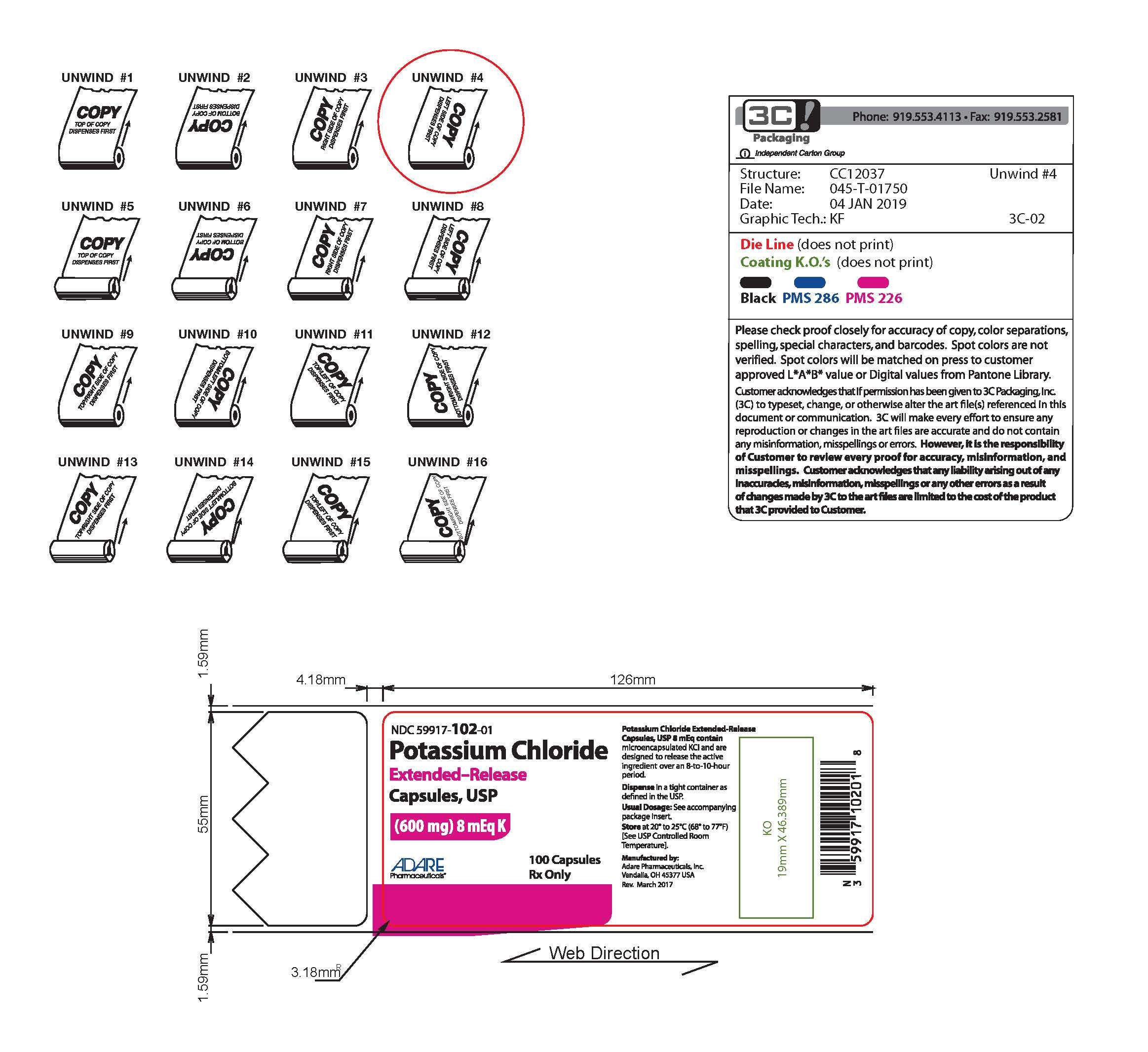
HOW SUPPLIED: Potassium Chloride Extended-release Capsules, USP, 8 mEq are white to ivory opaque capsules printed with “102” and containing 600 mg microencapsulated potassium chloride (equivalent to 8 mEq K) in bottles of 100 (NDC 59917-102-01), bottles of 500 (NDC 59917-102-05) and bottles of 1000 (NDC 59917-102-10). Potassium Chloride Extended-release Capsules, USP, 10 mEq are light blue opaque capsules printed with “103” and containing 750 mg microencapsulated potassium chloride (equivalent to 10 mEq K) in bottles of 100 (59917-103-01) , bottles of 500 (NDC 59917-103-05) and bottles of 1000 (NDC 59917-103-10).
Store at 20° to 25°C (68° to 77°F) [See USP Controlled Room Temperature]. Dispense in tight container. Manufactured by: Adare Pharmaceuticals, Inc.
Vandalia, OH 45377 USA Rev. date: 6/2016
📋 Description ▾
DESCRIPTION: Potassium Chloride Extended-release Capsules, USP, 8 mEq and 10 mEq are oral dosage forms of microencapsulated potassium chloride containing 600 and 750 mg respectively, of potassium chloride USP equivalent to 8 and 10 mEq of potassium. Dispersibility of potassium chloride (KCl) is accomplished by microencapsulation and a dispersing agent. The resultant flow characteristics of the KCl microcapsules and the controlled release of K+ ions by the microcapsular membrane are intended to avoid the possibility that excessive amounts of KCl can be localized at any point on the mucosa of the gastrointestinal tract.
Each crystal of KCl is microencapsulated by a process with an insoluble polymeric coating which functions as a semi-permeable membrane; it allows for the controlled release of potassium and chloride ions over an eight-to-ten-hour period. Fluids pass through the membrane and gradually dissolve the potassium chloride within the micro-capsules. The resulting potassium chloride solution slowly diffuses outward through the membrane.
Potassium Chloride Extended-release Capsules, USP, 8 mEq and 10 mEq are electrolyte replenishers. The chemical name of the active ingredient is potassium chloride and the structural formula is KCl. Potassium chloride USP occurs as a white, granular powder or as colorless crystals.
It is odorless and has a saline taste. Its solutions are neutral to litmus. It is freely soluble in water and insoluble in alcohol.
The inactive ingredients are ethylcellulose, gelatin, magnesium stearate, sodium lauryl sulfate, titanium dioxide and edible black ink. The 10 mEq capsules also contain black iron oxide, FD&C blue No. 1 and FD&C red No.
3.
💬 Information for Patients ▾
Information For Patients Physicians should consider reminding the patient of the following: To take each dose with meals and with a full glass of water or other suitable liquid. To take each dose without crushing, chewing, or sucking the capsules. To take this medicine following the frequency and amount prescribed by the physician.
This is especially important if the patient is also taking diuretics and/or digitalis preparations. To check with the physician if there is trouble swallowing capsules or if the capsules seem to stick in the throat. To check with the physician at once if tarry stools or other evidence of gastrointestinal bleeding is noticed.