
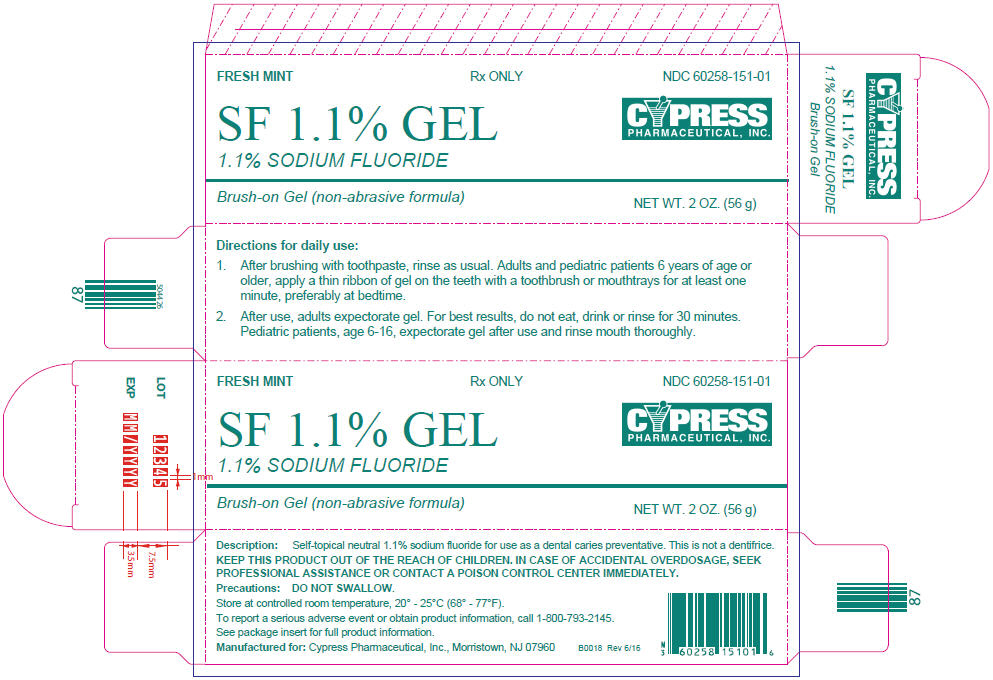
SF 1.1% Sodium Fluoride 11 mg/g Gel — NDC 60258-151-01 (Billing 60258-0151-01)
This is a package of SF 1.1% Sodium Fluoride 11 mg/g Gel from Cypress Pharmaceutical, Inc., marketed since Dec 1999 and currently FDA-listed; retail pharmacies pay about $0.1254 per g (NADAC). It is this product's only package size.
NDC database record
One package, one record: these facts belong to NDC 60258-151-01 alone.
- Record
- FDA NDC Directory package listing · Human prescription drug
- Code segments
- 60258 labeler · 151 product · 01 package
- Package marketed since
- Dec 1, 1999
- Sample package
- No — commercial package
- Listing certified through
- Dec 31, 2026
- Barcode (UPC-A, from the NDC)
- 3 6025815101 6
- FDA record last changed
- Jul 24, 2026
Identity & classification
Regulatory identifiers FDA, NLM and CMS codes for this package
Drug-database identifiers Medi-Span GPI and First Databank GCN / HICL / AHFS classification
- GSN (GCN sequence number): 002607
- GCN: 07358
- GPI-14 (Medi-Span): 88402020004020
- HICL (First Databank): 001127
- AHFS class code: 34:04.00.00
- RxCUI (RxNorm): 1486566
Where does this data come from?
- FDA openFDA NDC Directory · synced Oct 1, 2026
- FDA label on DailyMed · label index refreshed Oct 3, 2026
- RxNorm (NLM RxNav) · catalog refreshed Oct 1, 2026
- Medi-Span GPI (licensed)
- First Databank (licensed) · refreshed Oct 1, 2026
RxNorm drug class
This medicine belongs to the Caries prophylactic agents class.
Where does this data come from?
- RxClass (NLM) · catalog refreshed Oct 1, 2026
Clinical
Fluoride is used to prevent tooth decay. It is taken up by teeth and helps to strengthen teeth, resist acid, and block the cavity-forming action of bacteria. Fluoride usually is prescribed for children and adults whose homes have water that is not fluoridated (already has fluoride added). This medication is sometimes prescribed for other uses; ask your doctor or pharmacist for more information.
Read the full MedlinePlus article ↗This is a dental gel containing sodium fluoride at a concentration of 11 mg/g, applied directly to the teeth. Sodium fluoride is typically used in oral care products to help strengthen tooth enamel and reduce the risk of cavities. This product is marketed without an approved FDA application and should be used only under the direction of a dental professional.
Patient education
Supplement & herbal interactions
Where does this data come from?
- MedlinePlus (NLM) · refreshed Oct 1, 2026
- FDA label on DailyMed · label index refreshed Oct 3, 2026
Ask a licensed pharmacist directly — free, answered by our team.
Pricing
A drug doesn't have one price. Each row is a different public payment system, and none is what you'd pay at the counter — that depends on your insurance. The ⓘ on each row explains what it measures.
| Price system | Per g | Per package |
|---|---|---|
| Retail pharmacies payNADAC · weekly | $0.125 | $7.02 / 56 g |
| Medicaid paysCMS SDUD · 12 mo | No recent Medicaid claims on file for this NDC — rare and low-volume NDCs are suppressed in the public data. | |
| Medicare drug plans payPart D · quarterly | No Part D plan price is available for this NDC in our data. | |
Where does this data come from?
- CMS NADAC weekly file · file of Nov 23, 2022
- CMS ASP pricing files · refreshed Sep 20, 2026
- CMS Medicaid State Drug Utilization Data · refreshed Oct 4, 2026
- CMS Part D plan pricing files · refreshed Sep 24, 2026
- VA National Acquisition Center price file
Packaging — all sizes for this product
| Package NDC | Description | Marketing start | Marketing end | Status |
|---|---|---|---|---|
| 60258-0151-01 You're viewing this Main listing | 1 TUBE in 1 CARTON / 56 g in 1 TUBE | 1999-12-01 | — | Active |
Therapeutic equivalents
| Product | Labeler | Pack | NADAC/unit | TE | Status | Price vs. this |
|---|---|---|---|---|---|---|
| Sodium Fluoride 1.1% 5 mg/g 35573-0435-56 | Burel | 1 tube | $0.108 | — | Availability likely | save 14% |
| Sodium Fluoride Gel 5 mg/g 50268-0733-56 | AvPAK | 1 tube | $0.108 | — | Availability likely | save 14% |
| Sodium Fluoride 1.1% Gel 5 mg/g 69367-0310-56 | Westminster | 1 tube | $0.108 | — | Availability likely | save 14% |
| Sf 11 mg/gthis 60258-0151-01 | Cypress | 1 tube | $0.125 | — | FDA listed | — |
| Pcxx Anticaries No Flavor Ne G 11.1 mg/mL 62007-0835-16 | Ross | 473 ml | — | — | FDA listed | — |
| Sodium Fluoride 1.1% Dental Gel MINT 1.1 g/100g 71085-0074-02 | IPG | 1 tube | — | — | Discontinued | — |
| Sodium Fluoride 1.1% Dental Gel BUBBLEGUM 1.1 g/100g 71085-0079-02 | IPG | 1 tube | — | — | Discontinued | — |
Where does this data come from?
- FDA openFDA NDC Directory · synced Oct 1, 2026
- FDA Orange Book · refreshed Oct 3, 2026
- CMS NADAC weekly file · file of Nov 23, 2022
Availability & generic status
We did not find an FDA-approved generic match for this exact strength, form and route.
Where does this data come from?
- FDA Orange Book · refreshed Oct 3, 2026
What it looks like
Where does this data come from?
- FDA label on DailyMed · label index refreshed Oct 3, 2026
Inactive Ingredients / Excipients
Inactive ingredients, also called excipients, are components of the drug product other than the active ingredient. They may include fillers, dyes, coatings, preservatives, flavors, or other formulation ingredients.
💡 Tap an ingredient (hover on desktop) to see what it is and why it’s used.
-
UNII H3R47K3TBD
FD&C Blue No. 1 is a synthetic blue dye approved for use in foods and medicines. It serves as a colorant to give the medication its distinctive appearance and help with product identification.
-
UNII 8136Y38GY5
A plant-derived thickening agent made from cellulose. It increases the thickness and consistency of liquid medicines, helping them coat surfaces and flow smoothly.
-
UNII A2I8C7HI9T
Methylparaben is a preservative derived from benzoic acid that prevents growth of bacteria, fungi, and mold in medicines. It extends the product's shelf life and maintains safety during storage.
-
UNII TUF2IVW3M2
Poloxamer 407 is a synthetic polymer made from ethylene oxide and propylene oxide. In medicines, it acts as a thickener, emulsifier, and solubilizer to help mix ingredients and create the right texture.
-
UNII Z8IX2SC1OH
Propylparaben is a chemical preservative used to prevent bacterial and fungal growth in medicines and personal care products. It helps extend shelf life and maintain product safety during storage.
-
UNII SB8ZUX40TY
Saccharin sodium is an artificial sweetener made from saccharin salt. It's added to medicines to improve taste, especially in liquid formulations for children or bitter drugs.
-
UNII 506T60A25R
Sorbitol is a natural sugar alcohol derived from glucose. It serves as a sweetener, humectant, and bulking agent in medications to improve taste and help maintain moisture in the product.
-
UNII 059QF0KO0R
Water is a liquid solvent that dissolves and mixes ingredients together in liquid medicines, syrups, and injections. It helps distribute the active drug evenly throughout the product.
8 inactive ingredients listed in the exact product block matched to this NDC.
Label-section wording can be broader than the structured product block and may mention additional formulation ingredients.
Where does this data come from?
ingredient classCode="IACT" elements from the exact product block matched by this NDC. Label-section narrative from DailyMed / the openFDA label index is shown separately when available.- FDA label on DailyMed · label index refreshed Oct 3, 2026
- FDA openFDA NDC Directory · synced Oct 1, 2026
Inactive ingredient FAQ
Are inactive ingredients the same for every manufacturer?
Why might an inactive ingredient be missing?
Can inactive ingredients matter?
Manufacturer & labeler
More NDCs from Cypress Pharmaceutical, Inc. labeler code 60258
Where does this data come from?
- FDA openFDA NDC Directory · synced Oct 1, 2026
- Drugs@FDA
Full prescribing information FDA SPL
🎯 Indications and Usage ▾
INDICATIONS AND USAGE A dental caries preventive, for once daily self-applied topical use. It is well established that 1.1% sodium fluoride is safe and extraordinarily effective as a caries preventive when applied frequently with mouthpiece applicators. 1-4 SF 1.1% Brush-On Gel in a squeeze-tube is easily applied onto a toothbrush as well as a mouthpiece tray.
This prescription dental gel should be used once daily following use of a regular toothpaste unless otherwise instructed by your dental professional. May be used whether or not drinking water is fluoridated since topical fluoride cannot produce fluorosis. (See WARNINGS for exception.)
⏱️ Dosage and Administration ▾
DOSAGE AND ADMINISTRATION Follow these instructions unless otherwise instructed by your dental professional: 1. After brushing thoroughly with toothpaste, rinse as usual. Adults and pediatric patients 6 years of age or older, apply a thin ribbon of gel to the teeth with a toothbrush or mouth trays once daily for at least one minute, preferably at bedtime.
2. After use, adults expectorate gel. For the best results, do not eat, drink, or rinse for 30 minutes.
Pediatric patients, age 6-16, expectorate gel after use and rinse mouth thoroughly.
⛔ Contraindications ▾
CONTRAINDICATIONS Do not use in pediatric patients under age 6 years unless recommended by a dentist or physician.
⚠️ Warnings ▾
WARNINGS Prolonged daily ingestion may result in various degrees of dental fluorosis in pediatric patients under 6 years, especially if the water fluoridation exceeds 0.6 ppm, since younger pediatric patients frequently cannot perform the brushing process without significant swallowing. Use in pediatric patients under age 6 years requires special supervision to prevent repeated swallowing of gel which could cause dental fluorosis. Read directions carefully before using.
If using a mouthpiece application, prolonged exposure (longer than 1 minute) may result in oral irritation, such as burning. KEEP THIS PRODUCT OUT OF THE REACH OF CHILDREN. IN CASE OF ACCIDENTAL OVERDOSAGE, SEEK PROFESSIONAL ASSISTANCE OR CONTACT A POISON CONTROL CENTER IMMEDIATELY.
🤒 Adverse Reactions ▾
ADVERSE REACTIONS Allergic reactions and other idiosyncrasies have been rarely reported.
🤰 Pregnancy ▾
Pregnancy Pregnancy Category B. It has been shown that fluoride crosses the placenta of rats, but only 0.01% of the amount administered is incorporated in fetal tissue. Animal studies (rats, mice, rabbits) have shown that fluoride is not a teratogen.
Maternal exposure to 12.2 mg fluoride/kg of body weight (rats) or 13.1 mg/kg of body weight (rabbits) did not affect the litter size or fetal weight and did not increase the frequency of skeletal or visceral malformations. Epidemiological studies conducted in areas with high levels of naturally fluoridated water showed no increase in birth defects. Heavy exposure to fluoride in utero development may result in skeletal fluorosis which becomes evident in childhood.
🧒 Pediatric Use ▾
Pediatric Use The use of SF 1.1% Brush-On Gel in pediatric age groups 6 to 16 years as a caries preventive is supported by pioneering clinical studies with 1.1% sodium fluoride gels in mouth trays in students age 11-14 years conducted by Englander, et al. 2,3,4 . Safety and effectiveness in pediatric patients below the age of 6 years have not been established. Please refer to the CONTRAINDICATIONS and WARNINGS sections.
🆘 Overdosage ▾
OVERDOSAGE Accidental ingestion of large amounts of fluoride may result in acute burning in the mouth and sore tongue. Nausea, vomiting, and diarrhea may occur soon after ingestion (within 30 minutes) and are accompanied by salivation, hematemesis, and epigastric cramping and abdominal pain. These symptoms may persist for 24 hours.
If less than 5 mg fluoride/kg body weight (i.e., less than 2.3 mg fluoride/lb body weight) have been ingested, give calcium (e.g., milk) orally to relieve gastrointestinal symptoms and observe for a few hours. If more than 5 mg fluoride/kg body weight (i.e., more than 2.3 mg fluoride/lb body weight) have been ingested, induce emesis, give orally soluble calcium (e.g., milk, 5% calcium gluconate or calcium lactate solution) and immediately seek medical assistance. For accidental ingestion of more than 15 mg fluoride/kg of body weight (i.e., more than 6.9 mg fluoride/lb body weight), induce vomiting and admit immediately to a hospital facility.
A treatment dose (a thin ribbon) of SF 1.1% Brush-On Gel contains 2 mg flouride. A 2 oz. tube contains 266 mg fluoride.
🧬 Clinical Pharmacology ▾
CLINICAL PHARMACOLOGY Frequent topical applications to the teeth with preparations having a relatively high fluoride content increase tooth resistance to acid dissolution and enhance penetration of the fluoride ion into tooth enamel.
📦 How Supplied / Storage and Handling ▾
HOW SUPPLIED 2 oz. (56g) net wt. plastic tube. Flavor: Fresh Mint NDC 60258-151-01
📦 Storage and Handling ▾
STORAGE Store at Controlled Room Temperature, 20 o -25 o C (68 o -77 o F). Rx only
🧪 Inactive Ingredients ▾
Inactive Ingredients Purified Water, Sorbitol, Hydroxyethylcellulose, Flavor, Poloxamer 407, Sodium Saccharin, Methylparaben, Propylparaben, FD&C Blue No. 1.
📋 Description ▾
DESCRIPTION Self-topical neutral fluoride gel containing 1.1% (w/v) sodium fluoride for use as a dental caries preventive in pediatric patients and adults. This prescription product is not a dentifrice. Active Ingredient: Sodium Fluoride, USP 1.1% (w/v).
⚠️ Precautions ▾
PRECAUTIONS Not for systemic treatment. DO NOT SWALLOW.
🍼 Nursing Mothers ▾
Nursing Mothers It is not known if fluoride is excreted in human milk. However, many drugs are excreted in milk, and caution should be exercised when products containing fluoride are administered to a nursing woman. Reduced milk production was reported in farm-raised fox when animals were fed a diet containing a high concentration of fluoride (98-137 mg/kg of body weight).
No adverse effects on parturition, lactation, or offspring were seen in rats administered fluoride up to 5 mg/kg of body weight.
📄 Carcinogenesis, Mutagenesis, Impairment of Fertility ▾
Carcinogenesis, Mutagenesis, Impairment of Fertility In a study conducted in rodents, no carcinogenesis was found in male and female mice and female rats treated with fluoride at dose levels ranging from 4.1 to 9.1 mg/kg of body weight. Equivocal evidence of carcinogenesis was reported in male rats treated with 2.5 and 4.1 mg/kg of body weight. In a second study, no carcinogenesis was observed in rats, males or females, treated with fluoride up to 11.3 mg/kg of body weight.
Epidemiological data provide no credible evidence for an association between fluoride, either naturally occurring or added to drinking water, and risk of human cancer. Fluoride ion is not mutagenic in standard bacterial systems. It has been shown that fluoride ion has potential to induce chromosome aberrations in cultured human and rodent cells at doses much higher than those to which humans are exposed.
In vivo data are conflicting. Some studies report chromosome damage in rodents, while other studies using similar protocols report negative results. Potential adverse reproductive effects of fluoride exposure in humans has not been adequately evaluated.
Adverse effects on reproduction were reported for rats, mice, fox, and cattle exposed to 100 ppm or greater concentrations of fluoride in their diet or drinking water. Other studies conducted in rats demonstrated that lower concentrations of fluoride (5 mg/kg of body weight) did not result in impaired fertility and reproductive capabilities.
📚 References ▾
REFERENCES 1. American Dental Association, Council on Dental Therapeutics, Fluoride compounds, In: Accepted Dental Therapeutics, Ed. 40, Chicago, ADA, 405-407 (1984).
2. H.R. Englander et al., Clinical Anticaries Effect of Repeated Topical Sodium Fluoride Applications by Mouthpieces, JADA, 75, 638-644 (1967).
3. H.R. Englander et al., Residual Anticaries Effect of Repeated Topical Sodium Fluoride Applications by Mouthpieces, JADA, 78, 783-787 (1969).
4. H.R. Englander et al., Incremental Rates of Dental Caries After Repeated Topical Sodium Fluoride Applications in Children With Lifelong Consumption of Fluoridated Water, JADA, 82, 354-358, (1971).
You should call your doctor for medical advice about serious adverse events. To report a serious adverse event or obtain product information, contact Cypress Pharmaceutical, Inc. at 1-800-793-2145 or FDA at 1-800-FDA-1088 (Toll Free). Manufactured for: Cypress Pharmaceutical, Inc., Morristown, NJ 07960 P166 Rev.
6/2016 504433
📄 Package Label / Principal Display Panel ▾
PRINCIPAL DISPLAY PANEL - 56 g Tube Carton FRESH MINT Rx ONLY NDC 60258-151-01 SF 1.1% GEL 1.1% SODIUM FLUORIDE Brush-on Gel (non-abrasive formula) CYPRESS PHARMACEUTICAL, INC. NET WT. 2 OZ. (56 g) PRINCIPAL DISPLAY PANEL - 56 g Tube Carton
Medicare Part D spend CMS · PART D · 2026 (Q1)
About this NDC listing & data coverage
Listed without an FDA application
This product's marketing category indicates it is marketed without an approved FDA application (no NDA, ANDA, or BLA on file). Having an NDC does not by itself establish FDA approval — the NDC Directory is a listing system, not an approval decision. Approval-linked data such as Orange Book therapeutic-equivalence ratings therefore does not apply.
What data is (and isn’t) available for this NDC — tap to expand
| NDC identity (package / product / labeler codes) | ✓ Available |
| Labeler | ✓ Available |
| Product & package description | ✓ Available |
| Marketing category & status | ✓ Available |
| Active ingredient / dosage form / route | ✓ Available |
| FDA label (SPL via DailyMed) | ✓ Available |
| Package photos | ✓ Available |
| Inactive ingredients (structured) | ✓ Available |
| NADAC pharmacy acquisition price (CMS) | ✓ Available |
| Orange Book / therapeutic-equivalence data | — Not published for this NDC Applies only to products approved under an NDA/ANDA; many listings are out of scope. |
| HCPCS J-code billing crosswalk | — Not published for this NDC Most self-administered / retail products have no J-code — that is normal. |
| Medicaid utilization (CMS SDUD) | — Not published for this NDC CMS reports utilization only for NDCs with Medicaid claims above its privacy threshold. |