
HomeNDC LookupIngredientsSodium Fluoride › 69367-0310-56
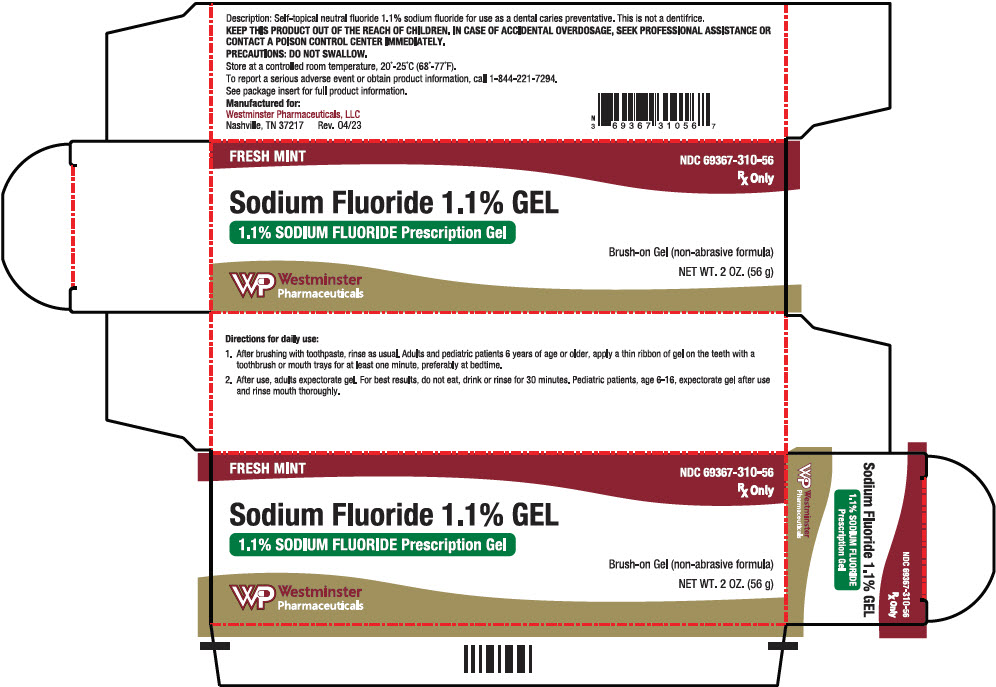
Sodium Fluoride 1.1% Gel 5 mg/g Gel — NDC 69367-0310-56 package photo

Sodium Fluoride 1.1% Gel 5 mg/g Gel

by Westminster Pharmaceuticals, LLC · 1 TUBE in 1 CARTON (69367-310-56) / 56 g in 1 TUBE
NDC 69367-0310-56
🏷️ FDA NDC (as labeled) 69367-310-56 billing pads the product segment with a zero
Rx only On market Non-controlled
🗂️ Data synced Jul 24, 2026 · sources: openFDA · FDA label (DailyMed) · FDA Orange & Purple Book · First Databank · CMS NADAC, ASP, Medicare & Medicaid · RxNorm
📋 All sources & update times →

🆔 Identity & classification

FDA NDC (as labeled) 69367-310-56
Product NDC 69367-310
11-digit billing NDC 69367031056
NCPDP billing unit GM — per gram (weight)
RxCUI 1486566
UNII 8ZYQ1474W7
SPL Set ID 1822c957-0bd6-4e86-a030-80e6e428063a
DEA schedule Non-controlled
Marketing category UNAPPROVED DRUG OTHER
Marketing status On market
FDA listing status Listed (active directory)
Marketing start 2021-03-09
Route DENTAL
Dosage form GEL
Substance SODIUM FLUORIDE
GPI-14 88402020004020
GPI class Sodium Fluoride
GCN Seq No 002607
GCN 07358
HICL code 001127
Ingredient (HICL) Fluoride (Sodium)
HIC1 code D
Therapeutic class — broad (HIC1) Biliary System/Gastro-Intestinal System
HIC2 code D2
Therapeutic class — intermediate (HIC2) Drugs Acting On Teeth
HIC3 code D2A
Therapeutic class — specific (HIC3) Fluoride Preparations
AHFS code 34:04.00.00
AHFS class Nutritional Supplements
FDB label name SODIUM FLUORIDE 1.1% GEL
FDB brand name Sodium Fluoride
Legend status F — Federal legend — prescription drug or device
Why two NDCs? The FDA registers this code as 69367-310-56 — a 5-3-2 layout, and that's what's printed on the package and shown on DailyMed. For insurance claims, every NDC is standardized to a uniform 11-digit 5-4-2 format by adding a zero to the product segment → 69367-0310-56. Same drug, same package — only the format differs.
Where does this data come from?
Identifiers from the FDA openFDA NDC Directory and Structured Product Labeling; RxCUI from RxNorm (NLM); GPI from Medi-Span; GCN / HIC / AHFS / legend from First Databank.

🏷️ RxNorm drug class

This medicine belongs to the Caries prophylactic agents class.

Drug family (ATC) Caries prophylactic agents, Fluoride
Where does this data come from?
Therapeutic classes from RxNorm RxClass (U.S. National Library of Medicine) — Established Pharmacologic Class (FDA), ATC drug family (WHO) and mechanism of action, matched by this product’s RxCUI.

🏭 Manufacturer & labeler

LabelerWestminster Pharmaceuticals, LLC
Labeler code69367
First marketedMar 2021
Product typeHuman Prescription Drug
Portfolio186 products on file
The labeler markets the product; the application holder owns the FDA approval. They’re often the same company but can differ (e.g. a repackager or an authorized generic). A mailing address / phone appears here when the manufacturer includes it in the product’s FDA label (not all do).
Where does this data come from?
Labeler, application holder and registered establishment from the FDA openFDA NDC Directory and Drugs@FDA; address/contact from the product’s FDA label.

🩺 Clinical

Label name SODIUM FLUORIDE 1.1% GEL Ingredient Fluoride (Sodium)
🧪 What is this product?

This is a dental gel containing sodium fluoride at a concentration of 1.1%, supplied as a prescription product. Sodium fluoride is typically used in dental care products to help strengthen tooth enamel and reduce cavity formation. The gel form is applied directly to the teeth during professional dental visits or as directed by a dentist. This product is marketed without an approved FDA application.

Where does this data come from?
Plain-language summary from MedlinePlus (U.S. National Library of Medicine); supplement & herbal interactions and nutrient depletion data from the Natural Medicines database; our full guide is HelloPharmacist editorial content.

💊 What it looks like

Color Blue
FlavorMint
One label can cover several strengths, so colors may be combined — always confirm a loose pill against the dispensed prescription label or a pharmacist.
Where does this data come from?
Physical description (imprint, shape, color, scoring, coating) from this product’s FDA Structured Product Labeling (SPL), mirrored from DailyMed / openFDA.

🧪 Inactive Ingredients / Excipients

Inactive ingredients, also called excipients, are components of the drug product other than the active ingredient. They may include fillers, dyes, coatings, preservatives, flavors, or other formulation ingredients.

💡 Tap an ingredient (hover on desktop) to see what it is and why it’s used.

  • UNII H3R47K3TBD
    FD&C Blue No. 1 is a synthetic blue dye approved for use in foods and medicines. It serves as a colorant to give the medication its distinctive appearance and help with product identification.
  • UNII PDC6A3C0OX
    Glycerin is a clear, thick liquid derived from plant oils or fats. It acts as a humectant to retain moisture, a sweetener, and a solvent in medications.
  • UNII 8136Y38GY5
    A plant-derived thickening agent made from cellulose. It increases the thickness and consistency of liquid medicines, helping them coat surfaces and flow smoothly.
  • UNII SB8ZUX40TY
    Saccharin sodium is an artificial sweetener made from saccharin salt. It's added to medicines to improve taste, especially in liquid formulations for children or bitter drugs.
  • UNII OJ245FE5EU
    Sodium benzoate is a salt derived from benzoic acid, a preservative. It's added to medicines to prevent growth of bacteria, fungi, and other microorganisms that could spoil the product.
  • UNII 506T60A25R
    Sorbitol is a natural sugar alcohol derived from glucose. It serves as a sweetener, humectant, and bulking agent in medications to improve taste and help maintain moisture in the product.
  • UNII 059QF0KO0R
    Water is a liquid solvent that dissolves and mixes ingredients together in liquid medicines, syrups, and injections. It helps distribute the active drug evenly throughout the product.
  • UNII VCQ006KQ1E
    Xylitol is a naturally occurring sugar alcohol derived from plants. It's used in medicines as a sweetener, bulking agent, and to improve taste, especially in liquid formulations and chewable tablets.

8 inactive ingredients listed in the exact product block matched to this NDC.

Where does this data come from?
Data sourced from official FDA Structured Product Labeling (SPL) via DailyMedingredient classCode="IACT" elements from the exact product block matched by this NDC. Label-section narrative from DailyMed / the openFDA label index is shown separately when available.

Inactive ingredient FAQ

Are inactive ingredients the same for every manufacturer?
No. Inactive ingredients can differ by manufacturer, dosage form, strength, and package / product version.
Why might an inactive ingredient be missing?
Some SPLs do not provide a complete structured inactive-ingredient list, and older or unusual labels may only include the information in narrative text.
Can inactive ingredients matter?
Yes. They can matter for allergies, intolerances, dyes, gluten / lactose concerns, preservatives, and formulation differences — but confirm with a pharmacist or the manufacturer when it’s clinically important.

💲 Pricing

A drug doesn't have one price. Each row is a different public payment system, and none is what you'd pay at the counter — that depends on your insurance. The ⓘ on each row explains what it measures.

Price systemPer gPer package
Retail pharmacies payNADAC · weekly $0.110 $6.15 / 56 g
Medicaid paysCMS SDUD · 12 mo $0.2636 $14.76 / 56 g
Medicare drug plans payPart D · quarterly No Part D plan price is available for this NDC in our data.
NADAC price history (per g) — tap or hover for the price & month
Dec 2021 Jul 2022 Dec 2025 Aug 2026 $0.135 $0.106
▼ Down 12% over the last 24 months.
Where does this data come from?
NADAC (National Average Drug Acquisition Cost) is the CMS weekly pharmacy-acquisition-cost survey — what pharmacies pay. ASP (Average Sales Price) is the CMS Medicare Part B drug-payment file, published quarterly. Medicaid pays is computed by us from CMS State Drug Utilization Data (total reimbursed ÷ units, trailing 12 months) — gross of rebates and inclusive of dispensing fees, so it reflects what Medicaid paid, not an acquisition cost. Medicare drug plans pay is the median negotiated point-of-sale unit cost across plans listing this NDC in the CMS quarterly Prescription Drug Plan pricing files, before rebates. The VA pays is the federal contract price (FSS, and the statutory Big 4 ceiling where listed) from the VA National Acquisition Center pharmaceutical price file. All are free public government data; each measures a different payer, so the figures are not directly comparable.

🔁 Therapeutic equivalents

ProductLabelerPackNADAC/unitTEStatusPrice vs. this
Sodium Fluoride 5000 Plus 5 mg/g 69367-0309-51 Westminster 1 tube $0.065 Availability likely save 41%
Sodium Fluoride 1.1% 5 mg/g 35573-0435-56 Burel 1 tube $0.110 Availability likely
Sodium Fluoride Gel 5 mg/g 50268-0733-56 AvPAK 1 tube $0.110 Availability likely
Sodium Fluoride 1.1% Gel 5 mg/gthis 69367-0310-56 Westminster 1 tube $0.110 Availability likely
Sf 11 mg/g 60258-0151-01 Cypress 1 tube $0.125 FDA listed +14%
Pcxx Anticaries No Flavor Ne G 11.1 mg/mL 62007-0835-16 Ross 473 ml FDA listed
Sodium Fluoride 1.1% Dental Gel MINT 1.1 g/100g 71085-0074-02 IPG 1 tube Discontinued
Sodium Fluoride 1.1% Dental Gel BUBBLEGUM 1.1 g/100g 71085-0079-02 IPG 1 tube Discontinued
Fluoridex 5 mg/g 59883-0016-04 DEN-MAT 1 tube FDA listed
Fluoridex 5 mg/g 59883-0020-04 DEN-MAT 1 tube FDA listed
PreviDent Fresh Mint 5 mg/g 00126-0088-02 Colgate 1 tube FDA listed
PreviDent Very Berry 5 mg/g 00126-0288-02 Colgate 1 tube FDA listed
About this product: other versions of the same ingredient, strength and form are listed above, least expensive first, with FDA equivalence ratings where available.
Where does this data come from?
Equivalents are other NDCs of the same ingredient, form and route from the openFDA NDC Directory, ranked least-expensive-first by NADAC. Therapeutic-equivalence (AB) ratings come from the FDA Orange Book; biologics use the FDA Purple Book for biosimilar & interchangeable status.

Availability & generic status

🏛️
2021
On the market since
Mar 2021
📍
2026
Currently FDA-listed
5 years listed
🔒
·
No generic listed yet
brand only
ℹ️No FDA-approved generic found

We did not find an FDA-approved generic match for this exact strength, form and route.

Where does this data come from?
Patents and exclusivity from the FDA Orange Book (small-molecule drugs), refreshed from public FDA data. Generic launch timing is an estimate, not a guarantee.

🗺️ Medicaid utilization & spend

📍 This exact package only: Medicaid data is reported per full 11-digit NDC — labeler, product and pack size — so every number here is for 69367-0310-56, not the drug overall. Other pack sizes report separately.
💊 Pharmacy benefit only: These are Medicaid outpatient pharmacy claims, billed by NDC. They exclude the medical benefit — clinic- or hospital-administered drugs billed under HCPCS J-codes — so drugs used mostly that way (e.g. Avastin, Lucentis, Keytruda) can look low or missing here. That’s expected, not an error.
📅 Q1 2025 – Q1 2026 · 5 quarters of data
ⓘ The newest quarter is usually incomplete when first published; states restate recent quarters in later CMS releases, so the latest figures typically revise upward. State coverage-policy changes can also shift quarter-to-quarter totals.
Prescriptions last 4 qtrs
20.4K
Units reimbursed last 4 qtrs
1.2M
Gross reimbursed last 4 qtrs
$316.1K
Avg / prescription
$15.47
Avg / unit
$0.2636
Latest quarter Q1 2026
4.4KRx
Medicaid pays / g
$0.2636
gross reimbursed
vs
NADAC / g
$0.1098
acquisition cost
=
Spread
+$0.1538
+140% vs cost
What Medicaid paid per g (before rebates; includes the pharmacy’s dispensing fee) compared with NADAC — the average price pharmacies pay to buy the drug. A positive spread means Medicaid reimbursed more than the purchase price, before manufacturer rebates.
Fee-for-service vs managed care
43% FFS 57% MCO
Fee-for-service · 8,832 Rx Managed care · 11,597 Rx
State Medicaid map
Alaska: no data reported AK Maine: 22,176 units · 1,590 per 100k residents ME Washington: 127,161 units · 1,628 per 100k residents WA Idaho: 43,322 units · 2,206 per 100k residents ID Montana: 9,408 units · 831 per 100k residents MT North Dakota: no data reported ND Minnesota: 71,390 units · 1,244 per 100k residents MN Wisconsin: 52,966 units · 896 per 100k residents WI Michigan: 43,720 units · 436 per 100k residents MI New York: 101,980 units · 521 per 100k residents NY Vermont: 12,926 units · 1,998 per 100k residents VT New Hampshire: no data reported NH Oregon: 10,068 units · 238 per 100k residents OR Nevada: 10,080 units · 316 per 100k residents NV Wyoming: no data reported WY South Dakota: 18,139 units · 1,974 per 100k residents SD Iowa: 17,180 units · 536 per 100k residents IA Illinois: 728 units · 5.8 per 100k residents IL Indiana: 8,619 units · 126 per 100k residents IN Ohio: 30,039 units · 255 per 100k residents OH Pennsylvania: 26,074 units · 201 per 100k residents PA New Jersey: 2,856 units · 30.7 per 100k residents NJ Massachusetts: 31,976 units · 457 per 100k residents MA California: 145,871 units · 374 per 100k residents CA Utah: 6,832 units · 200 per 100k residents UT Colorado: 9,235 units · 157 per 100k residents CO Nebraska: 51,688 units · 2,613 per 100k residents NE Missouri: 26,488 units · 428 per 100k residents MO Kentucky: 29,485 units · 651 per 100k residents KY West Virginia: 3,864 units · 218 per 100k residents WV Virginia: 12,644 units · 145 per 100k residents VA Maryland: 16,002 units · 259 per 100k residents MD Connecticut: 10,472 units · 290 per 100k residents CT Rhode Island: no data reported RI Arizona: 9,352 units · 126 per 100k residents AZ New Mexico: 13,384 units · 633 per 100k residents NM Kansas: no data reported KS Arkansas: 9,520 units · 310 per 100k residents AR Tennessee: 24,416 units · 343 per 100k residents TN North Carolina: 74,571 units · 688 per 100k residents NC South Carolina: 7,168 units · 133 per 100k residents SC Delaware: 4,256 units · 413 per 100k residents DE Oklahoma: 13,104 units · 323 per 100k residents OK Louisiana: 12,180 units · 266 per 100k residents LA Mississippi: 1,395 units · 47.4 per 100k residents MS Alabama: 2,072 units · 40.6 per 100k residents AL Georgia: 784 units · 7.1 per 100k residents GA D.C.: no data reported DC Hawaii: no data reported HI Texas: 61,578 units · 202 per 100k residents TX Florida: 11,872 units · 52.5 per 100k residents FL
Units reimbursed · per 100k residents
5.82,613
gray = no data reported
Colors are per 100,000 residents, so big states don’t automatically dominate. Tap or hover a state for its actual totals.
Tap or hover a state
…for its Medicaid breakdown
🏆 Top states by units · per 100k residents
1 Nebraska 2,613 /100k
2 Idaho 2,206 /100k
3 Vermont 1,998 /100k
4 South Dakota 1,974 /100k
5 Washington 1,628 /100k
6 Maine 1,590 /100k
7 Minnesota 1,244 /100k
8 Wisconsin 896 /100k
National units — by quarter
💵 About the dollar figures: “reimbursed” is what Medicaid paid pharmacies before confidential manufacturer rebates, so the program’s real net cost is lower than these numbers. Fee-for-service and managed-care claims are combined unless split above. Source: CMS State Drug Utilization Data; per-100k rates use 2023 Census population estimates.

📦 Packaging — all sizes for this product

Package NDCDescription Marketing startStatus
69367-0310-56 You're viewing this 1 TUBE in 1 CARTON (69367-310-56) / 56 g in 1 TUBE 2021-03-09 Active

🧭 About this NDC listing & data coverage

Finished prescription product Marketed without an FDA application

Listed without an FDA application

This product's marketing category indicates it is marketed without an approved FDA application (no NDA, ANDA, or BLA on file). Having an NDC does not by itself establish FDA approval — the NDC Directory is a listing system, not an approval decision. Approval-linked data such as Orange Book therapeutic-equivalence ratings therefore does not apply.

What data is (and isn’t) available for this NDC — tap to expand
NDC identity (package / product / labeler codes) ✓ Available
Labeler ✓ Available
Product & package description ✓ Available
Marketing category & status ✓ Available
Active ingredient / dosage form / route ✓ Available
FDA label (SPL via DailyMed) ✓ Available
Package photos ✓ Available
Inactive ingredients (structured) ✓ Available
NADAC pharmacy acquisition price (CMS) ✓ Available
Orange Book / therapeutic-equivalence data — Not published for this NDC Applies only to products approved under an NDA/ANDA; many listings are out of scope.
HCPCS J-code billing crosswalk — Not published for this NDC Most self-administered / retail products have no J-code — that is normal.
Medicaid utilization (CMS SDUD) ✓ Available
“Not published” reflects what the public FDA / CMS / NLM sources provide for this exact package code — it is a property of the data feeds, not a judgment about the product.

Questions about this listing

Is this NDC FDA-approved?
An NDC listing does not by itself establish FDA approval — the NDC Directory records that a product is listed with FDA, not that it was reviewed and approved. This listing's marketing category is "Unapproved Drug Other". Products approved under an application carry an NDA, ANDA, or BLA number.
Is the NDC printed on the package the same as the 11-digit billing NDC?
Yes, they identify this exact package in different formats. The FDA registers it as 69367-310-56, which is what is printed on the packaging and shown on DailyMed. Insurance claims use a fixed 11-digit 5-4-2 format, so the short segment is padded with a leading zero: 69367-0310-56, written without dashes as 69367031056. The Identity section at the top of this page lists every form of this code.
What do the three segments of this NDC mean?
In 69367-0310-56, the first segment (69367) is the labeler code FDA assigned to Westminster Pharmaceuticals, LLC; the middle segment (0310) identifies this specific product — its ingredient, strength, and dosage form; and the last segment (56) identifies this exact package size and type. Together they name one specific package of one specific product.
Is this package still being marketed?
Yes, per the latest FDA NDC Directory data on this page: this package is listed as actively marketed, with no marketing end date reported by Westminster Pharmaceuticals, LLC. Listing status can change — the directory data on this page refreshes weekly.
Who lists this product with the FDA?
Westminster Pharmaceuticals, LLC is the labeler of record for this NDC — the company under whose FDA-assigned code the package is listed. The labeler may be the manufacturer itself or a distributor marketing the product under its own code.
Do I need a prescription for this product?
This NDC is listed with FDA as a prescription product, so it is dispensed under a prescriber's order. Your pharmacist can tell you whether any over-the-counter forms of the same medication exist.
This page identifies an FDA-listed package (the NDC) and reports public regulatory and pricing data about the listing. It is reference information, not a medical recommendation — talk to your pharmacist or prescriber about your own medication.
Where does this data come from?
Listing facts (marketing category, packager status, marketing dates) from the FDA openFDA NDC Directory; label availability from DailyMed; pricing coverage from CMS NADAC; equivalence scope from the FDA Orange Book.

📄 Full prescribing information FDA SPL

The complete FDA label for this product — the official prescribing information, verbatim, section by section. Jump with a chip, search within the label, or expand everything.
🎯 Indications and Usage 98 words

INDICATIONS AND USAGE A dental caries preventive, for once daily self-applied topical use. It is well established that 1.1% sodium fluoride is safe and extraordinarily effective as a caries preventive when applied frequently with mouthpiece applicators. 1-4 SF 1.1% Brush-On Gel in a squeeze-tube is easily applied onto a toothbrush as well as a mouthpiece tray.

This prescription dental gel should be used once daily following use of a regular toothpaste unless otherwise instructed by your dental professional. May be used whether or not drinking water is fluoridated since topical fluoride cannot produce fluorosis. (See WARNINGS for exception.)

⏱️ Dosage and Administration 88 words

DOSAGE AND ADMINISTRATION Follow these instructions unless otherwise instructed by your dental professional: 1. After brushing thoroughly with toothpaste, rinse as usual. Adults and pedatric patients 6 years of age or older, apply a thin ribbon of gel to the teeth with a toothbrush or mouth trays once daily for at least one minute, preferably at bedtime.

2. After use, adults expectorate gel. For the best results, do not eat, drink, or rinse for 30 minutes.

Pediatric patients, age 6-16, expectorate gel after use and rinse mouth thoroughly.

Contraindications 18 words

CONTRAINDICATIONS Do not use in pediatric patients under age 6 years unless recommended by a dentist or physician.

⚠️ Warnings 109 words

WARNINGS Prolonged daily ingestion may result in various degrees of dental fluorosis in pediatric patients under 6 years, especially if the water fluoridation exceeds 0.6 ppm, since younger pediatric patients frequently cannot perform the brushing process without significant swallowing. Use in pediatric patients under age 6 years requires special supervision to prevent repeated swallowing of gel which could cause dental fluorosis. Read directions carefully before using.

If using a mouthpiece application, prolonged exposure (longer than 1 minute) may result in oral irritation, such as burning. KEEP THIS PRODUCT OUT OF THE REACH OF CHILDREN. IN CASE OF ACCIDENTAL OVERDOSAGE, SEEK PROFESSIONAL ASSISTANCE OR CONTACT A POISON CONTROL CENTER IMMEDIATELY.

🤒 Adverse Reactions 11 words

ADVERSE REACTIONS Allergic reactions and other idiosyncrasies have been rarely reported.

🤰 Pregnancy 112 words

Pregnancy Pregnancy Category B It has been shown that fluoride crosses the placenta of rats, but only 0.01% of the amount administered is incorporated in fetal tissue. Animal studies (rats, mice, rabbits) have shown that fluoride is not a teratogen. Maternal exposure to 12.2 mg fluoride/kg of body weight (rats) or 13.1 mg/kg of body weight (rabbits) did not affect the litter size or fetal weight and did not increase the frequency of skeletal or visceral malformations.

Epidemiological studies conducted in areas with high levels of naturally fluoridated water showed no increase in birth defects. Heavy exposure to fluoride in utero development may result in skeletal fluorosis which becomes evident in childhood.

🧒 Pediatric Use 71 words

Pediatric Use The use of SF 1.1% Brush-On Gel in pediatric age groups 6 to 16 years as a caries preventive is supported by pioneering clinical studies with 1.1% sodium fluoride gels in mouth trays in students are 11-14 years conducted by Englander, et al. 2,3,4 . Safety and effectiveness in pediatric patients below the age of 6 years have not been established. Please refer to the CONTRAINDICATIONS and WARNINGS sections.

🆘 Overdosage 175 words

OVERDOSAGE Accidental ingestion of large amounts of fluoride may result in acute burning in the mouth and sore tongue. Nausea, vomiting, and diarrhea may occur soon after ingestion (within 30 minutes) and are accompanies by salivation, hematemesis, and epigastric cramping and abdominal pain. These symptoms may persist for 24 hours.

If less than 5 mg fluoride/kg body weight (i.e., less than 2.3 mg fluoride/lb body weight) have been ingested, give calcium (e.g., milk) orally to relieve gastrointestinal symptoms and observe for a few hours. If more than 5 mg fluoride/kg body weight (i.e., more than 2.3 mg fluoride/lb body weight) have been ingested, induce emesis, give orally soluble calcium (e.g., milk, 5% calcium gluconate or calcium lactate solution) and immediately seek medical assistance. For accidental ingestion of more than 15 mg fluoride/kg of body weight (i.e., more than 6.9 mg fluoride/lb body weight), induce vomiting and admit immediately to a hospital facility.

A treatment dose (a thin ribbon) of SF 1.1% Brush-On Gel contains 2 mg fluoride. A 2 oz. tube contains 266 mg fluoride.

🧬 Clinical Pharmacology 32 words

CLINICAL PHARMACOLOGY Frequent topical applications to the teeth with preparations having a relatively high fluoride content increase tooth resistance to acid dissolution and enhance penetration of the fluoride ion into tooth enamel.

📦 How Supplied / Storage and Handling 30 words

HOW SUPPLIED 2 oz. (56g) net wt. plastic tube. Flavor: Fresh Mint NDC 69367-310-56 STORAGE Store at Controlled Room Temperature, 20° - 25° C (68° - 77° F). Rx only

📦 Storage and Handling 16 words

STORAGE Store at Controlled Room Temperature, 20° - 25° C (68° - 77° F). Rx only

📋 Description 54 words

DESCRIPTION Self-topical neutral fluoride gel containing 1.1% (w/v) sodium fluoride for use as a dental caries preventive in pediatric patients and adults. This prescription product is not a dentifrice. Active Ingredient: Sodium Fluoride, USP 1.1% (w/v). Inactive Ingredients FD&C Blue No. 1, glycerin, hydroxyethylcellulose, mint flavor, purified water, sodium benzoate, sodium saccharin, sorbitol, xylitol

Source: FDA Structured Product Labeling, mirrored from DailyMed / openFDA. Prefer the government’s original formatting? View this label on DailyMed ↗
For educational and professional reference only — not medical advice. Pricing reflects published NADAC and CMS ASP (free public data) and may differ from your acquisition cost; always verify before billing or dispensing.