
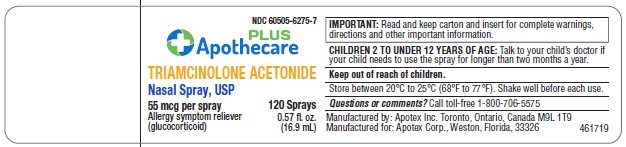
Triamcinolone acetonide 55 ug Spray, Metered — NDC 60505-6275-7 (Billing 60505-6275-07)
This is a package of Triamcinolone acetonide 55 ug Spray, Metered from Apotex Corp., marketed since Jan 2024 and currently FDA-listed; retail pharmacies pay about $0.7388 per mL (NADAC). It is this product's only package size.
NDC database record
One package, one record: these facts belong to NDC 60505-6275-7 alone.
- Record
- FDA NDC Directory package listing · Human OTC drug
- Code segments
- 60505 labeler · 6275 product · 7 package
- Package marketed since
- Jan 26, 2024
- Sample package
- No — commercial package
- Listing certified through
- Dec 31, 2027
- Barcode (UPC-A, from the NDC)
- 3 6050562757 8
- Medicaid fills, this package
- 5,068 prescriptions in the last four reported quarters
- FDA record last changed
- Oct 8, 2026
Other active recalls for Triamcinolone Acetonide (different manufacturers) — 1 · tap to view
Identity & classification
Regulatory identifiers FDA, NLM and CMS codes for this package
Drug-database identifiers Medi-Span GPI and First Databank GCN / HICL / AHFS classification
- GSN (GCN sequence number): 072054
- GCN: 36145
- HICL (First Databank): 002891
- AHFS class code: 48:10.08.00
Where does this data come from?
- FDA openFDA NDC Directory · synced Oct 8, 2026
- FDA label on DailyMed · label index refreshed Oct 8, 2026
- RxNorm (NLM RxNav) · catalog refreshed Oct 8, 2026
- Medi-Span GPI (licensed)
- First Databank (licensed) · refreshed Oct 8, 2026
Clinical
Triamcinolone nasal spray is used to relieve sneezing, runny, stuffy, or itchy nose and itchy, watery eyes caused by hay fever or other allergies. Triamcinolone nasal spray should not be used to treat symptoms (e.g., sneezing, stuffy, runny, or itchy nose) caused by the common cold. Triamcinolone is in a class of medications called corticosteroids. It works by blocking the release of certain natural substances that cause allergy symptoms.
Read the full MedlinePlus article ↗- It depends on the product. Injections treat severe allergic conditions, joint inflammation, certain skin problems and eye inflammation. Creams and ointments calm itchy, inflamed sk...
- Injections are given by a healthcare professional. Ointment is applied as a thin film to the affected area two to three times daily. Nasal spray bottles need priming before first u...
- Possible effects include injection site pain, joint swelling, headache, muscle spasms, cough, sinusitis and bruising. People with diabetes may see higher blood sugar. Tell your doc...
- Call right away for signs of an allergic reaction, fever or infection, a very painful and swollen joint, vision changes, or mood changes. Also report black stools, severe stomach p...
Patient education
Supplement & herbal interactions
Some supplements/herbs that may interact with Triamcinolone Acetonide — tap one for details:
Triamcinolone Acetonide may be associated with lower levels of 8 nutrients — worth a chat with your pharmacist, not a cause for alarm.
Where does this data come from?
- MedlinePlus (NLM) · refreshed Oct 8, 2026
- FDA label on DailyMed · label index refreshed Oct 8, 2026
Ask a licensed pharmacist directly — free, answered by our team.
Pricing
A drug doesn't have one price. Each row is a different public payment system, and none is what you'd pay at the counter — that depends on your insurance. The ⓘ on each row explains what it measures.
| Price system | Per mL | Per package |
|---|---|---|
| Retail pharmacies payNADAC · weekly | $0.739 | — |
| Medicaid paysCMS SDUD · 12 mo | $1.04 | — |
| Medicare drug plans payPart D · quarterly | No Part D plan price is available for this NDC in our data. | |
Where does this data come from?
- CMS NADAC weekly file · file of Oct 7, 2026
- CMS ASP pricing files · refreshed Sep 20, 2026
- CMS Medicaid State Drug Utilization Data · through Q1 2026
- CMS Part D plan pricing files · refreshed Sep 24, 2026
- VA National Acquisition Center price file
Packaging — all sizes for this product
| Package NDC | Description | Marketing start | Marketing end | Status |
|---|---|---|---|---|
| 60505-6275-07 You're viewing this Main listing | 1 BOTTLE, SPRAY in 1 CARTON / 120 SPRAY, METERED in 1 BOTTLE, SPRAY | 2024-01-26 | — | Active |
Therapeutic equivalents
| Product | Labeler | Pack | NADAC/unit | TE | Status | Price vs. this |
|---|---|---|---|---|---|---|
| Good Sense Nasal Allergy 55 ug 00113-0443-01 | L. | 1 bottle | $0.739 | — | Availability likely | — |
| Nasal Allergy 55 ug 00536-1457-69 | Rugby | 1 bottle | $0.739 | — | Availability likely | — |
| Triamcinolone Acetonide Nasal 55 ug 45802-0109-01 | Padagis | 1 bottle | $0.739 | — | Availability likely | — |
| Good Neighbor Pharmacy 24 Hour Nasal Allergy 55 ug 46122-0385-76 | Amerisource | 1 bottle | $0.739 | — | Availability likely | — |
| Triamcinolone acetonide 55 ugthis 60505-6275-07 | Apotex | 1 bottle | $0.739 | — | Availability likely | — |
| Triamcinolone acetonide 55 ug 70000-0702-01 | CARDINAL | 1 bottle | $0.739 | — | Discontinued | — |
| Triamcinolone Acetonide 55 ug 70000-0742-01 | CARDINAL | 1 bottle | $0.739 | — | Availability likely | — |
| foster and thrive 24 hour nasal allergy 55 ug 70677-1023-01 | Strategic | 1 bottle | $0.739 | — | Availability likely | — |
| Allergy Nasal 55 ug 00363-0811-01 | Walgreen | 1 bottle | — | — | FDA listed | — |
| Up and Up Nasal Allergy 55 ug 11673-0717-01 | Target | 1 bottle | — | — | FDA listed | — |
| Nasal Allergy 55 ug 11822-0443-01 | Rite | 1 bottle | — | — | Discontinued | — |
| Signature Care Nasal Allergy 55 ug 21130-0443-01 | Safeway | 1 bottle | — | — | FDA listed | — |
| Nasal Allergy 55 ug 21130-0613-02 | Safeway | 1 bottle | — | — | FDA listed | — |
| Nasal Allergy Relief 55 ug 30142-0665-01 | Kroger | 1 bottle | — | — | FDA listed | — |
| nasal allergy 55 ug 30142-0813-01 | Kroger | 1 bottle | — | — | FDA listed | — |
| Topcare Nasal Allergy 55 ug 36800-0621-01 | Topco | 1 bottle | — | — | FDA listed | — |
| Nasal Allergy 55 ug 37808-0443-01 | H | 1 bottle | — | — | FDA listed | — |
| Equaline nasal allergy 55 ug 41163-0443-01 | United | 1 bottle | — | — | FDA listed | — |
| Nasacort Allergy 24HR 55 ug 41167-5800-01 | Chattem, | 1 bottle | — | — | FDA listed | — |
| 24 Hour Nasal Allergy 55 ug 41250-0443-01 | Meijer | 1 bottle | — | — | FDA listed | — |
| CareOne Allergy Relief 55 ug 41520-0443-01 | American | 1 bottle | — | — | Discontinued | — |
| Equate Nasal Allergy 55 ug 49035-0443-01 | Wal-Mart | 1 bottle | — | — | FDA listed | — |
| Nasacort 55 ug 50090-1444-00 | A-S | 1 bottle | — | — | FDA listed | — |
| allergy relief 55 ug 51316-0711-01 | CVS | 1 bottle | — | — | FDA listed | — |
| DG Health Nasal Allergy 55 ug 55910-0280-02 | Dolgencorp, | 1 bottle | — | — | FDA listed | — |
| Nasal Allergy 55 ug 59779-0746-01 | CVS | 1 bottle | — | — | FDA listed | — |
| Triamcinolone acetonide 55 ug 69168-0482-01 | Allegiant | 1 bottle | — | — | FDA listed | — |
| Triamcinolone Acetonide Nasal 55 ug 72162-2289-02 | Bryant | 1 bottle | — | — | FDA listed | — |
| Basic Care Nasal Allergy 55 ug 72288-0443-01 | Amazon.com | 1 bottle | — | — | FDA listed | — |
| Nasal Allergy 55 ug 42507-0443-01 | HyVee | 1 bottle | — | — | FDA listed | — |
| Triamcinolone Acetonide 55 ug 58602-0035-07 | Aurohealth | 1 bottle | — | — | FDA listed | — |
| Childrens Triamcinolone Acetonide 55 ug 58602-0037-11 | Aurohealth | 1 bottle | — | — | FDA listed | — |
Where does this data come from?
- FDA openFDA NDC Directory · synced Oct 8, 2026
- FDA Orange Book · refreshed Oct 3, 2026
- CMS NADAC weekly file · file of Oct 7, 2026
Availability & generic status
This product is an FDA-approved generic. Other versions of the same drug are listed under Therapeutic equivalents, least expensive first.
Where does this data come from?
- FDA Orange Book · refreshed Oct 3, 2026
Inactive Ingredients / Excipients
Inactive ingredients, also called excipients, are components of the drug product other than the active ingredient. They may include fillers, dyes, coatings, preservatives, flavors, or other formulation ingredients.
🧪 Avoiding an ingredient? See Triamcinolone inactive ingredients by manufacturer: every current product's list side by side, so you can ask your pharmacy for the version that does not list it.
💡 Tap an ingredient (hover on desktop) to see what it is and why it’s used.
-
UNII F5UM2KM3W7
Benzalkonium chloride is a chemical compound that works as a preservative and antimicrobial agent in medications. It prevents bacterial and fungal growth in liquid formulations to keep the product safe during storage and use.
-
UNII K679OBS311
Carboxymethylcellulose sodium is a plant-derived thickening agent made from cellulose. In medicines, it acts as a binder to hold ingredients together, a disintegrant to help the tablet break apart, or a thickener in liquids.
-
UNII LX22YL083G
A simple sugar derived from corn or other sources. It acts as a filler to give the medicine bulk and volume, and as a sweetener to improve taste in oral medications.
-
UNII 7FLD91C86K
Edetate disodium is a chemical compound that binds and removes certain metal ions. In medicines, it acts as a preservative and stabilizer by preventing metals like calcium from interfering with the product's shelf life and consistency.
-
UNII QTT17582CB
A strong acid used to adjust and maintain the proper pH level in liquid medicines, ensuring stability and preventing breakdown of active ingredients.
-
UNII OP1R32D61U
Microcrystalline cellulose is a purified form of cellulose, a natural fiber from plant sources. It acts as a binder and filler in tablets and capsules, helping hold ingredients together and give the medicine its shape and size.
-
UNII 6OZP39ZG8H
Polysorbate 80 is a synthetic emulsifier derived from sorbitol and oleic acid. It helps mix oil and water-based ingredients together in medications and improves how the product disperses in the body.
-
UNII 55X04QC32I
A strong alkaline chemical used to adjust and maintain the pH balance of liquid medicines. It helps keep the medicine stable and ensures it stays effective during storage.
-
UNII 059QF0KO0R
Water is a liquid solvent that dissolves and mixes ingredients together in liquid medicines, syrups, and injections. It helps distribute the active drug evenly throughout the product.
9 inactive ingredients listed in the exact product block matched to this NDC.
Label-section wording can be broader than the structured product block and may mention additional formulation ingredients.
Where does this data come from?
ingredient classCode="IACT" elements from the exact product block matched by this NDC. Label-section narrative from DailyMed / the openFDA label index is shown separately when available.- FDA label on DailyMed · label index refreshed Oct 8, 2026
- FDA openFDA NDC Directory · synced Oct 8, 2026
Inactive ingredient FAQ
Are inactive ingredients the same for every manufacturer?
Why might an inactive ingredient be missing?
Can inactive ingredients matter?
Manufacturer & labeler
More NDCs from Apotex Corp. labeler code 60505
- Tofacitinib 5 mg Tablet, Film Coated NDC 60505-6263-5
- Tofacitinib 10 mg Tablet, Film Coated NDC 60505-6264-5
- Cefazolin 3 g Injection, Powder, For Solution NDC 60505-6266-5
- Cetrorelix acetate Kit NDC 60505-6270-1
- Azacitidine 100 mg Injection, Powder, Lyophilized, For Solution NDC 60505-6271-1
- Irinotecan Hydrochloride 20 mg/mL Injection, Solution NDC 60505-6272-1
- CISplatin 1 mg/mL Injection, Solution NDC 60505-6279-0
- CARBOPLATIN 10 mg/mL Injection, Solution NDC 60505-6282-1
- Oxaliplatin 5 mg/mL Injection, Solution NDC 60505-6287-2
- Regadenoson .08 mg/mL Injection, Solution NDC 60505-6288-0
- eribulin mesylate .5 mg/mL Injection NDC 60505-6289-0
- Hydrocortisone sodium succinate 100 mg/2mL Injection, Powder, For Solution NDC 60505-6411-0
Where does this data come from?
- FDA openFDA NDC Directory · synced Oct 8, 2026
- Drugs@FDA
FDA label — Drug Facts FDA SPL
🎯 Indications and Usage ▾
Uses Temporarily relieves these symptoms of hey fever or other respiratory allergies: nasal congestion runny nose sneezing itchy nose
⏱️ Dosage and Administration ▾
Directions Read insert (inside package) on how to: get a new bottle ready (primed) before first use prime bottle again if not used for more than 2 weeks use the spray clean the spray nozzle ADULTS AND CHILDREN 12 YEARS OF AGE AND OLDER adults and children 12 years of age and older once daily, spray 2 times into each nostril while sniffing gently once your allergy symptoms improve, reduce to 1 spray in each nostril CHILDREN 2 TO UNDER 12 YEARS OF AGE the growth rate of some children may be slower while using this product.
Talk to your child’s doctor if your child needs to use the spray longer than two months a year. children 6 to under 12 years of age an adult should supervise use once daily, spray 1 time into each nostril while sniffing gently if allergy symptoms do not improve, increase to 2 sprays in each nostril per day. Once allergy symptoms improve, reduce to 1 spray in each nostril per day. children 2 to under 6 years of age an adult should supervise use once daily, spray 1 time into each nostril while sniffing gently children under 2 years of age do not use do not use more than directed if you forget a dose, do not double the next dose do not spray into eyes or mouth if allergy symptoms do not improve after one week, stop using and talk to a doctor do not use for the common cold shake well before each use
⚠️ Warnings ▾
Warnings For external use only Do not use In children under 2 years of age If you have ever had an allergic reaction to any of the ingredients Ask a doctor before use if you have had recent nose ulcers or nose surgery have had a nose injury that has not healed are using a steroid medicine for asthma, allergies or skin rash have an eye infection have or had glaucoma or cataracts When using this product the growth rate of some children may be slower some symptoms may get better on the first day of treatment. It may take up to one week of daily use to feel the most symptom relief. do not share this bottle with anyone else as this may spread germs remember to tell your doctor about all the medicines you take, including this one Stop use and ask a doctor if you have, or come in contact with someone who has, chickenpox, measles or tuberculosis you have or develop symptoms of an infection such as persist fever you have any change in vision you have severe or frequent nosebleeds If pregnant or breast-feeding , ask a health professional before use.
Keep out of reach of children. In case of overdose, get medical help or contact a Poison Control Center right away.
🧪 Active Ingredient ▾
Active ingredient (in each spray) Triamcinolone acetonide 55 mcg (glucocorticoid)
🧪 Inactive Ingredients ▾
Inactive ingredients benzalkonium chloride solution (50% W/V) dextrose monohydrate, edetate disodium dihydrate, hydrochloric acid, microcrystalline cellulose, polysorbate 80 purified water & sodium hydroxide
🎯 Purpose ▾
Purpose Allergy symptom reliever
📄 Do Not Use ▾
Do not use In children under 2 years of age If you have ever had an allergic reaction to any of the ingredients
📄 Ask a Doctor Before Use If ▾
When using this product the growth rate of some children may be slower some symptoms may get better on the first day of treatment. It may take up to one week of daily use to feel the most symptom relief. do not share this bottle with anyone else as this may spread germs remember to tell your doctor about all the medicines you take, including this one
📄 Stop Use and Ask a Doctor If ▾
Stop use and ask a doctor if you have, or come in contact with someone who has, chickenpox, measles or tuberculosis you have or develop symptoms of an infection such as persist fever you have any change in vision you have severe or frequent nosebleeds
📄 Keep Out of Reach of Children ▾
Keep out of reach of children. In case of overdose, get medical help or contact a Poison Control Center right away.
📄 Questions or Comments ▾
Questions or comments? Call toll-free 1-800-706-5575
📄 Package Label / Principal Display Panel ▾
Principal Display Panel Triamcinolone Acetonide Nasal Spray, USP 55 mcg per spray allergy symptom reliever (glucocorticoid) 120 MD per spray NDC 60505-6275-7