
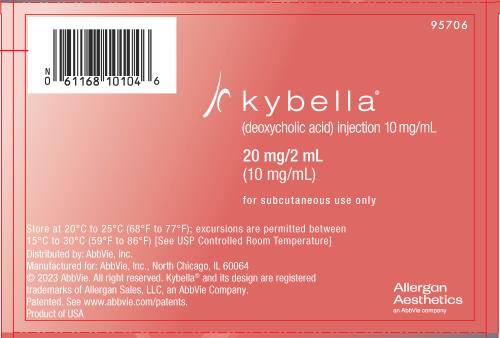
KYBELLA Deoxycholic Acid 20 mg/2mL Injection, Solution
🆔 Identity & classification
Where does this data come from?
🏷️ RxNorm drug class
This medicine belongs to the Cytolytic Agent class.
Where does this data come from?
🏭 Manufacturer & labeler
Where does this data come from?
🩺 Clinical
- Kybella works by physically destroying the fat cells under your chin. Once those cells are gone, they don't come back — so the results can be long-lasting as long as your weight st...
- What exactly does Kybella do, and will the results be permanent?
- You can receive up to 6 Kybella sessions total, and they need to be spaced at least a month apart. How many you actually need depends on how much submental fat you have and your pe...
- How many treatment sessions will I need, and how far apart are they?
Patient education
Supplement & herbal interactions
Where does this data come from?
Ask a licensed pharmacist directly — free, answered by our team.
🧪 Inactive Ingredients / Excipients
Inactive ingredients, also called excipients, are components of the drug product other than the active ingredient. They may include fillers, dyes, coatings, preservatives, flavors, or other formulation ingredients.
💡 Tap an ingredient (hover on desktop) to see what it is and why it’s used.
-
18 mg / 2 mL
UNII LKG8494WBH
Benzyl alcohol is a clear liquid used as a preservative and solvent in medicines. It helps prevent bacterial and fungal growth and dissolves other ingredients to create uniform liquid formulations.
-
UNII QTT17582CB
A strong acid used to adjust and maintain the proper pH level in liquid medicines, ensuring stability and preventing breakdown of active ingredients.
-
8.76 mg / 2 mL
UNII 451W47IQ8X
Sodium chloride is common table salt. It's used in medicines as a buffer to maintain proper pH, as a filler to add bulk, or to adjust the osmotic balance in liquid formulations.
-
2.86 mg / 2 mL
UNII 55X04QC32I
A strong alkaline chemical used to adjust and maintain the pH balance of liquid medicines. It helps keep the medicine stable and ensures it stays effective during storage.
-
2.84 mg / 2 mL
UNII GR686LBA74
Sodium phosphate, dibasic is a salt derived from phosphoric acid. It acts as a buffer to help maintain the medicine's pH balance and may serve as a binder or filler in tablets and capsules.
-
UNII 059QF0KO0R
Water is a liquid solvent that dissolves and mixes ingredients together in liquid medicines, syrups, and injections. It helps distribute the active drug evenly throughout the product.
6 inactive ingredients listed in the exact product block matched to this NDC.
Where does this data come from?
ingredient classCode="IACT" elements from the exact product block matched by this NDC. Label-section narrative from DailyMed / the openFDA label index is shown separately when available.Inactive ingredient FAQ
Are inactive ingredients the same for every manufacturer?
Why might an inactive ingredient be missing?
Can inactive ingredients matter?
💲 Pricing
A drug doesn't have one price. Each row is a different public payment system, and none is what you'd pay at the counter — that depends on your insurance. The ⓘ on each row explains what it measures.
| Price system | Per mL | Per package |
|---|---|---|
| Retail pharmacies payNADAC · weekly | Not in the retail survey — common for institutional, discontinued, or low-volume packs. | |
| Medicaid paysCMS SDUD · 12 mo | No recent Medicaid claims on file for this NDC — rare and low-volume NDCs are suppressed in the public data. | |
| Medicare drug plans payPart D · quarterly | No Part D plan price is available for this NDC in our data. | |
Where does this data come from?
🔁 Therapeutic equivalents
| Product | Labeler | Pack | NADAC/unit | TE | Status | Price vs. this |
|---|---|---|---|---|---|---|
| Kybella 20 mg/2mLthis 61168-0101-03 | Kythera | 2 vials | — | AP | FDA listed | — |
Where does this data come from?
⏳ Availability & generic status
The FDA lists approved generic versions of this medicine, but that does not always mean a pharmacy can get one today. Patent rules, launch agreements, supply and pricing can affect when generics actually arrive.
Why the date isn’t exact: Generic timing can change because patents may be challenged, settled, licensed, added, removed, or worked around with a narrower label — and FDA approval does not always mean a pharmacy can get the generic today.
🛈 What do these terms mean?
- Patent
- Legal protection listed in the Orange Book that may delay generic approval or launch. Issued by the U.S. Patent & Trademark Office.
- Substance patent
- Covers the active drug molecule itself — the hardest to design around. A generic generally can’t launch until it expires.
- Formulation (product) patent
- Covers a specific formulation or dosage form. A generic can sometimes work around it with a different formulation.
- Method-of-use patent
- A patent covering one specific approved use of the drug — not necessarily the whole molecule. A generic can sometimes launch with a “skinny label” that carves out the protected use and keeps the others.
- Skinny label
- A generic label that omits a still-patented use when the FDA allows it — letting a generic reach the market for the unprotected uses.
- Exclusivity
- FDA-granted marketing protection, separate from patents — e.g. 5-yr new chemical entity, 7-yr orphan drug, or a +6-month pediatric extension.
- Paragraph IV
- A generic applicant’s formal challenge to a listed patent. It can potentially lead to earlier generic entry, but often involves litigation or a settlement.
- RLD / RS
- Reference Listed Drug — the brand product the FDA uses as the reference for generic applications. Reference Standard — the product the FDA expects generics to compare against in bioequivalence testing.
- TE / AB rating
- FDA therapeutic-equivalence rating. An AB rating generally means the FDA considers a generic therapeutically equivalent to — and substitutable for — the brand.
- LOE (loss of exclusivity)
- The latest patent or exclusivity currently listed — the loss-of-exclusivity / latest-listed-protection date shown on this page. Paragraph-IV challenges and settlements can move the real date earlier; FDA approval and a manufacturer’s decision to market can move it later.
Built from the FDA Orange Book. The bars above are scaled to each protection’s expiry; the red LOE marker is the last one to lapse.
| Patent | Type | Use code | Expires |
|---|---|---|---|
| US 7754230 ↗ | Method of use | U-1690 | Dec 10, 2027 |
| US 9949986 ↗ | Method of use | U-1940 | Feb 21, 2028 |
| US 7622130 ↗ | Method of use | U-1690 | Dec 10, 2027 |
| US 12161653 ↗ | Method of use | U-1940 | Feb 17, 2032 |
| US 9636349 ↗ | Method of use | U-1940 | Feb 21, 2028 |
| US 9522155 ↗ | Method of use | U-1940 | Feb 21, 2028 |
| US 8546367 ↗ | Method of use | U-1690 | Feb 21, 2028 |
| US 8461140 ↗ | Drug product | — | Feb 21, 2028 |
| US 8653058 ↗ | Drug product | — | Mar 2, 2030 |
| US 8367649 ↗ | Drug product | — | Mar 2, 2030 |
| US 8101593 ↗ | Drug product | — | Mar 2, 2030 |
| US 8883770 ↗ | Drug product | — | Feb 21, 2028 |
| US 8242294 ↗ | Drug substance | — | May 16, 2028 |
| US 10500214 ↗ | Drug product | — | Mar 2, 2030 |
Is there a generic version of KYBELLA 20 MG/2 ML VIAL?
The FDA approved a generic — why can’t I get it at my pharmacy yet?
Why do different websites show different generic release dates?
What does “FDA listed” mean?
What does a patent or protection date mean here?
What does “current Orange Book estimate” mean?
Can a generic come out before the last patent expires?
Can a generic come out after the listed dates?
What is the difference between patents and exclusivity?
Why are there multiple patent dates?
Where does this data come from?
🔬 Reported adverse events (FAERS)
Top reported reactions
Age at onset
Reporter sex
Serious outcomes
Where does this data come from?
📦 Packaging — all sizes for this product
| Package NDC | Description | Marketing start | Status |
|---|---|---|---|
| 61168-0101-03 You're viewing this | 2 VIAL, GLASS in 1 CARTON (61168-101-03) / 2 mL in 1 VIAL, GLASS | 2018-08-01 | Active |
| 61168-0101-04 | 4 VIAL, GLASS in 1 CARTON (61168-101-04) / 2 mL in 1 VIAL, GLASS (61168-101-01) | 2015-06-08 | Active |
Pack size FAQ
What quantity is in NDC 61168-0101-03?
What NDC number is used to bill for this package of KYBELLA Deoxycholic Acid 20 mg/2mL Injection, Solution?
🧭 About this NDC listing & data coverage
What data is (and isn’t) available for this NDC — tap to expand
| NDC identity (package / product / labeler codes) | ✓ Available |
| Labeler | ✓ Available |
| Product & package description | ✓ Available |
| Marketing category & status | ✓ Available |
| Active ingredient / dosage form / route | ✓ Available |
| FDA label (SPL via DailyMed) | ✓ Available |
| Package photos | ✓ Available |
| Inactive ingredients (structured) | ✓ Available |
| NADAC pharmacy acquisition price (CMS) | — Not published for this NDC CMS publishes NADAC only for NDCs reported in its retail-pharmacy survey. |
| Orange Book / therapeutic-equivalence data | ✓ Available |
| HCPCS J-code billing crosswalk | — Not published for this NDC Most self-administered / retail products have no J-code — that is normal. |
| Medicaid utilization (CMS SDUD) | — Not published for this NDC CMS reports utilization only for NDCs with Medicaid claims above its privacy threshold. |
Questions about this listing
Why is there no price listed?
Is the NDC printed on the package the same as the 11-digit billing NDC?
What do the three segments of this NDC mean?
Is this package still being marketed?
Does this product come in other package sizes?
Who lists this product with the FDA?
Do I need a prescription for this product?
Where does this data come from?
📄 Full prescribing information FDA SPL
🎯 Indications and Usage ▾
1 INDICATIONS AND USAGE KYBELLA ® (deoxycholic acid) injection is indicated for improvement in the appearance of moderate to severe convexity or fullness associated with submental fat in adults. Limitations of use The safe and effective use of KYBELLA for the treatment of subcutaneous fat outside the submental region has not been established and is not recommended. KYBELLA is a cytolytic drug indicated for improvement in the appearance of moderate to severe convexity or fullness associated with submental fat in adults.
( 1 ) Limit ation s of use The safe and effective use of KYBELLA for the treatment of subcutaneous fat outside the submental region has not been established and is not recommended. ( 1 )
⏱️ Dosage and Administration ▾
2 DOSAGE AND ADMINISTRATION 0.2 mL injections spaced 1 cm apart until all sites in the planned treatment area have been injected. ( 2.1 ) Up to 50 injections or 10 mL may be injected in a single treatment. ( 2.1 ) Up to 6 single treatments may be administered at intervals no less than 1-month apart.
( 2.1 ) See General Considerations for Administration and Injection Technique before injection. ( 2.2 , 2.3 ) Figure 1. Avoid the Marginal Mandibular Nerve Area Figure 2.
Sagittal View of Platysma Area Figure 3. Injection Pattern
2.1Dos age KYBELLA injection is injected into subcutaneous fat tissue in the submental area using an area-adjusted dose of 2 mg/cm 2 . A single treatment consists of up to a maximum of 50 injections, 0.2 mL each (up to a total of 10 mL), spaced 1 cm apart. Up to 6 single treatments may be administered at intervals no less than 1 month apart. See General Considerations for Administration ( 2.2 ) and Injection Technique ( 2.3 ) before injection.
2.2General Considerations for Administration KYBELLA should be administered by a healthcare professional. Screen patients for other potential causes of submental convexity/fullness (e.g., thyromegaly and cervical lymphadenopathy). Give careful consideration to the use of KYBELLA in patients with excessive skin laxity, prominent platysmal bands or other conditions for which reduction of submental fat may result in an aesthetically undesirable outcome.
Use caution in patients who have had prior surgical or aesthetic treatment of the submental area. Changes in anatomy/landmarks or the presence of scar tissue may impact the ability to safely administer KYBELLA or to obtain the desired aesthetic result. KYBELLA is clear, colorless and free of particulate matter.
Visually inspect KYBELLA vials for particulate matter and/or discoloration, and discard the vial if the solution is discolored and/or contains particulate matter. After use, discard any remaining solution in the vial. 2.
3 Injection Technique The safe and effective use of KYBELLA depends on the use of the correct number and locations for injections, proper needle placement, and administration techniques. Healthcare professionals administering KYBELLA must understand the relevant submental anatomy and associated neuromuscular structures in the area involved and any alterations to the anatomy due to prior surgical or aesthetic procedures [ see W a r n in g s a n d Preca u ti o ns ( 5 ) ]. Avoid injections near the area of the marginal mandibular nerve Needle placement with respect to the mandible is very important as it reduces the potential for injury to the marginal mandibular nerve, a motor branch of the facial nerve.
Injury to the nerve presents as an asymmetrical smile due to paresis of lip depressor muscles [ see Warnings and Precautions ( 5.1 ) ] . To avoid injury to the marginal mandibular nerve: Do not inject above the inferior border of the mandible. Do not inject within a region defined by a 1-1.5 cm line below the inferior border (from the angle of the mandible to the mentum).
Inject KYBELLA only within the target submental fat treatment area (see Figures 1 and 3 ). Figure 1. Avoid the Marginal Mandibular Nerve Area Avoid injection into the platysma Prior to each treatment session, palpate the submental area to ensure sufficient submental fat and to identify subcutaneous fat between the dermis and platysma (pre-platysmal fat) within the target treatment area ( Figure 2 ).
The number of injections and the number of treatments should be tailored to the individual patient’s submental fat distribution and treatment goals. Figure 2 . Sagittal View of Platy s ma Area Injecting into the treatment area Use of ice/cold packs, topical and/or injectable local anesthesia (e.g., lidocaine) may enhance patient comfort.
Outline the planned treatment area with a surgical pen and apply a 1 cm injection grid to mark the injection sites ( Figures 2 and 3 ). Figure 3 . Treatment Area and Injection Pattern Do not inject KY…
💊 Dosage Forms and Strengths ▾
3 DOSAGE FORMS AND STRENG T HS Injection: 10 mg/mL. KYBELLA (deoxycholic acid) injection is a clear, colorless, sterile solution supplied in 2 mL vials intended for single patient use. Each milliliter of the solution contains 10 mg of deoxycholic acid. Injection: 10 mg/mL. ( 3 )
⛔ Contraindications ▾
4 CONTRAINDICATIONS KYBELLA injection is contraindicated in the presence of infection at the injection sites. KYBELLA is contraindicated: In the presence of infection at the injection sites . ( 4 )
⚠️ Warnings and Cautions ▾
5 WARNINGS AND PR E CAUTIONS Marginal mandibular nerve (MMN) injury: Follow injection technique to avoid this injury. ( 2.3 , 5.1 ) Dysphagia may occur with KYBELLA use. Use in patients with pre-existing dysphagia may exacerbate the condition.
( 5.2 ) Submental hematoma/bruising occurs frequently after KYBELLA administration. Use with caution in patients who are being treated with antiplatelet or anticoagulant therapy or have coagulation abnormalities. ( 5.3 ) Avoid injecting in proximity to vulnerable anatomic structures due to the increased risk of tissue damage and vascular injury.
( 2.3 , 5.4 ) Injection site alopecia: Withhold subsequent treatments until resolution. ( 5.5 ) Injection site ulceration, necrosis, and infection: Do not administer to the affected area until complete resolution. ( 5.6 ) 5 .
1 Marginal mandibular nerve injury Cases of marginal mandibular nerve injury, manifested as an asymmetric smile or facial muscle weakness (paresis), were reported during clinical trials. To avoid the potential for nerve injury, KYBELLA injection should not be injected into or in close proximity to the marginal mandibular branch of the facial nerve. All marginal mandibular nerve injuries reported from the trials resolved spontaneously (range 1-298 days, median 44 days).
5 . 2 Dysphagia Difficulty swallowing (dysphagia) occurred in clinical trials in the setting of administration site reactions, e.g., pain, swelling, and induration of the submental area. Cases of dysphagia spontaneously resolved (range 1-81 days, median 3 days).
Subjects with current or prior history of dysphagia were excluded from clinical trials. Avoid use of KYBELLA in these patients as current or prior history of dysphagia may exacerbate the condition.
5.3Injection site hematoma /bruising In clinical trials, 72% of subjects treated with KYBELLA experienced injection site hematoma/bruising [see Adverse Reactions ( 6.1 ) ] . KYBELLA should be used with caution in patients with bleeding abnormalities or who are currently being treated with antiplatelet or anticoagulant therapy as excessive bleeding or bruising in the treatment area may occur.
5.4Risk of injecting in proximity to vulnerable anatomic structure s To avoid potential tissue damage, KYBELLA should not be injected into or in close proximity (1-1.5 cm) to salivary glands, lymph nodes and muscles. Care should be taken to avoid inadvertent injection directly into an artery or a vein as it can result in vascular injury.
5.5Injection site alopecia Cases of injection site alopecia have been reported with the administration of KYBELLA. The onset and duration of this adverse reaction may vary among individuals and may persist. Consider withholding subsequent treatments until resolution of the adverse reaction.
5.6Injection site ulceration , necrosis , and infection Injections that are too superficial (into the dermis) may result in skin ulceration and necrosis [see Injection Technique ( 2.3 )] . Cases of injection site ulceration, necrosis, and infection have been reported with the administration of KYBELLA. Some cases of injection site infection have included cellulitis and abscess requiring intravenous antibiotic treatment and incision and drainage.
Do not administer KYBELLA into the affected area until complete resolution of the adverse reaction.
🤒 Adverse Reactions ▾
6 ADVERSE REACTIONS The most common adverse reactions (>20% of subjects) include injection site edema/swelling, hematoma, pain, numbness, erythema and induration. ( 6.1 ) To report SUSPECTED ADVERSE REACTIONS, contact Allergan at 1-800-678-1605 or FDA at 1-800-FDA-1088 or www.fda.gov/medwatch. 6 .
1 Clinical Trials Experience Because clinical trials are conducted under widely varying conditions, the adverse reaction rates observed in the clinical trials of a drug cannot be directly compared to rates in the clinical trials of another drug and may not reflect the rates observed in practice. In two double-blind, placebo-controlled clinical trials 513 subjects were treated with KYBELLA injection and 506 subjects were treated with placebo. The population was 19-65 years old, 85% were women, 87% Caucasian, 8% African American.
At baseline the population had a mean BMI of 29 kg/m 2 , moderate to severe submental convexity (graded as 2 or 3 on a 0 to 4 scale) and without excessive skin laxity. Subjects received up to 6 treatments at least 1 month apart and were followed for up to 6 months after the last received treatment. The most commonly reported adverse reactions are listed below ( Table 1 ).
Table 1. Adverse Reactions in the Pooled Trials 1 and 2 a Adverse reactions KYBELLA (N=513) n (%) Placebo (N=506) n (%) Injection site reactions 492 (96%) 411 (81%) edema/swelling 448 (87%) 218 (43%) hematoma/bruising 368 (72%) 353 (70%) pain 356 (70%) 160 (32%) numbness 341 (66%) 29 (6%) erythema 136 (27%) 91 (18%) induration 120 (23%) 13 (3%) paresthesia 70 (14%) 20 (4%) nodule 68 (13%) 14 (3%) pruritus 64 (12%) 30 (6%) skin tightness 24 (5%) 6 (1%) site warmth 22 (4%) 8 (2%) nerve injury b 20 (4 %) 1 (<1%) Headache 41 (8%) 20 (4%) Oropharyngeal pain 15 (3%) 7 (1%) Hypertension 13 (3%) 7 (1%) Nausea 12 (2%) 3 (1%) Dysphagia 10 (2%) 1 (<1%) a Adverse reactions that occurred in ≥ 2% KYBELLA treated subjects and at greater incidence than placebo b Marginal mandibular nerve paresis Other adverse reactions associated with the use of KYBELLA include: injection site hemorrhage, injection site discoloration, pre-syncope/syncope, lymphadenopathy, injection site urticaria, and neck pain.
Adverse reactions that lasted more than 30 days and occurred in more than 10% of subjects were injection site numbness (42%), injection site edema/swelling (20%), injection site pain (16%), and injection site induration (13%).
6.2Postmarketing Experience The following adverse reactions have been identified during post-approval use of KYBELLA. Because these reactions are reported voluntarily from a population of uncertain size, it is not always possible to reliably estimate their frequency or establish a causal relationship to KYBELLA exposure. Administration site conditions : injection site ulceration, necrosis, infection, alopecia, scarring, and mass.
Immune System Disorders: Hypersensitivity reactions including rash, urticaria, and itching. Nervous System Disorders: Oral hypoaesthesia and oral paraesthesia. Procedural Complications: Vascular injury due to inadvertent intravascular injection.
👥 Use in Specific Populations ▾
8 USE IN SPECIFIC POP U L A TIO N S 8 . 1 Preg n a n c y Risk Summary There are no adequate and well-controlled studies of KYBELLA injection in pregnant women to inform the drug-associated risk. In animal reproduction studies, no fetal harm was observed with the subcutaneous administration of deoxycholic acid to rats during organogenesis at doses up to 5 times the maximum recommended human dose (MRHD) of 100 mg [see Data] .
The background risk of major birth defects and miscarriage for the indicated population is unknown. However, the background risk of major birth defects in the U.S. general population is 2-4% and of miscarriage is 15-20% of clinically recognized pregnancies. Data Animal Data Embryofetal development studies have been performed in rats and rabbits using subcutaneous doses of deoxycholic acid administered during the period of organogenesis.
For the basis of comparing animal to human doses, the MRHD is 1.7 mg/kg (100 mg/60 kg). No evidence of fetal harm was observed in rats at up to the highest dose tested (50 mg/kg) which is 5-fold higher than the MRHD of KYBELLA based on a mg/m 2 comparison. However, missing intermediate lung lobe was noted in rabbits at all dose levels tested including the lowest dose (10 mg/kg) which is 2-fold higher than the MRHD of KYBELLA based on a mg/m 2 comparison.
These effects may be related to maternal toxicity, which was also seen at all dose levels tested. 8 . 2 Lactation Risk Summary There is no information available on the presence of synthetic deoxycholic acid in human milk, the effects of the drug on the breastfed infant or the effects of the drug on milk production.
The developmental and health benefits of breastfeeding should be considered along with the mother's clinical need for KYBELLA and any potential adverse effects on the breastfed child from KYBELLA or from the underlying maternal condition. 8 . 4 Ped i atr i c Use Safety and effectiveness in patients below the age of 18 years have not been established and KYBELLA is not intended for use in children or adolescents.
8.5Geriatric Use The clinical trials of KYBELLA did not include sufficient numbers of subjects aged 65 and over to determine whether they respond differently from younger subjects. Other reported clinical experience has not identified differences in responses between the elderly and younger subjects. In general, dose selection for an elderly patient should be cautious, usually starting at the low end of the dosing range, reflecting the greater frequency of decreased hepatic, renal, or cardiac function, and of concomitant disease or other drug therapy.
🤰 Pregnancy ▾
8 . 1 Preg n a n c y Risk Summary There are no adequate and well-controlled studies of KYBELLA injection in pregnant women to inform the drug-associated risk. In animal reproduction studies, no fetal harm was observed with the subcutaneous administration of deoxycholic acid to rats during organogenesis at doses up to 5 times the maximum recommended human dose (MRHD) of 100 mg [see Data] .
The background risk of major birth defects and miscarriage for the indicated population is unknown. However, the background risk of major birth defects in the U.S. general population is 2-4% and of miscarriage is 15-20% of clinically recognized pregnancies. Data Animal Data Embryofetal development studies have been performed in rats and rabbits using subcutaneous doses of deoxycholic acid administered during the period of organogenesis.
For the basis of comparing animal to human doses, the MRHD is 1.7 mg/kg (100 mg/60 kg). No evidence of fetal harm was observed in rats at up to the highest dose tested (50 mg/kg) which is 5-fold higher than the MRHD of KYBELLA based on a mg/m 2 comparison. However, missing intermediate lung lobe was noted in rabbits at all dose levels tested including the lowest dose (10 mg/kg) which is 2-fold higher than the MRHD of KYBELLA based on a mg/m 2 comparison.
These effects may be related to maternal toxicity, which was also seen at all dose levels tested.
🧒 Pediatric Use ▾
8 . 4 Ped i atr i c Use Safety and effectiveness in patients below the age of 18 years have not been established and KYBELLA is not intended for use in children or adolescents.
🧓 Geriatric Use ▾
8.5Geriatric Use The clinical trials of KYBELLA did not include sufficient numbers of subjects aged 65 and over to determine whether they respond differently from younger subjects. Other reported clinical experience has not identified differences in responses between the elderly and younger subjects. In general, dose selection for an elderly patient should be cautious, usually starting at the low end of the dosing range, reflecting the greater frequency of decreased hepatic, renal, or cardiac function, and of concomitant disease or other drug therapy.
🧬 Clinical Pharmacology ▾
12 CLINICAL PHARMACO L OGY
12.1Mechanism of Action KYBELLA injection is a cytolytic drug, which when injected into tissue physically destroys the cell membrane causing lysis. 1 2 .2 Phar m a c o d y n a mics Cardiac Electrophysiology At therapeutic doses, KYBELLA does not prolong the QTc interval. 1 2 .3 Phar m a c o k in et i cs Endogenous deoxycholic acid plasma levels are highly variable within and between individuals; most of this natural bile component is sequestered in the enterohepatic circulation loop.
Absorption and Distribution Deoxycholic acid from KYBELLA is rapidly absorbed following subcutaneous injection. After dosing with the maximum recommended single treatment dose with KYBELLA (100 mg), maximum plasma concentrations (mean C max ) were observed with a median T max of 18 minutes after injection. The mean (±SD) C max value was 1024 ± 304 ng/mL and was 3.2-fold higher than average C max values observed during a 24-hour baseline endogenous period in the absence of KYBELLA.
After maximum recommended single treatment dose (100 mg), mean (±SD) deoxycholic acid exposure (AUC 0-24 ) was 7896 ± 2269 ng.hr/mL and was 1.6-fold higher over endogenous exposure. Post-treatment deoxycholic acid plasma levels returned to the endogenous range within 24 hours. No accumulation is expected with the proposed treatment frequency.
Deoxycholic acid is extensively bound to proteins in plasma (98%). Metabolism and Excretion Endogenous deoxycholic acid is a product of cholesterol metabolism and is excreted intact in feces. Deoxycholic acid is not metabolized to any significant extent under normal conditions.
Deoxycholic acid from KYBELLA joins the endogenous bile acid pool in the enterohepatic circulation and is excreted along with the endogenous deoxycholic acid. In Vitro Assessment of Drug Interactions Results from in vitro studies indicate that deoxycholic acid does not inhibit or induce human cytochrome P450 (CYP) enzymes at clinically relevant concentrations. Deoxycholic acid does not inhibit the following transporters: P-gp, BCRP, MRP4, MRP2, OATP1B1, OATP2B1, OATP1B3, OCT1, OCT2, OAT1, OAT3, NTCP, and ASBT.
Specific Populations Hepatic Impairment KYBELLA has not been studied in subjects with hepatic impairment. Considering the intermittent dose frequency, the small dose administered that represents approximately 3% of the total bile acid pool, and the highly variable endogenous deoxycholic acid levels, the pharmacokinetics of deoxycholic acid following KYBELLA injection is unlikely to be influenced by hepatic impairment. Pharmacokinetic E ffects of Gender Deoxycholic acid pharmacokinetics were not influenced by gender.
🧬 Mechanism of Action ▾
12.1Mechanism of Action KYBELLA injection is a cytolytic drug, which when injected into tissue physically destroys the cell membrane causing lysis.
📦 How Supplied / Storage and Handling ▾
1 6 HOW SUPPLIED/STORAGE AND HANDLING KYBELLA (deoxycholic acid) injection, 10 mg/mL is a clear, colorless, sterile solution supplied in 2 mL, single patient use vials in the following dispensing pack: 4 vials, NDC 61168-101-04 Store at 20°C to 25°C (68°F to 77°F); excursions are permitted between 15°C to 30°C (59°F to 86°F) [See USP Controlled Room Temperature]. KYBELLA has a unique hologram on the vial label. If you do not see a hologram, do not use the product and call 1-800-678-1605.
Each vial is for a single patient use. Do not dilute or mix KYBELLA with other compounds. Discard unused portion.
📋 Description ▾
11 DESCRIPTION KYBELLA (deoxycholic acid) injection, 10 mg/mL is a clear colorless, sterile solution for subcutaneous use. It contains a cytolytic agent, deoxycholic acid, as the active ingredient. The chemical name of deoxycholic acid is 3α,12α-dihydroxy-5β-cholan-24-oic acid, and its molecular formula is C 24 H 40 O 4 , and its molecular weight is 392.57 g/mol.
The chemical structure of deoxycholic acid is: Each 2 mL vial of KYBELLA injection contains 20 mg synthetic deoxycholic acid as the active ingredient and the following inactive ingredients: benzyl alcohol (18 mg), dibasic sodium phosphate (2.84 mg), sodium chloride (8.76 mg), sodium hydroxide (2.86 mg) in water for injection, USP. Hydrochloric acid and additional sodium hydroxide are added as necessary to adjust the formulation to pH 8.3. Each vial is for single patient use.
The chemical structure of deoxycholic acid.
💬 Information for Patients ▾
1 7 PATIENT COUNSELING INFORMA T ION Advise the patient to read the FDA-approved patient labeling ( Patient Information ). Advise patients to contact their healthcare providers if patients begin to develop signs of marginal mandibular nerve paresis (e.g., asymmetric smile, facial muscle weakness), difficulty swallowing, or worsening of existing symptoms. Advise patients to contact their healthcare providers for development of erythema, pain, open sore(s) or drainage from the treatment area.
Distributed by: AbbVie Inc. Manufactured for: AbbVie Inc. North Chicago, IL 60064 © 2024 AbbVie.
All rights reserved. KYBELLA ® and its design are registered trademarks of Allergan Sales, LLC, an AbbVie company. Patented.
See www.abbvie.com/patents v4.0USPI0101 Shape Description automatically generated