
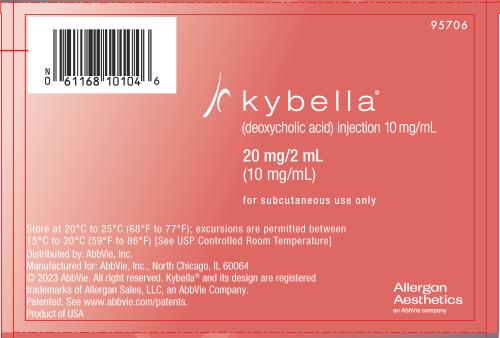
NDC 61168-0101-04: KYBELLA Deoxycholic Acid 20 mg/2mL Injection, Solution
This is a package of KYBELLA Deoxycholic Acid 20 mg/2mL Injection, Solution from Kythera Biopharmaceuticals Inc., first listed with the FDA Jun 2015 and currently FDA-listed.
NDC Database Record
One package, one record: these facts belong to NDC 61168-101-04 alone.
- Record
- FDA NDC Directory package listing · Human prescription drug
- Code segments
- 61168 labeler · 101 product · 04 package
- Package marketed since
- Jun 8, 2015
- Sample package
- No — commercial package
- Listing certified through
- Dec 31, 2027
- Barcode (UPC-A, from the NDC)
- 3 6116810104 7
- FDA record last changed
- Nov 12, 2026
Identity & Classification
Regulatory identifiers FDA, NLM and CMS codes for this package
Drug-database identifiers Medi-Span GPI and First Databank GCN / HICL / AHFS classification
- GSN (GCN sequence number): 074073
- GCN: 38608
- HICL (First Databank): 034320
- AHFS class code: 92:92.00.00
- RxCUI (RxNorm): 1649975
Where does this data come from?
- FDA openFDA NDC Directory · synced Nov 26, 2026
- FDA label on DailyMed · label index refreshed Nov 26, 2026
- RxNorm (NLM RxNav) · catalog refreshed Nov 26, 2026
- Medi-Span GPI (licensed)
- First Databank (licensed) · refreshed Nov 26, 2026
RxNorm Drug Class
This medicine belongs to the Cytolytic Agent class.
Where does this data come from?
- RxClass (NLM) · catalog refreshed Nov 26, 2026
Clinical
Deoxycholic acid injection is used to improve the appearance and profile of moderate to severe submental fat ('double chin'; fatty tissue located under the chin). Deoxycholic acid injection is in a class of medications called cytolytic medications. It works by breaking down cells in fatty tissue.
Read the full MedlinePlus article ↗- Kybella improves the look of moderate to severe fullness under the chin caused by fat, in adults. It is not recommended for fat in other parts of the body, because it hasn't been s...
- A healthcare professional gives it as a series of small injections into the fat under your chin. Up to 6 sessions can be given, at least a month apart. Your provider decides how ma...
- How is it given, and how many treatments will I need?
- Swelling, bruising, pain, numbness, redness and firm areas under the chin are very common. Lumps, itching and tingling can also happen. Most people have some reaction at the treate...
Patient education
Supplement & herbal interactions
Where does this data come from?
- MedlinePlus (NLM) · refreshed Nov 26, 2026
- FDA label on DailyMed · label index refreshed Nov 26, 2026
Ask a licensed pharmacist directly — free, answered by our team.
Pricing
A drug doesn't have one price. Each row is a different public payment system, and none is what you'd pay at the counter — that depends on your insurance. The ⓘ on each row explains what it measures.
| Price system | Per mL | Per package |
|---|---|---|
| Retail pharmacies payNADAC · weekly | Not in the retail survey — common for institutional, discontinued, or low-volume packs. | |
| Medicaid paysCMS SDUD · 12 mo | No recent Medicaid claims on file for this NDC — rare and low-volume NDCs are suppressed in the public data. | |
| Medicare drug plans payPart D · quarterly | No Part D plan price is available for this NDC in our data. | |
Where does this data come from?
- CMS NADAC weekly file
- CMS ASP pricing files · refreshed Nov 20, 2026
- CMS Medicaid State Drug Utilization Data · refreshed Nov 28, 2026
- CMS Part D plan pricing files · refreshed Nov 24, 2026
- VA National Acquisition Center price file
Packaging — All Sizes for This Product
| Package NDC | Description | Marketing start | Marketing end | Status |
|---|---|---|---|---|
| 61168-0101-03 61168-101-03 Main listing | 2 VIAL, GLASS in 1 CARTON / 2 mL in 1 VIAL, GLASS Sample | 2018-08-01 | — | Active |
| 61168-0101-04 You're viewing this | 4 VIAL, GLASS in 1 CARTON / 2 mL in 1 VIAL, GLASS Inner NDC 61168-101-01 · each glass vial (2 mL) | 2015-06-08 | — | Active |
Pack size FAQ
What quantity is in this package?
What NDC number is used to bill for this package of KYBELLA Deoxycholic Acid 20 mg/2mL Injection, Solution?
Therapeutic Equivalents
| Product | Labeler | Pack | NADAC/unit | TE | Status | Price vs. this |
|---|---|---|---|---|---|---|
| Kybella 20 mg/2mLthis 61168-0101-04 | Kythera | 4 vials | — | AP | FDA listed | — |
Where does this data come from?
- FDA openFDA NDC Directory · synced Nov 26, 2026
- FDA Orange Book · refreshed Nov 6, 2026
- CMS NADAC weekly file
Availability & Generic Status
The FDA lists approved generic versions of this medicine, but that does not always mean a pharmacy can get one today. Patent rules, launch agreements, supply and pricing can affect when generics actually arrive.
Why the date isn’t exact: Generic timing can change because patents may be challenged, settled, licensed, added, removed, or worked around with a narrower label — and FDA approval does not always mean a pharmacy can get the generic today.
Our estimate: 2027 to 2028 a wide window
How sure: Toss-up. Still unsettled, because the settlement behind this month is not in a public record we could find.
Why then: A settlement between the brand’s company and generic makers is the reason on record for this month. Settlement terms are usually kept confidential, and we could not find this date in a public filing or announcement, so we rate it a toss-up at most.
That is before the February 2032 date above, which is common: a court ruling or a deal with the brand’s maker often lets a generic in before the last patent runs out.
See the full forecast for generic Kybella →What do these terms mean?
- Patent
- Legal protection listed in the Orange Book that may delay generic approval or launch. Issued by the U.S. Patent & Trademark Office.
- Substance patent
- Covers the active drug molecule itself — the hardest to design around. A generic generally can’t launch until it expires.
- Formulation (product) patent
- Covers a specific formulation or dosage form. A generic can sometimes work around it with a different formulation.
- Method-of-use patent
- A patent covering one specific approved use of the drug — not necessarily the whole molecule. A generic can sometimes launch with a “skinny label” that carves out the protected use and keeps the others.
- Skinny label
- A generic label that omits a still-patented use when the FDA allows it — letting a generic reach the market for the unprotected uses.
- Exclusivity
- FDA-granted marketing protection, separate from patents — e.g. 5-yr new chemical entity, 7-yr orphan drug, or a +6-month pediatric extension.
- Paragraph IV
- A generic applicant’s formal challenge to a listed patent. It can potentially lead to earlier generic entry, but often involves litigation or a settlement.
- RLD / RS
- Reference Listed Drug — the brand product the FDA uses as the reference for generic applications. Reference Standard — the product the FDA expects generics to compare against in bioequivalence testing.
- TE / AB rating
- FDA therapeutic-equivalence rating. An AB rating generally means the FDA considers a generic therapeutically equivalent to — and substitutable for — the brand.
- LOE (loss of exclusivity)
- The latest patent or exclusivity currently listed — the loss-of-exclusivity / latest-listed-protection date shown on this page. Paragraph-IV challenges and settlements can move the real date earlier; FDA approval and a manufacturer’s decision to market can move it later.
Built from the FDA Orange Book. The bars above are scaled to each protection’s expiry; the red LOE marker is the last one to lapse.
| Patent | Type | Use code | Expires |
|---|---|---|---|
| US 7754230 ↗ | Method of use | U-1690 | Dec 10, 2027 |
| US 9949986 ↗ | Method of use | U-1940 | Feb 21, 2028 |
| US 7622130 ↗ | Method of use | U-1690 | Dec 10, 2027 |
| US 12161653 ↗ | Method of use | U-1940 | Feb 17, 2032 |
| US 9636349 ↗ | Method of use | U-1940 | Feb 21, 2028 |
| US 9522155 ↗ | Method of use | U-1940 | Feb 21, 2028 |
| US 8546367 ↗ | Method of use | U-1690 | Feb 21, 2028 |
| US 8461140 ↗ | Drug product | — | Feb 21, 2028 |
| US 8653058 ↗ | Drug product | — | Mar 2, 2030 |
| US 8367649 ↗ | Drug product | — | Mar 2, 2030 |
| US 8101593 ↗ | Drug product | — | Mar 2, 2030 |
| US 8883770 ↗ | Drug product | — | Feb 21, 2028 |
| US 8242294 ↗ | Drug substance | — | May 16, 2028 |
| US 10500214 ↗ | Drug product | — | Mar 2, 2030 |
Is there a generic version of KYBELLA 20 MG/2 ML VIAL?
The FDA approved a generic — why can’t I get it at my pharmacy yet?
Why do different websites show different generic release dates?
What does “FDA listed” mean?
What does a patent or protection date mean here?
What does “current Orange Book estimate” mean?
Can a generic come out before the last patent expires?
Can a generic come out after the listed dates?
What is the difference between patents and exclusivity?
Why are there multiple patent dates?
Where does this data come from?
- FDA Orange Book · refreshed Nov 6, 2026
Inactive Ingredients / Excipients
Inactive ingredients, also called excipients, are components of the drug product other than the active ingredient. They may include fillers, dyes, coatings, preservatives, flavors, or other formulation ingredients.
Avoiding an ingredient? See Deoxycholic Acid Injection inactive ingredients by manufacturer: every current product's list side by side, so you can ask your pharmacy for the version that does not list it.
Tap an ingredient (hover on desktop) to see what it is and why it’s used.
-
18 mg / 2 mL
UNII LKG8494WBH
Benzyl alcohol is a clear liquid used as a preservative and solvent in medicines. It helps prevent bacterial and fungal growth and dissolves other ingredients to create uniform liquid formulations.
-
UNII QTT17582CB
A strong acid used to adjust and maintain the proper pH level in liquid medicines, ensuring stability and preventing breakdown of active ingredients.
-
8.76 mg / 2 mL
UNII 451W47IQ8X
Sodium chloride is common table salt. It's used in medicines as a buffer to maintain proper pH, as a filler to add bulk, or to adjust the osmotic balance in liquid formulations.
-
2.86 mg / 2 mL
UNII 55X04QC32I
A strong alkaline chemical used to adjust and maintain the pH balance of liquid medicines. It helps keep the medicine stable and ensures it stays effective during storage.
-
2.84 mg / 2 mL
UNII GR686LBA74
Sodium phosphate, dibasic is a salt derived from phosphoric acid. It acts as a buffer to help maintain the medicine's pH balance and may serve as a binder or filler in tablets and capsules.
-
UNII 059QF0KO0R
Water is a liquid solvent that dissolves and mixes ingredients together in liquid medicines, syrups, and injections. It helps distribute the active drug evenly throughout the product.
6 inactive ingredients listed in the exact product block matched to this NDC.
Where does this data come from?
ingredient classCode="IACT" elements from the exact product block matched by this NDC. Label-section narrative from DailyMed / the openFDA label index is shown separately when available.- FDA label on DailyMed · label index refreshed Nov 26, 2026
- FDA openFDA NDC Directory · synced Nov 26, 2026
Inactive ingredient FAQ
Are inactive ingredients the same for every manufacturer?
Why might an inactive ingredient be missing?
Can inactive ingredients matter?
Manufacturer & Labeler
Where does this data come from?
- FDA openFDA NDC Directory · synced Nov 26, 2026
- Drugs@FDA
Full Prescribing Information FDA SPL
Indications and Usage
1 INDICATIONS AND USAGE KYBELLA ® is indicated for improvement in the appearance of moderate to severe convexity or fullness associated with submental fat in adults. Limitations of U se KYBELLA is not approved for the treatment of subcutaneous fat outside the submental region, and such use is not recommended [see Warnings and Precautions ( 5.5 )]. KYBELLA is a cytolytic drug indicated for improvement in the appearance of moderate to severe convexity or fullness associated with submental fat in adults.
( 1 ) Limit ation s of Use KYBELLA is not approved for the treatment of subcutaneous fat outside the submental region, and such use is not recommended. ( 1 , 5.5 )
Dosage and Administration
2 DOSAGE AND ADMINISTRATION Inject KYBELLA into subcutaneous fat tissue in the submental area using an area-adjusted dose of 2 mg/cm 2 (a single treatment of up to 100 mg (up to a total of 10 mL)) that consists of up to a maximum of 50 subcutaneous injections, (2 mg (0.2 mL)) each, spaced 1 cm apart ( 2.1 ) Up to 6 single treatments may be administered at intervals no less than 1-month apart. ( 2.1 ) Consider use of ice/cold packs, topical and/or injectable local anesthesia (e.g., lidocaine) to enhance patient comfort ( 2.3 ) Outline the planned KYBELLA treatment area with a surgical pen and apply a 1 cm injection grid to mark the injection sites ( 2.3 ) See Full Prescribing Information for additional administration instructions ( 2.3 ) Figure 1.
Avoid the Marginal Mandibular Nerve Area Figure 2. Sagittal View of Platysma Area Figure 3. Injection Pattern
2.1Recommended Dos age Before injection, see General Considerations for Administration [ see Dosage and Administration ( 2.2 , 2.3 ) ] . Inject KYBELLA into subcutaneous fat tissue in the submental area using an area-adjusted dose of 2 mg/cm 2 (a single treatment of up to 100 mg (up to a total of 10 mL)) that consists of up to a maximum of 50 subcutaneous injections, (2 mg (0.2 mL)) each, spaced 1 cm apart. Up to 6 treatments may be administered at intervals no less than 1 month apart.
2.2Recommendations Prior to KYBELLA Treatment KYBELLA should be administered by a healthcare provider. Prior to KYBELLA treatment: Screen patients for other potential causes of submental convexity/fullness (e.g., thyromegaly and cervical lymphadenopathy). Consider the risks of KYBELLA use in patients with excessive skin laxity, prominent platysmal bands or other conditions for which reduction of submental fat may result in an aesthetically undesirable outcome.
Visually inspect KYBELLA vials for particulate matter and/or discoloration, and discard the vial if the solution is discolored and/or contains particulate matter (KYBELLA is clear, colorless and free of particulate matter). Given that patients who have had prior surgical or aesthetic treatment of the submental area may have changes in anatomy/landmarks or scar tissue that may impact the ability of the health care provider to safely administer KYBELLA or to obtain the desired aesthetic result, use KYBELLA with caution in such patients.
2. 3 Recommended Preparation and Administration Instructions The safe and effective use of KYBELLA depends on the use of the correct number and locations of subcutaneous injections, proper needle placement, and administration technique. Prior to administration, understand the relevant submental anatomy and associated neuromuscular structures in the area involved and any alterations to the anatomy due to prior surgical or aesthetic procedures [ see W a r n in g s a n d Preca u ti o ns ( 5.1 ) ].
Avoid Injections Near the Area of the Marginal Mandibular Nerve To avoid injury to the marginal mandibular nerve: Inject KYBELLA only within the target submental fat treatment area (see Figures 1 and 3 ). Do not inject above the inferior border of the mandible. Do not inject within a region defined by a 1-1.5 cm line below the inferior border (from the angle of the mandible to the mentum).
Figure 1. Avoid the Marginal Mandibular Nerve Area Avoid Injection into the Platysma Prior to each treatment session, palpate the submental area to ensure sufficient submental fat and to identify subcutaneous fat between the dermis and platysma (pre-platysmal fat) within the target treatment area ( Figure 2 ). The number of injections and the number of treatments should be tailored to the individual patient’s submental fat distribution and treatment goals.
Figure 2 . Sagittal View of Platy s ma Area Administration Instructions Consider use of ice/cold packs, topical and/or injectable local anesthesia (e.g., lidocaine) to enhance patient comfort. Outline the planned KYBELLA treatment area with a surgical pen and apply a 1 cm injecti… [Excerpted — this section continues on DailyMed.]
Dosage Forms and Strengths
3 DOSAGE FORMS AND STRENG T HS Injection: 10 mg/mL, clear, colorless, sterile solution supplied in 2 mL vials intended for single patient use. Injection: 10 mg/mL. ( 3 )
Contraindications
4 CONTRAINDICATIONS KYBELLA is contraindicated in patients with an infection in the injection area. KYBELLA is contraindicated in patients with an infection at the injection area . ( 4 )
Warnings and Cautions
5 WARNINGS AND PR E CAUTIONS Marginal Mandibular Nerve Injury : Follow injection technique and do not inject KYBELLA into or in close proximity to the marginal mandibular branch of the facial nerve to avoid this injury. ( 2.3 , 5.1 ) Dysphagia : May occur with KYBELLA use. Avoid use in patients with pre-existing dysphagia because use may exacerbate the condition.
( 5.2 ) Injection Site Reactions ( 5.3 ): Hematoma/Bruising: Use KYBELLA with caution in patients with bleeding abnormalities (e.g., taking antiplatelet or anticoagulant therapy). Alopecia: Consider withholding subsequent KYBELLA treatments until resolution. Ulceration, Necrosis, Nodule, Mass, and Infection: Discontinue KYBELLA if patients develop injection site ulceration, necrosis, nodule, mass, or infection after KYBELLA administration.
Risk of Injecting in Proximity to Vulnerable Anatomic Structures: Avoid injecting in proximity to vulnerable anatomic structures due to the increased risk of tissue damage and vascular injury. ( 2.3 , 5.4 ) Serious Adverse Reactions Associated with Unapproved Use Outside the Submental Region: Serious adverse reactions have been reported following unapproved administration of KYBELLA outside the submental region. KYBELLA is not approved for the treatment of subcutaneous fat outside the submental region.
( 5.5 ) 5. 1 Marginal Mandibular Nerve Injury Cases of marginal mandibular nerve injury, manifested as an asymmetric smile or facial muscle weakness (paresis), were reported in KYBELLA-treated patients during clinical trials. All marginal mandibular nerve injuries reported from the trials resolved without additional treatment (range 1-298 days, median 44 days).
To avoid the potential for marginal mandibular nerve injury, do not inject KYBELLA into or in close proximity to the marginal mandibular branch of the facial nerve [see Dosage and Administration ( 2.3 )]. 5 . 2 Dysphagia Difficulty swallowing (dysphagia) occurred in KYBELLA-treated patients in clinical trials in the setting of administration site reactions, e.g., pain, swelling, and induration of the submental area.
Cases of dysphagia resolved without additional treatment (range 1-81 days, median 3 days). Subjects with current or prior history of dysphagia were excluded from clinical trials. Avoid use of KYBELLA in patients with a current or prior history of dysphagia because KYBELLA use may exacerbate the condition.
5.3Injection Site Reactions Injection Site Hematoma or Bruising In clinical trials, 72% of subjects treated with KYBELLA had an injection site hematoma or bruising [see Adverse Reactions ( 6.1 ) ] . Use KYBELLA with caution in patients with bleeding abnormalities (e.g., taking antiplatelet or anticoagulant therapy) as excessive bleeding or bruising in the treatment area may occur. Injection Site Alopecia Cases of injection site alopecia have been reported with KYBELLA administration.
The onset and duration of this adverse reaction may vary among individuals and may persist. Consider withholding subsequent KYBELLA treatments until resolution of this adverse reaction. Injection Site Ulceration, Necrosis, Nodule, Mass, and Infection Very superficial injections (into the dermis) of KYBELLA may result in skin ulceration and necrosis [see Dosage and Administration ( 2.3 )] .
Cases of injection site ulceration, necrosis, nodule (≤ 3 cm in diameter), mass (> 3 cm in diameter), and infection have been reported with KYBELLA administration. Nodules or masses may occur following initial or subsequent KYBELLA administration. Some nodules and masses may not resolve and medical intervention may be required.
Some cases of injection site infection have included cellulitis and abscess requiring intravenous antibiotic treatment and incision and drainage. Discontinue KYBELLA if patients develop injection site ulceration, necrosis, nodule, mass, or infection after KYBELLA administration.
5.4Risk of Injecting in Proximity to Vulnerable Anatomic Structures To avoid potential tissue dam… [Excerpted — this section continues on DailyMed.]
Adverse Reactions
6 ADVERSE REACTIONS The most common adverse reactions (>20% of subjects) include injection site edema/swelling, hematoma, pain, numbness, erythema and induration. ( 6.1 ) To report SUSPECTED ADVERSE REACTIONS, contact AbbVie Inc. at 1-800-633-9110 or FDA at 1-800-FDA-1088 or www.fda.gov/medwatch. 6 .
1 Clinical Trials Experience Because clinical trials are conducted under widely varying conditions, the adverse reaction rates observed in the clinical trials of a drug cannot be directly compared to rates in the clinical trials of another drug and may not reflect the rates observed in practice. In two double-blind, placebo-controlled clinical trials 513 subjects were treated with KYBELLA and 506 subjects were treated with placebo [see Clinical Studies ( 14 )]. Subjects received up to 6 treatments at least 1 month apart and were followed for up to 6 months after the last received treatment.
The most commonly reported adverse reactions are listed below ( Table 1 ). Table 1. Adverse Reactions in the Pooled Trials 1 and 2 a Adverse reactions KYBELLA (N=513) n (%) Placebo (N=506) n (%) Injection site reactions 492 (96%) 411 (81%) edema/swelling 448 (87%) 218 (43%) hematoma/bruising 368 (72%) 353 (70%) pain 356 (70%) 160 (32%) numbness 341 (66%) 29 (6%) erythema 136 (27%) 91 (18%) induration 120 (23%) 13 (3%) paresthesia 70 (14%) 20 (4%) nodule 68 (13%) 14 (3%) pruritus 64 (12%) 30 (6%) skin tightness 24 (5%) 6 (1%) site warmth 22 (4%) 8 (2%) nerve injury b 20 (4 %) 1 (<1%) Headache 41 (8%) 20 (4%) Oropharyngeal pain 15 (3%) 7 (1%) Hypertension 13 (3%) 7 (1%) Nausea 12 (2%) 3 (1%) Dysphagia 10 (2%) 1 (<1%) a Adverse reactions that occurred in ≥ 2% KYBELLA treated subjects and at greater incidence than placebo b Marginal mandibular nerve paresis Other adverse reactions associated with the use of KYBELLA included injection site hemorrhage, injection site discoloration, pre-syncope/syncope, lymphadenopathy, injection site urticaria, and neck pain.
Adverse reactions that lasted more than 30 days and occurred in more than 10% of KYBELLA-treated subjects were injection site numbness (42%), injection site edema/swelling (20%), injection site pain (16%), and injection site induration (13%).
6.2Postmarketing Experience The following adverse reactions have been identified during post-approval use of KYBELLA. Because these reactions are reported voluntarily from a population of uncertain size, it is not always possible to reliably estimate their frequency or establish a causal relationship to KYBELLA exposure. Administration Site Conditions : injection site ulceration, necrosis, mass, infection, alopecia, and scarring.
Immune System Disorders: Hypersensitivity reactions including rash, urticaria, and itching. Nervous System Disorders: Oral hypoaesthesia and oral paraesthesia. Procedural Complications: Vascular injury due to inadvertent intravascular injection.
Use in Specific Populations
8 USE IN SPECIFIC POP U L A TIO N S 8 . 1 Preg n a n c y Risk Summary There are no adequate and well-controlled trials of KYBELLA in pregnant women to inform the drug-associated risk. In animal reproduction studies, no fetal harm was observed with the subcutaneous administration of deoxycholic acid to rats during organogenesis at doses up to 5 times the maximum recommended human dose (MRHD) of 100 mg [see Data] .
The background risk of major birth defects and miscarriage for the indicated population is unknown. However, the background risk of major birth defects in the U.S. general population is 2-4% and of miscarriage is 15-20% of clinically recognized pregnancies. Data Animal Data: Embryofetal development studies have been performed in rats and rabbits using subcutaneous doses of deoxycholic acid administered during the period of organogenesis.
For the basis of comparing animal to human doses, the MRHD is 1.7 mg/kg (100 mg/60 kg). No evidence of fetal harm was observed in rats at up to the highest dose tested (50 mg/kg) which is 5-fold higher than the MRHD of KYBELLA based on a mg/m 2 comparison. However, missing intermediate lung lobe was noted in rabbits at all dose levels tested including the lowest dose (10 mg/kg) which is 2-fold higher than the MRHD of KYBELLA based on a mg/m 2 comparison.
These effects may be related to maternal toxicity, which was also seen at all dose levels tested. 8 . 2 Lactation Risk Summary There is no information available on the presence of synthetic deoxycholic acid in human milk, the effects of the drug on the breastfed infant or the effects of the drug on milk production.
The developmental and health benefits of breastfeeding should be considered along with the mother's clinical need for KYBELLA and any potential adverse effects on the breastfed child from KYBELLA or from the underlying maternal condition. 8 . 4 Ped i atr i c Use Safety and effectiveness of KYBELLA have not been established in pediatric patients and KYBELLA is not recommended for use in children or adolescents.
8.5Geriatric Use The clinical trials of KYBELLA did not include sufficient numbers of subjects aged 65 and over to determine whether they respond differently from younger adult subjects.
Pregnancy
8 . 1 Preg n a n c y Risk Summary There are no adequate and well-controlled trials of KYBELLA in pregnant women to inform the drug-associated risk. In animal reproduction studies, no fetal harm was observed with the subcutaneous administration of deoxycholic acid to rats during organogenesis at doses up to 5 times the maximum recommended human dose (MRHD) of 100 mg [see Data] .
The background risk of major birth defects and miscarriage for the indicated population is unknown. However, the background risk of major birth defects in the U.S. general population is 2-4% and of miscarriage is 15-20% of clinically recognized pregnancies. Data Animal Data: Embryofetal development studies have been performed in rats and rabbits using subcutaneous doses of deoxycholic acid administered during the period of organogenesis.
For the basis of comparing animal to human doses, the MRHD is 1.7 mg/kg (100 mg/60 kg). No evidence of fetal harm was observed in rats at up to the highest dose tested (50 mg/kg) which is 5-fold higher than the MRHD of KYBELLA based on a mg/m 2 comparison. However, missing intermediate lung lobe was noted in rabbits at all dose levels tested including the lowest dose (10 mg/kg) which is 2-fold higher than the MRHD of KYBELLA based on a mg/m 2 comparison.
These effects may be related to maternal toxicity, which was also seen at all dose levels tested.
Pediatric Use
8 . 4 Ped i atr i c Use Safety and effectiveness of KYBELLA have not been established in pediatric patients and KYBELLA is not recommended for use in children or adolescents.
Geriatric Use
8.5Geriatric Use The clinical trials of KYBELLA did not include sufficient numbers of subjects aged 65 and over to determine whether they respond differently from younger adult subjects.
Clinical Pharmacology
12 CLINICAL PHARMACO L OGY
12.1Mechanism of Action KYBELLA is a cytolytic drug, which when injected into submental fat - in patients with moderate to severe convexity or fullness associated with submental fat - physically destroys the cell membrane causing lysis. 1 2 .2 Phar m a c o d y n a mics Cardiac Electrophysiology At the recommended deoxycholic acid dose, clinically significant QTc interval prolongation was not observed. 1 2 .3 Phar m a c o k in et i cs Endogenous deoxycholic acid plasma levels are highly variable within and between individuals; most of this natural bile component is sequestered in the enterohepatic circulation loop.
Absorption and Distribution After KYBELLA subcutaneous injection, deoxycholic acid was rapidly absorbed. After dosing with the recommended single treatment KYBELLA dose (100 mg) Maximum plasma concentrations of deoxycholic acid (mean C max ) were observed with a median T max of 18 minutes after injection. Mean (±SD) deoxycholic acid exposure (AUC 0-24 ) was 7896 ± 2269 ng.hr/mL and was 1.6-fold higher over endogenous exposure.
The mean (±SD) C max value was 1024 ± 304 ng/mL and was 3.2-fold higher than average C max values observed during a 24-hour baseline endogenous period in the absence of KYBELLA. Post-treatment deoxycholic acid plasma levels returned to the endogenous range within 24 hours. No accumulation is expected with the proposed treatment frequency.
Deoxycholic acid is extensively bound to proteins in plasma (98%). Metabolism and Excretion Endogenous deoxycholic acid is a product of cholesterol metabolism and is excreted intact in feces. Deoxycholic acid is not metabolized to any significant extent under normal conditions.
Deoxycholic acid from KYBELLA joins the endogenous bile acid pool in the enterohepatic circulation and is excreted along with the endogenous deoxycholic acid. Drug Interaction Studies In Vitro Assessment of Drug Interactions : Results from in vitro studies indicate that deoxycholic acid does not inhibit or induce human cytochrome P450 (CYP) enzymes at clinically relevant concentrations. Deoxycholic acid does not inhibit the following transporters: P-gp, BCRP, MRP4, MRP2, OATP1B1, OATP2B1, OATP1B3, OCT1, OCT2, OAT1, OAT3, NTCP, and ASBT.
Specific Populations Patients with Hepatic Impairment : KYBELLA has not been studied in subjects with hepatic impairment. Considering the intermittent dose frequency, the small dose administered that represents approximately 3% of the total bile acid pool, and the highly variable endogenous deoxycholic acid levels, the pharmacokinetics of deoxycholic acid following KYBELLA injection is unlikely to be influenced by hepatic impairment. Male and Female Patients: Deoxycholic acid pharmacokinetics were not influenced by sex.
Mechanism of Action
12.1Mechanism of Action KYBELLA is a cytolytic drug, which when injected into submental fat - in patients with moderate to severe convexity or fullness associated with submental fat - physically destroys the cell membrane causing lysis.
How Supplied / Storage and Handling
1 6 HOW SUPPLIED/STORAGE AND HANDLING KYBELLA (deoxycholic acid) injection, 10 mg/mL is a clear, colorless, sterile solution supplied in 2 mL, single patient use vials in the following dispensing pack: vials, NDC 61168-101-04 Store at 20°C to 25°C (68°F to 77°F); excursions are permitted between 15°C to 30°C (59°F to 86°F) [See USP Controlled Room Temperature]. KYBELLA has a unique hologram on the vial label. If you do not see a hologram, do not use the product and call 1-800-633-9110.
Each vial is for a single patient use.
Description
11 DESCRIPTION The chemical name of deoxycholic acid is 3α,12α-dihydroxy-5β-cholan-24-oic acid, and its molecular formula is C 24 H 40 O 4 , and its molecular weight is 392.57 g/mol. The chemical structure of deoxycholic acid is: KYBELLA (deoxycholic acid) injection, 10 mg/mL is a clear colorless, sterile solution for subcutaneous use. Each 2 mL vial of KYBELLA contains 20 mg of deoxycholic acid, a cytolytic agent, as the active ingredient and the following inactive ingredients: benzyl alcohol (18 mg), dibasic sodium phosphate (2.84 mg), sodium chloride (8.76 mg), sodium hydroxide (2.86 mg) in water for injection, USP.
Hydrochloric acid and additional sodium hydroxide are added as necessary to adjust the formulation to pH 8.3. Each vial is for single patient use. The chemical structure of deoxycholic acid.
Information for Patients
1 7 PATIENT COUNSELING INFORMA T ION Advise the patient to read the FDA-approved patient labeling ( Patient Information ). Advise patients to contact their healthcare providers if they develop signs of marginal mandibular nerve paresis (e.g., asymmetric smile, facial muscle weakness) or difficulty swallowing, or if existing symptoms worsen [see Warnings and Precautions ( 5.1 , 5.2 )] . Advise patients to contact their healthcare providers if they develop injection site hematoma, brusing, alopecia, ulceration, necrosis, nodule, mass, infection, pain, numbness, induration, or paresthesia from the treatment area [see Warnings and Precautions ( 5.3 )] .
Distributed by: AbbVie Inc. Manufactured for: AbbVie Inc. North Chicago, IL 60064 © 2026 AbbVie.
All rights reserved. KYBELLA and its design are trademarks of Allergan Sales, LLC, an AbbVie company. Patented.
See www.abbvie.com/patents V5.0USPI0101 Logo Description automatically generated
Pharmacokinetics
1 2 .3 Phar m a c o k in et i cs Endogenous deoxycholic acid plasma levels are highly variable within and between individuals; most of this natural bile component is sequestered in the enterohepatic circulation loop. Absorption and Distribution After KYBELLA subcutaneous injection, deoxycholic acid was rapidly absorbed. After dosing with the recommended single treatment KYBELLA dose (100 mg) Maximum plasma concentrations of deoxycholic acid (mean C max ) were observed with a median T max of 18 minutes after injection.
Mean (±SD) deoxycholic acid exposure (AUC 0-24 ) was 7896 ± 2269 ng.hr/mL and was 1.6-fold higher over endogenous exposure. The mean (±SD) C max value was 1024 ± 304 ng/mL and was 3.2-fold higher than average C max values observed during a 24-hour baseline endogenous period in the absence of KYBELLA. Post-treatment deoxycholic acid plasma levels returned to the endogenous range within 24 hours.
No accumulation is expected with the proposed treatment frequency. Deoxycholic acid is extensively bound to proteins in plasma (98%). Metabolism and Excretion Endogenous deoxycholic acid is a product of cholesterol metabolism and is excreted intact in feces.
Deoxycholic acid is not metabolized to any significant extent under normal conditions. Deoxycholic acid from KYBELLA joins the endogenous bile acid pool in the enterohepatic circulation and is excreted along with the endogenous deoxycholic acid. Drug Interaction Studies In Vitro Assessment of Drug Interactions : Results from in vitro studies indicate that deoxycholic acid does not inhibit or induce human cytochrome P450 (CYP) enzymes at clinically relevant concentrations.
Deoxycholic acid does not inhibit the following transporters: P-gp, BCRP, MRP4, MRP2, OATP1B1, OATP2B1, OATP1B3, OCT1, OCT2, OAT1, OAT3, NTCP, and ASBT. Specific Populations Patients with Hepatic Impairment : KYBELLA has not been studied in subjects with hepatic impairment. Considering the intermittent dose frequency, the small dose administered that represents approximately 3% of the total bile acid pool, and the highly variable endogenous deoxycholic acid levels, the pharmacokinetics of deoxycholic acid following KYBELLA injection is unlikely to be influenced by hepatic impairment.
Male and Female Patients: Deoxycholic acid pharmacokinetics were not influenced by sex.
Pharmacodynamics
1 2 .2 Phar m a c o d y n a mics Cardiac Electrophysiology At the recommended deoxycholic acid dose, clinically significant QTc interval prolongation was not observed.
Clinical Studies
14 CLINICAL STUDIES Two randomized, multi-center, double-blind, placebo-controlled trials (Trials 1 and 2) of identical design were conducted to evaluate KYBELLA for use to improve the appearance of moderate to severe convexity or fullness associated with submental fat. The trials enrolled healthy adults (ages 19 to 65, BMI ≤ 40 kg/m 2 ) with moderate or severe convexity or fullness associated with submental fat (i.e., grade 2 or 3 on 5-point grading scales, where 0 = none and 4 = extreme), as judged by both clinician and subject ratings.
Subjects received up to 6 treatments with KYBELLA (N=514, combined trials) or placebo (N=508, combined trials) at no less than 1 month intervals. Use of ice/cold packs, topical and/or injectable local anesthesia was allowed during the clinical trials. Injection volume was 0.2 mL (2 mg) per injection site, spaced 1 cm apart into the submental fat tissue, which is also expressed in dose per area as 2 mg/cm 2 .
For each treatment session a maximum of 100 mg (10 mL) was permitted over the entire treatment area. Subjects were administered an average of 64 mg (6.4 mL) at the first treatment session, and subjects who received all six treatments were administered an average of 44 mg (4.4 mL) at the sixth treatment session. In these trials, 59% of subjects received all six treatments.
Baseline Demographics and Important Disease Characteristics In these trials, the mean age was 49 years and the mean BMI was 29 kg/m 2 . Most of the subjects were women (85%) and White (87%) and African American (8%). At baseline, 51% of the subjects had a clinician-rated submental fat severity rating of moderate submental fat rating (graded as 2 on a 0 to 4 scale) and 49% had a severe submental fat rating (graded as 3 on a 0 to 4 scale) and without excessive skin laxity.
Key Endpoints The co-primary efficacy assessments in these trials were based on at least 2-grade and at least 1-grade improvements in submental convexity or fullness on the composite of clinician-reported and patient-reported ratings of submental fat 12 weeks after final treatment. Additionally, changes in submental fat volume were evaluated in a subset of subjects (N=449, combined trials) using magnetic resonance imaging (MRI). Visual and emotional impacts of submental fat (happy, bothered, self-conscious, embarrassed, looking older or overweight) were also evaluated using a 6-question survey, with each question rated from 0 (not at all) to 10 (extremely/very much).
Efficacy Results In Trials 1 and 2, reductions in submental fat volume were observed more frequently in the KYBELLA group compared to the placebo group as measured by the composite clinician and patient ratings ( Table 2 ). The composite response rates by visit are presented in Figure 4 . Table 2. ≥ 2-Grade and ≥ 1-Grade Composite Clinician Response and Composite Patient Response 12 Weeks After Final Treatment in Adult Patients with Moderate to Severe Convexity or Fullness Associated with Submental Fat Trial 1 Trial 2 Endpoint KYBELLA (N=256) Placebo (N=250) KYBELLA (N=258) Placebo (N=258) 2-Grade Composite Response a 13.4% <0.1% 18.6% 3.0% 1-Grade Composite Response b 70.0% 18.6% 66.5% 22.2% a At least 2 grade reduction on both the clinician-reported and patient-reported ratings of submental fat b At least 1 grade reduction on both the clinician-reported and patient-reported ratings of submental fat Figure 4 .
Subjects with ≥ 2 -Grade on Both the Clinician -Reporting Ratings and the Patient Response in Adult Patients with Moderate to Severe Convexity or Fullness Associated with Submental Fat Subjects were followed up 4, 12 and 24 weeks after the last¬ treatment. Forty-one percent of subjects received fewer than 6 treatments and entered the post-treatment period earlier than Week 24. Figure 5 .
Subjects with ≥ 1 -Grade on Both the Composite Clinician Response and the Composite Patient Response in Adult Patients with Moderate to Severe Convexity or Fullness Associated with Submental Fat Subje… [Excerpted — this section continues on DailyMed.]
Nonclinical Toxicology
1 3 NONCLINICAL TO X ICOLOGY
13.1Carcinogenes i s, Mutagenes i s, Impairment of Fe r tility Long-term studies in animals have not been performed to evaluate the carcinogenic potential of deoxycholic acid. Deoxycholic acid was negative in a battery of in vitro (Ames test and chromosomal aberration assay in human lymphocytes) and in vivo (rat erythrocyte micronucleus assay) genetic toxicology assays. No effects on fertility were observed in male and female rats administered deoxycholic acid at subcutaneous doses up to 50 mg/kg (5 times the MRHD based on a mg/m 2 comparison) once weekly prior to and during the mating period and through gestation day 7 in female rats.
Carcinogenesis, Mutagenesis, Impairment of Fertility
13.1Carcinogenes i s, Mutagenes i s, Impairment of Fe r tility Long-term studies in animals have not been performed to evaluate the carcinogenic potential of deoxycholic acid. Deoxycholic acid was negative in a battery of in vitro (Ames test and chromosomal aberration assay in human lymphocytes) and in vivo (rat erythrocyte micronucleus assay) genetic toxicology assays. No effects on fertility were observed in male and female rats administered deoxycholic acid at subcutaneous doses up to 50 mg/kg (5 times the MRHD based on a mg/m 2 comparison) once weekly prior to and during the mating period and through gestation day 7 in female rats.
Patient Package Insert
P ATIENT INFORMATION KYBELLA ® (kye be lah) (deoxycholic acid ) i njection for subcutaneous use What is KYBELLA ? KYBELLA is a prescription medicine used in adults to improve the appearance and profile of moderate to severe fat below the chin (submental fat), also called “double chin.” The use of KYBELLA for the treatment of fat outside of the submental area is not recommended. It is not known if KYBELLA is safe and effective in children under 18 years of age.
Do not receive KYBELLA if you have an infection in the treatment area. Before receiving KYBELLA , tell your healthcare provider about all of your medical conditions, including if you: have had or plan to have surgery on your face, neck, or chin have had cosmetic treatments on your face, neck, or chin have had or have medical conditions in or near the neck area have had or have trouble swallowing have bleeding problems are pregnant or plan to become pregnant. It is not known if KYBELLA will harm your unborn baby. are breastfeeding or plan to breastfeed.
It is not known if KYBELLA passes into your breast milk. Tell your healthcare provider about all the medicines you take , including prescription and over-the-counter medicines, vitamins, and herbal supplements. Especially tell your healthcare provider if you take a medicine that prevents the clotting of your blood (antiplatelet or anticoagulant medicine).
How will I receive KYBELLA ? KYBELLA is injected into the fat under your chin (up to 50 injections under your skin) by your healthcare provider. KYBELLA injections may be given at least 1 month apart.
You and your healthcare provider will decide how many treatments you need. What are the possible side effects of KYBELLA ? KYBELLA can cause serious side effects, including: Nerve injury in the jaw that can cause an uneven smile or facial muscle weakness .
Trouble swallowing . Injection site problems including: a collection of blood under the skin (hematoma) or bruising damage to an artery or vein if KYBELLA is inadvertently injected into it hair loss open sores (ulcers) damage and tissue cell-death (necrosis) around the injection site nodules (≤ 3 cm in diameter) or mass (> 3 cm in diameter). Some nodules and masses may not resolve, and medical treatment, may be required.
Infection KYBELLA can cause serious side effects when injected into areas of the body other than below the chin (submental area) including: blurred or reduced vision when injected around the eyes muscle or nerve damage, including numbness and tingling in the face lumps or nodules where the injection was given. These lumps or nodules may not resolve in time and medical treatment, may be required Call your healthcare provider if you : begin to develop weakness in the muscles of your face, or your smile becomes uneven you have difficulty swallowing, or if any of the symptoms that you already have get worse develop redness, pain, open sores, or drainage at or from the treatment area.
The most common side effects of KYBELLA include: swelling pain numbness redness areas of hardness in the treatment area These are not all of the possible side effects of KYBELLA. Call your doctor for medical advice about side effects. You may report side effects to FDA at 1-800-FDA-1088.
General information about the safe and effective use of KYBELLA. Medicines are sometimes prescribed for purposes other than those listed in a Patient Information leaflet. If you would like more information, talk to your healthcare provider.
You can ask your pharmacist or healthcare provider for more information about KYBELLA that is written for health professionals. What are the ingredients in KYBELLA ? Active ingredient: deoxycholic acid Inactive ingredients: benzyl alcohol, dibasic sodium phosphate, hydrochloric acid, sodium chloride, sodium hydroxide and water for injection, USP.
Distributed by: AbbVie Inc. Manufactured for: AbbVie Inc. North Chicago, IL 60064 © 2026 AbbVie.
All rights reserved. KYBELLA and its design are trademarks of Allergan… [Excerpted — this section continues on DailyMed.]
Recent Major Changes
Warnings and Precautions ( 5.3 , 5.5 ) 09/2026
Package Label / Principal Display Panel
Principal Display Panel NDC: 61168-101-04 kybella ® (deoxycholic acid) injection 10 mg/mL 20 mg/2 mL (10 mg/mL) for subcutaneous use only Single use vials. Discard unused portion. Four ready-to-use vials. Do not dilute. Rx ONLY Principal Display Panel NDC: 61168-101-04 kybella® (deoxycholic acid) injection 10 mg/mL 20 mg/2 mL (10 mg/mL) for subcutaneous use only Single use vials. Discard unused portion. Four ready-to-use vials. Do not dilute. Rx ONLY
Reported Adverse Events (FAERS)
Top reported reactions
Age at onset
Reporter sex
Serious outcomes
Where does this data come from?
About This NDC Listing & Data Coverage
What data is (and isn’t) available for this NDC — tap to expand
| NDC identity (package / product / labeler codes) | Available |
| Labeler | Available |
| Product & package description | Available |
| Marketing category & status | Available |
| Active ingredient / dosage form / route | Available |
| FDA label (SPL via DailyMed) | Available |
| Package photos | Available |
| Inactive ingredients (structured) | Available |
| NADAC pharmacy acquisition price (CMS) | — Not published for this NDC CMS publishes NADAC only for NDCs reported in its retail-pharmacy survey. |
| Orange Book / therapeutic-equivalence data | Available |
| HCPCS J-code billing crosswalk | — Not published for this NDC Most self-administered / retail products have no J-code — that is normal. |
| Medicaid utilization (CMS SDUD) | — Not published for this NDC CMS reports utilization only for NDCs with Medicaid claims above its privacy threshold. |