
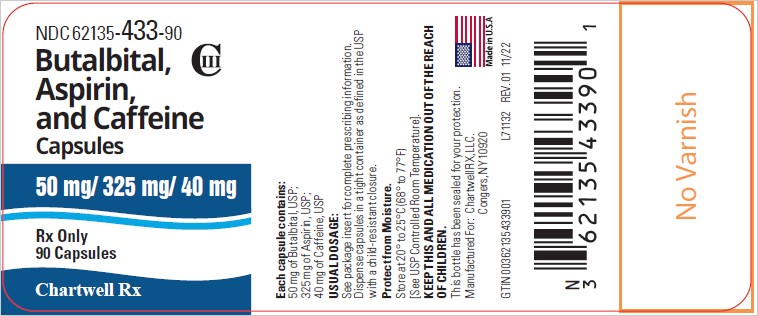
butalbital, aspirin, and caffeine 50 mg; 325 mg; 40 mg Capsule, 90-count — NDC 62135-433-90 (Billing 62135-0433-90)
This is a package of 90 capsules of butalbital, aspirin, and caffeine 50 mg; 325 mg; 40 mg Capsule from Chartwell RX, LLC, marketed since Oct 1985 and currently FDA-listed; retail pharmacies pay about $0.9482 per capsule (NADAC). It is this product's only package size.
NDC database record
One package, one record: these facts belong to NDC 62135-433-90 alone.
- Record
- FDA NDC Directory package listing · Human prescription drug
- Code segments
- 62135 labeler · 433 product · 90 package
- Package marketed since
- Dec 12, 2022
- Sample package
- No — commercial package
- Listing certified through
- Dec 31, 2027
- Billing quantity
- 90 EA per package
- Barcode (UPC)
- 0362135433901
- FDA record last changed
- Oct 8, 2026
Identity & classification
Regulatory identifiers FDA, NLM and CMS codes for this package
Drug-database identifiers Medi-Span GPI and First Databank GCN / HICL / AHFS classification
- GSN (GCN sequence number): 004308
- GCN: 71150
- HICL (First Databank): 001790
- AHFS class code: 20:12.18.00
- RxCUI (RxNorm): 238134
Where does this data come from?
- FDA openFDA NDC Directory · synced Oct 8, 2026
- FDA label on DailyMed · label index refreshed Oct 8, 2026
- RxNorm (NLM RxNav) · catalog refreshed Oct 1, 2026
- Medi-Span GPI (licensed)
- First Databank (licensed) · refreshed Oct 8, 2026
RxNorm drug class
This medicine belongs to the Platelet Aggregation Inhibitor class.
Where does this data come from?
- RxClass (NLM) · catalog refreshed Oct 1, 2026
Clinical
- It's used to relieve tension headache, also called muscle contraction headache. It hasn't been shown to work for multiple recurrent headaches, so talk with your prescriber if your...
- You take the capsules by mouth, one or two about every 4 hours. Don't go over 6 capsules in a day. Follow your prescriber's directions and avoid using it for long stretches.
- Drowsiness and dizziness are the most common. Lightheadedness, nausea, vomiting and gas can also happen. Be careful driving until you know how it affects you.
- It's best to avoid it. Alcohol and other sedating medicines, such as opioids and tranquilizers, can add to the drowsiness and slow your brain and breathing.
Patient education
Supplement & herbal interactions
Where does this data come from?
- MedlinePlus (NLM) · refreshed Oct 8, 2026
- FDA label on DailyMed · label index refreshed Oct 8, 2026
Ask a licensed pharmacist directly — free, answered by our team.
Pricing
A drug doesn't have one price. Each row is a different public payment system, and none is what you'd pay at the counter — that depends on your insurance. The ⓘ on each row explains what it measures.
| Price system | Per ea | Per package |
|---|---|---|
| Retail pharmacies payNADAC · weekly | $0.948 | $85.34 / 90 capsules |
| Medicaid paysCMS SDUD · 12 mo | No recent Medicaid claims on file for this NDC — rare and low-volume NDCs are suppressed in the public data. | |
| Medicare drug plans payPart D · quarterly | No Part D plan price is available for this NDC in our data. | |
Where does this data come from?
- CMS NADAC weekly file · file of Oct 7, 2026
- CMS ASP pricing files · refreshed Sep 20, 2026
- CMS Medicaid State Drug Utilization Data · refreshed Oct 8, 2026
- CMS Part D plan pricing files · refreshed Sep 24, 2026
- VA National Acquisition Center price file
Packaging — all sizes for this product
| Package NDC | Description | Marketing start | Marketing end | Status |
|---|---|---|---|---|
| 62135-0433-90 You're viewing this Main listing | 90 CAPSULE in 1 BOTTLE | 2022-12-12 | — | Active |
Therapeutic equivalents
| Product | Labeler | Pack | NADAC/unit | TE | Status | Price vs. this |
|---|---|---|---|---|---|---|
| Butalbital, aspirin, and caffeine 50 mg/1; 325 mg/1; 40 mg 00527-1552-01 | Lannett | 100 capsules | $0.948 | AA | Availability likely | — |
| Butalbital, aspirin, and caffeine 50 mg/1; 325 mg/1; 40 mg 00781-2270-01 | Sandoz | 100 capsules | $0.948 | AA | Availability likely | — |
| butalbital, aspirin, and caffeine 50 mg/1; 325 mg/1; 40 mgthis 62135-0433-90 | Chartwell | 90 capsules | $0.948 | AA | Availability likely | — |
| Butalbital, Aspirin, And Caffeine 50 mg/1; 325 mg/1; 40 mg 69367-0416-01 | Westminster | 100 capsules | $0.948 | AA | Availability likely | — |
Where does this data come from?
- FDA openFDA NDC Directory · synced Oct 8, 2026
- FDA Orange Book · refreshed Oct 3, 2026
- CMS NADAC weekly file · file of Oct 7, 2026
Availability & generic status
This product is an FDA-approved generic. Other versions of the same drug are listed under Therapeutic equivalents, least expensive first.
Where does this data come from?
- FDA Orange Book · refreshed Oct 3, 2026
Inactive Ingredients / Excipients
Inactive ingredients, also called excipients, are components of the drug product other than the active ingredient. They may include fillers, dyes, coatings, preservatives, flavors, or other formulation ingredients.
🧪 Avoiding an ingredient? See Aspirin, Butalbital, and Caffeine inactive ingredients by manufacturer: every current product's list side by side, so you can ask your pharmacy for the version that does not list it.
💡 Tap an ingredient (hover on desktop) to see what it is and why it’s used.
-
UNII 3K9958V90M
A liquid solvent derived from fermentation or chemical synthesis. In medicines, alcohol dissolves active ingredients, helps preserve the product, and improves how the body absorbs certain drugs.
-
UNII LMI26O6933
Alumina is a white powder form of aluminum oxide. It's used as a filler to add bulk to tablets and capsules, and sometimes as a thickening or anti-caking agent in powdered formulations.
-
UNII 8PJ61P6TS3
Butyl alcohol is a clear liquid organic solvent derived from petroleum or natural sources. In medicines, it helps dissolve active ingredients and serves as a solvent in liquid formulations and some topical products.
-
UNII 35SW5USQ3G
A synthetic yellow dye used to color medicines. It helps make tablets, capsules, and liquids visually distinct so patients can easily identify their medication.
-
UNII H3R47K3TBD
FD&C Blue No. 1 is a synthetic blue dye approved for use in foods and medicines. It serves as a colorant to give the medication its distinctive appearance and help with product identification.
-
UNII L06K8R7DQK
A synthetic blue dye approved by the FDA for use in medications and foods. It serves as a colorant to make pills and liquids visually distinct and easier to identify.
-
UNII 3P3ONR6O1S
A synthetic green dye approved by the FDA for use in medicines and foods. It serves as a colorant to make the pill or liquid visually distinctive and help with product identification.
-
UNII WZB9127XOA
A synthetic red dye used to color medications and make them easier to identify. It serves as a colorant in tablets, capsules, and liquid formulations.
-
UNII XM0M87F357
A dark iron oxide compound that gives medicines their black or dark color. It's used as a colorant in tablets and capsules to help identify the product and make it visually distinctive.
-
UNII 2G86QN327L
Gelatin is a protein derived from animal collagen, commonly used in medicines as a gelling agent and capsule material. It helps create soft or hard capsule shells that hold and release medication, and can also thicken liquid formulations.
-
UNII Y4S76JWI15
Methyl alcohol, also called methanol, is a simple organic solvent. It helps dissolve and carry active ingredients in liquid medicines, and helps the product mix evenly.
-
UNII OP1R32D61U
Microcrystalline cellulose is a purified form of cellulose, a natural fiber from plant sources. It acts as a binder and filler in tablets and capsules, helping hold ingredients together and give the medicine its shape and size.
-
UNII 6DC9Q167V3
Propylene glycol is a clear liquid derived from petroleum or vegetable sources. It acts as a solvent, humectant, and preservative in medicines, helping dissolve active ingredients and maintain product stability.
-
UNII 46N107B71O
Shellac is a natural resin secreted by the lac beetle. It's used as a coating on tablets and capsules to control how quickly the medicine dissolves and to improve appearance and stability.
-
UNII ETJ7Z6XBU4
Silicon dioxide is a naturally occurring mineral used as a glidant and anti-caking agent. It helps powder ingredients flow smoothly and prevents clumping during manufacturing and storage.
-
UNII 5856J3G2A2
A starch-based powder made from potatoes and processed with sodium. It acts as a disintegrant, helping the tablet or capsule break apart quickly in the stomach so the medicine can be absorbed.
-
UNII O8232NY3SJ
A plant-based carbohydrate derived from corn kernels. It acts as a filler to add bulk, a binder to hold ingredients together, and a disintegrant to help the tablet break apart in your stomach for absorption.
-
UNII 7SEV7J4R1U
A powder made from a naturally occurring mineral. In medicines, talc works as a glidant and anti-caking agent, helping tablets and capsules flow smoothly during manufacturing and preventing clumping.
-
UNII 18L31PSR28
Trimyristin is a fatty substance derived from plant or animal sources. It acts as a lubricant and binder in tablets and capsules, helping the medicine hold together and move smoothly through manufacturing equipment.
19 inactive ingredients listed in the exact product block matched to this NDC.
Where does this data come from?
ingredient classCode="IACT" elements from the exact product block matched by this NDC. Label-section narrative from DailyMed / the openFDA label index is shown separately when available.- FDA label on DailyMed · label index refreshed Oct 8, 2026
- FDA openFDA NDC Directory · synced Oct 8, 2026
Inactive ingredient FAQ
Are inactive ingredients the same for every manufacturer?
Why might an inactive ingredient be missing?
Can inactive ingredients matter?
Manufacturer & labeler
More NDCs from Chartwell RX, LLC labeler code 62135
- Paroxetine 37.5 mg Tablet, Film Coated, Extended Release NDC 62135-427-30
- Dicyclomine Hydrochloride 20 mg Tablet NDC 62135-428-01
- Posaconazole 100 mg Tablet NDC 62135-429-60
- Ursodiol 300 mg Capsule NDC 62135-430-60
- Disulfiram 250 mg Tablet NDC 62135-431-30
- Disulfiram 500 mg Tablet NDC 62135-432-30
- Sodium Citrate and Citric Acid 500 mg/5mL; 334 mg/5mL Solution NDC 62135-434-47
- Potassium Citrate and Citric Acid 1100 mg/5mL; 334 mg/5mL Solution NDC 62135-435-24
- Sucralfate 1 g Tablet NDC 62135-436-01
- Prednisolone 5 mg Tablet NDC 62135-437-30
- Tricitrates 550 mg/5mL; 500 mg/5mL; 334 mg/5mL Solution NDC 62135-438-24
- Ergocalciferol 1.25 mg Capsule NDC 62135-439-90
Where does this data come from?
- FDA openFDA NDC Directory · synced Oct 8, 2026
- Drugs@FDA
Full prescribing information FDA SPL
🎯 Indications and Usage ▾
INDICATIONS AND USAGE Butalbital, aspirin, and caffeine capsules are indicated for the relief of the symptom complex of tension (or muscle contraction) headache. Evidence supporting the efficacy and safety of butalbital, aspirin, and caffeine capsules in the treatment of multiple recurrent headaches is unavailable. Caution in this regard is required because butalbital is habit-forming and potentially abusable.
⏱️ Dosage and Administration ▾
DOSAGE AND ADMINISTRATION One or 2 capsules every 4 hours. Total daily dose should not exceed 6 capsules. Extended and repeated use of this product is not recommended because of the potential for physical dependence.
⛔ Contraindications ▾
CONTRAINDICATIONS Butalbital, aspirin, and caffeine capsules are contraindicated under the following conditions: Hypersensitivity or intolerance to aspirin, caffeine, or butalbital. Patients with a hemorrhagic diathesis (e.g., hemophilia, hypoprothrombinemia, von Willebrand's disease, the thrombocytopenias, thrombasthenia and other ill-defined hereditary platelet dysfunctions, severe vitamin K deficiency and severe liver damage). Patients with the syndrome of nasal polyps, angioedema and bronchospastic reactivity to aspirin or other nonsteroidal anti-inflammatory drugs.
Anaphylactoid reactions have occurred in such patients. Peptic ulcer or other serious gastrointestinal lesions. Patients with porphyria.
⚠️ Warnings ▾
WARNINGS Therapeutic doses of aspirin can cause anaphylactic shock and other severe allergic reactions. It should be ascertained if the patient is allergic to aspirin, although a specific history of allergy may be lacking. Significant bleeding can result from aspirin therapy in patients with peptic ulcer or other gastrointestinal lesions, and in patients with bleeding disorders.
Aspirin administered preoperatively may prolong the bleeding time. Butalbital is habit-forming and potentially abusable. Consequently, the extended use of butalbital, aspirin, and caffeine capsules is not recommended.
Results from epidemiologic studies indicate an association between aspirin and Reye's Syndrome. Caution should be used in administering this product to children, including teenagers, with chicken pox or flu. Fetal Toxicity Premature Closure of Fetal Ductus Arteriosus Avoid use of NSAIDs, including butalbital, aspirin, and caffeine capsules, in pregnant women at about 30 weeks gestation and later.
NSAIDs including butalbital, aspirin, and caffeine capsules, increase the risk of premature closure of the fetal ductus arteriosus at approximately this gestational age. Oligohydramnios/Neonatal Renal Impairment Use of NSAIDs, including butalbital, aspirin, and caffeine capsules, at about 20 weeks gestation or later in pregnancy may cause fetal renal dysfunction leading to oligohydramnios and, in some cases, neonatal renal impairment. These adverse outcomes are seen, on average, after days to weeks of treatment, although oligohydramnios has been infrequently reported as soon as 48 hours after NSAID initiation.
Oligohydramnios is often, but not always, reversible with treatment discontinuation. Complications of prolonged oligohydramnios may, for example, include limb contractures and delayed lung maturation. In some post-marketing cases of impaired neonatal renal function, invasive procedures such as exchange transfusion or dialysis were required.
If NSAID treatment is necessary between about 20 weeks and 30 weeks gestation, limit butalbital, aspirin, and caffeine capsules use to the lowest effective dose and shortest duration possible. Consider ultrasound monitoring of amniotic fluid if butalbital, aspirin, and caffeine capsules treatment extends beyond 48 hours. Discontinue butalbital, aspirin, and caffeine capsules if oligohydramnios occurs and follow up according to clinical practice [ see PRECAUTIONS ; Pregnancy ].
Drug Reaction with Eosinophilia and Systemic Symptoms (DRESS) Drug Reaction with Eosinophilia and Systemic Symptoms (DRESS) has been reported in patients taking NSAIDs such as butalbital, aspirin, and caffeine capsules. Some of these events have been fatal or life-threatening. DRESS typically, although not exclusively, presents with fever, rash, lymphadenopathy, and/or facial swelling.
Other clinical manifestations may include hepatitis, nephritis, hematological abnormalities, myocarditis, or myositis. Sometimes symptoms of DRESS may resemble an acute viral infection. Eosinophilia is often present.
Because this disorder is variable in its presentation, other organ systems not noted here may be involved. It is important to note that early manifestations of hypersensitivity, such as fever or lymphadenopathy, may be present even though rash is not evident. If such signs or symptoms are present, discontinue butalbital, aspirin, and caffeine capsules and evaluate the patient immediately.
🤒 Adverse Reactions ▾
ADVERSE REACTIONS The most frequent adverse reactions are drowsiness and dizziness. Less frequent adverse reactions are lightheadedness and gastrointestinal disturbances including nausea, vomiting, and flatulence. A single incidence of bone marrow suppression has been reported with the use of butalbital, aspirin, and caffeine capsules. Several cases of dermatological reactions including toxic epidermal necrolysis and erythema multiforme have been reported.
🆘 Overdosage ▾
OVERDOSAGE The toxic effects of acute overdosage of butalbital, aspirin, and caffeine capsules are attributable mainly to its barbiturate component, and, to a lesser extent, aspirin. Because toxic effects of caffeine occur in very high dosages only, the possibility of significant caffeine toxicity from butalbital, aspirin, and caffeine capsules overdosage is unlikely. Signs and Symptoms Symptoms attributable to acute barbiturate poisoning include drowsiness, confusion, and coma; respiratory depression; hypotension; hypovolemic shock.
Symptoms attributable to acute aspirin poisoning include hyperpnea; acid-base disturbances with development of metabolic acidosis; vomiting and abdominal pain; tinnitus; hyperthermia; hypoprothrombinemia; restlessness; delirium; convulsions. Acute caffeine poisoning may cause insomnia, restlessness, tremor, and delirium; tachycardia and extrasystoles. Treatment Treatment consists primarily of management of barbiturate intoxication and the correction of the acid-base imbalance due to salicylism.
Vomiting should be induced mechanically or with emetics in the conscious patient. Gastric lavage may be used if the pharyngeal and laryngeal reflexes are present and if less than 4 hours have elapsed since ingestion. A cuffed endotracheal tube should be inserted before gastric lavage of the unconscious patient and when necessary to provide assisted respiration.
Diuresis, alkalinization of the urine, and correction of electrolyte disturbances should be accomplished through administration of intravenous fluids such as 1% sodium bicarbonate in 5% dextrose in water. Meticulous attention should be given to maintaining adequate pulmonary ventilation. The value of vasopressor agents such as Norepinephrine or Phenylephrine Hydrochloride in treating hypotension is questionable since they increase vasoconstriction and decrease blood flow.
However, if prolonged support of blood pressure is required, Norepinephrine Bitartrate (Levophed ® ) may be given I.V. with the usual precautions and serial blood pressure monitoring. In severe cases of intoxication, peritoneal dialysis, hemodialysis, or exchange transfusion may be lifesaving. Hypoprothrombinemia should be treated with Vitamin K, intravenously.
Up-to-date information about the treatment of overdose can often be obtained from a Certified Regional Poison Control Center. Telephone numbers of Certified Regional Poison Control Centers are listed in the Physicians' Desk Reference ® . Toxic and Lethal Doses (for adults) Butalbital: toxic dose 1 g (20 capsules) Aspirin: toxic blood level greater than 30 mg/100 mL; lethal dose 10 to 30 g Caffeine: toxic dose 1 g (25 capsules)
🧬 Clinical Pharmacology ▾
CLINICAL PHARMACOLOGY Pharmacologically, butalbital, aspirin, and caffeine capsules combine the analgesic properties of aspirin with the anxiolytic and muscle relaxant properties of butalbital. The clinical effectiveness of butalbital, aspirin, and caffeine capsules in tension headache has been established in double-blind, placebo-controlled, multi-clinic trials. A factorial design study compared butalbital, aspirin, and caffeine capsules with each of its major components.
This study demonstrated that each component contributes to the efficacy of butalbital, aspirin, and caffeine capsules in the treatment of the target symptoms of tension headache (headache pain, psychic tension, and muscle contraction in the head, neck, and shoulder region). For each symptom and the symptom complex as a whole, butalbital, aspirin, and caffeine capsules were shown to have significantly superior clinical effects to either component alone. Pharmacokinetics The behavior of the individual components is described below.
Aspirin The systemic availability of aspirin after an oral dose is highly dependent on the dosage form, the presence of food, the gastric emptying time, gastric pH, antacids, buffering agents, and particle size. These factors affect not necessarily the extent of absorption of total salicylates but more the stability of aspirin prior to absorption. During the absorption process and after absorption, aspirin is mainly hydrolyzed to salicylic acid and distributed to all body tissues and fluids, including fetal tissues, breast milk, and the central nervous system (CNS).
Highest concentrations are found in plasma, liver, renal cortex, heart, and lung. In plasma, about 50% to 80% of the salicylic acid and its metabolites are loosely bound to plasma proteins. The clearance of total salicylates is subject to saturable kinetics; however, first-order elimination kinetics are still a good approximation for doses up to 650 mg.
The plasma half-life for aspirin is about 12 minutes and for salicylic acid and/or total salicylates is about 3 hours. The elimination of therapeutic doses is through the kidneys either as salicylic acid or other biotransformation products. The renal clearance is greatly augmented by an alkaline urine as is produced by concurrent administration of sodium bicarbonate or potassium citrate.
The biotransformation of aspirin occurs primarily in the hepatocytes. The major metabolites are salicyluric acid (75%), the phenolic and acyl glucuronides of salicylate (15%), and gentisic and gentisuric acid (1%). The bioavailability of the aspirin component of butalbital, aspirin, and caffeine capsules is equivalent to that of a solution except for as lower rate of absorption.
A peak concentration of 8.8 mcg/mL was obtained at 40 minutes after a 650 mg dose. See OVERDOSAGE for toxicity information. Butalbital Butalbital is well absorbed from the gastrointestinal tract and is expected to distribute to most of the tissues in the body.
Barbiturates, in general, may appear in breast milk and readily cross the placental barrier. They are bound to plasma and tissue proteins to a varying degree and binding increases directly as a function of lipid solubility. Elimination of butalbital is primarily via the kidney (59% to 88% of the dose) as unchanged drug or metabolites.
The plasma half-life is about 35 hours. Urinary excretion products included parent drug (about 3.6% of the dose), 5-isobutyl-5-(2, 3-dihydroxypropyl) barbituric acid (about 24% of the dose), 5-allyl-5(3-hydroxy-2-methyl-1-propyl) barbituric acid (about 4.8% of the dose), products with the barbituric acid ring hydrolyzed with excretion of urea (about 14% of the dose), as well as unidentified materials. Of the material excreted in the urine, 32% was conjugated.
The bioavailability of the butalbital component of butalbital, aspirin, and caffeine capsules is equivalent to that of a solution except for a decrease in the rate of absorption. A peak concentration of 2,020 ng/mL is obta… [Excerpted — this section continues on DailyMed.]
📦 How Supplied / Storage and Handling ▾
HOW SUPPLIED Butalbital, aspirin, and caffeine capsules are dark green and light green in color, imprinted with logo " LANNETT " or “ SANDOZ ” on the cap and " 1552 " on the body. Each capsule contains: butalbital USP, 50 mg; aspirin USP, 325 mg; caffeine USP, 40 mg and is available as follows: Bottles of 90 NDC 62135-433-90 Dispense in a tight container as defined in the USP. Use child-resistant closure.
Store at 20° to 25°C (68° to 77°F) [See USP Controlled Room Temperature]. Protect from moisture. For all medical inquiries contact: Chartwell RX, LLC.
1-845-232-1683. Manufactured for: Chartwell RX, LLC Congers, NY 10920 All trademarks are the property of their respective owners. L71133 Rev.
08/2026
📋 Description ▾
DESCRIPTION Butalbital, aspirin, and caffeine capsules are supplied in capsule form for oral administration. Each capsule contains the following active ingredients: butalbital, USP.......................... 50 mg aspirin, USP..............................
325 mg caffeine, USP............................ 40 mg Butalbital (5-allyl-5-isobutylbarbituric acid) is a short- to intermediate-acting barbiturate. It has the following structural formula: Aspirin (benzoic acid, 2-(acetyloxy)-) is an analgesic, antipyretic, and anti-inflammatory.
It has the following structural formula: Caffeine (1, 3, 7-trimethylxanthine) is a central nervous system stimulant. It has the following structural formula: Inactive Ingredients: pregelatinized starch, microcrystalline cellulose, sodium starch glycolate, trimyristin, talc, colloidal silicon dioxide, D&C Yellow No. 10, FD&C Green No.
3, and gelatin. The capsule imprinting ink contains: shellac glaze in ethanol, iron oxide black, n-butyl alcohol, propylene glycol, ethanol, methanol, FD&C Blue No. 2 Aluminum Lake, FD&C Red No.
40 Aluminum Lake, FD&C Blue No. 1 Aluminum Lake, and D&C Yellow No.10 Aluminum Lake. image description image description image description
⚠️ Precautions ▾
PRECAUTIONS General Butalbital, aspirin, and caffeine capsules should be prescribed with caution for certain special-risk patients such as the elderly or debilitated, and those with severe impairment of renal or hepatic function, coagulation disorders, head injuries, elevated intracranial pressure, acute abdominal conditions, hypothyroidism, urethral stricture, Addison's disease, or prostatic hypertrophy. Aspirin should be used with caution in patients on anticoagulant therapy and in patients with underlying hemostatic defects, and extreme caution in the presence of peptic ulcer.
Precautions should be taken when administering salicylates to persons with known allergies. Hypersensitivity to aspirin is particularly likely in patients with nasal polyps, and relatively common in those with asthma. Information for Patients Patients should be informed that butalbital, aspirin, and caffeine capsules contain aspirin and should not be taken by patients with an aspirin allergy.
Serious Skin Reactions, including DRESS Advise patients to stop taking butalbital, aspirin, and caffeine capsules immediately if they develop any type of rash or fever and to contact their healthcare provider as soon as possible [ see WARNINGS ]. Butalbital, aspirin, and caffeine capsules may impair the mental and/or physical abilities required for performance of potentially hazardous tasks such as driving a car or operating machinery. Such tasks should be avoided while taking butalbital, aspirin, and caffeine capsules.
Alcohol and other CNS depressants may produce an additive CNS depression when taken with butalbital, aspirin, and caffeine capsules and should be avoided. Butalbital may be habit-forming. Patients should take the drug only for as long as it is prescribed, in the amounts prescribed, and no more frequently than prescribed.
Pregnancy Embryo-Fetal Toxicity Inform pregnant women to avoid use of aspirin and other NSAIDs starting at 30 weeks gestation because of the risk of the premature closing of the fetal ductus arteriosus. If treatment with butalbital, aspirin, and caffeine capsules is needed for a pregnant woman between about 20 to 30 weeks gestation, advise her that she may need to be monitored for oligohydramnios, if treatment continues for longer than 48 hours [ see WARNINGS ; Fetal Toxicity , PRECAUTIONS ; Pregnancy ]. Laboratory Tests In patients with severe hepatic or renal disease, effects of therapy should be monitored with serial liver and/or renal function tests.
Drug Interactions The CNS effects of butalbital may be enhanced by monoamine oxidase (MAO) inhibitors. In patients receiving concomitant corticosteroids and chronic use of aspirin, withdrawal of corticosteroids may result in salicylism because corticosteroids enhance renal clearance of salicylates and their withdrawal is followed by return to normal rates of renal clearance. Butalbital, aspirin, and caffeine capsules may enhance the effects of: Oral anticoagulants, causing bleeding by inhibiting prothrombin formation in the liver and displacing anticoagulants from plasma protein binding sites.
Oral antidiabetic agents and insulin, causing hypoglycemia by contributing an additive effect, if dosage of butalbital, aspirin, and caffeine capsules exceeds maximum recommended daily dosage. 6-mercaptopurine and methotrexate, causing bone marrow toxicity and blood dyscrasias by displacing these drugs from secondary binding sites, and, in the case of methotrexate, also reducing its excretion. Non-steroidal anti-inflammatory agents, increasing the risk of peptic ulceration and bleeding by contributing additive effects.
Other narcotic analgesics, alcohol, general anesthetics, tranquilizers such as chlordiazepoxide, sedative-hypnotics, or other CNS depressants, causing increased CNS depression. Butalbital, aspirin, and caffeine capsules may diminish the effects of: Uricosuric agents such as probenecid and sulfinpyrazone, reducing their effectiveness in the treatment of gout. Aspirin competes w… [Excerpted — this section continues on DailyMed.]
🔒 Drug Abuse and Dependence ▾
DRUG ABUSE AND DEPENDENCE Controlled Substance Butalbital, aspirin, and caffeine capsules are controlled by the Drug Enforcement Administration and are classified under Schedule III. Abuse and Dependence Butalbital Barbiturates may be habit-forming: Tolerance, psychological dependence, and physical dependence may occur especially following prolonged use of high doses of barbiturates. The average daily dose for the barbiturate addict is usually about 1,500 mg.
As tolerance to barbiturates develops, the amount needed to maintain the same level of intoxication increases; tolerance to a fatal dosage, however, does not increase more than two-fold. As this occurs, the margin between an intoxication dosage and fatal dosage becomes smaller. The lethal dose of a barbiturate is far less if alcohol is also ingested.
Major withdrawal symptoms (convulsions and delirium) may occur within 16 hours and last up to 5 days after abrupt cessation of these drugs. Intensity of withdrawal symptoms gradually declines over a period of approximately 15 days. Treatment of barbiturate dependence consists of cautious and gradual withdrawal of the drug.
Barbiturate-dependent patients can be withdrawn by using a number of different withdrawal regimens. One method involves initiating treatment at the patient's regular dosage level and gradually decreasing the daily dosage as tolerated by the patient.
📄 Package Label / Principal Display Panel ▾
Butalbital, Aspirin and Caffeine Capsules - NDC 62135-433-90 Bottle Label image description