
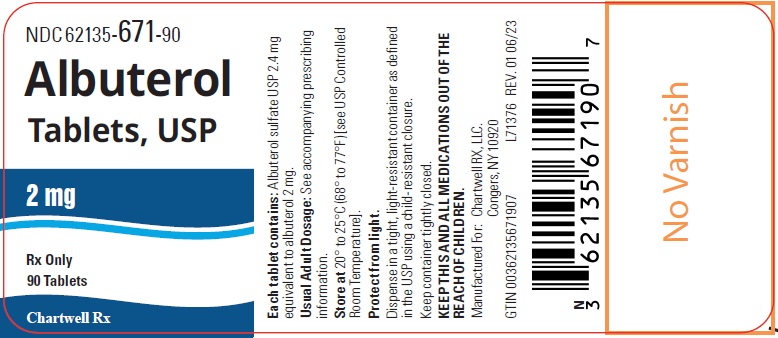
Albuterol Sulfate 2 mg Tablet, 90-count — NDC 62135-671-90 (Billing 62135-0671-90)
This is a package of 90 tablets of Albuterol Sulfate 2 mg Tablet from Chartwell RX, LLC, marketed since Dec 1989 and currently FDA-listed; retail pharmacies pay about $0.2879 per tablet (NADAC). It is this product's only package size.
Other active recalls for Albuterol Sulfate (different manufacturers) — 1 · tap to view
Identity & classification
Regulatory identifiers FDA, NLM and CMS codes for this package
Drug-database identifiers Medi-Span GPI and First Databank GCN / HICL / AHFS classification
- GSN (GCN sequence number): 005033
- GCN: 20100
- GPI-14 (Medi-Span): 44201010100305
- HICL (First Databank): 002073
- AHFS class code: 12:12.08.12
- RxCUI (RxNorm): 197316
Where does this data come from?
- FDA openFDA NDC Directory · synced Oct 1, 2026
- FDA label on DailyMed · label index refreshed Oct 1, 2026
- RxNorm (NLM RxNav) · catalog refreshed Oct 1, 2026
- Medi-Span GPI (licensed)
- First Databank (licensed) · refreshed Oct 1, 2026
RxNorm drug class
This medicine belongs to the beta2-Adrenergic Agonist class.
Where does this data come from?
- RxClass (NLM) · catalog refreshed Oct 1, 2026
Clinical
Albuterol is used to prevent and treat wheezing, difficulty breathing, chest tightness, and coughing caused by lung diseases such as asthma and chronic obstructive pulmonary disease (COPD; a group of diseases that affect the lungs and airways). Albuterol is in a class of medications called bronchodilators. It works by relaxing and opening the air passages to the lungs to make breathing easier.
Read the full MedlinePlus article ↗- Albuterol opens up your airways when the muscles around them tighten (bronchospasm), as in asthma. Inhalers and powders are also used before exercise to prevent exercise-induced br...
- It is breathed in through your mouth. The usual pattern for bronchospasm is a couple of puffs every 4 to 6 hours, and before exercise it is used 15 to 30 minutes ahead. Some inhale...
- The most common are throat irritation, cough, upper respiratory irritation, viral respiratory infections and muscle or bone aches. These are usually manageable. Call me or your doc...
- Get help right away if your breathing gets worse after a dose, or if you have hives, swelling of the face or throat, or chest pain or a racing heartbeat. Also call your doctor if y...
Patient education
Supplement & herbal interactions
Some supplements/herbs that may interact with Albuterol Sulfate — tap one for details:
Albuterol Sulfate may be associated with lower levels of 2 nutrients — worth a chat with your pharmacist, not a cause for alarm.
Where does this data come from?
- MedlinePlus (NLM) · refreshed Oct 1, 2026
- FDA label on DailyMed · label index refreshed Oct 1, 2026
Ask a licensed pharmacist directly — free, answered by our team.
Pricing
A drug doesn't have one price. Each row is a different public payment system, and none is what you'd pay at the counter — that depends on your insurance. The ⓘ on each row explains what it measures.
| Price system | Per ea | Per package |
|---|---|---|
| Retail pharmacies payNADAC · weekly | $0.288 | $25.91 / 90 tablets |
| Medicaid paysCMS SDUD · 12 mo | No recent Medicaid claims on file for this NDC — rare and low-volume NDCs are suppressed in the public data. | |
| Medicare drug plans payPart D · Q2 2026 | $0.6733 | $60.60 / 90 tablets |
Where does this data come from?
- CMS NADAC weekly file · file of Sep 30, 2026
- CMS ASP pricing files · refreshed Sep 20, 2026
- CMS Medicaid State Drug Utilization Data · refreshed Oct 3, 2026
- CMS Part D plan pricing files · refreshed Sep 24, 2026
- VA National Acquisition Center price file
Packaging — all sizes for this product
| Package NDC | Description | Marketing start | Marketing end | Status |
|---|---|---|---|---|
| 62135-0671-90 You're viewing this Main listing | 90 TABLET in 1 BOTTLE | 2023-06-14 | — | Active |
Therapeutic equivalents
| Product | Labeler | Pack | NADAC/unit | TE | Status | Price vs. this |
|---|---|---|---|---|---|---|
| albuterol sulfate 2 mg 53489-0176-01 | Sun | 100 tablets | $0.288 | AB | Availability likely | — |
| Albuterol Sulfate 2 mgthis 62135-0671-90 | Chartwell | 90 tablets | $0.288 | — | Availability likely | — |
| Albuterol 2 mg 64980-0442-01 | Rising | 100 tablets | $0.288 | AB | Availability likely | — |
| Albuterol Sulfate 2 mg 68084-0949-25 | American | 30 tablets | $0.288 | AB | Availability likely | — |
| Albuterol 2 mg 70710-1061-01 | Zydus | 100 tablets | $0.288 | AB | Availability likely | — |
| Albuterol 2 mg 75834-0273-01 | Nivagen | 100 tablets | $0.587 | — | Discontinued | +104% |
| albuterol sulfate 2 mg 51407-0367-01 | Golden | 100 tablets | — | AB | FDA listed | — |
| Albuterol 2 mg 59651-0333-01 | Aurobindo | 100 tablets | — | — | FDA listed | — |
| Albuterol 2 mg 69238-1344-05 | Amneal | 500 tablets | — | AB | FDA listed | — |
| Albuterol 2 mg 70771-1511-01 | Zydus | 100 tablets | — | AB | FDA listed | — |
| Albuterol 2 mg 71205-0898-00 | Proficient | 100 tablets | — | AB | FDA listed | — |
Where does this data come from?
- FDA openFDA NDC Directory · synced Oct 1, 2026
- FDA Orange Book · refreshed Sep 3, 2026
- CMS NADAC weekly file · file of Sep 30, 2026
Availability & generic status
This product is an FDA-approved generic. Other versions of the same drug are listed under Therapeutic equivalents, least expensive first.
Where does this data come from?
- FDA Orange Book · refreshed Sep 3, 2026
Inactive Ingredients / Excipients
Inactive ingredients, also called excipients, are components of the drug product other than the active ingredient. They may include fillers, dyes, coatings, preservatives, flavors, or other formulation ingredients.
💡 Tap an ingredient (hover on desktop) to see what it is and why it’s used.
-
UNII EWQ57Q8I5X
Lactose monohydrate is a natural sugar derived from milk. It serves as a filler and binder in tablets and capsules, helping create the proper size, texture, and consistency of the medicine.
-
UNII 70097M6I30
Magnesium stearate is a salt made from magnesium and stearic acid, a fatty substance. It's used in tablets and capsules as a lubricant and glidant to help ingredients flow smoothly during manufacturing and prevent sticking.
-
UNII O8232NY3SJ
A plant-based carbohydrate derived from corn kernels. It acts as a filler to add bulk, a binder to hold ingredients together, and a disintegrant to help the tablet break apart in your stomach for absorption.
3 inactive ingredients listed in the exact product block matched to this NDC.
Where does this data come from?
ingredient classCode="IACT" elements from the exact product block matched by this NDC. Label-section narrative from DailyMed / the openFDA label index is shown separately when available.- FDA label on DailyMed · label index refreshed Oct 1, 2026
- FDA openFDA NDC Directory · synced Oct 1, 2026
Inactive ingredient FAQ
Are inactive ingredients the same for every manufacturer?
Why might an inactive ingredient be missing?
Can inactive ingredients matter?
Manufacturer & labeler
Where does this data come from?
- FDA openFDA NDC Directory · synced Oct 1, 2026
- Drugs@FDA
Full prescribing information FDA SPL
🎯 Indications and Usage ▾
INDICATIONS AND USAGE Albuterol tablets are indicated for the relief of bronchospasm in adults and children 6 years of age and older with reversible obstructive airway disease.
⏱️ Dosage and Administration ▾
DOSAGE AND ADMINISTRATION The following dosages of albuterol tablets are expressed in terms of albuterol base. Usual Dosage Adults and Children Over 12 Years of Age The usual starting dosage for adults and children 12 years and older is 2 or 4 mg three or four times a day. Children 6 to 12 Years of Age The usual starting dosage for children 6 to 12 years of age is 2 mg three or four times a day.
Dosage Adjustment Adults and Children Over 12 Years of Age For adults and children 12 years and older, a dosage above 4 mg four times a day should be used only when the patient fails to respond. If a favorable response does not occur with the 4 mg initial dosage, it should be cautiously increased stepwise up to a maximum of 8 mg four times a day as tolerated. Children 6 to 12 Years of Age Who Fail to Respond to the Initial Starting Dosage of 2 mg Four Times a Day For children from 6 to 12 years of age who fail to respond to the initial starting dosage of 2 mg four times a day, the dosage may be cautiously increased stepwise, but not to exceed 24 mg/day (given in divided doses).
Elderly Patients and Those Sensitive to Beta-adrenergic Stimulators An initial dosage of 2 mg three or four times a day is recommended for elderly patients and for those with a history of unusual sensitivity to beta-adrenergic stimulators. If adequate bronchodilation is not obtained, dosage may be increased gradually to as much as 8 mg three or four times a day. The total daily dose should not exceed 32 mg in adults and children 12 years and older.
⛔ Contraindications ▾
CONTRAINDICATIONS Albuterol tablets are contraindicated in patients with a history of hypersensitivity to albuterol, or any of its components.
⚠️ Warnings ▾
WARNINGS Paradoxical Bronchospasm Albuterol tablets can produce paradoxical bronchospasm, which may be life threatening. If paradoxical bronchospasm occurs, albuterol should be discontinued immediately and alternative therapy instituted. Cardiovascular Effects Albuterol, like all other beta-adrenergic agonists, can produce a clinically significant cardiovascular effect in some patients as measured by pulse rate, blood pressure, and/or symptoms.
Although such effects are uncommon after administration of albuterol tablets at recommended doses, if they occur, the drug may need to be discontinued. In addition, beta-agonists have been reported to produce electrocardiogram (ECG) changes, such as flattening of the T wave, prolongation of the QTc interval, and ST segment depression. The clinical significance of these findings is unknown.
Therefore, albuterol, like all sympathomimetic amines, should be used with caution in patients with cardiovascular disorders, especially coronary insufficiency, cardiac arrhythmias, and hypertension. Deterioration of Asthma Asthma may deteriorate acutely over a period of hours or chronically over several days or longer. If the patient needs more doses of albuterol than usual, this may be a marker of destabilization of asthma and requires reevaluation of the patient and treatment regimen, giving special consideration to the possible need for anti-inflammatory treatment, e.g., corticosteroids.
Use of Anti-Inflammatory Agents The use of beta-adrenergic agonist bronchodilators alone may not be adequate to control asthma in many patients. Early consideration should be given to adding anti-inflammatory agents, e.g., corticosteroids. Immediate Hypersensitivity Reactions Immediate hypersensitivity reactions may occur after administration of albuterol, as demonstrated by rare cases of urticaria, angioedema, rash, bronchospasm, and oropharyngeal edema.
Albuterol, like other beta-adrenergic agonists, can produce a significant cardiovascular effect in some patients, as measured by pulse rate, blood pressure, symptoms, and/or electrocardiographic changes. Rarely, erythema multiforme and Stevens-Johnson syndrome have been associated with the administration of oral albuterol sulfate in children. To report SUSPECTED ADVERSE REACTIONS, contact Chartwell RX, LLC. at 1-845-232-1683 or FDA at 1-800-FDA-1088 or www.fda.gov/medwatch.
🤒 Adverse Reactions ▾
ADVERSE REACTIONS In clinical trials, the most frequent adverse reactions to albuterol tablets were: Percent Incidence of Adverse Reactions Reaction Percent Incidence Central nervous system Nervousness 20% Tremor 20% Headache 7% Sleeplessness 2% Weakness 2% Dizziness 2% Drowsiness <1% Restlessness <1% Irritability <1% Cardiovascular Tachycardia 5% Palpitations 5% Chest discomfort <1% Flushing <1% Musculoskeletal Muscle cramps 3% Gastrointestinal Nausea 2% Genitourinary Difficulty in micturition <1% Rare cases of urticaria, angioedema, rash, bronchospasm, and oropharyngeal edema have been reported after the use of albuterol.
In addition, albuterol, like other sympathomimetic agents, can cause adverse reactions such as hypertension, angina, vomiting, vertigo, central nervous system stimulation, unusual taste, and drying or irritation of the oropharynx. The reactions are generally transient in nature, and it is usually not necessary to discontinue treatment with albuterol tablets. In selected cases, however, dosage may be reduced temporarily; after the reaction has subsided, dosage should be increased in small increments to the optimal dosage.
🆘 Overdosage ▾
OVERDOSAGE The expected symptoms with overdosage are those of excessive beta-adrenergic stimulation and/or occurrence or exaggeration of any of the symptoms listed under ADVERSE REACTIONS, e.g., seizures, angina, hypertension or hypotension, tachycardia with rates up to 200 beats/min, arrhythmias, nervousness, headache, tremor, dry mouth, palpitation, nausea, dizziness, fatigue, malaise, and sleeplessness. Hypokalemia may also occur. As with all sympathomimetic medications, cardiac arrest and even death may be associated with abuse of albuterol tablets.
Treatment consists of discontinuation of albuterol together with appropriate symptomatic therapy. The judicious use of a cardioselective beta-receptor blocker may be considered, bearing in mind that such medication can produce bronchospasm. There is insufficient evidence to determine if dialysis is beneficial for overdosage of albuterol.
The oral median lethal dose of albuterol sulfate in mice is greater than 2000 mg/kg (approximately 250 times the maximum recommended daily oral dose for adults on a mg/m 2 basis, or, approximately 200 times the maximum recommended daily oral dose for children on a mg/m 2 basis). In mature rats, the subcutaneous (sc) median lethal dose of albuterol sulfate is approximately 450 mg/kg (approximately 110 times the maximum recommended daily oral dose for adults on a mg/m 2 basis, or, approximately 90 times the maximum recommended daily oral dose for children on a mg/m 2 basis).
In small young rats, the subcutaneous median lethal dose is approximately 2000 mg/kg (approximately 500 times the maximum recommended daily oral dose for adults on a mg/m 2 basis, or, approximately 400 times the maximum recommended daily oral dose for children on a mg/m 2 basis).
🧬 Clinical Pharmacology ▾
CLINICAL PHARMACOLOGY In vitro studies and in vivo pharmacologic studies have demonstrated that albuterol has a preferential effect on beta 2 -adrenergic receptors compared with isoproterenol. While it is recognized that beta 2 -adrenergic receptors are the predominant receptors in bronchial smooth muscle, data indicate that there is a population of beta 2 -receptors in the human heart existing in a concentration between 10% and 50%. The precise function of these receptors has not been established (see WARNINGS ).
The pharmacologic effects of beta-adrenergic agonist drugs, including albuterol, are at least in part attributable to stimulation through beta-adrenergic receptors of intracellular adenyl cyclase, the enzyme that catalyzes the conversion of adenosine triphosphate (ATP) to cyclic-3',5'-adenosine monophosphate (cyclic AMP). Increased cyclic AMP levels are associated with relaxation of bronchial smooth muscle and inhibition of release of mediators of immediate hypersensitivity from cells, especially from mast cells. Albuterol has been shown in most controlled clinical trials to have more effect on the respiratory tract, in the form of bronchial smooth muscle relaxation, than isoproterenol at comparable doses while producing fewer cardiovascular effects.
Albuterol is longer acting than isoproterenol in most patients by any route of administration because it is not a substrate for the cellular uptake processes for catecholamines nor for catechol- O -methyl transferase. Preclinical Intravenous studies in rats with albuterol sulfate have demonstrated that albuterol crosses the blood brain barrier and reaches brain concentrations amounting to approximately 5% of the plasma concentrations. In structures outside the brain barrier (pineal and pituitary glands), albuterol concentrations were found to be 100 times those in the whole brain.
Studies in laboratory animals (minipigs, rodents, and dogs) have demonstrated the occurrence of cardiac arrhythmias and sudden death (with histologic evidence of myocardial necrosis) when beta-agonists and methylxanthines are administered concurrently. The clinical significance of these findings is unknown. Pharmacokinetics Albuterol is rapidly absorbed after oral administration of one 4 mg albuterol tablet in normal volunteers.
Maximum plasma concentrations of about 18 ng/mL of albuterol are achieved within 2 hours, and the drug is eliminated with a half-life of about 5 hours. In other studies, the analysis of urine samples of patients given 8 mg of tritiated albuterol orally showed that 76% of the dose was excreted over 3 days, with the majority of the dose being excreted within the first 24 hours. Sixty percent of this radioactivity was shown to be the metabolite.
Feces collected over this period contained 4% of the administered dose. Clinical Trials In controlled clinical trials in patients with asthma, the onset of improvement in pulmonary function, as measured by maximum midexpiratory flow rate (MMEF), was within 30 minutes after a dose of albuterol, with peak improvement occurring between 2 and 3 hours. In controlled clinical trials in which measurements were conducted for 6 hours, clinically significant improvement (defined as maintaining a 15% or more increase in forced expiratory volume in 1 second [FEV 1 ] and a 20% or more increase in MMEF over baseline values) was observed in 60% of patients at 4 hours and in 40% at 6 hours.
In other single-dose, controlled clinical trials, clinically significant improvement was observed in at least 40% of the patients at 8 hours. No decrease in the effectiveness of albuterol was reported in patients who received long-term treatment with the drug in uncontrolled studies for periods up to 6 months.
📦 How Supplied / Storage and Handling ▾
HOW SUPPLIED Albuterol Tablets, USP are available containing albuterol sulfate, USP 2.4 mg equivalent to albuterol 2 mg or albuterol sulfate, USP 4.8 mg equivalent to albuterol 4 mg. The 2 mg tablets are white to off white round flat face beveled edge tablets, debossed with “CE” over “84” on one side and score on the other side. They are available as follows: Bottles of 90 tablets NDC 62135-671-90 The 4 mg tablets are white to off white round flat face beveled edge tablets, debossed with “CE” over “85” on one side and score on the other side.
They are available as follows: Bottles of 90 tablets NDC 62135-672-90 Store at 20° to 25°C (68° to 77°F). [See USP Controlled Room Temperature]. Protect from light. Dispense in a tight, light-resistant container as defined in the USP using a child-resistant closure.
Manufactured for: Chartwell RX, LLC. Congers, NY 10920 L71378 Revised: 06/2023
📋 Description ▾
DESCRIPTION Albuterol tablets contain albuterol sulfate USP, the racemic form of albuterol and a relatively selective beta 2 -adrenergic bronchodilator. Albuterol sulfate has the chemical name α 1 -[( tert -butylamino)methyl]-4-hydroxy- m -xylene- α,α-diol sulfate (2:1) (salt) and the following structural formula: Albuterol sulfate has a molecular weight of 576.7, and the molecular formula is (C 13 H 21 NO 3 ) 2 H 2 SO 4 . Albuterol sulfate, USP is a white or almost white crystalline powder, freely soluble in water, practically insoluble or very slightly soluble in Methylene chloride and alcohol, slightly soluble in Chloroform and Ether.
The World Health Organization recommended name for albuterol base is salbutamol. Each albuterol tablet for oral administration contains 2 mg or 4 mg of albuterol as 2.4 mg or 4.8 mg of albuterol sulfate USP, respectively. Each tablet also contains the following inactive ingredients: lactose monohydrate, pregelatinized starch, corn starch, and magnesium stearate. "Chemical Stucture"
⚠️ Precautions ▾
PRECAUTIONS General Albuterol, as with all sympathomimetic amines, should be used with caution in patients with cardiovascular disorders, especially coronary insufficiency, cardiac arrhythmias, and hypertension; in patients with convulsive disorders, hyperthyroidism, or diabetes mellitus; and in patients who are unusually responsive to sympathomimetic amines. Clinically significant changes in systolic and diastolic blood pressure have been seen in individual patients and could be expected to occur in some patients after use of any beta-adrenergic bronchodilator.
Large doses of intravenous albuterol have been reported to aggravate preexisting diabetes mellitus and ketoacidosis. As with other beta-agonists, albuterol may produce significant hypokalemia in some patients, possibly through intracellular shunting, which has the potential to produce adverse cardiovascular effects. The decrease is usually transient, not requiring supplementation.
Information for Patients The action of albuterol tablets may last up to 8 hours or longer. Albuterol tablets should not be taken more frequently than recommended. Do not increase the dose or frequency of albuterol tablets without consulting your physician.
If you find that treatment with albuterol tablets becomes less effective for symptomatic relief, your symptoms get worse, and/or you need to take the product more frequently than usual, you should seek medical attention immediately. While you are taking albuterol tablets, other asthma medications and inhaled drugs should be taken only as directed by your physician. Common adverse effects include palpitations, chest pain, rapid heart rate, and tremor or nervousness.
If you are pregnant or nursing, contact your physician about use of albuterol tablets. Effective and safe use of albuterol tablets includes an understanding of the way that it should be administered. Drug Interactions The concomitant use of albuterol and other oral sympathomimetic agents is not recommended since such combined use may lead to deleterious cardiovascular effects.
This recommendation does not preclude the judicious use of an aerosol bronchodilator of the adrenergic stimulant type in patients receiving albuterol. Such concomitant use, however, should be individualized and not given on a routine basis. If regular coadministration is required, then alternative therapy should be considered.
Monamine Oxidase Inhibitors or Tricyclic Antidepressants Albuterol should be administered with extreme caution to patients being treated with monoamine oxidase inhibitors or tricyclic antidepressants, or within 2 weeks of discontinuation of such agents, because the action of albuterol on the vascular system may be potentiated. Beta-Blockers Beta-adrenergic receptor blocking agents not only block the pulmonary effect of beta-agonists, such as albuterol, but may produce severe bronchospasm in asthmatic patients. Therefore, patients with asthma should not normally be treated with beta-blockers.
However, under certain circumstances, e.g., as prophylaxis after myocardial infarction, there may be no acceptable alternatives to the use of beta-adrenergic blocking agents in patients with asthma. In this setting, cardioselective beta-blockers could be considered, although they should be administered with caution. Diuretics The ECG changes and/or hypokalemia that may result from the administration of nonpotassium-sparing diuretics (such as loop or thiazide diuretics) can be acutely worsened by beta-agonists, especially when the recommended dose of the beta-agonist is exceeded.
Although the clinical significance of these effects is not known, caution is advised in the coadministration of beta-agonists with nonpotassium-sparing diuretics. Digoxin Mean decreases of 16% to 22% in serum digoxin levels were demonstrated after single-dose intravenous and oral administration of albuterol, respectively, to normal volunteers who had received digoxin for 10 days. The clinical significance of these findings… [Excerpted — this section continues on DailyMed.]
📄 Package Label / Principal Display Panel ▾
PRINICIPAL DISPLAY PANEL Albuterol Tablets, USP- 2mg- NDC 62135-671-90- 90's Bottle Label Albuterol Tablets, USP- 4mg- NDC 62135-672-90- 90's Bottle Label "Albuterol Tablets 2mg-Bottle Label" "Albuterol Tablets 4mg-Bottle Label"