
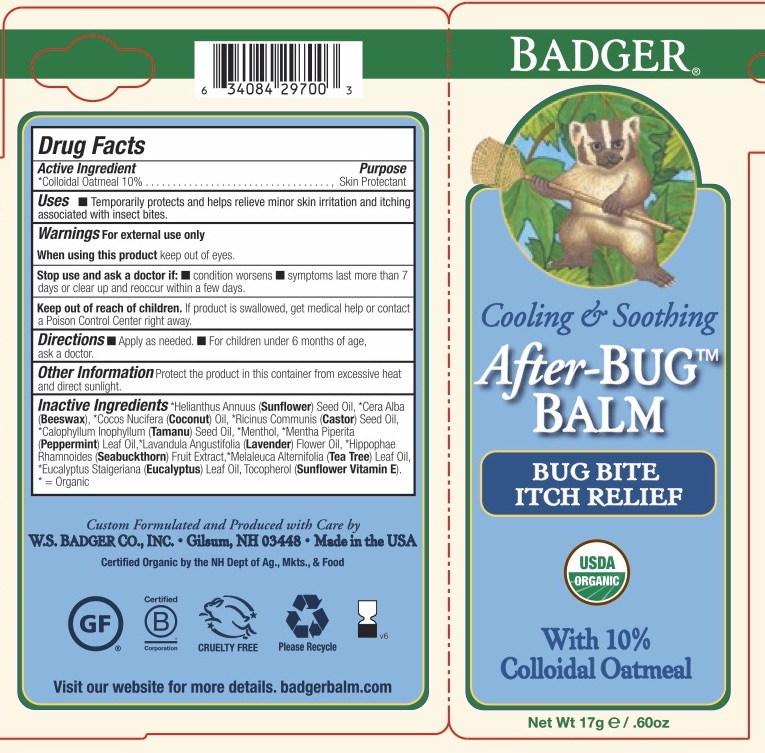
Badger After-BUG Balm Colloidal Oatmeal 10 g/100g Stick — NDC 62206-0297-0 (Billing 62206-0297-00)
This is a package of Badger After-BUG Balm Colloidal Oatmeal 10 g/100g Stick from W.S. Badger Company, Inc., marketed since May 2020 and currently FDA-listed. It is this product's only package size.
NDC database record
One package, one record: these facts belong to NDC 62206-0297-0 alone.
- Record
- FDA NDC Directory package listing · Human OTC drug
- Code segments
- 62206 labeler · 0297 product · 0 package
- Package marketed since
- May 21, 2020
- Sample package
- No — commercial package
- Listing certified through
- Dec 31, 2026
- Barcode (UPC)
- 0634084297003
- FDA record last changed
- Jul 24, 2026
Identity & classification
Regulatory identifiers FDA, NLM and CMS codes for this package
- RxCUI (RxNorm): 1745093
Where does this data come from?
- FDA openFDA NDC Directory · synced Oct 8, 2026
- FDA label on DailyMed · label index refreshed Oct 8, 2026
- RxNorm (NLM RxNav) · catalog refreshed Oct 1, 2026
- Medi-Span GPI (licensed)
- First Databank (licensed) · refreshed Oct 8, 2026
RxNorm drug class
This medicine belongs to the Non-Standardized Food Allergenic Extract class.
Where does this data come from?
- RxClass (NLM) · catalog refreshed Oct 1, 2026
Clinical
This is a topical stick product containing colloidal oatmeal, marketed as an over-the-counter monograph drug. Colloidal oatmeal is commonly used in skin-care products to help soothe minor skin irritation and itching. The product is applied directly to the skin and is intended for external use only.
Patient education
Supplement & herbal interactions
Where does this data come from?
- MedlinePlus (NLM) · refreshed Oct 8, 2026
- FDA label on DailyMed · label index refreshed Oct 8, 2026
Ask a licensed pharmacist directly — free, answered by our team.
Pricing
A drug doesn't have one price. Each row is a different public payment system, and none is what you'd pay at the counter — that depends on your insurance. The ⓘ on each row explains what it measures.
| Price system | Per each | Per package |
|---|---|---|
| Retail pharmacies payNADAC · weekly | Not in the retail survey — common for institutional, discontinued, or low-volume packs. | |
| Medicaid paysCMS SDUD · 12 mo | No recent Medicaid claims on file for this NDC — rare and low-volume NDCs are suppressed in the public data. | |
| Medicare drug plans payPart D · quarterly | No Part D plan price is available for this NDC in our data. | |
Where does this data come from?
- CMS NADAC weekly file
- CMS ASP pricing files · refreshed Sep 20, 2026
- CMS Medicaid State Drug Utilization Data · refreshed Oct 8, 2026
- CMS Part D plan pricing files · refreshed Sep 24, 2026
- VA National Acquisition Center price file
Packaging — all sizes for this product
| Package NDC | Description | Marketing start | Marketing end | Status |
|---|---|---|---|---|
| 62206-0297-00 You're viewing this Main listing | 1 TUBE in 1 CARTON / 17 g in 1 TUBE | 2020-05-21 | — | Active |
Therapeutic equivalents
| Product | Labeler | Pack | NADAC/unit | TE | Status | Price vs. this |
|---|---|---|---|---|---|---|
| Babyganics Soothing Itch 100 mg/g 59062-3301-01 | KAS | 1 applicator | — | — | FDA listed | — |
| Badger After-BUG Balm 10 g/100gthis 62206-0297-00 | W.S. | 1 tube | — | — | FDA listed | — |
Where does this data come from?
- FDA openFDA NDC Directory · synced Oct 8, 2026
- FDA Orange Book · refreshed Oct 3, 2026
- CMS NADAC weekly file
Availability & generic status
We did not find an FDA-approved generic match for this exact strength, form and route.
Where does this data come from?
- FDA Orange Book · refreshed Oct 3, 2026
Inactive Ingredients / Excipients
Inactive ingredients, also called excipients, are components of the drug product other than the active ingredient. They may include fillers, dyes, coatings, preservatives, flavors, or other formulation ingredients.
💡 Tap an ingredient (hover on desktop) to see what it is and why it’s used.
-
UNII D5340Y2I9G
Castor oil is a natural plant-based oil used in medicines as a lubricant, laxative agent, and solvent. It helps medicine ingredients dissolve or flow smoothly and can aid bowel movement in formulations designed for that purpose.
-
UNII Q9L0O73W7L
Coconut oil is a natural fat extracted from coconut fruit. It's used in medicines as a lubricant, emollient, or carrier to help dissolve or deliver active ingredients smoothly through the formulation.
-
UNII 2R04ONI662
Eucalyptus oil is a fragrant liquid extracted from eucalyptus tree leaves. It's used in medicines as a flavor, scent, or soothing agent in topical products and cough preparations.
-
UNII AVL0R9111T
A plant extract from sea buckthorn berries. It's used in medicines as a natural coloring agent and flavor ingredient to make the product more appealing and easier to take.
-
UNII ZBP1YXW0H8
A fragrant oil extracted from lavender plants, used as a flavoring and scent agent in medicines to improve taste and aroma.
-
UNII L7T10EIP3A
A cooling compound from mint plants used as a flavoring agent and to create a fresh sensation in medicines. It helps mask bitter tastes and improve how the product feels in the mouth.
-
UNII AV092KU4JH
A natural oil extracted from peppermint plants. It's used as a flavoring agent to mask bitter tastes and add a refreshing mint flavor to medicines, making them easier to take.
-
UNII 3W1JG795YI
Sunflower oil is a natural vegetable oil derived from sunflower seeds. It serves as a solvent, lubricant, and carrier in medicines, helping dissolve active ingredients and improve how the medication flows and absorbs in the body.
-
UNII JT3LVK84A1
A plant-based oil extracted from tamanu tree nuts, used as an emollient and skin-conditioning agent in topical formulations. It helps soften and moisturize the product's texture.
-
UNII VIF565UC2G
Tea tree oil is an essential oil extracted from the leaves of the Australian tea tree plant. In medicines, it typically serves as a flavoring agent, fragrance, or antimicrobial component in topical formulations.
-
UNII R0ZB2556P8
Tocopherol is a form of vitamin E derived from plant oils. It acts as an antioxidant in medicines to prevent oils and fats from breaking down and spoiling during storage.
-
UNII 2ZA36H0S2V
Beeswax is a natural wax produced by honeybees. In medicines, it works as a coating agent and thickener to control how fast the drug dissolves and improve the product's texture and appearance.
12 inactive ingredients listed in the exact product block matched to this NDC.
Label-section wording can be broader than the structured product block and may mention additional formulation ingredients.
Where does this data come from?
ingredient classCode="IACT" elements from the exact product block matched by this NDC. Label-section narrative from DailyMed / the openFDA label index is shown separately when available.- FDA label on DailyMed · label index refreshed Oct 8, 2026
- FDA openFDA NDC Directory · synced Oct 8, 2026
Inactive ingredient FAQ
Are inactive ingredients the same for every manufacturer?
Why might an inactive ingredient be missing?
Can inactive ingredients matter?
Manufacturer & labeler
More NDCs from W.S. Badger Company, Inc. labeler code 62206
- Badger BROAD SPECTRUM SPF 15 Lip Balm ZINC OXIDE 8 g/100g Stick NDC 62206-1542-2
- Badger Diaper ZINC OXIDE 10 g/100mL Cream NDC 62206-2850-1
- Badger Active SPF 30 Mineral Sunscreen ZINC OXIDE 18.75 g/100mL Cream NDC 62206-3031-1
- Badger SPF 30 Face Mineral Sunscreen ZINC OXIDE 18.75 g/100mL Cream NDC 62206-3063-1
- Badger SPF 30 Daily Sunscreen ZINC OXIDE 18.75 g/100mL Cream NDC 62206-3081-1
- Badger SPF 35 Kids Clear Face Stick ZINC OXIDE 22.5 g/100g Stick NDC 62206-3522-2
Where does this data come from?
- FDA openFDA NDC Directory · synced Oct 8, 2026
- Drugs@FDA
FDA label — Drug Facts FDA SPL
🎯 Indications and Usage ▾
Uses Uses • Temporarily protects and helps relieve minor skin irritation and itching associated with insect bites.
⏱️ Dosage and Administration ▾
Directions Directions Apply as needed . For children under 6 months of age, ask a doctor.
⚠️ Warnings ▾
Warnings For external use only When using this product When using this product keep out of eyes. Stop use and ask a doctor if Stop use and ask a doctor if condition worsens . symptoms last more than 7 days or clear up and reoccur within a few days. Keep out of reach of children. If swallowed, get medical help or contact a poison control center right away.
🧪 Active Ingredient ▾
Active Ingredient Colloidal Oatmeal 10%
🧪 Inactive Ingredients ▾
Ingredients = Certified Organic Helianthus Annuus ( Sunflower ) Oil, Cera Alba ( Beeswax ), 1 Cocos Nuclfera ( Coconut ) Oil, 1 Ricinus Communis ( Castor ) Seed Oil, 1 Calophyllum Inophyllum ( Tamanu ) Seed Oil, 1 Menthol, 'Mentha Piperita ( Peppermint ) Leaf Oil: 1 Lavandula Anguslifolia ( Lavender ) Flower Oil, 1 Hippophae Rhamnoides ( Sea buckthorn ) Fruit Extract, 1 Melaleuca Alternifolia (Tea Tree) Leaf Oil, 1 Eucalyptus Staigeriana ( Eucalyptus ) Leaf Oil, Tocopherol ( Sunflower Vitamin E ).
🎯 Purpose ▾
Purpose Skin Protectant
📄 When Using This Product ▾
When using this product When using this product keep out of eyes.
📄 Stop Use and Ask a Doctor If ▾
Stop use and ask a doctor if Stop use and ask a doctor if condition worsens . symptoms last more than 7 days or clear up and reoccur within a few days.
📄 Keep Out of Reach of Children ▾
Keep out of reach of children. If swallowed, get medical help or contact a poison control center right away.
📄 Questions or Comments ▾
Questions? (603) 357-2958
📄 Package Label / Principal Display Panel ▾
PRINCIPAL DISPLAY PANEL - 17g/.60 oz Label BADGER ® Cooling & Soothing After-BUG Balm BUG BITE ITCH RELIEF USDA Organic With 10% Colloidal Oatmeal 17g/.60 oz Carton Label
About this NDC listing & data coverage
What data is (and isn’t) available for this NDC — tap to expand
| NDC identity (package / product / labeler codes) | ✓ Available |
| Labeler | ✓ Available |
| Product & package description | ✓ Available |
| Marketing category & status | ✓ Available |
| Active ingredient / dosage form / route | ✓ Available |
| FDA label (SPL via DailyMed) | ✓ Available |
| Package photos | ✓ Available |
| Inactive ingredients (structured) | ✓ Available |
| NADAC pharmacy acquisition price (CMS) | — Not published for this NDC CMS publishes NADAC only for NDCs reported in its retail-pharmacy survey. |
| Orange Book / therapeutic-equivalence data | — Not published for this NDC Applies only to products approved under an NDA/ANDA; many listings are out of scope. |
| HCPCS J-code billing crosswalk | — Not published for this NDC Most self-administered / retail products have no J-code — that is normal. |
| Medicaid utilization (CMS SDUD) | — Not published for this NDC CMS reports utilization only for NDCs with Medicaid claims above its privacy threshold. |