
Ranitidine cool mint 150 mg Tablet, 24-count — NDC 62207-774-41 (Billing 62207-0774-41)
This is a package of 24 tablets of Ranitidine cool mint 150 mg Tablet from Granules India Ltd, marketed since Jun 2019 and currently FDA-listed.
NDC database record
One package, one record: these facts belong to NDC 62207-774-41 alone.
- Record
- FDA NDC Directory package listing · Human OTC drug
- Code segments
- 62207 labeler · 774 product · 41 package
- Package marketed since
- Jun 26, 2019
- Sample package
- No — commercial package
- Listing certified through
- Dec 31, 2026
- Barcode (UPC-A, from the NDC)
- 3 6220777441 3
- FDA record last changed
- Jul 24, 2026
Identity & classification
Regulatory identifiers FDA, NLM and CMS codes for this package
- RxCUI (RxNorm): 198191
Where does this data come from?
- FDA openFDA NDC Directory · synced Oct 8, 2026
- FDA label on DailyMed · label index refreshed Oct 6, 2026
- RxNorm (NLM RxNav) · catalog refreshed Oct 1, 2026
- Medi-Span GPI (licensed)
- First Databank (licensed) · refreshed Oct 8, 2026
RxNorm drug class
This medicine belongs to the Histamine-2 Receptor Antagonist class.
Where does this data come from?
- RxClass (NLM) · catalog refreshed Oct 1, 2026
Clinical
- Ranitidine is used to reduce the amount of acid your stomach makes. Prescription versions treat ulcers in the stomach or small intestine, acid reflux disease (GERD), and acid damag...
- No, food doesn't significantly affect how ranitidine works, so you can take it with or without a meal. For prescription forms, your doctor will tell you how often to take it — usua...
- How should I take ranitidine — does it matter if I eat first?
- Most people do fine on ranitidine. The most common complaints are headache, constipation, diarrhea, nausea, or an upset stomach. Dizziness or trouble sleeping can also happen. Thes...
Patient education
Supplement & herbal interactions
Some supplements/herbs that may interact with Ranitidine — tap one for details:
Ranitidine may be associated with lower levels of 6 nutrients — worth a chat with your pharmacist, not a cause for alarm.
Where does this data come from?
- MedlinePlus (NLM) · refreshed Oct 1, 2026
- FDA label on DailyMed · label index refreshed Oct 6, 2026
Ask a licensed pharmacist directly — free, answered by our team.
Pricing
A drug doesn't have one price. Each row is a different public payment system, and none is what you'd pay at the counter — that depends on your insurance. The ⓘ on each row explains what it measures.
| Price system | Per each | Per package |
|---|---|---|
| Retail pharmacies payNADAC · weekly | Not in the retail survey — common for institutional, discontinued, or low-volume packs. | |
| Medicaid paysCMS SDUD · 12 mo | No recent Medicaid claims on file for this NDC — rare and low-volume NDCs are suppressed in the public data. | |
| Medicare drug plans payPart D · quarterly | No Part D plan price is available for this NDC in our data. | |
Where does this data come from?
- CMS NADAC weekly file
- CMS ASP pricing files · refreshed Sep 20, 2026
- CMS Medicaid State Drug Utilization Data · refreshed Oct 8, 2026
- CMS Part D plan pricing files · refreshed Sep 24, 2026
- VA National Acquisition Center price file
Packaging — all sizes for this product
| Package NDC | Description | Marketing start | Marketing end | Status |
|---|---|---|---|---|
| 62207-0774-36 62207-774-36 Main listing | 5 BAG in 1 CARTON / 10000 TABLET in 1 BAG | 2019-06-26 | — | Active |
| 62207-0774-41 You're viewing this | 1 BOTTLE in 1 CARTON / 24 TABLET in 1 BOTTLE | 2019-06-26 | — | Active |
| 62207-0774-47 62207-774-47 | 1 BOTTLE in 1 CARTON / 500 TABLET in 1 BOTTLE | 2019-06-26 | — | Active |
| 62207-0774-58 62207-774-58 | 2 BLISTER PACK in 1 CARTON / 10 TABLET in 1 BLISTER PACK | 2019-06-26 | — | Active |
Pack size FAQ
What quantity is in this package?
How does this package differ from NDC 62207-0774-58?
What NDC number is used to bill for this package of Ranitidine cool mint 150 mg Tablet?
Therapeutic equivalents
| Product | Labeler | Pack | NADAC/unit | TE | Status | Price vs. this |
|---|---|---|---|---|---|---|
| Ranitidine 150 mg 62207-0773-36 | Granules | 50000 tablets | — | — | FDA listed | — |
| Ranitidine 150 mg 55111-0404-02 | Dr. | 200 tablets | — | — | FDA listed | — |
| Ranitidine 150 mg 53746-0253-01 | Amneal | 100 tablets | — | — | FDA listed | — |
| Ranitidine cool mint 150 mgthis 62207-0774-41 | Granules | 24 tablets | — | — | FDA listed | — |
| Ranitidine 150 mg 64980-0636-03 | Rising | 30 tablets | — | AB | FDA listed | — |
| Ranitidine 150 mg 71993-0314-30 | Atland | 30 tablets | — | AB | FDA listed | — |
Where does this data come from?
- FDA openFDA NDC Directory · synced Oct 8, 2026
- FDA Orange Book · refreshed Oct 3, 2026
- CMS NADAC weekly file
Availability & generic status
This product is an FDA-approved generic. Other versions of the same drug are listed under Therapeutic equivalents, least expensive first.
Where does this data come from?
- FDA Orange Book · refreshed Oct 3, 2026
What it looks like
Where does this data come from?
- FDA label on DailyMed · label index refreshed Oct 6, 2026
Inactive Ingredients / Excipients
Inactive ingredients, also called excipients, are components of the drug product other than the active ingredient. They may include fillers, dyes, coatings, preservatives, flavors, or other formulation ingredients.
🧪 Avoiding an ingredient? See Ranitidine inactive ingredients by manufacturer: every current product's list side by side, so you can ask your pharmacy for the version that does not list it.
💡 Tap an ingredient (hover on desktop) to see what it is and why it’s used.
-
UNII 5C5403N26O
Acacia is a natural gum derived from acacia tree sap. It serves as a binder, thickener, and emulsifier to help hold ingredients together, improve texture, and stabilize the medicine.
-
UNII OP1R32D61U
Microcrystalline cellulose is a purified form of cellulose, a natural fiber from plant sources. It acts as a binder and filler in tablets and capsules, helping hold ingredients together and give the medicine its shape and size.
-
UNII M28OL1HH48
Croscarmellose sodium is a plant-based substance derived from cellulose. It acts as a disintegrant, helping tablets and capsules break down quickly in the digestive system so the medicine can be absorbed.
-
UNII H3R47K3TBD
FD&C Blue No. 1 is a synthetic blue dye approved for use in foods and medicines. It serves as a colorant to give the medication its distinctive appearance and help with product identification.
-
UNII 70097M6I30
Magnesium stearate is a salt made from magnesium and stearic acid, a fatty substance. It's used in tablets and capsules as a lubricant and glidant to help ingredients flow smoothly during manufacturing and prevent sticking.
-
UNII L7T10EIP3A
A cooling compound from mint plants used as a flavoring agent and to create a fresh sensation in medicines. It helps mask bitter tastes and improve how the product feels in the mouth.
-
UNII 3WJQ0SDW1A
Polyethylene glycol is a synthetic liquid or solid polymer used in medicines as a solvent, lubricant, and humectant. It helps dissolve active ingredients, reduces friction during manufacturing, and retains moisture in the final product.
-
UNII 532B59J990
Polyvinyl alcohol is a synthetic polymer made from plant-derived materials. It's used as a binder to hold ingredients together, a film-former in coatings, and a thickener in liquid formulations.
-
UNII 7SEV7J4R1U
A powder made from a naturally occurring mineral. In medicines, talc works as a glidant and anti-caking agent, helping tablets and capsules flow smoothly during manufacturing and preventing clumping.
-
UNII 15FIX9V2JP
Titanium dioxide is a bright white mineral powder commonly used as a colorant and opacifying agent. It makes pills and tablets white or lighter in color and helps make coatings non-transparent.
10 inactive ingredients listed in the exact product block matched to this NDC.
Label-section wording can be broader than the structured product block and may mention additional formulation ingredients.
Where does this data come from?
ingredient classCode="IACT" elements from the exact product block matched by this NDC. Label-section narrative from DailyMed / the openFDA label index is shown separately when available.- FDA label on DailyMed · label index refreshed Oct 6, 2026
- FDA openFDA NDC Directory · synced Oct 8, 2026
Inactive ingredient FAQ
Are inactive ingredients the same for every manufacturer?
Why might an inactive ingredient be missing?
Can inactive ingredients matter?
Manufacturer & labeler
More NDCs from Granules India Ltd labeler code 62207
- Naproxen Sodium 220 mg Tablet, Film Coated NDC 62207-762-21
- Cetirizine hydrochloride 10 mg Tablet, Coated NDC 62207-764-49
- Fexofenadine Hydrochloride 60 mg Tablet NDC 62207-765-49
- Fexofenadine Hydrochloride 180 mg Tablet NDC 62207-766-35
- Methocarbamol 750 mg Tablet, Coated NDC 62207-770-41
- Ranitidine 150 mg Tablet NDC 62207-773-36
- Loratadine 10 mg Tablet NDC 62207-787-49
- Naproxen Sodium and Diphenhydramine HCl 220 mg; 25 mg Tablet, Film Coated NDC 62207-814-38
- Guaifenesin and Pseudoephedrine HCl 600 mg; 60 mg Tablet, Extended Release NDC 62207-827-72
- Guaifenesin and Pseudoephedrine HCl 1200 mg; 120 mg Tablet, Extended Release NDC 62207-828-71
- Guaifenesin 600 mg Tablet, Extended Release NDC 62207-839-72
- Guaifenesin 1200 mg Tablet, Extended Release NDC 62207-840-71
Where does this data come from?
- FDA openFDA NDC Directory · synced Oct 8, 2026
- Drugs@FDA
FDA label — Drug Facts FDA SPL
🎯 Indications and Usage ▾
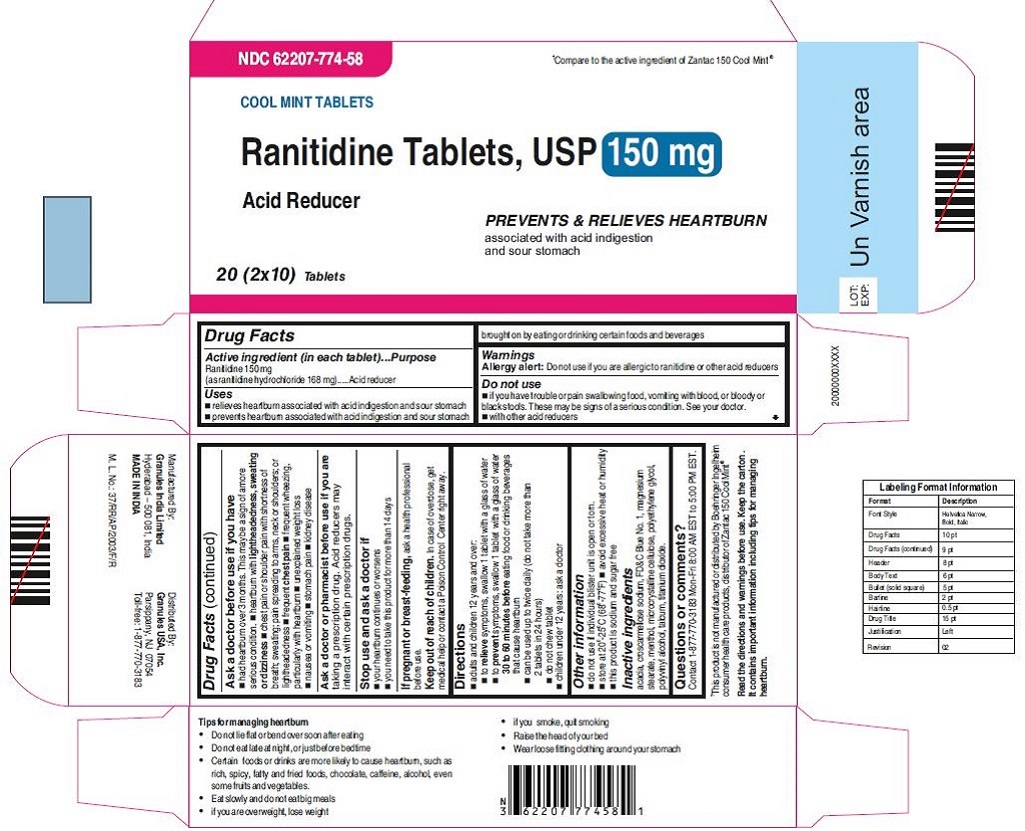
USE(S) ◾ relieves heartburn associated with acid indigestion and sour stomach ◾ prevents heartburn associated with acid indigestion and sour stomach brought on by eating or drinking certain foods and beverages
⏱️ Dosage and Administration ▾
DIRECTIONS ◾ adults and children 12 years and over: ◾ to relieve symptoms, swallow 1 tablet with a glass of water ◾ to prevent symptoms, swallow 1 tablet with a glass of water ◾ 30 to 60 minutes before eating food or drinking beverages that cause heartburn ◾ can be used up to twice daily (do not take more than 2 tablets in 24 hours) ◾ do not chew tablet (for cool mint tablets only) ◾ children under 12 years: ask a doctor
⚠️ Warnings ▾
WARNINGS Allergy alert: Do not use if you are allergic to ranitidine or other acid reducers
🧪 Active Ingredient ▾
ACTIVE INGREDIENT(S) Ranitidine 150 mg
🧪 Inactive Ingredients ▾
INACTIVE INGREDIENTS For 150 mg: croscarmellose sodium, iron oxide red, magnesium stearate, microcrystalline cellulose, polyethylene glycol, polyvinyl alcohol,talcum, titanium dioxide For 150 mg cool mint: acacia, croscarmellose sodium, FD&C Blue No. 1,magnesium stearate, menthol, microcrystalline cellulose,polyethylene glycol, polyvinyl alcohol, talcum, titanium dioxide
🎯 Purpose ▾
PURPOSE Acid reducer
📄 Do Not Use ▾
DO NOT USE ◾ if you have trouble or pain swallowing food, vomiting with blood, or bloody or black stools. These may be signs of a serious condition. See your doctor. ◾ with other acid reducers
📄 Ask a Doctor Before Use If ▾
ASK A DOCTOR BEFORE USE IF ◾ had heartburn over 3 months. This may be a sign of a more serious condition. ◾ heartburn with lightheadedness, sweating or dizziness ◾ chest pain or shoulder pain with shortness of breath; sweating; pain spreading to arms, neck or shoulders; or lightheadedness ◾ frequent chest pain ◾ frequent wheezing, particularly with heartburn ◾ unexplained weight loss ◾ nausea or vomiting ◾ stomach pain ◾ kidney disease Ask a doctor or pharmacist before use if you are taking a prescription drug. Acid reducers may interact with certain prescription drugs.
📄 Stop Use and Ask a Doctor If ▾
STOP USE AND ASK DOCTOR IF ◾ your heartburn continues or worsens ◾ you need to take this product for more than 14 days
🤰 If Pregnant or Breast-Feeding ▾
PREGNANCY/BREASTFEEDING ask a health professional before use.
📄 Keep Out of Reach of Children ▾
KEEP OUT OF REACH OF CHILDREN In case of overdose, get medical help or contact a Poison Control Center right away.
📄 Package Label / Principal Display Panel ▾
PRINCIPAL DISPLAY PANEL 62207-774-58-carton.jpg 62207-773-32 62207-773-36-carton 62207-773-41-carton 62207-773-47-carton 62207-773-58-carton 62207-774-32 62207-774-36 62207-774-41-carton 62207-774-47-carton 62207-774-58-carton ranitidine-150mg-label1 ranitidine-150mg-label2 ranitidine-label3 ranitidine-label4
About this NDC listing & data coverage
What data is (and isn’t) available for this NDC — tap to expand
| NDC identity (package / product / labeler codes) | ✓ Available |
| Labeler | ✓ Available |
| Product & package description | ✓ Available |
| Marketing category & status | ✓ Available |
| Active ingredient / dosage form / route | ✓ Available |
| FDA label (SPL via DailyMed) | ✓ Available |
| Package photos | ✓ Available |
| Inactive ingredients (structured) | ✓ Available |
| NADAC pharmacy acquisition price (CMS) | — Not published for this NDC CMS publishes NADAC only for NDCs reported in its retail-pharmacy survey. |
| Orange Book / therapeutic-equivalence data | — Not published for this NDC Applies only to products approved under an NDA/ANDA; many listings are out of scope. |
| HCPCS J-code billing crosswalk | — Not published for this NDC Most self-administered / retail products have no J-code — that is normal. |
| Medicaid utilization (CMS SDUD) | — Not published for this NDC CMS reports utilization only for NDCs with Medicaid claims above its privacy threshold. |