
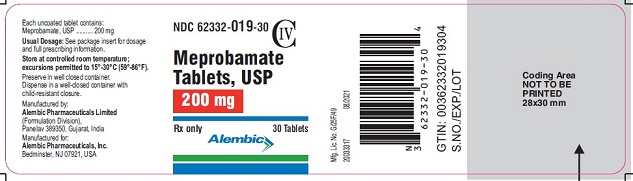
Meprobamate 200 mg Tablet, 30-count — NDC 62332-019-30 (Billing 62332-0019-30)
This is a package of 30 tablets of Meprobamate 200 mg Tablet from Alembic Pharmaceuticals Inc., marketed since Mar 2016 and currently FDA-listed.
Identity & classification
Regulatory identifiers FDA, NLM and CMS codes for this package
Drug-database identifiers Medi-Span GPI and First Databank GCN / HICL / AHFS classification
- GSN (GCN sequence number): 003713
- GCN: 13801
- GPI-14 (Medi-Span): 57200050000305
- HICL (First Databank): 001605
- AHFS class code: 28:24.12.00
- RxCUI (RxNorm): 197928
Where does this data come from?
- FDA openFDA NDC Directory · synced Oct 1, 2026
- FDA label on DailyMed · label index refreshed Oct 1, 2026
- RxNorm (NLM RxNav) · catalog refreshed Oct 1, 2026
- Medi-Span GPI (licensed)
- First Databank (licensed) · refreshed Oct 1, 2026
RxNorm drug class
This medicine belongs to the Carbamates class.
Where does this data come from?
- RxClass (NLM) · catalog refreshed Oct 1, 2026
Clinical
Meprobamate is used to treat anxiety disorders or for short-term relief of the symptoms of anxiety in adults and children 6 years of age and older. Meprobamate is in a class of medications called tranquilizers. It works by slowing activity in the brain to allow for relaxation.
Read the full MedlinePlus article ↗- It's used to manage anxiety disorders and for short-term relief of anxiety symptoms. It usually isn't needed for ordinary everyday stress. Your doctor should check from time to tim...
- Meprobamate tablets are taken by mouth, usually spread over the day in several doses. Follow the directions on your label and don't take extra. If you think it isn't working, talk...
- It's best not to. Alcohol and other sedating medicines add to meprobamate's effects, which can make you very sleepy or unsteady. Tell me or your doctor about everything else you ta...
- If you've taken it for a long time or in high amounts, don't stop abruptly. Withdrawal can cause anxiety, trouble sleeping, vomiting, tremors, confusion and, rarely, seizures. Your...
Patient education
Supplement & herbal interactions
Some supplements/herbs that may interact with Meprobamate — tap one for details:
Where does this data come from?
- MedlinePlus (NLM) · refreshed Oct 1, 2026
- FDA label on DailyMed · label index refreshed Oct 1, 2026
Ask a licensed pharmacist directly — free, answered by our team.
Pricing
A drug doesn't have one price. Each row is a different public payment system, and none is what you'd pay at the counter — that depends on your insurance. The ⓘ on each row explains what it measures.
| Price system | Per each | Per package |
|---|---|---|
| Retail pharmacies payNADAC · weekly | Not in the retail survey — common for institutional, discontinued, or low-volume packs. | |
| Medicaid paysCMS SDUD · 12 mo | No recent Medicaid claims on file for this NDC — rare and low-volume NDCs are suppressed in the public data. | |
| Medicare drug plans payPart D · Q2 2026 | $3.63 | $108.90 / 30 tablets |
Where does this data come from?
- CMS NADAC weekly file
- CMS ASP pricing files · refreshed Sep 20, 2026
- CMS Medicaid State Drug Utilization Data · refreshed Oct 2, 2026
- CMS Part D plan pricing files · refreshed Sep 24, 2026
- VA National Acquisition Center price file
Packaging — all sizes for this product
| Package NDC | Description | Per unit | Per pack | Marketing start | Marketing end | Status |
|---|---|---|---|---|---|---|
| 62332-0019-30 You're viewing this | 30 TABLET in 1 BOTTLE | — | — | 2016-03-31 | — | Active |
| 62332-0019-31 62332-019-31 Main listing | 100 TABLET in 1 BOTTLE | $4.54 / ea | $454.26 | 2016-03-31 | — | Active |
| 62332-0019-91 62332-019-91 | 1000 TABLET in 1 BOTTLE | — | — | 2016-03-31 | — | Active |
You're viewing the smallest of 3 pack sizes for this product.
Pack size FAQ
What quantity is in this package?
How does this package differ from NDC 62332-0019-31?
What NDC number is used to bill for this package of Meprobamate 200 mg Tablet?
Prices are the latest CMS NADAC pharmacy acquisition cost per NDC; per-pack figures are per-unit × pack quantity, shown only when the pack is denominated in the same measure NADAC prices.
Therapeutic equivalents
| Product | Labeler | Pack | NADAC/unit | TE | Status | Price vs. this |
|---|---|---|---|---|---|---|
| Meprobamate 200 mg 69097-0974-07 | Cipla | 100 tablets | $4.543 | AA | Availability likely | — |
| Meprobamate 200 mg 46708-0019-30 | Alembic | 30 tablets | — | AA | FDA listed | — |
| Meprobamate 200 mgthis 62332-0019-30 | Alembic | 30 tablets | — | AA | FDA listed | — |
Where does this data come from?
- FDA openFDA NDC Directory · synced Oct 1, 2026
- FDA Orange Book · refreshed Sep 3, 2026
- CMS NADAC weekly file
Availability & generic status
This product is an FDA-approved generic. Other versions of the same drug are listed under Therapeutic equivalents, least expensive first.
Where does this data come from?
- FDA Orange Book · refreshed Sep 3, 2026
What it looks like
Where does this data come from?
- FDA label on DailyMed · label index refreshed Oct 1, 2026
Inactive Ingredients / Excipients
Inactive ingredients, also called excipients, are components of the drug product other than the active ingredient. They may include fillers, dyes, coatings, preservatives, flavors, or other formulation ingredients.
💡 Tap an ingredient (hover on desktop) to see what it is and why it’s used.
-
UNII OP1R32D61U
Microcrystalline cellulose is a purified form of cellulose, a natural fiber from plant sources. It acts as a binder and filler in tablets and capsules, helping hold ingredients together and give the medicine its shape and size.
-
UNII 70097M6I30
Magnesium stearate is a salt made from magnesium and stearic acid, a fatty substance. It's used in tablets and capsules as a lubricant and glidant to help ingredients flow smoothly during manufacturing and prevent sticking.
-
UNII ETJ7Z6XBU4
Silicon dioxide is a naturally occurring mineral used as a glidant and anti-caking agent. It helps powder ingredients flow smoothly and prevents clumping during manufacturing and storage.
-
UNII 5856J3G2A2
A starch-based powder made from potatoes and processed with sodium. It acts as a disintegrant, helping the tablet or capsule break apart quickly in the stomach so the medicine can be absorbed.
-
UNII O8232NY3SJ
A plant-based carbohydrate derived from corn kernels. It acts as a filler to add bulk, a binder to hold ingredients together, and a disintegrant to help the tablet break apart in your stomach for absorption.
5 inactive ingredients listed in the exact product block matched to this NDC.
Where does this data come from?
ingredient classCode="IACT" elements from the exact product block matched by this NDC. Label-section narrative from DailyMed / the openFDA label index is shown separately when available.- FDA label on DailyMed · label index refreshed Oct 1, 2026
- FDA openFDA NDC Directory · synced Oct 1, 2026
Inactive ingredient FAQ
Are inactive ingredients the same for every manufacturer?
Why might an inactive ingredient be missing?
Can inactive ingredients matter?
Manufacturer & labeler
Where does this data come from?
- FDA openFDA NDC Directory · synced Oct 1, 2026
- Drugs@FDA
Full prescribing information FDA SPL
🎯 Indications and Usage ▾
INDICATIONS AND USAGE Meprobamate tablets are indicated for the management of anxiety disorders or for the short-term relief of the symptoms of anxiety. Anxiety or tension associated with the stress of everyday life usually do not require treatment with an anxiolytic. The effectiveness of meprobamate tablets in long-term use, that is, more than 4 months, has not been assessed by systematic clinical studies.
The physician should periodically reassess the usefulness of the drug for the individual patient.
⏱️ Dosage and Administration ▾
DOSAGE AND ADMINISTRATION Meprobamate Tablets USP: The usual adult daily dosage is 1200mg to 1600 mg, in three or four divided doses; a daily dosage above 2400 mg is not recommended. The usual daily dosage for children ages six to twelve years is 200 mg to 600 mg, in two or three divided doses. Not recommended for children under age 6 (see Usage in Children ).
⛔ Contraindications ▾
CONTRAINDICATIONS Acute intermittent porphyria as well as allergic or idiosyncratic reactions to meprobamate or related compounds such as carisoprodol, mebutamate, tybamate, or carbromal.
⚠️ Warnings ▾
WARNINGS Drug Dependence Physical dependence, psychological dependence, and abuse have occurred. When chronic intoxication from prolonged use occurs, it usually involves ingestion of greater than recommended doses and is manifested by ataxia, slurred speech, and vertigo. Therefore, careful supervision of dose and amounts prescribed is advised, as well as avoidance of prolonged administration, especially for alcoholics and other patients with a known propensity for taking excessive quantities of drugs.
Sudden withdrawal of the drug after prolonged and excessive use may precipitate recurrence of pre-existing symptoms such as anxiety, anorexia, insomnia, or withdrawal reactions such as vomiting, ataxia, tremors, muscle twitching, confusional states, hallucinosis, and rarely, convulsive seizures. Such seizures are more likely to occur in persons with central nervous system damage or pre-existent or latent convulsive disorders. Onset of withdrawal symptoms occurs usually within 12 to 48 hours after discontinuation of meprobamate; symptoms usually cease within the next 12 to 48 hours.
When excessive dosage has continued for weeks or months, dosage should be reduced gradually over a period of one or two weeks rather than abruptly stopped. Alternatively, a long-acting barbiturate may be substituted, then gradually withdrawn. Potentially Hazardous Tasks Patients should be warned that meprobamate may impair the mental and/or physical abilities required for performance of potentially hazardous tasks such as driving or operating machinery.
Additive Effects Since the effects of meprobamate and alcohol or meprobamate and other CNS depressants or psychotropic drugs may be additive, appropriate caution should be exercised with patients who take more than one of these agents simultaneously. Usage in Pregnancy and Lactation An increased risk of congenital malformations associated with the use of minor tranquilizers (meprobamate, chlordiazepoxide and diazepam) during the first trimester of pregnancy has been suggested in several studies. Because use of these drugs is rarely a matter of urgency, their use during this period should almost always be avoided.
The possibility that a woman of childbearing potential may be pregnant at the time of institution of therapy should be considered. Patients should be advised that if they become pregnant during therapy or intend to become pregnant they should communicate with their physician about the desirability of discontinuing the drug. Meprobamate passes the placental barrier.
It is present both in umbilical cord blood at or near maternal plasma levels and in breast milk of lactating mothers at concentrations two to four times that of maternal plasma. When use of meprobamate is contemplated in breastfeeding patients, the drug's higher concentration in breast milk as compared to maternal plasma should be considered. Usage in Children Meprobamate tablets should not be administered to children under age six, since there is a lack of documented evidence for safety and effectiveness in this age group.
🤒 Adverse Reactions ▾
ADVERSE REACTIONS Central Nervous System Drowsiness, ataxia, dizziness, slurred speech, headache, vertigo, weakness, paresthesias, impairment of visual accommodation, euphoria, overstimulation, paradoxical excitement, fast EEG activity. Gastrointestinal Nausea, vomiting, diarrhea. Cardiovascular Palpitation, tachycardia, various forms of arrhythmia, transient ECG changes, syncope; also hypotensive crisis (including one fatal case).
Allergic or Idiosyncratic Allergic or idiosyncratic reactions are usually seen within the period of the first to fourth dose in patients having had no previous contact with the drug. Milder reactions are characterized by an itchy, urticarial, or erythematous maculopapular rash which may be generalized or confined to the groin. Other reactions have included leukopenia, acute nonthrombocytopenic purpura, petechiae, ecchymoses, eosinophilia, peripheral edema, adenopathy, fever, fixed drug eruption with cross reaction to carisoprodol, and cross sensitivity between meprobamate/mebutamate and meprobamate/carbromal.
More severe hypersensitivity reactions, rarely reported, include hyperpyrexia, chills, angioneurotic edema, bronchospasm, oliguria and anuria. Also, anaphylaxis, erythema multiforme, exfoliative dermatitis, stomatitis, proctitis, Stevens-Johnson syndrome and bullous dermatitis, including one fatal case of the latter following administration of meprobamate in combination with prednisolone. In case of allergic or idiosyncratic reactions to meprobamate, discontinue the drug and initiate appropriate symptomatic therapy, which may include epinephrine, antihistamines, and in severe cases, corticosteroids.
In evaluating possible allergic reactions, also consider allergy to excipients. Hematologic (See also Allergic or Idiosyncratic . ) Agranulocytosis and aplastic anemia have been reported. These cases rarely were fatal.
Rare cases of thrombocytopenic purpura have been reported. Other Exacerbation of porphyric symptoms.
🧓 Geriatric Use ▾
Geriatric Use Clinical studies of meprobamate tablets did not include sufficient numbers of subjects aged 65 and over to determine whether they respond differently from younger subjects. Other reported clinical experience has not identified differences in responses between the elderly and younger patients. In general, dose selection for an elderly patient should be cautious, usually starting at the low end of the dosing range, reflecting the greater frequency of decreased hepatic, renal, or cardiac function, and of concomitant disease or other drug therapy.
🆘 Overdosage ▾
OVERDOSAGE Suicidal attempts with meprobamate have resulted in drowsiness, lethargy, stupor, ataxia, coma, shock, vasomotor, and respiratory collapse. Some suicidal attempts have been fatal. The following data on meprobamate tablets have been reported in the literature and from other sources.
These data are not expected to correlate with each case (considering factors such as individual susceptibility and length of time from ingestion to treatment), but represent the usual ranges reported. Acute simple overdose (meprobamate alone): Death has been reported with ingestion of as little as 12 g meprobamate and survival with as much as 40 g. Blood Levels 0.5-2 mg% represents the usual blood level range of meprobamate after therapeutic doses.
The level may occasionally be as high as 3 mg%. 3-10 mg% usually corresponds to findings of mild to moderate symptoms of overdosage, such as stupor or light coma. 10-20 mg% usually corresponds to deeper coma, requiring more intensive treatment.
Some fatalities occur. At levels greater than 20 mg%, more fatalities than survivals can be expected. Acute combined overdose (meprobamate with alcohol or other CNS depressants or psychotropic drugs): Since effects can be additive, a history of ingestion of a low dose of meprobamate plus any of these compounds (or of a relative low blood or tissue level) cannot be used as a prognostic indicator.
In cases where excessive doses have been taken, sleep ensues rapidly and blood pressure, pulse, and respiratory rates are reduced to basal levels. Any drug remaining in the stomach should be removed and symptomatic therapy given. Should respiration or blood pressure become compromised, respiratory assistance, central nervous system stimulants, and pressor agents should be administered cautiously as indicated.
Meprobamate is metabolized in the liver and excreted by the kidney. Diuresis, osmotic (mannitol) diuresis, peritoneal dialysis, and hemodialysis have been used successfully. Careful monitoring of urinary output is necessary and caution should be taken to avoid overhydration.
Relapse and death, after initial recovery, have been attributed to incomplete gastric emptying and delayed absorption. Meprobamate can be measured in biological fluids by two methods: colorimetric (Hoffman, A.J. and Ludwig, B.J.: J Amer Pharm Assn 48: 740, 1959) and gas chromatographic (Douglas, J.F. et al: Anal Chem 39: 956, 1967).
🧬 Clinical Pharmacology ▾
CLINICAL PHARMACOLOGY Meprobamate is a carbamate derivative which has been shown in animal studies to have effects at multiple sites in the central nervous system including the thalamus and limbic system.
📦 How Supplied / Storage and Handling ▾
HOW SUPPLIED Meprobamate Tablets USP 200 mg are white to off white, round, biconvex, uncoated tablets debossed with "L125" on one side and break line on other side. NDC 62332-019-30 Bottle of 30 NDC 62332-019-31 Bottle of 100 NDC 62332-019-91 Bottle of 1000 Meprobamate Tablets USP 400 mg are white to off white, round, biconvex, uncoated tablets debossed with "L105" on one side and break line on other side. NDC 62332-020-30 Bottle of 30 NDC 62332-020-31 Bottle of 100 NDC 62332-020-91 Bottle of 1000 Dispense in well-closed container with child-resistant closure.
Store at controlled room temperature, excursions permitted to 15°C-30°C (59°F-86°F). Preserve in well closed container. Call your doctor for medical advice about side effects.
You may report side effects to Alembic Pharmaceuticals Limited at 1-866 210 9797 or FDA at 1-800-FDA-1088. Manufactured by: Alembic Pharmaceuticals Limited (Formulation Division), Panelav 389350, Gujarat, India Manufactured for: Alembic Pharmaceuticals, Inc. Bedminster, NJ 07921, USA Revised: 09/2021
📋 Description ▾
DESCRIPTION Meprobamate is a white powder with a characteristic odor and a bitter taste. It is slightly soluble in water, freely soluble in acetone and alcohol, and sparingly soluble in ether. The structural formula of meprobamate is: C 9 H 18 N 2 O 4 M.W.
218.25 Meprobamate Tablets USP 200 mg and 400 mg for oral administration contain the following inactive ingredients: colloidal silicon dioxide, magnesium stearate, microcrystalline cellulose, sodium starch glycolate and pregelatinised starch. Structure
⚠️ Precautions ▾
PRECAUTIONS The lowest effective dose should be administered, particularly to elderly and/or debilitated patients, in order to preclude oversedation. The possibility of suicide attempts should be considered and the least amount of drug feasible should be dispensed at any one time. Meprobamate is metabolized in the liver and excreted by the kidney; to avoid its excess accumulation, caution should be exercised in administration to patients with compromised liver or kidney function.
Meprobamate occasionally may precipitate seizures in epileptic patients. Geriatric Use Clinical studies of meprobamate tablets did not include sufficient numbers of subjects aged 65 and over to determine whether they respond differently from younger subjects. Other reported clinical experience has not identified differences in responses between the elderly and younger patients.
In general, dose selection for an elderly patient should be cautious, usually starting at the low end of the dosing range, reflecting the greater frequency of decreased hepatic, renal, or cardiac function, and of concomitant disease or other drug therapy.
📄 Package Label / Principal Display Panel ▾
PACKAGE LABEL.PRINCIPAL DISPLAY PANEL - 200 mg NDC 62332-019-30 Meprobamate Tablets, USP 200 mg Rx only 30 Tablets Alembic 30tablets
PACKAGE LABEL.PRINCIPAL DISPLAY PANEL - 400 mg NDC 62332-020-30 Meprobamate Tablets, USP 400 mg Rx only 30 Tablets Alembic 30tablets
Medicare Part D spend CMS · PART D · 2026 (Q1)
Reported adverse events (FAERS)
Top reported reactions
Age at onset
Reporter sex
Serious outcomes
Where does this data come from?
About this NDC listing & data coverage
What data is (and isn’t) available for this NDC — tap to expand
| NDC identity (package / product / labeler codes) | ✓ Available |
| Labeler | ✓ Available |
| Product & package description | ✓ Available |
| Marketing category & status | ✓ Available |
| Active ingredient / dosage form / route | ✓ Available |
| FDA label (SPL via DailyMed) | ✓ Available |
| Package photos | ✓ Available |
| Inactive ingredients (structured) | ✓ Available |
| NADAC pharmacy acquisition price (CMS) | — Not published for this NDC CMS publishes NADAC only for NDCs reported in its retail-pharmacy survey. |
| Orange Book / therapeutic-equivalence data | ✓ Available |
| HCPCS J-code billing crosswalk | — Not published for this NDC Most self-administered / retail products have no J-code — that is normal. |
| Medicaid utilization (CMS SDUD) | — Not published for this NDC CMS reports utilization only for NDCs with Medicaid claims above its privacy threshold. |