
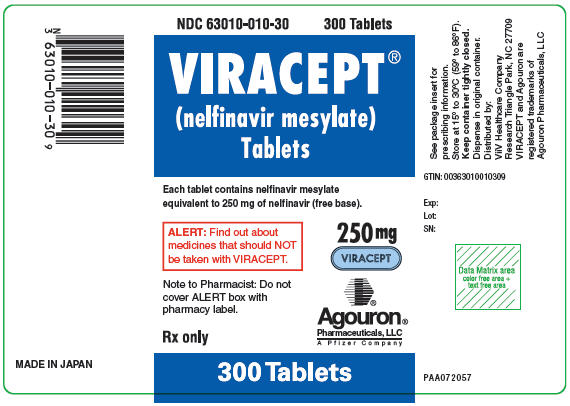
Viracept nelfinavir mesylate 250 mg Tablet, Film Coated, 300-count — NDC 63010-010-30 (Billing 63010-0010-30)
This is a package of 300 tablets of Viracept nelfinavir mesylate 250 mg Tablet, Film Coated from AGOURON, marketed since Mar 1997 and currently FDA-listed. It is this product's only package size.
NDC database record
One package, one record: these facts belong to NDC 63010-010-30 alone.
- Record
- FDA NDC Directory package listing · Human prescription drug
- Code segments
- 63010 labeler · 010 product · 30 package
- Package marketed since
- Mar 14, 1997
- Sample package
- No — commercial package
- Listing certified through
- Dec 31, 2026
- Billing quantity
- 300 EA per package
- Barcode (UPC)
- 0363010010309
- FDA record last changed
- Jul 24, 2026
Identity & classification
Regulatory identifiers FDA, NLM and CMS codes for this package
Drug-database identifiers Medi-Span GPI and First Databank GCN / HICL / AHFS classification
- GSN (GCN sequence number): 030366
- GCN: 40312
- GPI-14 (Medi-Span): 12104545200320
- HICL (First Databank): 010858
- AHFS class code: 08:18.08.08
- RxCUI (RxNorm): 212118
Where does this data come from?
- FDA openFDA NDC Directory · synced Oct 8, 2026
- FDA label on DailyMed · label index refreshed Oct 8, 2026
- RxNorm (NLM RxNav) · catalog refreshed Oct 1, 2026
- Medi-Span GPI (licensed)
- First Databank (licensed) · refreshed Oct 8, 2026
RxNorm drug class
This medicine belongs to the Protease Inhibitor class.
Where does this data come from?
- RxClass (NLM) · catalog refreshed Oct 1, 2026
Clinical
- Viracept (nelfinavir) is used to treat HIV-1 infection. It belongs to a class called protease inhibitors, which work by blocking an enzyme HIV needs to replicate. It's always used...
- Yes, every time. Food — especially a meal with some calories and fat — dramatically increases how much nelfinavir your body absorbs. Taking it on an empty stomach means much less m...
- Do I really need to take it with food every time?
- Diarrhea is by far the most common side effect — usually mild to moderate and manageable. Nausea, gas, and rash also occur. These are worth mentioning at your next appointment but...
Patient education
Supplement & herbal interactions
Some supplements/herbs that may interact with Nelfinavir Mesylate — tap one for details:
Where does this data come from?
- MedlinePlus (NLM) · refreshed Oct 8, 2026
- FDA label on DailyMed · label index refreshed Oct 8, 2026
Ask a licensed pharmacist directly — free, answered by our team.
Pricing
A drug doesn't have one price. Each row is a different public payment system, and none is what you'd pay at the counter — that depends on your insurance. The ⓘ on each row explains what it measures.
| Price system | Per each | Per package |
|---|---|---|
| Retail pharmacies payNADAC · weekly | Not in the retail survey — common for institutional, discontinued, or low-volume packs. | |
| Medicaid paysCMS SDUD · 12 mo | No recent Medicaid claims on file for this NDC — rare and low-volume NDCs are suppressed in the public data. | |
| Medicare drug plans payPart D · Q2 2026 | $4.10 | $1,230.24 / 300 tablets |
Where does this data come from?
- CMS NADAC weekly file
- CMS ASP pricing files · refreshed Sep 20, 2026
- CMS Medicaid State Drug Utilization Data · refreshed Oct 8, 2026
- CMS Part D plan pricing files · refreshed Sep 24, 2026
- VA National Acquisition Center price file
Packaging — all sizes for this product
| Package NDC | Description | Marketing start | Marketing end | Status |
|---|---|---|---|---|
| 63010-0010-30 You're viewing this Main listing | 300 TABLET, FILM COATED in 1 BOTTLE | 1997-03-14 | — | Active |
Therapeutic equivalents
| Product | Labeler | Pack | NADAC/unit | TE | Status | Price vs. this |
|---|---|---|---|---|---|---|
| Viracept 250 mgthis 63010-0010-30 | AGOURON | 300 tablets | — | — | FDA listed | — |
Where does this data come from?
- FDA openFDA NDC Directory · synced Oct 8, 2026
- FDA Orange Book · refreshed Oct 3, 2026
- CMS NADAC weekly file
Availability & generic status
We did not find an FDA-approved generic match for this exact strength, form and route.
Where does this data come from?
- FDA Orange Book · refreshed Oct 3, 2026
Inactive Ingredients / Excipients
Inactive ingredients, also called excipients, are components of the drug product other than the active ingredient. They may include fillers, dyes, coatings, preservatives, flavors, or other formulation ingredients.
🧪 Avoiding an ingredient? See Nelfinavir inactive ingredients by manufacturer: every current product's list side by side, so you can ask your pharmacy for the version that does not list it.
💡 Tap an ingredient (hover on desktop) to see what it is and why it’s used.
-
UNII S4255P4G5M
Calcium silicate is a white powder made from calcium and silicon compounds. It acts as an anti-caking agent and flow aid, helping powder ingredients move smoothly during tablet or capsule manufacturing.
-
UNII 68401960MK
Crospovidone is a synthetic polymer made from polyvinylpyrrolidone. It acts as a disintegrant, helping tablets break apart quickly in the stomach so the medicine dissolves and absorbs into the body.
-
UNII L06K8R7DQK
A synthetic blue dye approved by the FDA for use in medications and foods. It serves as a colorant to make pills and liquids visually distinct and easier to identify.
-
UNII 3NXW29V3WO
Hypromellose is a plant-based thickener made from cellulose. It's used in medicines as a binder to hold ingredients together, a coating for tablets, and a thickener for liquids.
-
UNII 70097M6I30
Magnesium stearate is a salt made from magnesium and stearic acid, a fatty substance. It's used in tablets and capsules as a lubricant and glidant to help ingredients flow smoothly during manufacturing and prevent sticking.
-
UNII XHX3C3X673
Triacetin is a clear, oily liquid made from glycerin and acetic acid. It works as a plasticizer and solvent in medicines, helping soften coatings and improve how liquids mix together in formulations.
6 inactive ingredients listed in the exact product block matched to this NDC.
Where does this data come from?
ingredient classCode="IACT" elements from the exact product block matched by this NDC. Label-section narrative from DailyMed / the openFDA label index is shown separately when available.- FDA label on DailyMed · label index refreshed Oct 8, 2026
- FDA openFDA NDC Directory · synced Oct 8, 2026
Inactive ingredient FAQ
Are inactive ingredients the same for every manufacturer?
Why might an inactive ingredient be missing?
Can inactive ingredients matter?
Manufacturer & labeler
More NDCs from AGOURON labeler code 63010
Where does this data come from?
- FDA openFDA NDC Directory · synced Oct 8, 2026
- Drugs@FDA
Full prescribing information FDA SPL
🎯 Indications and Usage ▾
1 INDICATIONS AND USAGE VIRACEPT in combination with other antiretroviral agents is indicated for the treatment of HIV-1 infection. VIRACEPT is a protease inhibitor indicated for the treatment of HIV-1 infection in combination with other antiretroviral agents. ( 1 )
⏱️ Dosage and Administration ▾
2 DOSAGE AND ADMINISTRATION • See full prescribing information for administration instructions ( 2 ) • Adults and adolescents 13 years and older (tablets): 1250 mg twice daily or 750 mg three times daily with a meal ( 2.1 ) • Children 2 to less than 13 years (oral powder or 250 mg tablets): 45 to 55 mg/kg twice daily or 25 to 35 mg/kg three times daily with a meal. Refer to Tables 1 and 2 of the full prescribing information for specific dosing guidelines based on age and body weight ( 2.2 )
2.1Adults and Adolescents (13 years and older) The recommended dose is 1250 mg (five 250 mg tablets or two 625 mg tablets) twice daily or 750 mg (three 250 mg tablets) three times daily. VIRACEPT should be taken with a meal. Patients unable to swallow the 250 or 625 mg tablets may dissolve the tablets in a small amount of water [see Dosage and Administration (2.3) ] .
2.2Pediatric Patients (2 to less than 13 years) In children 2 years of age and older, the recommended oral dose of VIRACEPT Oral Powder or 250 mg tablets is 45 to 55 mg/kg twice daily or 25 to 35 mg/kg three times daily. All doses should be taken with a meal . Doses higher than the adult maximum dose of 2500 mg per day have not been studied in children.
For children unable to swallow tablets, VIRACEPT 250 mg tablet(s) may be dissolved in a small amount of water or, VIRACEPT Oral Powder may be administered [see Dosage and Administration (2.3) ] . The healthcare provider should assess appropriate formulation and dosage for each patient. Tables 1 and 2 provide dosing guidelines for VIRACEPT tablets and powder based on age and body weight.
Table 1: Dosing Table for Children 2 to less than 13 years of age (tablets) Body weight Twice daily (BID) 45 – 55 mg/kg ≥2 years Three times daily (TID) 25 – 35 mg/kg ≥2 years Number of tablets (250 mg) Number of tablets (250 mg) Kg 10 – 12 2 1 13 – 18 3 2 19 – 20 4 2 ≥21 4 – 5 For BID dosing, the maximum dose per day is 5 tablets BID 3 For TID dosing, the maximum dose per day is 3 tablets TID Table 2: Dosing Table for Children 2 to less than 13 years of age (powder) Body weight Twice daily (BID) 45 – 55 mg/kg Three times daily (TID) 25 – 35 mg/kg Kg Scoops of powder (50 mg/1 g) Teaspoons If a teaspoon is used to measure VIRACEPT oral powder, 1 level teaspoon contains 200 mg of VIRACEPT (4 level scoops equals 1 level teaspoon) of powder Scoops of powder (50 mg/1 g) Teaspoons of powder 9.0 to <10.5 10 2½ 6 1½ 10.5 to <12 11 2¾ 7 1¾ 12 to <14 13 3¼ 8 2 14 to <16 15 3¾ 9 2¼ 16 to <18 Not recommended Use VIRACEPT 250 mg tablet Not recommended 10 2½ 18 to <23 Not recommended Not recommended 12 3 ≥23 Not recommended Not recommended 15 3¾
2.3Method of Administration For Patients Unable to Swallow Viracept Tablets • Place VIRACEPT tablet(s) in small amount of water. • Once dissolved, mix the cloudy liquid well, and consume it immediately. • The glass should be rinsed with water and the rinse swallowed to ensure the entire dose is consumed. Viracept Oral Powder • Mix VIRACEPT Oral Powder with a small amount of water, milk, formula, soy formula, soy milk, or dietary supplements • Once mixed, the entire contents must be consumed in order to obtain the full dose. • If the mixture is not consumed immediately, it must be stored under refrigeration, but storage must not exceed 6 hours. • Acidic food or juice (e.g., orange juice, apple juice, or apple sauce) are not recommended for mixing VIRACEPT Oral Powder because the combination may result in a bitter taste. • VIRACEPT Oral Powder should not be reconstituted with water in its original container.
2.4Hepatic Impairment VIRACEPT can be used in patients with mild hepatic impairment without any dose adjustment. VIRACEPT should not be used in patients with either moderate or severe hepatic impairment [see Warnings and Precautions (5.2) , Use in Specific Populations (8.6) , and Clinical Pharmacology (12.3) ] .
💊 Dosage Forms and Strengths ▾
3 DOSAGE FORMS AND STRENGTHS VIRACEPT 250 mg Tablet: Light-blue, capsule-shaped tablets with a clear film coating engraved with "VIRACEPT" on one side and "250 mg" on the other. VIRACEPT 625 mg Tablet: White oval tablet with a clear film coating engraved with "V" on one side and "625" on the other. VIRACEPT Oral Powder: Off-white powder containing 50 mg (as nelfinavir-free base) in each level scoopful (1 gram). • Tablet: 250 mg, 625 mg nelfinavir free base ( 3 ) • Oral Powder: 50 mg/g nelfinavir free base ( 3 )
⛔ Contraindications ▾
4 CONTRAINDICATIONS Coadministration of VIRACEPT is contraindicated with drugs that are highly dependent on CYP3A for clearance and for which elevated plasma concentrations are associated with serious and/or life-threatening events. These drugs and other contraindicated drugs (which may lead to reduced efficacy of nelfinavir) are listed in Table 3 [also see Drug Interactions (7) , Table 6 ] . Table 3: Drugs That Are Contraindicated With VIRACEPT Drug Class Drugs Within Class That Are Contraindicated With VIRACEPT Clinical Comment Alpha 1-adrenoreceptor antagonist Alfuzosin Potentially increased alfuzosin concentrations can result in hypotension.
Antiarrhythmics Amiodarone, quinidine Potential for serious and/or life-threatening cardiac arrhythmia. Antimycobacterial Agents Rifampin Plasma concentrations of nelfinavir can be reduced by concomitant use of rifampin. This may lead to loss of therapeutic effect and possible development of resistance to VIRACEPT or other coadministered antiretroviral agents.
Antipsychotics Lurasidone Pimozide Potential for serious and/or life-threatening reactions. Potential for serious and/or life threatening reactions such as cardiac arrhythmias. Ergot Derivatives Dihydroergotamine, ergotamine, methylergonovine Potential for serious and/or life threatening reactions such as ergot toxicity characterized by peripheral vasospasm and ischemia of the extremities and other tissues.
GI Motility Agent Cisapride Potential for serious and/or life threatening reactions such as cardiac arrhythmias. Herbal products St. John's wort ( Hypericum perforatum ) Plasma concentrations of nelfinavir can be reduced by concomitant use of the herbal preparation St.
John's wort. This may lead to loss of therapeutic effect and possible development of resistance to VIRACEPT or other coadministered antiretroviral agents. HMG-CoA Reductase Inhibitors Lovastatin, Simvastatin Potential for serious reactions such as myopathy including rhabdomyolysis.
PDE5 Inhibitors Sildenafil (Revatio ® ) [for treatment of pulmonary arterial hypertension] See Drug Interactions , Table 6 for coadministration of sildenafil and tadalafil when dosed for erectile dysfunction. A safe and effective dose has not been established when used with nelfinavir. There is increased potential for sildenafil-associated adverse events (which include visual disturbances, hypotension, prolonged erection, and syncope).
Sedative/Hypnotics Triazolam, oral midazolam Potential for serious and/or life threatening reactions such as prolonged or increased sedation or respiratory depression. • Coadministration with drugs that are highly dependent on CYP3A for clearance and which elevated concentrations are associated with serious and/or life-threatening events ( 4 )
⚠️ Warnings and Cautions ▾
5 WARNINGS AND PRECAUTIONS ALERT: Find out about medicines that should not be taken with VIRACEPT. This statement is included on the product's bottle label. ALERT: Find out about medicines that should not be taken with VIRACEPT. • The concomitant use of VIRACEPT and certain other drugs may result in known or potentially significant drug interactions.
Consult the full prescribing information prior to and during treatment for potential drug interactions ( 5.1 , 7.3 ) • Hepatic impairment: should not be used in patients with either moderate or severe hepatic impairment ( 2.4 , 5.2 ) • Phenylketonuria: the oral powder contains 11.2 mg phenylalanine per gram of powder ( 5.3 ) • Diabetes mellitus/hyperglycemia: new onset or exacerbation of pre-existing diabetes mellitus and hyperglycemia reported with protease inhibitors. In some cases after treatment discontinuation, hyperglycemia persisted ( 5.4 ) • Hemophilia: increased bleeding, including spontaneous skin hematomas and hemarthrosis reported with protease inhibitors.
In more than half of the cases, protease inhibitors was continued or reintroduced ( 5.5 ) • Fat redistribution: observed with antiretroviral therapy ( 5.6 ) • Immune reconstitution syndrome: reported with combination antiretroviral therapy, including VIRACEPT. Patients may develop an inflammatory response to indolent or residual opportunistic infections ( 5.7 )
5.1Risk of Serious Adverse Reactions Due to Drug Interactions Initiation of VIRACEPT, a CYP3A inhibitor, in patients receiving medications metabolized by CYP3A or initiation of medications metabolized by CYP3A in patients already receiving VIRACEPT, may increase plasma concentrations of medications metabolized by CYP3A. Initiation of medications that inhibit or induce CYP3A may increase or decrease concentrations of VIRACEPT, respectively. These interactions may lead to: • Clinically significant adverse reactions, potentially leading to severe, life threatening, or fatal events from greater exposures of concomitant medications. • Clinically significant adverse reactions from greater exposures of VIRACEPT. • Loss of therapeutic effect of VIRACEPT and possible development of resistance.
See Table 6 for steps to prevent or manage these possible and known significant drug interactions, including dosing recommendations [see Drug Interactions (7) ] . Consider the potential for drug interactions prior to and during VIRACEPT therapy; review concomitant medications during VIRACEPT therapy; and monitor for the adverse reactions associated with the concomitant medications [see Contraindications (4) and Drug Interactions (7) ] .
5.2Hepatic Impairment VIRACEPT should not be used in patients with either moderate or severe hepatic impairment (Child-Pugh B or C, score greater than or equal to 7) [see Dosage and Administration (2.4) and Clinical Pharmacology (12.3) ].
5.3Phenylketonurics Viracept Oral Powder contains phenylalanine, a component of aspartame. Each gram of VIRACEPT powder contains 11.2 mg phenylalanine. Phenylalanine can be harmful to patients with phenylketonuria.
5.4Diabetes Mellitus/Hyperglycemia New onset diabetes mellitus, exacerbation of pre-existing diabetes mellitus and hyperglycemia have been reported during post-marketing surveillance in HIV-infected patients receiving protease inhibitor therapy. Some patients required either initiation or dose adjustments of insulin or oral hypoglycemic agents for treatment of these events. In some cases diabetic ketoacidosis has occurred.
In those patients who discontinued protease inhibitor therapy, hyperglycemia persisted in some cases. Because these events have been reported voluntarily during clinical practice, estimates of frequency cannot be made and a causal relationship between protease inhibitor therapy and these events has not been established.
5.5Hemophilia There have been reports of increased bleeding, including spontaneous skin hematomas and hemarthrosis, in patients with hemophilia type A and B trea… [Excerpted — this section continues on DailyMed.]
🤒 Adverse Reactions ▾
6 ADVERSE REACTIONS Because clinical trials are conducted under widely varying conditions, adverse reaction rates observed in the clinical trials of a drug cannot be directly compared to rates in the clinical trials of another drug and may not reflect the rates observed in practice. • Most common adverse reactions (≥2%) of moderate or severe intensity in adults and adolescents (13 years and older) are diarrhea, nausea, rash, and flatulence ( 6.1 ) • Most common adverse reactions in pediatric patients (2 to less than 13 years) are diarrhea, leukopenia/neutropenia, rash, anorexia, and abdominal pain.
( 6.2 ) To report SUSPECTED ADVERSE REACTIONS, contact Pfizer Inc at 1-800-438-1985 or FDA at 1-800-FDA-1088 or www.fda.gov/medwatch .
6.1Clinical Trials Experience: Adults and Adolescents (13 years and older) The safety of VIRACEPT was studied in over 5000 patients who received drug either alone or in combination with nucleoside analogues. The majority of adverse events were of mild intensity. The most frequently reported adverse event among patients receiving VIRACEPT was diarrhea, which was generally of mild to moderate intensity.
Drug-related clinical adverse experiences of moderate or severe intensity in ≥2% of patients treated with VIRACEPT coadministered with d4T and 3TC (Study 542) for up to 48 weeks, or with ZDV plus 3TC (Study 511) for up to 24 weeks are presented in Table 4. Table 4: Percentage of Patients with Treatment-Emergent Includes those adverse events at least possibly, probably or definitely related to study drug or of unknown relationship and excludes concurrent HIV conditions Adverse Events of Moderate or Severe Intensity Reported in ≥ 2% of Adult and Adolescent Patients Study 511 Study 542 24 weeks 48 weeks Adverse Events Placebo + ZDV/3TC (n=101) 500 mg TID VIRACEPT + ZDV/3TC (n=97) 750 mg TID VIRACEPT + ZDV/3TC (n=100) 1250 mg BID VIRACEPT + d4T/3TC (n=344) 750 mg TID VIRACEPT + d4T/3TC (n=210) Digestive System Diarrhea 3% 14% 20% 20% 15% Nausea 4% 3% 7% 3% 3% Flatulence 0 5% 2% 1% 1% Skin/Appendages Rash 1% 1% 3% 2% 1% Adverse events occurring in less than 2% of patients receiving VIRACEPT in all phase 2 and 3 clinical trials and considered at least possibly related or of unknown relationship to treatment and of at least moderate severity are listed below.
Body as a Whole : abdominal pain, accidental injury, allergic reaction, asthenia, back pain, fever, headache, malaise, pain, and redistribution/accumulation of body fat [see Warnings and Precautions (5.7) ] . Digestive System : anorexia, dyspepsia, epigastric pain, gastrointestinal bleeding, hepatitis, mouth ulceration, pancreatitis, and vomiting. Hemic/Lymphatic System : anemia, leukopenia, and thrombocytopenia.
Metabolic/Nutritional System : increases in alkaline phosphatase, amylase, creatine phosphokinase, lactic dehydrogenase, SGOT, SGPT, and gamma-glutamyl transpeptidase; hyperlipemia, hyperuricemia, hyperglycemia, hypoglycemia, dehydration, and liver function tests abnormal. Musculoskeletal System : arthralgia, arthritis, cramps, myalgia, myasthenia, and myopathy. Nervous System : anxiety, depression, dizziness, emotional lability, hyperkinesia, insomnia, migraine, paresthesia, seizures, sleep disorder, somnolence, and suicide ideation.
Respiratory System : dyspnea, pharyngitis, rhinitis, and sinusitis. Skin/Appendages : dermatitis, folliculitis, fungal dermatitis, maculopapular rash, pruritus, sweating, and urticaria. Special Senses : acute iritis and eye disorder.
Urogenital System : kidney calculus, sexual dysfunction, and urine abnormality. Laboratory Abnormalities The percentage of patients with marked laboratory abnormalities in Studies 542 and 511 are presented in Table 5. Marked laboratory abnormalities are defined as a Grade 3 or 4 abnormality in a patient with a normal baseline value, or a Grade 4 abnormality in a patient with a Grade 1 abnormality at baseline.
Table 5: Percentage of Patients by Treatment Group with Marked Laboratory Abn… [Excerpted — this section continues on DailyMed.]
🔄 Drug Interactions ▾
7 DRUG INTERACTIONS • Coadministration of VIRACEPT with other drugs ( CYP3A substrates) can alter the concentration of these other drugs , and other drugs (inhibitors and/or inducers of CYP3A or CYP2C19) may alter the concentrations of nelfinavir. The potential drug-drug concentrations must be considered prior to and during therapy ( 4 , 7 , 12.3 ) • VIRACEPT should be given with food one hour after or more than 2 hours before didanosine ( 7 )
7.1Potential for VIRACEPT to Affect Other Drugs Nelfinavir is an inhibitor of CYP3A. Coadministration of VIRACEPT and drugs primarily metabolized by CYP3A (e.g., dihydropyridine calcium channel blockers, HMG-CoA reductase inhibitors, immunosuppressants, and PDE5 inhibitors) may result in increased plasma concentrations of such drugs that could increase or prolong both its therapeutic and adverse effects (see Tables 3 and 6 ).
7.2Potential for Other Drugs to Affect VIRACEPT Nelfinavir is metabolized by CYP3A and CYP2C19. Coadministration of VIRACEPT and drugs that induce CYP3A or CYP2C19, such as rifampin, may decrease nelfinavir plasma concentrations and reduce its therapeutic effect. Coadministration of VIRACEPT and drugs that inhibit CYP3A or CYP2C19 may increase nelfinavir plasma concentrations.
7.3Established and Other Potentially Significant Drug Interactions Table 6 provides the effect on concentrations of VIRACEPT or concomitant drug as a result of coadministration with VIRACEPT. These recommendations are based on either drug interaction studies or predicted interactions due to the expected magnitude of interaction and potential for serious adverse events or loss of efficacy. Table 6: Established and Other Potentially Significant Drug Interactions: Alteration in Dose or Regimen May Be Recommended Based on Drug Interaction Studies [see Clinical Pharmacology (12.3) ( Tables 12 and 13 ) for magnitude of interaction] Concomitant Drug Class: Drug Name Effect on Concentration Clinical Comment HIV Antiviral Agents: Reverse Transcriptase Inhibitors Delavirdine ↑ nelfinavir (C min ) ↓ delavirdine Concentrations of nelfinavir were increased while concentrations of delavirdine were decreased when the two agents were coadministered.
Appropriate doses of the combination, with respect to safety and efficacy, have not been established. Nevirapine ↓ nelfinavir (C min ) Concentrations of nelfinavir were decreased when coadministered with nevirapine. An appropriate dose of nelfinavir with respect to safety and efficacy has not been established.
Didanosine ↔ nelfinavir There was no change in nelfinavir concentration when coadministered with didanosine. However, it is recommended that didanosine be administered on an empty stomach; therefore, didanosine should be given one hour before or two hours after VIRACEPT (given with food). HIV Antiviral Agents: Protease Inhibitors Indinavir ↑ nelfinavir ↑ indinavir Concentrations of both indinavir and nelfinavir were increased when the two agents were coadministered.
Appropriate doses for these combinations, with respect to safety and efficacy, have not been established. Ritonavir ↑ nelfinavir ↔ ritonavir Concentrations of nelfinavir were increased when coadministered with ritonavir. An appropriate dose of nelfinavir for this combination, with respect to safety and efficacy, has not been established.
Saquinavir ↑ nelfinavir ↑ saquinavir Concentrations of both saquinavir and nelfinavir were increased when the two agents were coadministered. Appropriate doses for these combinations, with respect to safety and efficacy, have not been established. ANTICOAGULANT Warfarin Warfarin Coadministration of warfarin and VIRACEPT may affect concentrations of warfarin.
It is recommended that the INR (international normalized ratio) be monitored carefully during treatment with VIRACEPT, especially when commencing therapy. ANTICONVULSANTS Carbamazepine Phenobarbital Phenytoin ↓ nelfinavir ↓ phenytoin Concentrations of nelfinavir may be decreased. VIRACEPT may not be effect… [Excerpted — this section continues on DailyMed.]
👥 Use in Specific Populations ▾
8 USE IN SPECIFIC POPULATIONS • Use during pregnancy if the potential benefit justifies the potential risk to the fetus ( 8.1 ) • Lactation: Patients infected with HIV should be instructed not to breastfeed due to the potential for HIV transmission ( 8.2 )
8.1Pregnancy Pregnancy Exposure Registry There is a pregnancy exposure registry that monitors pregnancy outcomes in women exposed to VIRACEPT during pregnancy. Healthcare providers are encouraged to register patients by calling the Antiretroviral Pregnancy Registry (APR) at 1-800-258-4263. Risk Summary Published reports of hepatic adverse events ranging from elevated liver enzymes to hepatic failure in pregnant patients exposed to nelfinavir have been reported (see Clinical Considerations ).
Due to VIRACEPT's overall adverse event profile, including hepatic adverse events, and literature reports of decreased exposures in second and third trimesters, consider alternative antiretroviral drugs during pregnancy. Available data from the APR suggests a statistically significant increase in overall risks of major birth defects with first trimester exposure with nelfinavir (3.9%) when compared with the background rate of 2.7% in one U.S. reference population (the Metropolitan Atlanta Congenital Defects Program [MACDP]), but the risk is similar to the background rate of 4.2% reported in another U.S. reference population (the Texas Birth Defects Registry [TBDR]).
No pattern of defects was identified by the APR. The clinical relevance of this statistical finding is uncertain (see Data ) . The estimated background risk of major birth defects and miscarriage for the indicated populations is unknown.
In the U.S. general population, the estimated background risk of major birth defects and miscarriages in clinically recognized pregnancies is 2 to 4% and 15 to 20% respectively. In animal reproductive studies, no effects on embryo-fetal development were observed when nelfinavir was administered orally to pregnant rats and rabbits during organogenesis at systemic exposures similar to or less than human exposure (based on AUC) at the maximum recommended human dose (MRHD), respectively (see Data ) . Clinical Considerations Maternal Adverse Reactions There have been reports of hepatic adverse events ranging from elevated liver enzymes to hepatic failure in pregnant patients receiving nelfinavir as part of combination treatment of HIV-1 infection.
Consider alternative antiretroviral drugs during pregnancy. If VIRACEPT is used during pregnancy, clinical monitoring is recommended [see Warnings and Precautions (5.2) and Use in Specific Populations (8.6) ] . Data Human Data Based on prospective reports to the APR of over 1,200 live births following first trimester and over 2,700 live births following second and third trimester exposure to nelfinavir-containing regimens, there was an increase in overall rates of major birth defects (n=47) with nelfinavir when compared with the background birth defect rate of 2.7% in the U.S. reference population of the MACDP.
The prevalence of birth defects in live births was 3.9% (95% CI: 2.9% to 5.1%) with first trimester exposure to nelfinavir-containing regimens and 3.1% (95% CI: 2.5% to 3.9%) with the second/third trimester exposure to nelfinavir-containing regimens. The rate for nelfinavir-containing regimens is greater than the overall rates of defects in the MACDP (2.7%) but less than rates of defects in the TBDR (4.2%). Methodological limitations of the APR include the use of MACDP as the external comparator group.
Limitations of using an external comparator include differences in methodology and populations, as well as confounding due to the underlying disease; these limitations preclude an accurate comparison of outcomes. The MACDP population is not disease specific, evaluates women and infants from a limited geographic area, and does not include outcomes for births that occurred at <20 weeks gestation. Animal Data Nelfinavir was administered orally to preg… [Excerpted — this section continues on DailyMed.]
🤰 Pregnancy ▾
8.1Pregnancy Pregnancy Exposure Registry There is a pregnancy exposure registry that monitors pregnancy outcomes in women exposed to VIRACEPT during pregnancy. Healthcare providers are encouraged to register patients by calling the Antiretroviral Pregnancy Registry (APR) at 1-800-258-4263. Risk Summary Published reports of hepatic adverse events ranging from elevated liver enzymes to hepatic failure in pregnant patients exposed to nelfinavir have been reported (see Clinical Considerations ).
Due to VIRACEPT's overall adverse event profile, including hepatic adverse events, and literature reports of decreased exposures in second and third trimesters, consider alternative antiretroviral drugs during pregnancy. Available data from the APR suggests a statistically significant increase in overall risks of major birth defects with first trimester exposure with nelfinavir (3.9%) when compared with the background rate of 2.7% in one U.S. reference population (the Metropolitan Atlanta Congenital Defects Program [MACDP]), but the risk is similar to the background rate of 4.2% reported in another U.S. reference population (the Texas Birth Defects Registry [TBDR]).
No pattern of defects was identified by the APR. The clinical relevance of this statistical finding is uncertain (see Data ) . The estimated background risk of major birth defects and miscarriage for the indicated populations is unknown.
In the U.S. general population, the estimated background risk of major birth defects and miscarriages in clinically recognized pregnancies is 2 to 4% and 15 to 20% respectively. In animal reproductive studies, no effects on embryo-fetal development were observed when nelfinavir was administered orally to pregnant rats and rabbits during organogenesis at systemic exposures similar to or less than human exposure (based on AUC) at the maximum recommended human dose (MRHD), respectively (see Data ) . Clinical Considerations Maternal Adverse Reactions There have been reports of hepatic adverse events ranging from elevated liver enzymes to hepatic failure in pregnant patients receiving nelfinavir as part of combination treatment of HIV-1 infection.
Consider alternative antiretroviral drugs during pregnancy. If VIRACEPT is used during pregnancy, clinical monitoring is recommended [see Warnings and Precautions (5.2) and Use in Specific Populations (8.6) ] . Data Human Data Based on prospective reports to the APR of over 1,200 live births following first trimester and over 2,700 live births following second and third trimester exposure to nelfinavir-containing regimens, there was an increase in overall rates of major birth defects (n=47) with nelfinavir when compared with the background birth defect rate of 2.7% in the U.S. reference population of the MACDP.
The prevalence of birth defects in live births was 3.9% (95% CI: 2.9% to 5.1%) with first trimester exposure to nelfinavir-containing regimens and 3.1% (95% CI: 2.5% to 3.9%) with the second/third trimester exposure to nelfinavir-containing regimens. The rate for nelfinavir-containing regimens is greater than the overall rates of defects in the MACDP (2.7%) but less than rates of defects in the TBDR (4.2%). Methodological limitations of the APR include the use of MACDP as the external comparator group.
Limitations of using an external comparator include differences in methodology and populations, as well as confounding due to the underlying disease; these limitations preclude an accurate comparison of outcomes. The MACDP population is not disease specific, evaluates women and infants from a limited geographic area, and does not include outcomes for births that occurred at <20 weeks gestation. Animal Data Nelfinavir was administered orally to pregnant rats and rabbits during organogenesis, from gestation day 6 to 17 (rats) and 7 to 20 (rabbits).
There were no effects on fetal development or maternal toxicity when nelfinavir was administered to pregnant rats at systemic exposures (AUC) similar to hum… [Excerpted — this section continues on DailyMed.]
🧒 Pediatric Use ▾
8.4Pediatric Use The safety, tolerability, pharmacokinetic profile and efficacy of VIRACEPT were evaluated in HIV infected pediatric patients from 2 to 13 years of age in multicenter clinical trials, Study 556 and PACTG 337 [see Clinical Pharmacology (12.3) and Clinical Studies (14.3) ] . In patients less than 2 years of age, VIRACEPT was found to be safe at the doses studied, but a reliably effective dose could not be established [see Dosage and Administration (2.2) , Adverse Reactions (6.2) , and Clinical Pharmacology (12.3) ] .
The pharmacokinetic profile, safety and antiviral activity of VIRACEPT in adolescent patients 13 years and older is supported by data from the adult clinical trials where some trials allowed enrolment of subjects 13 years and older. Thus, the data for adolescents and adults were analyzed collectively [see Adverse Reactions (6.1) ] .
🧓 Geriatric Use ▾
8.5Geriatric Use Clinical studies of VIRACEPT did not include sufficient numbers of subjects aged 65 and over to determine whether they respond differently from younger subjects.
🆘 Overdosage ▾
10 OVERDOSAGE Human experience of acute overdose with VIRACEPT is limited. There is no specific antidote for overdose with VIRACEPT. If indicated, elimination of unabsorbed drug should be achieved by emesis or gastric lavage. Administration of activated charcoal may also be used to aid removal of unabsorbed drug. Since nelfinavir is highly protein bound, dialysis is unlikely to significantly remove drug from blood.
🧬 Clinical Pharmacology ▾
12 CLINICAL PHARMACOLOGY
12.1Mechanism of Action Nelfinavir is an inhibitor of the HIV-1 protease [see Microbiology (12.4) ] .
12.2Pharmacodynamics Effects on Electrocardiogram The effect of Viracept at the recommended dose of 1250 mg twice daily on the QTcF interval administered with a low fat meal (20% fat) was evaluated in a randomized, placebo and active (moxifloxacin 400 mg once daily) controlled, crossover study in 66 healthy subjects. The maximum mean time-matched (95% upper confidence bound) differences in QTcF interval from placebo after baseline-correction was below 10 milliseconds, the threshold of clinical concern. This finding was unchanged when a single supratherapeutic dose of Viracept 3125 mg was administered following a 3-day administration of Viracept 1250 mg twice daily.
The exposure at 3125 mg was 1.4-fold that at 1250 mg. The dose of 3125 mg in this study did not achieve the anticipated exposures in patients taking a high fat meal (50% fat) or with concomitant administration of drugs that could increase nelfinavir exposure [see Pharmacokinetics (12.3) ] . No subject in any group had an increase in QTcF of ≥60 milliseconds from baseline.
No subject experienced an interval exceeding the potentially clinically relevant threshold of 500 milliseconds.
12.3Pharmacokinetics The pharmacokinetic properties of nelfinavir were evaluated in healthy volunteers and HIV-infected patients; no substantial differences were observed between the two groups. Absorption Pharmacokinetic parameters of nelfinavir (area under the plasma concentration-time curve during a 24-hour period at steady-state [AUC 24 ], peak plasma concentrations [C max ], morning and evening trough concentrations [C trough ]) from a pharmacokinetic study in HIV-positive patients after multiple dosing with 1250 mg (five 250 mg tablets) twice daily (BID) for 28 days (10 patients) and 750 mg (three 250 mg tablets) three times daily (TID) for 28 days (11 patients) are summarized in Table 7.
Table 7: Summary of a Pharmacokinetic Study in HIV-positive Patients With Multiple Dosing of 1250 mg (Five 250 mg Tablets) BID for 28 Days and 750 mg (Three 250 mg Tablets) TID for 28 Days Regimen AUC 24 mg∙h/L C max mg/L C trough Morning mg/L C trough Afternoon or Evening mg/L Data are mean ± SD 1250 mg BID 52.8±15.7 4.0±0.8 2.2±1.3 0.7±0.4 750 mg TID 43.6±17.8 3.0±1.6 1.4±0.6 1.0±0.5 The difference between morning and afternoon or evening trough concentrations for the TID and BID regimens was also observed in healthy volunteers who were dosed at precisely 8- or 12-hour intervals.
In healthy volunteers receiving a single 1250 mg dose, the 625 mg tablet was not bioequivalent to the 250 mg tablet formulation. Under fasted conditions (n=27), the AUC and C max were 34% and 24% higher, respectively, for the 625 mg tablets. In a relative bioavailability assessment under fed conditions (n=28), the AUC was 24% higher for the 625 mg tablet; the C max was comparable for both formulations.
In HIV-1 infected subjects (N=21) receiving multiple doses of 1250 mg BID under fed conditions, the 625 mg formulation was bioequivalent to the 250 mg formulation based on similarity in steady state exposure (C max and AUC). Table 8 shows the summary of the steady state pharmacokinetic parameters (mean ± SD) of nelfinavir after multiple dose administration of 1250 mg BID (2 × 625 mg tablets) to HIV-infected patients (N=21) for 14 days. Table 8: Summary of the Steady State Pharmacokinetic Parameters (Mean ± SD) of Nelfinavir After Multiple Dose Administration of 1250 mg BID (2 × 625 mg Tablets) to HIV-infected Patients (N=21) for 14 Days.
Regimen AUC 12 mg∙h/L C max mg/L C min mg/L AUC 12 : Steady state AUC C max : Maximum plasma concentration at steady state C min : Minimum plasma concentration at steady state 1250 mg BID 35.3 (16.4) 4.7 (1.9) 1.5 (1.0) In healthy volunteers receiving a single 750 mg dose under fed conditions, nelfinavir concentrations were similar following administration of th… [Excerpted — this section continues on DailyMed.]
🧬 Mechanism of Action ▾
12.1Mechanism of Action Nelfinavir is an inhibitor of the HIV-1 protease [see Microbiology (12.4) ] .
📦 How Supplied / Storage and Handling ▾
16 HOW SUPPLIED/STORAGE AND HANDLING VIRACEPT (nelfinavir mesylate) 250 mg: Light-blue, capsule-shaped tablets with a clear film coating engraved with "VIRACEPT" on one side and "250 mg" on the other. Bottles of 300 (250 mg) tablets – NDC 63010-010-30 VIRACEPT (nelfinavir mesylate) 625 mg: White oval tablet with a clear film coating engraved with "V" on one side and "625" on the other. Bottles of 120 (625 mg) tablets – NDC 63010-027-70 VIRACEPT (nelfinavir mesylate) Oral Powder is available as a 50 mg/g off-white powder containing 50 mg (as nelfinavir free base) in each level scoopful (1 gram).
Multiple use bottles of 144 grams of powder with scoop …….NDC 63010-011-90 VIRACEPT tablets and oral powder should be stored at 15° to 30°C (59° to 86°F). Keep container tightly closed. Dispense in original container .
📦 Storage and Handling ▾
VIRACEPT tablets and oral powder should be stored at 15° to 30°C (59° to 86°F). Keep container tightly closed. Dispense in original container .
📋 Description ▾
11 DESCRIPTION VIRACEPT ® (nelfinavir mesylate) is an inhibitor of the human immunodeficiency virus type 1 (HIV-1) protease. VIRACEPT Tablets are available for oral administration as a light-blue, capsule-shaped tablet with a clear film coating in 250 mg strength (as nelfinavir-free base) and as a white oval tablet with a clear film coating in 625 mg strength (as nelfinavir-free base). Each tablet contains the following common inactive ingredients: calcium silicate, crospovidone, magnesium stearate, hypromellose, and triacetin.
In addition, the 250 mg tablet contains FD&C blue #2 powder and the 625 mg tablet contains colloidal silicon dioxide. VIRACEPT Oral Powder is available for oral administration in a 50 mg/g strength (as nelfinavir-free base) in bottles. The oral powder also contains the following inactive ingredients: microcrystalline cellulose, maltodextrin, dibasic potassium phosphate, crospovidone, hypromellose, aspartame, sucrose palmitate, and natural and artificial flavor.
The chemical name for nelfinavir mesylate is [3 S -[2(2 S* , 3 S* ), 3α,4aβ,8aβ]]- N -(1,1-dimethylethyl)decahydro-2-[2-hydroxy-3-[(3-hydroxy-2-methylbenzoyl)amino]-4-(phenylthio)butyl]-3-isoquinoline carboxamide mono-methanesulfonate (salt) and the molecular weight is 663.90 (567.79 as the free base). Nelfinavir mesylate has the following structural formula: Nelfinavir mesylate is a white to off-white amorphous powder, slightly soluble in water at pH ≤4 and freely soluble in methanol, ethanol, 2-propanol and propylene glycol.
Chemical Structure
💬 Information for Patients ▾
17 PATIENT COUNSELING INFORMATION See FDA-approved patient labeling (Patient Information) A statement to patients and healthcare providers is included on the product's bottle label: ALERT: Find out about medicines that should NOT be taken with VIRACEPT . Instruction for Use For optimal absorption, patients should be advised to take VIRACEPT with food. Patients should be informed that VIRACEPT Tablets are film-coated and that this film-coating is intended to make the tablets easier to swallow.
If a dose of VIRACEPT is missed, patients should take the dose as soon as possible and then return to their normal schedule. However, if a dose is skipped, the patient should not double the next dose. Adult or pediatric patients unable to swallow the tablets may dissolve the tablets in a small amount of water: • Place VIRACEPT tablet(s) in small amount of water • Once dissolved, mix the cloudy liquid well, and consume it immediately. • The glass should be rinsed with water and the rinse swallowed to ensure the entire dose is consumed Pediatric patients unable to swallow tablets can also use the powder formulation: • Mix VIRACEPT Oral Powder with a small amount of water, milk, formula, soy formula, soy milk, or dietary supplements • Once mixed, the entire contents must be consumed in order to obtain the full dose. • If the mixture is not consumed immediately, it must be stored under refrigeration, but storage must not exceed 6 hours. • Acidic food or juice (e.g., orange juice, apple juice, or apple sauce) are not recommended for mixing VIRACEPT Oral Powder because the combination may result in a bitter taste. • VIRACEPT Oral Powder should not be reconstituted with water in its original container.
Drug Interactions VIRACEPT may interact with some drugs; therefore, advise patients to report to their healthcare provider the use of any other prescription, non-prescription medication or herbal products, including St. John's wort [see Contraindications (4) , Drug Interactions (7.3) , and Use in Specific Populations (8.3) ] . Hepatic Impairment Patients should be informed that VIRACEPT should not be used if there is moderate or severe hepatic impairment.
Phenylketonuria Physicians should alert patients with phenylketonuria that VIRACEPT Oral Powder contains phenylalanine Fat Redistribution Patients should be informed that redistribution or accumulation of body fat may occur in patients receiving antiretroviral therapy, including PREZISTA/ritonavir, and that the cause and long-term health effects of these conditions are not known at this time The most frequent adverse event associated with VIRACEPT is diarrhea, which can usually be controlled with non-prescription drugs, such as loperamide, which slow gastrointestinal motility.
Pregnancy Registry Advise patients that there is a pregnancy exposure registry that monitors pregnancy outcomes in women exposed to VIRACEPT during pregnancy [see Use in Specific Populations (8.1) ]. Lactation Instruct patients with HIV-1 infection not to breastfeed because HIV-1 can be passed to the infant in the breast milk [see Use in Specific Populations (8.2) ] . Females and Males of Reproductive Potential Advise females of reproductive potential that VIRACEPT may reduce the effectiveness of estrogen-based contraceptives, and to use alternative non-hormonal contraception [see Drug Interactions (7.3) , Use in Specific Populations (8.3) ] .
🧬 Pharmacokinetics ▾
12.3Pharmacokinetics The pharmacokinetic properties of nelfinavir were evaluated in healthy volunteers and HIV-infected patients; no substantial differences were observed between the two groups. Absorption Pharmacokinetic parameters of nelfinavir (area under the plasma concentration-time curve during a 24-hour period at steady-state [AUC 24 ], peak plasma concentrations [C max ], morning and evening trough concentrations [C trough ]) from a pharmacokinetic study in HIV-positive patients after multiple dosing with 1250 mg (five 250 mg tablets) twice daily (BID) for 28 days (10 patients) and 750 mg (three 250 mg tablets) three times daily (TID) for 28 days (11 patients) are summarized in Table 7.
Table 7: Summary of a Pharmacokinetic Study in HIV-positive Patients With Multiple Dosing of 1250 mg (Five 250 mg Tablets) BID for 28 Days and 750 mg (Three 250 mg Tablets) TID for 28 Days Regimen AUC 24 mg∙h/L C max mg/L C trough Morning mg/L C trough Afternoon or Evening mg/L Data are mean ± SD 1250 mg BID 52.8±15.7 4.0±0.8 2.2±1.3 0.7±0.4 750 mg TID 43.6±17.8 3.0±1.6 1.4±0.6 1.0±0.5 The difference between morning and afternoon or evening trough concentrations for the TID and BID regimens was also observed in healthy volunteers who were dosed at precisely 8- or 12-hour intervals.
In healthy volunteers receiving a single 1250 mg dose, the 625 mg tablet was not bioequivalent to the 250 mg tablet formulation. Under fasted conditions (n=27), the AUC and C max were 34% and 24% higher, respectively, for the 625 mg tablets. In a relative bioavailability assessment under fed conditions (n=28), the AUC was 24% higher for the 625 mg tablet; the C max was comparable for both formulations.
In HIV-1 infected subjects (N=21) receiving multiple doses of 1250 mg BID under fed conditions, the 625 mg formulation was bioequivalent to the 250 mg formulation based on similarity in steady state exposure (C max and AUC). Table 8 shows the summary of the steady state pharmacokinetic parameters (mean ± SD) of nelfinavir after multiple dose administration of 1250 mg BID (2 × 625 mg tablets) to HIV-infected patients (N=21) for 14 days. Table 8: Summary of the Steady State Pharmacokinetic Parameters (Mean ± SD) of Nelfinavir After Multiple Dose Administration of 1250 mg BID (2 × 625 mg Tablets) to HIV-infected Patients (N=21) for 14 Days.
Regimen AUC 12 mg∙h/L C max mg/L C min mg/L AUC 12 : Steady state AUC C max : Maximum plasma concentration at steady state C min : Minimum plasma concentration at steady state 1250 mg BID 35.3 (16.4) 4.7 (1.9) 1.5 (1.0) In healthy volunteers receiving a single 750 mg dose under fed conditions, nelfinavir concentrations were similar following administration of the 250 mg tablet and oral powder. Effect of Food on Oral Absorption Food increases nelfinavir exposure and decreases nelfinavir pharmacokinetic variability relative to the fasted state.
In one study, healthy volunteers received a single dose of 1250 mg of VIRACEPT 250 mg tablets (5 tablets) under fasted or fed conditions (three different meals). In a second study, healthy volunteers received single doses of 1250 mg VIRACEPT (5 × 250 mg tablets) under fasted or fed conditions (two different fat content meals). The results from the two studies are summarized in Table 9 and Table 10, respectively.
Table 9: Increase in AUC, C max and T max for Nelfinavir in Fed State Relative to Fasted State Following 1250 mg VIRACEPT (5 × 250 mg Tablets) Number of Kcal % Fat Number of subjects AUC fold increase C max fold increase Increase in T max (hr) 125 20 n=21 2.2 2.0 1.00 500 20 n=22 3.1 2.3 2.00 1000 50 n=23 5.2 3.3
2.00Table 10: Increase in Nelfinavir AUC, C max and T max in Fed Low Fat (20%) versus High Fat (50%) State Relative to Fasted State Following 1250 mg VIRACEPT (5 × 250 mg Tablets) Number of Kcal % Fat Number of subjects AUC fold increase C max fold increase Increase in T max (hr) 500 20 n=22 3.1 2.5 1.8 500 50 n=22 5.1 3.8
2.1Nelfinavir exposure can be increased by incr… [Excerpted — this section continues on DailyMed.]
🧬 Pharmacodynamics ▾
12.2Pharmacodynamics Effects on Electrocardiogram The effect of Viracept at the recommended dose of 1250 mg twice daily on the QTcF interval administered with a low fat meal (20% fat) was evaluated in a randomized, placebo and active (moxifloxacin 400 mg once daily) controlled, crossover study in 66 healthy subjects. The maximum mean time-matched (95% upper confidence bound) differences in QTcF interval from placebo after baseline-correction was below 10 milliseconds, the threshold of clinical concern. This finding was unchanged when a single supratherapeutic dose of Viracept 3125 mg was administered following a 3-day administration of Viracept 1250 mg twice daily.
The exposure at 3125 mg was 1.4-fold that at 1250 mg. The dose of 3125 mg in this study did not achieve the anticipated exposures in patients taking a high fat meal (50% fat) or with concomitant administration of drugs that could increase nelfinavir exposure [see Pharmacokinetics (12.3) ] . No subject in any group had an increase in QTcF of ≥60 milliseconds from baseline.
No subject experienced an interval exceeding the potentially clinically relevant threshold of 500 milliseconds.
🔬 Clinical Studies ▾
14 CLINICAL STUDIES Description of Clinical Studies The efficacy of VIRACEPT is based on analyses of multiple clinical studies in HIV-1 infected antiretroviral treatment-naïve and experienced adult patients. In the adult clinical studies described below, efficacy was evaluated by the percent of patients with plasma HIV RNA <400 copies/mL (Studies 511 and 542), <500 copies/mL (Study ACTG 364), or <50 copies/mL (Study Avanti 3). In the analysis presented in each figure, patients who terminated the study early for any reason, switched therapy due to inadequate efficacy or who had a missing HIV-RNA measurement that was either preceded or followed by a measurement above the limit of assay quantification were considered to have HIV-RNA above 400 copies/mL, above 500 copies/mL, or above 50 copies/mL at subsequent time points, depending on the study's definition of virologic failure.
14.1Studies in Antiretroviral Treatment Naïve Adult Patients Study 511: VIRACEPT + zidovudine + lamivudine versus zidovudine + lamivudine Study 511 is a double-blind, randomized, placebo-controlled trial comparing treatment with zidovudine (ZDV; 200 mg TID) and lamivudine (3TC; 150 mg BID) plus 2 doses of VIRACEPT (750 mg and 500 mg TID) to zidovudine (200 mg TID) and lamivudine (150 mg BID) alone in 297 antiretroviral naïve HIV-1 infected patients. The median age was 35 years [range 21 to 63]; 89% were male and 78% were Caucasian.
Mean baseline CD4 cell count was 288 cells/mm 3 and mean baseline plasma HIV RNA was 5.21 log 10 copies/mL (160,394 copies/mL). The proportion of patients with plasma HIV RNA <400 copies/mL at Week 48 was 86%, as summarized in Figure 1. The mean change in CD4 cell count at Week 48 was 207.6 cells/mm 3 .
Figure 1 Study 511: Percentage of Patients With HIV RNA Below 400 Copies/mL Figure 1 Study 542: VIRACEPT BID + stavudine + lamivudine compared to VIRACEPT TID + stavudine + lamivudine Study 542 is a, randomized, open-label trial comparing the HIV RNA suppression achieved by VIRACEPT 1250 mg BID versus VIRACEPT 750 mg TID in patients also receiving stavudine (d4T; 30–40 mg BID) and lamivudine (3TC; 150 mg BID). Patients had a median age of 36 years (range 18 to 83), were 84% male, and were 91% Caucasian. Patients had received less than 6 months of therapy with nucleoside transcriptase inhibitors and were naïve to protease inhibitors.
Mean baseline CD4 cell count was 296 cells/mm 3 and mean baseline plasma HIV RNA was 5.0 log 10 copies/mL (100,706 copies/mL). Results showed that there was no significant difference in mean CD4 cell count among treatment groups; the mean increases from baseline for the BID and TID arms were 150 cells/mm 3 at 24 weeks and approximately 200 cells/mm 3 at 48 weeks. The percent of patients with HIV RNA <400 copies/mL and the outcomes of patients through 48 weeks of treatment are summarized in Table 14.
Table 14: Outcomes of Randomized Treatment Through 48 Weeks Outcome VIRACEPT 1250 mg BID Regimen VIRACEPT 750 mg TID Regimen Number of patients evaluable Twelve patients in the BID arm and fourteen patients in the TID arm had not yet reached 48 weeks of therapy. 323 192 HIV-1 RNA <400 copies/mL 198 (61%) 111 (58%) HIV-1 RNA ≥400 copies/mL 46 (14%) 22 (11%) Discontinued due to VIRACEPT toxicity These rates only reflect dose-limiting toxicities that were counted as the initial reason for treatment failure in the analysis [see Adverse Reactions (6) ] .
9 (3%) 2 (1%) Discontinued due to other antiretroviral agents' toxicity 3 (1%) 3 (2%) Others Consent withdrawn, lost to follow-up, intercurrent illness, noncompliance or missing data; all assumed as failures. 67 (21%) 54 (28%) Study Avanti 3: VIRACEPT TID + zidovudine + lamivudine compared to zidovudine + lamivudine Study Avanti 3 was a placebo-controlled, randomized, double-blind study designed to evaluate the safety and efficacy of VIRACEPT (750 mg TID) in combination with zidovudine (ZDV; 300 mg BID) and lamivudine (3TC; 150 mg BID) (n=53) versus placebo i… [Excerpted — this section continues on DailyMed.]
🧪 Nonclinical Toxicology ▾
13 NONCLINICAL TOXICOLOGY
13.1Carcinogenesis, Mutagenesis, Impairment of Fertility Carcinogenicity studies in mice and rats were conducted with nelfinavir at oral doses up to 1000 mg/kg/day. No evidence of a tumorigenic effect was noted in mice at systemic exposures (C max ) up to 9-fold those measured in humans at the recommended therapeutic dose (750 mg TID or 1250 mg BID). In rats, thyroid follicular cell adenomas and carcinomas were increased in males at 300 mg/kg/day and higher and in females at 1000 mg/kg/day.
Systemic exposures (C max ) at 300 and 1000 mg/kg/day were 1- to 3-fold, respectively, those measured in humans at the recommended therapeutic dose. Repeated administration of nelfinavir to rats produced effects consistent with hepatic microsomal enzyme induction and increased thyroid hormone deposition; these effects predispose rats, but not humans, to thyroid follicular cell neoplasms. Nelfinavir showed no evidence of mutagenic or clastogenic activity in a battery of in vitro and in vivo genetic toxicology assays.
These studies included bacterial mutation assays in S. typhimurium and E. coli, a mouse lymphoma tyrosine kinase assay, a chromosomal aberration assay in human lymphocytes, and an in vivo mouse bone marrow micronucleus assay. Nelfinavir produced no effects on either male or female mating and fertility or embryo survival in rats at systemic exposures comparable to the human therapeutic exposure.
📄 Carcinogenesis, Mutagenesis, Impairment of Fertility ▾
13.1Carcinogenesis, Mutagenesis, Impairment of Fertility Carcinogenicity studies in mice and rats were conducted with nelfinavir at oral doses up to 1000 mg/kg/day. No evidence of a tumorigenic effect was noted in mice at systemic exposures (C max ) up to 9-fold those measured in humans at the recommended therapeutic dose (750 mg TID or 1250 mg BID). In rats, thyroid follicular cell adenomas and carcinomas were increased in males at 300 mg/kg/day and higher and in females at 1000 mg/kg/day.
Systemic exposures (C max ) at 300 and 1000 mg/kg/day were 1- to 3-fold, respectively, those measured in humans at the recommended therapeutic dose. Repeated administration of nelfinavir to rats produced effects consistent with hepatic microsomal enzyme induction and increased thyroid hormone deposition; these effects predispose rats, but not humans, to thyroid follicular cell neoplasms. Nelfinavir showed no evidence of mutagenic or clastogenic activity in a battery of in vitro and in vivo genetic toxicology assays.
These studies included bacterial mutation assays in S. typhimurium and E. coli, a mouse lymphoma tyrosine kinase assay, a chromosomal aberration assay in human lymphocytes, and an in vivo mouse bone marrow micronucleus assay. Nelfinavir produced no effects on either male or female mating and fertility or embryo survival in rats at systemic exposures comparable to the human therapeutic exposure.
📄 Patient Package Insert ▾
PATIENT INFORMATION VIRACEPT (VI-ra-cept) (nelfinavir mesylate) Tablets VIRACEPT (VI-ra-cept) (nelfinavir mesylate) Oral Powder Important: VIRACEPT can interact with other medicines and cause serious side effects. It is important to know the medicines that should not be taken with VIRACEPT. See the section " Do not take VIRACEPT if you: " What is VIRACEPT?
VIRACEPT is a prescription HIV-1 medicine used with other HIV-1 medicines to treat human immunodeficiency virus (HIV-1) infection. HIV-1 is the virus that causes Acquired Immune Deficiency Syndrome (AIDS). It is not known if VIRACEPT is safe and effective in children less than 2 years of age.
Do not take VIRACEPT if you: • are taking any of the following medicines. VIRACEPT may cause serious life-threatening side effects or death when used with these medicines: o alfuzosin o amiodarone o cisapride o ergot-containing medicines: ▪ dihydroergotamine ▪ ergotamine ▪ methylergonovine o lovastatin o lurasidone o midazolam, when taken by mouth for sedation o pimozide o quinidine o rifampin o sildenafil (Revatio ® ), when used for the treatment of pulmonary arterial hypertension (PAH) o simvastatin o St. John's wort ( Hypericum perforatum ) o triazolam Before taking VIRACEPT, tell your healthcare provider about all of your medical conditions, including if you: • have liver problems • have kidney problems • have phenylketonuria.
VIRACEPT Oral Powder contains aspartame. • have high blood sugar (diabetes) • have hemophilia • are pregnant or plan to become pregnant. VIRACEPT may harm your unborn baby. o Tell your healthcare provider right away if you become pregnant during treatment with VIRACEPT. o Hormonal forms of birth control, such as injections, vaginal rings or implants, contraceptive patches, and some birth control pills may not work during treatment with VIRACEPT. Talk to your healthcare provider about forms of birth control that may be used during treatment with VIRACEPT. o Pregnancy Registry.
There is a pregnancy registry for women who take VIRACEPT during pregnancy. The purpose of the registry is to collect information about the health of you and your baby. Talk to your healthcare provider about how you can take part in this registry. • are breastfeeding or plan to breastfeed.
Do not breastfeed if you take VIRACEPT. o You should not breastfeed if you have HIV-1 because of the risk of passing HIV-1 to your baby. o VIRACEPT can pass into your breast milk. o Talk to your healthcare provider about the best way to feed your baby. Tell your healthcare provider about all the medicines you take , including prescription and over-the-counter medicines, vitamins and herbal supplements. Some medicines interact with VIRACEPT.
Keep a list of your medicines to show your healthcare provider and pharmacist. • You can ask your healthcare provider or pharmacist for a list of medicines that interact with VIRACEPT. • Do not start taking a new medicine without telling your healthcare provider. Your healthcare provider can tell you if it is safe to take VIRACEPT with other medicines. o Especially tell your healthcare provider if you take medicines that contain didanosine. Take VIRACEPT with food one hour after or more than two hours before you take didanosine.
How should I take VIRACEPT? • You should stay under a healthcare provider's care during treatment with VIRACEPT. • Take VIRACEPT every day exactly as prescribed by your healthcare provider. • Do not change your dose of VIRACEPT or stop treatment without talking to your healthcare provider first. • Take VIRACEPT with a meal. • VIRACEPT is usually taken 2 or 3 times each day. Your healthcare provider will tell you how much VIRACEPT to take and when to take it. • If your child is taking VIRACEPT, your child's healthcare provider will decide the right dose based on your child's weight. • VIRACEPT Tablets are film-coated to help make the tablets easier to swallow. • If you or your child are unable to swallow the tablets: o You may dissolve the tab… [Excerpted — this section continues on DailyMed.]
📄 Package Label / Principal Display Panel ▾
PRINCIPAL DISPLAY PANEL - 250 mg Tablet Bottle Label NDC 63010-010-30 Pfizer VIRACEPT ® (nelfinavir mesylate) Tablets 250 mg ALERT: Find out about medicines that should NOT be taken with VIRACEPT. Note to Pharmacist: Do not cover ALERT box with pharmacy label. 300 Tablets Rx only PRINCIPAL DISPLAY PANEL - 250 mg Tablet Bottle Label
PRINCIPAL DISPLAY PANEL - 625 mg Tablet Bottle Label NDC 63010-027-70 Pfizer VIRACEPT ® (nelfinavir mesylate) Tablets 625 mg ALERT: Find out about medicines that should NOT be taken with VIRACEPT. Note to Pharmacist: Do not cover ALERT box with pharmacy label. 120 Tablets Rx only PRINCIPAL DISPLAY PANEL - 625 mg Tablet Bottle Label
Medicare Part D spend CMS · PART D · 2026 (Q1)
About this NDC listing & data coverage
What data is (and isn’t) available for this NDC — tap to expand
| NDC identity (package / product / labeler codes) | ✓ Available |
| Labeler | ✓ Available |
| Product & package description | ✓ Available |
| Marketing category & status | ✓ Available |
| Active ingredient / dosage form / route | ✓ Available |
| FDA label (SPL via DailyMed) | ✓ Available |
| Package photos | ✓ Available |
| Inactive ingredients (structured) | ✓ Available |
| NADAC pharmacy acquisition price (CMS) | — Not published for this NDC CMS publishes NADAC only for NDCs reported in its retail-pharmacy survey. |
| Orange Book / therapeutic-equivalence data | — Not published for this NDC Applies only to products approved under an NDA/ANDA; many listings are out of scope. |
| HCPCS J-code billing crosswalk | — Not published for this NDC Most self-administered / retail products have no J-code — that is normal. |
| Medicaid utilization (CMS SDUD) | — Not published for this NDC CMS reports utilization only for NDCs with Medicaid claims above its privacy threshold. |