
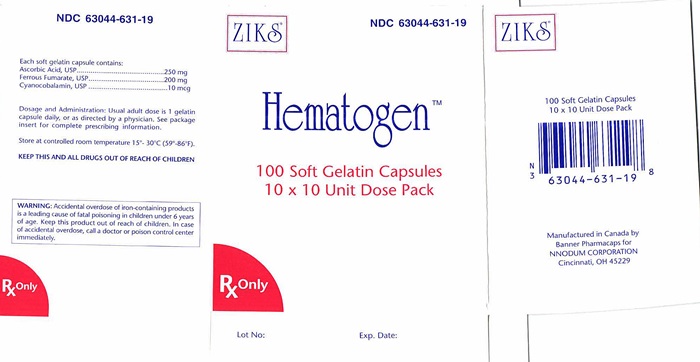
Hematogen Ferrous Fumarate, Ascorbic Acid, Intrinsic Factor , Cyanocobalamin 250; 10; 66; 100 mg; ug; mg; mg Capsule, 100-count — NDC 63044-631-19 (Billing 63044-0631-19)
This is a package of 100 capsules of Hematogen Ferrous Fumarate, Ascorbic Acid, Intrinsic Factor , Cyanocobalamin 250; 10; 66; 100 mg; ug; mg; mg Capsule from Nnodum Pharmaceuticals, no longer marketed, no longer in the FDA NDC Directory. It is this product's only package size.
NDC database record
One package, one record: these facts belong to NDC 63044-631-19 alone.
- Record
- FDA NDC Directory package listing · Human prescription drug
- Code segments
- 63044 labeler · 631 product · 19 package
- Billing quantity
- 100 EA per package
- Barcode (UPC-A, from the NDC)
- 3 6304463119 8
- FDA record last changed
- Jul 14, 2026
Identity & classification
Regulatory identifiers FDA, NLM and CMS codes for this package
Drug-database identifiers Medi-Span GPI and First Databank GCN / HICL / AHFS classification
- GSN (GCN sequence number): 062970
- GCN: 98730
- HICL (First Databank): 000657
- AHFS class code: 20:04.04.00
Where does this data come from?
- FDA openFDA NDC Directory · synced Oct 1, 2026
- FDA label on DailyMed · label index refreshed Oct 3, 2026
- RxNorm (NLM RxNav) · catalog refreshed Oct 1, 2026
- Medi-Span GPI (licensed)
- First Databank (licensed) · refreshed Oct 1, 2026
Clinical
Patient education
Supplement & herbal interactions
Where does this data come from?
- MedlinePlus (NLM) · refreshed Oct 1, 2026
- FDA label on DailyMed · label index refreshed Oct 3, 2026
Ask a licensed pharmacist directly — free, answered by our team.
Pricing
A drug doesn't have one price. Each row is a different public payment system, and none is what you'd pay at the counter — that depends on your insurance. The ⓘ on each row explains what it measures.
| Price system | Per each | Per package |
|---|---|---|
| Retail pharmacies payNADAC · weekly | Not in the retail survey — common for institutional, discontinued, or low-volume packs. | |
| Medicaid paysCMS SDUD · 12 mo | No recent Medicaid claims on file for this NDC — rare and low-volume NDCs are suppressed in the public data. | |
| Medicare drug plans payPart D · quarterly | No Part D plan price is available for this NDC in our data. | |
Where does this data come from?
- CMS NADAC weekly file
- CMS ASP pricing files · refreshed Sep 20, 2026
- CMS Medicaid State Drug Utilization Data · refreshed Oct 4, 2026
- CMS Part D plan pricing files · refreshed Sep 24, 2026
- VA National Acquisition Center price file
Packaging — all sizes for this product
| Package NDC | Description | Marketing start | Marketing end | Status |
|---|---|---|---|---|
| 63044-0631-19 You're viewing this Main listing | 100 BLISTER PACK in 1 BOX / 1 CAPSULE in 1 BLISTER PACK | 2007-05-10 | — | Inactivated by FDA |
Therapeutic equivalents
| Product | Labeler | Pack | NADAC/unit | TE | Status | Price vs. this |
|---|---|---|---|---|---|---|
| Hematogen 250; 10; 66; 100 mg/1; ug/1; mg/1; mgthis 63044-0631-19 | Nnodum | 100 capsules | — | — | Discontinued | — |
Where does this data come from?
- FDA openFDA NDC Directory · synced Oct 1, 2026
- FDA Orange Book · refreshed Oct 3, 2026
- CMS NADAC weekly file
Availability & generic status
We did not find an FDA-approved generic match for this exact strength, form and route.
Where does this data come from?
- FDA Orange Book · refreshed Oct 3, 2026
What it looks like
Where does this data come from?
- FDA label on DailyMed · label index refreshed Oct 3, 2026
Inactive Ingredients / Excipients
Inactive ingredients, also called excipients, are components of the drug product other than the active ingredient. They may include fillers, dyes, coatings, preservatives, flavors, or other formulation ingredients.
Where does this data come from?
IACT rows and label-wide narrative are kept separate; availability and product-level specificity depend on the submitted label.- FDA label on DailyMed · label index refreshed Oct 3, 2026
- FDA openFDA NDC Directory · synced Oct 1, 2026
Inactive ingredient FAQ
Are inactive ingredients the same for every manufacturer?
Why might an inactive ingredient be missing?
Can inactive ingredients matter?
Manufacturer & labeler
More NDCs from Nnodum Pharmaceuticals labeler code 63044
Where does this data come from?
- FDA openFDA NDC Directory · synced Oct 1, 2026
- Drugs@FDA
Full prescribing information FDA SPL
🎯 Indications and Usage ▾
INDICATIONS: For the treatment of all anemias responsive to oral iron therapy, such as hypochromic anemia associated with pregnancy, chronic or acute blood loss, dietary restriction, metabolic disease and post-surgical convalescence.
⏱️ Dosage and Administration ▾
DOSAGE AND ADMINISTRATION: Usual adult dose is 1 soft gelatin capsule daily.
⛔ Contraindications ▾
CONTRAINDICATIONS: Hemochromatosis and hemosiderosis are contraindications to iron therapy. WARNING: Accidental overdose of iron-containing products is a leading cause of fatal poisoning in children under 6 years of age. Keep this product out of reach of children. In case of accidental overdose, call a doctor or poison control center immediately.
🤒 Adverse Reactions ▾
ADVERSE REACTIONS: Average capsule doses in sensitive individuals or excessive dosage may cause nausea, skin rash, vomiting, diarrhea, precordial pain, or flushing of the face or extremities.
🧬 Clinical Pharmacology ▾
ACTIONS/CLINICAL PHARMACOLOGY HIGH ELEMENTAL IRON CONTENT: Ferrous fumarate, used in Hematogen™ Capsules, is an organic iron complex which has the highest elemental iron content of any hematinic salt-33%. This compares with 20% for ferrous sulfate (heptahydrate) and 13% for ferrous gluconate. Hematogen™ contains 66 mg of elemental iron.
MORE COMPLETE ABSORPTION: It has been repeatedly shown that ascorbic acid, when given in sufficient amounts, can increase the absorption of ferrous iron from the gastrointestinal tract. The absorption promoting effect is mainly due to the reducing action of ascorbic acid within the gastro intestinal lumen, which helps to prevent or delay the formation of insoluble or less dissociated ferric compounds. Iron absorption has been shown to increase sharply with increasing amounts of ascorbic acid, showing a gain in absorption of approximately 40% at 250 mg.
Above 250 mg, the gain becomes insignificant, with an additional gain of only approximately 8% at 500 mg. Each Hematogen™ Capsule contains 250 mg of ascorbic acid, believed to be the optimal amount. PROMOTES MOVEMENT OF PLASMA IRON: Ascorbic acid also plays an important role in the movement of plasma iron to storage depots in the tissues .
The action, which leads to the transport of plasma iron to ferritin, presumably involves its reducing effect; converting transferrin iron from 5 the ferric to the ferrous state. There is also evidence that ascorbic acid improves iron utilization, presumably as a further result of its reducing action , and some evidence that it may have a direct effect upon erythropoiesis. Ascorbic acid is further alleged to enhance the conversion of folic acid to a more physiologically active form, folinic acid. which would make it even more important in the 11 treatment of anemia since it would aid in the utilization of dietary folic acid.
EXCELLENT ORAL TOLERATION: Ferrous fumarate is used in Hematogen™ Capsules because it is less likely to cause the gastric disturbances so often associated with oral iron therapy. Ferrous fumarate has a low ionization constant and high solubility in the entire pH range of the gastrointestinal tract. It does not precipitate proteins or have the astringency of more ionizable forms of iron, and does not interfere with proteolytic or diastatic activities of the digestive system.
Because of excellent oral toleration, Hematogen™ Capsules can usually be administered between meals when iron absorption is maximal. FACILITATES ABSORPTION OF VITAMIN B12 : It is now known that "Intrinsic Factor" is essential for the adequate alimentary absorption of vitamin B. The inclusion of desiccated stomach powder 12 with oral vitamin B will furnish sufficient intrinsic factor to assure absorption of the vitamin 12 only TOXICITY: Ferrous fumarate was found to be the least toxic of three popular oral iron salts, with an oral LD50 of 630 mg/kg.
In the same report, the LD50 of ferrous gluconate was reported to be 320 mg/kg and ferrous sulfate 230 mg/kg.
📦 How Supplied / Storage and Handling ▾
HOW SUPPLIED: Each Red soft gelatin capsule is imprinted with "Ziks631" on one side. NDC 63044-0631-19 10 x 10, unit dose packs, in packs of 100's. Store at controlled between temperature 15°- 30°C (59°- 86°F).
Protect from direct / excessive heat 40°C (104°F). Avoid freezing. 1 BIBLIOGRAPHY: Berk, M.S. and Novich, M.A.: 'Treatment of Iron Deficiency Anemia With Ferrous 2 Fumarate," Am.
J. Obst. & Gynec., 203-206, 1962. Shapleigh, J.B., and Montgomery, A.; Am.
Pract. & 3 Dig. Treat. 10-461, 1959.
Brise, H. and Hallberg, L.: "Effect of Ascorbic Acid on Iron Absorption," Acta. 4 5 Med. Scand.
171 :376, 51 -58,1962. New Drugs, p. 309, AMA, Chicago, 1966.
Mazur, A., Green, S. and Carleton, A.: "Mechanism of Plasma Iron Incorporation into Hepatic Ferritin," J. of Bio. Chem. 6 3:595-603, 1960.
Greenberg, S.M., Tucker, A.E., Mathues, H. and J.D.: "Iron Absorption and 7 Metabolism, I. Interrelationship of Ascorbic Acid and Vitamin E," J. Nutrition 63:19-31, 1957.
Moore, C. V., and Dubach, R.: "Observations on the Absorption of Iron From Foods Tagged with Radioiron, 8 "Trans. Assoc.
Amer. Physic. 64:245, 1951.
Steinkamp, R., Dubach, R. and Moore, C.Y. "Studies in 9 Iron Transportation and Metabolism," Arch. Int. Med.
95:181, 1955. Gorten, M.K. and Bradley, J.E.: "The Treatment of Nutritional Anemia in Infancy and Childhood with Oral Iron and Ascorbic l0 Acid,"J. Pediatrics, 45: 1, 1954.
Mazur, A.: "Role of Ascorbic Acid in the Incorporation of Plasma Iron 11 into Ferritin." An. N.Y. Acad.
Sci. 92:223-229, 1961. COX, E.
V. et al.: "The Anemia of Scurvy," Amer. J. 12 Med.
42:220-227, 1967. Berk, L. et al.: "Observations on the Etiologic Relationship of Achylia 13 Gastrica to Pernicious Anemia, X," N. Eng.
J. Med. 239:911-913, 1948.
Hall, B.E.: "Studies on the 14 Nature of the Intrinsic Factor of Castle," Brit. Med. J.
2:585-589,1950. Wallerstein, R.O. et al.: "Observations on the Etiologic Relationship of Achylia Gastrica to Pernicious Anemia, XV" J. Lab 15 & Clin.
Med. 41 :363-375, 1953. Castle, W.B.: "Observations on the Etiologic Relationship of Achylia 16 Gastrica to Pernicious Anemia, 1," Am.
J. Med. Sc.178:748-764, 1929.
📄 Package Label / Principal Display Panel ▾
PACKAGE LABEL.PRINCIPAL DISPLAY PANEL Nnodium Hematogen 631 Label
About this NDC listing & data coverage
Listed without an FDA application
This product's marketing category indicates it is marketed without an approved FDA application (no NDA, ANDA, or BLA on file). Having an NDC does not by itself establish FDA approval — the NDC Directory is a listing system, not an approval decision. Approval-linked data such as Orange Book therapeutic-equivalence ratings therefore does not apply.
What data is (and isn’t) available for this NDC — tap to expand
| NDC identity (package / product / labeler codes) | ✓ Available |
| Labeler | ✓ Available |
| Product & package description | ✓ Available |
| Marketing category & status | ✓ Available |
| Active ingredient / dosage form / route | ✓ Available |
| FDA label (SPL via DailyMed) | ✓ Available |
| Package photos | ✓ Available |
| Inactive ingredients (structured) | — Not published for this NDC The labeler did not submit a structured excipient list, or no SPL is available. |
| NADAC pharmacy acquisition price (CMS) | — Not published for this NDC CMS publishes NADAC only for NDCs reported in its retail-pharmacy survey. |
| Orange Book / therapeutic-equivalence data | — Not published for this NDC Applies only to products approved under an NDA/ANDA; many listings are out of scope. |
| HCPCS J-code billing crosswalk | — Not published for this NDC Most self-administered / retail products have no J-code — that is normal. |
| Medicaid utilization (CMS SDUD) | — Not published for this NDC CMS reports utilization only for NDCs with Medicaid claims above its privacy threshold. |