
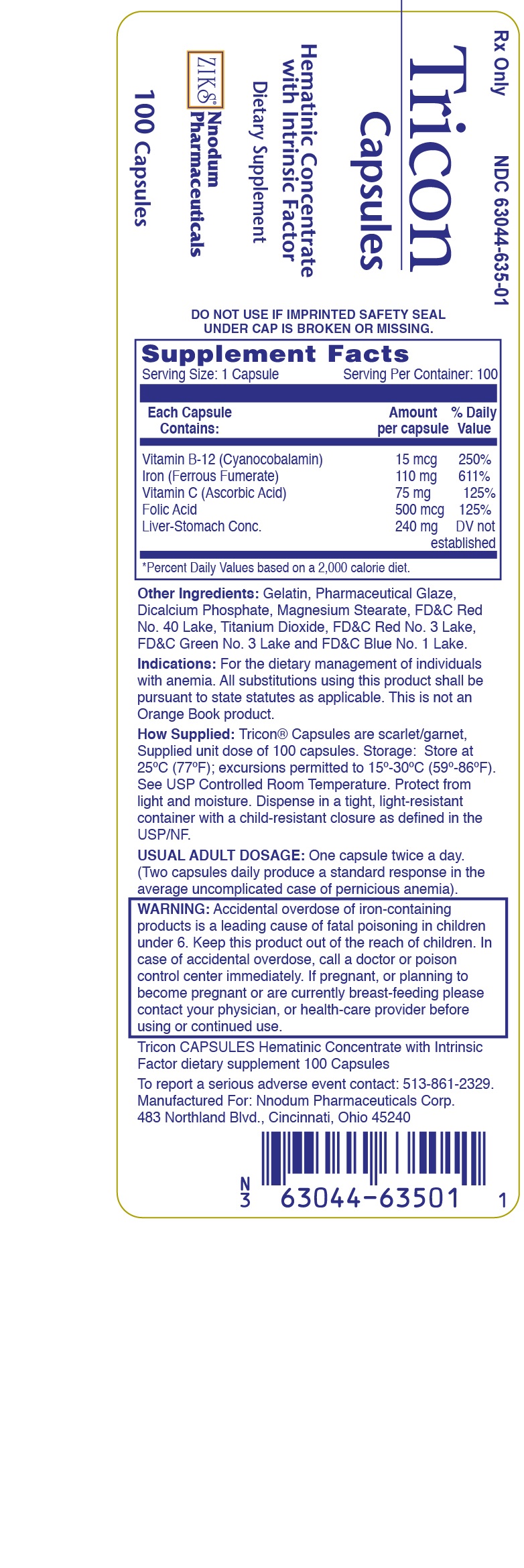
Tricon 15 ug; 110 mg; 75 mg; .5 mg Capsule, 100-count — NDC 63044-635-10 (Billing 63044-0635-10)
This is a package of 100 capsules of Tricon 15 ug; 110 mg; 75 mg; .5 mg Capsule from Nnodum Pharmaceuticals, marketed since May 2005 and currently FDA-listed. It is this product's only package size.
NDC database record
One package, one record: these facts belong to NDC 63044-635-10 alone.
- Record
- FDA NDC Directory package listing · Human prescription drug
- Code segments
- 63044 labeler · 635 product · 10 package
- Package marketed since
- May 20, 2005
- Sample package
- No — commercial package
- Listing certified through
- Dec 31, 2026
- Billing quantity
- 100 EA per package
- Barcode (UPC)
- 0363044635011
- FDA record last changed
- Aug 27, 2026
Identity & classification
Regulatory identifiers FDA, NLM and CMS codes for this package
Drug-database identifiers Medi-Span GPI and First Databank GCN / HICL / AHFS classification
- GSN (GCN sequence number): 038271
- GCN: 58912
- GPI-14 (Medi-Span): 82992005250130
- HICL (First Databank): 000667
- AHFS class code: 20:04.04.00
- RxCUI (RxNorm): 999799
Where does this data come from?
- FDA openFDA NDC Directory · synced Oct 1, 2026
- FDA label on DailyMed · label index refreshed Oct 3, 2026
- RxNorm (NLM RxNav) · catalog refreshed Oct 1, 2026
- Medi-Span GPI (licensed)
- First Databank (licensed) · refreshed Oct 1, 2026
RxNorm drug class
This medicine belongs to the Vitamin B12 class.
Where does this data come from?
- RxClass (NLM) · catalog refreshed Oct 1, 2026
Clinical
Tricon is an oral capsule containing four active ingredients: ascorbic acid (vitamin C), cyanocobalamin (vitamin B12), ferrous fumarate (an iron salt), and folic acid (vitamin B9). These ingredients are typically used as nutritional supplements to help support or correct deficiencies in these vitamins and minerals. This product is marketed without an approved FDA application.
Patient education
Supplement & herbal interactions
Where does this data come from?
- MedlinePlus (NLM) · refreshed Oct 1, 2026
- FDA label on DailyMed · label index refreshed Oct 3, 2026
Ask a licensed pharmacist directly — free, answered by our team.
Pricing
A drug doesn't have one price. Each row is a different public payment system, and none is what you'd pay at the counter — that depends on your insurance. The ⓘ on each row explains what it measures.
| Price system | Per each | Per package |
|---|---|---|
| Retail pharmacies payNADAC · weekly | Not in the retail survey — common for institutional, discontinued, or low-volume packs. | |
| Medicaid paysCMS SDUD · 12 mo | No recent Medicaid claims on file for this NDC — rare and low-volume NDCs are suppressed in the public data. | |
| Medicare drug plans payPart D · quarterly | No Part D plan price is available for this NDC in our data. | |
Where does this data come from?
- CMS NADAC weekly file
- CMS ASP pricing files · refreshed Sep 20, 2026
- CMS Medicaid State Drug Utilization Data · refreshed Oct 4, 2026
- CMS Part D plan pricing files · refreshed Sep 24, 2026
- VA National Acquisition Center price file
Packaging — all sizes for this product
| Package NDC | Description | Marketing start | Marketing end | Status |
|---|---|---|---|---|
| 63044-0635-10 You're viewing this Main listing | 10 BLISTER PACK in 1 BOX / 10 CAPSULE in 1 BLISTER PACK | 2005-05-20 | — | Active |
Therapeutic equivalents
| Product | Labeler | Pack | NADAC/unit | TE | Status | Price vs. this |
|---|---|---|---|---|---|---|
| Tricon 15 ug/1; 110 mg/1; 75 mg/1; .5 mgthis 63044-0635-10 | Nnodum | 100 capsules | — | — | FDA listed | — |
Where does this data come from?
- FDA openFDA NDC Directory · synced Oct 1, 2026
- FDA Orange Book · refreshed Oct 3, 2026
- CMS NADAC weekly file
Availability & generic status
We did not find an FDA-approved generic match for this exact strength, form and route.
Where does this data come from?
- FDA Orange Book · refreshed Oct 3, 2026
What it looks like
Where does this data come from?
- FDA label on DailyMed · label index refreshed Oct 3, 2026
Inactive Ingredients / Excipients
Inactive ingredients, also called excipients, are components of the drug product other than the active ingredient. They may include fillers, dyes, coatings, preservatives, flavors, or other formulation ingredients.
💡 Tap an ingredient (hover on desktop) to see what it is and why it’s used.
-
UNII 2968PHW8QP
A weak organic acid derived from citrus fruits or made through fermentation. It works as a buffer to control pH, a preservative to extend shelf life, and a flavoring agent in medications.
-
UNII 35SW5USQ3G
A synthetic yellow dye used to color medicines. It helps make tablets, capsules, and liquids visually distinct so patients can easily identify their medication.
-
UNII 7Z8S9VYZ4B
Ethylcellulose is a plant-derived thickener and film-former made by chemically modifying cellulose. It's used as a binder to hold tablet ingredients together, a coating to control how quickly medicine is released, or a thickener in liquid formulations.
-
UNII H3R47K3TBD
FD&C Blue No. 1 is a synthetic blue dye approved for use in foods and medicines. It serves as a colorant to give the medication its distinctive appearance and help with product identification.
-
UNII 2G86QN327L
Gelatin is a protein derived from animal collagen, commonly used in medicines as a gelling agent and capsule material. It helps create soft or hard capsule shells that hold and release medication, and can also thicken liquid formulations.
-
UNII 1DI56QDM62
A natural fatty substance from soybeans that helps mix oil and water-based ingredients together. It acts as an emulsifier and lubricant in medicines to improve texture and help the product break down properly in your body.
-
UNII 70097M6I30
Magnesium stearate is a salt made from magnesium and stearic acid, a fatty substance. It's used in tablets and capsules as a lubricant and glidant to help ingredients flow smoothly during manufacturing and prevent sticking.
-
UNII ETJ7Z6XBU4
Silicon dioxide is a naturally occurring mineral used as a glidant and anti-caking agent. It helps powder ingredients flow smoothly and prevents clumping during manufacturing and storage.
-
UNII OJ245FE5EU
Sodium benzoate is a salt derived from benzoic acid, a preservative. It's added to medicines to prevent growth of bacteria, fungi, and other microorganisms that could spoil the product.
-
UNII 1Q73Q2JULR
Sodium citrate is a salt derived from citric acid. It works as a buffer to maintain the medicine's pH level and may also help improve taste or act as a preservative in the formulation.
-
UNII X045WJ989B
Sorbic acid is a preservative derived from berries that prevents mold, yeast, and bacterial growth in medicines. It keeps the product stable and safe during storage.
-
UNII O8232NY3SJ
A plant-based carbohydrate derived from corn kernels. It acts as a filler to add bulk, a binder to hold ingredients together, and a disintegrant to help the tablet break apart in your stomach for absorption.
-
UNII 15FIX9V2JP
Titanium dioxide is a bright white mineral powder commonly used as a colorant and opacifying agent. It makes pills and tablets white or lighter in color and helps make coatings non-transparent.
13 inactive ingredients listed in the exact product block matched to this NDC.
Where does this data come from?
ingredient classCode="IACT" elements from the exact product block matched by this NDC. Label-section narrative from DailyMed / the openFDA label index is shown separately when available.- FDA label on DailyMed · label index refreshed Oct 3, 2026
- FDA openFDA NDC Directory · synced Oct 1, 2026
Inactive ingredient FAQ
Are inactive ingredients the same for every manufacturer?
Why might an inactive ingredient be missing?
Can inactive ingredients matter?
Manufacturer & labeler
More NDCs from Nnodum Pharmaceuticals labeler code 63044
Where does this data come from?
- FDA openFDA NDC Directory · synced Oct 1, 2026
- Drugs@FDA
Full prescribing information FDA SPL
🎯 Indications and Usage ▾
INDICATIONS AND USAGE TRICON™ is a multifactor preparation effective in the treatment of anemias that respond to oral hematinics, including pernicious anemia and other megaloblastic anemias and also irondeficiency anemia. Therapeutic quantities of hematopoietic factors that are known to be important are present in the recommended daily dose.
⏱️ Dosage and Administration ▾
DOSAGE AND ADMINISTRATION One capsule twice a day. (Two capsules daily produce a standard response in the average uncomplicated case of pernicious anemia.)
⛔ Contraindications ▾
CONTRAINDICATIONS Hemochromatosis and hemosiderosis are contraindications to iron therapy.
🤒 Adverse Reactions ▾
ADVERSE REACTIONS Rarely, iron in therapeutic doses produces gastrointestinal reactions, such as diarrhea or constipation. Reducing the dose and administering it with meals will minimize these effects in the iron-sensitive patient. In extremely rare instances, skin rash suggesting allergy has been noted following the oral administration of liver-stomach material.
Allergic sensitization has been reported following both oral and parenteral administration of folic acid.
🤰 Pregnancy ▾
Pregnancy Teratogenic Effects Pregnancy Category C: Animal reproduction studies have not been conducted with TRICON™ Capsules. It is also not known whether TRICON™ Capsules can cause fetal harm when administered to pregnant women or can affect reproduction capacity. TRICON™ Capsules should be given to pregnant women only if clearly needed.
🧒 Pediatric Use ▾
Pediatric Use Safety and effectiveness in pediatric patients below the age of 10 have not been established.
🧓 Geriatric Use ▾
Geriatric Use Geriatric Use: Clinical studies on this product have not been performed in sufficient numbers of subjects aged 65 and over to determine whether elderly subjects respond differently from younger subjects. In general, dose selection for an elderly patient should be cautious, usually starting at the low end of the dosing range, reflecting the greater frequency of decreased hepatic, renal or cardiac function and of concomitant disease or other drug therapy.
🆘 Overdosage ▾
OVERDOSAGE Symptoms: Those of iron intoxication, which may include pallor and cyanosis, vomiting, hematemesis, diarrhea, melena, shock, drowsiness, and coma. Treatment: For specific therapy, exchange transfusion and chelating agents. For general management, gastric and rectal lavage with sodium bicarbonate solution or milk, administration of intravenous fluids and electrolytes, and use of oxygen.
🧬 Clinical Pharmacology ▾
CLINICAL PHARMACOLOGY: Vitamin B12 with Intrinsic Factor: when secretion of intrinsic factor in gastric juice is inadequate or absent (e.g., Addisonian pernicious anemia or after gastrectomy), vitamin B12 in physiologic doses is absorbed poorly, if at all. The resulting deficiency of vitamin B12 leads to the clinical manifestations of pernicious anemia. Similar megaloblastic anemias may develop in fish tapeworm ( Diphyllobothrium latum ) infection or after a surgically created small bowel blind loop; in these situations, treatment requires freeing the host of the parasites or bacteria that appear to compete for the available vitamin B12.
Strict vegetarianism and malabsorption syndromes may also lead to vitamin B12 deficiency. In the latter case, parenteral therapy or oral therapy with so-called massive doses of vitamin B12 may be necessary for adequate treatment of the patient. Potency of intrinsic factor concentrates is determined physiologically, i.e., by their use in patients with pernicious anemia.
The liver-stomach concetrate with intrinsic factor and the vitamin B12 contained in two TRICON™ Capsules provide 1½ times the minimum amount of therapeutic agent that, when given daily in an uncomplicated case of pernicious anemia, will produce a satisfactory response and relief of anemia and symptoms. Concentrates of intrinsic factor derived from hog gastric, pyloric, and duodenal mucosa have been used successfully in patients who lack intrinsic factor. Folic Acid: Folic acid deficiency is the immediate cause of most, if not all, cases of nutritional megaloblastic anemia and of the megaloblastic anemias of pregnancy and infancy; usually, it is also at least partially responsible for the megaloblastic anemias of malabsorption syndromes, e.g., tropical and nontropical sprue.
It is apparent that in vitamin B12 deficiency (e.g., pernicious anemia) lack of this vitamin results in impaired utilization of folic acid. There are other evidences of the close folic acid-vitamin B12 interrelationship: (1) B12 influences the storage, absorption, and utilization of folic acid, and (2) as a deficiency of B12 progresses, the requirement for folic acid increases. However, folic acid does not change the requirements for vitamin B12.
Iron: A very common anemia is that due to iron deficiency. In most cases, the response to iron salts is prompt, safe, and predictable. Within limits, the response is quicker and more certain to large doses of iron than to small doses.
Each TRICON™ (hematinic concentrate with intrinsic factor) Capsule furnishes 110 mg of elemental iron (as ferrous fumarate) to provide a maximum response. Ascorbic Acid: Vitamin C plays a role in anemia therapy. It augments the conversion of folic acid to its active form, folinic acid.
In addition, ascorbic acid promotes the reduction of ferric iron in food to the more readily absorbed ferrous form. Severe and prolonged vitamin C deficiency is associated with an anemia that is usually hypochromic but occasionally megaloblastic in type.
📦 How Supplied / Storage and Handling ▾
HOW SUPPLIED TRICON™ Capsules are opaque brown NDC 63044-0635-10 Unit Dose Packs containing 10 capsules per card. 100 capsules. Storage: Store at controlled room temperature 25°C (77°F); excursions permitted to 15°-30°C (59°-86°F). [See USP Controlled Room Temperature. Manufactured For Nnodum Pharmaceuticals by Contract Pharmacal Corporation 135 Adams Avenue Hauppauge, New York 11788
📋 Description ▾
DESCRIPTION Each TRICON™ Capsule contains: Special liver-stomach concentrate (containing intrinsic factor). . . . . . . . . . . . . . . . 240 mg Vitamin B12 (activity equivalent) . . . . . . . . . . . .15 mcg Iron, elemental (ferrous fumarate) . . . . . . . . . .110 mg Vitamin C (ascorbic acid) . . . . . . . . . . . . . . . . . 75 mg Folic acid . . . . . . . . . . . . . . . . . . . . . . . . . . . .
0.5mg with other factors of vitamin B complex present in the liver-stomach concentrate. Inactive ingredients: Citric acid, D&C Yellow No. 10, ethylcellulose, FD&C Blue No.
1, FD&C Red #28, gelatin, lecithin, magnesium stearate, pharmaceutical glaze, silicon dioxide, simethicone, sodium benzoate, sodium citrate, sorbic acid, starch, and titanium dioxide.
⚠️ Precautions ▾
PRECAUTIONS General Anemia is a manifestation that requires appropriate investigation to determine its cause or causes. Folic acid alone is unwarranted in the treatment of pure vitamin B12 deficiency states, such as pernicious anemia. Folic acid may obscure pernicious anemia in that the blood picture may revert to normal while neurological manifestations remain progressive.
As with all preparations containing intrinsic factor, resistance may develop in some cases of pernicious anemia to the potentiation of absorption of physiologic doses of vitamin B12. If resistance occurs, parenteral therapy or oral therapy with so-called massive doses of vitamin B12 may be necessary for adequate treatment of the patient. No single regimen fits all cases, and the status of the patient observed in follow-up is the final criterion for adequacy of therapy.
Periodic clinical and laboratory studies are considered essential and are recommended. Pregnancy Teratogenic Effects Pregnancy Category C: Animal reproduction studies have not been conducted with TRICON™ Capsules. It is also not known whether TRICON™ Capsules can cause fetal harm when administered to pregnant women or can affect reproduction capacity.
TRICON™ Capsules should be given to pregnant women only if clearly needed. Nursing Mothers It is not known whether this drug is excreted in human milk. Because many drugs are excreted in human milk, caution should be exercised when TRICON™ is administered to a nursing woman.
Pediatric Use Safety and effectiveness in pediatric patients below the age of 10 have not been established. Geriatric Use Geriatric Use: Clinical studies on this product have not been performed in sufficient numbers of subjects aged 65 and over to determine whether elderly subjects respond differently from younger subjects. In general, dose selection for an elderly patient should be cautious, usually starting at the low end of the dosing range, reflecting the greater frequency of decreased hepatic, renal or cardiac function and of concomitant disease or other drug therapy.
🍼 Nursing Mothers ▾
Nursing Mothers It is not known whether this drug is excreted in human milk. Because many drugs are excreted in human milk, caution should be exercised when TRICON™ is administered to a nursing woman.
📄 Package Label / Principal Display Panel ▾
PACKAGE LABEL.PRINCIPAL DISPLAY PANEL Rx Only NDC 63044-635-01 Tricon Capsules 100 Capsules Manufactured for Nnodum Pharmaceuticals Corp. 483 Northland Blvd., Cincinnati, OH 45240 res Tricon 635-01
Reported adverse events (FAERS)
Top reported reactions
Age at onset
Reporter sex
Serious outcomes
Where does this data come from?
About this NDC listing & data coverage
Listed without an FDA application
This product's marketing category indicates it is marketed without an approved FDA application (no NDA, ANDA, or BLA on file). Having an NDC does not by itself establish FDA approval — the NDC Directory is a listing system, not an approval decision. Approval-linked data such as Orange Book therapeutic-equivalence ratings therefore does not apply.
What data is (and isn’t) available for this NDC — tap to expand
| NDC identity (package / product / labeler codes) | ✓ Available |
| Labeler | ✓ Available |
| Product & package description | ✓ Available |
| Marketing category & status | ✓ Available |
| Active ingredient / dosage form / route | ✓ Available |
| FDA label (SPL via DailyMed) | ✓ Available |
| Package photos | ✓ Available |
| Inactive ingredients (structured) | ✓ Available |
| NADAC pharmacy acquisition price (CMS) | — Not published for this NDC CMS publishes NADAC only for NDCs reported in its retail-pharmacy survey. |
| Orange Book / therapeutic-equivalence data | — Not published for this NDC Applies only to products approved under an NDA/ANDA; many listings are out of scope. |
| HCPCS J-code billing crosswalk | — Not published for this NDC Most self-administered / retail products have no J-code — that is normal. |
| Medicaid utilization (CMS SDUD) | — Not published for this NDC CMS reports utilization only for NDCs with Medicaid claims above its privacy threshold. |