
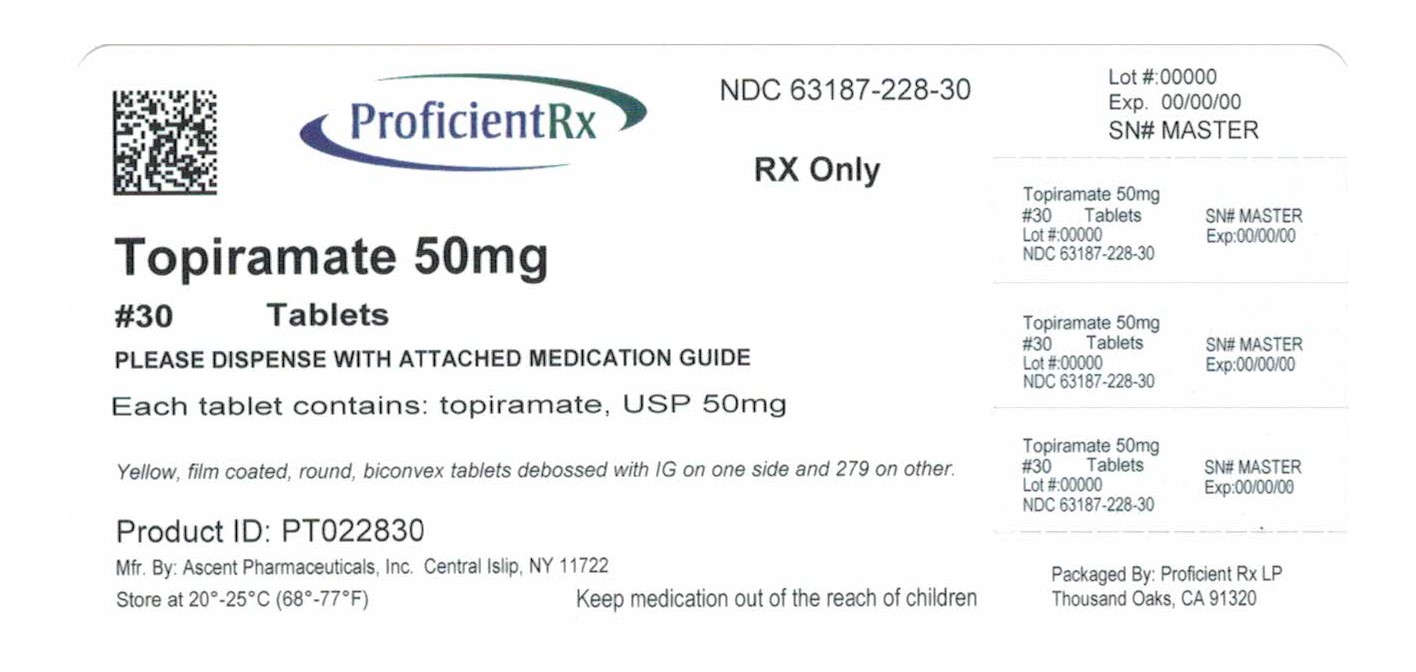
Topiramate 50 mg Tablet, 30-count — NDC 63187-228-30 (Billing 63187-0228-30)
This is a package of 30 tablets of Topiramate 50 mg Tablet from Proficient Rx LP, marketed since Jan 2011 and currently FDA-listed. It is the main listing for this product, which comes in 3 package sizes.
NDC database record
One package, one record: these facts belong to NDC 63187-228-30 alone.
- Record
- FDA NDC Directory package listing · Human prescription drug
- Code segments
- 63187 labeler · 228 product · 30 package
- Package marketed since
- Jan 1, 2019
- Sample package
- No — commercial package
- Listing certified through
- Dec 31, 2026
- Billing quantity
- 30 EA per package
- Barcode (UPC-A, from the NDC)
- 3 6318722830 9
- FDA record last changed
- Jul 24, 2026
Identity & classification
Regulatory identifiers FDA, NLM and CMS codes for this package
Drug-database identifiers Medi-Span GPI and First Databank GCN / HICL / AHFS classification
- GSN (GCN sequence number): 026169
- GCN: 36550
- GPI-14 (Medi-Span): 72600075000320
- HICL (First Databank): 011060
- AHFS class code: 28:12.92.00
- RxCUI (RxNorm): 151226
Where does this data come from?
- FDA openFDA NDC Directory · synced Oct 1, 2026
- FDA label on DailyMed · label index refreshed Oct 3, 2026
- RxNorm (NLM RxNav) · catalog refreshed Oct 1, 2026
- Medi-Span GPI (licensed)
- First Databank (licensed) · refreshed Oct 1, 2026
RxNorm drug class
This medicine belongs to the Centrally acting antiobesity products class.
Where does this data come from?
- RxClass (NLM) · catalog refreshed Oct 1, 2026
Clinical
Topiramate is used to treat certain types of seizures. Topiramate is also used to prevent migraine headaches but not to relieve the pain of migraine headaches when they occur. Topiramate is in a class of medications called anticonvulsants. It works by decreasing abnormal excitement in the brain.
Read the full MedlinePlus article ↗- It treats certain seizures in epilepsy, either alone or added to other medicines. Most products also prevent migraine in people 12 and older. Generic topiramate tablets are labeled...
- Take it by mouth exactly as prescribed. Your doctor will raise the dose slowly. Trokendi XR must be swallowed whole, while Qudexy XR can be sprinkled on soft food. Don't stop sudde...
- Tingling, dizziness, sleepiness, tiredness, appetite and weight loss, and trouble with memory, concentration or speech are common. Tell me if they bother you.
- Call right away for eye pain or vision changes, decreased sweating with a fever, mood changes or suicidal thoughts, a severe rash, or confusion. These can be serious.
Patient education
Supplement & herbal interactions
Some supplements/herbs that may interact with Topiramate — tap one for details:
Topiramate may be associated with lower levels of 1 nutrient — worth a chat with your pharmacist, not a cause for alarm.
Where does this data come from?
- MedlinePlus (NLM) · refreshed Oct 1, 2026
- FDA label on DailyMed · label index refreshed Oct 3, 2026
Ask a licensed pharmacist directly — free, answered by our team.
Pricing
A drug doesn't have one price. Each row is a different public payment system, and none is what you'd pay at the counter — that depends on your insurance. The ⓘ on each row explains what it measures.
| Price system | Per each | Per package |
|---|---|---|
| Retail pharmacies payNADAC · weekly | Not in the retail survey — common for institutional, discontinued, or low-volume packs. | |
| Medicaid paysCMS SDUD · 12 mo | No recent Medicaid claims on file for this NDC — rare and low-volume NDCs are suppressed in the public data. | |
| Medicare drug plans payPart D · Q2 2026 | $0.0808 | $2.42 / 30 tablets |
Where does this data come from?
- CMS NADAC weekly file
- CMS ASP pricing files · refreshed Sep 20, 2026
- CMS Medicaid State Drug Utilization Data · refreshed Oct 4, 2026
- CMS Part D plan pricing files · refreshed Sep 24, 2026
- VA National Acquisition Center price file
Packaging — all sizes for this product
| Package NDC | Description | Marketing start | Marketing end | Status |
|---|---|---|---|---|
| 63187-0228-30 You're viewing this Main listing | 30 TABLET in 1 BOTTLE | 2019-01-01 | — | Active |
| 63187-0228-60 63187-228-60 | 60 TABLET in 1 BOTTLE | 2019-04-01 | — | Active |
| 63187-0228-90 63187-228-90 | 90 TABLET in 1 BOTTLE | 2019-01-01 | — | Active |
You're viewing the smallest of 3 pack sizes for this product.
Pack size FAQ
What quantity is in this package?
How does this package differ from NDC 63187-0228-60?
What NDC number is used to bill for this package of Topiramate 50 mg Tablet?
Therapeutic equivalents
| Product | Labeler | Pack | NADAC/unit | TE | Status | Price vs. this |
|---|---|---|---|---|---|---|
| Topiramate 50 mg 68084-0343-01 | American | 1 tablet | $0.037 | AB | Availability likely | — |
| Topiramate 50 mg 68462-0153-05 | Glenmark | 500 tablets | $0.037 | AB | Availability likely | — |
| Topiramate 50 mg 69097-0123-03 | Cipla | 60 tablets | $0.037 | AB | Availability likely | — |
| Topiramate 50 mg 76282-0279-10 | EXELAN | 1000 tablets | $0.037 | AB | Availability likely | — |
| topiramate 50 mg 82009-0136-05 | Quallent | 500 tablets | $0.037 | AB | Availability likely | — |
| Topiramate 50 mg 69097-0817-03 | Cipla | 60 tablets | $0.044 | AB | FDA listed | — |
| Topamax 50 mg 50458-0640-65 | Janssen | 60 tablets | $13.134 | AB | Availability likely | — |
| Topiramate 50 mg 00615-8139-39 | NCS | 30 tablets | — | AB | Discontinued | — |
| Topiramate 50 mg 00615-8594-39 | NCS | 30 tablets | — | AB | FDA listed | — |
| topiramate 50 mg 29300-0116-01 | Unichem | 100 tablets | — | AB | FDA listed | — |
| Topiramate 50 mg 31722-0182-05 | Camber | 500 tablets | — | AB | FDA listed | — |
| Topiramate 50 mg 43063-0734-07 | PD-Rx | 7 tablets | — | AB | FDA listed | — |
| Topiramate 50 mg 43063-0997-21 | PD-Rx | 21 tablets | — | AB | FDA listed | — |
| Topiramate 50 mg 47335-0710-08 | Sun | 100 tablets | — | AB | FDA listed | — |
| topiramate 50 mg 50090-2203-00 | A-S | 60 tablets | — | AB | FDA listed | — |
| Topiramate 50 mg 50090-3461-00 | A-S | 60 tablets | — | AB | FDA listed | — |
| Topiramate 50 mg 50090-6828-00 | A-S | 90 tablets | — | AB | FDA listed | — |
| topiramate 50 mg 50090-7757-00 | A-S | 90 tablets | — | AB | FDA listed | — |
| topiramate 50 mg 50268-0807-15 | AvPAK | 1 tablet | — | AB | FDA listed | — |
| Topiramate 50 mg 51655-0606-26 | Northwind | 90 tablets | — | AB | FDA listed | — |
| topiramate 50 mg 51655-0746-26 | Northwind | 90 tablets | — | AB | FDA listed | — |
| topiramate 50 mg 60760-0577-60 | St. | 60 tablets | — | AB | FDA listed | — |
| Topiramate 50 mg 62756-0710-08 | Sun | 100 tablets | — | AB | FDA listed | — |
| Topiramate 50 mg 63187-0059-30 | Proficient | 30 tablets | — | AB | FDA listed | — |
| Topiramate 50 mgthis 63187-0228-30 | Proficient | 30 tablets | — | AB | FDA listed | — |
| Topiramate 50 mg 63187-0479-30 | Proficient | 30 tablets | — | AB | FDA listed | — |
| Topiramate 50 mg 63187-0758-30 | Proficient | 30 tablets | — | AB | FDA listed | — |
| topiramate 50 mg 65841-0648-01 | Zydus | 100 tablets | — | AB | FDA listed | — |
| Topiramate 50 mg 65862-0172-05 | Aurobindo | 500 tablets | — | AB | FDA listed | — |
| topiramate 50 mg 67046-1202-03 | Coupler | 30 tablets | — | AB | FDA listed | — |
| topiramate 50 mg 68071-4760-03 | NuCare | 30 tablets | — | AB | FDA listed | — |
| Topiramate 50 mg 68071-5165-06 | NuCare | 60 tablets | — | AB | FDA listed | — |
| topiramate 50 mg 68382-0139-01 | Zydus | 100 tablets | — | AB | FDA listed | — |
| topiramate 50 mg 68788-7351-01 | Preferred | 100 tablets | — | AB | FDA listed | — |
| topiramate 50 mg 68788-8828-01 | Preferred | 100 tablets | — | AB | FDA listed | — |
| topiramate 50 mg 70518-1180-00 | REMEDYREPACK | 30 tablets | — | AB | Discontinued | — |
| topiramate 50 mg 70518-1937-00 | REMEDYREPACK | 30 tablets | — | AB | FDA listed | — |
| Topiramate 50 mg 70518-4340-00 | REMEDYREPACK | 1 tablet | — | AB | FDA listed | — |
| topiramate 50 mg 71205-0187-30 | Proficient | 30 tablets | — | AB | FDA listed | — |
| Topiramate 50 mg 71205-0819-30 | Proficient | 30 tablets | — | AB | FDA listed | — |
| Topiramate 50 mg 71335-0487-00 | Bryant | 20 tablets | — | AB | FDA listed | — |
| topiramate 50 mg 71335-1064-00 | Bryant | 20 tablets | — | AB | FDA listed | — |
| topiramate 50 mg 71335-1147-00 | Bryant | 20 tablets | — | AB | FDA listed | — |
| Topiramate 50 mg 71610-0486-30 | Aphena | 30 tablets | — | AB | FDA listed | — |
| topiramate 50 mg 72162-2481-00 | Bryant | 1000 tablets | — | AB | FDA listed | — |
| Topiramate 50 mg 72789-0443-60 | PD-Rx | 60 tablets | — | AB | FDA listed | — |
| Topiramate 50 mg 72865-0314-10 | XLCare | 1000 tablets | — | AB | FDA listed | — |
| Topiramate 50 mg 76420-0276-30 | Asclemed | 30 tablets | — | AB | FDA listed | — |
| Topiramate 50 mg 80425-0092-02 | Advanced | 60 tablets | — | AB | FDA listed | — |
| Topiramate 50 mg 80425-0195-02 | Advanced | 60 tablets | — | AB | FDA listed | — |
| Topiramate 50 mg 80425-0214-02 | Advanced | 60 tablets | — | AB | FDA listed | — |
| topiramate 50 mg 80425-0495-01 | Advanced | 30 tablets | — | AB | FDA listed | — |
| topiramate 50 mg 83008-0011-30 | Quality | 30 tablets | — | AB | Discontinued | — |
| Topiramate 50 mg 70518-2419-00 | REMEDYREPACK | 30 tablets | — | AB | Discontinued | — |
| topiramate 50 mg 60760-0952-60 | St. | 60 tablets | — | AB | FDA listed | — |
Where does this data come from?
- FDA openFDA NDC Directory · synced Oct 1, 2026
- FDA Orange Book · refreshed Oct 3, 2026
- CMS NADAC weekly file
Availability & generic status
This product is an FDA-approved generic. Other versions of the same drug are listed under Therapeutic equivalents, least expensive first.
Where does this data come from?
- FDA Orange Book · refreshed Oct 3, 2026
What it looks like
Where does this data come from?
- FDA label on DailyMed · label index refreshed Oct 3, 2026
Inactive Ingredients / Excipients
Inactive ingredients, also called excipients, are components of the drug product other than the active ingredient. They may include fillers, dyes, coatings, preservatives, flavors, or other formulation ingredients.
💡 Tap an ingredient (hover on desktop) to see what it is and why it’s used.
-
UNII EX438O2MRT
Ferric oxide yellow is a naturally occurring iron compound used as a colorant in medications. It gives tablets, capsules, and other forms a yellow or golden hue for identification and appearance.
-
UNII 0VUT3PMY82
Hypromellose 2910 is a plant-derived thickening agent made from cellulose. In medicines, it forms protective coatings on tablets or capsules, controls how fast the drug releases, and thickens liquid formulations.
-
UNII 0WZ8WG20P6
Hypromellose 2910 is a plant-based cellulose derivative that acts as a thickener, binder, and film-coating agent. It helps control how quickly the medicine dissolves and protects the tablet or capsule from moisture and light.
-
UNII EWQ57Q8I5X
Lactose monohydrate is a natural sugar derived from milk. It serves as a filler and binder in tablets and capsules, helping create the proper size, texture, and consistency of the medicine.
-
UNII 70097M6I30
Magnesium stearate is a salt made from magnesium and stearic acid, a fatty substance. It's used in tablets and capsules as a lubricant and glidant to help ingredients flow smoothly during manufacturing and prevent sticking.
-
UNII OP1R32D61U
Microcrystalline cellulose is a purified form of cellulose, a natural fiber from plant sources. It acts as a binder and filler in tablets and capsules, helping hold ingredients together and give the medicine its shape and size.
-
UNII B697894SGQ
Polyethylene glycol 400 is a clear, thick liquid made from petroleum-derived polymers. It acts as a solvent and humectant in medicines, helping dissolve active ingredients and retain moisture in the formulation.
-
UNII 6OZP39ZG8H
Polysorbate 80 is a synthetic emulsifier derived from sorbitol and oleic acid. It helps mix oil and water-based ingredients together in medications and improves how the product disperses in the body.
-
UNII ETJ7Z6XBU4
Silicon dioxide is a naturally occurring mineral used as a glidant and anti-caking agent. It helps powder ingredients flow smoothly and prevents clumping during manufacturing and storage.
-
UNII 5856J3G2A2
A starch-based powder made from potatoes and processed with sodium. It acts as a disintegrant, helping the tablet or capsule break apart quickly in the stomach so the medicine can be absorbed.
-
UNII O8232NY3SJ
A plant-based carbohydrate derived from corn kernels. It acts as a filler to add bulk, a binder to hold ingredients together, and a disintegrant to help the tablet break apart in your stomach for absorption.
11 inactive ingredients listed in the exact product block matched to this NDC.
Where does this data come from?
ingredient classCode="IACT" elements from the exact product block matched by this NDC. Label-section narrative from DailyMed / the openFDA label index is shown separately when available.- FDA label on DailyMed · label index refreshed Oct 3, 2026
- FDA openFDA NDC Directory · synced Oct 1, 2026
Inactive ingredient FAQ
Are inactive ingredients the same for every manufacturer?
Why might an inactive ingredient be missing?
Can inactive ingredients matter?
Manufacturer & labeler
More NDCs from Proficient Rx LP labeler code 63187
- Prednisolone Sodium Phosphate 15 mg/5mL Solution NDC 63187-215-64
- Quetiapine fumarate 50 mg Tablet, Film Coated NDC 63187-219-30
- Citalopram Hydrobromide 10 mg Tablet NDC 63187-220-00
- Diclofenac Sodium Delayed Release 75 mg Tablet, Delayed Release NDC 63187-222-15
- Alprazolam .5 mg Tablet NDC 63187-225-30
- Clonazepam .5 mg Tablet NDC 63187-226-30
- Fluoxetine 10 mg Capsule NDC 63187-233-30
- Metoclopramide 10 mg Tablet NDC 63187-235-12
- Ondansetron 4 mg Tablet, Film Coated NDC 63187-236-10
- Lisinopril 40 mg Tablet NDC 63187-237-30
- Metformin Hydrochloride 500 mg Tablet, Film Coated NDC 63187-238-30
- Metformin Hydrochloride 1000 mg Tablet, Film Coated NDC 63187-239-30
Where does this data come from?
- FDA openFDA NDC Directory · synced Oct 1, 2026
- Drugs@FDA
Full prescribing information FDA SPL
🎯 Indications and Usage ▾
INDICATIONS AND USAGE Monotherapy Epilepsy Topiramate Tablets are indicated as initial monotherapy in patients 10 years of age and older with partial onset or primary generalized tonic-clonic seizures. Effectiveness was demonstrated in a controlled trial in patients with epilepsy who had no more than 2 seizures in the 3 months prior to enrollment. Safety and effectiveness in patients who were converted to monotherapy from a previous regimen of other anticonvulsant drugs have not been established in controlled trials.
Adjunctive Therapy Epilepsy Topiramate Tablets are indicated as adjunctive therapy for adults and pediatric patients ages 2 to 16 years with partial onset seizures, or primary generalized tonic-clonic seizures, and in patients 2 years of age and older with seizures associated with Lennox-Gastaut syndrome.
⏱️ Dosage and Administration ▾
DOSAGE AND ADMINISTRATION Epilepsy In the controlled add-on trials, no correlation has been demonstrated between trough plasma concentrations of topiramate and clinical efficacy. No evidence of tolerance has been demonstrated in humans. Doses above 400 mg/day (600, 800, or 1000 mg/day) have not been shown to improve responses in dose-response studies in adults with partial onset seizures.
It is not necessary to monitor topiramate plasma concentrations to optimize Topiramate therapy. On occasion, the addition of Topiramate to phenytoin may require an adjustment of the dose of phenytoin to achieve optimal clinical outcome. Addition or withdrawal of phenytoin and/or carbamazepine during adjunctive therapy with Topiramate may require adjustment of the dose of Topiramate.
Because of the bitter taste, tablets should not be broken. Topiramate can be taken without regard to meals. Monotherapy Use The recommended dose for topiramate monotherapy in adults and children 10 years of age and older is 400 mg/day in two divided doses.
Approximately 58% of patients randomized to 400 mg/day achieved this maximal dose in the monotherapy controlled trial; the mean dose achieved in the trial was 275 mg/day. The dose should be achieved by titrating according to the following schedule: Morning Dose Evening Dose Week 1 25 mg 25 mg Week 2 50 mg 50 mg Week 3 75 mg 75 mg Week 4 100 mg 100 mg Week 5 150 mg 150 mg Week 6 200 mg 200 mg Adjunctive Therapy Use Adults (17 Years of Age and Over) - Partial Seizures, Primary Generalized Tonic-Clonic Seizures, or Lennox-Gastaut Syndrome The recommended total daily dose of Topiramate as adjunctive therapy in adults with partial seizures is 200-400 mg/day in two divided doses, and 400 mg/day in two divided doses as adjunctive treatment in adults with primary generalized tonic-clonic seizures.
It is recommended that therapy be initiated at 25-50 mg/day followed by titration to an effective dose in increments of 25-50 mg/week. Titrating in increments of 25 mg/week may delay the time to reach an effective dose. Daily doses above 1,600 mg have not been studied.
In the study of primary generalized tonic-clonic seizures the initial titration rate was slower than in previous studies; the assigned dose was reached at the end of 8 weeks (see CLINICAL STUDIES , Adjunctive Therapy Controlled Trials in Patients With Primary Generalized Tonic-Clonic Seizures ). Pediatric Patients (Ages 2 - 16 Years) - Partial Seizures, Primary Generalized Tonic-Clonic Seizures, or Lennox-Gastaut Syndrome The recommended total daily dose of Topiramate as adjunctive therapy for patients with partial seizures, primary generalized tonic-clonic seizures, or seizures associated with Lennox-Gastaut Syndrome is approximately 5 to 9 mg/kg/day in two divided doses.
Titration should begin at 25 mg (or less, based on a range of 1 to 3 mg/kg/day) nightly for the first week. The dosage should then be increased at 1- or 2-week intervals by increments of 1 to 3 mg/kg/day (administered in two divided doses), to achieve optimal clinical response. Dose titration should be guided by clinical outcome.
In the study of primary generalized tonic-clonic seizures the initial titration rate was slower than in previous studies; the assigned dose of 6 mg/kg/day was reached at the end of 8 weeks (see CLINICAL STUDIES , Adjunctive Therapy Controlled Trial in Patients With Primary Generalized Tonic-Clonic Seizures ). Patients with Renal Impairment: In renally impaired subjects (creatinine clearance less than 70 mL/min/1.73m2), one half of the usual adult dose is recommended. Such patients will require a longer time to reach steady-state at each dose.
Geriatric Patients (Ages 65 Years and Over): Dosage adjustment may be indicated in the elderly patient when impaired renal function (creatinine clearance rate ≤70 mL/min/1.73 m2) is evident (see DOSAGE AND ADMINISTRATION: Patients with Renal Impairment and CLINICAL PHARMACOLOGY: Special Populations: Age, Gender, and Race ). Patie… [Excerpted — this section continues on DailyMed.]
⛔ Contraindications ▾
CONTRAINDICATIONS Topiramate is contraindicated in patients with a history of hypersensitivity to any component of this product.
⚠️ Warnings ▾
WARNINGS Metabolic Acidosis Hyperchloremic, non-anion gap, metabolic acidosis (i.e., decreased serum bicarbonate below the normal reference range in the absence of chronic respiratory alkalosis) is associated with topiramate treatment. This metabolic acidosis is caused by renal bicarbonate loss due to the inhibitory effect of topiramate on carbonic anhydrase. Such electrolyte imbalance has been observed with the use of topiramate in placebo-controlled clinical trials and in the post-marketing period.
Generally,topiramate-induced metabolic acidosis occurs early in treatment although cases can occur at any time during treatment. Bicarbonate decrements are usually mild moderate(average decrease of 4 mEq/L at daily doses of 400 mg in adults and at approximately 6 mg/kg/day in pediatric patients); rarely, patients can experience severe decrements to values below 10 mEq/L. Conditions or therapies that predispose to acidosis (such as renal disease, severe respiratory disorders, status epilepticus, diarrhea, surgery, ketogenic diet, or drugs) may be additive to the bicarbonate lowering effects of topiramate.
In adults, the incidence of persistent treatment-emergent decreases in serum bicarbonate (levels of <20 mEq/L at two consecutive visits or at the final visit) in controlled clinical trials for adjunctive treatment of epilepsy was 32% for 400 mg/day, and 1% for placebo. Metabolic acidosis has been observed at doses as low as 50 mg/day. The incidence of persistent treatment-emergent decreases in serum bicarbonate in adults in the epilepsy controlled clinical trial for monotherapy was 15% for 50 mg/day and 25% for 400 mg/day.
The incidence of a markedly abnormally low serum bicarbonate (i.e., absolute value <17 mEq/L and >5 mEq/L decrease from pretreatment) in the adjunctive therapy trials was 3% for 400 mg/day,and 0% for placebo and in the monotherapy trial was 1% for 50 mg/day and 7% for 400 mg/day. Serum bicarbonate levels have not been systematically evaluated at daily doses greater than 400 mg/day. In pediatric patients (<16 years of age), the incidence of persistent treatment emergent decreases in serum bicarbonate in placebo-controlled trials for adjunctive treatment of Lennox-Gastaut syndrome or refractory partial onset seizures was 67% for topiramate (at approximately 6 mg/kg/day), and 10% for placebo.
The incidence of a markedly abnormally low serum bicarbonate (i.e., absolute value <17 mEq/L and >5 mEq/L decrease from pretreatment) in these trials was 11% for topiramate and 0% for placebo. Cases of moderately severe metabolic acidosis have been reported in patients as young as 5 months old, especially at daily doses above 5 mg/kg/day. In pediatric patients (10 years up to 16 years of age), the incidence of persistent treatment-emergent decreases in serum bicarbonate in the epilepsy controlled clinical trial for monotherapy was 7% for 50 mg/day and 20% for 400 mg/day.
The incidence of a markedly abnormally low serum bicarbonate (i.e., absolute value <17 mEq/L and >5 mEq/L decrease from pretreatment) in this trial was 4% for 50 mg/day and 4% for 400 mg/day. The incidence of a markedly abnormally low serum bicarbonate (i.e., absolute value <17 mEq/L and >5 mEq/L decrease from pretreatment) in these trials was 11% for 200 mg/day, 9% for 100 mg/day, 2% for 50 mg/day, and <1% for placebo. Some manifestations of acute or chronic metabolic acidosis may include hyperventilation, nonspecific symptoms such as fatigue and anorexia, or more severe sequelae including cardiac arrhythmias or stupor.
Chronic, untreated metabolic acidosis may increase the risk for nephrolithiasis or nephrocalcinosis, and may also result in osteomalacia (referred to as rickets in pediatric patients) and/or osteoporosis with an increased risk for fractures. Chronic metabolic acidosis in pediatric patients may also reduce growth rates. A reduction in growth rate may eventually decrease the maximal height achieved.
The effect of topiramate on growth and bone-re… [Excerpted — this section continues on DailyMed.]
🤒 Adverse Reactions ▾
ADVERSE REACTIONS The data described in the following section were obtained using Topiramate Tablets. Monotherapy Epilepsy The adverse events in the controlled trial that occurred most commonly in adults in the 400 mg/day group and at a rate higher than the 50 mg/day group were: paresthesia, weight decrease, somnolence, anorexia, dizziness, and difficulty with memory NOS [see Table 4 ]. The adverse events in the controlled trial that occurred most commonly in children (10 years up to 16 years of age) in the 400 mg/day group and at a rate higher than the 50 mg/day group were: weight decrease, upper respiratory tract infection, paresthesia, anorexia, diarrhea, and mood problems [see Table 5 ].
Approximately 21% of the 159 adult patients in the 400 mg/day group who received topiramate as monotherapy in the controlled clinical trial discontinued therapy due to adverse events. Adverse events associated with discontinuing therapy (≥2%) included depression, insomnia, difficulty with memory (NOS), somnolence, paresthesia, psychomotor slowing, dizziness, and nausea. Approximately 12% of the 57 pediatric patients in the 400 mg/day group who received topiramate as monotherapy in the controlled clinical trial discontinued therapy due to adverse events.
Adverse events associated with discontinuing therapy (≥5%) included difficulty with concentration/attention. The prescriber should be aware that these data cannot be used to predict the frequency of adverse events in the course of usual medical practice where patient characteristics and other factors may differ from those prevailing during the clinical study. Similarly, the cited frequencies cannot be directly compared with data obtained from other clinical investigations involving different treatments, uses, or investigators.
Inspection of these frequencies, however, does provide the prescribing physician with a basis to estimate the relative contribution of drug and non-drug factors to the adverse event incidences in the population studied. Table 4: Incidence of Treatment-Emergent Adverse Events in the Monotherapy Epilepsy Trial in Adults a Where Rate Was at Least 2% in the 400 mg/day Topiramate Group and Greater Than the Rate in the 50 mg/day Topiramate Group a Values represent the percentage of patients reporting a given adverse event.
Patients may have reported more than one adverse event during the study and can be included in more than one adverse event category Body System/ Adverse Event Topiramate Dosage (mg/day) 50 (N=160) 400 (N=159) Body as a Whole- General Disorders Asthenia Leg Pain Chest Pain 4 2 1 6 3 2 Central & Peripheral Nervous system Disorders Paresthesia Dizziness Hypoaesthesia Ataxia Hypertonia 21 13 4 3 0 40 14 5 4 3 Gastro-Intestinal System Disorders Diarrhea Constipation Gastritis Dry Mouth Gastroesophageal Reflux 5 1 0 1 1 6 4 3 3 2 Liver and Biliary System Disorders Gamma-GT Increased 1 3 Metabolic and nutritional Disorders Weight Decrease 6 16 Psychiatric Disorders Somnolence Anorexia Difficulty with Memory NOS Insomnia Depression Difficulty with Concentration/Attention Anxiety Psychomotor Slowing Mood Problems Confusion Cognitive Problem NOS Libido Decreased 9 4 5 8 7 7 4 3 2 3 1 0 15 14 10 9 9 8 6 5 5 4 4 3 Reproductive Disorders, female Vaginal Hemorrhage 0 3 Red Blood Cell disorders Anemia 1 2 Table 5: Incidence of Treatment-Emergent Adverse Events in the Monotherapy Epilepsy Trail in Children Ages 10 up to 16 Yearsa where Rate was at least 5% in the 400 mg/day Topiramate Group and Greater Than the Rate in the 50 mg/day Topiramate Group a Values represent the percentage of patients reporting a given adverse event.
Patients may have reported more than one adverse event during the study and can be included in more than one adverse event category Body System/ Adverse Event Topiramate Dosage (mg/day) b 50 (N=57) 400 (N=57) Body as a Whole-General Disorders Fever 0 9 Central & Peripheral Nervous system Disorders Paresthesia 2 16 Gastro-Intestinal System Disorders… [Excerpted — this section continues on DailyMed.]
🆘 Overdosage ▾
OVERDOSAGE Overdoses of Topiramate have been reported. Signs and symptoms included convulsions, drowsiness, speech disturbance, blurred vision, diplopia, mentation impaired, lethargy, abnormal coordination, stupor, hypotension, abdominal pain, agitation, dizziness and depression. The clinical consequences were not severe in most cases, but deaths have been reported after poly-drug overdoses involving Topiramate.
Topiramate overdose has resulted in severe metabolic acidosis (see WARNINGS ). A patient who ingested a dose between 96 and 110 g topiramate was admitted to hospital with coma lasting 20-24 hours followed by full recovery after 3 to 4 days. In acute Topiramate overdose, if the ingestion is recent, the stomach should be emptied immediately by lavage or by induction of emesis.
Activated charcoal has been shown to adsorb topiramate in vitro . Treatment should be appropriately supportive. Hemodialysis is an effective means of removing topiramate from the body.
🧬 Clinical Pharmacology ▾
CLINICAL PHARMACOLOGY Mechanism of Action: The precise mechanisms by which topiramate exerts its anticonvulsant effects are unknown; however, preclinical studies have revealed four properties that may contribute to topiramate's efficacy for epilepsy. Electrophysiological and biochemical evidence suggests that topiramate, at pharmacologically relevant concentrations, blocks voltage-dependent sodium channels, augments the activity of the neurotransmitter gamma-aminobutyrate at some subtypes of the GABA-A receptor, antagonizes the AMPA/kainate subtype of the glutamate receptor, and inhibits the carbonic anhydrase enzyme, particularly isozymes II and IV.
Pharmacodynamics: Topiramate has anticonvulsant activity in rat and mouse maximal electroshock seizure (MES) tests. Topiramate is only weakly effective in blocking clonic seizures induced by the GABAA receptor antagonist, pentylenetetrazole. Topiramate is also effective in rodent models of epilepsy, which include tonic and absence-like seizures in the spontaneous epileptic rat (SER) and tonic and clonic seizures induced in rats by kindling of the amygdala or by global ischemia.
Pharmacokinetics: The sprinkle formulation is bioequivalent to the immediate release tablet formulation and, therefore, may be substituted as a therapeutic equivalent. Absorption of topiramate is rapid, with peak plasma concentrations occurring at approximately 2 hours following a 400 mg oral dose. The relative bioavailability of topiramate from the tablet formulation is about 80% compared to a solution.
The bioavailability of topiramate is not affected by food. The pharmacokinetics of topiramate are linear with dose proportional increases in plasma concentration over the dose range studied (200 to 800 mg/day). The mean plasma elimination half-life is 21 hours after single or multiple doses.
Steady state is thus reached in about 4 days in patients with normal renal function. Topiramate is 15 to 41% bound to human plasma proteins over the blood concentration range of 0.5 to 250 mcg/mL. The fraction bound decreased as blood concentration increased.
Carbamazepine and phenytoin do not alter the binding of topiramate. Sodium valproate, at 500 mcg /mL (a concentration 5 to10 times higher than considered therapeutic for valproate) decreased the protein binding of topiramate from 23% to 13%. Topiramate does not influence the binding of sodium valproate.
Metabolism and Excretion: Topiramate is not extensively metabolized and is primarily eliminated unchanged in the urine (approximately 70% of an administered dose). Six metabolites have been identified in humans, none of which constitutes more than 5% of an administered dose. The metabolites are formed via hydroxylation, hydrolysis, and glucuronidation.
There is evidence of renal tubular reabsorption of topiramate. In rats, given probenecid to inhibit tubular reabsorption, along with topiramate, a significant increase in renal clearance of topiramate was observed. This interaction has not been evaluated in humans.
Overall, oral plasma clearance (CL/F) is approximately 20 to 30 mL/min in humans following oral administration. Pharmacokinetic Interactions (see also Drug Interactions): Antiepileptic Drugs Potential interactions between topiramate and standard AEDs were assessed in controlled clinical pharmacokinetic studies in patients with epilepsy. The effect of these interactions on mean plasma AUCs are summarized under PRECAUTIONS ( Table 3 ).
Special Populations: Renal Impairment: The clearance of topiramate was reduced by 42% in moderately renally impaired (creatinine clearance 30 to 69 mL/min/1.73m 2 ) and by 54% in severely renally impaired subjects (creatinine clearance <30 mL/min/1.73m 2 ) compared to normal renal function subjects (creatinine clearance >70 mL/min/1.73m 2 ). Since topiramate is presumed to undergo significant tubular reabsorption, it is uncertain whether this experience can be generalized to all situations of renal impairment. It is conceivable… [Excerpted — this section continues on DailyMed.]
🧬 Mechanism of Action ▾
Mechanism of Action: The precise mechanisms by which topiramate exerts its anticonvulsant effects are unknown; however, preclinical studies have revealed four properties that may contribute to topiramate's efficacy for epilepsy. Electrophysiological and biochemical evidence suggests that topiramate, at pharmacologically relevant concentrations, blocks voltage-dependent sodium channels, augments the activity of the neurotransmitter gamma-aminobutyrate at some subtypes of the GABA-A receptor, antagonizes the AMPA/kainate subtype of the glutamate receptor, and inhibits the carbonic anhydrase enzyme, particularly isozymes II and IV.
📦 How Supplied / Storage and Handling ▾
HOW SUPPLIED Topiramate Tablets are available containing 50 mg, of topiramate USP. The 50 mg tablets are yellow, round, biconvex tablets de-bossed with IG on one side and 279 on other. They are available as follows: NDC 63187-228-30 bottles of 30 tablets NDC 63187-228-60 bottles of 60 tablets NDC 63187-228-90 bottles of 90 tablets Store at 20° to 25°C (68° to 77°F); [See USP Controlled Room Temperature].
Protect from moisture. PATIENT INFORMATION Topiramate Tablets What do TOPIRAMATE Tablets look like? TOPIRAMATE Tablets 25mg 50mg 100mg 200mg White Yellow Light Pink Yellow Note: The pictures above show the shapes and lettering of TOPIRAMATE tablets.
The wording describes the strength and colors of the medication. Before taking your medicine, it is important to compare the tablets you receive from your healthcare professional or pharmacist with these pictures to make sure you have received the correct medicine. Please read this patient information carefully before you take TOPIRAMATE and each time you obtain a refill, in case any information has changed.
This summary does not contain all the information about TOPIRAMATE and is not meant to take the place of talking with your healthcare professional. If you have any questions about TOPIRAMATE, discuss them with your healthcare professional or pharmacist. What is TOPIRAMATE?
TOPIRAMATE is a prescription medicine used: • alone to treat seizures in patients 10 years and older • with other medicines to treat seizures in adults and children over age 2 Who Should Not Take TOPIRAMATE? Do not take TOPIRAMATE if you are allergic to anything in it. See the end of this leaflet for a complete list of ingredients in TOPIRAMATE.
What Should I Tell My Healthcare Professional Before Taking TOPIRAMATE? Tell your healthcare professional about all of your medical conditions, including if you: • have kidney problems, especially kidney stones, or are getting kidney dialysis • have a history of metabolic acidosis (blood and body fluid abnormality) • have liver problems • have osteoporosis (weak or brittle bones) and/or soft bones (osteomalacia) or decreased bone density (osteopenia) • have lung or breathing problems • have eye problems, especially glaucoma • have diarrhea • have a growth problem • are on a diet high in fat called a ketogenic diet • are having surgery • are pregnant or planning to become pregnant.
It is not known if TOPIRAMATE can harm your unborn baby. • are breastfeeding. TOPIRAMATE may pass into your milk. Talk to your healthcare professional about the best way to feed your baby while taking TOPIRAMATE. • suffer from depression, mood problems or suicidal thoughts or behavior Tell your healthcare professional about all the medicines you take including prescription and nonprescription medicines, vitamins and herbal supplements.
TOPIRAMATE and certain other medicines can affect each other. Sometimes the dose of some of your other medicines or TOPIRAMATE will have to be adjusted. Especially, tell your healthcare professional if you are taking: • other medicines that impair or decrease your thinking, concentration, or muscle coordination (e.g. central nervous system depressant medicines). • birth control pills.
TOPIRAMATE may make your birth control pills less effective. Tell your healthcare professional if your menstrual bleeding changes while you are taking birth control pills and TOPIRAMATE. Keep a list of all the medicines you take.
Show this list to your healthcare professionals and pharmacists before you start a new medicine. How Should I Take TOPIRAMATE? • Take TOPIRAMATE exactly as prescribed. Your healthcare professional will usually start you on a low dose of TOPIRAMATE and slowly increase your dose until the best dose is found for you. • TOPIRAMATE Tablets should be swallowed whole.
Avoid, chewing the tablets as they may leave a bitter taste. • Never store any medicine and food mixture for use at a later time. • TOPIRAMATE can be taken before, during, or after a meal. Drink p… [Excerpted — this section continues on DailyMed.]
📋 Description ▾
DESCRIPTION Topiramate is a sulfamate-substituted monosaccharide. Topiramate Tablets are available as 25 mg, 50 mg, 100 mg, and 200 mg round tablets for oral administration. Topiramate USP is a white crystalline powder with a bitter taste.
Topiramate USP is most soluble in alkaline solutions containing sodium hydroxide or sodium phosphate and having a pH of 9 to 10. It is freely soluble in acetone, chloroform, dimethylsulfoxide, and ethanol. The solubility in water is 9.8 mg/mL.
Its saturated solution has a pH of 6.3. Topiramate USP has the molecular formula C 12 H 21 NO 8 S and a molecular weight of 339.37. Topiramate USP is designated chemically as 2,3:4,5-Di-O-isopropylidene-β-Dfructopyranose sulfamate and has the following structural formula: Topiramate tablets contain the following inactive ingredients: lactose monohydrate, microcrystalline cellulose, pre-gelatinized starch, lactose monohydrate, sodium starch glycolate, magnesium stearate, opadry white (titanium dioxide, hypromellose 3cp, hypromellose 6cp, PEG 400, polysorbate 80) for 25 mg tablets, opadry yellow (titanium dioxide, hypromellose 3cp, hypromellose 6cp, PEG 400, polysorbate 80, iron oxide yellow) for 50 mg tablets, opadry yellow (hypromellose 3cp, hypromellose 6cp titanium dioxide, PEG 400, iron oxide yellow, polysorbate 80, iron oxide red) for 100 mg tablets and), opadry pink (titanium dioxide, hypromellose 6cp, PEG 400, iron oxide red) for 200 mg tablets.
43e1322a-figure-01
💬 Medication Guide ▾
Medication Guide Topiramate Tablets, USP (toe pir’a mate). Read this Medication Guide before you start taking topiramate tablets and each time you get a refill. There may be new information.
This information does not take the place of talking to your healthcare provider about your medical condition or treatment. If you have any questions about topiramate tablets, talk to your healthcare provider or pharmacist. What is the most important information I should know about topiramate tablets?
Topiramate tablets may cause eye problems. Serious eye problems include: • any sudden decrease in vision with or without eye pain and redness, • a blockage of fluid in the eye causing increased pressure in the eye (secondary angle closure glaucoma). • These eye problems can lead to permanent loss of vision if not treated. • You should call your healthcare provider right away if you have any new eye symptoms, including any new problems with your vision. Topiramate tablets may cause decreased sweating and increased body temperature (fever) .
People, especially children, should be watched for signs of decreased sweating and fever, especially in hot temperatures. Some people may need to be hospitalized for this condition. Call your healthcare provider right away if you have a high fever, a fever that does not go away, or decreased sweating.
Topiramate tablets can increase the level of acid in your blood (metabolic acidosis). If left untreated, metabolic acidosis can cause brittle or soft bones (osteoporosis, osteomalacia, osteopenia), kidney stones, can slow the rate of growth in children, and may possibly harm your baby if you are pregnant. Metabolic acidosis can happen with or without symptoms.
Sometimes people with metabolic acidosis will: • feel tired • not feel hungry (loss of appetite) • feel changes in heartbeat • have trouble thinking clearly Your healthcare provider should do a blood test to measure the level of acid in your blood before and during your treatment with topiramate tablets. If you are pregnant, you should talk to your healthcare provider about whether you have metabolic acidosis. Like other antiepileptic drugs, topiramate tablets may cause suicidal thoughts or actions in a very small number of people, about 1 in 500.
Call a healthcare provider right away if you have any of these symptoms, especially if they are new, worse, or worry you: • thoughts about suicide or dying • attempts to commit suicide • new or worse depression • new or worse anxiety • feeling agitated or restless • panic attacks • trouble sleeping (insomnia) • new or worse irritability • acting aggressive, being angry, or violent • acting on dangerous impulses • an extreme increase in activity and talking (mania) • other unusual changes in behavior or mood Do not stop topiramate tablets without first talking to a healthcare provider. • Stopping topiramate tablets suddenly can cause serious problems. • Suicidal thoughts or actions can be caused by things other than medicines.
If you have suicidal thoughts or actions, your healthcare provider may check for other causes. How can I watch for early symptoms of suicidal thoughts and actions? • Pay attention to any changes, especially sudden changes, in mood, behaviors, thoughts, or feelings. • Keep all follow-up visits with your healthcare provider as scheduled. • Call your healthcare provider between visits as needed, especially if you are worried about symptoms. Topiramate tablets can harm your unborn baby. • If you take topiramate tablets during pregnancy, your baby has a higher risk for birth defects called cleft lip and cleft palate.
These defects can begin early in pregnancy, even before you know you are pregnant. • Cleft lip and cleft palate may happen even in children born to women who are not taking any medicines and do not have other risk factors. • There may be other medicines to treat your condition that have a lower chance of birth defects. • All women of childbearing age should talk to their healthcare… [Excerpted — this section continues on DailyMed.]
⚠️ Precautions ▾
PRECAUTIONS Hyperammonemia and Encephalopathy Associated with Concomitant Valproic Acid Use Concomitant administration of topiramate and valproic acid has been associated with hyperammonemia with or without encephalopathy in patients who have tolerated either drug alone. Clinical symptoms of hyperammonemic encephalopathy often include acute alterations in level of consciousness and/or cognitive function with lethargy or vomiting. In most cases, symptoms and signs abated with discontinuation of either drug.
This adverse event is not due to a pharmacokinetic interaction. It is not known if topiramate monotherapy is associated with hyperammonemia. Patients with inborn errors of metabolism or reduced hepatic mitochondrial activity may be at an increased risk for hyperammonemia with or without encephalopathy.Although not studied, an interaction of topiramate and valproic acid may exacerbate existing defects or unmask deficiencies in susceptible persons.
In patients who develop unexplained lethargy, vomiting, or changes in mental status, hyperammonemic encephalopathy should be considered and an ammonia level should be measured. Kidney Stones A total of 32/2,086 (1.5%) of adults exposed to topiramate during its adjunctive epilepsy therapy development reported the occurrence of kidney stones, an incidence about 2 to 4 times greater than expected in a similar, untreated population. In the double-blind monotherapy epilepsy study, a total of 4/319 (1.3%) of adults exposed to topiramate reported the occurrence of kidney stones.
As in the general population, the incidence of stone formation among topiramate treated patients was higher in men. Kidney stones have also been reported in pediatric patients. An explanation for the association of Topiramate and kidney stones may lie in the fact that topiramate is a carbonic anhydrase inhibitor.
Carbonic anhydrase inhibitors,e.g., acetazolamide or dichlorphenamide, promote stone formation by reducing urinary citrate excretion and by increasing urinary pH. The concomitant use of Topiramate with other carbonic anhydrase inhibitors or potentially in patients on a ketogenic diet may create a physiological environment that increases the risk of kidney stone formation, and should therefore be avoided. Increased fluid intake increases the urinary output, lowering the concentration of substances involved in stone formation.
Hydration is recommended to reduce new stone formation. Paresthesia Paresthesia (usually tingling of the extremities), an effect associated with the use of other carbonic anhydrase inhibitors, appears to be a common effect of Topiramate. Paresthesia was more frequently reported in the monotherapy epilepsy trials versus the adjunctive therapy epilepsy trials.
In the majority of instances, paresthesia did not lead to treatment discontinuation. Adjustment of Dose in Renal Failure The major route of elimination of unchanged topiramate and its metabolites is via the kidney. Dosage adjustment may be required in patients with reduced renal function (see DOSAGE AND ADMINISTRATION ).
Decreased Hepatic Function In hepatically impaired patients, topiramate should be administered with caution as the clearance of topiramate may be decreased. Information for Patients Patients taking Topiramate should be told to seek immediate medical attention if they experience blurred vision or periorbital pain. Patients, especially pediatric patients, treated with Topiramate should be monitored closely for evidence of decreased sweating and increased body temperature,especially in hot weather.
Patients, particularly those with predisposing factors, should be instructed to maintain an adequate fluid intake in order to minimize the risk of renal stone formation [see PRECAUTIONS: Kidney Stones , for support regarding hydration as a preventative measure]. Patients should be warned about the potential for somnolence, dizziness, confusion, and difficulty concentrating and advised not to drive or operate machinery until… [Excerpted — this section continues on DailyMed.]
🧬 Pharmacokinetics ▾
Pharmacokinetics: The sprinkle formulation is bioequivalent to the immediate release tablet formulation and, therefore, may be substituted as a therapeutic equivalent. Absorption of topiramate is rapid, with peak plasma concentrations occurring at approximately 2 hours following a 400 mg oral dose. The relative bioavailability of topiramate from the tablet formulation is about 80% compared to a solution.
The bioavailability of topiramate is not affected by food. The pharmacokinetics of topiramate are linear with dose proportional increases in plasma concentration over the dose range studied (200 to 800 mg/day). The mean plasma elimination half-life is 21 hours after single or multiple doses.
Steady state is thus reached in about 4 days in patients with normal renal function. Topiramate is 15 to 41% bound to human plasma proteins over the blood concentration range of 0.5 to 250 mcg/mL. The fraction bound decreased as blood concentration increased.
Carbamazepine and phenytoin do not alter the binding of topiramate. Sodium valproate, at 500 mcg /mL (a concentration 5 to10 times higher than considered therapeutic for valproate) decreased the protein binding of topiramate from 23% to 13%. Topiramate does not influence the binding of sodium valproate.
🧬 Pharmacodynamics ▾
Pharmacodynamics: Topiramate has anticonvulsant activity in rat and mouse maximal electroshock seizure (MES) tests. Topiramate is only weakly effective in blocking clonic seizures induced by the GABAA receptor antagonist, pentylenetetrazole. Topiramate is also effective in rodent models of epilepsy, which include tonic and absence-like seizures in the spontaneous epileptic rat (SER) and tonic and clonic seizures induced in rats by kindling of the amygdala or by global ischemia.
🔬 Clinical Studies ▾
CLINICAL STUDIES The studies described in the following sections were conducted using topiramate tablets. Epilepsy Monotherapy Controlled Trial The effectiveness of topiramate as initial monotherapy in adults and children 10 years of age and older with partial onset or primary generalized seizures was established in a multicenter, randomized, double-blind, parallel-group trial. The trial was conducted in 487 patients diagnosed with epilepsy (6 to 83 years of age) who had 1 or 2 well-documented seizures during the 3-month retrospective baseline phase who then entered the study and received topiramate 25 mg/day for 7 days in an open-label fashion.
Forty-nine percent of subjects had no prior AED treatment and 17% had a diagnosis of epilepsy for greater than 24 months. Any AED therapy used for temporary or emergency purposes was discontinued prior to randomization. In the double-blind phase, 470 patients were randomized to titrate up to 50 mg/day or 400 mg/day.
If the target dose could not be achieved, patients were maintained on the maximum tolerated dose. Fifty eight percent of patients achieved the maximal dose of 400 mg/day for ≥ 2 weeks, and patients who did not tolerate 150 mg/day were discontinued. The primary efficacy assessment was a between group comparison of time to first seizure during the double-blind phase.
Comparison of the Kaplan-Meier survival curves of time to first seizure favored the topiramate 400 mg/day group over the topiramate 50 mg/day group (p=0.0002, log rank test; Figure 1). The treatment effects with respect to time to first seizure were consistent across various patient subgroups defined by age, sex, geographic region, baseline body weight, baseline seizure type, time since diagnosis, and baseline AED use. Figure 1: Kaplan-Meier Estimates of Cumulative Rates for Time to First Seizure Adjunctive Therapy Controlled Trials in Adult Patients With Partial Onset Seizures The effectiveness of topiramate as an adjunctive treatment for adults with partial onset seizures was established in six multicenter, randomized, double-blind, placebo controlled trials, two comparing several dosages of topiramate and placebo and four comparing a single dosage with placebo, in patients with a history of partial onset seizures, with or without secondarily generalized seizures.
Patients in these studies were permitted a maximum of two antiepileptic drugs (AEDs) in addition to Topiramate Tablets or placebo. In each study, patients were stabilized on optimum dosages of their concomitant AEDs during baseline phase lasting between 4 and 12 weeks. Patients who experienced a prespecified minimum number of partial onset seizures, with or without secondary generalization, during the baseline phase (12 seizures for 12-week baseline, 8 for 8-week baseline, or 3 for 4- week baseline) were randomly assigned to placebo or a specified dose of Topiramate Tablets in addition to their other AEDs.
Following randomization, patients began the double-blind phase of treatment. In five of the six studies, patients received active drug beginning at 100 mg per day; the dose was then increased by 100 mg or 200 mg/day increments weekly or every other week until the assigned dose was reached, unless intolerance prevented increases. In the sixth study (119), the 25 or 50 mg/day initial doses of topiramate were followed by respective weekly increments of 25 or 50 mg/day until the target dose of 200 mg/day was reached.
After titration, patients entered a 4, 8, or 12-week stabilization period. The numbers of patients randomized to each dose, and the actual mean and median doses in the stabilization period are shown in Table 1. Adjunctive Therapy Controlled Trial in Pediatric Patients Ages 2 to 16 Years With Partial Onset Seizures The effectiveness of topiramate as an adjunctive treatment for pediatric patients ages 2 to 16 years with partial onset seizures was established in a multicenter, randomized, double-blind, placebo-controlled trial, comparing topir… [Excerpted — this section continues on DailyMed.]
🔒 Drug Abuse and Dependence ▾
DRUG ABUSE AND DEPENDENCE The abuse and dependence potential of Topiramate has not been evaluated in human studies.
📄 Package Label / Principal Display Panel ▾
PACKAGE LABEL.PRINCIPAL DISPLAY PANEL 63187-228-30
Medicare Part D spend CMS · PART D · 2026 (Q1)
About this NDC listing & data coverage
What data is (and isn’t) available for this NDC — tap to expand
| NDC identity (package / product / labeler codes) | ✓ Available |
| Labeler | ✓ Available |
| Product & package description | ✓ Available |
| Marketing category & status | ✓ Available |
| Active ingredient / dosage form / route | ✓ Available |
| FDA label (SPL via DailyMed) | ✓ Available |
| Package photos | ✓ Available |
| Inactive ingredients (structured) | ✓ Available |
| NADAC pharmacy acquisition price (CMS) | — Not published for this NDC CMS publishes NADAC only for NDCs reported in its retail-pharmacy survey. |
| Orange Book / therapeutic-equivalence data | ✓ Available |
| HCPCS J-code billing crosswalk | — Not published for this NDC Most self-administered / retail products have no J-code — that is normal. |
| Medicaid utilization (CMS SDUD) | — Not published for this NDC CMS reports utilization only for NDCs with Medicaid claims above its privacy threshold. |