
Acetaminophen and Codeine 300 mg; 30 mg Tablet, 20-count — NDC 63187-491-20 (Billing 63187-0491-20)
This is a package of 20 tablets of Acetaminophen and Codeine 300 mg; 30 mg Tablet from Proficient Rx LP, marketed since May 2008 and currently FDA-listed. It is the main listing for this product, which comes in 4 package sizes.
NDC database record
One package, one record: these facts belong to NDC 63187-491-20 alone.
- Record
- FDA NDC Directory package listing · Human prescription drug
- Code segments
- 63187 labeler · 491 product · 20 package
- Package marketed since
- Feb 2, 2015
- Sample package
- No — commercial package
- Listing certified through
- Dec 31, 2026
- Barcode (UPC-A, from the NDC)
- 3 6318749120 8
- FDA record last changed
- Jul 24, 2026
Identity & classification
Regulatory identifiers FDA, NLM and CMS codes for this package
- RxCUI (RxNorm): 993781
Where does this data come from?
- FDA openFDA NDC Directory · synced Oct 1, 2026
- FDA label on DailyMed · label index refreshed Oct 3, 2026
- RxNorm (NLM RxNav) · catalog refreshed Oct 1, 2026
- Medi-Span GPI (licensed)
- First Databank (licensed) · refreshed Oct 1, 2026
RxNorm drug class
This medicine belongs to the Anilides class.
Where does this data come from?
- RxClass (NLM) · catalog refreshed Oct 1, 2026
Clinical
The combination of acetaminophen and codeine is used to relieve pain. Acetaminophen is in a class of medications called analgesics (pain relievers) and antipyretics (fever reducers). It works by changing the way the body senses pain and by cooling the body. Codeine belongs to a class of medications called opiate (narcotic) analgesics. When codeine is used to treat pain, it works by changing the way the brain and nervous system respond to pain.
Read the full MedlinePlus article ↗- It treats mild to moderate pain when you need an opioid and other pain relievers have not worked or were not tolerated. It is not meant for long-term use unless your pain stays sev...
- Take it by mouth exactly as prescribed, usually as needed for pain. Your prescriber aims for the lowest dose for the shortest time. If you have the liquid, use an oral syringe or c...
- Drowsiness, dizziness, nausea, vomiting, sweating, and constipation are common. Call for help right away if you have slow or shallow breathing, extreme sleepiness, fainting, or sig...
- No, not without checking with me or your doctor first. Alcohol, benzodiazepines, and other sedating drugs can cause dangerous sleepiness, slowed breathing, coma, and death.
Patient education
Supplement & herbal interactions
Where does this data come from?
- MedlinePlus (NLM) · refreshed Oct 1, 2026
- FDA label on DailyMed · label index refreshed Oct 3, 2026
Ask a licensed pharmacist directly — free, answered by our team.
Pricing
A drug doesn't have one price. Each row is a different public payment system, and none is what you'd pay at the counter — that depends on your insurance. The ⓘ on each row explains what it measures.
| Price system | Per each | Per package |
|---|---|---|
| Retail pharmacies payNADAC · weekly | Not in the retail survey — common for institutional, discontinued, or low-volume packs. | |
| Medicaid paysCMS SDUD · 12 mo | No recent Medicaid claims on file for this NDC — rare and low-volume NDCs are suppressed in the public data. | |
| Medicare drug plans payPart D · Q2 2026 | $0.5009 | $10.02 / 20 tablets |
Where does this data come from?
- CMS NADAC weekly file
- CMS ASP pricing files · refreshed Sep 20, 2026
- CMS Medicaid State Drug Utilization Data · refreshed Oct 4, 2026
- CMS Part D plan pricing files · refreshed Sep 24, 2026
- VA National Acquisition Center price file
Packaging — all sizes for this product
| Package NDC | Description | Marketing start | Marketing end | Status |
|---|---|---|---|---|
| 63187-0491-20 You're viewing this Main listing | 20 TABLET in 1 BOTTLE | 2015-02-02 | — | Active |
| 63187-0491-30 63187-491-30 | 30 TABLET in 1 BOTTLE | 2015-02-02 | — | Active |
| 63187-0491-60 63187-491-60 | 60 TABLET in 1 BOTTLE | 2015-02-02 | — | Active |
| 63187-0491-90 63187-491-90 | 90 TABLET in 1 BOTTLE | 2015-02-02 | — | Active |
You're viewing the smallest of 4 pack sizes for this product.
Pack size FAQ
What quantity is in this package?
How does this package differ from NDC 63187-0491-30?
What NDC number is used to bill for this package of Acetaminophen and Codeine 300 mg; 30 mg Tablet?
Therapeutic equivalents
| Product | Labeler | Pack | NADAC/unit | TE | Status | Price vs. this |
|---|---|---|---|---|---|---|
| Acetaminophen And Codeine Phosphate 300 mg/1; 30 mg 00406-0484-01 | SpecGx | 100 tablets | $0.256 | AA | Availability likely | — |
| Acetaminophen and Codeine Phosphate 300 mg/1; 30 mg 13107-0059-01 | Aurolife | 100 tablets | $0.256 | AA | Availability likely | — |
| Acetaminophen and Codeine Phosphate 300 mg/1; 30 mg 64380-0446-01 | Strides | 100 tablets | $0.256 | AA | Availability likely | — |
| Acetaminophen and Codeine 300 mg/1; 30 mg 65162-0033-10 | Amneal | 100 tablets | $0.256 | AA | Availability likely | — |
| Acetaminophen And Codeine Phosphate 300 mg/1; 30 mg 71930-0055-12 | Eywa | 100 tablets | $0.256 | AA | Availability likely | — |
| Acetaminophen And Codeine Phosphate 300 mg/1; 30 mg 49999-0060-30 | Quality | 30 tablets | — | AA | Discontinued | — |
| Acetaminophen And Codeine Phosphate 300 mg/1; 30 mg 50090-4610-00 | A-S | 10 tablets | — | AA | FDA listed | — |
| Acetaminophen And Codeine Phosphate 300 mg/1; 30 mg 50090-4611-01 | A-S | 16 tablets | — | AA | FDA listed | — |
| Acetaminophen And Codeine Phosphate 300 mg/1; 30 mg 58118-4484-08 | Clinical | 30 tablets | — | AA | FDA listed | — |
| Acetaminophen And Codeine Phosphate 300 mg/1; 30 mg 60760-0581-30 | St. | 30 tablets | — | AA | FDA listed | — |
| Acetaminophen and Codeine Phosphate 300 mg/1; 30 mg 60760-0938-30 | ST. | 30 tablets | — | AA | FDA listed | — |
| Acetaminophen And Codeine 300 mg/1; 30 mg 61919-0484-18 | Direct_Rx | 18 tablets | — | AA | FDA listed | — |
| Acetaminophen And Codeine Phosphate 300 mg/1; 30 mg 63187-0106-15 | Proficient | 15 tablets | — | AA | FDA listed | — |
| Acetaminophen and Codeine 300 mg/1; 30 mgthis 63187-0491-20 | Proficient | 20 tablets | — | AA | FDA listed | — |
| Acetaminophen and Codeine Phosphate 300 mg/1; 30 mg 63187-0815-15 | Proficient | 15 tablets | — | AA | FDA listed | — |
| Acetaminophen And Codeine Phosphate 300 mg/1; 30 mg 63629-5666-01 | Bryant | 10 tablets | — | AA | FDA listed | — |
| Acetaminophen and Codeine Phosphate 300 mg/1; 30 mg 64850-0642-12 | Elite | 120 tablets | — | AA | FDA listed | — |
| Acetaminophen and Codeine 300 mg/1; 30 mg 67296-1772-06 | RedPharm | 6 tablets | — | AA | FDA listed | — |
| Acetaminophen And Codeine Phosphate 300 mg/1; 30 mg 67296-2239-02 | Redpharm | 6 tablets | — | AA | FDA listed | — |
| Acetaminophen And Codeine Phosphate 300 mg/1; 30 mg 67544-0002-09 | Aphena | 9 tablets | — | AA | FDA listed | — |
| Acetaminophen And Codeine Phosphate 300 mg/1; 30 mg 68071-3651-06 | NuCare | 6 tablets | — | AA | FDA listed | — |
| Acetaminophen And Codeine Phosphate 300 mg/1; 30 mg 68071-3658-02 | NuCare | 20 tablets | — | AA | FDA listed | — |
| Acetaminophen and Codeine Phosphate 300 mg/1; 30 mg 68071-3798-06 | NuCare | 6 tablets | — | AA | FDA listed | — |
| Acetaminophen and Codeine Phosphate 300 mg/1; 30 mg 68071-3824-06 | NuCare | 6 tablets | — | AA | FDA listed | — |
| Acetaminophen And Codeine Phosphate 300 mg/1; 30 mg 68071-4475-02 | NuCare | 12 tablets | — | AA | FDA listed | — |
| Acetaminophen And Codeine Phosphate 300 mg/1; 30 mg 68071-4533-02 | NuCare | 20 tablets | — | AA | FDA listed | — |
| Acetaminophen and Codeine Phosphate 300 mg/1; 30 mg 68071-4673-02 | NuCare | 20 tablets | — | AA | FDA listed | — |
| Acetaminophen and Codeine Phosphate 300 mg/1; 30 mg 68071-5010-04 | NuCare | 4 tablets | — | AA | FDA listed | — |
| Acetaminophen And Codeine Phosphate 300 mg/1; 30 mg 68788-7835-01 | Preferred | 15 tablets | — | AA | FDA listed | — |
| Acetaminophen And Codeine Phosphate 300 mg/1; 30 mg 70518-2628-00 | REMEDYREPACK | 30 tablets | — | AA | FDA listed | — |
| Acetaminophen And Codeine Phosphate 300 mg/1; 30 mg 70518-3705-00 | REMEDYREPACK | 30 tablets | — | AA | FDA listed | — |
| Acetaminophen and Codeine Phosphate 300 mg/1; 30 mg 70518-4104-00 | REMEDYREPACK | 30 tablets | — | AA | FDA listed | — |
| Acetaminophen and Codeine Phosphate 300 mg/1; 30 mg 71335-0256-00 | Bryant | 40 tablets | — | AA | FDA listed | — |
| Acetaminophen and Codeine 300 mg/1; 30 mg 71335-0545-00 | Bryant | 40 tablets | — | AA | FDA listed | — |
| Acetaminophen And Codeine Phosphate 300 mg/1; 30 mg 71335-1522-00 | Bryant | 40 tablets | — | AA | FDA listed | — |
| Acetaminophen And Codeine Phosphate 300 mg/1; 30 mg 71335-1818-00 | Bryant | 40 tablets | — | AA | FDA listed | — |
| Acetaminophen and Codeine Phosphate 300 mg/1; 30 mg 71335-2916-00 | Bryant | 40 tablets | — | AA | FDA listed | — |
| Acetaminophen And Codeine Phosphate 300 mg/1; 30 mg 72162-2001-01 | Bryant | 100 tablets | — | AA | FDA listed | — |
| Acetaminophen and Codeine 300 mg/1; 30 mg 76420-0103-03 | Asclemed | 3 tablets | — | AA | FDA listed | — |
| Acetaminophen And Codeine Phosphate 300 mg/1; 30 mg 76420-0821-00 | Asclemed | 100 tablets | — | AA | FDA listed | — |
| Acetaminophen and Codeine Phosphate 300 mg/1; 30 mg 80425-0527-01 | Advanced | 30 tablets | — | AA | FDA listed | — |
| Acetaminophen and Codeine Phosphate 300 mg/1; 30 mg 80425-0529-01 | Advanced | 30 tablets | — | AA | FDA listed | — |
| Acetaminophen and Codeine Phosphate 300 mg/1; 30 mg 82804-0181-30 | Proficient | 30 tablets | — | AA | FDA listed | — |
| Acetaminophen and Codeine Phosphate 300 mg/1; 30 mg 82804-0283-20 | Proficient | 20 tablets | — | AA | FDA listed | — |
| Acetaminophen And Codeine Phosphate 300 mg/1; 30 mg 87441-0009-01 | Unit | 30 tablets | — | AA | FDA listed | — |
Where does this data come from?
- FDA openFDA NDC Directory · synced Oct 1, 2026
- FDA Orange Book · refreshed Oct 3, 2026
- CMS NADAC weekly file
Availability & generic status
This product is an FDA-approved generic. Other versions of the same drug are listed under Therapeutic equivalents, least expensive first.
Where does this data come from?
- FDA Orange Book · refreshed Oct 3, 2026
What it looks like
Where does this data come from?
- FDA label on DailyMed · label index refreshed Oct 3, 2026
Inactive Ingredients / Excipients
Inactive ingredients, also called excipients, are components of the drug product other than the active ingredient. They may include fillers, dyes, coatings, preservatives, flavors, or other formulation ingredients.
💡 Tap an ingredient (hover on desktop) to see what it is and why it’s used.
-
UNII M28OL1HH48
Croscarmellose sodium is a plant-based substance derived from cellulose. It acts as a disintegrant, helping tablets and capsules break down quickly in the digestive system so the medicine can be absorbed.
-
UNII 68401960MK
Crospovidone is a synthetic polymer made from polyvinylpyrrolidone. It acts as a disintegrant, helping tablets break apart quickly in the stomach so the medicine dissolves and absorbs into the body.
-
UNII EWQ57Q8I5X
Lactose monohydrate is a natural sugar derived from milk. It serves as a filler and binder in tablets and capsules, helping create the proper size, texture, and consistency of the medicine.
-
UNII 70097M6I30
Magnesium stearate is a salt made from magnesium and stearic acid, a fatty substance. It's used in tablets and capsules as a lubricant and glidant to help ingredients flow smoothly during manufacturing and prevent sticking.
-
UNII OP1R32D61U
Microcrystalline cellulose is a purified form of cellulose, a natural fiber from plant sources. It acts as a binder and filler in tablets and capsules, helping hold ingredients together and give the medicine its shape and size.
-
UNII FZ989GH94E
Povidone is a synthetic polymer made from a plastic-like material. It acts as a binder to hold tablet ingredients together and as a disintegrant to help the tablet break apart in your stomach so the medicine can be absorbed.
-
UNII O8232NY3SJ
A plant-based carbohydrate derived from corn kernels. It acts as a filler to add bulk, a binder to hold ingredients together, and a disintegrant to help the tablet break apart in your stomach for absorption.
-
UNII 4ELV7Z65AP
Stearic acid is a fatty acid derived from plant or animal sources. It acts as a binder and lubricant in tablets and capsules, helping them hold together and flow smoothly during manufacturing.
8 inactive ingredients listed in the exact product block matched to this NDC.
Where does this data come from?
ingredient classCode="IACT" elements from the exact product block matched by this NDC. Label-section narrative from DailyMed / the openFDA label index is shown separately when available.- FDA label on DailyMed · label index refreshed Oct 3, 2026
- FDA openFDA NDC Directory · synced Oct 1, 2026
Inactive ingredient FAQ
Are inactive ingredients the same for every manufacturer?
Why might an inactive ingredient be missing?
Can inactive ingredients matter?
Manufacturer & labeler
More NDCs from Proficient Rx LP labeler code 63187
- Venlafaxine Hydrochloride 37.5 mg Capsule, Extended Release NDC 63187-481-30
- Glimepiride 4 mg Tablet NDC 63187-486-30
- Lamotrigine 25 mg Tablet NDC 63187-487-30
- Amoxicillin and Clavulanate Potassium 875 mg; 125 mg Tablet, Film Coated NDC 63187-488-14
- Ibuprofen 400 mg Tablet NDC 63187-489-20
- Metaxalone 800 mg Tablet NDC 63187-490-10
- Tizanidine 4 mg Tablet NDC 63187-493-14
- Hydroxyzine Hydrochloride 10 mg/5mL Syrup NDC 63187-494-04
- Triamcinolone Acetonide 5 mg/g Ointment NDC 63187-495-15
- temazepam 30 mg Capsule NDC 63187-497-00
- Neomycin Polymyxin B Sulfates and Dexamethasone Neomycin sulfate, Polymyxin B Sulfate 3.5 mg/mL; 10000 [USP'U]/mL; 1 mg/mL Suspension/ Drops NDC 63187-498-05
- Benazepril Hydrochloride 10 mg Tablet, Coated NDC 63187-499-30
Where does this data come from?
- FDA openFDA NDC Directory · synced Oct 1, 2026
- Drugs@FDA
Full prescribing information FDA SPL
🚨 Boxed Warning ▾
WARNING: Death Related to Ultra-Rapid Metabolism of Codeine to Morphine Respiratory depression and death have occurred in children who received codeine following tonsillectomy and/or adenoidectomy and had evidence of being ultra-rapid metabolizers of codeine due to a CYP2D6 polymorphism. Hepatotoxicity Acetaminophen has been associated with cases of acute liver failure, at times resulting in liver transplant and death. Most of the cases of liver injury are associated with the use of acetaminophen at doses that exceed 4000 milligrams per day, and often involve more than one acetaminophen-containing product.
🎯 Indications and Usage ▾
1 INDICATIONS AND USAGE Acetaminophen and Codeine Phosphate Tablets, USP are indicated for the relief of mild to moderately severe pain.
⏱️ Dosage and Administration ▾
2 DOSAGE AND ADMINISTRATION Dosage should be adjusted according to severity of pain and response of the patient. The usual adult dosage is: Single Doses Maximum Range 24-Hour Dose Codeine Phosphate 15mg to 60mg 360 mg Acetaminophen 300 mg to 1000 mg 4000 mg The usual dose of codeine phosphate in children is 0.5 mg/kg. Doses may be repeated up to every 4 hours.
The prescriber must determine the number of tablets per dose, and the maximum number of tablets per 24 hours, based upon the above dosage guidance. This information should be conveyed in the prescription. It should be kept in mind, however, that tolerance to codeine can develop with continued use and that the incidence of untoward effects is dose related.
Adult doses of codeine higher than 60 mg fail to give commensurate relief of pain but merely prolong analgesia and are associated with an appreciably increased incidence of undesirable side effects. Equivalently high doses in children would have similar effects.
💊 Dosage Forms and Strengths ▾
3 DOSAGE FORMS AND STRENGTHS Click here to enter Dosage Forms and Strengths
⛔ Contraindications ▾
4 CONTRAINDICATIONS Codeine-containing products are contraindicated for post-operative pain management in children who have undergone tonsillectomy and/or adenoidectomy. Acetaminophen and Codeine Phosphate Tablets should not be administered to patients who have previously exhibited hypersensitivity to codeine or acetaminophen.
⚠️ Warnings and Cautions ▾
5 WARNINGS AND PRECAUTIONS Click here to enter Warnings and Precautions
⚠️ Warnings ▾
WARNINGS Hepatotoxicity Acetaminophen has been associated with cases of acute liver failure, at times resulting in liver transplant and death. Most of the cases of liver injury are associated with the use of acetaminophen at doses that exceed 4000 milligrams per day, and often involve more than one acetaminophen-containing product. The excessive intake of acetaminophen may be intentional to cause self-harm or unintentional as patients attempt to obtain more pain relief or unknowingly take other acetaminophen-containing products.
The risk of acute liver failure is higher in individuals with underlying liver disease and in individuals who ingest alcohol while taking acetaminophen. Instruct patients to look for acetaminophen or APAP on package labels and not to use more than one product that contains acetaminophen. Instruct patients to seek medical attention immediately upon ingestion of more than 4000 milligrams of acetaminophen per day, even if they feel well.
Serious skin reactions Rarely, acetaminophen may cause serious skin reactions such as acute generalized exanthematous pustulosis (AGEP), Stevens-Johnson Syndrome (SJS), and toxic epidermal necrolysis (TEN), which can be fatal. Patients should be informed about the signs of serious skin reactions, and use of the drug should be discontinued at the first appearance of skin rash or any other sign of hypersensitivity. Death Related to Ultra-Rapid Metabolism of Codeine to Morphine Respiratory depression and death have occurred in children who received codeine in the post-operative period following tonsillectomy and/or adenoidectomy and had evidence of being ultra-rapid metabolizers of codeine (i.e., multiple copies of the gene for cytochrome P450 isoenzyme 2D6 of high morphine concentrations).
Deaths have also occurred in nursing infants who were exposed to high levels of morphine in breast milk because their mothers were ultra-rapid metabolizers of codeine [see Precautions, Nursing Mothers ]. Some individuals may be ultra-rapid metabolizers because of a specific CYP2D6 genotype (gene duplications denoted as *1/*1xN or *1/*2xN). The prevalence of this CYP2D6 phenotype varies widely and has been estimated at 0.5 to 1% in Chinese and Japanese, 0.5 to 1% in Hispanics, 1 to 10% in Caucasians, 3% in African Americans, and 16 to 28% in North Africans, Ethiopians and Arabs.
Data are not available for other ethnic groups. These individuals convert codeine into its active metabolite, morphine, more rapidly and completely than other people. This rapid conversion results in higher than expected serum morphine levels.
Even at labeled dosage regimens, individuals who are ultra-rapid metabolizers may have life-threatening or fatal respiratory depression or experience signs of overdose (such as extreme sleepiness, confusion, or shallow breathing) [see Overdosage ]. Children with obstructive sleep apnea who are treated with codeine for post-tonsillectomy and/or adenoidectomy pain may be particularly sensitive to the respiratory depressant effects of codeine that has been rapidly metabolized to morphine. Codeine-containing products are contraindicated for post-operative pain management in all pediatric patients undergoing tonsillectomy and/or adenoidectomy [see Contraindications ].
When prescribing codeine-containing products, healthcare providers should choose the lowest effective dose for the shortest period of time and inform patients and caregivers about these risks and the signs of morphine overdose [see Overdosage ]. Hypersensitivity/ anaphylaxis There have been post-marketing reports of hypersensitivity and anaphylaxis associated with use of acetaminophen. Clinical signs include swelling of the face, mouth and throat, respiratory distress, urticaria, rash, pruritus and vomiting.
There were infrequent reports of life-threatening anaphylaxis requiring emergency medical attention. Instruct patients to discontinue Acetaminophen and Codeine Phosphate Tablets, USP immediately and seek medical… [Excerpted — this section continues on DailyMed.]
🤒 Adverse Reactions ▾
6 ADVERSE REACTIONS The most frequently observed adverse reactions include drowsiness, lightheadedness, dizziness, sedation, shortness of breath, nausea and vomiting. These effects seem to be more prominent in ambulatory than in non-ambulatory patients, and some of these adverse reactions may be alleviated if the patient lies down. Other adverse reactions include allergic reactions, euphoria, dysphoria, constipation, abdominal pain, pruritus, rash, thrombocytopenia and agranulocytosis.
At higher doses codeine has most of the disadvantages of morphine including respiratory depression.
👥 Use in Specific Populations ▾
8 USE IN SPECIFIC POPULATIONS Click here to enter Use in Specific Populations
8.1 Pregnancy Click here to enter Pregnancy
8.2 Lactation Click here to enter Lactation
8.3Females and Males of Reproductive Potential Click here to enter Females and Males of Reproductive Potential
8.4 Pediatric Use Click here to enter Pediatric Use
8.5 Geriatric Use Click here to enter Geriatric Use
🤰 Pregnancy ▾
8.1 Pregnancy Click here to enter Pregnancy
🧒 Pediatric Use ▾
8.4 Pediatric Use Click here to enter Pediatric Use
🧓 Geriatric Use ▾
8.5 Geriatric Use Click here to enter Geriatric Use
🆘 Overdosage ▾
10 OVERDOSAGE Following an acute overdosage, toxicity may result from codeine or acetaminophen. Signs and Symptoms: Toxicity from codeine poisoning includes the opioid triad of: pinpoint pupils, depression of respiration and loss of consciousness. Convulsions may occur.
In acetaminophen overdosage: dose-dependent, potentially fatal hepatic necrosis is the most serious adverse effect. Renal tubular necrosis, hypoglycemic coma and coagulation defects may also occur. Early symptoms following a potentially hepatotoxic overdose may include: nausea, vomiting, diaphoresis and general malaise.
Clinical and laboratory evidence of hepatic toxicity may not be apparent until 48 to 72 hours post-ingestion. Treatment: A single or multiple drug overdose with acetaminophen and codeine is a potentially lethal polydrug overdose, and consultation with a regional poison control center is recommended. Immediate treatment includes support of cardiorespiratory function and measures to reduce drug absorption.
Oxygen, intravenous fluids, vasopressors and other supportive measures should be employed as indicated. Assisted or controlled ventilation should also be considered. For respiratory depression due to overdosage or unusual sensitivity to codeine phosphate, parenteral naloxone is a specific and effective antagonist.
Gastric decontamination with activated charcoal should be administered just prior to N-acetylcysteine (NAC) to decrease systemic absorption if acetaminophen ingestion is known or suspected to have occurred within a few hours of presentation. Serum acetaminophen levels should be obtained immediately if the patient presents 4 hours or more after ingestion to assess potential risk of hepatotoxicity; acetaminophen levels drawn less then 4 hours post-ingestion may be misleading. To obtain the best possible outcome, NAC should be administered as soon as possible where impending or evolving liver injury is suspected.
Intravenous NAC may be administered when circumstances preclude oral administration. Vigorous supportive therapy is required in severe intoxication. Procedures to limit the continuing absorption of the drug must be readily performed since the hepatic injury is dose dependent and occurs early in the course of intoxication.
🧬 Clinical Pharmacology ▾
12 CLINICAL PHARMACOLOGY Acetaminophen and Codeine Phosphate Tablets combines the analgesic effects of a centrally acting analgesic, codeine, with a peripherally acting analgesic, acetaminophen. Pharmacokinetics The behavior on the individual components is described below. Codeine Codeine is rapidly absorbed from the gastrointestinal tract.
It is rapidly distributed from the intravascular spaces to the various body tissues, with preferential uptake by parenchymatous organs such as the liver, spleen and kidney. Codeine crosses the blood-brain barrier, and is found in fetal tissue and breast milk. The plasma concentration does not correlate with brain concentration or relief of pain: however, codeine is not bound to plasma proteins and does not accumulate in body tissues.
The plasma half-life is about 2.9 hours. The elimination of codeine is primarily via the kidneys, and about 90% of an oral dose is excreted by the kidneys within 24 hours of dosing. The urinary secretion products consist of free and glucuronide (about 70%). free and conjugated morphine (about 10%), normorphine (4%) and hydrocodone (1%).
The remainder of the dose is excreted in the feces. At therapeutic doses, the analgesic effect reaches a peak within 2 hours and persists between 4 and 6 hours. See OVERDOSAGE for toxicity information.
Acetaminophen Acetaminophen is rapidly absorbed from the gastrointestinal tract and is distributed throughout most body tissues. The plasma half-life is 1.25 to 3 hours, but may be increased by liver damage and following overdosage. Elimination of acetaminophen is principally by liver metabolism (conjugation) and subsequent renal excretion of metabolites.
Approximately 85% of an oral dose appears in the urine within 24 hours of administration, most as the glucuronide conjugate, with small amounts of other conjugates and unchanged drug. See OVERDOSAGE for toxicity information.
12.1 Mechanism of Action Click here to enter Mechanism of Action
12.2 Pharmacodynamics Click here to enter Pharmacodynamics
12.3 Pharmacokinetics Click here to enter Pharmacokinetics
🧬 Mechanism of Action ▾
12.1 Mechanism of Action Click here to enter Mechanism of Action
📦 How Supplied / Storage and Handling ▾
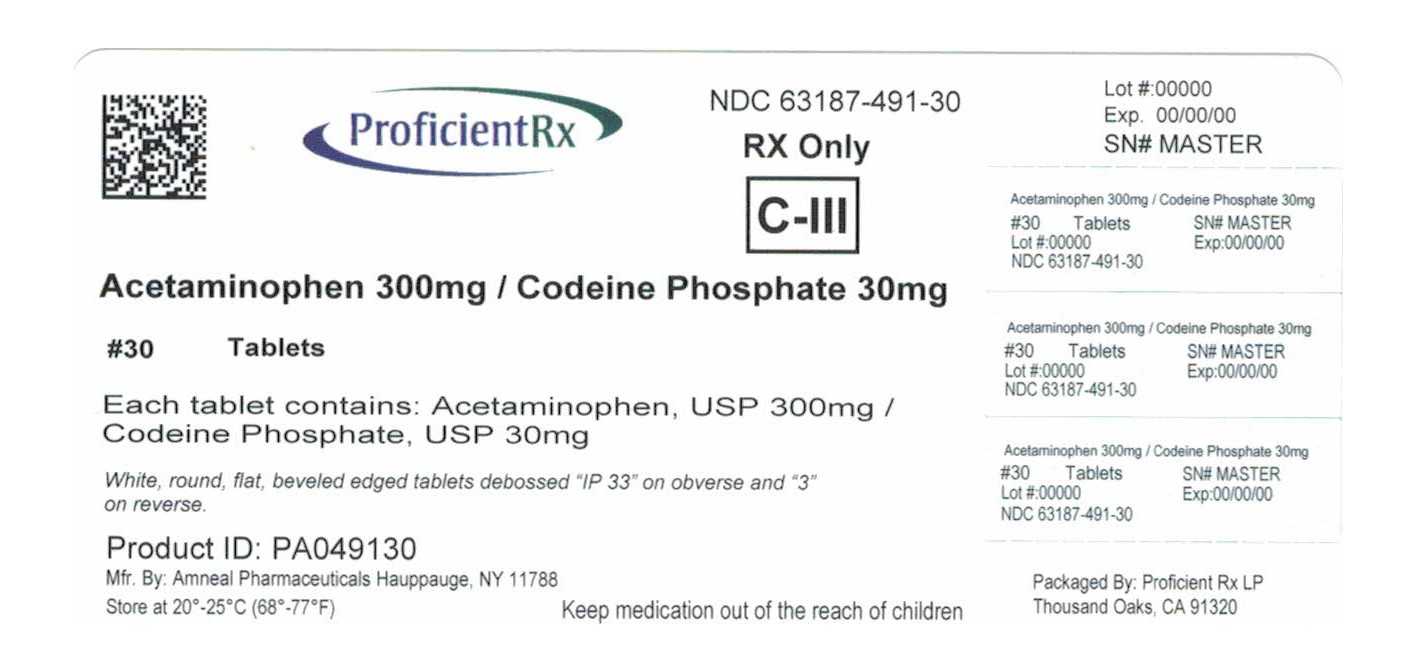
16 HOW SUPPLIED/STORAGE AND HANDLING Acetaminophen and Codeine Phosphate Tablets, USP 300 mg /30 mg are white, round, flat, beveled edged tablets debossed “IP 33” on obverse and “3” on reverse. They are available as follows: Bottles of 20: NDC 63187-491-20 Bottles of 30: NDC 63187-491-30 Bottles of 60 : NDC 63187-491-60 Bottles of 90 : NDC 63187-491-90 Store Acetaminophen and Codeine Phosphate Tablets, USP 300 mg/30 mg at 20° to 25°C (68° to 77°F) [See USP Controlled Room Temperature]. Dispense in tight, light-resistant container as defined in the USP.
Questions or Comments? Call 1-877-835-5472 Monday through Friday 9AM-5PM EST Manufactured by: Amneal Pharmaceuticals Hauppauge, NY 11788 Repackaged by: Proficient Rx LP Thousand Oaks, CA 91320 Rev. 10-2013
📋 Description ▾
11 DESCRIPTION Each tablet contains: Acetaminophen, USP……………………………………………………..300 mg Codeine Phosphate, USP…………………………………………………...30 mg (Warning: May be habit forming) Inactive ingredients: croscarmellose sodium, crospovidone, lactose monohydrate, magnesium stearate, microcrystalline cellulose, povidone, pregelatinized starch and stearic acid. Acetaminophen and codeine is supplied in tablet form for oral administration. Acetaminophen, 4'-hydroxyacetanlllde, IS a slightly bitter, white, odorless, crystalline powder, is a non-opiate, non-salicylate analgesic and antipyretic.
It has the following structural formula: Codeine phosphate: 7,8-didehydro-4,5α-epoxy-3-methoxy-l7-methylmorphinan-6α-ol phosphate (1:1) (salt) hemihydrate, a white crystalline powder, is a narcotic analgesic and antitussive. It has the following structural formula: 9ba1db7f-figure-01 9ba1db7f-figure-02
💬 Information for Patients ▾
17 PATIENT COUNSELING INFORMATION Click here to enter Patient Counseling Information
⚠️ Precautions ▾
PRECAUTIONS General Acetaminophen and Codeine Phosphate Tablets should be prescribed with caution in certain special-risk patients, such as the elderly or debilitated, and those with severe impairment of renal or hepatic function, head injuries, elevated intracranial pressure, acute abdominal conditions, hypothyroidism, urethral stricture, Addison's disease, or prostatic hypertrophy. INFORMATION FOR PATIENTS/CAREGIVERS 1. Do not take Acetaminophen and Codeine Phosphate Tablets, USP if you are allergic to any of its ingredients.
2. If you develop signs of allergy such as a rash or difficulty breathing, stop taking Acetaminophen and Codeine Phosphate Tablets, USP and contact your healthcare provider immediately. 3.
Do not take more than 4000 milligrams of acetaminophen per day. Call your doctor if you took more than the recommended dose. Codeine may impair mental and/or physical abilities required for the performance of potentially hazardous tasks such as driving a car or operating machinery.
Such tasks should be avoided while taking this product. Alcohol and other CNS depressants may produce an additive CNS depression, when taken with this combination product, and should be avoided. Codeine may be habit forming.
Patients should take the drug only for as long as it is prescribed, in the amounts prescribed, and no more frequently than prescribed. Advise patients that some people have a genetic variation that results in codeine changing into morphine more rapidly and completely than other people. Most people are unaware of whether they are an ultra-rapid codeine metabolizer or not.
These higher-than-normal levels of morphine in the blood may lead to life-threatening or fatal respiratory depression or signs of overdose such as extreme sleepiness, confusion, or shallow breathing. Children with this genetic variation who were prescribed codeine after tonsillectomy and/or adenoidectomy for obstructive sleep apnea may be at greatest risk based on reports of several deaths in this population due to respiratory depression. Codeine-containing products are contraindicated in all children who undergo tonsillectomy and/or adenoidectomy.
Advise caregivers of children receiving codeine-containing products for other reasons to monitor for signs of respiratory depression. Nursing mothers taking codeine can also have higher morphine levels in their breast milk if they are ultra-rapid metabolizers. These higher levels of morphine in breast milk may lead to life-threatening or fatal side effects in nursing babies.
Instruct nursing mothers to watch for signs of morphine toxicity in their infants including increased sleepiness (more than usual), difficulty breastfeeding, breathing difficulties, or limpness, Instruct nursing mothers to talk to the baby's doctor immediately if they notice these signs and, if they cannot reach the doctor right away, to take the baby to an emergency room or call 911 (or local emergency services). Laboratory Tests In patients with severe hepatic or renal disease, effects of therapy should be monitored with serial liver and/or renal function tests.
Drug Interactions This drug may enhance the effects of other narcotic analgesics, alcohol, general anesthetics, tranquilizers such as chlordiazepoxide, sedative-hypnotics, or other CNS depressants, causing increased CNS depression. Drug and Laboratory Test Interactions Codeine may increase serum amylase levels. Acetaminophen may produce false-positive test results for urinary 5-hydroxyindoleacetic acid.
Carcinogenesis, Mutagenesis, Impairment of Fertility No adequate studies have been conducted in animals to determine whether acetaminophen and codeine have a potential for carcinogenesis or mutagenesis. No adequate studies have been conducted in animals to determine whether acetaminophen has a potential for impairment of fertility. Acetaminophen and codeine have been found to have no mutagenic potential using the Ames Salmonella-Microsomal Activation test, the Basc test on Drosop… [Excerpted — this section continues on DailyMed.]
🧬 Pharmacokinetics ▾
12.3 Pharmacokinetics Click here to enter Pharmacokinetics
🧬 Pharmacodynamics ▾
12.2 Pharmacodynamics Click here to enter Pharmacodynamics
🔬 Clinical Studies ▾
14 CLINICAL STUDIES Click here to enter Clinical Studies
🔒 Drug Abuse and Dependence ▾
9 DRUG ABUSE AND DEPENDENCE Controlled Substance Acetaminophen and Codeine Phosphate Tablets are classified as a Schedule III controlled substance. Drug Abuse and Dependence Codeine can produce drug dependence of the morphine type and, therefore, has the potential for being abused. Psychological dependence, physical dependence and tolerance may develop upon repeated administration, and it should be prescribed and administered with the same degree of caution appropriate to the use of other oral narcotic medications.
9.1 Controlled Substance Click here to enter Controlled Substance
9.2 Abuse Click here to enter Abuse
9.3 Dependence Click here to enter Dependence
🔒 Controlled Substance ▾
9.1 Controlled Substance Click here to enter Controlled Substance
🧪 Nonclinical Toxicology ▾
13 NONCLINICAL TOXICOLOGY Click here to enter Nonclinical Toxicology
13.1Carcinogenesis, Mutagenesis, Impairment of Fertility Click here to enter Carcinogenesis, Mutagenesis, Impairment of Fertility
13.2Animal Toxicology and/or Pharmacology Click here to enter Animal Toxicology and/or Pharmacology
📄 Carcinogenesis, Mutagenesis, Impairment of Fertility ▾
13.1Carcinogenesis, Mutagenesis, Impairment of Fertility Click here to enter Carcinogenesis, Mutagenesis, Impairment of Fertility
📚 References ▾
15 REFERENCES Click here to enter References
📄 Recent Major Changes ▾
Click here to enter Recent Major Changes
📄 Package Label / Principal Display Panel ▾
PACKAGE/LABEL PRINCIPAL DISPLAY PANEL 63187-491-30
Reported adverse events (FAERS)
Top reported reactions
Reporter sex
Serious outcomes
Where does this data come from?
About this NDC listing & data coverage
What data is (and isn’t) available for this NDC — tap to expand
| NDC identity (package / product / labeler codes) | ✓ Available |
| Labeler | ✓ Available |
| Product & package description | ✓ Available |
| Marketing category & status | ✓ Available |
| Active ingredient / dosage form / route | ✓ Available |
| FDA label (SPL via DailyMed) | ✓ Available |
| Package photos | ✓ Available |
| Inactive ingredients (structured) | ✓ Available |
| NADAC pharmacy acquisition price (CMS) | — Not published for this NDC CMS publishes NADAC only for NDCs reported in its retail-pharmacy survey. |
| Orange Book / therapeutic-equivalence data | ✓ Available |
| HCPCS J-code billing crosswalk | — Not published for this NDC Most self-administered / retail products have no J-code — that is normal. |
| Medicaid utilization (CMS SDUD) | — Not published for this NDC CMS reports utilization only for NDCs with Medicaid claims above its privacy threshold. |