
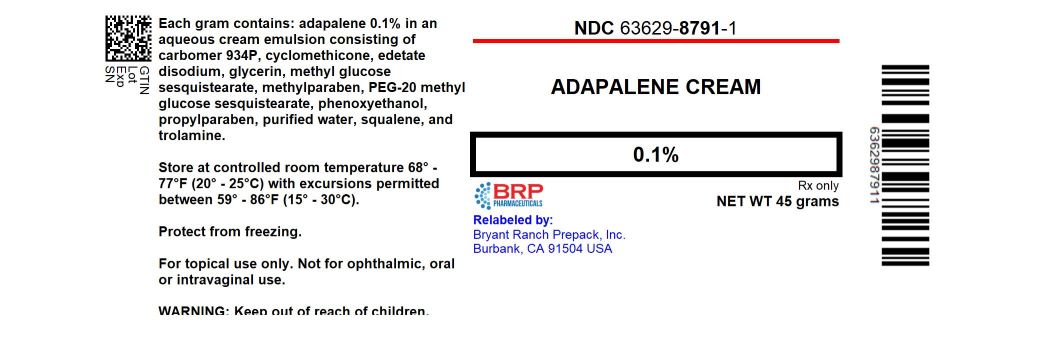
Adapalene 1 mg/g Cream — NDC 63629-8791-1 (Billing 63629-8791-01)
This is a package of Adapalene 1 mg/g Cream from Bryant Ranch Prepack, marketed since Jun 2010 and currently FDA-listed. It is this product's only package size.
NDC database record
One package, one record: these facts belong to NDC 63629-8791-1 alone.
- Record
- FDA NDC Directory package listing · Human prescription drug
- Code segments
- 63629 labeler · 8791 product · 1 package
- Package marketed since
- Jun 30, 2010
- Sample package
- No — commercial package
- Listing certified through
- Dec 31, 2027
- Barcode (UPC-A, from the NDC)
- 3 6362987911 3
- FDA record last changed
- Jul 24, 2026
Identity & classification
Regulatory identifiers FDA, NLM and CMS codes for this package
Drug-database identifiers Medi-Span GPI and First Databank GCN / HICL / AHFS classification
- GSN (GCN sequence number): 031789
- GCN: 29301
- GPI-14 (Medi-Span): 90050003003710
- HICL (First Databank): 011233
- AHFS class code: 84:28.00.00
- RxCUI (RxNorm): 313852
Where does this data come from?
- FDA openFDA NDC Directory · synced Oct 8, 2026
- FDA label on DailyMed · label index refreshed Oct 8, 2026
- RxNorm (NLM RxNav) · catalog refreshed Oct 1, 2026
- Medi-Span GPI (licensed)
- First Databank (licensed) · refreshed Oct 8, 2026
RxNorm drug class
This medicine belongs to the Retinoid class.
Where does this data come from?
- RxClass (NLM) · catalog refreshed Oct 1, 2026
Clinical
- It treats acne vulgaris, the common type of acne. Some products are labeled for ages 12 and up. Ask a doctor before using it in younger children.
- Use it once a day, usually in the evening, on clean, dry skin. Apply a thin layer to the whole affected area and keep it away from your eyes, lips and inside of your mouth or nose....
- Give it about 8 to 12 weeks. Acne can seem to flare in the early weeks, which is not a reason to stop. If you see no improvement after 12 weeks, talk to your prescriber.
- Redness, dryness, peeling and some burning or stinging are the most common, especially in the first month. They are usually mild to moderate and often ease. A moisturizer can help....
Patient education
Supplement & herbal interactions
Where does this data come from?
- MedlinePlus (NLM) · refreshed Oct 8, 2026
- FDA label on DailyMed · label index refreshed Oct 8, 2026
Ask a licensed pharmacist directly — free, answered by our team.
Pricing
A drug doesn't have one price. Each row is a different public payment system, and none is what you'd pay at the counter — that depends on your insurance. The ⓘ on each row explains what it measures.
| Price system | Per g | Per package |
|---|---|---|
| Retail pharmacies payNADAC · weekly | Not in the retail survey — common for institutional, discontinued, or low-volume packs. | |
| Medicaid paysCMS SDUD · 12 mo | No recent Medicaid claims on file for this NDC — rare and low-volume NDCs are suppressed in the public data. | |
| Medicare drug plans payPart D · Q2 2026 | $2.81 | $126.31 / 45 g |
Where does this data come from?
- CMS NADAC weekly file
- CMS ASP pricing files · refreshed Sep 20, 2026
- CMS Medicaid State Drug Utilization Data · refreshed Oct 8, 2026
- CMS Part D plan pricing files · refreshed Sep 24, 2026
- VA National Acquisition Center price file
Packaging — all sizes for this product
| Package NDC | Description | Marketing start | Marketing end | Status |
|---|---|---|---|---|
| 63629-8791-01 You're viewing this Main listing | 1 TUBE in 1 CARTON / 45 g in 1 TUBE | 2010-06-30 | — | Active |
Therapeutic equivalents
| Product | Labeler | Pack | NADAC/unit | TE | Status | Price vs. this |
|---|---|---|---|---|---|---|
| Adapalene 1 mg/g 70000-0666-01 | Cardinal | 1 tube | $0.466 | — | Availability likely | — |
| Adapalene 1 mg/g 46122-0768-36 | AMERISOURCE | 1 tube | $0.466 | — | Availability likely | — |
| Adapalene 1 mg/g 00536-1412-20 | RUGBY | 1 tube | $0.466 | — | Availability likely | — |
| Adapalene 1 mg/g 51672-2150-01 | Sun | 1 tube | $0.466 | — | Availability likely | — |
| Adapalene 1 mg/g 00168-0424-46 | E. | 1 tube | $2.855 | AB | Availability likely | — |
| Adapalene .1 g/100g 45802-0453-84 | Padagis | 1 tube | $2.855 | AB | Availability likely | — |
| Adapalene 1 mg/gthis 63629-8791-01 | Bryant | 1 tube | — | AB | FDA listed | — |
| Adapalene 1 mg/g 72162-1048-02 | Bryant | 1 tube | — | AB | FDA listed | — |
| Differin 1 mg/g 00299-4910-00 | Galderma | 1 tube | — | — | FDA listed | — |
| Adapalene 1 mg/g 41250-0288-05 | MEIJER, | 1 tube | — | — | FDA listed | — |
| Adapalene 1 mg/g 49967-0354-01 | LOreal | 1 tube | — | — | FDA listed | — |
| Effaclar 1 mg/g 49967-0591-01 | LOreal | 1 tube | — | — | FDA listed | — |
| Adapalene 1 mg/g 59726-0888-05 | P | 1 tube | — | — | Discontinued | — |
| Adapalene 1 mg/g 79481-1140-05 | Meijer | 1 tube | — | — | FDA listed | — |
| PanOxyl 1 mg/g 00316-0143-15 | CROWN | 1 tube | — | — | FDA listed | — |
| Adapalene 1 mg/g 73581-0215-45 | YYBA | 1 tube | — | — | FDA listed | — |
| Adapalene 1 mg/g 55910-0880-05 | Dolgencorp, | 1 tube | — | — | FDA listed | — |
| Neutrogena Evenly Clear Retinoid Adapalene Gel 0.1% Acne Treatment 1 mg/g 69968-0945-02 | Kenvue | 1 tube | — | — | FDA listed | — |
| Neutrogena Adapalene 0.1% Acne Treatment 1 mg/g 69968-0826-01 | Kenvue | 1 tube | — | — | FDA listed | — |
| Adapalene 1 mg/g 21130-0754-05 | Safeway, | 1 tube | — | — | FDA listed | — |
| Adapalene 1 mg/g 00363-1401-05 | Walgreens | 1 tube | — | — | FDA listed | — |
| Neutrogena Evenly Clear Retinoid Adapalene Gel 0.1% Acne Treatment 1 mg/g 69968-1004-02 | Kenvue | 1 tube | — | — | FDA listed | — |
| Adapalene 1 mg/g 72657-0158-15 | GLENMARK | 1 bottle | — | — | FDA listed | — |
| Adapalene 1 mg/g 73581-0019-06 | YYBA | 1 tube | — | — | FDA listed | — |
| Adapalene 1 mg/g 59726-0114-05 | P | 1 tube | — | — | FDA listed | — |
| Adapalene 1 mg/g 73581-0214-06 | YYBA | 1 tube | — | — | FDA listed | — |
| Adapalene 1 mg/g 76162-0114-05 | Topco | 1 tube | — | — | FDA listed | — |
| Adapalene 1 mg/g 82442-0105-01 | Target | 1 tube | — | — | FDA listed | — |
| Adapalene 1 mg/g 11822-0062-01 | RITE | 1 tube | — | — | FDA listed | — |
| Adapalene 1 mg/g 30142-0725-05 | The | 1 tube | — | — | FDA listed | — |
| Adapalene 1 mg/g 36800-0088-05 | TOP | 1 tube | — | — | Discontinued | — |
| Adapalene 1 mg/g 69842-0088-05 | CVS | 1 tube | — | — | FDA listed | — |
| Effaclar 1 mg/g 49967-0592-01 | LOreal | 1 tube | — | — | FDA listed | — |
| PanOxyl 1 mg/g 00316-0284-15 | CROWN | 1 tube | — | — | FDA listed | — |
| Adapalene 1 mg/g 00363-4110-05 | Walgreens | 1 tube | — | — | FDA listed | — |
| Adapalene 1 mg/g 73581-0216-45 | YYBA | 1 tube | — | — | FDA listed | — |
| Adapalene 1 mg/g 51316-0114-05 | CVS | 1 tube | — | — | FDA listed | — |
| Adapalene 1 mg/g 00363-0888-05 | Walgreens | 1 tube | — | — | FDA listed | — |
| Adapalene 1 mg/g 79903-0338-05 | Wal-Mart | 1 tube | — | — | FDA listed | — |
| Adapalene Paraben Free 1 mg/g 76162-0221-05 | Topco | 1 tube | — | — | FDA listed | — |
| Adapalene Paraben Free 1 mg/g 79481-2210-05 | Meijer | 1 tube | — | — | FDA listed | — |
| Adapalene Paraben Free 1 mg/g 30142-0542-05 | The | 1 tube | — | — | FDA listed | — |
| Adapalene Paraben Free 1 mg/g 51316-0219-05 | CVS | 1 tube | — | — | FDA listed | — |
Where does this data come from?
- FDA openFDA NDC Directory · synced Oct 8, 2026
- FDA Orange Book · refreshed Oct 3, 2026
- CMS NADAC weekly file
Availability & generic status
This product is an FDA-approved generic. Other versions of the same drug are listed under Therapeutic equivalents, least expensive first.
Where does this data come from?
- FDA Orange Book · refreshed Oct 3, 2026
Inactive Ingredients / Excipients
Inactive ingredients, also called excipients, are components of the drug product other than the active ingredient. They may include fillers, dyes, coatings, preservatives, flavors, or other formulation ingredients.
🧪 Avoiding an ingredient? See Adapalene inactive ingredients by manufacturer: every current product's list side by side, so you can ask your pharmacy for the version that does not list it.
💡 Tap an ingredient (hover on desktop) to see what it is and why it’s used.
-
UNII Z135WT9208
Carbomer is a synthetic polymer that forms a thick, gel-like consistency. It's used in medicines as a thickener and stabilizer to improve texture and keep ingredients evenly mixed throughout the product.
-
UNII NMQ347994Z
Cyclomethicone is a silicone-based fluid that acts as a lubricant and solvent in medicines. It helps products flow smoothly, reduces friction between particles, and aids in even distribution of active ingredients.
-
UNII 7FLD91C86K
Edetate disodium is a chemical compound that binds and removes certain metal ions. In medicines, it acts as a preservative and stabilizer by preventing metals like calcium from interfering with the product's shelf life and consistency.
-
UNII PDC6A3C0OX
Glycerin is a clear, thick liquid derived from plant oils or fats. It acts as a humectant to retain moisture, a sweetener, and a solvent in medications.
-
UNII A2I8C7HI9T
Methylparaben is a preservative derived from benzoic acid that prevents growth of bacteria, fungi, and mold in medicines. It extends the product's shelf life and maintains safety during storage.
-
UNII HIE492ZZ3T
Phenoxyethanol is a synthetic preservative and antimicrobial agent used to prevent bacterial and fungal growth in medicines and cosmetic products, extending shelf life and maintaining product safety.
-
UNII Z8IX2SC1OH
Propylparaben is a chemical preservative used to prevent bacterial and fungal growth in medicines and personal care products. It helps extend shelf life and maintain product safety during storage.
-
UNII 7QWM220FJH
Squalene is a natural oil-like substance found in shark liver and some plants. It's used in medicines as an emulsifier to help mix oil and water-based ingredients together.
-
UNII 9O3K93S3TK
Trolamine is an alkaline compound used as a pH buffer and emulsifier in medicines. It helps neutralize acids, stabilize formulations, and enable mixing of oil and water-based ingredients.
-
UNII 059QF0KO0R
Water is a liquid solvent that dissolves and mixes ingredients together in liquid medicines, syrups, and injections. It helps distribute the active drug evenly throughout the product.
10 inactive ingredients listed in the exact product block matched to this NDC.
Where does this data come from?
ingredient classCode="IACT" elements from the exact product block matched by this NDC. Label-section narrative from DailyMed / the openFDA label index is shown separately when available.- FDA label on DailyMed · label index refreshed Oct 8, 2026
- FDA openFDA NDC Directory · synced Oct 8, 2026
Inactive ingredient FAQ
Are inactive ingredients the same for every manufacturer?
Why might an inactive ingredient be missing?
Can inactive ingredients matter?
Manufacturer & labeler
More NDCs from Bryant Ranch Prepack labeler code 63629
- Triamcinolone acetonide 1 mg/g Cream NDC 63629-8779-1
- Triamcinolone acetonide 1 mg/g Cream NDC 63629-8780-1
- Triamcinolone acetonide 1 mg/g Cream NDC 63629-8781-1
- Triamcinolone Acetonide .25 mg/g Cream NDC 63629-8782-1
- Triamcinolone Acetonide .25 mg/g Cream NDC 63629-8784-1
- Triamcinolone Acetonide 5 mg/g Cream NDC 63629-8785-1
- Cilostazol 100 mg Tablet NDC 63629-8795-1
- Cilostazol 50 mg Tablet NDC 63629-8796-1
- Enulose Lactulose 10 g/15mL Solution NDC 63629-8800-1
- Epinephrine .15 mg/.3mL Injection NDC 63629-8801-1
- Estradiol .5 mg Tablet NDC 63629-8802-1
- Estradiol 10 ug Insert NDC 63629-8803-1
Where does this data come from?
- FDA openFDA NDC Directory · synced Oct 8, 2026
- Drugs@FDA
Full prescribing information FDA SPL
🎯 Indications and Usage ▾
INDICATIONS AND USAGE: Adapalene cream is indicated for the topical treatment of acne vulgaris.
⏱️ Dosage and Administration ▾
DOSAGE AND ADMINISTRATION: Adapalene cream should be applied to affected areas of the skin, once daily at nighttime. A thin film of the cream should be applied to the skin areas where acne lesions appear, using enough to cover the entire affected areas lightly. A mild transitory sensation of warmth or slight stinging may occur shortly after the application of adapalene cream.
⛔ Contraindications ▾
CONTRAINDICATIONS: Adapalene cream should not be administered to individuals who are hypersensitive to adapalene or any of the components in the cream vehicle.
🤒 Adverse Reactions ▾
ADVERSE REACTIONS: In controlled clinical trials, local cutaneous irritation was monitored in 285 acne patients who used adapalene cream once daily for 12 weeks. The frequency and severity of erythema, scaling, dryness, pruritus and burning were assessed during these studies. The incidence of local cutaneous irritation with adapalene cream from the controlled clinical studies is provided in the following table: Incidence of Local Cutaneous Irritations with Adapalene Cream from Controlled Clinical Studies (N=285) None Mild Moderate Severe Erythema 52% (148) 38% (108) 10% (28) <1% (1) Scaling 58% (166) 35% (100) 6% (18) <1% (1) Dryness 48% (136) 42% (121) 9% (26) <1% (2) Pruritis (persistent) 74% (211) 21% (61) 4% (12) <1% (1) Burning/Stinging (persistent) 71% (202) 24% (69) 4% (12) <1% (2) Other reported local cutaneous adverse events in patients who used adapalene cream once daily included: sunburn (2%), skin discomfort-burning and stinging (1%) and skin irritation (1%).
Events occurring in less than 1% of patients treated with adapalene cream included: acne flare, dermatitis and contact dermatitis, eyelid edema, conjunctivitis, erythema, pruritus, skin discoloration, rash, and eczema.
🔄 Drug Interactions ▾
Drug Interactions: As adapalene cream has the potential to produce local irritation in some patients, concomitant use of other potentially irritating topical products (medicated or abrasive soaps and cleansers, soaps and cosmetics that have a strong drying effect, and products with high concentrations of alcohol, astringents, spices or lime rind) should be approached with caution. Particular caution should be exercised in using preparations containing sulfur, resorcinol, or salicylic acid in combination with adapalene cream.
If these preparations have been used, it is advisable not to start therapy with adapalene cream until the effects of such preparations in the skin have subsided.
🤰 Pregnancy ▾
Pregnancy: Teratogenic effects. Pregnancy Category C. No teratogenic effects were seen in rats at oral doses of 0.15 to 5.0 mg/kg/day adapalene (up to 20 times the MRHD based on mg/m 2 comparisons).
However, adapalene administered orally at doses of ≥ 25 mg/kg, (100 times the MRHD for rats or 200 times MRHD for rabbits) has been shown to be teratogenic. Cutaneous teratology studies in rats and rabbits at doses of 0.6, 2.0, and 6.0 mg/kg/day (24 times the MRHD for rats or 48 times the MRHD for rabbits) exhibited no fetotoxicity and only minimal increases in supernumerary ribs in rats. There are no adequate and well-controlled studies in pregnant women.
Adapalene should be used during pregnancy only if the potential benefit justifies the potential risk to the fetus.
🧒 Pediatric Use ▾
Pediatric Use: Safety and effectiveness in pediatric patients below the age of 12 have not been established.
🧓 Geriatric Use ▾
Geriatric Use: Clinical studies of adapalene cream were conducted in patients 12 to 30 years of age with acne vulgaris and therefore did not include subjects 65 years and older to determine whether they respond differently than younger subjects. Other reported clinical experience has not identified differences in responses between the elderly and younger patients.
🆘 Overdosage ▾
OVERDOSAGE: Adapalene cream is intended for cutaneous use only. If the medication is applied excessively, no more rapid or better results will be obtained and marked redness, scaling, or skin discomfort may occur. The acute oral toxicity of adapalene cream in mice and rats is greater than 10 mL/kg. Chronic ingestion of the drug may lead to the same side effects as those associated with excessive oral intake of Vitamin A.
🧬 Clinical Pharmacology ▾
CLINICAL PHARMACOLOGY: Mechanism of Action: Adapalene acts on retinoid receptors. Biochemical and pharmacological profile studies have demonstrated that adapalene is a modulator of cellular differentiation, keratinization, and inflammatory processes all of which represent important features in the pathology of acne vulgaris. Mechanistically, adapalene binds to specific retinoic acid nuclear receptors but does not bind to the cytosolic receptor protein.
Although the exact mode of action of adapalene is unknown, it is suggested that topical adapalene normalizes the differentiation of follicular epithelial cells resulting in decreased microcomedone formation. Pharmacokinetics: Absorption of adapalene from adapalene cream through human skin is low. In a pharmacokinetic study with six acne patients treated once daily for 5 days with 2 grams of adapalene cream applied to 1000 cm 2 of acne involved skin, there were no quantifiable amounts (limit of quantification = 0.35 ng/mL) of adapalene in the plasma samples from any patient.
Excretion appears to be primarily by the biliary route.
🧬 Mechanism of Action ▾
Mechanism of Action: Adapalene acts on retinoid receptors. Biochemical and pharmacological profile studies have demonstrated that adapalene is a modulator of cellular differentiation, keratinization, and inflammatory processes all of which represent important features in the pathology of acne vulgaris. Mechanistically, adapalene binds to specific retinoic acid nuclear receptors but does not bind to the cytosolic receptor protein.
Although the exact mode of action of adapalene is unknown, it is suggested that topical adapalene normalizes the differentiation of follicular epithelial cells resulting in decreased microcomedone formation.
📦 How Supplied / Storage and Handling ▾
HOW SUPPLIED: Adapalene Cream, 0.1% is supplied in 45 g tube: NDC 63629-8791-1 Storage: Store at controlled room temperature 68° to 77°F (20° to 25°C). Excursions permitted between 59° and 86° F (15° and 30° C). Protect from freezing. Repackaged/Relabeled by: Bryant Ranch Prepack Burbank, CA 91504
📋 Description ▾
DESCRIPTION: Adapalene cream, 0.1%, contains adapalene 0.1% in an aqueous cream emulsion consisting of carbomer 934P, cyclomethicone, edetate disodium, glycerin, methyl glucose sesquistearate, methylparaben, PEG-20 methyl glucose sesquistearate, phenoxyethanol, propylparaben, purified water, squalane, and trolamine. The chemical name of adapalene is 6-[3-(1-adamantyl)-4-methoxyphenyl]-2-naphthoic acid. It is a white to off-white powder which is soluble in tetrahydrofuran, sparingly soluble in ethanol, and practically insoluble in water.
The molecular formula is C 28 H 28 O 3 and molecular weight is 412.52. Adapalene is represented by the following structural formula:
💬 Information for Patients ▾
Information for Patients: Patients using adapalene cream should receive the following information and instructions: 1. This medication is to be used only as directed by the physician. 2.
It is for external use only. 3. Avoid contact with the eyes, lips, angles of the nose, and mucous membranes.
4. Cleanse area with a mild or soapless cleanser before applying this medication. 5.
Moisturizers may be used if necessary, however, products containing alpha hydroxyl or glycolic acids should be avoided. 6. Exposure of the eye to this medication may result in reactions such as swelling, conjunctivitis, and eye irritation.
7. This medication should not be applied to cuts, abrasions, eczematous or sunburned skin. 8.
Wax epilation should not be performed on treated skin due to the potential for skin erosions. 9. During the early weeks of therapy, an apparent exacerbation of acne may occur.
This is due to the action of this medication on previously unseen lesions and should not be considered a reason to discontinue therapy. Overall clinical benefit may be noticed after two weeks of therapy, but at least eight weeks are required to obtain consistent beneficial effects.
⚠️ Precautions ▾
PRECAUTIONS: General: Certain cutaneous signs and symptoms of treatment such as erythema, dryness, scaling, burning, or pruritus may be experienced with use of adapalene cream. These are most likely to occur during the first two to four weeks of treatment, are mostly mild to moderate in intensity, and usually lessen with continued use of the medication. Depending upon the severity of these side effects, patients should be instructed to reduce the frequency of application or discontinue use.
If a reaction suggesting sensitivity or chemical irritation occurs, use of the medication should be discontinued. Exposure to sunlight, including sunlamps, should be minimized during use of adapalene. Patients who normally experience high levels of sun exposure, and those with inherent sensitivity to sun, should be warned to exercise caution.
Use of sunscreen products and protective clothing over treated areas is recommended when exposure cannot be avoided. Weather extremes, such as wind or cold, also may be irritating to patients under treatment with adapalene. Avoid contact with the eyes, lips, angles of the nose, and mucous membranes.
The product should not be applied to cuts, abrasions, eczematous or sunburned skin. As with other retinoids, use of "waxing" as a depilatory method should be avoided on skin treated with adapalene. Information for Patients: Patients using adapalene cream should receive the following information and instructions: 1.
This medication is to be used only as directed by the physician. 2. It is for external use only.
3. Avoid contact with the eyes, lips, angles of the nose, and mucous membranes. 4.
Cleanse area with a mild or soapless cleanser before applying this medication. 5. Moisturizers may be used if necessary, however, products containing alpha hydroxyl or glycolic acids should be avoided.
6. Exposure of the eye to this medication may result in reactions such as swelling, conjunctivitis, and eye irritation. 7.
This medication should not be applied to cuts, abrasions, eczematous or sunburned skin. 8. Wax epilation should not be performed on treated skin due to the potential for skin erosions.
9. During the early weeks of therapy, an apparent exacerbation of acne may occur. This is due to the action of this medication on previously unseen lesions and should not be considered a reason to discontinue therapy.
Overall clinical benefit may be noticed after two weeks of therapy, but at least eight weeks are required to obtain consistent beneficial effects. Drug Interactions: As adapalene cream has the potential to produce local irritation in some patients, concomitant use of other potentially irritating topical products (medicated or abrasive soaps and cleansers, soaps and cosmetics that have a strong drying effect, and products with high concentrations of alcohol, astringents, spices or lime rind) should be approached with caution.
Particular caution should be exercised in using preparations containing sulfur, resorcinol, or salicylic acid in combination with adapalene cream. If these preparations have been used, it is advisable not to start therapy with adapalene cream until the effects of such preparations in the skin have subsided. Carcinogenesis, Mutagenesis, and Impairment of Fertility: Carcinogenicity studies with adapalene have been conducted in mice at topical doses of 0.4, 1.3, and 4.0 mg/kg/day, and in rats at oral doses of 0.15, 0.5, and 1.5 mg/kg/day.
These doses are up to 8 times (mice) and 6 times (rats) in terms of mg/m 2 /day the maximum potential exposure at the recommended topical human dose (MRHD), assumed to be 2.5 grams adapalene cream, which is approximately 1.5 mg/m 2 adapalene. In the oral study, increased incidence of benign and malignant pheochromocytomas in the adrenal medullas of male rats was observed. No photocarcinogenicity studies were conducted.
Animal studies have shown an increased risk of skin neoplasms with the use of pharmacologically similar drugs (e.g., retinoids) when expo… [Excerpted — this section continues on DailyMed.]
🍼 Nursing Mothers ▾
Nursing Mothers: It is not known whether this drug is excreted in human milk. Because many drugs are excreted in human milk, caution should be exercised when adapalene cream is administered to a nursing woman.
🧬 Pharmacokinetics ▾
Pharmacokinetics: Absorption of adapalene from adapalene cream through human skin is low. In a pharmacokinetic study with six acne patients treated once daily for 5 days with 2 grams of adapalene cream applied to 1000 cm 2 of acne involved skin, there were no quantifiable amounts (limit of quantification = 0.35 ng/mL) of adapalene in the plasma samples from any patient. Excretion appears to be primarily by the biliary route.
🔬 Clinical Studies ▾
CLINICAL STUDIES: Two vehicle-controlled clinical studies were conducted in patients 12 to 30 years of age with mild to moderate acne vulgaris, in which adapalene cream was compared with its vehicle. Patients were instructed to apply their treatment medication once daily at bedtime for 12 weeks. In one study patients were provided with a soapless cleanser and were encouraged to refrain from using moisturizers.
No other topical medications, other than adapalene cream, were to be applied to the face during the studies. Adapalene cream was significantly more effective than its vehicle in the reduction of acne lesion counts. The mean percent reduction in lesion counts from baseline after treatment for 12 weeks are presented in the following table: MEAN PERCENT REDUCTION IN LESION COUNTS FROM BASELINE TO WEEK 12 Study No.
1 Study No. 2 Efficacy Variable Adapalene Cream, 0.1% N=119 Cream Vehicle N=118 Adapalene Cream, 0.1% N=175 Cream Vehicle N=175 Non-inflammatory lesions 34% 18% 35% 15% Inflammatory lesions 32% 17% 14% 6% Total lesions 34% 18% 30% 15% The trend in the Investigator's global assessment of severity supported the efficacy of adapalene cream when compared to the cream vehicle.
📄 Carcinogenesis, Mutagenesis, Impairment of Fertility ▾
Carcinogenesis, Mutagenesis, and Impairment of Fertility: Carcinogenicity studies with adapalene have been conducted in mice at topical doses of 0.4, 1.3, and 4.0 mg/kg/day, and in rats at oral doses of 0.15, 0.5, and 1.5 mg/kg/day. These doses are up to 8 times (mice) and 6 times (rats) in terms of mg/m 2 /day the maximum potential exposure at the recommended topical human dose (MRHD), assumed to be 2.5 grams adapalene cream, which is approximately 1.5 mg/m 2 adapalene. In the oral study, increased incidence of benign and malignant pheochromocytomas in the adrenal medullas of male rats was observed.
No photocarcinogenicity studies were conducted. Animal studies have shown an increased risk of skin neoplasms with the use of pharmacologically similar drugs (e.g., retinoids) when exposed to UV irradiation in the laboratory or to sunlight. Although the significance of these studies to human use is not clear, patients should be advised to avoid or minimize exposure to either sunlight or artificial UV irradiation sources.
Adapalene did not exhibit mutagenic or genotoxic effects in vivo (mouse micronucleous test) and in vitro (Ames test, Chinese hamster ovary cell assay, mouse lymphoma TK assay) studies. Reproductive function and fertility studies were conducted in rats administered oral doses of adapalene in amounts up to 20 mg/kg/day (up to 80 times the MRHD based on mg/m 2 comparisons). No effects of adapalene were found on the reproductive performance or fertility of the Fo males or females.
There were also no detectable effects on the growth, development and subsequent reproductive function of the F 1 generation.
📄 Package Label / Principal Display Panel ▾
Adapalene 0.1% Cream Label
Medicare Part D spend CMS · PART D · 2026 (Q1)
About this NDC listing & data coverage
What data is (and isn’t) available for this NDC — tap to expand
| NDC identity (package / product / labeler codes) | ✓ Available |
| Labeler | ✓ Available |
| Product & package description | ✓ Available |
| Marketing category & status | ✓ Available |
| Active ingredient / dosage form / route | ✓ Available |
| FDA label (SPL via DailyMed) | ✓ Available |
| Package photos | ✓ Available |
| Inactive ingredients (structured) | ✓ Available |
| NADAC pharmacy acquisition price (CMS) | — Not published for this NDC CMS publishes NADAC only for NDCs reported in its retail-pharmacy survey. |
| Orange Book / therapeutic-equivalence data | ✓ Available |
| HCPCS J-code billing crosswalk | — Not published for this NDC Most self-administered / retail products have no J-code — that is normal. |
| Medicaid utilization (CMS SDUD) | — Not published for this NDC CMS reports utilization only for NDCs with Medicaid claims above its privacy threshold. |