
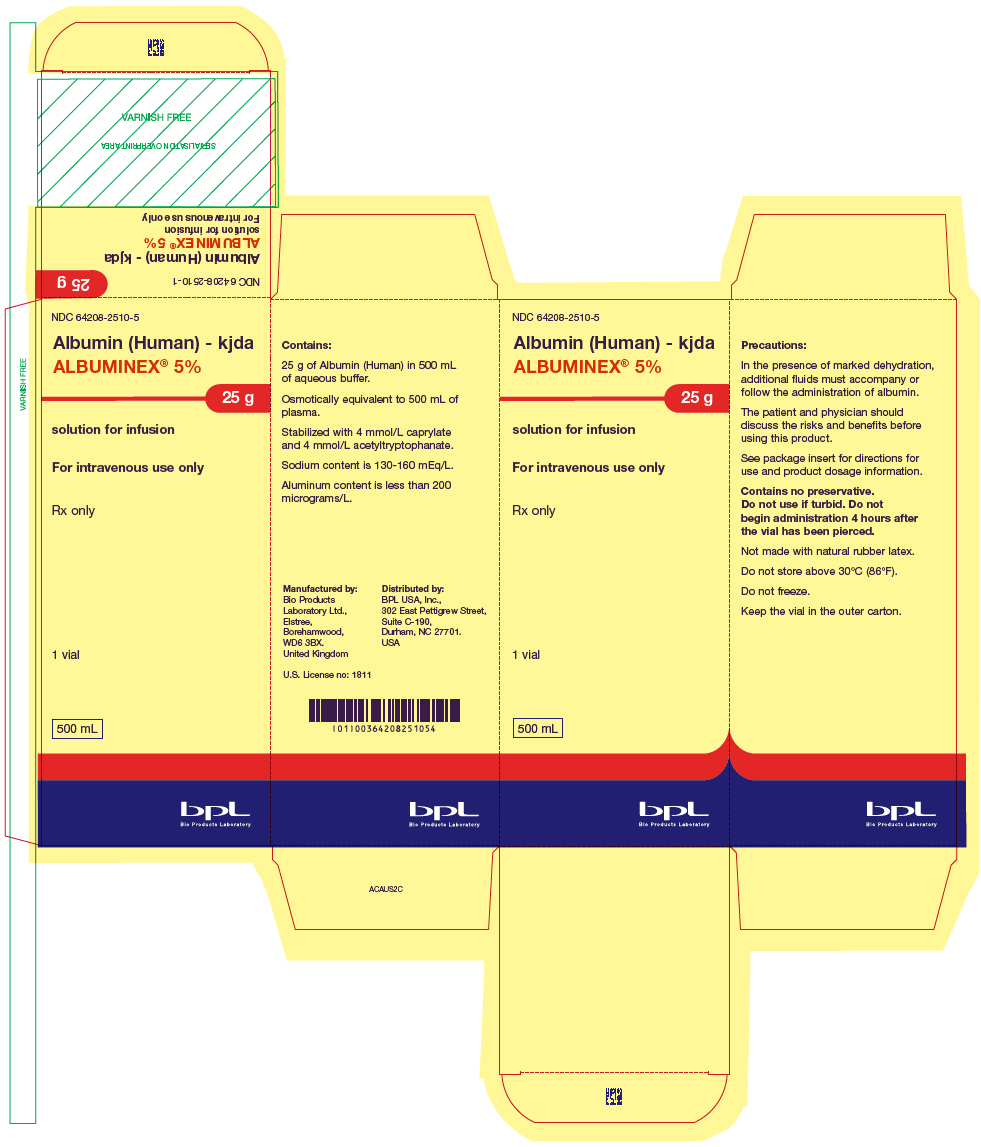
ALBUMINEX Albumin Human .05 g/mL Solution — NDC 64208-2510-5 (Billing 64208-2510-05)
This is a package of ALBUMINEX Albumin Human .05 g/mL Solution from BPL, marketed since May 2020 and currently FDA-listed.
NDC database record
One package, one record: these facts belong to NDC 64208-2510-5 alone.
- Record
- FDA NDC Directory package listing · Human prescription drug
- Code segments
- 64208 labeler · 2510 product · 5 package
- Package marketed since
- May 27, 2020
- Sample package
- No — commercial package
- Listing certified through
- Dec 31, 2026
- Barcode (UPC-A, from the NDC)
- 3 6420825105 4
- FDA record last changed
- Jul 24, 2026
Identity & classification
Regulatory identifiers FDA, NLM and CMS codes for this package
Drug-database identifiers Medi-Span GPI and First Databank GCN / HICL / AHFS classification
- GSN (GCN sequence number): 078626
- GCN: 44985
- GPI-14 (Medi-Span): 85400010202010
- HICL (First Databank): 045087
- AHFS class code: 16:00.00.00
- RxCUI (RxNorm): 2054221
Where does this data come from?
- FDA openFDA NDC Directory · synced Oct 8, 2026
- FDA label on DailyMed · label index refreshed Oct 8, 2026
- RxNorm (NLM RxNav) · catalog refreshed Oct 8, 2026
- Medi-Span GPI (licensed)
- First Databank (licensed) · refreshed Oct 8, 2026
RxNorm drug class
This medicine belongs to the Human Serum Albumin class.
Where does this data come from?
- RxClass (NLM) · catalog refreshed Oct 8, 2026
Clinical
Albumin (human) injection is used to treat low blood volume (hypovolemia) and low albumin levels in the blood (hypoalbuminemia) caused by bleeding, burns, major injuries or infections, malnutrition, major surgery, and other serious medical problems. It is also used during certain surgeries and medical treatments. Albumin (human) injection is in a class of medications called protein colloids. It works by keeping fluid from leaking out of blood vessels and helps to move important substances through the body.
Read the full MedlinePlus article ↗Patient education
Supplement & herbal interactions
Where does this data come from?
- MedlinePlus (NLM) · refreshed Oct 8, 2026
- FDA label on DailyMed · label index refreshed Oct 8, 2026
Ask a licensed pharmacist directly — free, answered by our team.
Pricing
A drug doesn't have one price. Each row is a different public payment system, and none is what you'd pay at the counter — that depends on your insurance. The ⓘ on each row explains what it measures.
| Price system | Per mL | Per package |
|---|---|---|
| Retail pharmacies payNADAC · weekly | Not in the retail survey — common for institutional, discontinued, or low-volume packs. | |
| Medicaid paysCMS SDUD · 12 mo | No recent Medicaid claims on file for this NDC — rare and low-volume NDCs are suppressed in the public data. | |
| Medicare drug plans payPart D · quarterly | No Part D plan price is available for this NDC in our data. | |
Where does this data come from?
- CMS NADAC weekly file
- CMS ASP pricing files · refreshed Sep 20, 2026
- CMS Medicaid State Drug Utilization Data · refreshed Oct 9, 2026
- CMS Part D plan pricing files · refreshed Sep 24, 2026
- VA National Acquisition Center price file
Packaging — all sizes for this product
| Package NDC | Description | Marketing start | Marketing end | Status |
|---|---|---|---|---|
| 64208-2510-01 64208-2510-1 Main listing | 1 VIAL, GLASS in 1 CARTON / 250 mL in 1 VIAL, GLASS | 2020-05-27 | — | Active |
| 64208-2510-05 You're viewing this | 1 VIAL, GLASS in 1 CARTON / 500 mL in 1 VIAL, GLASS | 2020-05-27 | — | Active |
Pack size FAQ
What quantity is in this package?
What NDC number is used to bill for this package of ALBUMINEX Albumin Human .05 g/mL Solution?
Therapeutic equivalents
| Product | Labeler | Pack | NADAC/unit | TE | Status | Price vs. this |
|---|---|---|---|---|---|---|
| Albuminex .05 g/mLthis 64208-2510-05 | BPL | 1 vial | — | — | FDA listed | — |
| Flexbumin .05 g/mL 00944-0495-05 | Takeda | 250 ml | — | — | FDA listed | — |
Where does this data come from?
- FDA openFDA NDC Directory · synced Oct 8, 2026
- FDA Purple Book · refreshed Oct 5, 2026
- CMS NADAC weekly file
Availability & biosimilar status
Biologics have no small-molecule generics; biosimilar competition is tracked in the FDA Purple Book.
Why the date isn’t exact: Biosimilar timing can change because patents may be challenged, settled, licensed, added or removed, and litigation can move the real date earlier or later.
🛈 What do these terms mean?
- Biologic patent
- A patent the reference product’s maker has publicly listed. A biosimilar generally can’t launch until these expire — unless they’re invalidated or resolved in a settlement.
- Reference-product exclusivity
- A flat 12 years of FDA market protection from the biologic’s first licensure (the BPCIA). No biosimilar can be licensed before it ends, regardless of patents.
- Interchangeable exclusivity
- The first interchangeable biosimilar can earn a period as the only interchangeable version (pharmacists can substitute it without the prescriber).
- Earliest biosimilar (LOE)
- The latest of all the dates above — the soonest a biosimilar can realistically reach the market. Litigation and settlements can move it earlier.
Biologics have no small-molecule “generics” — competition comes from FDA-licensed biosimilars, tracked in the FDA Purple Book.
| Code | What it grants | Expires |
|---|---|---|
| RefProduct | Reference-product exclusivity (12-year, BPCIA) — no biosimilar can be licensed before this date | Jun 19, 2030 |
Is there a biosimilar for ALBUMINEX 5% VIAL?
Why do different websites show different biosimilar dates?
Can a biosimilar launch before the last patent expires?
What does “current Purple Book estimate” mean?
What does “FDA listed” mean?
What does a patent or protection date mean here?
Where does this data come from?
- FDA Purple Book · refreshed Oct 5, 2026
Inactive Ingredients / Excipients
Inactive ingredients, also called excipients, are components of the drug product other than the active ingredient. They may include fillers, dyes, coatings, preservatives, flavors, or other formulation ingredients.
💡 Tap an ingredient (hover on desktop) to see what it is and why it’s used.
-
UNII OBL58JN025
Octanoic acid is a fatty acid used as a solvent and surfactant in medicines. It helps dissolve active ingredients and improve how the body absorbs them.
-
UNII 3EN9H0M2FX
A salt form of an amino acid derivative used as a solubilizer and stabilizer in liquid and injectable formulations. It helps keep active ingredients dissolved and protected from degradation during storage.
-
UNII 451W47IQ8X
Sodium chloride is common table salt. It's used in medicines as a buffer to maintain proper pH, as a filler to add bulk, or to adjust the osmotic balance in liquid formulations.
-
UNII 55X04QC32I
A strong alkaline chemical used to adjust and maintain the pH balance of liquid medicines. It helps keep the medicine stable and ensures it stays effective during storage.
4 inactive ingredients listed in the exact product block matched to this NDC.
Where does this data come from?
ingredient classCode="IACT" elements from the exact product block matched by this NDC. Label-section narrative from DailyMed / the openFDA label index is shown separately when available.- FDA label on DailyMed · label index refreshed Oct 8, 2026
- FDA openFDA NDC Directory · synced Oct 8, 2026
Inactive ingredient FAQ
Are inactive ingredients the same for every manufacturer?
Why might an inactive ingredient be missing?
Can inactive ingredients matter?
Manufacturer & labeler
More NDCs from BPL labeler code 64208
- ALBUMINEX Albumin Human .25 g/mL Solution NDC 64208-2512-3
- Coagadex Coagulation Factor X Human Kit NDC 64208-7752-1
- Coagadex Coagulation Factor X Human Kit NDC 64208-7753-1
- Gammaplex HUMAN IMMUNOGLOBULIN G 5 g/100mL Solution NDC 64208-8234-6
- Gammaplex HUMAN IMMUNOGLOBULIN G 5 g/50mL Solution NDC 64208-8235-5
Where does this data come from?
- FDA openFDA NDC Directory · synced Oct 8, 2026
- Drugs@FDA
Full prescribing information FDA SPL
🎯 Indications and Usage ▾
1 INDICATIONS AND USAGE ALBUMINEX 5% is a 5% albumin solution indicated for adults and children: Hypovolemia ( 1.1 ) Ascites ( 1.2 ) Hypoalbuminemia including from burns ( 1.3 ) Acute Nephrosis ( 1.4 ) Acute Respiratory Distress Syndrome (ARDS) ( 1.5 ) Cardiopulmonary Bypass ( 1.6 )
1.1Hypovolemia ALBUMINEX 5% is indicated for restoration and maintenance of circulating blood volume where volume deficiency has been demonstrated, and use of a colloid is appropriate e.g. hypovolemia following shock due to trauma or sepsis, in surgical patients and in other similar conditions with volume deficiency when restoration and maintenance of circulating blood volume is required in both adult and pediatric patients. In pediatric patients to reverse hypovolemia and achieve normal capillary refill time. 1, 2, 3, 4, 5, 6, 7, 8
1.2Ascites ALBUMINEX 5% is indicated for prevention of central volume depletion and maintenance of cardiovascular function after large volume parencentesis in patients with liver cirrhosis or other chronic liver disease in adults and children. 9, 10, 11, 12 ALBUMINEX 5% infusion plus administration of vasoactive drugs is indicated in the treatment of type I hepatorenal syndrome. 6 For patients with spontaneous bacterial peritonitis ALBUMINEX 5% is indicated as adjuvant treatment to antibiotic therapy.
9, 10, 13
1.3Hypoalbuminemia including from burns ALBUMINEX 5% is indicated in patients with severe burn injury (> 20% total body surface area), but not until at least 12 to 24 hours after the burn, in order to correct protein loss, decrease overall fluid requirements, decrease systemic edema and stabilize cardiovascular hemodynamics without fluid overload (initial resuscitation should be with crystalloids). 8, 14 ALBUMINEX 5% is also indicated in patients with pre- or post-operative hypoproteinemia and for third space protein loss due to infection or burns.
1.4Acute Nephrosis ALBUMINEX 5% is indicated in patients with acute nephrosis in combination with loop diuretics to reinforce the diuretic therapeutic effect, which is reduced by hypoalbuminemia, and for the correction of reduced oncotic pressure. 15, 16
1.5Acute Respiratory Distress Syndrome (ARDS) ALBUMINEX 5% is indicated in conjunction with diuretics to correct fluid volume overload associated with ARDS. 17, 18, 19
1.6Cardiopulmonary Bypass ALBUMINEX 5% is indicated in cardiopulmonary bypass procedures as part of the priming fluids to passivate the synthetic surfaces of the extracorporeal circuit and maintain the patient's colloid oncotic pressure. 20, 21, 22, 23, 24, 25
⏱️ Dosage and Administration ▾
2 DOSAGE AND ADMINISTRATION For intravenous administration only. For intravenous use only. ALBUMINEX 5% may be diluted with 0.9% saline or 5% dextrose (glucose).
Dosage and infusion rate should be adjusted to the patient's individual requirements. Indication Dose Hypovolemia Adults: Initial dose of 25 g (including renal dialysis). For acute liver failure: initial dose of 12 to 25 g.
( 2.1 ) Prevention of central volume depletion after paracentesis due to cirrhotic ascites Adults: 8 g for every 1000 mL of ascitic fluid removed. ( 2.1 ) Hypoalbuminemia including from burns Adults: 50 to 75 g For pre- and post-operative hypoproteinemia: 50 to 75 g. For burn therapy after the first 24 h: initial dose of 25 g and dose adjustment to maintain plasma protein concentration of 2.5 g per 100 mL.
Third space protein loss due to infection: initial dose of 50 to 100 g. ( 2.1 ) Acute nephrosis Adults: 25 g together with diuretic once a day for 7-10 days. ( 2.1 ) Adult respiratory distress syndrome (ARDS) Adults: 25 g over 30 minutes and repeated at 8 hours for 3 days, if necessary.
( 2.1 ) Cardiopulmonary bypass procedures Adults: Initial dose of 25 g. ( 2.1 )
2.1Dosage The concentration of ALBUMINEX 5% used, its dosage, and infusion rate should be adjusted to the patient's individual requirements and clinical indication. Indication Dose Hypovolemia Hypovolemia Adults: Initial dose of 25 g. If hemodynamic stability is not achieved within 15 to 30 minutes, an additional dose may be given.
For acute liver failure: initial dose of 12 to 25 g. An infusion rate of 1-2 mL per minute is usually indicated. For renal dialysis; the initial dose should not exceed 25 g and patients should be carefully observed for signs of fluid overload.
Prevention of central volume depletion after paracentesis due to cirrhotic ascites Adults: 8 g for every 1000 mL of ascitic fluid removed. Hypoalbuminemia including from burns Adults: 50 to 75 g For pre- and post-operative hypoproteinemia: 50 to 75 g. In burns, therapy usually starts with administration of large volumes of crystalloid solution to maintain plasma volume.
After 24 hours: initial dose of 25 g and dose adjustment to maintain plasma protein concentration of 2.5 g per 100 mL or a serum protein concentration of 5.2 g per 100 mL. Third space protein loss due to infection or burns: initial dose of 50 to 100 g. An infusion rate of 1-2 mL per minute is usually indicated in the absence of shock.
Treatment should always be guided by hemodynamic response. Acute nephrosis Adults: 25 g together with diuretic once a day for 7-10 days. Adult respiratory distress syndrome (ARDS) Adults: 25 g over 30 minutes and repeated at 8 hours for 3 days, if necessary.
Cardiopulmonary bypass procedures Adults: Initial dose of 25 g. Additional amounts may be administered as clinically indicated.
2.3Administration Visually inspect the solution for particulate matter and discoloration prior to administration, whenever solution and container permit. Do not use if there are any particulates seen or if the solution is discolored. If a large volume is infused, ensure that the vial is at room temperature before infusion.
Do not dilute with Sterile Water for Injection as hemolysis may occur. ALBUMINEX 5% may be diluted with 0.9% saline or 5% dextrose. Begin the infusion within 4 hours of piercing the vial stopper (the product does not contain any preservative).
Adjust the rate of infusion according to the individual patient's hemodynamic and other physiological responses, using appropriate clinical monitoring.
💊 Dosage Forms and Strengths ▾
3 DOSAGE FORMS AND STRENGTHS ALBUMINEX 5% is a sterile, aqueous solution of human albumin (5% w/v i.e. 5 g/dL) for intravenous administration available as: 250 mL (12.5 g) single dose vial 500 mL (25 g) single dose vial ALBUMINEX 5% is a solution for infusion: ALBUMINEX 5% contains 5 g per dL of human albumin in 250 mL (12.5 g) and 500 mL (25 g) glass vials
⛔ Contraindications ▾
4 CONTRAINDICATIONS ALBUMINEX 5% is contraindicated in patients with: Hypersensitivity to human albumin or any of the excipients Severe anemia or cardiac failure with normal or increased intravascular volume Hypersensitivity to human albumin or the excipients Severe anemia or cardiac failure with normal or increased intravascular volume
⚠️ Warnings and Cautions ▾
5 WARNINGS AND PRECAUTIONS Suspicion of allergic or anaphylactic reactions requires immediate discontinuation of the injection and implementation of appropriate medical treatment ( 5.1 ) Hypervolemia may occur if the dosage and rate of infusion are not adjusted to the patient's volume status. Use with caution in conditions where hypervolemia and its consequences or hemodilution could represent a special risk to the patient. ( 5.2 ) Assess electrolytes, coagulation and hematology parameters, and hemodynamic status when albumin is administered ( 5.4 ) Do not dilute with sterile water for injection ( 2.3 , 5.5 , 7.0 ) This product is made from human plasma and may contain infectious agents, e.g. viruses and, theoretically, the Creutzfeldt-Jakob disease agent.
( 5.5 )
5.1Hypersensitivity Reactions Suspicion of allergic or anaphylactic reactions, require immediate discontinuation of the infusion and implementation of appropriate medical treatment.
5.2Hypervolemia Hypervolemia may occur if the dosage and rate of infusion are not adjusted to the patient's volume status. At the first clinical signs of cardiovascular overload (headache, dyspnea, jugular venous distention, increased blood pressure), the infusion must be slowed or stopped immediately. Use albumin with caution in conditions where hypervolemia and its consequences or hemodilution could represent a special risk to the patient.
Examples of such conditions are: Decompensated heart failure Hypertension Esophageal varices Pulmonary edema Hemorrhagic diathesis Severe anemia Renal and post-renal anuria
5.3Laboratory Parameters When large volumes of albumin are being infused, control of coagulation parameters and hematocrit value is essential. Also, ensure adequate substitution of other blood constituents such as coagulation factors, electrolytes, platelets, and erythrocytes, as appropriate.
5.4Clinical Hemodynamic Parameters The colloid osmotic pressure of ALBUMINEX 5% is about the same as plasma. The following parameters should be assessed during administration of ALBUMINEX 5%: Arterial blood pressure and pulse rate Central venous pressure Pulmonary artery occlusion pressure Urine output Electrolytes Hematocrit/hemoglobin
5.5Pre-infusion preparation ALBUMINEX 5% must not be diluted with sterile water for injection as this may cause hemolysis in recipients. The product can be diluted in an isotonic solution (e.g., 5% dextrose in water or 0.9% sodium chloride) [see Dosage and Administration (2.2) ].
5.6Infectious Diseases Albumin is a derivative of human blood. Based on effective donor screening and product manufacturing processes, it carries an extremely remote risk for transmission of viral diseases. A theoretical risk for transmission of Creutzfeldt-Jakob disease (CJD) is also considered extremely remote. No cases of transmission of viral diseases or CJD have ever been identified for ALBUMINEX 5%.
🤒 Adverse Reactions ▾
6 ADVERSE REACTIONS The most common adverse reactions are rigors, hypotension/decreased BP, tachycardia/increased heart rate, pyrexia, feeling cold (chills), nausea, vomiting, dyspnea/bronchospasm, rash/pruritus. Stop the infusion if anaphylaxis, with or without shock is observed. To report SUSPECTED ADVERSE REACTIONS, contact Kedrion Biopharma, Inc. at 1-855-3KDRION (1-855-353-7466) or the FDA at 1-800-FDA-1088 or www.fda.gov/medwatch
6.1General In general, human albumin solutions are well-tolerated and no specific, clinically relevant alterations in organ function or coagulopathy have been substantiated. 26 The most common adverse reactions associated with infusion of human albumin solutions are rigors, hypotension/decreased BP, tachycardia/increased heart rate, pyrexia, feeling cold (chills), nausea, vomiting, dyspnea/bronchospasm, rash/pruritus. Reactions usually resolve when the infusion is slowed or stopped.
Anaphylaxis, with or without shock, may occur and in this situation, stop the infusion.
6.2Clinical Trials Experience No clinical studies were done using ALBUMINEX 5%.
🔄 Drug Interactions ▾
7 DRUG INTERACTIONS Do not mix ALBUMINEX 5% with blood, blood components, protein hydrolysates, alcoholic solutions or other medicinal products. Although it is not usually necessary to dilute Albuminex 5%, if it should be necessary, it may be diluted with 0.9% saline or 5% dextrose. However, it can be administered, via a separate IV line, concomitantly with other parenterals.
👥 Use in Specific Populations ▾
8 USE IN SPECIFIC POPULATIONS
8.1Pregnancy Risk Summary There are no data with ALBUMINEX 5% use in pregnant women to inform on drug-associated risk. Animal reproduction studies have not been conducted using ALBUMINEX 5%. It is not known whether ALBUMINEX 5% can cause fetal harm when administered to a pregnant woman or can affect fertility.
ALBUMINEX 5% should be given to a pregnant woman only if clearly needed. In the U.S. general population, the estimated background risk of major birth defects and miscarriage in clinically recognized pregnancies is 2-4% and 15-20%, respectively.
8.2Lactation Risk Summary There is no information regarding the presence of ALBUMINEX 5% in human milk, the effects on the breast-fed infant, or the effects on milk production. The developmental and health benefits of breast-feeding should be considered along with the mother's clinical need for ALBUMINEX 5% and any potential adverse effects on the breast-fed infant from ALBUMINEX 5% or from the underlying maternal condition.
8.4Pediatric Use No human or animal data. Use only if clearly needed.
8.5Geriatric Use No human or animal data. Use only if clearly needed.
🤰 Pregnancy ▾
8.1Pregnancy Risk Summary There are no data with ALBUMINEX 5% use in pregnant women to inform on drug-associated risk. Animal reproduction studies have not been conducted using ALBUMINEX 5%. It is not known whether ALBUMINEX 5% can cause fetal harm when administered to a pregnant woman or can affect fertility.
ALBUMINEX 5% should be given to a pregnant woman only if clearly needed. In the U.S. general population, the estimated background risk of major birth defects and miscarriage in clinically recognized pregnancies is 2-4% and 15-20%, respectively.
🧒 Pediatric Use ▾
8.4Pediatric Use No human or animal data. Use only if clearly needed.
🧓 Geriatric Use ▾
8.5Geriatric Use No human or animal data. Use only if clearly needed.
🧬 Clinical Pharmacology ▾
12 CLINICAL PHARMACOLOGY
12.1Mechanism of Action Human albumin accounts for more than half of the total protein in the plasma and represents about 10% of protein synthesis activity by the liver. The primary physiological function of albumin results from its contribution to plasma colloid oncotic pressure and transport function. Albumin stabilizes circulating blood volume and is a carrier of hormones, enzymes, medicinal products and toxins.
Other physiological functions include antioxidant properties, free radical scavenging, and capillary membrane integrity.
12.3Pharmacokinetics Albumin is distributed throughout the extracellular space and more than 60% of the body albumin pool is located in the extravascular fluid compartment. Albumin has a circulating life span of 15-20 days, with a turnover of approximately 15 g per day. The balance between synthesis and breakdown is normally achieved by feedback regulation.
Elimination is predominantly intracellular and due to lysosome proteases. In healthy subjects, less than 10% of infused albumin leaves the intravascular compartment during the first 2 hours following infusion. There is considerable individual variation in the effect of albumin on plasma volume.
In some patients, the plasma volume can remain elevated for several hours. In critically ill patients, however, albumin can leak out of the vascular space in substantial amounts at an unpredictable rate.
🧬 Mechanism of Action ▾
12.1Mechanism of Action Human albumin accounts for more than half of the total protein in the plasma and represents about 10% of protein synthesis activity by the liver. The primary physiological function of albumin results from its contribution to plasma colloid oncotic pressure and transport function. Albumin stabilizes circulating blood volume and is a carrier of hormones, enzymes, medicinal products and toxins.
Other physiological functions include antioxidant properties, free radical scavenging, and capillary membrane integrity.
📦 How Supplied / Storage and Handling ▾
16 HOW SUPPLIED/STORAGE AND HANDLING How ALBUMINEX 5% is supplied ALBUMINEX 5%, 5 g/dL in clear Type II glass vials. Strength Grams and fill size NDC carton number NDC vial number 5% 12.5 g in 250 mL 64208-2510-1 64208-2510-2 5% 25 g in 500 mL 64208-2510-5 64208-2510-6 Not all pack sizes may be marketed. Storage and handling Do not store above 30 ° C (86 ° F).
Keep the vial stored in the outer carton in order to protect from light. Do not freeze. Do not use ALBUMINEX 5% after the expiration date which is stated on the carton and label after "EXP." The expiration date refers to the last day of that month.
ALBUMINEX 5% should be inspected visually for particulate matter and discoloration prior to administration. U.S. federal law prohibits dispensing without prescription.
📦 Storage and Handling ▾
Storage and handling Do not store above 30 ° C (86 ° F). Keep the vial stored in the outer carton in order to protect from light. Do not freeze.
Do not use ALBUMINEX 5% after the expiration date which is stated on the carton and label after "EXP." The expiration date refers to the last day of that month. ALBUMINEX 5% should be inspected visually for particulate matter and discoloration prior to administration. U.S. federal law prohibits dispensing without prescription.
📋 Description ▾
11 DESCRIPTION ALBUMINEX 5% is a sterile, ready-for-use, clear, slightly viscous, almost colorless, yellow, amber or slightly green aqueous solution of human albumin for single dose intravenous infusion. It is prepared from the pooled plasma of US donors in FDA-licensed facilities in the US. The product also contains 130-160 mmol/L of sodium, less than 200 micrograms/L of aluminum and is stabilized with caprylate (0.08 mmol/g albumin) and acetyltryptophanate (0.08 mmol/g albumin) but does not contain any preservative.
12.5g (250 mL) of ALBUMINEX 5% is oncotically equivalent to 250 mL plasma. 25 g (500 mL) of ALBUMINEX 5 % is oncotically equivalent to 500 mL plasma. The vials are closed with a synthetic rubber stopper.
The stopper is not made with natural rubber latex. The viral risk from human plasma is minimized by the fractionation process and pasteurization of the albumin solution for 10 hours at 60 ° C (140 ° F) in its final container. These processes are effective for both enveloped and non-enveloped viruses.
There have been no reports of virus transmission with products manufactured using this combination of processes. Typical reductions of experimental viral loads are shown in Table 1. Table 1: Virus Reduction for Albumin (Human) 5% Mean Reduction Factors (log 10 ) Enveloped Virus Enveloped Virus Enveloped Virus Enveloped Virus Non-Enveloped Virus Non-Enveloped Virus nd: not determined HIV-1: Human Immunodeficiency Virus Type 1 BVDV: Bovine Viral Diarrhoea Virus IBR: Infectious Bovine Rhinotracheitis HAV: Hepatitis A Virus CPV: Canine Parvovirus Manufacturing Step HIV-1 Sindbis BVDV IBR HAV CPV A+1 Precipitation nd 4.1 >3.4 3.4 3.4
3.7Fraction IV Precipitation >4.6 >7.1 >4.2 >5.7 4.2
6.0Pasteurization >6.7 >6.4 >4.2 >5.4 4.0
4.0Overall >11.3 >13.5 >8.4 >11.1 8.2 10.0
💬 Information for Patients ▾
17 PATIENT COUNSELING INFORMATION Ensure that patients to be treated with ALBUMINEX 5% are informed of the potential risks and benefits of its use for their clinical condition [ see Warnings and Precautions (5) ] . Check that they are not known to be allergic to the product or its excipients [see Contraindications (4) and Description (11) ] . Make them aware of the symptoms of anaphylaxis [see Hypersensitivity (5.1) ].
Make them aware of the symptoms of potential circulatory overload [see Hypervolemia (5.2) Inform patients that because ALBUMINEX 5% is derived from human blood plasma it may contain infectious agents that cause disease (e.g. viruses and, theoretically CJD agent) although the risk of infection from ALBUMINEX 5% has been reduced by the procedures used in donor selection and during manufacture [see Infectious Diseases (5.6) and Description (11) ] .
🧬 Pharmacokinetics ▾
12.3Pharmacokinetics Albumin is distributed throughout the extracellular space and more than 60% of the body albumin pool is located in the extravascular fluid compartment. Albumin has a circulating life span of 15-20 days, with a turnover of approximately 15 g per day. The balance between synthesis and breakdown is normally achieved by feedback regulation.
Elimination is predominantly intracellular and due to lysosome proteases. In healthy subjects, less than 10% of infused albumin leaves the intravascular compartment during the first 2 hours following infusion. There is considerable individual variation in the effect of albumin on plasma volume.
In some patients, the plasma volume can remain elevated for several hours. In critically ill patients, however, albumin can leak out of the vascular space in substantial amounts at an unpredictable rate.
📚 References ▾
15 REFERENCES 1. Finfer S, Bellomo R, Boyce N, et al. A comparison of albumin and saline for fluid resuscitation in the intensive care unit.
N Engl J Med 2004;3650:2247-2256 2. Bunn F, Trivedi D, Ashraf S. Colloid solutions for fluid resuscitation.
Cochrane Database of Systematic Reviews 2011, Issue 3. Art. No.: CD001319.
DOI: 10.1002/14651858.CD001319.pub3 3. Powell-Tuck J, Gosling P, Lobo DN, et al. British Consensus Guidelines on Intravenous Fluid Therapy for Adult Surgical Patients.
BAPEN; 2011. Available from: http://www.bapen.org.uk/pdfs/bapen_pubs/giftasup.pdf (Guideline Ref ID GIFTASUP2011) 4. Rochwerg B, Alhazzani W, Sindi A, et al.
Fluid resuscitation in sepsis: a systematic review and network meta-analysis. Ann Intern Med 2014;161(5):347-355 5. Wiedermann CJ, Joannidis M.
Albumin replacement in severe sepsis or septic shock. N Engl J Med 2014;371:83-84 6. Akech S, Gwer S, Idro R, et al.
Volume expansion with albumin compared to gelofusine in children with severe malaria: results of a controlled trial. PLoS Clin Trials 2006; 5:0001-0011 7. Dellinger RP, Levy MM, Rhodes, A et al.
Surviving sepsis campaign: international guidelines for management of severe sepsis and septic shock: 2012. Critical Care Medicine, 2013; 41(2):580–637 8. Perel P, Roberts I, Ker K.
Colloids versus crystalloids for fluid resuscitation in critically ill patients. Cochrane Database of Systemic Reviews 2013, Issue 2.Art. No.CD000567.
DOI:10.1002/14651858.CD000567.pub6. 9. Runyon BA.
Management of Adult Patients with Ascites Due to Cirrhosis: Update 2012. The American Association for the Study of Liver Diseases 2012. http://www.aasld.org/publications/practice-guidelines-0 [accessed 15 April 2016] 10. EASL clinical practise guidelines on the management of ascites, spontaneous bacterial peritonitis, and hepatorenal syndrome in cirrhosis.
J Hepatol 2010; 53: 397–417 11. Bernardi M, Carceni P, Navickis RJ, et al. Albumin infusion in patients undergoing large-volume paracentesis: a meta-analysis of randomized trials.
Hepatology 2012;55:1172-1181 12. Sarma MS, Yachha SK, Bhatia V, et al. Safety, complications and outcome of large volume paracentesis with or without albumin therapy in children with severe ascites due to liver disease.
J Hepatol 2015:63;1126-1132 13. Wiest R, Krag A, Gerbes A. Spontaneous Bacterial Peritonitis.
Recent Guidelines and Beyond. Gut 2012; 61(2):297-310 14. Pham TN, Cancio LC, Gibran NS.
American Burn Association Practice Guidelines Burn Shock Resuscitation. J Burn Care Res 2008; 29(1): 257-266 15. Bircan Z, Kervancioglu M.
Does albumin and furosemide therapy affect plasma volume in nephrotic children? Pediatr Nephrol 2001;16:497-499 16. Dharmaraj R, Hari P, Bagga A.
Randomized cross-over trial comparing albumin and frusemide infusions in nephrotic syndrome. Pediatr Nephrol 2009; 24(4):775-782 17. Martin GS, Moss M, Wheeler AP, et al.
A randomized, controlled trial of furosemide with or without albumin in hypoproteinemic patients with acute lung injury. Crit Care Med 2005;33(8):1681-1687 18. Uhlig C, Pedro L, Silva PL, et al.
Albumin versus crystalloid solutions in patients with the acute respiratory distress syndrome: a systematic review and meta-analysis. Crit Care 2014, 18:R10 http://ccforum.com/content/18/1/R10 [accessed 02 November 2016] 19. Quinlan GJ, Mumby S, Martin GS, et al.
Albumin influences total plasma antioxidant capacity favorably in patients with acute lung injury. Crit Care Med 2004;32:755–759 20. Wilkes MM, Navickis RJ, Sibbald WJ.
Albumin versus hydroxyethyl starch in cardiopulmonary bypass surgery: a meta-analysis of postoperative bleeding. Ann Thorac Surg 2001;72(2):527-534 21. Golab HD, Scohy TV, de Jong PL, et al.
Relevance of colloid oncotic pressure regulation during neonatal and infant cardiopulmonary bypass: a prospective randomized study. Eur J Cardio-Thor Surg 2011; 39(6):886-891 22. Hanart C, Khalife M, De Villé A, et al.
Perioperative volume replacement in children undergoing cardiac surgery: Al… [Excerpted — this section continues on DailyMed.]
📄 Package Label / Principal Display Panel ▾
PRINCIPAL DISPLAY PANEL - 500 mL Vial Label NDC 64208-2510-6 Albumin (Human) - kjda ALBUMINEX ® 5% 25 g 500 mL solution for infusion For intravenous use only. See package insert for directions for use and product dosage information. Do not use if turbid.
Do not begin administration 4 hours after the vial has been pierced. Rx only ACAUS3L Marketed by: Kedrion Biopharma, Inc, 400 Kelby St., Fort Lee, NJ 07024, United States Manufactured by: Bio Products Laboratory Ltd., Elstree, Borehamwood, WD6 3BX. U.K.
U.S. License No. 1811 PRINCIPAL DISPLAY PANEL - 500 mL Vial Label
PRINCIPAL DISPLAY PANEL - 500 mL Vial Carton NDC 64208-2510-5 Albumin (Human) - kjda ALBUMINEX ® 5% 25 g solution for infusion For intravenous use only Rx only 1 vial 500 mL Bio Products Laboratory PRINCIPAL DISPLAY PANEL - 500 mL Vial Carton
PRINCIPAL DISPLAY PANEL - 250 mL Vial Label NDC 64208-2510-2 Albumin (Human) - kjda ALBUMINEX ® 5% 12.5 g 250 mL solution for infusion For intravenous use only. See package insert for directions for use and product dosage information. Do not use if turbid.
Do not begin administration 4 hours after the vial has been pierced. Rx only ACBUS3L Marketed by: Kedrion Biopharma, Inc, 400 Kelby St., Fort Lee, NJ 07024, United States Manufactured by: Bio Products Laboratory Ltd., Elstree, Borehamwood, WD6 3BX. U.K.
U.S. License No. 1811 PRINCIPAL DISPLAY PANEL - 250 mL Vial Label
PRINCIPAL DISPLAY PANEL - 250 mL Vial Carton NDC 64208-2510-1 Albumin (Human) - kjda ALBUMINEX ® 5% 12.5 g solution for infusion For intravenous use only Rx only 1 vial 250 mL Bio Products Laboratory PRINCIPAL DISPLAY PANEL - 250 mL Vial Carton
Medicare Part D spend CMS · PART D · 2025 (Q1-Q4)
About this NDC listing & data coverage
What data is (and isn’t) available for this NDC — tap to expand
| NDC identity (package / product / labeler codes) | ✓ Available |
| Labeler | ✓ Available |
| Product & package description | ✓ Available |
| Marketing category & status | ✓ Available |
| Active ingredient / dosage form / route | ✓ Available |
| FDA label (SPL via DailyMed) | ✓ Available |
| Package photos | ✓ Available |
| Inactive ingredients (structured) | ✓ Available |
| NADAC pharmacy acquisition price (CMS) | — Not published for this NDC CMS publishes NADAC only for NDCs reported in its retail-pharmacy survey. |
| Orange Book / therapeutic-equivalence data | ✓ Available |
| HCPCS J-code billing crosswalk | — Not published for this NDC Most self-administered / retail products have no J-code — that is normal. |
| Medicaid utilization (CMS SDUD) | — Not published for this NDC CMS reports utilization only for NDCs with Medicaid claims above its privacy threshold. |