
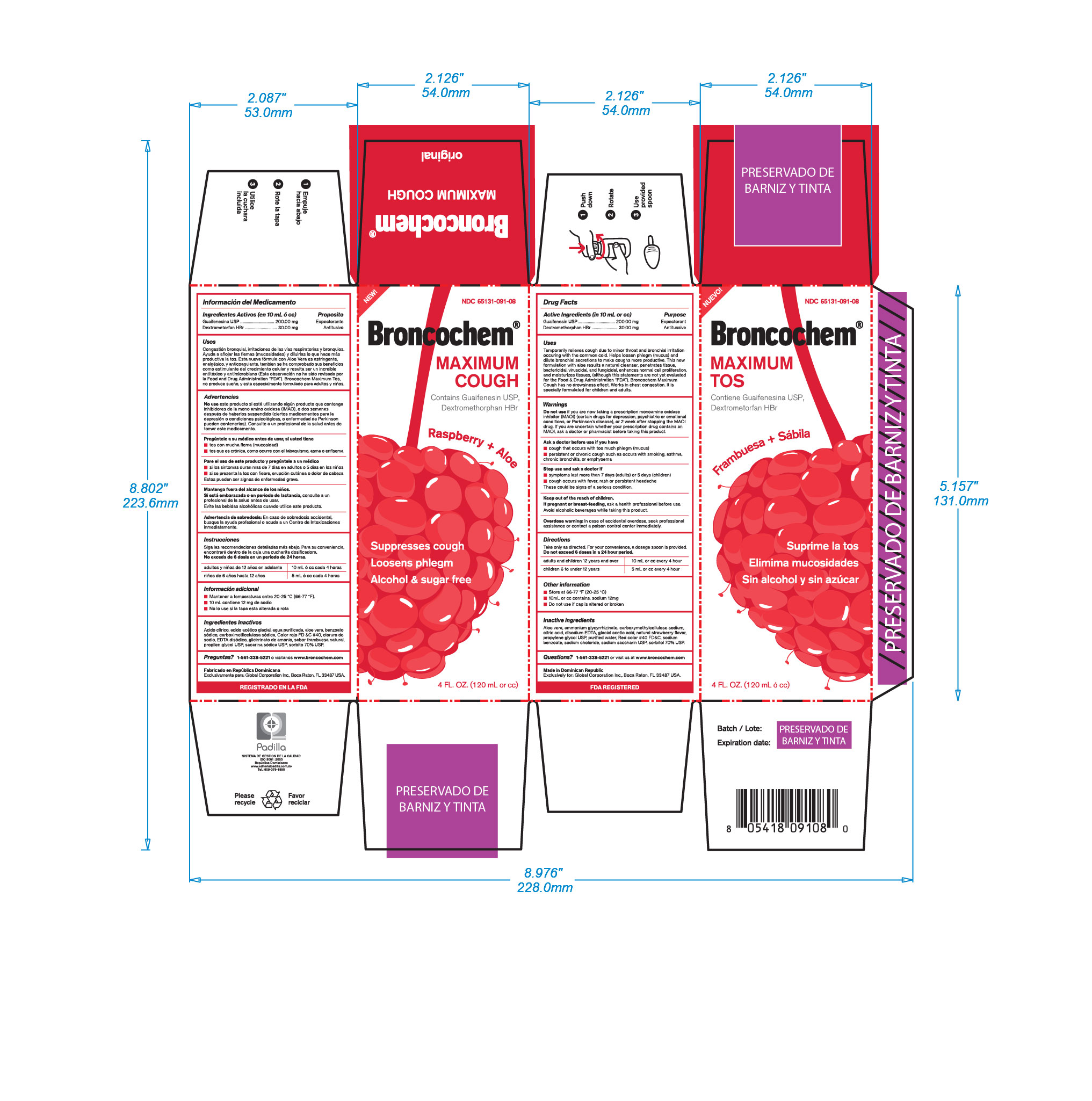
BRONCOCHEM MAXIMUM COUGH DEXTROMETHORPHAN HBr-GYAIFENESIN 30 mg/10mL; 200 mg/10mL Syrup — NDC 65131-091-08 (Billing 65131-0091-08)
This is a package of BRONCOCHEM MAXIMUM COUGH DEXTROMETHORPHAN HBr-GYAIFENESIN 30 mg/10mL; 200 mg/10mL Syrup from LABORATORIO MAGNACHEM INTERNATIONAL SRL, marketed since Dec 2016 and currently FDA-listed. It is this product's only package size.
NDC database record
One package, one record: these facts belong to NDC 65131-091-08 alone.
- Record
- FDA NDC Directory package listing · Human OTC drug
- Code segments
- 65131 labeler · 091 product · 08 package
- Package marketed since
- Dec 30, 2016
- Sample package
- No — commercial package
- Listing certified through
- Dec 31, 2026
- Barcode (UPC)
- 0805418091080
- FDA record last changed
- Jul 24, 2026
Identity & classification
Regulatory identifiers FDA, NLM and CMS codes for this package
- RxCUI (RxNorm): 1234473
Where does this data come from?
- FDA openFDA NDC Directory · synced Oct 1, 2026
- FDA label on DailyMed · label index refreshed Oct 3, 2026
- RxNorm (NLM RxNav) · catalog refreshed Oct 1, 2026
- Medi-Span GPI (licensed)
- First Databank (licensed) · refreshed Oct 1, 2026
RxNorm drug class
This medicine belongs to the Uncompetitive N-methyl-D-aspartate Receptor Antagonist class.
Where does this data come from?
- RxClass (NLM) · catalog refreshed Oct 1, 2026
Clinical
- It helps loosen mucus and makes coughs more productive. It also temporarily eases cough from minor throat and bronchial irritation, like with a cold or inhaled irritants.
- Swallow them whole with a full glass of water. Don’t crush, chew or break them. You can take them with or without food, about every 12 hours as your label directs.
- How do I take the extended-release tablets?
- The extended-release tablets are not for children under 12. Some liquid products are made for children, so check that product’s label and ask me if you’re unsure.
Patient education
Supplement & herbal interactions
Where does this data come from?
- MedlinePlus (NLM) · refreshed Oct 1, 2026
- FDA label on DailyMed · label index refreshed Oct 3, 2026
Ask a licensed pharmacist directly — free, answered by our team.
Pricing
A drug doesn't have one price. Each row is a different public payment system, and none is what you'd pay at the counter — that depends on your insurance. The ⓘ on each row explains what it measures.
| Price system | Per mL | Per package |
|---|---|---|
| Retail pharmacies payNADAC · weekly | Not in the retail survey — common for institutional, discontinued, or low-volume packs. | |
| Medicaid paysCMS SDUD · 12 mo | No recent Medicaid claims on file for this NDC — rare and low-volume NDCs are suppressed in the public data. | |
| Medicare drug plans payPart D · quarterly | No Part D plan price is available for this NDC in our data. | |
Where does this data come from?
- CMS NADAC weekly file
- CMS ASP pricing files · refreshed Sep 20, 2026
- CMS Medicaid State Drug Utilization Data · refreshed Oct 4, 2026
- CMS Part D plan pricing files · refreshed Sep 24, 2026
- VA National Acquisition Center price file
Packaging — all sizes for this product
| Package NDC | Description | Marketing start | Marketing end | Status |
|---|---|---|---|---|
| 65131-0091-08 You're viewing this Main listing | 1 BOTTLE, PLASTIC in 1 BOX / 120 mL in 1 BOTTLE, PLASTIC | 2016-12-30 | — | Active |
Therapeutic equivalents
| Product | Labeler | Pack | NADAC/unit | TE | Status | Price vs. this |
|---|---|---|---|---|---|---|
| Stona Cough 30 mg/10mL; 200 mg/10mL 49873-0302-01 | Sato | 1 bottle | — | — | FDA listed | — |
| Broncochem Maximum Cough 30 mg/10mL; 200 mg/10mLthis 65131-0091-08 | LABORATORIO | 1 bottle | — | — | FDA listed | — |
Where does this data come from?
- FDA openFDA NDC Directory · synced Oct 1, 2026
- FDA Orange Book · refreshed Oct 3, 2026
- CMS NADAC weekly file
Availability & generic status
We did not find an FDA-approved generic match for this exact strength, form and route.
Where does this data come from?
- FDA Orange Book · refreshed Oct 3, 2026
Inactive Ingredients / Excipients
Inactive ingredients, also called excipients, are components of the drug product other than the active ingredient. They may include fillers, dyes, coatings, preservatives, flavors, or other formulation ingredients.
💡 Tap an ingredient (hover on desktop) to see what it is and why it’s used.
-
0.016 mL / 10 mL
UNII Q40Q9N063P
Acetic acid is a weak organic acid commonly used in medicines as a buffer and pH adjuster. It helps maintain the proper acidity level to ensure the drug remains stable and effective in its formulation.
-
20 mg / 10 mL
UNII ZY81Z83H0X
Aloe vera leaf is a plant extract derived from the aloe plant. It is used in medicines as a natural moisturizer and skin-soothing agent in topical formulations.
-
20 mg / 10 mL
UNII 3VRD35U26C
A natural extract from licorice root, ammonium glycyrrhizate is used as a flavoring agent and sweetener in medicines. It may also help soothe irritated tissues in the mouth or throat.
-
4 mg / 10 mL
UNII XF417D3PSL
Anhydrous citric acid is a sour, crystalline powder derived from citric acid with water removed. In medicines, it acts as a buffer to control pH, adds tartness to improve taste, and helps tablets disintegrate.
-
6.8 mg / 10 mL
UNII K679OBS311
Carboxymethylcellulose sodium is a plant-derived thickening agent made from cellulose. In medicines, it acts as a binder to hold ingredients together, a disintegrant to help the tablet break apart, or a thickener in liquids.
-
5 mg / 10 mL
UNII KME849MC7A
Disodium HEDTA is a chelating agent, a chemical that binds to metal ions. It's used in medicines to prevent metal impurities from causing discoloration or degradation of the product.
-
0.508 mg / 10 mL
UNII WZB9127XOA
A synthetic red dye used to color medications and make them easier to identify. It serves as a colorant in tablets, capsules, and liquid formulations.
-
1.6 mL / 10 mL
UNII 6DC9Q167V3
Propylene glycol is a clear liquid derived from petroleum or vegetable sources. It acts as a solvent, humectant, and preservative in medicines, helping dissolve active ingredients and maintain product stability.
-
0.04 mL / 10 mL
UNII 4N14V5R27W
A natural flavoring derived from raspberry fruit that gives medicines a pleasant taste. It helps mask bitter or unpleasant flavors to make medications easier to swallow.
-
30 mg / 10 mL
UNII SB8ZUX40TY
Saccharin sodium is an artificial sweetener made from saccharin salt. It's added to medicines to improve taste, especially in liquid formulations for children or bitter drugs.
-
20 mg / 10 mL
UNII OJ245FE5EU
Sodium benzoate is a salt derived from benzoic acid, a preservative. It's added to medicines to prevent growth of bacteria, fungi, and other microorganisms that could spoil the product.
-
12 mg / 10 mL
UNII 451W47IQ8X
Sodium chloride is common table salt. It's used in medicines as a buffer to maintain proper pH, as a filler to add bulk, or to adjust the osmotic balance in liquid formulations.
-
2 mL / 10 mL
UNII 506T60A25R
Sorbitol is a natural sugar alcohol derived from glucose. It serves as a sweetener, humectant, and bulking agent in medications to improve taste and help maintain moisture in the product.
-
10 mL / 10 mL
UNII 059QF0KO0R
Water is a liquid solvent that dissolves and mixes ingredients together in liquid medicines, syrups, and injections. It helps distribute the active drug evenly throughout the product.
14 inactive ingredients listed in the exact product block matched to this NDC.
Label-section wording can be broader than the structured product block and may mention additional formulation ingredients.
Where does this data come from?
ingredient classCode="IACT" elements from the exact product block matched by this NDC. Label-section narrative from DailyMed / the openFDA label index is shown separately when available.- FDA label on DailyMed · label index refreshed Oct 3, 2026
- FDA openFDA NDC Directory · synced Oct 1, 2026
Inactive ingredient FAQ
Are inactive ingredients the same for every manufacturer?
Why might an inactive ingredient be missing?
Can inactive ingredients matter?
Manufacturer & labeler
More NDCs from LABORATORIO MAGNACHEM INTERNATIONAL SRL labeler code 65131
- BRONCOCHEM EXPECTORANT II ACETAMINOPHEN-CHLORPHENIRAMINE MALEATE-DEXTROMETHORPHAN HBr-GUAIFENESIN-PHENYLEPHRINE HCl 325 mg/10mL; 20 mg/10mL; 400 mg/10mL; 10 mg/10mL Syrup NDC 65131-011-68
- BRONCOCHEM MAXIMUM COUGH NIGHT DEXTROMETHORPHAN HBR-PYRILAMINE MALEATE 15 mg/5mL; 6 mg/5mL Syrup NDC 65131-035-80
- BRONCOCHEM KIDS COLD AND FLU ACETAMINOPHEN-PHENYLEPHRINE HCl-GUAIFENESIN 325 mg/10mL; 5 mg/10mL; 200 mg/10mL Syrup NDC 65131-054-18
- Broncochem Cold and Flu Tea Acetaminophen-Phenylephrine Hydrochloride-Chlorpheniramine Maleate 500 mg/13g; 4 mg/13g Granule, For Solution NDC 65131-097-12
- BRONCOCHEM ALLERGY CONTROL Cholpheniramine maleate-Phenylephrine HCl 4 mg/10mL; 10 mg/10mL Syrup NDC 65131-098-47
- BRONCOCHEM MAXIMUM COUGH DEXTROMETHORPHAN HBr-GYAIFENESIN 20 mg/10mL; 400 mg/10mL Syrup NDC 65131-100-91
- BRONCOCHEM COLD AND FLU CAPLETS Acetaminophen-Dextromethorphan HBr-Phenylephrine HCl-Chlorpheniramine Maleate 325 mg; 20 mg; 10 mg; 4 mg Tablet, Coated NDC 65131-101-11
- BRONCOCHEM KIDS COLD AND FLU ACETAMINOPHEN-PHENYLEPHRINE HCl-GUAIFENESIN 325 mg/10mL; 10 mg/10mL; 200 mg/10mL Syrup NDC 65131-109-84
- BRONCOCHEM MAXIMUM COUGH NIGHT DEXTROMETHORPHAN HBR-PYRILAMINE MALEATE 30 mg/5mL; 50 mg/5mL Syrup NDC 65131-110-35
Where does this data come from?
- FDA openFDA NDC Directory · synced Oct 1, 2026
- Drugs@FDA
FDA label — Drug Facts FDA SPL
🎯 Indications and Usage ▾
Indications and Usage Temporarily relieves cough due to minor throat and bronchial irritation occuring with common cold. Helps loosen phlegm (mucus) and dilute bronchial secretions to make coughs more productive. This new formulation with aloe results a natural cleanser, penetrates tissue, bactericidal, viruscidal, and fungicidal, enhances normal cell proliferation and moisturizes tissues (this statements are not yet evaluated by the Food and Drugs Administration "FDA") Broncochem Maximum Cough has not drowsiness effect.
Work in chest congestion, its specially formulated for children and adults.
⏱️ Dosage and Administration ▾
Dossage and Administration Do not exceed 6 doses in a 24 hour period Adults and children 12 years and over: (10mL or cc) every 4 hours Children 6 years up to 12 years: (5mL or cc) every 4 hours
⚠️ Warnings ▾
Warning Secction Do not take this product for persitent or chronic cough such as occurs with smoking, asthma, or emphysema or if cough is accompainied with excessive phlegm (mucus) unless directed by a doctor. Persistent cough may be the sign of a serious condition. Stop use and dask a doctor if symptoms persist or last more than 5 days (children) or 7 days (adults), tends to recur, is accompained or followed by fever, headache, rash, swelling, nausea or vomiting, consult a doctor.
Do not take this product if you are hypersensitive to any of the ingredients. As with any drug, if you are pregnant or nursing a baby, seek the advice of a health professional before using this product. Avoid alcoholic beverages while taking this product.
🔄 Drug Interactions ▾
Drug Interactions Section Do not use if you are now taking a prescription monoamine oxidase inhibitor (MAOI), (certain drugs for depression, psychiatric or emotional conditions or Parkinsons disease), or 2 weeks after stopping the MAOI drug. Id you are uncertain ehether your prescription drug contains an MAOI, consult a health professional before taking this product
🧪 Active Ingredient ▾
Active Ingredients Guaifenesin Dextromethorphan HBr
🧪 Inactive Ingredients ▾
Inactive Ingredient Section Aloe Vera, Ammonium Glycyrrhizinate, Citric Acid, Disodium HEDTA, Glacial Acetic Acid, Strawberry flavor, Propylene Glycol, Purified Water, FD&C Red 40, Sodium Benzoate, Sodium Chloride, Sodium Saccharin, Sorbitol, Carboxymethylcellulose sodium, Total Sodium content: 12mg (in 10mL or cc)
🎯 Purpose ▾
Purpose Expectorant Antitussive
📄 Keep Out of Reach of Children ▾
Keep out of the reach of children In case of accidental overdose, seek professional assistance or contact a poison control center immediately
📄 Package Label / Principal Display Panel ▾
Package Label Principal Display Panel image descriptionBMCUSABOX
Reported adverse events (FAERS)
Top reported reactions
Reporter sex
Where does this data come from?
About this NDC listing & data coverage
What data is (and isn’t) available for this NDC — tap to expand
| NDC identity (package / product / labeler codes) | ✓ Available |
| Labeler | ✓ Available |
| Product & package description | ✓ Available |
| Marketing category & status | ✓ Available |
| Active ingredient / dosage form / route | ✓ Available |
| FDA label (SPL via DailyMed) | ✓ Available |
| Package photos | ✓ Available |
| Inactive ingredients (structured) | ✓ Available |
| NADAC pharmacy acquisition price (CMS) | — Not published for this NDC CMS publishes NADAC only for NDCs reported in its retail-pharmacy survey. |
| Orange Book / therapeutic-equivalence data | — Not published for this NDC Applies only to products approved under an NDA/ANDA; many listings are out of scope. |
| HCPCS J-code billing crosswalk | — Not published for this NDC Most self-administered / retail products have no J-code — that is normal. |
| Medicaid utilization (CMS SDUD) | — Not published for this NDC CMS reports utilization only for NDCs with Medicaid claims above its privacy threshold. |