
sirolimus .5 mg Tablet, Film Coated, 90-count — NDC 65841-771-16 (Billing 65841-0771-16)
This is a package of 90 tablets of sirolimus .5 mg Tablet, Film Coated from Zydus Lifesciences Limited, marketed since Jan 2014 and currently FDA-listed.
NDC database record
One package, one record: these facts belong to NDC 65841-771-16 alone.
- Record
- FDA NDC Directory package listing · Human prescription drug
- Code segments
- 65841 labeler · 771 product · 16 package
- Package marketed since
- Jan 15, 2014
- Sample package
- No — commercial package
- Listing certified through
- Dec 31, 2026
- Barcode (UPC-A, from the NDC)
- 3 6584177116 9
- FDA record last changed
- Jul 24, 2026
Other active recalls for Sirolimus (different manufacturers) — 1 · tap to view
Identity & classification
Regulatory identifiers FDA, NLM and CMS codes for this package
- RxCUI (RxNorm): 349208
Where does this data come from?
- FDA openFDA NDC Directory · synced Oct 8, 2026
- FDA label on DailyMed · label index refreshed Oct 6, 2026
- RxNorm (NLM RxNav) · catalog refreshed Oct 1, 2026
- Medi-Span GPI (licensed)
- First Databank (licensed) · refreshed Oct 8, 2026
RxNorm drug class
This medicine belongs to the Kinase Inhibitor class.
Where does this data come from?
- RxClass (NLM) · catalog refreshed Oct 1, 2026
Clinical
Sirolimus is used in combination with other medications to prevent rejection of kidney transplants. It is also used to treat lymphangioleiomyomatosis (LAM; a rare lung condition). Sirolimus is in a class of medications called immunosuppressants. It works by suppressing the body's immune system.
Read the full MedlinePlus article ↗- Oral sirolimus helps prevent your body from rejecting a transplanted kidney if you are 13 or older. It is also used for LAM, a rare lung disease. Other sirolimus products treat a t...
- Take oral sirolimus once a day, the same way each time, either always with food or always without. Swallow tablets whole and do not crush, chew or split them. Never take it with gr...
- Swelling, high blood pressure, high cholesterol, stomach upset, headache and acne are common. Call your doctor right away for fever or other signs of infection, new cough or troubl...
- What side effects are normal, and when should I call?
Patient education
Supplement & herbal interactions
Some supplements/herbs that may interact with Sirolimus — tap one for details:
Where does this data come from?
- MedlinePlus (NLM) · refreshed Oct 1, 2026
- FDA label on DailyMed · label index refreshed Oct 6, 2026
Ask a licensed pharmacist directly — free, answered by our team.
Pricing
A drug doesn't have one price. Each row is a different public payment system, and none is what you'd pay at the counter — that depends on your insurance. The ⓘ on each row explains what it measures.
| Price system | Per each | Per package |
|---|---|---|
| Retail pharmacies payNADAC · weekly | Not in the retail survey — common for institutional, discontinued, or low-volume packs. | |
| Medicaid paysCMS SDUD · 12 mo | No recent Medicaid claims on file for this NDC — rare and low-volume NDCs are suppressed in the public data. | |
| Medicare drug plans payPart D · Q2 2026 | $3.75 | $337.88 / 90 tablets |
Where does this data come from?
- CMS NADAC weekly file
- CMS ASP pricing files · refreshed Sep 20, 2026
- CMS Medicaid State Drug Utilization Data · refreshed Oct 8, 2026
- CMS Part D plan pricing files · refreshed Sep 24, 2026
- VA National Acquisition Center price file
Packaging — all sizes for this product
| Package NDC | Description | Marketing start | Marketing end | Status |
|---|---|---|---|---|
| 65841-0771-01 65841-771-01 Main listing | 100 TABLET, FILM COATED in 1 BOTTLE | 2014-01-15 | — | Active |
| 65841-0771-05 65841-771-05 | 500 TABLET, FILM COATED in 1 BOTTLE | 2014-01-15 | — | Active |
| 65841-0771-06 65841-771-06 | 30 TABLET, FILM COATED in 1 BOTTLE | 2014-01-15 | — | Active |
| 65841-0771-10 65841-771-10 | 1000 TABLET, FILM COATED in 1 BOTTLE | 2014-01-15 | — | Active |
| 65841-0771-16 You're viewing this | 90 TABLET, FILM COATED in 1 BOTTLE | 2014-01-15 | — | Active |
| 65841-0771-77 65841-771-77 | 10 BLISTER PACK in 1 CARTON / 10 TABLET, FILM COATED in 1 BLISTER PACK | 2014-01-15 | — | Active |
Pack size FAQ
What quantity is in this package?
How does this package differ from NDC 65841-0771-06?
What NDC number is used to bill for this package of sirolimus .5 mg Tablet, Film Coated?
Therapeutic equivalents
| Product | Labeler | Pack | NADAC/unit | TE | Status | Price vs. this |
|---|---|---|---|---|---|---|
| sirolimus .5 mg 16714-0187-01 | NORTHSTAR | 100 tablets | $0.841 | AB | Availability likely | — |
| Sirolimus .5 mg 59762-1001-01 | Mylan | 100 tablets | $0.841 | — | Availability likely | — |
| sirolimus .5 mg 60687-0902-21 | American | 1 tablet | $0.841 | AB | Availability likely | — |
| Sirolimus .5 mg 67877-0746-01 | Ascend | 100 tablets | $0.841 | AB | Availability likely | — |
| sirolimus .5 mg 68382-0520-01 | Zydus | 100 tablets | $0.841 | AB | Availability likely | — |
| sirolimus .5 mg 68462-0682-01 | Glenmark | 100 tablets | $0.841 | AB | Availability likely | — |
| sirolimus .5 mgthis 65841-0771-16 | Zydus | 90 tablets | — | AB | FDA listed | — |
| Sirolimus .5 mg 70518-3546-00 | REMEDYREPACK | 100 tablets | — | AB | FDA listed | — |
| sirolimus .5 mg 70518-4376-00 | REMEDYREPACK | 1 tablet | — | AB | FDA listed | — |
| sirolimus .5 mg 70518-4449-00 | REMEDYREPACK | 1 tablet | — | AB | FDA listed | — |
Where does this data come from?
- FDA openFDA NDC Directory · synced Oct 8, 2026
- FDA Orange Book · refreshed Oct 3, 2026
- CMS NADAC weekly file
Availability & generic status
This product is an FDA-approved generic. Other versions of the same drug are listed under Therapeutic equivalents, least expensive first.
Where does this data come from?
- FDA Orange Book · refreshed Oct 3, 2026
What it looks like
Where does this data come from?
- FDA label on DailyMed · label index refreshed Oct 6, 2026
Inactive Ingredients / Excipients
Inactive ingredients, also called excipients, are components of the drug product other than the active ingredient. They may include fillers, dyes, coatings, preservatives, flavors, or other formulation ingredients.
🧪 Avoiding an ingredient? See Sirolimus inactive ingredients by manufacturer: every current product's list side by side, so you can ask your pharmacy for the version that does not list it.
💡 Tap an ingredient (hover on desktop) to see what it is and why it’s used.
-
UNII 9E8X80D2L0
A synthetic form of vitamin E used as an antioxidant and preservative in medications. It helps prevent the active ingredients from degrading when exposed to oxygen or light.
-
UNII OP1R32D61U
Microcrystalline cellulose is a purified form of cellulose, a natural fiber from plant sources. It acts as a binder and filler in tablets and capsules, helping hold ingredients together and give the medicine its shape and size.
-
UNII 2968PHW8QP
A weak organic acid derived from citrus fruits or made through fermentation. It works as a buffer to control pH, a preservative to extend shelf life, and a flavoring agent in medications.
-
UNII 68401960MK
Crospovidone is a synthetic polymer made from polyvinylpyrrolidone. It acts as a disintegrant, helping tablets break apart quickly in the stomach so the medicine dissolves and absorbs into the body.
-
UNII I753WB2F1M
FD&C Yellow No. 5 is a synthetic yellow colorant approved by the FDA. It is added to medicines to make pills, tablets, or liquids visually distinct and easier to identify.
-
UNII EX438O2MRT
Ferric oxide yellow is a naturally occurring iron compound used as a colorant in medications. It gives tablets, capsules, and other forms a yellow or golden hue for identification and appearance.
-
UNII 4PC054V79P
A fatty acid derived from glycerin and oleic acid (a natural oil component). It acts as an emulsifier to help mix oil and water-based ingredients, and serves as a lubricant and surfactant in the formulation.
-
UNII 3NXW29V3WO
Hypromellose is a plant-based thickener made from cellulose. It's used in medicines as a binder to hold ingredients together, a coating for tablets, and a thickener for liquids.
-
UNII EWQ57Q8I5X
Lactose monohydrate is a natural sugar derived from milk. It serves as a filler and binder in tablets and capsules, helping create the proper size, texture, and consistency of the medicine.
-
UNII LQA7B6G8JG
A synthetic polymer made by combining water-soluble compounds. It acts as a surfactant and solubilizer to help mix oil and water-based ingredients, improving the medicine's texture and how active ingredients dissolve.
-
UNII 3WJQ0SDW1A
Polyethylene glycol is a synthetic liquid or solid polymer used in medicines as a solvent, lubricant, and humectant. It helps dissolve active ingredients, reduces friction during manufacturing, and retains moisture in the final product.
-
UNII FZ989GH94E
Povidone is a synthetic polymer made from a plastic-like material. It acts as a binder to hold tablet ingredients together and as a disintegrant to help the tablet break apart in your stomach so the medicine can be absorbed.
-
UNII C151H8M554
A natural sugar derived from sugar cane or sugar beets. It's used as a sweetener, filler, and binder to improve taste, add bulk, and help hold tablet or capsule ingredients together.
-
UNII 7SEV7J4R1U
A powder made from a naturally occurring mineral. In medicines, talc works as a glidant and anti-caking agent, helping tablets and capsules flow smoothly during manufacturing and preventing clumping.
-
UNII 15FIX9V2JP
Titanium dioxide is a bright white mineral powder commonly used as a colorant and opacifying agent. It makes pills and tablets white or lighter in color and helps make coatings non-transparent.
15 inactive ingredients listed in the exact product block matched to this NDC.
Where does this data come from?
ingredient classCode="IACT" elements from the exact product block matched by this NDC. Label-section narrative from DailyMed / the openFDA label index is shown separately when available.- FDA label on DailyMed · label index refreshed Oct 6, 2026
- FDA openFDA NDC Directory · synced Oct 8, 2026
Inactive ingredient FAQ
Are inactive ingredients the same for every manufacturer?
Why might an inactive ingredient be missing?
Can inactive ingredients matter?
Manufacturer & labeler
More NDCs from Zydus Lifesciences Limited labeler code 65841
- Omeprazole 10 mg Capsule, Delayed Release NDC 65841-759-01
- Omeprazole 20 mg Capsule, Delayed Release NDC 65841-760-01
- Omeprazole 40 mg Capsule, Delayed Release NDC 65841-761-01
- acetazolamide 500 mg Capsule NDC 65841-762-01
- Zolmitriptan 2.5 mg Tablet, Orally Disintegrating NDC 65841-767-01
- Zolmitriptan 5 mg Tablet, Orally Disintegrating NDC 65841-768-01
- sirolimus 1 mg Tablet, Film Coated NDC 65841-772-01
- sirolimus 2 mg Tablet, Film Coated NDC 65841-773-01
- Etodolac 400 mg Tablet, Film Coated, Extended Release NDC 65841-777-01
- Etodolac 500 mg Tablet, Film Coated, Extended Release NDC 65841-778-01
- Etodolac 600 mg Tablet, Film Coated, Extended Release NDC 65841-779-01
- bupropion 300 mg Tablet, Extended Release NDC 65841-780-05
Where does this data come from?
- FDA openFDA NDC Directory · synced Oct 8, 2026
- Drugs@FDA
Full prescribing information FDA SPL
💬 Medication Guide ▾
SPL MEDGUIDE
📄 Package Label / Principal Display Panel ▾
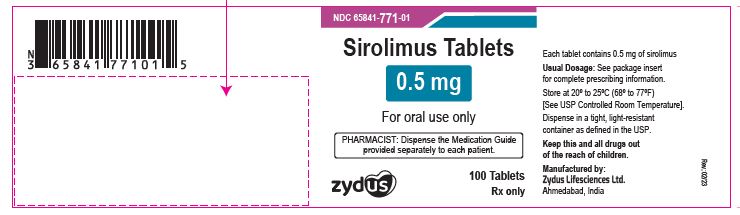
PACKAGE LABEL.PRINCIPAL DISPLAY PANEL Sirolimus Tablets, 0.5 mg NDC 65841-771-01 100 Tablets Rx only Sirolimus Tablets, 1 mg NDC 65841-772-01 100 Tablets Rx only Sirolimus Tablets, 2 mg NDC 65841-773-01 100 Tablets Rx only Sirolimus Tablets, 0.5 mg 1 mg label 2 mg label
Medicare Part D spend CMS · PART D · 2026 (Q1)
About this NDC listing & data coverage
What data is (and isn’t) available for this NDC — tap to expand
| NDC identity (package / product / labeler codes) | ✓ Available |
| Labeler | ✓ Available |
| Product & package description | ✓ Available |
| Marketing category & status | ✓ Available |
| Active ingredient / dosage form / route | ✓ Available |
| FDA label (SPL via DailyMed) | ✓ Available |
| Package photos | ✓ Available |
| Inactive ingredients (structured) | ✓ Available |
| NADAC pharmacy acquisition price (CMS) | — Not published for this NDC CMS publishes NADAC only for NDCs reported in its retail-pharmacy survey. |
| Orange Book / therapeutic-equivalence data | ✓ Available |
| HCPCS J-code billing crosswalk | — Not published for this NDC Most self-administered / retail products have no J-code — that is normal. |
| Medicaid utilization (CMS SDUD) | — Not published for this NDC CMS reports utilization only for NDCs with Medicaid claims above its privacy threshold. |