
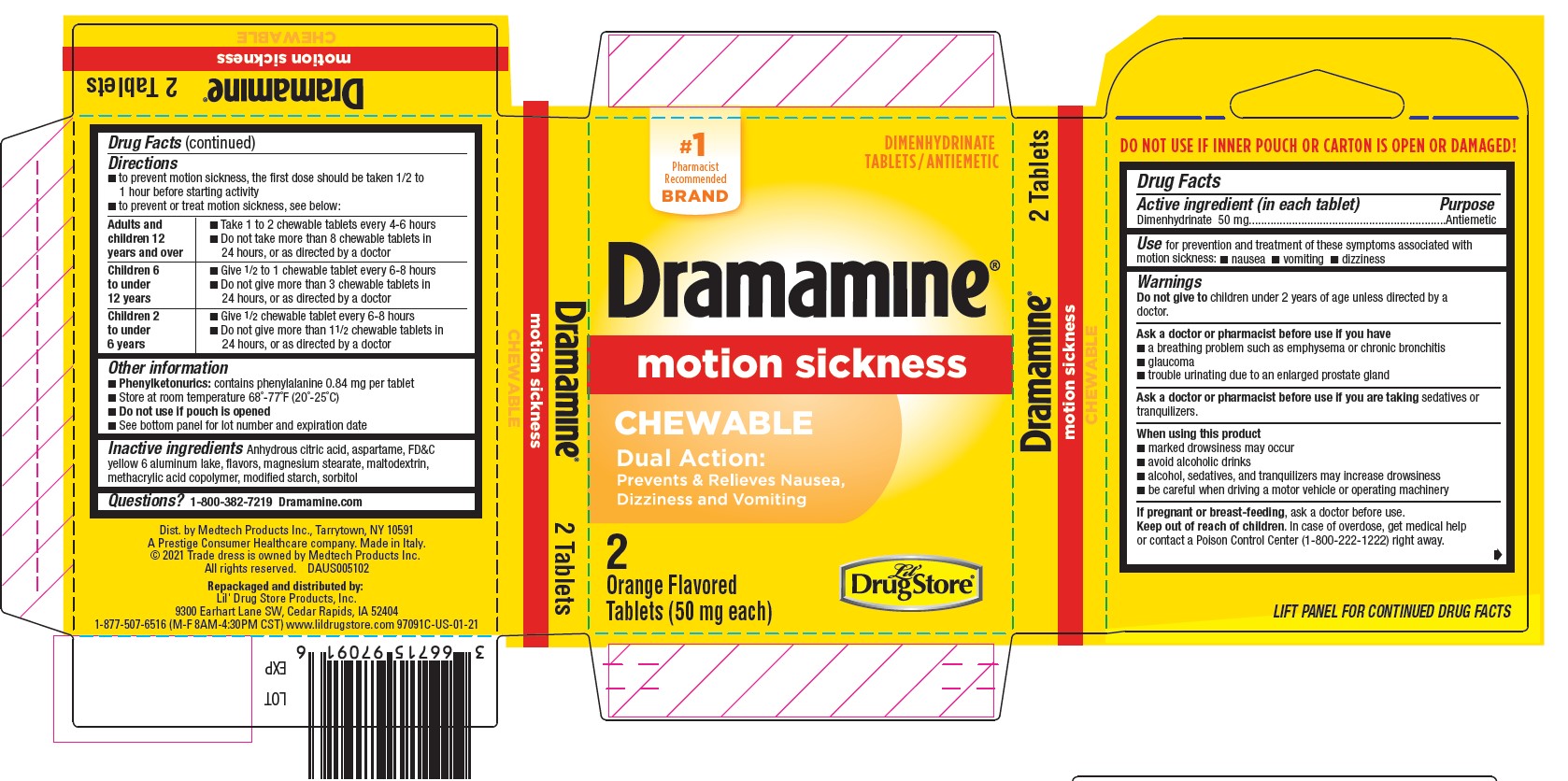
Dramamine Dimenhydrinate 50 mg Tablet, Chewable
🆔 Identity & classification
Where does this data come from?
🏷️ RxNorm drug class
This medicine belongs to the Aminoalkyl ethers class.
Where does this data come from?
🏭 Manufacturer & labeler
Where does this data come from?
🩺 Clinical
Dimenhydrinate is used to prevent and treatmotion sickness. Dimenhydrinate is in a class of medications called antihistamines. It works by preventing problems with body balance.
Read the full MedlinePlus article ↗- Dimenhydrinate works by calming your inner ear when it gets overstimulated during travel — that's the root cause of the nausea, vomiting, and dizziness you feel. It's proven effect...
- What exactly does dimenhydrinate do — and will it stop my motion sickness?
- Drowsiness is the most common side effect — it's very real and something to plan for. Avoid driving or operating machinery until you know how dimenhydrinate affects you. Alcohol, s...
- It can be used in children as young as 2 years old — but only with a doctor's guidance for children under 2, and never in newborns. In young children especially, antihistamine over...
Patient education
Supplement & herbal interactions
Some supplements/herbs that may interact with Dimenhydrinate — tap one for details:
Where does this data come from?
Ask a licensed pharmacist directly — free, answered by our team.
💊 What it looks like
Where does this data come from?
🧪 Inactive Ingredients / Excipients
Inactive ingredients, also called excipients, are components of the drug product other than the active ingredient. They may include fillers, dyes, coatings, preservatives, flavors, or other formulation ingredients.
💡 Tap an ingredient (hover on desktop) to see what it is and why it’s used.
-
UNII LMI26O6933
Alumina is a white powder form of aluminum oxide. It's used as a filler to add bulk to tablets and capsules, and sometimes as a thickening or anti-caking agent in powdered formulations.
-
UNII XF417D3PSL
Anhydrous citric acid is a sour, crystalline powder derived from citric acid with water removed. In medicines, it acts as a buffer to control pH, adds tartness to improve taste, and helps tablets disintegrate.
-
UNII Z0H242BBR1
Aspartame is an artificial sweetener made from amino acids. It's added to medicines to improve taste, making bitter or unpleasant-tasting drugs easier to take.
-
UNII H77VEI93A8
A synthetic yellow dye used to color medications. It helps identify the drug and make it visually distinctive, with no effect on how the medicine works.
-
UNII 70097M6I30
Magnesium stearate is a salt made from magnesium and stearic acid, a fatty substance. It's used in tablets and capsules as a lubricant and glidant to help ingredients flow smoothly during manufacturing and prevent sticking.
-
UNII 7CVR7L4A2D
A starch-derived carbohydrate produced by breaking down corn, potato, or tapioca starch. It functions as a filler and binder to give the medicine bulk and texture, and sometimes as a mild sweetener or texture enhancer in powders and tablets.
-
UNII 74G4R6TH13
A synthetic polymer made by combining two plastic-like chemicals. It forms a coating on tablets or capsules that dissolves at a specific point in the digestive tract, controlling where and when the medicine releases.
-
UNII 506T60A25R
Sorbitol is a natural sugar alcohol derived from glucose. It serves as a sweetener, humectant, and bulking agent in medications to improve taste and help maintain moisture in the product.
-
UNII O8232NY3SJ
A plant-based carbohydrate derived from corn kernels. It acts as a filler to add bulk, a binder to hold ingredients together, and a disintegrant to help the tablet break apart in your stomach for absorption.
9 inactive ingredients listed in the exact product block matched to this NDC.
Label-section wording can be broader than the structured product block and may mention additional formulation ingredients.
Where does this data come from?
ingredient classCode="IACT" elements from the exact product block matched by this NDC. Label-section narrative from DailyMed / the openFDA label index is shown separately when available.Inactive ingredient FAQ
Are inactive ingredients the same for every manufacturer?
Why might an inactive ingredient be missing?
Can inactive ingredients matter?
💲 Pricing
A drug doesn't have one price. Each row is a different public payment system, and none is what you'd pay at the counter — that depends on your insurance. The ⓘ on each row explains what it measures.
| Price system | Per each | Per package |
|---|---|---|
| Retail pharmacies payNADAC · weekly | Not in the retail survey — common for institutional, discontinued, or low-volume packs. | |
| Medicaid paysCMS SDUD · 12 mo | No recent Medicaid claims on file for this NDC — rare and low-volume NDCs are suppressed in the public data. | |
| Medicare drug plans payPart D · quarterly | No Part D plan price is available for this NDC in our data. | |
Where does this data come from?
🔁 Therapeutic equivalents
| Product | Labeler | Pack | NADAC/unit | TE | Status | Price vs. this |
|---|---|---|---|---|---|---|
| Gravol Chewables Motion Sickness Dimenhydrinate 50 mg 10237-0943-08 | Church | 8 tablets | — | — | FDA listed | — |
| Dramamine Chewable Dimenhydrinate 50 mg 50269-0525-00 | JC | 20 tablets | — | — | FDA listed | — |
| Dramamine Orange 50 mg 63029-0902-01 | Medtech | 8 tablets | — | — | FDA listed | — |
| Dramamine, TRAVEL BASIX 50 mg 66715-6409-02 | Lil' | 2 tablets | — | — | FDA listed | — |
| Dramamine 50 mgthis 66715-9809-07 | Lil' | 2 tablets | — | — | FDA listed | — |
Where does this data come from?
⏳ Availability & generic status
We did not find an FDA-approved generic match for this exact strength, form and route.
Where does this data come from?
📊 Medicare Part D spend CMS · PART D · 2025 (Q1-Q4)
🔬 Reported adverse events (FAERS)
Top reported reactions
Age at onset
Reporter sex
Serious outcomes
Where does this data come from?
📦 Packaging — all sizes for this product
| Package NDC | Description | Marketing start | Status |
|---|---|---|---|
| 66715-9809-01 | 1 POUCH in 1 CARTON (66715-9809-1) / 2 TABLET, CHEWABLE in 1 POUCH | 2016-08-26 | Active |
| 66715-9809-02 | 2 POUCH in 1 CARTON (66715-9809-2) / 2 TABLET, CHEWABLE in 1 POUCH | 2022-05-16 | Active |
| 66715-9809-07 You're viewing this | 25 POUCH in 1 BOX, UNIT-DOSE (66715-9809-7) / 2 TABLET, CHEWABLE in 1 POUCH | 2022-04-19 | Active |
Pack size FAQ
What quantity is in NDC 66715-9809-07?
What NDC number is used to bill for this package of Dramamine Dimenhydrinate 50 mg Tablet, Chewable?
🧭 About this NDC listing & data coverage
What data is (and isn’t) available for this NDC — tap to expand
| NDC identity (package / product / labeler codes) | ✓ Available |
| Labeler | ✓ Available |
| Product & package description | ✓ Available |
| Marketing category & status | ✓ Available |
| Active ingredient / dosage form / route | ✓ Available |
| FDA label (SPL via DailyMed) | ✓ Available |
| Package photos | ✓ Available |
| Inactive ingredients (structured) | ✓ Available |
| NADAC pharmacy acquisition price (CMS) | — Not published for this NDC CMS publishes NADAC only for NDCs reported in its retail-pharmacy survey. |
| Orange Book / therapeutic-equivalence data | — Not published for this NDC Applies only to products approved under an NDA/ANDA; many listings are out of scope. |
| HCPCS J-code billing crosswalk | — Not published for this NDC Most self-administered / retail products have no J-code — that is normal. |
| Medicaid utilization (CMS SDUD) | — Not published for this NDC CMS reports utilization only for NDCs with Medicaid claims above its privacy threshold. |
Questions about this listing
Is this NDC FDA-approved?
Why is there no price listed?
Is the NDC printed on the package the same as the 11-digit billing NDC?
What do the three segments of this NDC mean?
Is this package still being marketed?
Does this product come in other package sizes?
Who lists this product with the FDA?
Do I need a prescription for this product?
Where does this data come from?
📄 FDA label — Drug Facts FDA SPL
🎯 Indications and Usage ▾
Use for prevention and treatment of these symptoms associated with motion sickness: nausea vomiting dizziness
⏱️ Dosage and Administration ▾
Directions to prevent motion sickness, the first dose should be taken 1/2 to 1 hour before starting activity to prevent or treat motion sickness, see below: adults and children 12 years and over take 1 to 2 chewable tablets every 4-6 hours do not take more than 8 chewable tablets in 24 hours, or as directed by a doctor children 6 to under 12 years give ½ to 1 chewable tablet every 6-8 hours do not give more than 3 chewable tablets in 24 hours, or as directed by a doctor children 2 to under 6 years give ½ chewable tablet every 6-8 hours do not give more than 1-½ chewable tablets in 24 hours, or as directed by a doctor
⚠️ Warnings ▾
Warnings Do not use for children under 2 years of age unless directed by a doctor Ask a doctor before use if you have a breathing problem such as emphysema or chronic bronchitis glaucoma trouble urinating due to an enlarged prostate gland Ask a doctor or pharmacist before use if you are taking sedatives or tranquilizers When using this product marked drowsiness may occur avoid alcoholic drinks alcohol, sedatives, and tranquilizers may increase drowsiness be careful when driving a motor vehicle or operating machinery If pregnant or breast-feeding, ask a doctor before use.
Keep out of reach of children. In case of accidental overdose, get medical help or contact a Poison Control Center (1-800-222-1222) right away.
📦 Storage and Handling ▾
Other information Phenylketonurics: contains phenylalanine 0.84 mg per tablet store at room temperature 68°-77°F (20°-25°C) do not use if packet is torn see bottom panel for lot number and expiration date
🧪 Active Ingredient ▾
Active ingredient (in each tablet) Dimenhydrinate 50 mg
🧪 Inactive Ingredients ▾
Inactive ingredients anhydrous citric acid, aspartame, FD&C yellow 6 aluminum lake, flavors, magnesium stearate, maltodextrin, methacrylic acid copolymer, modified starch, sorbitol
🎯 Purpose ▾
Purpose Antiemetic