
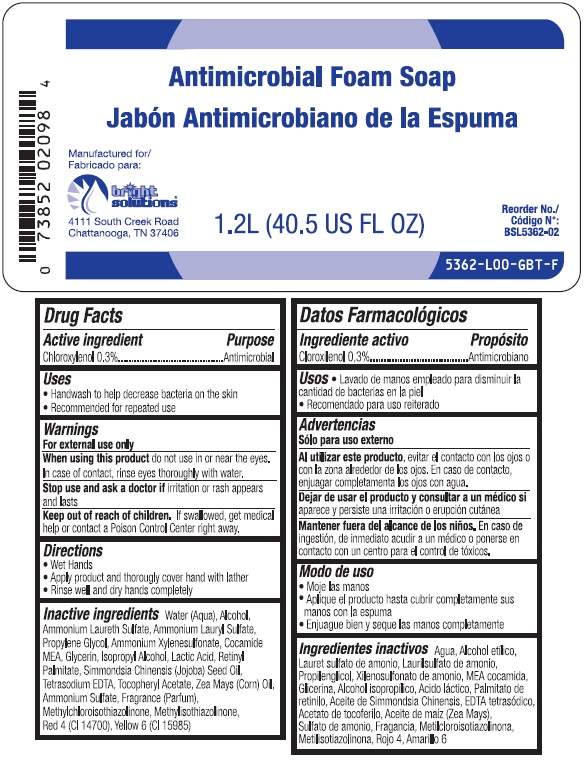
BRIGHT SOLUTIONS Antimicrobial Foam So ap Chloroxylenol .003 mg/mL Liquid, 1200 mL — NDC 66885-081-40 (Billing 66885-0081-40)
This is a package of 1,200 mL of BRIGHT SOLUTIONS Antimicrobial Foam So ap Chloroxylenol .003 mg/mL Liquid from Kel-San, Inc., marketed since Aug 2007 and currently FDA-listed. It is this product's only package size.
NDC database record
One package, one record: these facts belong to NDC 66885-081-40 alone.
- Record
- FDA NDC Directory package listing · Human OTC drug
- Code segments
- 66885 labeler · 081 product · 40 package
- Package marketed since
- Aug 30, 2007
- Sample package
- No — commercial package
- Listing certified through
- Dec 31, 2026
- Barcode (UPC-A, from the NDC)
- 3 6688508140 5
- FDA record last changed
- Jul 24, 2026
Identity & classification
Regulatory identifiers FDA, NLM and CMS codes for this package
Where does this data come from?
- FDA openFDA NDC Directory · synced Oct 8, 2026
- FDA label on DailyMed · label index refreshed Oct 6, 2026
- RxNorm (NLM RxNav) · catalog refreshed Oct 1, 2026
- Medi-Span GPI (licensed)
- First Databank (licensed) · refreshed Oct 8, 2026
Clinical
Bright Solutions Antimicrobial Foam Soap is a liquid product applied to the skin and is marketed as an over-the-counter antimicrobial soap under the FDA's monograph rules for this category. It contains chloroxylenol, an ingredient typically used in soaps and cleansers for its antimicrobial properties to help reduce bacteria on the skin during washing. This product is formulated as a foam soap for topical cleansing use.
Patient education
Supplement & herbal interactions
Where does this data come from?
- MedlinePlus (NLM) · refreshed Oct 1, 2026
- FDA label on DailyMed · label index refreshed Oct 6, 2026
Ask a licensed pharmacist directly — free, answered by our team.
Pricing
A drug doesn't have one price. Each row is a different public payment system, and none is what you'd pay at the counter — that depends on your insurance. The ⓘ on each row explains what it measures.
| Price system | Per mL | Per package |
|---|---|---|
| Retail pharmacies payNADAC · weekly | Not in the retail survey — common for institutional, discontinued, or low-volume packs. | |
| Medicaid paysCMS SDUD · 12 mo | No recent Medicaid claims on file for this NDC — rare and low-volume NDCs are suppressed in the public data. | |
| Medicare drug plans payPart D · quarterly | No Part D plan price is available for this NDC in our data. | |
Where does this data come from?
- CMS NADAC weekly file
- CMS ASP pricing files · refreshed Sep 20, 2026
- CMS Medicaid State Drug Utilization Data · refreshed Oct 8, 2026
- CMS Part D plan pricing files · refreshed Sep 24, 2026
- VA National Acquisition Center price file
Packaging — all sizes for this product
| Package NDC | Description | Marketing start | Marketing end | Status |
|---|---|---|---|---|
| 66885-0081-40 You're viewing this Main listing | 1200 mL in 1 PACKAGE | 2007-08-30 | — | Active |
Therapeutic equivalents
Where does this data come from?
- FDA openFDA NDC Directory · synced Oct 8, 2026
- FDA Orange Book · refreshed Oct 3, 2026
- CMS NADAC weekly file
Availability & generic status
We did not find an FDA-approved generic match for this exact strength, form and route.
Where does this data come from?
- FDA Orange Book · refreshed Oct 3, 2026
Inactive Ingredients / Excipients
Inactive ingredients, also called excipients, are components of the drug product other than the active ingredient. They may include fillers, dyes, coatings, preservatives, flavors, or other formulation ingredients.
💡 Tap an ingredient (hover on desktop) to see what it is and why it’s used.
-
UNII A7E6112E4N
A form of vitamin E used as an antioxidant in medicines. It prevents oils and fats in the product from breaking down, helping maintain stability and shelf life.
-
UNII 3K9958V90M
A liquid solvent derived from fermentation or chemical synthesis. In medicines, alcohol dissolves active ingredients, helps preserve the product, and improves how the body absorbs certain drugs.
-
UNII 698O4Z48G6
A synthetic cleaning agent derived from coconut oil. Used as a surfactant and emulsifier to help blend water and oil-based ingredients together in liquid or semi-solid formulations.
-
UNII Q7AO2R1M0B
Ammonium lauryl sulfate is a mild detergent and foaming agent derived from plant oils. It helps mix water and oil-based ingredients together and creates a light foam in topical formulations like shampoos and cleansers.
-
UNII SU46BAM238
Ammonium sulfate is a mineral salt used in medications as a buffering agent and pH regulator. It helps maintain the chemical stability and balance of the drug formulation.
-
UNII 4FZY6L6XCM
A synthetic compound derived from xylenol and ammonia. It functions as a solubilizing agent and surfactant, helping dissolve poorly water-soluble active ingredients and improve their absorption in the body.
-
UNII C80684146D
A foaming agent and thickener derived from coconut oil. It helps create a smooth texture and stable foam in liquid or semi-solid medicines, improving how the product feels and applies.
-
UNII 8470G57WFM
Corn oil is a vegetable oil extracted from corn kernels. It's used in medicines as a solvent to dissolve active ingredients and help the body absorb them, and sometimes as a lubricant in capsules.
-
UNII MP1J8420LU
A salt derived from edetic acid that binds to trace metals in medicines. It serves as a chelating agent and preservative to prevent metal-catalyzed breakdown of the drug and extend shelf life.
-
UNII X3W0AM1JLX
A synthetic red dye used to color medicines and products. It helps make pills, liquids, and capsules visually distinct and easier to identify.
-
UNII H77VEI93A8
A synthetic yellow dye used to color medications. It helps identify the drug and make it visually distinctive, with no effect on how the medicine works.
-
UNII PDC6A3C0OX
Glycerin is a clear, thick liquid derived from plant oils or fats. It acts as a humectant to retain moisture, a sweetener, and a solvent in medications.
-
UNII ND2M416302
Isopropyl alcohol is a clear liquid solvent derived from petroleum. In medicines, it dissolves active ingredients and other components, helps the product flow smoothly, and aids in sterilization during manufacturing.
-
UNII 724GKU717M
Jojoba oil is a natural liquid wax extracted from jojoba plant seeds. It's used in medicines as an emollient and lubricant to soften and smooth the product, and sometimes as a carrier or penetration enhancer.
-
UNII 33X04XA5AT
Lactic acid is a naturally occurring organic acid derived from milk or plant sources. It lowers and maintains pH in formulations, helps preserve the product, and can enhance ingredient stability and absorption.
-
UNII DEL7T5QRPN
A synthetic preservative that kills bacteria and fungi. It's added to medications to prevent microbial growth and extend shelf life, especially in liquid or topical formulations.
-
UNII 229D0E1QFA
Methylisothiazolinone is a synthetic chemical preservative that prevents bacterial and fungal growth in liquid medicines and topical products. It helps keep the medication safe and extends shelf life during storage.
-
UNII 6DC9Q167V3
Propylene glycol is a clear liquid derived from petroleum or vegetable sources. It acts as a solvent, humectant, and preservative in medicines, helping dissolve active ingredients and maintain product stability.
-
UNII 1D1K0N0VVC
A fat-soluble form of vitamin A used as a colorant and nutritional fortification ingredient. It gives products a yellow or orange tint and increases vitamin A content in the formula.
-
UNII 059QF0KO0R
Water is a liquid solvent that dissolves and mixes ingredients together in liquid medicines, syrups, and injections. It helps distribute the active drug evenly throughout the product.
20 inactive ingredients listed in the exact product block matched to this NDC.
Label-section wording can be broader than the structured product block and may mention additional formulation ingredients.
Where does this data come from?
ingredient classCode="IACT" elements from the exact product block matched by this NDC. Label-section narrative from DailyMed / the openFDA label index is shown separately when available.- FDA label on DailyMed · label index refreshed Oct 6, 2026
- FDA openFDA NDC Directory · synced Oct 8, 2026
Inactive ingredient FAQ
Are inactive ingredients the same for every manufacturer?
Why might an inactive ingredient be missing?
Can inactive ingredients matter?
Manufacturer & labeler
More NDCs from Kel-San, Inc. labeler code 66885
Where does this data come from?
- FDA openFDA NDC Directory · synced Oct 8, 2026
- Drugs@FDA
FDA label — Drug Facts FDA SPL
🎯 Indications and Usage ▾
Uses Handwash to help decrease bacteria on the skin Recommended for repeated use
⏱️ Dosage and Administration ▾
Directions Wet hands Apply a small amount of product and work into a lather Rinse well and dry hands completely
⚠️ Warnings ▾
Warnings For external use only When using this product do not use in or near the eyes. In case of contact, rinse eyes thoroughly with water. Stop use and ask a doctor if irritation or rash appears and lasts Keep out of reach of children. If swallowed, get medical help or contact a Poison Control Center right away.
🧪 Active Ingredient ▾
Active ingredient Chloroxylenol 0.3%
🧪 Inactive Ingredients ▾
Inactive ingredients Water (Aqua), Alcohol, Ammonium Laureth Sulfate, Ammonium Lauryl Sulfate, Propylene Glycol, Ammonium Xylenesulfonate, Cocamide MEA, Glycerin, Isopropyl Alcohol, Lactic Acid, Retinyl Palmitate, Simmondsia Chinensis (Jojoba) Seed Oil, Tetrasodium EDTA, Tocopheryl Acetate, Zea Mays (Corn) Oil, Ammonium Sulfate, Fragrance (Parfum), Methylchloroisothiazolinone, Methylisothiazolinone, Red 4 (CI 14700), Yellow 6 (CI 15985)
🎯 Purpose ▾
Purpose Antimicrobial
📄 When Using This Product ▾
When using this product do not use in or near the eyes. In case of contact, rinse eyes thoroughly with water.
📄 Stop Use and Ask a Doctor If ▾
Stop use and ask a doctor if irritation or rash appears and lasts
📄 Keep Out of Reach of Children ▾
Keep out of reach of children. If swallowed, get medical help or contact a Poison Control Center right away.
📄 Package Label / Principal Display Panel ▾
Product Label
About this NDC listing & data coverage
What data is (and isn’t) available for this NDC — tap to expand
| NDC identity (package / product / labeler codes) | ✓ Available |
| Labeler | ✓ Available |
| Product & package description | ✓ Available |
| Marketing category & status | ✓ Available |
| Active ingredient / dosage form / route | ✓ Available |
| FDA label (SPL via DailyMed) | ✓ Available |
| Package photos | ✓ Available |
| Inactive ingredients (structured) | ✓ Available |
| NADAC pharmacy acquisition price (CMS) | — Not published for this NDC CMS publishes NADAC only for NDCs reported in its retail-pharmacy survey. |
| Orange Book / therapeutic-equivalence data | — Not published for this NDC Applies only to products approved under an NDA/ANDA; many listings are out of scope. |
| HCPCS J-code billing crosswalk | — Not published for this NDC Most self-administered / retail products have no J-code — that is normal. |
| Medicaid utilization (CMS SDUD) | — Not published for this NDC CMS reports utilization only for NDCs with Medicaid claims above its privacy threshold. |