
Potassium Chloride 750 mg Tablet, Film Coated, Extended Release, 1,000-count — NDC 68001-518-08 (Billing 68001-0518-08)
This is a package of 1,000 tablets of Potassium Chloride 750 mg Tablet, Film Coated, Extended Release from BluePoint Laboratories, marketed since Sep 2021 and currently FDA-listed; retail pharmacies pay about $0.0828 per tablet (NADAC). It is the main listing for this product, which comes in 2 package sizes.
NDC database record
One package, one record: these facts belong to NDC 68001-518-08 alone.
- Record
- FDA NDC Directory package listing · Human prescription drug
- Code segments
- 68001 labeler · 518 product · 08 package
- Package marketed since
- Sep 10, 2021
- Sample package
- No — commercial package
- Listing certified through
- Dec 31, 2026
- Billing quantity
- 1,000 EA per package
- Barcode (UPC)
- 0368001518000
- Medicaid fills, this package
- 35,524 prescriptions in the last four reported quarters
- FDA record last changed
- Jul 24, 2026
Other active recalls for Potassium Chloride (different manufacturers) — 6 · tap to view
Identity & classification
Regulatory identifiers FDA, NLM and CMS codes for this package
Drug-database identifiers Medi-Span GPI and First Databank GCN / HICL / AHFS classification
- GSN (GCN sequence number): 001275
- GCN: 03510
- GPI-14 (Medi-Span): 79700030000430
- HICL (First Databank): 000549
- AHFS class code: 40:12.00.00
- RxCUI (RxNorm): 628953
Where does this data come from?
- FDA openFDA NDC Directory · synced Oct 1, 2026
- FDA label on DailyMed · label index refreshed Oct 5, 2026
- RxNorm (NLM RxNav) · catalog refreshed Oct 1, 2026
- Medi-Span GPI (licensed)
- First Databank (licensed) · refreshed Oct 1, 2026
RxNorm drug class
This medicine belongs to the Potassium class.
Where does this data come from?
- RxClass (NLM) · catalog refreshed Oct 1, 2026
Clinical
Potassium is essential for the proper functioning of the heart, kidneys, muscles, nerves, and digestive system. Usually the food you eat supplies all of the potassium you need. However, certain diseases (e.g., kidney disease and gastrointestinal disease with vomiting and diarrhea) and drugs, especially diuretics ('water pills'), remove potassium from the body. Potassium supplements are taken to replace potassium losses and prevent potassium deficiency. This medication is sometimes prescribed for other uses; ask your doctor or pharmacist for more information.
Read the full MedlinePlus article ↗- It treats and prevents low potassium. Doctors often use it when you take diuretics or lose fluids through diarrhea or vomiting and food alone isn't enough. The injection is used in...
- Take tablets and capsules with meals, not on an empty stomach, to protect your stomach. Powders and liquids need to be diluted first. Follow your prescriber's directions and keep y...
- The most common issue is stomach upset. Taking it with food helps. Call your doctor if you have severe vomiting, belly pain, swelling or bleeding, since that can mean an ulcer or b...
- Check with me first. Blood pressure medicines such as ACE inhibitors and ARBs, spironolactone, and NSAIDs can raise potassium. Triamterene and amiloride should be avoided with it.
Patient education
Supplement & herbal interactions
Some supplements/herbs that may interact with Potassium Chloride (prescription drug) — tap one for details:
Where does this data come from?
- MedlinePlus (NLM) · refreshed Oct 1, 2026
- FDA label on DailyMed · label index refreshed Oct 5, 2026
Ask a licensed pharmacist directly — free, answered by our team.
Pricing
A drug doesn't have one price. Each row is a different public payment system, and none is what you'd pay at the counter — that depends on your insurance. The ⓘ on each row explains what it measures.
| Price system | Per ea | Per package |
|---|---|---|
| Retail pharmacies payNADAC · weekly | $0.083 | $82.80 / 1000 tablets |
| Medicaid paysCMS SDUD · 12 mo | $0.2792 | $279.20 / 1000 tablets |
| Medicare drug plans payPart D · Q2 2026 | $0.1839 | $183.90 / 1000 tablets |
Where does this data come from?
- CMS NADAC weekly file · file of Sep 30, 2026
- CMS ASP pricing files · refreshed Sep 20, 2026
- CMS Medicaid State Drug Utilization Data · through Q4 2025
- CMS Part D plan pricing files · refreshed Sep 24, 2026
- VA National Acquisition Center price file
Packaging — all sizes for this product
| Package NDC | Description | Per unit | Per pack | Marketing start | Marketing end | Status |
|---|---|---|---|---|---|---|
| 68001-0518-00 68001-518-00 | 100 TABLET, FILM COATED, EXTENDED RELEASE in 1 BOTTLE | $0.0828 / ea | $8.28 | 2021-09-10 | — | Active |
| 68001-0518-08 You're viewing this Main listing | 1000 TABLET, FILM COATED, EXTENDED RELEASE in 1 BOTTLE | $0.0828 / ea | $82.80 | 2021-09-10 | — | Active |
You're viewing the largest of 2 pack sizes for this product.
This pack effectively ties for the lowest per-ea cost of the 2 priced pack sizes ($0.0828 NADAC).
In Medicaid, this is the most-dispensed pack of this product — about 74% of fills over the last four reported quarters. See all packs ↓
Pack size FAQ
What quantity is in this package?
How does this package differ from NDC 68001-0518-00?
What NDC number is used to bill for this package of Potassium Chloride 750 mg Tablet, Film Coated, Extended Release?
Prices are the latest CMS NADAC pharmacy acquisition cost per NDC; per-pack figures are per-unit × pack quantity, shown only when the pack is denominated in the same measure NADAC prices.
Therapeutic equivalents
| Product | Labeler | Pack | NADAC/unit | TE | Status | Price vs. this |
|---|---|---|---|---|---|---|
| Potassium Chloride 10 meq 00378-4561-05 | Mylan | 500 tablets | $0.083 | AB2 | Availability likely | — |
| Potassium Chloride 750 mg 00832-5323-10 | Upsher-Smith | 1000 tablets | $0.083 | AB2 | Availability likely | — |
| Potassium Chloride 750 mg 00904-7216-61 | Major | 1 tablet | $0.083 | AB2 | Availability likely | — |
| Potassium Chloride Extended Release 750 mg 16571-0843-01 | Rising | 100 tablets | $0.083 | AB2 | Availability likely | — |
| Potassium Chloride Extended-Release 750 mg 24979-0231-01 | Upsher-Smith | 100 tablets | $0.083 | AB3 | Availability likely | — |
| Potassium Chloride 750 mg 42806-0423-01 | Epic | 100 tablets | $0.083 | AB2 | Availability likely | — |
| Potassium Chloride 750 mg 60687-0810-09 | American | 1 tablet | $0.083 | AB2 | Availability likely | — |
| Potassium Chloride 750 mg 64380-0861-06 | Strides | 100 tablets | $0.083 | AB2 | Availability likely | — |
| Potassium Chloride 750 mg 65862-0987-01 | Aurobindo | 100 tablets | $0.083 | AB2 | Availability likely | — |
| Potassium Chloride 750 mgthis 68001-0518-08 | BluePoint | 1000 tablets | $0.083 | AB2 | Availability likely | — |
| Potassium Chloride Extended Release 750 mg 70010-0022-01 | Granules | 100 tablets | $0.083 | AB2 | Availability likely | — |
| Potassium chloride 750 mg 72888-0075-00 | Advagen | 1000 tablets | $0.083 | — | Availability likely | — |
| Potassium Chloride 750 mg 70436-0002-01 | Slate | 100 tablets | $0.110 | AB2 | FDA listed | +33% |
| Klor-Con 750 mg 00245-0836-11 | Upsher-Smith | 100 tablets | $0.121 | AB2 | Availability likely | +46% |
| Klor-Con 750 mg 00245-5316-01 | Upsher-Smith | 1 tablet | $0.121 | AB2 | Availability likely | +46% |
| Potassium Chloride Extended-Release 750 mg 63304-0076-01 | Sun | 100 tablets | $0.127 | AB1 | Availability likely | +54% |
| potassium chloride 750 mg 68462-0471-01 | Glenmark | 100 tablets | $0.127 | AB1 | Discontinued | +54% |
| Potassium Chloride 750 mg 31722-0133-01 | Camber | 100 tablets | $0.127 | AB1 | Availability likely | +54% |
| potassium chloride 750 mg 72603-0337-01 | Northstar | 100 tablets | $0.127 | AB1 | Availability likely | +54% |
| Potassium Chloride Extended-Release 750 mg 00904-7547-61 | Major | 1 tablet | $0.127 | AB1 | Availability likely | +54% |
| Potassium Chloride 750 mg 00832-5324-10 | Upsher-SmithLaboratories, | 1000 tablets | $0.127 | AB1 | Availability likely | +54% |
| Potassium Chloride Extended-Release 750 mg 60687-0632-01 | American | 1 tablet | $0.127 | AB1 | Availability likely | +54% |
| Klor-Con M 750 mg 00245-5317-01 | Upsher-Smith | 1 tablet | $0.133 | AB1 | Availability likely | +60% |
| Potassium Chloride 750 mg 00904-7292-61 | Major | 1 tablet | $0.135 | — | Discontinued | +63% |
| Potassium Chloride 750 mg 63739-0972-10 | Mckesson | 10 tablets | $0.150 | AB1 | Discontinued | +81% |
| Potassium Chloride 750 mg 00615-8570-05 | NCS | 15 tablets | — | AB2 | FDA listed | — |
| Potassium Chloride 750 mg 24979-0230-00 | Upsher-Smith | 64000 tablets | — | AB2 | FDA listed | — |
| Potassium chloride 750 mg 33342-0418-11 | Macleods | 100 tablets | — | AB2 | FDA listed | — |
| Potassium Chloride 750 mg 42291-0487-01 | AvKARE | 100 tablets | — | AB2 | FDA listed | — |
| Potassium Chloride 750 mg 42291-0506-01 | AvKARE | 100 tablets | — | AB2 | FDA listed | — |
| Potassium Chloride 750 mg 50090-5335-00 | A-S | 30 tablets | — | AB2 | FDA listed | — |
| Potassium Chloride 10 meq 50090-6635-00 | A-S | 90 tablets | — | AB2 | FDA listed | — |
| Potassium Chloride Extended-Release 750 mg 50090-6639-00 | A-S | 30 tablets | — | AB3 | FDA listed | — |
| Potassium Chloride Extended-Release 750 mg 50090-6640-00 | A-S | 90 tablets | — | AB3 | FDA listed | — |
| Potassium Chloride 750 mg 50090-7378-00 | A-S | 30 tablets | — | AB2 | FDA listed | — |
| Potassium Chloride 750 mg 50090-7379-00 | A-S | 90 tablets | — | AB2 | FDA listed | — |
| Potassium Chloride 750 mg 50090-7639-00 | A-S | 30 tablets | — | AB2 | FDA listed | — |
| Potassium Chloride 750 mg 50090-7640-00 | A-S | 90 tablets | — | AB2 | FDA listed | — |
| Potassium chloride 750 mg 50090-7748-00 | A-S | 30 tablets | — | — | FDA listed | — |
| Potassium chloride 750 mg 50090-7749-00 | A-S | 90 tablets | — | — | FDA listed | — |
| Potassium Chloride 750 mg 51655-0226-26 | Northwind | 90 tablets | — | AB2 | FDA listed | — |
| Potassium Chloride 750 mg 51655-0463-84 | Northwind | 14 tablets | — | AB2 | FDA listed | — |
| Potassium Chloride 750 mg 51655-0706-52 | Northwind | 30 tablets | — | AB2 | FDA listed | — |
| Potassium Chloride 750 mg 60760-0423-90 | St. | 90 tablets | — | AB2 | FDA listed | — |
| Potassium chloride extended release 750 mg 63629-8442-01 | Bryant | 100 tablets | — | AB2 | Discontinued | — |
| Potassium Chloride 750 mg 68788-8262-03 | Preferred | 30 tablets | — | AB2 | FDA listed | — |
| Potassium Chloride 750 mg 70436-0152-01 | Slate | 100 tablets | — | AB3 | FDA listed | — |
| Potassium Chloride 750 mg 70518-2964-00 | REMEDYREPACK | 30 tablets | — | AB2 | FDA listed | — |
| Potassium Chloride Extended Release 750 mg 70518-4520-00 | REMEDYREPACK | 30 tablets | — | AB2 | FDA listed | — |
| Potassium Chloride 750 mg 71335-1131-01 | Bryant | 30 tablets | — | AB2 | FDA listed | — |
| Potassium Chloride Extended-Release 750 mg 71335-2447-01 | Bryant | 30 tablets | — | AB3 | FDA listed | — |
| Potassium Chloride 750 mg 71610-0349-15 | Aphena | 15 tablets | — | AB2 | FDA listed | — |
| Potassium Chloride Extended Release 750 mg 71610-0932-60 | Aphena | 90 tablets | — | AB2 | FDA listed | — |
| Potassium Chloride Extended-Release 750 mg 71610-0935-60 | Aphena | 90 tablets | — | AB3 | FDA listed | — |
| Potassium Chloride 750 mg 71610-0944-30 | Aphena | 30 tablets | — | AB2 | FDA listed | — |
| Potassium Chloride 750 mg 71610-0945-30 | Aphena | 30 tablets | — | AB2 | FDA listed | — |
| Potassium chloride 750 mg 71610-0960-60 | Aphena | 90 tablets | — | — | FDA listed | — |
| Potassium Chloride 750 mg 71610-0977-30 | Aphena | 30 tablets | — | AB2 | FDA listed | — |
| Potassium Chloride 750 mg 72189-0027-04 | Direct_Rx | 4 tablets | — | AB2 | FDA listed | — |
| Potassium chloride 750 mg 72789-0503-95 | PD-Rx | 1000 tablets | — | — | FDA listed | — |
| Potassium Chloride 750 mg 82804-0187-30 | Proficient | 30 tablets | — | AB2 | FDA listed | — |
| Potassium Chloride 750 mg 59651-0429-01 | Aurobindo | 100 tablets | — | — | FDA listed | — |
| Potassium Chloride 750 mg 68382-0861-01 | Zydus | 100 tablets | — | AB1 | FDA listed | — |
| Potassium Chloride 750 mg 70771-1599-00 | Zydus | 1000 tablets | — | AB1 | FDA listed | — |
| Potassium Chloride Extended-Release 750 mg 63629-1072-01 | Bryant | 100 tablets | — | AB1 | FDA listed | — |
| Potassium Chloride Extended-Release 750 mg 72162-1786-00 | Bryant | 1000 tablets | — | AB1 | FDA listed | — |
| Potassium Chloride 750 mg 72865-0194-01 | XLCare | 100 tablets | — | AB1 | FDA listed | — |
| Potassium Chloride 750 mg 82868-0027-90 | Northwind | 90 tablets | — | AB1 | FDA listed | — |
| Potassium Chloride 750 mg 72888-0097-00 | Advagen | 1000 tablets | — | AB1 | FDA listed | — |
| Potassium Chloride Extended-Release 750 mg 71335-2866-01 | Bryant | 100 tablets | — | AB1 | FDA listed | — |
| Potassium Chloride Extended-Release 750 mg 71335-2913-01 | Bryant | 500 tablets | — | AB1 | FDA listed | — |
| Potassium Chloride Extended-Release 750 mg 63629-1073-01 | Bryant | 1000 tablets | — | AB1 | FDA listed | — |
| Potassium Chloride Extended-Release 750 mg 63629-1074-01 | Bryant | 90 tablets | — | AB1 | FDA listed | — |
| Potassium Chloride Extended-Release 750 mg 71335-1900-01 | Bryant | 30 tablets | — | AB1 | FDA listed | — |
| Potassium Chloride Extended-Release 750 mg 71335-2607-01 | Bryant | 30 tablets | — | AB1 | FDA listed | — |
| Potassium Chloride Extended-Release 750 mg 70518-3024-01 | REMEDYREPACK | 90 tablets | — | AB1 | FDA listed | — |
| potassium chloride 750 mg 71335-1781-01 | Bryant | 30 tablets | — | AB1 | Discontinued | — |
| Potassium Chloride Extended-Release 750 mg 71335-2958-01 | Bryant | 90 tablets | — | AB1 | FDA listed | — |
| Potassium Chloride Extended-Release 750 mg 63629-1075-01 | Bryant | 500 tablets | — | AB1 | FDA listed | — |
| Potassium Chloride 750 mg 82868-0111-90 | Northwind | 90 tablets | — | AB2 | FDA listed | — |
| Potassium Chloride 750 mg 67046-1032-03 | Coupler | 30 tablets | — | AB2 | FDA listed | — |
Where does this data come from?
- FDA openFDA NDC Directory · synced Oct 1, 2026
- FDA Orange Book · refreshed Oct 3, 2026
- CMS NADAC weekly file · file of Sep 30, 2026
Availability & generic status
This product is an FDA-approved generic. Other versions of the same drug are listed under Therapeutic equivalents, least expensive first.
Where does this data come from?
- FDA Orange Book · refreshed Oct 3, 2026
What it looks like
Where does this data come from?
- FDA label on DailyMed · label index refreshed Oct 5, 2026
Inactive Ingredients / Excipients
Inactive ingredients, also called excipients, are components of the drug product other than the active ingredient. They may include fillers, dyes, coatings, preservatives, flavors, or other formulation ingredients.
🧪 Avoiding an ingredient? See Potassium Chloride inactive ingredients by manufacturer: every current product's list side by side, so you can ask your pharmacy for the version that does not list it.
Where does this data come from?
IACT rows and label-wide narrative are kept separate; availability and product-level specificity depend on the submitted label.- FDA label on DailyMed · label index refreshed Oct 5, 2026
- FDA openFDA NDC Directory · synced Oct 1, 2026
Inactive ingredient FAQ
Are inactive ingredients the same for every manufacturer?
Why might an inactive ingredient be missing?
Can inactive ingredients matter?
Manufacturer & labeler
More NDCs from BluePoint Laboratories labeler code 68001
- Metoprolol Succinate 200 mg Tablet, Film Coated, Extended Release NDC 68001-503-00
- Polyethylene Glycol 3350 17 g/17g Powder, For Suspension NDC 68001-505-55
- Piperacillin and Tazobactam 2 g/10mL; .25 g/10mL Injection, Powder, For Solution NDC 68001-506-30
- Piperacillin and Tazobactam 3 g/15mL; .375 g/15mL Injection, Powder, For Solution NDC 68001-507-82
- Piperacillin and Tazobactam 4 g/20mL; .5 g/20mL Injection, Powder, For Solution NDC 68001-508-31
- Paclitaxel 6 mg/mL Injection, Solution NDC 68001-516-27
- Bupropion Hydrochloride 150 mg Tablet, Extended Release NDC 68001-519-03
- Bupropion Hydrochloride 300 mg Tablet, Extended Release NDC 68001-520-03
- CHILDRENS IBUPROFEN 100 mg/5mL Suspension NDC 68001-521-92
- FULVESTRANT 250 mg/5mL Injection NDC 68001-522-85
- Fosaprepitant 150 mg/5mL Injection, Powder, Lyophilized, For Solution NDC 68001-523-36
- Fluorouracil 50 mg/mL Injection, Solution NDC 68001-524-30
Where does this data come from?
- FDA openFDA NDC Directory · synced Oct 1, 2026
- Drugs@FDA
Full prescribing information FDA SPL
🎯 Indications and Usage ▾
1 INDICATIONS AND USAGE Potassium chloride extended-release tablets are indicated for the treatment and prophylaxis of hypokalemia with or without metabolic alkalosis, in patients for whom dietary management with potassium-rich foods or diuretic dose reduction is insufficient. Potassium chloride extended-release tablets are a potassium salt, indicated for the treatment and prophylaxis of hypokalemia with or without metabolic alkalosis in patients for whom dietary management with potassium-rich foods or diuretic dose reduction is insufficient.
(1)
⏱️ Dosage and Administration ▾
2 DOSAGE AND ADMINISTRATION Monitor serum potassium and adjust dosages accordingly (2.1) If serum potassium is less than 2.5 mEq/L, use intravenous potassium instead of oral supplementation (2.1) Take with meals and with a glass of water or other liquid. Swallow tablets whole without crushing, chewing or sucking. (2.1) Treatment of hypokalemia : Doses range from 40 to 100 mEq/day in divided doses.
Limit doses to 40 mEq per dose. (2.2) Prevention of hypokalemia : Typical dose is 20 mEq per day. (2.2)
2.1Administration and Monitoring If serum potassium concentration is less than 2.5 mEq/L, use intravenous potassium instead of oral supplementation. Monitoring Monitor serum potassium and adjust dosages accordingly. Monitor serum potassium periodically during maintenance therapy to ensure potassium remains in desired range.
The treatment of potassium depletion, particularly in the presence of cardiac disease, renal disease, or acidosis, requires careful attention to acid-base balance, volume status, electrolytes, including magnesium, sodium, chloride, phosphate, and calcium, electrocardiograms, and the clinical status of the patient. Correct volume status, acid-base balance, and electrolyte deficits as appropriate. Administration Take potassium chloride extended-release tablets with meals and with a glass of water or other liquid.
Do not take potassium chloride extended-release tablets on an empty stomach because of its potential for gastric irritation [see Warnings and Precautions (5.1) ] . Swallow tablets whole without crushing, chewing or sucking.
2.2Dosing Dosage must be adjusted to the individual needs of each patient. Dosages greater than 40 mEq per day should be divided such that no more than 40 mEq is given in a single dose. Treatment of Hypokalemia: Typical dose range is 40 to 100 mEq per day. Maintenance or Prophylaxis: Typical dose range is 20 mEq per day.
💊 Dosage Forms and Strengths ▾
3 DOSAGE FORMS AND STRENGTHS Potassium chloride extended-release tablets USP are supplied as: 750 mg (10 mEq) are white to off-white, circular, film-coated biconvex tablet debossed with “N 32” on one side and plain on other side. Tablets: 750 mg (10 mEq) (3)
⛔ Contraindications ▾
4 CONTRAINDICATIONS Potassium chloride is contraindicated in patients on triamterene and amiloride. Concomitant use with triamterene and amiloride (4)
⚠️ Warnings and Cautions ▾
5 WARNINGS AND PRECAUTIONS Gastrointestinal Irritation: Take with meals ( 5.1)
5.1Gastrointestinal Adverse Reactions Solid oral dosage forms of potassium chloride can produce ulcerative and/or stenotic lesions of the gastrointestinal tract, particularly if the drug maintains contact with the gastrointestinal mucosa for prolonged periods. Consider the use of liquid potassium in patients with dysphagia, swallowing disorders, or severe gastrointestinal motility disorders. If severe vomiting, abdominal pain, distention, or gastrointestinal bleeding occurs, discontinue potassium chloride extended-release tablets and consider possibility of ulceration, obstruction or perforation.
Potassium chloride extended-release tablets should not be taken on an empty stomach because of its potential for gastric irritation [see Dosage and Administration (2.1) ] .
🤒 Adverse Reactions ▾
6 ADVERSE REACTIONS The following adverse reactions have been identified with use of oral potassium salts. Because these reactions are reported voluntarily from a population of uncertain size, it is not always possible to reliably estimate their frequency or establish a causal relationship to drug exposure. The most common adverse reactions to oral potassium salts are nausea, vomiting, flatulence, abdominal pain/discomfort, and diarrhea.
There have been reports hyperkalemia and of upper and lower gastrointestinal condition including obstruction, bleeding, ulceration, perforation. Skin rash has been reported rarely. The most common adverse reactions are nausea, vomiting, flatulence, abdominal pain/discomfort and diarrhea.
(6) To report SUSPECTED ADVERSE REACTIONS, contact Aurobindo Pharma USA, Inc. at 1-866-850-2876 or FDA at 1-800-FDA-1088 or www.fda.gov/medwatch
🔄 Drug Interactions ▾
7 DRUG INTERACTIONS Triamterene and amiloride: Concomitant use is contraindicated (7.1) Renin-angiotensin-aldosterone inhibitors: Monitor for hyperkalemia (7.2) Nonsteroidal anti-inflammatory drugs: Monitor for hyperkalemia (7.3)
7.1Triamterene or amiloride Use with triamterene or amiloride can produce severe hyperkalemia. Concomitant use is contraindicated [see Contraindications (4) ] .
7.2Renin-angiotensin-aldosterone Inhibitors Drugs that inhibit the renin-angiotensin-aldosterone system (RAAS) including angiotensin converting enzyme (ACE) inhibitors, angiotensin receptor blockers (ARBs), spironolactone, eplerenone, or aliskiren produce potassium retention by inhibiting aldosterone production. Closely monitor potassium in patients on concomitant RAAS inhibitors.
7.3Nonsteroidal Anti-inflammatory Drugs (NSAIDs) NSAIDS may produce potassium retention by reducing renal synthesis of prostaglandin E and imparing the renin-angiotensin system. Closely monitor potassium in patients on concomitant NSAIDs.
👥 Use in Specific Populations ▾
8 USE IN SPECIFIC POPULATIONS Cirrhosis: Initiate therapy at the low end of the dosing range (8.6) Renal Impairment: Initiate therapy at the low end of the dosing range (8.7)
8.1Pregnancy Risk Summary There are no human data related to use of potassium chloride extended-release tablets during pregnancy, and animal reproduction studies have not been conducted. Potassium supplementation that does not lead to hyperkalemia is not expected to cause fetal harm. The background risk for major birth defects and miscarriage in the indicated population is unknown.
All pregnancies have a background risk of birth defect, loss, or other adverse outcomes. In the U.S. general population, the estimated background risk of major birth defects and miscarriage in clinically recognized pregnancies is 2 to 4% and 15 to 20%, respectively.
8.2Lactation Risk Summary The normal potassium ion content of human milk is about 13 mEq per liter. Since oral potassium becomes part of the body potassium pool, so long as body potassium is not excessive, the contribution of potassium chloride supplementation should have little or no effect on the level in human milk.
8.4Pediatric Use Safety and effectiveness in the pediatric population have not been established.
8.5Geriatric Use Clinical studies of potassium chloride extended-release tablets did not include sufficient numbers of subjects aged 65 and over to determine whether they respond differently from younger subjects. Other reported clinical experience has not identified differences in responses between the elderly and younger patients. In general, dose selection for an elderly patient should be cautious, usually starting at the low end of the dosing range, reflecting the greater frequency of decreased hepatic, renal or cardiac function, and of concomitant disease or other drug therapy.
This drug is known to be substantially excreted by the kidney, and the risk of toxic reactions to this drug may be greater in patients with impaired renal function. Because elderly patients are more likely to have decreased renal function, care should be taken in dose selection, and it may be useful to monitor renal function.
8.6Cirrhotics Based on publish literature, the baseline corrected serum concentrations of potassium measured over 3 hours after administration in cirrhotic subjects who received an oral potassium load rose to approximately twice that of normal subjects who received the same load. Patients with cirrhosis should usually be started at the low end of the dosing range, and the serum potassium level should be monitored frequently [see Clinical Pharmacology (12.3) ] .
8.7Renal Impairment Patients with renal impairment have reduced urinary excretion of potassium and are at substantially increased risk of hyperkalemia. Patients with impaired renal function, particularly if the patient is on RAAS inhibitors or NSAIDs, should usually be started at the low end of the dosing range because of the potential for development of hyperkalemia [see Drug Interactions (7.2 , 7.3) ] . The serum potassium level should be monitored frequently.
Renal function should be assessed periodically.
🤰 Pregnancy ▾
8.1Pregnancy Risk Summary There are no human data related to use of potassium chloride extended-release tablets during pregnancy, and animal reproduction studies have not been conducted. Potassium supplementation that does not lead to hyperkalemia is not expected to cause fetal harm. The background risk for major birth defects and miscarriage in the indicated population is unknown.
All pregnancies have a background risk of birth defect, loss, or other adverse outcomes. In the U.S. general population, the estimated background risk of major birth defects and miscarriage in clinically recognized pregnancies is 2 to 4% and 15 to 20%, respectively.
🧒 Pediatric Use ▾
8.4Pediatric Use Safety and effectiveness in the pediatric population have not been established.
🧓 Geriatric Use ▾
8.5Geriatric Use Clinical studies of potassium chloride extended-release tablets did not include sufficient numbers of subjects aged 65 and over to determine whether they respond differently from younger subjects. Other reported clinical experience has not identified differences in responses between the elderly and younger patients. In general, dose selection for an elderly patient should be cautious, usually starting at the low end of the dosing range, reflecting the greater frequency of decreased hepatic, renal or cardiac function, and of concomitant disease or other drug therapy.
This drug is known to be substantially excreted by the kidney, and the risk of toxic reactions to this drug may be greater in patients with impaired renal function. Because elderly patients are more likely to have decreased renal function, care should be taken in dose selection, and it may be useful to monitor renal function.
🆘 Overdosage ▾
10 OVERDOSAGE
10.1Symptoms The administration of oral potassium salts to persons with normal excretory mechanisms for potassium rarely causes serious hyperkalemia. However, if excretory mechanisms are impaired, potentially fatal hyperkalemia can result [see CONTRAINDICATIONS and WARNINGS ] . It is important to recognize that hyperkalemia is usually asymptomatic and may be manifested only by an increased serum potassium concentration (6.5 to 8.0 mEq/L) and characteristic electrocardiographic changes (peaking of T-waves, loss of P-wave, depression of S-T segment and prolongation of the QT interval).
Late manifestations include muscle paralysis and cardiovascular collapse from cardiac arrest (9 to 12 mEq/L).
10.2Treatment Treatment measures for hyperkalemia include the following: Elimination of foods and medications containing potassium and of any agents with potassium-sparing properties. Intravenous administration of 300 to 500 mL/hr of 10% dextrose solution containing 10 to 20 units of crystalline insulin per 1,000 mL. Correction of acidosis, if present, with intravenous sodium bicarbonate.
Use of exchange resins, hemodialysis or peritoneal dialysis. In treating hyperkalemia, it should be recalled that in patients who have been stabilized on digitalis, too rapid a lowering of the serum potassium concentration can produce digitalis toxicity. The extended release feature means that absorption and toxic effects may be delayed for hours.
Consider standard measures to remove any unabsorbed drug.
🧬 Clinical Pharmacology ▾
12 CLINICAL PHARMACOLOGY
12.1Mechanism of Action The potassium ion is the principal intracellular cation of most body tissues. Potassium ions participate in a number of essential physiological processes including the maintenance of intracellular tonicity, the transmission of nerve impulses, the contraction of cardiac, skeletal and smooth muscle and the maintenance of normal renal function. The intracellular concentration of potassium is approximately 150 to 160 mEq per liter.
The normal adult plasma concentration is 3.5 to 5 mEq per liter. An active ion transport system maintains this gradient across the plasma membrane. Potassium is a normal dietary constituent and under steady state conditions the amount of potassium absorbed from the gastrointestinal tract is equal to the amount excreted in the urine.
The usual dietary intake of potassium is 50 to 100 mEq per day.
12.3Pharmacokinetics The potassium chloride in potassium chloride extended-release tablets are completely absorbed before it leaves the small intestine. The wax matrix is not absorbed and is excreted in the feces; in some instances the empty matrices may be noticeable in the stool. When the bioavailability of the potassium ion from the potassium chloride extended-release tablets are compared to that of a true solution the extent of absorption is similar.
The extended-release properties of potassium chloride extended-release tablets are demonstrated by the finding that a significant increase in time is required for renal excretion of the first 50% of the potassium chloride extended-release tablets dose as compared to the solution. Increased urinary potassium excretion is first observed 1 hour after administration of potassium chloride extended-release tablets, reaches a peak at approximately 4 hours, and extends up to 8 hours. Mean daily steady-state plasma levels of potassium following daily administration of potassium chloride extended-release tablets cannot be distinguished from those following administration of potassium chloride solution or from control plasma levels of potassium ion.
Specific Populations Cirrhotics Based on publish literature, the baseline corrected serum concentrations of potassium measured over 3 hours after administration in cirrhotic subjects who received an oral potassium load rose to approximately twice that of normal subjects who received the same load.
🧬 Mechanism of Action ▾
12.1Mechanism of Action The potassium ion is the principal intracellular cation of most body tissues. Potassium ions participate in a number of essential physiological processes including the maintenance of intracellular tonicity, the transmission of nerve impulses, the contraction of cardiac, skeletal and smooth muscle and the maintenance of normal renal function. The intracellular concentration of potassium is approximately 150 to 160 mEq per liter.
The normal adult plasma concentration is 3.5 to 5 mEq per liter. An active ion transport system maintains this gradient across the plasma membrane. Potassium is a normal dietary constituent and under steady state conditions the amount of potassium absorbed from the gastrointestinal tract is equal to the amount excreted in the urine.
The usual dietary intake of potassium is 50 to 100 mEq per day.
📦 How Supplied / Storage and Handling ▾
16 HOW SUPPLIED/STORAGE AND HANDLING Potassium Chloride Extended-Release Tablets USP contains 750 mg of potassium chloride equivalent to 10 mEq. Potassium chloride is provided as extended-release tablets. Potassium Chloride Extended-Release Tablets USP 750 mg (10 mEq) are white to off-white, circular, film-coated biconvex tablet debossed with “N 32” on one side and plain on other side.
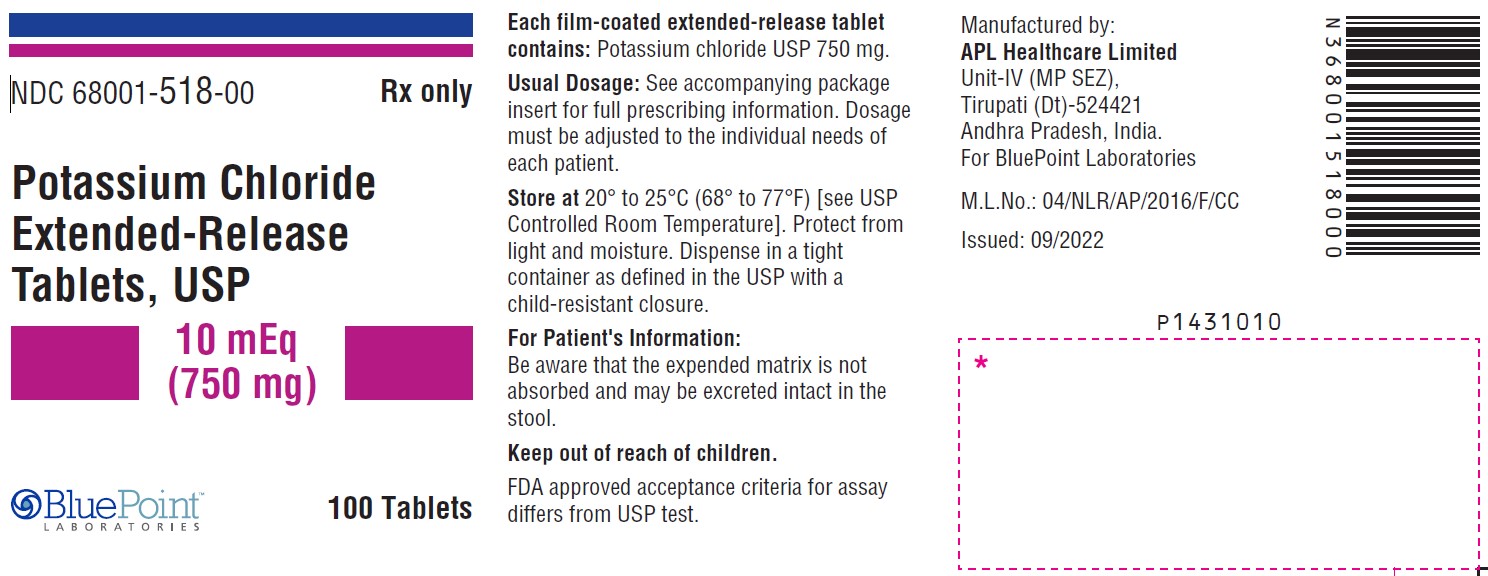
Bottles of 100 NDC 68001-518-00 Bottles of 1,000 NDC 68001-518-08 Store at 20 o to 25 o C (68 o to 77 o F) [see USP Controlled Room Temperature]. Protect from light and moisture. Dispense in a tight, light-resistant container with a child-resistant closure.
📋 Description ▾
11 DESCRIPTION Potassium chloride extended-release tablets USP are a solid oral dosage form of potassium chloride. Each contains 750 mg of potassium chloride equivalent to 10 mEq of potassium in a wax matrix tablet. Potassium chloride extended-release tablets USP are an electrolyte replenisher.
The chemical name is potassium chloride, and the structural formula is KCl. Potassium chloride, USP is a white, crystalline powder or colorless crystals. It is odorless and has a saline taste.
Its solutions are neutral to litmus. It is freely soluble in water and practically insoluble in ethanol. Inactive Ingredients: Colloidal silicon dioxide, hydrogenated vegetable oil, magnesium stearate, polyethylene glycol, polyvinyl alcohol, talc and titanium dioxide.
FDA approved acceptance criteria for assay differs from USP test. Meets USP Dissolution Test 5.
💬 Information for Patients ▾
17 PATIENT COUNSELING INFORMATION Inform patients to take each dose with meals and with a full glass of water or other liquid, and to not crush, chew, or suck the tablets. Inform patients that the wax matrix is not absorbed and is excreted in the feces; in some instances the empty matrices may be noticeable in the stool. Advise patients seek medical attention if tarry stools or other evidence of gastrointestinal bleeding is noticed.
Manufactured by: APL Healthcare Limited Unit-IV (MP SEZ), Tirupati (Dt)-524421 Andhra Pradesh, India For BluePoint Laboratories Issued: 09/2022
🧬 Pharmacokinetics ▾
12.3Pharmacokinetics The potassium chloride in potassium chloride extended-release tablets are completely absorbed before it leaves the small intestine. The wax matrix is not absorbed and is excreted in the feces; in some instances the empty matrices may be noticeable in the stool. When the bioavailability of the potassium ion from the potassium chloride extended-release tablets are compared to that of a true solution the extent of absorption is similar.
The extended-release properties of potassium chloride extended-release tablets are demonstrated by the finding that a significant increase in time is required for renal excretion of the first 50% of the potassium chloride extended-release tablets dose as compared to the solution. Increased urinary potassium excretion is first observed 1 hour after administration of potassium chloride extended-release tablets, reaches a peak at approximately 4 hours, and extends up to 8 hours. Mean daily steady-state plasma levels of potassium following daily administration of potassium chloride extended-release tablets cannot be distinguished from those following administration of potassium chloride solution or from control plasma levels of potassium ion.
Specific Populations Cirrhotics Based on publish literature, the baseline corrected serum concentrations of potassium measured over 3 hours after administration in cirrhotic subjects who received an oral potassium load rose to approximately twice that of normal subjects who received the same load.
🧪 Nonclinical Toxicology ▾
13 NON CLINICAL TOXICOLOGY
13.1Carcinogenesis, Mutagenesis, Impairment of Fertility Carcinogenicity, mutagenicity and fertility studies in animals have not been performed. Potassium is a normal dietary constituent.
📄 Carcinogenesis, Mutagenesis, Impairment of Fertility ▾
13.1Carcinogenesis, Mutagenesis, Impairment of Fertility Carcinogenicity, mutagenicity and fertility studies in animals have not been performed. Potassium is a normal dietary constituent.
📄 Package Label / Principal Display Panel ▾
PACKAGE LABEL-PRINCIPAL DISPLAY PANEL NDC 68001-518-00 Rx only Potassium Chloride Extended-Release Tablets, USP 10 mEq (750 mg)100 Tablets Bottle Label Potassium Chloride ER Tablets USP 10 mEq ( 750 mg )