
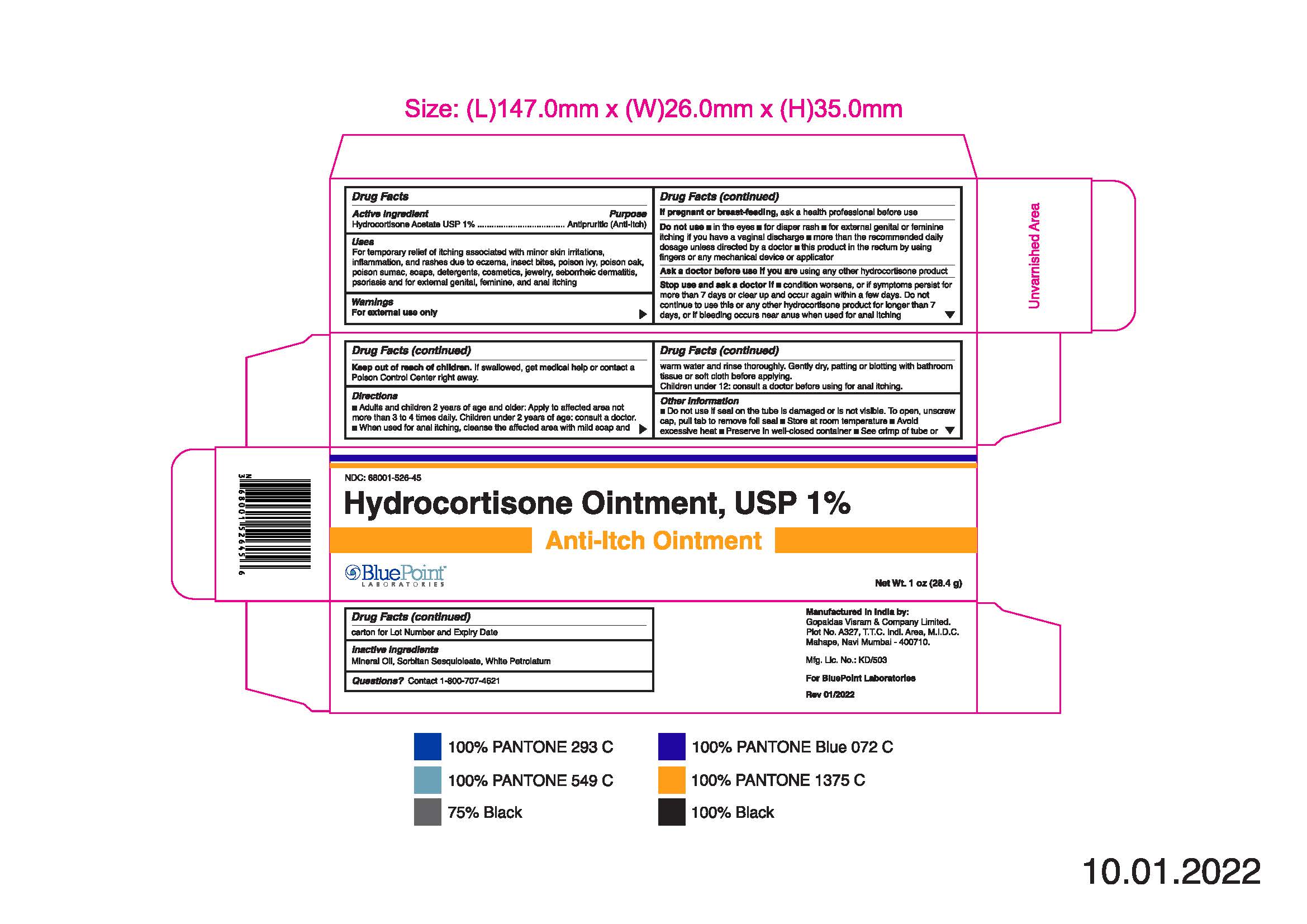
Hydrocortisone Antipruritic (Anti-Itch) 1 g/100g Ointment, 1 tube — NDC 68001-526-45 (Billing 68001-0526-45)
This is a package of 1 tube of Hydrocortisone Antipruritic (Anti-Itch) 1 g/100g Ointment from BluePoint Laboratories, marketed since May 2023 and currently FDA-listed; retail pharmacies pay about $0.0741 per g (NADAC). It is this product's only package size.
NDC database record
One package, one record: these facts belong to NDC 68001-526-45 alone.
- Record
- FDA NDC Directory package listing · Human OTC drug
- Code segments
- 68001 labeler · 526 product · 45 package
- Package marketed since
- May 17, 2023
- Sample package
- No — commercial package
- Listing certified through
- Dec 31, 2026
- Barcode (UPC-A, from the NDC)
- 3 6800152645 6
- Medicaid fills, this package
- 1,683 prescriptions in the last four reported quarters
- FDA record last changed
- Jul 24, 2026
Identity & classification
Regulatory identifiers FDA, NLM and CMS codes for this package
Drug-database identifiers Medi-Span GPI and First Databank GCN / HICL / AHFS classification
- GSN (GCN sequence number): 007526
- GCN: 30851
- GPI-14 (Medi-Span): 90550075104208
- HICL (First Databank): 002863
- AHFS class code: 52:08.08.00
- RxCUI (RxNorm): 1440184
Where does this data come from?
- FDA openFDA NDC Directory · synced Oct 8, 2026
- FDA label on DailyMed · label index refreshed Oct 8, 2026
- RxNorm (NLM RxNav) · catalog refreshed Oct 8, 2026
- Medi-Span GPI (licensed)
- First Databank (licensed) · refreshed Oct 8, 2026
RxNorm drug class
This medicine belongs to the Corticosteroid class.
Where does this data come from?
- RxClass (NLM) · catalog refreshed Oct 8, 2026
Clinical
Hydrocortisone topical is used to treat redness, swelling, itching, and discomfort of various skin conditions. Hydrocortisone is in a class of medications called corticosteroids. It works by activating natural substances in the skin to reduce swelling, redness, and itching.
Read the full MedlinePlus article ↗- It depends on the product. Tablets and oral granules are used for adrenal insufficiency, among other conditions. Injections are used for severe allergic states and skin diseases. R...
- Don't stop it suddenly if you take it for adrenal insufficiency. Stopping abruptly can cause adrenal crisis, which can be fatal. Talk to your prescriber before making any changes.
- Common ones are fluid retention, higher blood pressure, changes in blood sugar, mood changes, bigger appetite and weight gain. Call your doctor for signs of infection, vision chang...
- Grapefruit juice and some antifungals and antibiotics can raise hydrocortisone levels. Some seizure medicines and rifampicin can lower them. Tell me about any diabetes medicines, w...
Patient education
Supplement & herbal interactions
Where does this data come from?
- MedlinePlus (NLM) · refreshed Oct 8, 2026
- FDA label on DailyMed · label index refreshed Oct 8, 2026
Ask a licensed pharmacist directly — free, answered by our team.
Pricing
A drug doesn't have one price. Each row is a different public payment system, and none is what you'd pay at the counter — that depends on your insurance. The ⓘ on each row explains what it measures.
| Price system | Per g | Per package |
|---|---|---|
| Retail pharmacies payNADAC · weekly | $0.074 | $2.10 / 28.4 g |
| Medicaid paysCMS SDUD · 12 mo | $0.3312 | $9.41 / 28.4 g |
| Medicare drug plans payPart D · quarterly | No Part D plan price is available for this NDC in our data. | |
Where does this data come from?
- CMS NADAC weekly file · file of Oct 7, 2026
- CMS ASP pricing files · refreshed Sep 20, 2026
- CMS Medicaid State Drug Utilization Data · through Q1 2026
- CMS Part D plan pricing files · refreshed Sep 24, 2026
- VA National Acquisition Center price file
Packaging — all sizes for this product
| Package NDC | Description | Marketing start | Marketing end | Status |
|---|---|---|---|---|
| 68001-0526-45 You're viewing this Main listing | 1 TUBE in 1 CARTON / 28.4 g in 1 TUBE | 2023-05-17 | — | Active |
Therapeutic equivalents
| Product | Labeler | Pack | NADAC/unit | TE | Status | Price vs. this |
|---|---|---|---|---|---|---|
| Hydrocortisone 1 g/100gthis 68001-0526-45 | BluePoint | 1 tube | $0.074 | — | Availability likely | — |
| Hydrocortisone 1 g/100g 70000-0489-01 | Cardinal | 1 tube | $0.074 | — | Availability likely | — |
| Poli-A 1 g/100g 49873-0703-01 | Sato | 1 tube | — | — | FDA listed | — |
| procure 1 g/100g 55681-0224-02 | TWIN | 144 packets | — | — | FDA listed | — |
Where does this data come from?
- FDA openFDA NDC Directory · synced Oct 8, 2026
- FDA Orange Book · refreshed Oct 3, 2026
- CMS NADAC weekly file · file of Oct 7, 2026
Availability & generic status
We did not find an FDA-approved generic match for this exact strength, form and route.
Where does this data come from?
- FDA Orange Book · refreshed Oct 3, 2026
Inactive Ingredients / Excipients
Inactive ingredients, also called excipients, are components of the drug product other than the active ingredient. They may include fillers, dyes, coatings, preservatives, flavors, or other formulation ingredients.
🧪 Avoiding an ingredient? See Hydrocortisone inactive ingredients by manufacturer: every current product's list side by side, so you can ask your pharmacy for the version that does not list it.
💡 Tap an ingredient (hover on desktop) to see what it is and why it’s used.
-
UNII T5L8T28FGP
Mineral oil is a clear, odorless liquid derived from crude oil. It acts as a lubricant and emollient in medications, helping pills slide smoothly during manufacturing and aiding moisture retention in topical products.
-
UNII 0W8RRI5W5A
A fatty acid derivative used as an emulsifier and surfactant in medications. It helps blend oily and water-based ingredients together to create a stable, uniform product.
-
UNII B6E5W8RQJ4
White petrolatum is a purified mineral oil product used as a lubricant and skin protectant in medications. It helps pills slide through manufacturing equipment and can soften or protect the skin when applied topically.
3 inactive ingredients listed in the exact product block matched to this NDC.
Label-section wording can be broader than the structured product block and may mention additional formulation ingredients.
Where does this data come from?
ingredient classCode="IACT" elements from the exact product block matched by this NDC. Label-section narrative from DailyMed / the openFDA label index is shown separately when available.- FDA label on DailyMed · label index refreshed Oct 8, 2026
- FDA openFDA NDC Directory · synced Oct 8, 2026
Inactive ingredient FAQ
Are inactive ingredients the same for every manufacturer?
Why might an inactive ingredient be missing?
Can inactive ingredients matter?
Manufacturer & labeler
More NDCs from BluePoint Laboratories labeler code 68001
- Bupropion Hydrochloride 300 mg Tablet, Extended Release NDC 68001-520-03
- CHILDRENS IBUPROFEN 100 mg/5mL Suspension NDC 68001-521-92
- FULVESTRANT 250 mg/5mL Injection NDC 68001-522-85
- Fosaprepitant 150 mg/5mL Injection, Powder, Lyophilized, For Solution NDC 68001-523-36
- Fluorouracil 50 mg/mL Injection, Solution NDC 68001-524-30
- Fluorouracil 50 mg/mL Injection, Solution NDC 68001-525-27
- Azacitidine 100 mg Injection, Powder, Lyophilized, For Solution NDC 68001-527-54
- Meclizine HCl MECLIZINE HYDROCHLORIDE 12.5 mg Tablet NDC 68001-528-00
- Meclizine HCl MECLIZINE HYDROCHLORIDE CHEWABLE 25 mg Tablet, Chewable NDC 68001-529-00
- OLOPATADINE HYDROCHLORIDE 2 mg/mL Solution NDC 68001-530-69
- Bacitracin Zinc First Aid Antibiotic 500 [USP'U]/g Ointment NDC 68001-531-45
- Zinc Oxide Skin Protectant 20 g/100g Ointment NDC 68001-532-45
Where does this data come from?
- FDA openFDA NDC Directory · synced Oct 8, 2026
- Drugs@FDA
FDA label — Drug Facts FDA SPL
🎯 Indications and Usage ▾
Uses For temporary relief of itching associated with minor skin irritations, inflammation, and rashes due to eczema, insect bites, poison ivy, poison oak, poison sumac, soaps, detergents, cosmetics, jewelry, seborrheic dermatitis, psoriasis, and for external genital, feminine, and anal itching.
⏱️ Dosage and Administration ▾
Directions Adults and children 2 years of age and older: Apply to affected area not more than 3 to 4 times daily. Children under 2 years of age: consult a doctor. When used for anal itching, cleanse the affected area with mild soap and warm water and rinse thoroughly. Gently dry, patting or blotting with bathroom tissue or soft cloth before applying. Children under 12: consult a doctor before using for anal itching.
⚠️ Warnings ▾
Warnings For external use only If pregnant or breast-feeding, ask a health professional before use Do not use in the eyes for diaper rash for external genital or feminine itching if you have a vaginal discharge more than the recommended daily dosage unless directed by a doctor this product in the rectum by using fingers or any mechanical device or applicator Ask a doctor before use if you are using any other hydrocortisone product Stop use and ask a doctor if Condition worsens, or if symptoms persist for more than 7 days or clear up and occur again within a few days.
Do not continue to use this or any other hydrocortisone product for longer than 7 days, or if bleeding occurs near anus when used for anal itching Keep out of reach of children If swallowed, get medical help or contact a Poison Control Center right away.
📦 Storage and Handling ▾
Other Information Do not use if seal on the tube is damaged or is not visible. To open, unscrew cap, pull tab to remove foil seal Store at room temperature Avoid excessive heat Preserve in well-closed container See crimp of tube or carton for Lot Number and Expiry Date
🧪 Active Ingredient ▾
Active ingredient Hydrocortisone Acetate USP 1%
🧪 Inactive Ingredients ▾
Inactive Ingredients Mineral Oil, Sorbitan Sesquioleate, White Petrolatum
🎯 Purpose ▾
Purpose Antipruritic (Anti-Itch)
📄 Do Not Use ▾
Do not use in the eyes for diaper rash for external genital or feminine itching if you have a vaginal discharge more than the recommended daily dosage unless directed by a doctor this product in the rectum by using fingers or any mechanical device or applicator Ask a doctor before use if you are using any other hydrocortisone product
📄 Stop Use and Ask a Doctor If ▾
Stop use and ask a doctor if Condition worsens, or if symptoms persist for more than 7 days or clear up and occur again within a few days. Do not continue to use this or any other hydrocortisone product for longer than 7 days, or if bleeding occurs near anus when used for anal itching
🤰 If Pregnant or Breast-Feeding ▾
If pregnant or breast-feeding, ask a health professional before use
📄 Keep Out of Reach of Children ▾
Keep out of reach of children If swallowed, get medical help or contact a Poison Control Center right away.
📄 Questions or Comments ▾
Questions? Contact 1-800-707-4621 Manufactured in India by: Gopaldas Visram & Company Limited Plot No. A327, T.T.C Indl. Area, M.I.D.C Mahape, Navi Mumbai - 400710. Mfg. Lic. No.: KD/503 For BluePoint Laboratories Rev 01/2022
📄 Package Label / Principal Display Panel ▾
Label
Hydrocortisone Ointment, USP 1% Tube
Hydrocortisone Ointment, USP 1% carton