
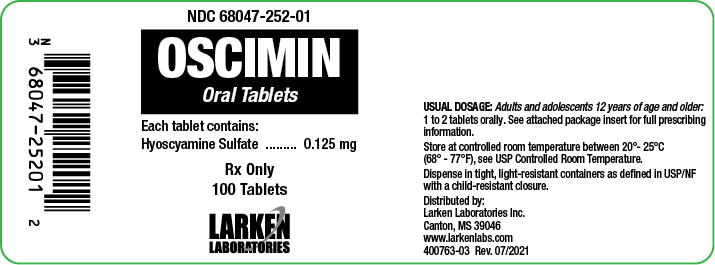
OSCIMIN Hyoscyamine Sulfate .125 mg Tablet, 100-count — NDC 68047-252-01 (Billing 68047-0252-01)
This is a package of 100 tablets of OSCIMIN Hyoscyamine Sulfate .125 mg Tablet from Larken Laboratories, Inc., marketed since Aug 2011 and currently FDA-listed; retail pharmacies pay about $0.1459 per tablet (NADAC). It is this product's only package size.
NDC database record
One package, one record: these facts belong to NDC 68047-252-01 alone.
- Record
- FDA NDC Directory package listing · Human prescription drug
- Code segments
- 68047 labeler · 252 product · 01 package
- Package marketed since
- Aug 3, 2011
- Sample package
- No — commercial package
- Listing certified through
- Dec 31, 2026
- Billing quantity
- 100 EA per package
- Barcode (UPC)
- 0368047252012
- Medicaid fills, this package
- 376 prescriptions in the last four reported quarters
- FDA record last changed
- Jul 24, 2026
Identity & classification
Regulatory identifiers FDA, NLM and CMS codes for this package
Drug-database identifiers Medi-Span GPI and First Databank GCN / HICL / AHFS classification
- GSN (GCN sequence number): 004865
- GCN: 18961
- GPI-14 (Medi-Span): 49101030100310
- HICL (First Databank): 002017
- AHFS class code: 12:08.08.00
- RxCUI (RxNorm): 1047905
Where does this data come from?
- FDA openFDA NDC Directory · synced Oct 8, 2026
- FDA label on DailyMed · label index refreshed Oct 8, 2026
- RxNorm (NLM RxNav) · catalog refreshed Oct 1, 2026
- Medi-Span GPI (licensed)
- First Databank (licensed) · refreshed Oct 8, 2026
RxNorm drug class
This medicine belongs to the Belladonna alkaloids, tertiary amines class.
Where does this data come from?
- RxClass (NLM) · catalog refreshed Oct 1, 2026
Clinical
- Hyoscyamine calms spasms and slows secretions in the stomach, bowel and bladder. It is often an add-on for peptic ulcer or irritable bowel syndrome. Some products have additional u...
- Many tablets are taken 30 to 60 minutes before meals and at bedtime, and some are taken as needed. Follow your label, since dissolving, under-the-tongue and extended-release forms...
- Dry mouth, blurred vision, drowsiness, dizziness and constipation are common. Use caution driving until you know how it affects you. Call your doctor if you cannot urinate or feel...
- Be careful. Hyoscyamine reduces sweating, so you can overheat and even get heat stroke. Stay cool and get help for fever or heat illness.
Patient education
Supplement & herbal interactions
Where does this data come from?
- MedlinePlus (NLM) · refreshed Oct 8, 2026
- FDA label on DailyMed · label index refreshed Oct 8, 2026
Ask a licensed pharmacist directly — free, answered by our team.
Pricing
A drug doesn't have one price. Each row is a different public payment system, and none is what you'd pay at the counter — that depends on your insurance. The ⓘ on each row explains what it measures.
| Price system | Per ea | Per package |
|---|---|---|
| Retail pharmacies payNADAC · weekly | $0.146 | $14.59 / 100 tablets |
| Medicaid paysCMS SDUD · 12 mo | $0.3077 | $30.77 / 100 tablets |
| Medicare drug plans payPart D · quarterly | No Part D plan price is available for this NDC in our data. | |
Where does this data come from?
- CMS NADAC weekly file · file of Oct 7, 2026
- CMS ASP pricing files · refreshed Sep 20, 2026
- CMS Medicaid State Drug Utilization Data · through Q1 2026
- CMS Part D plan pricing files · refreshed Sep 24, 2026
- VA National Acquisition Center price file
Packaging — all sizes for this product
| Package NDC | Description | Marketing start | Marketing end | Status |
|---|---|---|---|---|
| 68047-0252-01 You're viewing this Main listing | 100 TABLET in 1 BOTTLE | 2011-08-03 | — | Active |
Therapeutic equivalents
| Product | Labeler | Pack | NADAC/unit | TE | Status | Price vs. this |
|---|---|---|---|---|---|---|
| Hyoscyamine Sulfate TAB .125 mg 42192-0340-01 | Acella | 100 tablets | $0.146 | — | Availability likely | — |
| Digenyx .125 mg 59088-0150-54 | PureTek | 30 tablets | $0.146 | — | Availability likely | — |
| Hyoscyamine sulfate .125 mg 62135-0512-12 | Chartwell | 120 tablets | $0.146 | — | Availability likely | — |
| Hyoscyamine Sulfate .125 mg 62559-0421-01 | ANI | 100 tablets | $0.146 | — | Availability likely | — |
| Oscimin .125 mgthis 68047-0252-01 | Larken | 100 tablets | $0.146 | — | Availability likely | — |
| Levsin .125 mg 68220-0112-10 | Viatris | 100 tablets | $2.656 | — | Availability likely | +1720% |
| Hyoscyamine Sulfate .125 mg 00615-8537-39 | NCS | 30 tablets | — | — | FDA listed | — |
| Hyoscyamine Sulfate .125 mg 39328-0050-10 | Patrin | 100 tablets | — | — | FDA listed | — |
| Hyoscyamine Sulfate TAB .125 mg 42708-0183-56 | QPharma, | 56 tablets | — | — | FDA listed | — |
| Hyoscyamine Sulfate .125 mg 51655-0764-52 | Northwind | 30 tablets | — | — | FDA listed | — |
| Hyoscyamine Sulfate TAB .125 mg 51655-0845-52 | Northwind | 30 tablets | — | — | FDA listed | — |
| Hyoscyamine Sulfate .125 mg 63629-1028-01 | Bryant | 100 tablets | — | — | Discontinued | — |
| Hyoscyamine Sulfate TAB .125 mg 63629-5911-01 | Bryant | 20 tablets | — | — | FDA listed | — |
| Hyoscyamine Sulfate .125 mg 69367-0677-01 | Westminster | 100 tablets | — | — | FDA listed | — |
| Hyoscyamine Sulfate TAB .125 mg 70518-3847-00 | REMEDYREPACK | 90 tablets | — | — | Discontinued | — |
| Hyoscyamine Sulfate .125 mg 70518-4436-00 | REMEDYREPACK | 180 tablets | — | — | FDA listed | — |
| Hyoscyamine Sulfate .125 mg 72162-1939-01 | Bryant | 100 tablets | — | — | FDA listed | — |
| Hyoscyamine Sulfate .125 mg 82804-0965-30 | Proficient | 30 tablets | — | — | FDA listed | — |
| Hyoscyamine Sulfate .125 mg 63629-1030-01 | Bryant | 100 tablets | — | — | Discontinued | — |
| Hyoscyamine Sulfate .125 mg 63629-1031-01 | Bryant | 100 tablets | — | — | Discontinued | — |
| Hyoscyamine Sulfate .125 mg 71335-1647-01 | Bryant | 20 tablets | — | — | FDA listed | — |
| Hyoscyamine Sulfate .125 mg 72162-1940-01 | Bryant | 100 tablets | — | — | FDA listed | — |
| Hyoscyamine Sulfate .125 mg 72162-1941-01 | Bryant | 100 tablets | — | — | FDA listed | — |
| Hyoscyamine Sulfate SL .125 mg 69367-0678-01 | Westminster | 100 tablets | — | — | FDA listed | — |
| Hyoscyamine Sulfate .125 mg 63561-0203-01 | Granulation | 100 tablets | — | — | FDA listed | — |
Where does this data come from?
- FDA openFDA NDC Directory · synced Oct 8, 2026
- FDA Orange Book · refreshed Oct 3, 2026
- CMS NADAC weekly file · file of Oct 7, 2026
Availability & generic status
We did not find an FDA-approved generic match for this exact strength, form and route.
Where does this data come from?
- FDA Orange Book · refreshed Oct 3, 2026
Inactive Ingredients / Excipients
Inactive ingredients, also called excipients, are components of the drug product other than the active ingredient. They may include fillers, dyes, coatings, preservatives, flavors, or other formulation ingredients.
🧪 Avoiding an ingredient? See Hyoscyamine inactive ingredients by manufacturer: every current product's list side by side, so you can ask your pharmacy for the version that does not list it.
💡 Tap an ingredient (hover on desktop) to see what it is and why it’s used.
-
UNII 35SW5USQ3G
A synthetic yellow dye used to color medicines. It helps make tablets, capsules, and liquids visually distinct so patients can easily identify their medication.
-
UNII H3R47K3TBD
FD&C Blue No. 1 is a synthetic blue dye approved for use in foods and medicines. It serves as a colorant to give the medication its distinctive appearance and help with product identification.
-
UNII EWQ57Q8I5X
Lactose monohydrate is a natural sugar derived from milk. It serves as a filler and binder in tablets and capsules, helping create the proper size, texture, and consistency of the medicine.
-
UNII 70097M6I30
Magnesium stearate is a salt made from magnesium and stearic acid, a fatty substance. It's used in tablets and capsules as a lubricant and glidant to help ingredients flow smoothly during manufacturing and prevent sticking.
-
UNII 3OWL53L36A
A natural sugar alcohol derived from seaweed or synthesized in the lab. It's used as a filler to add bulk, a sweetener in sugar-free formulas, and a disintegrant to help tablets break apart in the stomach.
-
UNII O8232NY3SJ
A plant-based carbohydrate derived from corn kernels. It acts as a filler to add bulk, a binder to hold ingredients together, and a disintegrant to help the tablet break apart in your stomach for absorption.
-
UNII 4ELV7Z65AP
Stearic acid is a fatty acid derived from plant or animal sources. It acts as a binder and lubricant in tablets and capsules, helping them hold together and flow smoothly during manufacturing.
7 inactive ingredients listed in the exact product block matched to this NDC.
Label-section wording can be broader than the structured product block and may mention additional formulation ingredients.
Where does this data come from?
ingredient classCode="IACT" elements from the exact product block matched by this NDC. Label-section narrative from DailyMed / the openFDA label index is shown separately when available.- FDA label on DailyMed · label index refreshed Oct 8, 2026
- FDA openFDA NDC Directory · synced Oct 8, 2026
Inactive ingredient FAQ
Are inactive ingredients the same for every manufacturer?
Why might an inactive ingredient be missing?
Can inactive ingredients matter?
Manufacturer & labeler
More NDCs from Larken Laboratories, Inc. labeler code 68047
- LoHist D Chlorpheniramine Maleate / Pseudoephedrine HCl 2 mg/5mL; 30 mg/5mL Liquid NDC 68047-120-16
- LoHist DM Brompheniramine Maleate, Dextromethorphan Hydrobromide and Phenylephrine Hydrochloride 10 mg/5mL; 5 mg/5mL; 2 mg/5mL Liquid NDC 68047-129-16
- EndaCof DM Brompheniramine Maleate, Dextromethorphan Hydrobromide and Phenylephrine Hydrochloride 1 mg/5mL; 5 mg/5mL; 2.5 mg/5mL Liquid NDC 68047-143-16
- LoHist-D Chlorpheniramine Maleate / Pseudoephedrine HCl 2 mg/5mL; 30 mg/5mL Liquid NDC 68047-159-16
- NoHist DM Chlorpheniramine Maleate, Dextromethorphan Hydrobromide and Phenylephrine Hydrochloride 4 mg/5mL; 10 mg/5mL; 15 mg/5mL Liquid NDC 68047-186-16
- OSCIMIN Hyoscyamine Sulfate .125 mg Tablet, Orally Disintegrating NDC 68047-253-01
- Dexamethasone 1.5 mg 1.5 mg Tablet NDC 68047-702-01
- Doxycycline Hyclate 20 mg Tablet NDC 68047-714-01
- Butalbital And Acetaminophen 50 mg; 325 mg Tablet NDC 68047-721-01
- Allzital butalbital and acetaminophen 25 mg; 325 mg Tablet NDC 68047-752-01
- Butalbital and Acetaminophen 25 mg; 325 mg Tablet NDC 68047-753-01
Where does this data come from?
- FDA openFDA NDC Directory · synced Oct 8, 2026
- Drugs@FDA
Full prescribing information FDA SPL
🎯 Indications and Usage ▾
INDICATIONS AND USAGE This product may be used in functional intestinal disorders to reduce symptoms such as those seen in mild dysenteries and diverticulitis. It can also be used to control gastric secretion, visceral spasm and hypermotility in cystitis, pylorospasm and associated abdominal cramps. Along with appropriate analgesics, this product is indicated in symptomatic relief of biliary and renal colic and as a drying agent in the relief of symptoms of acute rhinitis.
This product is effective as adjunctive therapy in the treatment of peptic ulcer and irritable bowel syndrome, acute enterocolitis and other functional gastrointestinal disorders.
⏱️ Dosage and Administration ▾
DOSAGE AND ADMINISTRATION Dosage may be adjusted according to the condition and severity of symptoms. May be taken with or without water. Adults and adolescents 12 years of age and older: 1 to 2 tablets orally three or four times a day, thirty minutes to one hour before meals and at bedtime. Dosage may be increased to every four hours as needed. Do not exceed 12 tablets in 24 hours.
⛔ Contraindications ▾
CONTRAINDICATIONS Glaucoma, obstructive uropathy, obstructive diseases of the gastrointestinal tract, paralytic ileum, intestinal atony of elderly or debilitated patients, unstable cardiovascular status, severe ulcerative colitis, toxic megacolon, myasthenia gravis, and myocardial ischemia. This product is not recommended for use in children under twelve years of age.
⚠️ Warnings ▾
WARNINGS Heat prostration can occur with drug use in the event of high environmental temperature. Diarrhea may be an early symptom of incomplete intestinal obstruction, especially in patients with ileostomy or colostomy; in this instance, treatment would be inappropriate and possibly harmful. This product may cause drowsiness or blurred vision.
Patients taking this product should be warned not to engage in activities requiring mental alertness such as operating a motor vehicle or other machinery or to perform hazardous tasks while taking this drug.
🤒 Adverse Reactions ▾
ADVERSE REACTIONS Not all of the following adverse reactions have been reported with hyoscyamine sulfate. The following adverse reactions have been reported for pharmacologically similar drugs with anticholinergic-antispasmodic action. Adverse reactions may include dryness of the mouth, urinary hesitancy and retention; blurred vision; tachycardia; palpitations; mydriasis; cycloplegia; increased ocular tension; loss of taste; headache; nervousness; drowsiness; weakness; dizziness; insomnia; nausea; vomiting; impotence; suppression of lactation; constipation; bloated feeling; allergic reactions or drug idiosyncrasies; urticaria and other dermal manifestations; ataxia; speech disturbance; some degree of mental confusion and/or excitement (especially in elderly persons); and decreased sweating.
To report SUSPECTED ADVERSE REACTIONS, contact Larken Laborties, Inc. at 1-601-588-7678 or FDA at 1-800-FDA-1088 or www.fda.gov/medwatch.
🔄 Drug Interactions ▾
Drug Interactions: Absorption of other oral medications may be decreased during concurrent use with anticholinergics due to decreased gastrointestinal motility and delayed gastric emptying. Drug interactions may occur when anticholinergics are used with the following medications: antacids, antidiarrheals (adsorbent), other anticholinergics, antimyasthenics, cyclopropane, haloperidol, ketoconazole, metoclopramide, opioid (narcotic) analgesics, and potassium chloride.
🤰 Pregnancy ▾
Pregnancy Pregnancy Category C. Animal reproduction studies have not been conducted with this product. It is also not known whether this product can cause fetal harm when administered to a pregnant woman or can affect reproduction capacity. Hyoscyamine crosses the placenta. This product should be given to a pregnant woman only if clearly needed.
🧒 Pediatric Use ▾
Pediatric Use: This product is not recommended for use in children under twelve years of age. Infants and young children are especially susceptible to the toxic effects of anticholinergics. Close supervision is recommended for infants and children with spastic paralysis or brain damage since an increased response to anticholinergics has been reported in these patients and dosage adjustments are often required.
When anticholinergics are given to children where the environmental temperature is high, there is a risk of a rapid increase in body temperature because of these medications’ suppression of sweat gland activity. A paradoxical reaction characterized by hyperexcitability may occur in children taking large doses of anticholinergics.
🧓 Geriatric Use ▾
Geriatric Use: Geriatric patients may respond to usual doses of anticholinergics with excitement, agitation, drowsiness, or confusion. Geriatric patients are especially susceptible to the anticholinergic side effects, such as constipation, dryness of mouth, and urinary retention (especially in males). If these side effects occur and continue or are severe, medication should probably be discontinued.
Caution is also recommended when anticholinergics are given to geriatric patients, because of the danger of precipitating undiagnosed glaucoma. Memory may become severely impaired in geriatric patients, especially those who already have memory problems, with the continued use of anticholinergics since these drugs block the actions of acetylcholine, which is responsible for many functions of the brain, including memory functions.
🆘 Overdosage ▾
OVERDOSAGE The signs and symptoms of overdose are headache, nausea, vomiting, blurred vision, dilated pupils, hot dry skin, dizziness, dryness of the mouth, difficulty in swallowing and CNS stimulation. Measures to be taken are immediate lavage of the stomach and injection of physostigmine 0.5 to 2 mg intravenously and repeated as necessary up to a total of 5 mg. Fever may be treated symptomatically (tepid water sponge baths, hypothermic blanket).
Excitement to a d degree which demands attention may be managed with sodium thiopental 2% solution given slowly intravenously or chloral hydrate (100- 200 mL of a 2% solution) by rectal infusion. In the event of progression of the curare-like effect to paralysis of the respiratory muscles, artificial respiration should be instituted and maintained until effective respiratory action returns. In rats, the LD 50 for hyoscyamine is 375 mg/kg.
Hyoscyamine is dialyzable.
🧬 Clinical Pharmacology ▾
CLINICAL PHARMACOLOGY Hyoscyamine has actions similar to those of atropine, but is more potent in both its central and peripheral effects. This product inhibits gastrointestinal propulsive motility and decreases gastric acid secretions. This product controls excessive pharyngeal, tracheal, and bronchial secretion.
Once absorbed, this product disappears rapidly from the blood and is distributed throughout the entire body. The majority of hyoscyamine sulfate is excreted in the urine unchanged within the first 12 hours and only traces of hyoscyamine sulfate are found in the breast milk.
📦 How Supplied / Storage and Handling ▾
HOW SUPPLIED OSCIMIN Oral Tablets are supplied as round, green, peppermint flavored tablets with "LL" over “252” debossed on one side. Available in bottles of 100 tablets, NDC 68047-252-01. Storage and Handling Dispense in a tight, light-resistant container as defined in USP/NF, with a child-resistant closure.
Store at controlled room temperature between 20°-25°C (68°-77°F), see USP Controlled Room Temperature. KEEP THIS AND ALL MEDICATION OUT OF THE REACH OF CHILDREN. IN CASE OF ACCIDENTAL OVERDOSE, SEEK PROFESSIONAL ASSISTANCE OR CONTACT A POISON CONTROL CENTER IMMEDIATELY .
Distributed by: Larken Laboratories, Inc. Canton, MS 39046 www.larkenlabs.com Rev. 09/2025 201098-01
📦 Storage and Handling ▾
Storage and Handling Dispense in a tight, light-resistant container as defined in USP/NF, with a child-resistant closure. Store at controlled room temperature between 20°-25°C (68°-77°F), see USP Controlled Room Temperature. KEEP THIS AND ALL MEDICATION OUT OF THE REACH OF CHILDREN.
IN CASE OF ACCIDENTAL OVERDOSE, SEEK PROFESSIONAL ASSISTANCE OR CONTACT A POISON CONTROL CENTER IMMEDIATELY . Distributed by: Larken Laboratories, Inc. Canton, MS 39046 www.larkenlabs.com Rev.
09/2025 201098-01
🧪 Inactive Ingredients ▾
INACTIVE INGREDIENTS Inactive ingredients include: D&C Yellow #10 Aluminum Lake, FD&C Blue #1 Aluminum Lake, lactose monohydrate, magnesium stearate (veg), mannitol, peppermint flavor, starch and stearic acid.
📋 Description ▾
DESCRIPTION Each tablet for oral administration contains: Hyoscyamine Sulfate, USP …… 0.125 mg. Hyoscyamine sulfate is one of the principal anticholinergic/antispasmodic components of belladonna alkaloids. Hyoscyamine sulfate is Benzeneacetic acid, α-(hydroxymethyl)-, 8- methyl-8-azabicyclo[3.2.1]oct-3-yl ester, [3(S)-endo]-, sulfate (2:1), dihydrate. (C 17 H 23 NO 3 ) 2 • H 2 SO 4 • 2H 2 O M.W. = 712.85 Hyoscyamine Sulfate
💬 Information for Patients ▾
Information for Patients: This medication should be taken 30 minutes to one hour before meals. This medication should be used with caution during exercise or hot weather; overheating may result in heat stroke. Hyoscyamine may cause drowsiness, dizziness or blurred vision; patients should observe caution before driving, using machinery or performing other tasks requiring mental alertness.
⚠️ Precautions ▾
PRECAUTIONS General: Use caution in patients with hiatal hernia associated with reflex esophagitis. Use extreme caution and only when needed in patients with autonomic neuropathy, hyperthyroidism, coronary heart disease, congestive heart failure and cardiac arrhythmia. Investigate any tachycardia before giving any anticholinergic drugs since they may increase the heart rate.
Prolonged use of anticholinergics may decrease or inhibit salivary flow, thus contributing to the development of caries, periodontal disease, oral candidiasis, and discomfort. Information for Patients: This medication should be taken 30 minutes to one hour before meals. This medication should be used with caution during exercise or hot weather; overheating may result in heat stroke.
Hyoscyamine may cause drowsiness, dizziness or blurred vision; patients should observe caution before driving, using machinery or performing other tasks requiring mental alertness. Drug Interactions: Absorption of other oral medications may be decreased during concurrent use with anticholinergics due to decreased gastrointestinal motility and delayed gastric emptying. Drug interactions may occur when anticholinergics are used with the following medications: antacids, antidiarrheals (adsorbent), other anticholinergics, antimyasthenics, cyclopropane, haloperidol, ketoconazole, metoclopramide, opioid (narcotic) analgesics, and potassium chloride.
Pregnancy Pregnancy Category C. Animal reproduction studies have not been conducted with this product. It is also not known whether this product can cause fetal harm when administered to a pregnant woman or can affect reproduction capacity.
Hyoscyamine crosses the placenta. This product should be given to a pregnant woman only if clearly needed. Nursing Mothers: This product is excreted in human milk.
This product should not be administered to a nursing mother. Pediatric Use: This product is not recommended for use in children under twelve years of age. Infants and young children are especially susceptible to the toxic effects of anticholinergics.
Close supervision is recommended for infants and children with spastic paralysis or brain damage since an increased response to anticholinergics has been reported in these patients and dosage adjustments are often required. When anticholinergics are given to children where the environmental temperature is high, there is a risk of a rapid increase in body temperature because of these medications’ suppression of sweat gland activity. A paradoxical reaction characterized by hyperexcitability may occur in children taking large doses of anticholinergics.
Geriatric Use: Geriatric patients may respond to usual doses of anticholinergics with excitement, agitation, drowsiness, or confusion. Geriatric patients are especially susceptible to the anticholinergic side effects, such as constipation, dryness of mouth, and urinary retention (especially in males). If these side effects occur and continue or are severe, medication should probably be discontinued.
Caution is also recommended when anticholinergics are given to geriatric patients, because of the danger of precipitating undiagnosed glaucoma. Memory may become severely impaired in geriatric patients, especially those who already have memory problems, with the continued use of anticholinergics since these drugs block the actions of acetylcholine, which is responsible for many functions of the brain, including memory functions.
🍼 Nursing Mothers ▾
Nursing Mothers: This product is excreted in human milk. This product should not be administered to a nursing mother.
📄 Package Label / Principal Display Panel ▾
PRINCIPAL DISPLAY PANEL Container Label
Medicaid utilization & spend
Medicare Part D spend CMS · PART D · 2025 (Q1-Q4)
About this NDC listing & data coverage
Listed without an FDA application
This product's marketing category indicates it is marketed without an approved FDA application (no NDA, ANDA, or BLA on file). Having an NDC does not by itself establish FDA approval — the NDC Directory is a listing system, not an approval decision. Approval-linked data such as Orange Book therapeutic-equivalence ratings therefore does not apply.
What data is (and isn’t) available for this NDC — tap to expand
| NDC identity (package / product / labeler codes) | ✓ Available |
| Labeler | ✓ Available |
| Product & package description | ✓ Available |
| Marketing category & status | ✓ Available |
| Active ingredient / dosage form / route | ✓ Available |
| FDA label (SPL via DailyMed) | ✓ Available |
| Package photos | ✓ Available |
| Inactive ingredients (structured) | ✓ Available |
| NADAC pharmacy acquisition price (CMS) | ✓ Available |
| Orange Book / therapeutic-equivalence data | — Not published for this NDC Applies only to products approved under an NDA/ANDA; many listings are out of scope. |
| HCPCS J-code billing crosswalk | — Not published for this NDC Most self-administered / retail products have no J-code — that is normal. |
| Medicaid utilization (CMS SDUD) | ✓ Available |