
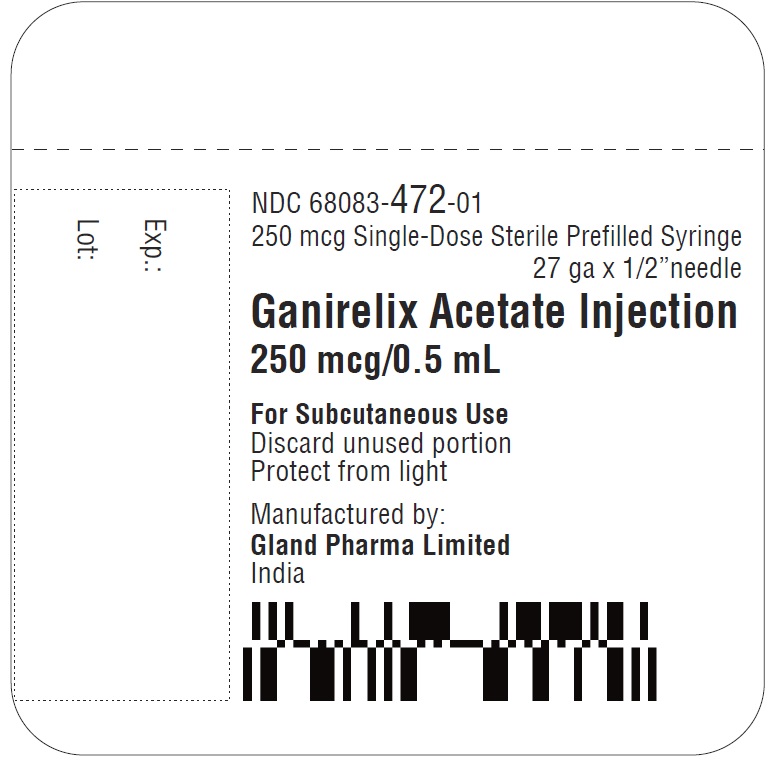
GANIRELIX ACETATE 250 ug/.5mL Injection, Solution, 1 syringe
Other active recalls for Ganirelix Acetate (different manufacturers) — 1 · tap to view
🆔 Identity & classification
Where does this data come from?
🏷️ RxNorm drug class
This medicine belongs to the Gonadotropin Releasing Hormone Receptor Antagonist class.
Where does this data come from?
🏭 Manufacturer & labeler
Where does this data come from?
🩺 Clinical
Patient education
Supplement & herbal interactions
Where does this data come from?
Ask a licensed pharmacist directly — free, answered by our team.
🧪 Inactive Ingredients / Excipients
Inactive ingredients, also called excipients, are components of the drug product other than the active ingredient. They may include fillers, dyes, coatings, preservatives, flavors, or other formulation ingredients.
💡 Tap an ingredient (hover on desktop) to see what it is and why it’s used.
-
0.1 mg / 0.5 mL
UNII Q40Q9N063P
Acetic acid is a weak organic acid commonly used in medicines as a buffer and pH adjuster. It helps maintain the proper acidity level to ensure the drug remains stable and effective in its formulation.
-
23.5 mg / 0.5 mL
UNII 3OWL53L36A
A natural sugar alcohol derived from seaweed or synthesized in the lab. It's used as a filler to add bulk, a sweetener in sugar-free formulas, and a disintegrant to help tablets break apart in the stomach.
-
UNII 55X04QC32I
A strong alkaline chemical used to adjust and maintain the pH balance of liquid medicines. It helps keep the medicine stable and ensures it stays effective during storage.
-
UNII 059QF0KO0R
Water is a liquid solvent that dissolves and mixes ingredients together in liquid medicines, syrups, and injections. It helps distribute the active drug evenly throughout the product.
4 inactive ingredients listed in the exact product block matched to this NDC.
Where does this data come from?
ingredient classCode="IACT" elements from the exact product block matched by this NDC. Label-section narrative from DailyMed / the openFDA label index is shown separately when available.Inactive ingredient FAQ
Are inactive ingredients the same for every manufacturer?
Why might an inactive ingredient be missing?
Can inactive ingredients matter?
💲 Pricing
A drug doesn't have one price. Each row is a different public payment system, and none is what you'd pay at the counter — that depends on your insurance. The ⓘ on each row explains what it measures.
| Price system | Per mL | Per package |
|---|---|---|
| Retail pharmacies payNADAC · weekly | Not in the retail survey — common for institutional, discontinued, or low-volume packs. | |
| Medicaid paysCMS SDUD · 12 mo | No recent Medicaid claims on file for this NDC — rare and low-volume NDCs are suppressed in the public data. | |
| Medicare drug plans payPart D · quarterly | No Part D plan price is available for this NDC in our data. | |
Where does this data come from?
🔁 Therapeutic equivalents
| Product | Labeler | Pack | NADAC/unit | TE | Status | Price vs. this |
|---|---|---|---|---|---|---|
| Ganirelix Acetate 250 ug/.5mL 00548-5001-00 | Amphastar | 1 syringe | $62.347 | AP | Availability likely | — |
| Fyremadel 250 ug/.5mL 55566-1010-01 | Ferring | 1 syringe | $62.347 | AP | Availability likely | — |
| Ganirelix Acetate 250 ug/.5mL 65219-0028-05 | Fresenius | 1 syringe | $62.347 | AP | Availability likely | — |
| Ganirelix Acetate 250 ug/.5mL 70700-0327-98 | Xiromed | 1 syringe | $62.347 | AP | Availability likely | — |
| Ganirelix Acetate 250 ug/.5mL 70748-0274-01 | Lupin | 1 syringe | $62.347 | AP | Availability likely | — |
| Ganirelix Acetate 250 ug/.5mL 71288-0554-80 | Meitheal | 1 syringe | $62.347 | AP | Availability likely | — |
| Ganirelix Acetate 250 ug/.5mL 83301-0082-01 | Mullan | 1 syringe | $62.347 | AP | Availability likely | — |
| Ganirelix Acetate 250 ug/.5mL 67184-0574-01 | Qilu | 1 syringe | — | AP | FDA listed | — |
| Ganirelix Acetate 250 ug/.5mLthis 68083-0472-01 | Gland | 1 syringe | — | AP | FDA listed | — |
| Ganirelix Acetate 250 ug/.5mL 78206-0138-01 | Organon | 1 syringe | — | AP | FDA listed | — |
Where does this data come from?
⏳ Availability & generic status
This product is an FDA-approved generic. Other versions of the same drug are listed under Therapeutic equivalents, least expensive first.
Where does this data come from?
📦 Packaging — all sizes for this product
| Package NDC | Description | Marketing start | Status |
|---|---|---|---|
| 68083-0472-01 You're viewing this | 1 BLISTER PACK in 1 CARTON (68083-472-01) / 1 SYRINGE, GLASS in 1 BLISTER PACK / 1 mL in 1 SYRINGE, GLASS | 2023-02-28 | Active |
🧭 About this NDC listing & data coverage
What data is (and isn’t) available for this NDC — tap to expand
| NDC identity (package / product / labeler codes) | ✓ Available |
| Labeler | ✓ Available |
| Product & package description | ✓ Available |
| Marketing category & status | ✓ Available |
| Active ingredient / dosage form / route | ✓ Available |
| FDA label (SPL via DailyMed) | ✓ Available |
| Package photos | ✓ Available |
| Inactive ingredients (structured) | ✓ Available |
| NADAC pharmacy acquisition price (CMS) | — Not published for this NDC CMS publishes NADAC only for NDCs reported in its retail-pharmacy survey. |
| Orange Book / therapeutic-equivalence data | ✓ Available |
| HCPCS J-code billing crosswalk | — Not published for this NDC Most self-administered / retail products have no J-code — that is normal. |
| Medicaid utilization (CMS SDUD) | — Not published for this NDC CMS reports utilization only for NDCs with Medicaid claims above its privacy threshold. |
Questions about this listing
Why is there no price listed?
Is the NDC printed on the package the same as the 11-digit billing NDC?
What do the three segments of this NDC mean?
Is this package still being marketed?
Who lists this product with the FDA?
Do I need a prescription for this product?
Where does this data come from?
📄 Full prescribing information FDA SPL
🎯 Indications and Usage ▾
INDICATIONS AND USAGE Ganirelix Acetate Injection is indicated for the inhibition of premature LH surges in women undergoing controlled ovarian hyperstimulation.
⏱️ Dosage and Administration ▾
DOSAGE AND ADMINISTRATION After initiating FSH therapy on Day 2 or 3 of the cycle, Ganirelix Acetate Injection 250 mcg may be administered subcutaneously once daily during the mid to late portion of the follicular phase. By taking advantage of endogenous pituitary FSH secretion, the requirement for exogenously administered FSH may be reduced. Treatment with Ganirelix Acetate should be continued daily until the day of hCG administration.
When a sufficient number of follicles of adequate size are present, as assessed by ultrasound, final maturation of follicles is induced by administering hCG. The administration of hCG should be withheld in cases where the ovaries are abnormally enlarged on the last day of FSH therapy to reduce the chance of developing OHSS (Ovarian Hyperstimulation Syndrome). Directions for Using Ganirelix Acetate Injection Ganirelix Acetate Injection is supplied in a single dose, sterile, prefilled syringe and is intended for SUBCUTANEOUS administration only.
Air bubble(s) may be seen in the pre-filled syringe. This is expected, and removal of theair bubble(s) is not needed. Wash hands thoroughly with soap and water.
The most convenient sites for SUBCUTANEOUS injection are in the abdomen around the navel or upper thigh. The injection site should be swabbed with a disinfectant to remove any surface bacteria. Clean about two inches around the point where the needle will be inserted and let the disinfectant dry for at least one minute before proceeding.
With syringe held upward, remove needle cover. Pinch up a large area of skin between the finger and thumb. Vary the injection site a little with each injection.
The needle should be inserted at the base of the pinched-up skin at an angle of 45–90° to the skin surface. When the needle is correctly positioned, it will be difficult to draw back on the plunger. If any blood is drawn into the syringe, the needle tip has penetrated a vein or artery.
If this happens, withdraw the needle slightly and reposition the needle without removing it from the skin. Alternatively, remove the needle and use a new, sterile, prefilled syringe. Cover the injection site with a swab containing disinfectant and apply pressure; the site should stop bleeding within one or two minutes.
Once the needle is correctly placed, depress the plunger slowly and steadily, so the solution is correctly injected and the skin is not damaged. Pull the syringe out quickly and apply pressure to the site with a swab containing disinfectant. Use the sterile, prefilled syringe only once.
Discard the unused portion and dispose of it properly.
⛔ Contraindications ▾
CONTRAINDICATIONS Ganirelix Acetate Injection is contraindicated under the following conditions: • Known hypersensitivity to Ganirelix Acetate or to any of its components. • Known hypersensitivity to GnRH or any other GnRH analog. • Known or suspected pregnancy (see PRECAUTIONS ).
⚠️ Warnings ▾
WARNINGS Ganirelix Acetate Injection should be prescribed by physicians who are experienced in infertility treatment. Before starting treatment with Ganirelix Acetate, pregnancy must be excluded. Safe use of Ganirelix Acetate during pregnancy has not been established (see CONTRAINDICATIONS and PRECAUTIONS ).
🤒 Adverse Reactions ▾
ADVERSE REACTIONS The safety of Ganirelix Acetate Injection was evaluated in two randomized, parallel-group, multicenter controlled clinical studies. Treatment duration for Ganirelix Acetate ranged from 1 to 14 days. Table IV represents adverse events (AEs) from first day of Ganirelix Acetate administration until confirmation of pregnancy by ultrasound at an incidence of ≥ 1% in Ganirelix Acetate-treated subjects without regard to causality.
TABLE IV: Incidence of common adverse events (Incidence ≥ 1% in Ganirelix Acetate-treated subjects). Completed controlled clinical studies (All-subjects -treated group). Adverse Events Occurring in ≥ 1% Ganirelix Acetate N=794 % (n) Abdominal Pain (gynecological) 4.8 (38) Death Fetal 3.7 (29) Headache 3.0 (24) Ovarian Hyper stimulation Syndrome 2.4 (19) Vaginal Bleeding 1.8 (14) Injection Site Reaction 1.1 (9) Nausea 1.1 (9) Abdominal Pain (gastrointestinal) 1.0 (8) During post-marketing surveillance, rare cases of hypersensitivity reactions, including anaphylaxis (including anaphylactic shock), angioedema and urticaria have been reported with Ganirelix Acetate, as early as with the first dose (see PRECAUTIONS ).
Congenital Anomalies An observational study in more than 1000 newborns compared the incidence of congenital anomalies in newborns of women administered Ganirelix Acetate to historical controls of a GnRH agonist. This study demonstrated that the incidence of congenital anomalies in children born after COH treatment in women using Ganirelix Acetate was comparable with that reported after a COH treatment cycle using a GnRH agonist. The incidence of congenital malformations after some Assisted Reproductive Technologies (ART) [specifically in vitro fertilization (IVF) or intracytoplasmic sperm injection (ICSI)] may be slightly higher than after spontaneous conception.
This slightly higher incidence is thought to be related to differences in parental characteristics (e.g., maternal age, maternal and paternal genetic background, sperm characteristics) and to the higher incidence of multi-fetal gestations after IVF or ICSI. The causal relationship between these congenital anomalies and Ganirelix Acetate Injection is unknown.
🆘 Overdosage ▾
OVERDOSAGE There have been no reports of over dosage with Ganirelix Acetate Injection in humans.
🧬 Clinical Pharmacology ▾
CLINICAL PHARMACOLOGY The pulsatile release of GnRH stimulates the synthesis and secretion of luteinizing hormone (LH) and follicle-stimulating hormone (FSH). The frequency of LH pulses in the mid and late follicular phase is approximately 1 pulse per hour. These pulses can be detected as transient rises in serum LH.
At midcycle, a large increase in GnRH release results in an LH surge. The midcycle LH surge initiates several physiologic actions including: ovulation, resumption of meiosis in the oocyte, and luteinization. Luteinization results in a rise in serum progesterone with an accompanying decrease in estradiol levels.
Ganirelix Acetate acts by competitively blocking the GnRH receptors on the pituitary gonadotroph and subsequent transduction pathway. It induces a rapid, reversible suppression of gonadotropin secretion. The suppression of pituitary LH secretion by Ganirelix Acetate is more pronounced than that of FSH.
An initial release of endogenous gonadotropins has not been detected with Ganirelix Acetate, which is consistent with an antagonist effect. Upon discontinuation of Ganirelix Acetate, pituitary LH and FSH levels are fully recovered within 48 hours. Pharmacokinetics The pharmacokinetic parameters of single and multiple injections of Ganirelix Acetate Injection in healthy adult females are summarized in Table I.
Steady-state serum concentrations are reached after 3 days of treatment. The pharmacokinetics of Ganirelix Acetate are dose-proportional in the dose range of 125 to 500 mcg. TABLE I: Mean (SD) pharmacokinetic parameters of 250 mcg of Ganirelix Acetate following a single subcutaneous (SC) injection (n=15) and daily SC injections (n=15) for seven days. t max h t½h C max ng/mL AUC ng•h/mL CL/F L/h V d /F L Ganirelix Acetate single dose 1.1(0.3) 12.8 (4.3) 14.8 (3.2) 96 (12) 2.4 (0.2) † 43.7 (11.4) † Ganirelix Acetate multiple dose 1.1(0.2) 16.2 (1.6) 11.2 (2.4) 77.1 (9.8) 3.3 (0.4) 76.5 (10.3) t max Time to maximum concentration t 1/2 Elimination half-life C max Maximum serum concentration AUC Area under the curve; Single dose: AUC 0-∞ ; multiple dose: AUC 0-24 V d Volume of distribution † Based on intravenous administration CL Clearance = Dose/AUC 0-∞ F Absolute bioavailability Absorption Ganirelix Acetate is rapidly absorbed following subcutaneous injection with maximum serum concentrations reached approximately one hour after dosing.
The mean absolute bioavailability of Ganirelix Acetate following a single 250 mcg subcutaneous injection to healthy female volunteers is 91.1%. Distribution The mean (SD) volume of distribution of Ganirelix Acetate in healthy females following intravenous administration of a single 250-mcg dose is 43.7 (11.4) liters (L). In vitro protein binding to human plasma is 81.9%.
Metabolism Following single-dose intravenous administration of radiolabeled Ganirelix Acetate to healthy female volunteers, Ganirelix Acetate is the major compound present in the plasma (50 to 70% of total radioactivity in the plasma) up to 4 hours and urine (17.1 to 18.4% of administered dose) up to 24 hours. Ganirelix Acetate is not found in the feces. The 1 to 4 peptide and 1 to 6 peptide of Ganirelix Acetate are the primary metabolites observed in the feces.
Excretion On average, 97.2% of the total radiolabeled Ganirelix Acetate dose is recovered in the feces and urine (75.1% and 22.1%, respectively) over 288 h following intravenous single dose administration of 1 mg [ 14 C]-Ganirelix Acetate. Urinary excretion is virtually complete in 24 h, whereas fecal excretion starts to plateau 192 h after dosing. Special Populations The pharmacokinetics of Ganirelix Acetate Injection have not been determined in special populations such as geriatric, pediatric, renally impaired and hepatically impaired patients (see PRECAUTIONS ).
Drug-Drug Interactions Formal in vivo or in vitro drug-drug interaction studies have not been conducted (see PRECAUTIONS ). Since Ganirelix Acetate can suppress the secretion of pituitary…
📦 How Supplied / Storage and Handling ▾
HOW SUPPLIED Ganirelix Acetate Injection is supplied in: Disposable, ready for use, single dose, sterile prefilled 1 mL glass syringes containing 250 mcg/0.5 mL aqueous solution of Ganirelix Acetate closed with a rubber piston that does not contain latex. Each Ganirelix Acetate sterile, prefilled syringe is affixed with a 27 gauge × ½-inch needle closed by a needle shield. Packaging components of this product are free from dry natural rubber/latex.
Single syringe NDC 68083-472-01 Storage Store at 20° to 25°C (68° to 77°F) [see USP Controlled Room Temperature]. Protect from light. Manufactured by: Gland Pharma Limited Hyderabad - 502307, India Revised: 11/2023
📋 Description ▾
DESCRIPTION Ganirelix Acetate Injection is a synthetic decapeptide with high antagonistic activity against naturally occurring gonadotropin-releasing hormone (GnRH). Ganirelix Acetate is derived from native GnRH with substitutions of amino acids at positions 1, 2, 3, 6, 8, and 10 to form the following molecular formula of the peptide: N-acetyl-3-(2-naphthyl)-D-alanyl-4-chloro-D-phenylalanyl-3-(3-pyridyl)-D-alanyl-L-seryl-L-tyrosyl-N 9 ,N 10 -diethyl-D-homoarginyl-L-leucyl- N 9 ,N 10 -diethyl-L-homoarginyl-L-prolyl-D-alanylamide acetate.
The molecular weight for Ganirelix Acetate is 1570.4 as an anhydrous free base. The structural formula is as follows: Ganirelix Acetate Ganirelix Acetate Injection is supplied as a colorless, sterile, ready-to-use, aqueous solution intended for SUBCUTANEOUS administration only. Each single dose, sterile, prefilled syringe contains 250 mcg/0.5 mL of Ganirelix Acetate, 0.1 mg glacial acetic acid, 23.5 mg mannitol, and water for injection adjusted to pH 5.0 with acetic acid, NF and/or sodium hydroxide, NF. ganirelix-spl-structure