
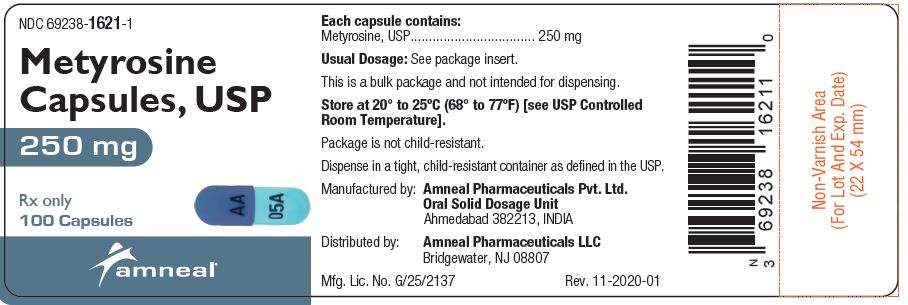
metyrosine 250 mg Capsule, 30-count — NDC 69238-1621-3 (Billing 69238-1621-03)
This is a package of 30 capsules of metyrosine 250 mg Capsule from Amneal Pharmaceuticals LLC, marketed since Jul 2020 and currently FDA-listed.
NDC database record
One package, one record: these facts belong to NDC 69238-1621-3 alone.
- Record
- FDA NDC Directory package listing · Human prescription drug
- Code segments
- 69238 labeler · 1621 product · 3 package
- Package marketed since
- Dec 15, 2020
- Sample package
- No — commercial package
- Listing certified through
- Dec 31, 2027
- Billing quantity
- 30 EA per package
- Barcode (UPC-A, from the NDC)
- 3 6923816213 4
- FDA record last changed
- Oct 1, 2026
Identity & classification
Regulatory identifiers FDA, NLM and CMS codes for this package
Drug-database identifiers Medi-Span GPI and First Databank GCN / HICL / AHFS classification
- GSN (GCN sequence number): 000400
- GCN: 01540
- HICL (First Databank): 000138
- AHFS class code: 36:64.00.00
Where does this data come from?
- FDA openFDA NDC Directory · synced Oct 1, 2026
- FDA label on DailyMed · label index refreshed Oct 6, 2026
- RxNorm (NLM RxNav) · catalog refreshed Oct 1, 2026
- Medi-Span GPI (licensed)
- First Databank (licensed) · refreshed Oct 1, 2026
Clinical
Patient education
Supplement & herbal interactions
Where does this data come from?
- MedlinePlus (NLM) · refreshed Oct 1, 2026
- FDA label on DailyMed · label index refreshed Oct 6, 2026
Ask a licensed pharmacist directly — free, answered by our team.
Pricing
A drug doesn't have one price. Each row is a different public payment system, and none is what you'd pay at the counter — that depends on your insurance. The ⓘ on each row explains what it measures.
| Price system | Per each | Per package |
|---|---|---|
| Retail pharmacies payNADAC · weekly | Not in the retail survey — common for institutional, discontinued, or low-volume packs. | |
| Medicaid paysCMS SDUD · 12 mo | No recent Medicaid claims on file for this NDC — rare and low-volume NDCs are suppressed in the public data. | |
| Medicare drug plans payPart D · Q2 2026 | $236.16 | $7,084.73 / 30 capsules |
Where does this data come from?
- CMS NADAC weekly file
- CMS ASP pricing files · refreshed Sep 20, 2026
- CMS Medicaid State Drug Utilization Data · refreshed Oct 7, 2026
- CMS Part D plan pricing files · refreshed Sep 24, 2026
- VA National Acquisition Center price file
Packaging — all sizes for this product
| Package NDC | Description | Marketing start | Marketing end | Status |
|---|---|---|---|---|
| 69238-1621-01 69238-1621-1 Main listing | 100 CAPSULE in 1 BOTTLE, PLASTIC | 2020-07-24 | — | Active |
| 69238-1621-03 You're viewing this | 30 CAPSULE in 1 BOTTLE, PLASTIC | 2020-12-15 | — | Active |
You're viewing the smallest of 2 pack sizes for this product.
Pack size FAQ
What quantity is in this package?
How does this package differ from NDC 69238-1621-01?
What NDC number is used to bill for this package of metyrosine 250 mg Capsule?
Therapeutic equivalents
| Product | Labeler | Pack | NADAC/unit | TE | Status | Price vs. this |
|---|---|---|---|---|---|---|
| Demser 250 mg 25010-0305-15 | Bausch | 100 capsules | — | AB | FDA listed | — |
| Metyrosine 250 mg 68682-0310-01 | Oceanside | 100 capsules | — | AB | FDA listed | — |
| metyrosine 250 mgthis 69238-1621-03 | Amneal | 30 capsules | — | AB | FDA listed | — |
| Metyrosine 250 mg 75907-0166-01 | Dr. | 100 capsules | — | AB | FDA listed | — |
Where does this data come from?
- FDA openFDA NDC Directory · synced Oct 1, 2026
- FDA Orange Book · refreshed Oct 3, 2026
- CMS NADAC weekly file
Availability & generic status
This product is an FDA-approved generic. Other versions of the same drug are listed under Therapeutic equivalents, least expensive first.
Where does this data come from?
- FDA Orange Book · refreshed Oct 3, 2026
What it looks like
Where does this data come from?
- FDA label on DailyMed · label index refreshed Oct 6, 2026
Inactive Ingredients / Excipients
Inactive ingredients, also called excipients, are components of the drug product other than the active ingredient. They may include fillers, dyes, coatings, preservatives, flavors, or other formulation ingredients.
💡 Tap an ingredient (hover on desktop) to see what it is and why it’s used.
-
UNII 3K9958V90M
A liquid solvent derived from fermentation or chemical synthesis. In medicines, alcohol dissolves active ingredients, helps preserve the product, and improves how the body absorbs certain drugs.
-
UNII 5138Q19F1X
Ammonia is a colorless gas made from nitrogen and hydrogen. It's used in medicines as a pH buffer to maintain the correct acidity level and help keep the product stable.
-
UNII 8PJ61P6TS3
Butyl alcohol is a clear liquid organic solvent derived from petroleum or natural sources. In medicines, it helps dissolve active ingredients and serves as a solvent in liquid formulations and some topical products.
-
UNII 35SW5USQ3G
A synthetic yellow dye used to color medicines. It helps make tablets, capsules, and liquids visually distinct so patients can easily identify their medication.
-
UNII H3R47K3TBD
FD&C Blue No. 1 is a synthetic blue dye approved for use in foods and medicines. It serves as a colorant to give the medication its distinctive appearance and help with product identification.
-
UNII PN2ZH5LOQY
A synthetic red dye approved by the FDA for use in foods, medicines, and cosmetics. It serves as a colorant to make tablets, capsules, and liquids visually distinctive for product identification.
-
UNII WZB9127XOA
A synthetic red dye used to color medications and make them easier to identify. It serves as a colorant in tablets, capsules, and liquid formulations.
-
UNII XM0M87F357
A dark iron oxide compound that gives medicines their black or dark color. It's used as a colorant in tablets and capsules to help identify the product and make it visually distinctive.
-
UNII 2G86QN327L
Gelatin is a protein derived from animal collagen, commonly used in medicines as a gelling agent and capsule material. It helps create soft or hard capsule shells that hold and release medication, and can also thicken liquid formulations.
-
UNII 2165RE0K14
A plant-based thickener made from cellulose that helps control how quickly the medicine dissolves and releases its active ingredient. It also binds ingredients together and improves the tablet's texture and handling during manufacturing.
-
UNII 9XZ8H6N6OH
A plant-based cellulose derivative used as a binder to hold tablet ingredients together, a thickener in liquids, and a coating agent to control how fast the medicine dissolves.
-
UNII ND2M416302
Isopropyl alcohol is a clear liquid solvent derived from petroleum. In medicines, it dissolves active ingredients and other components, helps the product flow smoothly, and aids in sterilization during manufacturing.
-
UNII 70097M6I30
Magnesium stearate is a salt made from magnesium and stearic acid, a fatty substance. It's used in tablets and capsules as a lubricant and glidant to help ingredients flow smoothly during manufacturing and prevent sticking.
-
UNII WZH3C48M4T
Potassium hydroxide is a strong alkaline chemical used in medicines to adjust and maintain the pH level of liquid formulations, helping keep the product stable and the active ingredients effective.
-
UNII 6DC9Q167V3
Propylene glycol is a clear liquid derived from petroleum or vegetable sources. It acts as a solvent, humectant, and preservative in medicines, helping dissolve active ingredients and maintain product stability.
-
UNII 46N107B71O
Shellac is a natural resin secreted by the lac beetle. It's used as a coating on tablets and capsules to control how quickly the medicine dissolves and to improve appearance and stability.
-
UNII ETJ7Z6XBU4
Silicon dioxide is a naturally occurring mineral used as a glidant and anti-caking agent. It helps powder ingredients flow smoothly and prevents clumping during manufacturing and storage.
-
UNII 15FIX9V2JP
Titanium dioxide is a bright white mineral powder commonly used as a colorant and opacifying agent. It makes pills and tablets white or lighter in color and helps make coatings non-transparent.
-
UNII 059QF0KO0R
Water is a liquid solvent that dissolves and mixes ingredients together in liquid medicines, syrups, and injections. It helps distribute the active drug evenly throughout the product.
19 inactive ingredients listed in the exact product block matched to this NDC.
Where does this data come from?
ingredient classCode="IACT" elements from the exact product block matched by this NDC. Label-section narrative from DailyMed / the openFDA label index is shown separately when available.- FDA label on DailyMed · label index refreshed Oct 6, 2026
- FDA openFDA NDC Directory · synced Oct 1, 2026
Inactive ingredient FAQ
Are inactive ingredients the same for every manufacturer?
Why might an inactive ingredient be missing?
Can inactive ingredients matter?
Manufacturer & labeler
More NDCs from Amneal Pharmaceuticals LLC labeler code 69238
- Methylergonovine Maleate .2 mg Tablet NDC 69238-1605-2
- Tri Femynor norgestimate and ethinyl estradiol Kit NDC 69238-1607-6
- Lopreeza estradiol/norethindrone acetate .5 mg; .1 mg Tablet, Film Coated NDC 69238-1609-6
- Lopreeza estradiol/norethindrone acetate 1 mg; .5 mg Tablet, Film Coated NDC 69238-1610-6
- Ofloxacin 3 mg/mL Solution NDC 69238-1615-3
- Ofloxacin 3 mg/mL Solution NDC 69238-1616-6
- Dimethyl Fumarate Kit NDC 69238-1626-3
- Dapsone Daspone 75 mg/g Gel NDC 69238-1627-6
- Estradiol .025 mg/d Patch, Extended Release NDC 69238-1629-7
- Estradiol .0375 mg/d Patch, Extended Release NDC 69238-1630-7
- Estradiol .05 mg/d Patch, Extended Release NDC 69238-1631-7
- Estradiol .075 mg/d Patch, Extended Release NDC 69238-1632-7
Where does this data come from?
- FDA openFDA NDC Directory · synced Oct 1, 2026
- Drugs@FDA
Full prescribing information FDA SPL
🎯 Indications and Usage ▾
INDICATIONS AND USAGE Metyrosine capsules are indicated in the treatment of patients with pheochromocytoma for: 1. Preoperative preparation of patients for surgery. 2. Management of patients when surgery is contraindicated. 3. Chronic treatment of patients with malignant pheochromocytoma. Metyrosine capsules are not recommended for the control of essential hypertension.
⏱️ Dosage and Administration ▾
DOSAGE AND ADMINISTRATION The recommended initial dosage of metyrosine capsules for adults and children 12 years of age and older is 250 mg orally four times daily. This may be increased by 250 mg to 500 mg every day to a maximum of 4 g/day in divided doses. When used for preoperative preparation, the optimally effective dosage of metyrosine capsules should be given for at least five to seven days.
Optimally effective dosages of metyrosine capsules usually are between 2 g/day and 3 g/day, and the dose should be titrated by monitoring clinical symptoms and catecholamine excretion. In patients who are hypertensive, dosage should be titrated to achieve normalization of blood pressure and control of clinical symptoms. In patients who are usually normotensive, dosage should be titrated to the amount that will reduce urinary metanephrines and/or vanillylmandelic acid by 50% or more.
If patients are not adequately controlled by the use of metyrosine capsules, an alpha-adrenergic blocking agent (phenoxybenzamine) should be added. Use of metyrosine capsules in children under 12 years of age has been limited and a dosage schedule for this age group cannot be given.
⛔ Contraindications ▾
CONTRAINDICATIONS Metyrosine capsules are contraindicated in persons known to be hypersensitive to this compound.
⚠️ Warnings ▾
WARNINGS Maintain Fluid Volume During and After Surgery When metyrosine is used preoperatively, alone or especially in combination with alpha-adrenergic blocking drugs, adequate intravascular volume must be maintained intraoperatively (especially after tumor removal) and postoperatively to avoid hypotension and decreased perfusion of vital organs resulting from vasodilatation and expanded volume capacity. Following tumor removal, large volumes of plasma may be needed to maintain blood pressure and central venous pressure within the normal range.
In addition, life-threatening arrhythmias may occur during anesthesia and surgery, and may require treatment with a beta-blocker or lidocaine. During surgery, patients should have continuous monitoring of blood pressure and electrocardiogram. Intraoperative Effects While the preoperative use of metyrosine in patients with pheochromocytoma is thought to decrease intraoperative problems with blood pressure control, metyrosine does not eliminate the danger of hypertensive crises or arrhythmias during manipulation of the tumor, and the alpha-adrenergic blocking drug, phentolamine, may be needed.
Interaction with Alcohol Metyrosine may add to the sedative effects of alcohol and other CNS depressants, e.g., hypnotics, sedatives, and tranquilizers (see PRECAUTIONS, Information for Patients and Drug Interactions ).
🤒 Adverse Reactions ▾
ADVERSE REACTIONS Central Nervous System Sedation The most common adverse reaction to metyrosine is moderate to severe sedation, which has been observed in almost all patients. It occurs at both low and high dosages. Sedative effects begin within the first 24 hours of therapy, are maximal after two to three days, and tend to wane during the next few days.
Sedation usually is not obvious after one week unless the dosage is increased, but at dosages greater than 2000 mg/day some degree of sedation or fatigue may persist. In most patients who experience sedation, temporary changes in sleep pattern occur following withdrawal of the drug. Changes consist of insomnia that may last for two or three days and feelings of increased alertness and ambition.
Even patients who do not experience sedation while on metyrosine may report symptoms of psychic stimulation when the drug is discontinued. Extrapyramidal Signs Extrapyramidal signs such as drooling, speech difficulty, and tremor have been reported in approximately 10% of patients. These occasionally have been accompanied by trismus and frank parkinsonism.
Anxiety and Psychic Disturbances Anxiety and psychic disturbances such as depression, hallucinations, disorientation, and confusion may occur. These effects seem to be dose-dependent and may disappear with reduction of dosage. Diarrhea Diarrhea occurs in about 10% of patients and may be severe.
Anti-diarrheal agents may be required if continuation of metyrosine is necessary. Miscellaneous Infrequently, slight swelling of the breast, galactorrhea, nasal stuffiness, decreased salivation, dry mouth, headache, nausea, vomiting, abdominal pain, and impotence or failure of ejaculation may occur. Crystalluria (see PRECAUTIONS ) and transient dysuria and hematuria have been observed in a few patients.
Hematologic disorders (including eosinophilia, anemia, thrombocytopenia, and thrombocytosis), increased SGOT levels, peripheral edema, and hypersensitivity reactions such as urticaria and pharyngeal edema have been reported rarely. To report SUSPECTED ADVERSE REACTIONS, contact Amneal Pharmaceuticals at 1-877-835-5472 or FDA at 1-800-FDA-1088 or www.fda.gov/medwatch .
🔄 Drug Interactions ▾
Drug Interactions Caution should be observed in administering metyrosine to patients receiving phenothiazines or haloperidol because the extrapyramidal effects of these drugs can be expected to be potentiated by inhibition of catecholamine synthesis. Concurrent use of metyrosine with alcohol or other CNS depressants can increase their sedative effects (see WARNINGS and PRECAUTIONS, Information for Patients ).
🤰 Pregnancy ▾
Pregnancy Animal reproduction studies have not been conducted with metyrosine. It is also not known whether metyrosine can cause fetal harm when administered to a pregnant woman or can affect reproduction capacity. Metyrosine should be given to a pregnant woman only if clearly needed.
🧓 Geriatric Use ▾
Geriatric Use Clinical studies of metyrosine did not include sufficient numbers of subjects aged 65 and over to determine whether they respond differently from younger subjects. Other reported clinical experience has not identified differences in responses between the elderly and younger patients. In general, dose selection for an elderly patient should be cautious, usually starting at the low end of the dosing range, reflecting the greater frequency of decreased hepatic, renal, or cardiac function, and of concomitant disease or other drug therapy.
🆘 Overdosage ▾
OVERDOSAGE Signs of metyrosine overdosage include those central nervous system effects observed in some patients even at low dosages. At doses exceeding 2000 mg/day, some degree of sedation or feeling of fatigue may persist. Doses of 2000 mg/day to 4000 mg/day can result in anxiety or agitated depression, neuromuscular effects (including fine tremor of the hands, gross tremor of the trunk, tightening of the jaw with trismus), diarrhea, and decreased salivation with dry mouth.
Reduction of drug dose or cessation of treatment results in the disappearance of these symptoms. The acute toxicity of metyrosine was 442 mg/kg and 752 mg/kg in the female mouse and rat respectively.
🧬 Clinical Pharmacology ▾
CLINICAL PHARMACOLOGY Metyrosine inhibits tyrosine hydroxylase, which catalyzes the first transformation in catecholamine biosynthesis, i.e. the conversion of tyrosine to dihydroxyphenylalanine (DOPA). Because the first step is also the rate-limiting step, blockade of tyrosine hydroxylase activity results in decreased endogenous levels of catecholamines, usually measured as decreased urinary excretion of catecholamines and their metabolites. In patients with pheochromocytoma, who produce excessive amounts of norepinephrine and epinephrine, administration of one gram to four grams of metyrosine per day has reduced catecholamine biosynthesis from about 35% to 80% as measured by the total excretion of catecholamines and their metabolites (metanephrine and vanillylmandelic acid).
The maximum biochemical effect usually occurs within two to three days, and the urinary concentration of catecholamines and their metabolites usually returns to pre-treatment levels within three to four days after metyrosine is discontinued. In some patients the total excretion of catecholamines and catecholamine metabolites may be lowered to normal or near normal levels (less than 10 mg/24 hours). In most patients the duration of treatment has been two to eight weeks, but several patients have received metyrosine for periods of 1 to 10 years.
Most patients with pheochromocytoma treated with metyrosine experience decreased frequency and severity of hypertensive attacks with their associated headache, nausea, sweating, and tachycardia. In patients who respond, blood pressure decreases progressively during the first two days of therapy with metyrosine; after withdrawal, blood pressure usually increases gradually to pre-treatment values within two to three days. Metyrosine is well absorbed from the gastrointestinal tract.
From 53% to 88% (mean 69%) was recovered in the urine as unchanged drug following maintenance oral doses of 600 mg to 4000 mg/24 hours in patients with pheochromocytoma or essential hypertension. Less than 1% of the dose was recovered as catechol metabolites. These metabolites are probably not present in sufficient amounts to contribute to the biochemical effects of metyrosine.
The quantities excreted, however, are sufficient to interfere with accurate determination of urinary catecholamines determined by routine techniques. Plasma half-life of metyrosine determined over an 8-hour period after single oral doses was 3 to 3.7 hours in three patients. For further information, refer to: Sjoerdsma A, Engelman K, Waldman TA, Cooperman LH, Hammond WG.
Pheochromocytoma: Current Concepts of Diagnosis and Treatment: Combined Clinical Staff Conference at the National Institutes of Health. Ann Intern Med. 1966;65:1302-1326.
📦 How Supplied / Storage and Handling ▾
HOW SUPPLIED Metyrosine Capsules USP, 250 mg are supplied as size “0”, hard gelatin capsules with dark blue opaque cap imprinted with “AA” and light blue opaque body imprinted with “05A” with black ink. Each capsule is filled with white to off-white granular powder. They are available as follows: Bottles of 100: NDC 69238-1621-1 Bottles of 30: NDC 69238-1621-3 Storage Store at 20° to 25°C (68° to 77°F) [see USP Controlled Room Temperature].
Package is not child-resistant. Dispense in a tight, child-resistant container as defined in the USP. Manufactured by: Amneal Pharmaceuticals Pvt.
Ltd. Oral Solid Dosage Unit Ahmedabad 382213, INDIA Distributed by: Amneal Pharmaceuticals LLC Bridgewater, NJ 08807 Rev. 03-2026-03
📋 Description ▾
DESCRIPTION Metyrosine is (–)-α-methyl-L-tyrosine or (α-MPT). It has the following structural formula: Metyrosine, USP is a white to off-white powder of molecular weight 195.22 g/mol and molecular formula C 10 H 13 NO 3 . It is very slightly soluble in methanol and insoluble in chloroform.
Metyrosine, USP is supplied as capsules for oral administration. Each capsule contains 250 mg metyrosine, USP. Inactive ingredients are colloidal silicon dioxide, D & C yellow 10, FD & C blue 1, FD & C red 3, FD & C red 40, gelatin, hydroxypropyl cellulose, low-substituted hydroxypropyl cellulose, magnesium stearate, titanium dioxide and water.
Each capsule is imprinted with black pharmaceutical ink which contains: butyl alcohol, dehydrated alcohol, ferrosoferric oxide, isopropyl alcohol, potassium hydroxide, propylene glycol, purified water, shellac and strong ammonia solution. Meets USP Dissolution Test 2. QWERTY
💬 Information for Patients ▾
Information for Patients When receiving metyrosine, patients should be warned about engaging in activities requiring mental alertness and motor coordination, such as driving a motor vehicle or operating machinery. Metyrosine may have additive sedative effects with alcohol and other CNS depressants, e.g., hypnotics, sedatives, and tranquilizers. Patients should be advised to maintain a liberal fluid intake (see PRECAUTIONS, General ).
⚠️ Precautions ▾
PRECAUTIONS General Metyrosine Crystalluria Crystalluria and urolithias is have been found in dogs treated with metyrosine at doses similar to those used in humans, and crystalluria has also been observed in a few patients. To minimize the risk of crystalluria, patients should be urged to maintain water intake sufficient to achieve a daily urine volume of 2000 mL or more, particularly when doses greater than 2 g per day are given. Routine examination of the urine should be carried out.
Metyrosine will crystallize as needles or rods. If metyrosine crystalluria occurs, fluid intake should be increased further. If crystalluria persists, the dosage should be reduced or the drug discontinued.
Relatively Little Data Regarding Long-Term Use The total human experience with the drug is quite limited and few patients have been studied long-term. Chronic animal studies have not been carried out. Therefore, suitable laboratory tests should be carried out periodically in patients requiring prolonged use of metyrosine and caution should be observed in patients with impaired hepatic or renal function.
Information for Patients When receiving metyrosine, patients should be warned about engaging in activities requiring mental alertness and motor coordination, such as driving a motor vehicle or operating machinery. Metyrosine may have additive sedative effects with alcohol and other CNS depressants, e.g., hypnotics, sedatives, and tranquilizers. Patients should be advised to maintain a liberal fluid intake (see PRECAUTIONS, General ).
Drug Interactions Caution should be observed in administering metyrosine to patients receiving phenothiazines or haloperidol because the extrapyramidal effects of these drugs can be expected to be potentiated by inhibition of catecholamine synthesis. Concurrent use of metyrosine with alcohol or other CNS depressants can increase their sedative effects (see WARNINGS and PRECAUTIONS, Information for Patients ). Laboratory Test Interference Spurious increases in urinary catecholamines may be observed in patients receiving metyrosine due to the presence of metabolites of the drug.
Carcinogenesis, Mutagenesis, Impairment of Fertility Long-term carcinogenic studies in animals and studies on mutagenesis and impairment of fertility have not been performed with metyrosine. Pregnancy Animal reproduction studies have not been conducted with metyrosine. It is also not known whether metyrosine can cause fetal harm when administered to a pregnant woman or can affect reproduction capacity.
Metyrosine should be given to a pregnant woman only if clearly needed. Nursing Mothers It is not known whether metyrosine is excreted in human milk. Because many drugs are excreted in human milk, caution should be exercised when metyrosine is administered to a nursing woman.
Pediatric Use Safety and effectiveness in pediatric patients below the age of 12 years have not been established. Geriatric Use Clinical studies of metyrosine did not include sufficient numbers of subjects aged 65 and over to determine whether they respond differently from younger subjects. Other reported clinical experience has not identified differences in responses between the elderly and younger patients.
In general, dose selection for an elderly patient should be cautious, usually starting at the low end of the dosing range, reflecting the greater frequency of decreased hepatic, renal, or cardiac function, and of concomitant disease or other drug therapy.
🍼 Nursing Mothers ▾
Nursing Mothers It is not known whether metyrosine is excreted in human milk. Because many drugs are excreted in human milk, caution should be exercised when metyrosine is administered to a nursing woman.
📄 Carcinogenesis, Mutagenesis, Impairment of Fertility ▾
Carcinogenesis, Mutagenesis, Impairment of Fertility Long-term carcinogenic studies in animals and studies on mutagenesis and impairment of fertility have not been performed with metyrosine.
📄 Package Label / Principal Display Panel ▾
PRINCIPAL DISPLAY PANEL NDC 69238-1621-1 Metyrosine Capsules USP, 250 mg Rx Only 100 Capsules Amneal Pharmaceuticals LLC NDC 69238-1621-3 Metyrosine Capsules USP, 250 mg Rx Only 30 Capsules Amneal Pharmaceuticals LLC ad fgh
Medicare Part D spend CMS · PART D · 2026 (Q1)
Reported adverse events (FAERS)
Top reported reactions
Age at onset
Reporter sex
Serious outcomes
Where does this data come from?
About this NDC listing & data coverage
What data is (and isn’t) available for this NDC — tap to expand
| NDC identity (package / product / labeler codes) | ✓ Available |
| Labeler | ✓ Available |
| Product & package description | ✓ Available |
| Marketing category & status | ✓ Available |
| Active ingredient / dosage form / route | ✓ Available |
| FDA label (SPL via DailyMed) | ✓ Available |
| Package photos | ✓ Available |
| Inactive ingredients (structured) | ✓ Available |
| NADAC pharmacy acquisition price (CMS) | — Not published for this NDC CMS publishes NADAC only for NDCs reported in its retail-pharmacy survey. |
| Orange Book / therapeutic-equivalence data | ✓ Available |
| HCPCS J-code billing crosswalk | — Not published for this NDC Most self-administered / retail products have no J-code — that is normal. |
| Medicaid utilization (CMS SDUD) | — Not published for this NDC CMS reports utilization only for NDCs with Medicaid claims above its privacy threshold. |