
paroxetine hydrochloride 30 mg Tablet, Film Coated, 500-count — NDC 69584-673-50 (Billing 69584-0673-50)
This is a package of 500 tablets of paroxetine hydrochloride 30 mg Tablet, Film Coated from Oxford Pharmaceuticals, LLC, marketed since Nov 2022 and currently FDA-listed; retail pharmacies pay about $0.0954 per tablet (NADAC).
Other active recalls for Paroxetine Hydrochloride (different manufacturers) — 4 · tap to view
Identity & classification
Regulatory identifiers FDA, NLM and CMS codes for this package
Drug-database identifiers Medi-Span GPI and First Databank GCN / HICL / AHFS classification
- GSN (GCN sequence number): 046224
- GCN: 16367
- GPI-14 (Medi-Span): 58160060000330
- HICL (First Databank): 007344
- AHFS class code: 28:16.04.20
- RxCUI (RxNorm): 1738483
Where does this data come from?
- FDA openFDA NDC Directory · synced Oct 1, 2026
- FDA label on DailyMed · label index refreshed Oct 1, 2026
- RxNorm (NLM RxNav) · catalog refreshed Oct 1, 2026
- Medi-Span GPI (licensed)
- First Databank (licensed) · refreshed Oct 1, 2026
RxNorm drug class
This medicine belongs to the Serotonin Reuptake Inhibitor class.
Where does this data come from?
- RxClass (NLM) · catalog refreshed Oct 1, 2026
Clinical
- It depends on the product. Tablets and oral suspension treat depression, OCD, panic disorder, social anxiety, generalized anxiety, and PTSD in adults. Extended-release tablets trea...
- Take it once a day, usually in the morning, with or without food. The menopause capsule is taken at bedtime. Swallow extended-release tablets whole, and shake the suspension well....
- The most common are nausea, sleepiness, dry mouth, sweating, constipation or diarrhea, dizziness, trouble sleeping, and sexual side effects. Tell me or your doctor if they're bothe...
- Yes. Never combine it with MAOIs, thioridazine, or pimozide. Be careful with other serotonin-affecting drugs like triptans, tramadol, or St. John's Wort, and with aspirin, NSAIDs,...
Patient education
Supplement & herbal interactions
Paroxetine may be associated with lower levels of 1 nutrient — worth a chat with your pharmacist, not a cause for alarm.
Where does this data come from?
- MedlinePlus (NLM) · refreshed Oct 1, 2026
- FDA label on DailyMed · label index refreshed Oct 1, 2026
Ask a licensed pharmacist directly — free, answered by our team.
Pricing
A drug doesn't have one price. Each row is a different public payment system, and none is what you'd pay at the counter — that depends on your insurance. The ⓘ on each row explains what it measures.
| Price system | Per ea | Per package |
|---|---|---|
| Retail pharmacies payNADAC · weekly | $0.095 | $47.70 / 500 tablets |
| Medicaid paysCMS SDUD · 12 mo | No recent Medicaid claims on file for this NDC — rare and low-volume NDCs are suppressed in the public data. | |
| Medicare drug plans payPart D · Q2 2026 | $0.2824 | $141.20 / 500 tablets |
Where does this data come from?
- CMS NADAC weekly file · file of Sep 30, 2026
- CMS ASP pricing files · refreshed Sep 20, 2026
- CMS Medicaid State Drug Utilization Data · refreshed Oct 3, 2026
- CMS Part D plan pricing files · refreshed Sep 24, 2026
- VA National Acquisition Center price file
Packaging — all sizes for this product
| Package NDC | Description | Per unit | Per pack | Marketing start | Marketing end | Status |
|---|---|---|---|---|---|---|
| 69584-0673-03 69584-673-03 Main listing | 30 TABLET, FILM COATED in 1 BOTTLE | $0.0954 / ea | $2.86 | 2022-11-14 | — | Active |
| 69584-0673-09 69584-673-09 | 90 TABLET, FILM COATED in 1 BOTTLE | $0.0954 / ea | $8.59 | 2022-11-14 | — | Active |
| 69584-0673-10 69584-673-10 | 100 TABLET, FILM COATED in 1 BOTTLE | — | — | 2022-11-14 | — | Active |
| 69584-0673-50 You're viewing this | 500 TABLET, FILM COATED in 1 BOTTLE | $0.0954 / ea | $47.72 | 2022-11-14 | — | Active |
| 69584-0673-90 69584-673-90 | 1000 TABLET, FILM COATED in 1 BOTTLE | $0.0954 / ea | $95.43 | 2022-11-14 | — | Active |
You're viewing one of 5 pack sizes for this product.
This pack effectively ties for the lowest per-ea cost of the 4 priced pack sizes ($0.0954 NADAC).
Pack size FAQ
What quantity is in this package?
How does this package differ from NDC 69584-0673-03?
What NDC number is used to bill for this package of paroxetine hydrochloride 30 mg Tablet, Film Coated?
Prices are the latest CMS NADAC pharmacy acquisition cost per NDC; per-pack figures are per-unit × pack quantity, shown only when the pack is denominated in the same measure NADAC prices.
Therapeutic equivalents
| Product | Labeler | Pack | NADAC/unit | TE | Status | Price vs. this |
|---|---|---|---|---|---|---|
| Paroxetine 30 mg 00378-7003-10 | Mylan | 1000 tablets | $0.095 | AB | Availability likely | — |
| Paroxetine 30 mg 16714-0183-01 | NorthStar | 30 tablets | $0.095 | AB | Availability likely | — |
| Paroxetine 30 mg 43547-0349-03 | Solco | 30 tablets | $0.095 | AB | Availability likely | — |
| Paroxetine 30 mg 50268-0642-15 | AvPAK | 1 tablet | $0.095 | AB | Availability likely | — |
| Paroxetine 30 mg 60505-0084-01 | Apotex | 30 tablets | $0.095 | AB | Availability likely | — |
| Paroxetine 30 mg 62135-0543-90 | Chartwell | 90 tablets | $0.095 | AB | Availability likely | — |
| Paroxetine 30 mg 68084-0046-01 | American | 1 tablet | $0.095 | AB | Availability likely | — |
| paroxetine hydrochloride 30 mgthis 69584-0673-50 | Oxford | 500 tablets | $0.095 | AB | Availability likely | — |
| Paxil 30 mg 60505-4519-03 | Apotex | 30 tablets | $10.807 | AB | Availability likely | +11225% |
| Paroxetine 30 mg 00615-8173-39 | NCS | 30 tablets | — | AB | FDA listed | — |
| Paroxetine 30 mg 13107-0156-01 | Aurolife | 100 tablets | — | AB | FDA listed | — |
| Paroxetine 30 mg 50090-5987-00 | A-S | 90 tablets | — | AB | FDA listed | — |
| Paroxetine 30 mg 60429-0736-10 | Golden | 1000 tablets | — | AB | FDA listed | — |
| Paroxetine 30 mg 65841-0099-01 | Zydus | 100 tablets | — | AB | FDA listed | — |
| Paroxetine 30 mg 65862-0156-01 | Aurobindo | 100 tablets | — | AB | FDA listed | — |
| Paroxetine 30 mg 68382-0099-01 | Zydus | 100 tablets | — | AB | FDA listed | — |
| Paroxetine 30 mg 68788-7410-01 | Preferred | 100 tablets | — | AB | FDA listed | — |
| Paroxetine 30 mg 69117-0026-01 | Yiling | 30 tablets | — | AB | FDA listed | — |
| Paroxetine 30 mg 70518-1460-01 | REMEDYREPACK | 1 tablet | — | AB | FDA listed | — |
| Paroxetine 30 mg 70518-2465-00 | REMEDYREPACK | 30 tablets | — | AB | FDA listed | — |
| Paroxetine 30 mg 71335-0321-01 | Bryant | 30 tablets | — | AB | FDA listed | — |
| paroxetine hydrochloride 30 mg 71335-9650-01 | Bryant | 30 tablets | — | AB | FDA listed | — |
| Paroxetine 30 mg 71610-0243-60 | Aphena | 90 tablets | — | AB | FDA listed | — |
| Paroxetine 30 mg 76420-0718-01 | Asclemed | 100 tablets | — | AB | FDA listed | — |
Where does this data come from?
- FDA openFDA NDC Directory · synced Oct 1, 2026
- FDA Orange Book · refreshed Sep 3, 2026
- CMS NADAC weekly file · file of Sep 30, 2026
Availability & generic status
This product is an FDA-approved generic. Other versions of the same drug are listed under Therapeutic equivalents, least expensive first.
Where does this data come from?
- FDA Orange Book · refreshed Sep 3, 2026
What it looks like
Where does this data come from?
- FDA label on DailyMed · label index refreshed Oct 1, 2026
Inactive Ingredients / Excipients
Inactive ingredients, also called excipients, are components of the drug product other than the active ingredient. They may include fillers, dyes, coatings, preservatives, flavors, or other formulation ingredients.
Where does this data come from?
IACT rows and label-wide narrative are kept separate; availability and product-level specificity depend on the submitted label.- FDA label on DailyMed · label index refreshed Oct 1, 2026
- FDA openFDA NDC Directory · synced Oct 1, 2026
Inactive ingredient FAQ
Are inactive ingredients the same for every manufacturer?
Why might an inactive ingredient be missing?
Can inactive ingredients matter?
Manufacturer & labeler
Where does this data come from?
- FDA openFDA NDC Directory · synced Oct 1, 2026
- Drugs@FDA
Full prescribing information FDA SPL
🚨 Boxed Warning ▾
WARNING: SUICIDAL THOUGHTS AND BEHAVIORS Antidepressants increased the risk of suicidal thoughts and behaviors in pediatric and young adult patients in short-term studies. Closely monitor all antidepressant-treated patients for clinical worsening, and for emergence of suicidal thoughts and behaviors [see Warnings and Precautions ( 5.1 )] . Paroxetine tablets, USP is not approved for use in pediatric patients [see Use in Specific Populations ( 8.4 )] .
WARNING: SUICIDAL THOUGHTS AND BEHAVIORS See full prescribing information for complete boxed warning. Increased risk of suicidal thoughts and behavior in pediatric and young adult patients taking antidepressants. Closely monitor all antidepressant- treated patients for clinical worsening and emergence of suicidal thoughts and behaviors.
Paroxetine tablets, USP is not approved for use in pediatric patients. ( 5.1 , 8.4 )
🎯 Indications and Usage ▾
1 INDICATIONS AND USAGE Paroxetine is a selective serotonin reuptake inhibitor (SSRI) indicated in adults for the treatment of ( 1 ): Major Depressive Disorder (MDD) Obsessive Compulsive Disorder (OCD) Panic Disorder (PD) Social Anxiety Disorder (SAD) Generalized Anxiety Disorder (GAD) Posttraumatic Stress Disorder (PTSD) Paroxetine is indicated in adults for the treatment of: Major depressive disorder (MDD) Obsessive compulsive disorder (OCD) Panic disorder (PD) Social anxiety disorder (SAD) Generalized anxiety disorder (GAD) Posttraumatic stress disorder (PTSD)
⏱️ Dosage and Administration ▾
2 DOSAGE AND ADMINISTRATION Recommended starting and maximum daily dosage for MDD, OCD, PD, and PTSD: ( 2.2 ) Indication Starting Daily Dose Maximum Daily Dose MDD 20 mg 50 mg OCD 20 mg 60 mg PD 10 mg 60 mg PTSD 20 mg 50 mg Recommended starting dosage for SAD and GAD is 20 mg daily. ( 2.3 ) Elderly patients, patients with severe renal impairment or severe hepatic impairment: Starting dosage is 10 mg daily. Maximum dosage is 40 mg daily.
( 2.4 ) When discontinuing paroxetine, reduce dosage gradually. ( 2.6 , 5.7 )
2.1Administration Information Administer paroxetine tablets, USP as a single daily dose in the morning, with or without food.
2.2Recommended Dosage for MDD, OCD, PD, and PTSD The recommended starting dosages and maximum dosages of paroxetine in patients with MDD, OCD, PD, and PTSD are presented in Table 1 . In patients with an inadequate response, increase dosage in increments of 10 mg per day at intervals of at least 1 week, depending on tolerability. Table 1: Recommended Daily Dosage of Paroxetine in Patients with MDD, OCD, PD, and PTSD Indication Starting Dose Maximum Dose MDD 20 mg 50 mg OCD 20 mg 60 mg PD 10 mg 60 mg PTSD 20 mg 50 mg
2.3Recommended Dosage for SAD and GAD SAD The starting and recommended dosage in patients with SAD is 20 mg daily. In clinical trials the effectiveness of paroxetine was demonstrated in patients dosed in a range of 20 mg to 60 mg daily. While the safety of paroxetine has been evaluated in patients with SAD at doses up to 60 mg daily, available information does not suggest any additional benefit for doses above 20 mg daily [see Clinical Studies ( 14.4 )].
GAD The starting and recommended dosage in patients with GAD is 20 mg daily. In clinical trials the effectiveness of paroxetine in GAD was demonstrated in patients dosed in a range of 20 mg to 50 mg daily. There is not sufficient evidence to suggest a greater benefit to doses higher than 20 mg daily [see Clinical Studies ( 14.5 )] .
In patients with an inadequate response, increase dosage in increments of 10 mg per day at intervals of at least 1 week, depending on tolerability.
2.4Screen for Bipolar Disorder Prior to Starting Paroxetine Prior to initiating treatment with paroxetine or another antidepressant, screen patients for a personal or family history of bipolar disorder, mania, or hypomania [see Warnings and Precautions ( 5.6 )].
2.5Recommended Dosage for Elderly Patients, Patients with Severe Renal Impairment, and Patients with Severe Hepatic Impairment The recommended initial dosage is 10 mg per day for elderly patients, patients with severe renal impairment, and patients with severe hepatic impairment. Dosage should not exceed 40 mg/day.
2.6Switching Patients to or From a Monoamine Oxidase Inhibitor (MAOI) At least 14 days must elapse between discontinuation of a monoamine oxidase inhibitor (MAOI) and initiation of paroxetine. In addition, at least 14 days must elapse after stopping paroxetine before starting an MAOI antidepressant [see Contraindications ( 4 ), Warnings and Precautions ( 5.2 )] .
2.7Discontinuation of Treatment With Paroxetine Adverse reactions may occur upon discontinuation of paroxetine [see Warnings and Precautions ( 5.7 )]. Gradually reduce the dosage rather than stopping paroxetine abruptly whenever possible.
💊 Dosage Forms and Strengths ▾
3 DOSAGE FORMS AND STRENGTHS Paroxetine tablets, USP are available as: 10 mg orange, modified capsule shape, film-coated scored tablets debossed with "671" on one side and "O" on the other side with bisect. 20 mg yellow, modified capsule shape, film-coated scored tablets debossed with "672" on one side and "O" on the other side with bisect. 30 mg white to off-white, modified capsule shape, film-coated tablets debossed with "673" on one side and "O" on the other.
40 mg blue, modified capsule shape, film-coated tablets debossed with "674" on one side and "O" on the other. Tablets: 10 mg, scored; 20 mg, scored; 30 mg; and 40 mg tablets. ( 3 )
⛔ Contraindications ▾
4 CONTRAINDICATIONS Paroxetine is contraindicated in patients: Taking, or within 14 days of stopping, MAOIs (including the MAOIs linezolid and intravenous methylene blue) because of an increased risk of serotonin syndrome [see Warnings and Precautions ( 5.2 ), Drug Interactions ( 7 )]. Taking thioridazine because of risk of QT prolongation [see Warnings and Precautions ( 5.3 ) and Drug Interactions ( 7 )]. T aking pimozide because of risk of QT prolongation [see Warnings and Precautions ( 5.3 ), Drug Interactions ( 7 )].
With known hypersensitivity (e.g., anaphylaxis, angioedema, Stevens-Johnson syndrome) to paroxetine or any of the inactive ingredients in paroxetine tablets, USP [see Adverse Reactions ( 6.1 ), ( 6.2 )] . Concomitant use of monoamine oxidase inhibitors (MAOIs) or use within 14 days of discontinuing a MAOI. ( 4 , 5.3 , 7 ) Concomitant use of pimozide or thioridazine.
( 4 , 5.3 , 7 ) Known hypersensitivity to paroxetine or to any of the inactive ingredients in paroxetine tablets. ( 4 )
⚠️ Warnings and Cautions ▾
5 WARNINGS AND PRECAUTIONS Serotonin Syndrome: Increased risk when co-administered with other serotonergic agents (e.g., SSRI, SNRI, triptans), but also when taken alone. If occurs, discontinue paroxetine and initiate supportive measures. ( 5.2 ) Embryofetal and Neonatal Toxicity: Can cause fetal and neonatal harm.
Increased risk of cardiovascular malformations with exposure during the first trimester. Exposure in late pregnancy may lead to an increased risk for persistent pulmonary hypertension of the newborn. ( 5.4 , 8.1 ) Increased Risk of Bleeding : Concomitant use of aspirin, nonsteroidal anti- inflammatory drugs, other antiplatelet drugs, warfarin, and other anticoagulant drugs may increase risk.
( 5.5 ) Activation of Mania/Hypomania : Screen patients for bipolar disorder. ( 5.6 ) Seizures : Use with caution in patients with seizure disorders. ( 5.8 ) Angle-Closure Glaucoma : Angle-closure glaucoma has occurred in patients with untreated anatomically narrow angles treated with antidepressants.
( 5.9 ) Sexual Dysfunction: paroxetine may cause symptoms of sexual dysfunction. ( 5.13 )
5.1Suicidal Thoughts and Behaviors in Adolescents and Young Adults In pooled analyses of placebo-controlled trials of antidepressant drugs (SSRIs and other antidepressant classes) that included approximately 77,000 adult patients and 4,500 pediatric patients, the incidence of suicidal thoughts and behaviors in antidepressant-treated patients age 24 years and younger was greater than in placebo-treated patients. There was considerable variation in risk of suicidal thoughts and behaviors among drugs, but there was an increased risk identified in young patients for most drugs studied.
There were differences in absolute risk of suicidal thoughts and behaviors across the different indications, with the highest incidence in patients with MDD. The drug-placebo differences in the number of cases of suicidal thoughts and behaviors per 1000 patients treated are provided in Table 2 . Table 2.
Risk Differences of the Number of Patients with Suicidal Thoughts and Behaviors in the Pooled Placebo-Controlled Trials of Antidepressants in Pediatric and Adult Patients Age Range Drug-Placebo Difference in Number of Patients with Suicidal Thoughts and Behaviors per 1,000 Patients Treated Increases Compared to Placebo < 18 years old 14 additional patients 18 to 24 years old 5 additional patients Decreases Compared to Placebo 25 to 64 years old 1 fewer patient ≥ 65 years old 6 fewer patients Paroxetine is not approved for use in pediatric patients.
It is unknown whether the risk of suicidal thoughts and behaviors in children, adolescents, and young adults extends to longer-term use, i.e., beyond four months. However, there is substantial evidence from placebo-controlled maintenance trials in adults with MDD that antidepressants delay the recurrence of depression and that depression itself is a risk factor for suicidal thoughts and behaviors. Monitor all antidepressant-treated patients for any indication for clinical worsening and emergence of suicidal thoughts and behaviors, especially during the initial few months of drug therapy, and at times of dosage changes.
Counsel family members or caregivers of patients to monitor for changes in behavior and to alert the healthcare provider. Consider changing the therapeutic regimen, including possibly discontinuing paroxetine, in patients whose depression is persistently worse, or who are experiencing emergent suicidal thoughts or behaviors.
5.2Serotonin Syndrome SSRIs, including paroxetine, can precipitate serotonin syndrome, a potentially life-threatening condition. The risk is increased with concomitant use of other serotonergic drugs (including triptans, tricyclic antidepressants, fentanyl, lithium, tramadol, meperidine, methadone, tryptophan, buspirone, amphetamines and St. John’s Wort) and with drugs that impair metabolism of serotonin, i.e., MAOIs [see Contraindications ( 4 ), Drug Interactions ( 7 )] .
Serotonin s… [Excerpted — this section continues on DailyMed.]
🤒 Adverse Reactions ▾
6 ADVERSE REACTIONS Most common adverse reactions (≥5% and at least twice placebo) are abnormal ejaculation, asthenia, constipation, decreased appetite, diarrhea, dizziness, dry mouth, female genital disorder, impotence, infection, insomnia, libido decreased, male genital disorder, nausea, nervousness, somnolence, sweating, tremor, yawn. ( 6 ) To report SUSPECTED ADVERSE REACTIONS, contact Oxford Pharmaceuticals at 1- 844-508-1455, 8:00 AM to
4.30PM ET, Monday – Friday or FDA at 1-800-FDA-1088 or www.fda.gov/medwatch. The following adverse reactions are included in more detail in other sections of the prescribing information: Hypersensitivity reactions to paroxetine [see Contraindications ( 4 )] Suicidal Thoughts and Behaviors [see Warnings and Precautions ( 5.1 )] Serotonin Syndrome [see Warnings and Precautions ( 5.2 )] Embryofetal and Neonatal Toxicity [see Warnings and Precautions ( 5.4 )] Increased Risk of Bleeding [see Warnings and Precautions ( 5.5 )] Activation of Mania/Hypomania [see Warnings and Precautions ( 5.6 )] Discontinuation Syndrome [see Warnings and Precautions ( 5.7 )] Seizures [see Warnings and Precautions ( 5.8 )] Angle-closure Glaucoma [see Warnings and Precautions ( 5.9 )] Hyponatremia [see Warnings and Precautions ( 5.10 )] Bone Fracture [see Warnings and Precautions ( 5.12 )] Sexual Dysfunction [see Warnings and Precautions ( 5.13 )]
6.1Clinical Trials Experience Because clinical trials are conducted under widely varying conditions, adverse reaction rates observed in the clinical trials of a drug cannot be directly compared to rates in the clinical trials of another drug and may not reflect the rates observed in practice. The safety data for paroxetine are from: 6-week clinical trials in MDD patients who received paroxetine 20 mg to 50 mg once daily 12-week clinical trials in OCD patients who received paroxetine 20 mg to 60 mg once daily 10- to 12-week clinical trials in PD patients who received paroxetine 10 mg to 60 mg once daily 12-week clinical trials in SAD patients who received paroxetine 20 mg to 50 mg once daily 8-week clinical trials in GAD patients who received paroxetine 10 mg to 50 mg once daily 12-week clinical trials in PTSD patients who received paroxetine 20 mg to 50 mg once daily Adverse Reactions Leading to Discontinuation Twenty percent (1,199/6,145) of patients treated with paroxetine in clinical trials in MDD and 16.1% (84/522), 11.8% (64/542), 9.4% (44/469), 10.7% (79/735), and 11.7% (79/676) of patients treated with paroxetine in clinical trials in SAD, OCD, PD, GAD, and PTSD, respectively, discontinued treatment due to an adverse reaction.
The most common adverse reactions (≥1%) associated with discontinuation (i.e., those adverse reactions associated with dropout at a rate approximately twice or greater for paroxetine compared to placebo) are presented in Table 3 : Table 3: Adverse Reactions Reported as Leading to Discontinuation (≥1% of Paroxetine - Treated Patients and Greater than Placebo) in MDD, OCD, PD, SAD, GAD, and PTSD Trials Where numbers are not provided the incidence of the adverse reactions in patients treated with paroxetine was not >1% or was not greater than or equal to 2 times the incidence of placebo. a.
Incidence corrected for gender. MDD OCD PD SAD GAD PTSD Paroxetine % Placebo % Paroxetine % Placebo % Paroxetine % Placebo % Paroxetine % Placebo % Paroxetine % Placebo % Paroxetine % Placebo % CNS Somnolence 2.3 0.7 — 1.9 0.3 3.4 0.3 2.0 0.2 2.8
0.6Insomnia — — 1.7 0 1.3 0.3 3.1 0 — — Agitation 1.1 0.5 — — — Tremor 1.1 0.3 — 1.7 0 1.0
0.2Anxiety — — — 1.1 0 — — Dizziness — — 1.5 0 1.9 0 1.0 0.2 — — Gastrointestinal Constipation — 1.1 0 — — Nausea 3.2 1.1 1.9 0 3.2 1.2 4.0 0.3 2.0 0.2 2.2
0.6Diarrhea 1.0 0.3 — Dry mouth 1.0 0.3 — — — Vomiting 1.0 0.3 — 1.0 0 — — Flatulence 1.0 0.3 — — Other Asthenia 1.6 0.4 1.9 0.4 2.5 0.6 1.8 0.2 1.6
0.2Abnormal Ejaculation a 1.6 0 2.1 0 4.9 0.6 2.5 0.5 — — Sweating 1.0 0.3 — 1.1 0 1.1 0.2 — — Impotence a — 1.5 0 — — L… [Excerpted — this section continues on DailyMed.]
🔄 Drug Interactions ▾
7 DRUG INTERACTIONS Table 9 presents clinically significant drug interactions with paroxetine. Table 9: Clinically Significant Drug Interactions with Paroxetine Monoamine Oxidase Inhibitors (MAOIs) Clinical Impact The concomitant use of SSRIs, including paroxetine, and MAOIs increases the risk of serotonin syndrome. Intervention Paroxetine is contraindicated in patients taking MAOIs, including MAOIs such as linezolid or intravenous methylene blue [see Dosage and Administration ( 2.5 ), Contraindications ( 4 ), Warnings and Precautions ( 5.2 )] .
Examples selegiline, tranylcypromine, isocarboxazid, phenelzine, linezolid, methylene blue Pimozide and Thioridazine Clinical Impact Increased plasma concentrations of pimozide and thioridazine, drugs with a narrow therapeutic index, may increase the risk of QTc prolongation and ventricular arrhythmias. Intervention Paroxetine is contraindicated in patients taking pimozide or thioridazine [see Contraindications ( 4 )]. Other Serotonergic Drugs Clinical Impact The concomitant use of serotonergic drugs with paroxetine increases the risk of serotonin syndrome.
Intervention Monitor patients for signs and symptoms of serotonin syndrome, particularly during treatment initiation and dosage increases. If serotonin syndrome occurs, consider discontinuation of paroxetine and/or concomitant serotonergic drugs [see Warnings and Precautions ( 5.2 )] . Examples other SSRIs, SNRIs, triptans, tricyclic antidepressants, opioids, lithium, tryptophan, buspirone, amphetamines, and St.
John’s Wort Drugs that Interfere with Hemostasis (antiplatelet agents and anticoagulants) Clinical Impact The concurrent use of an antiplatelet agent or anticoagulant with paroxetine may potentiate the risk of bleeding. Intervention Inform patients of the increased risk of bleeding associated with the concomitant use of paroxetine and antiplatelet agents and anticoagulants. For patients taking warfarin, carefully monitor the international normalized ratio [see Warnings and Precautions ( 5.5 )] .
Examples aspirin, clopidogrel, heparin, warfarin Drugs Highly Bound to Plasma Protein Clinical Impact Paroxetine is highly bound to plasma protein. The concomitant use of paroxetine with another drug that is highly bound to plasma protein may increase free concentrations of paroxetine or other tightly-bound drugs in plasma . Intervention Monitor for adverse reactions and reduce dosage of paroxetine or other protein-bound drugs as warranted.
Examples warfarin Drugs Metabolized by CYP2D6 Clinical Impact Paroxetine is a CYP2D6 inhibitor [see Clinical Pharmacology ( 12.3 )]. The concomitant use of paroxetine with a CYP2D6 substrate may increase the exposure of the CYP2D6 substrate. Intervention Decrease the dosage of a CYP2D6 substrate if needed with concomitant paroxetine use.
Conversely, an increase in dosage of a CYP2D6 substrate may be needed if paroxetine is discontinued. Examples propafenone, flecainide, atomoxetine, desipramine, dextromethorphan, metoprolol, nebivolol, perphenazine, tolterodine, venlafaxine, risperidone. Tamoxifen Clinical Impact Concomitant use of tamoxifen with paroxetine may lead to reduced plasma concentrations of the active metabolite (endoxifen) and reduced efficacy of tamoxifen Intervention Consider use of an alternative antidepressant with little or no CYP2D6 inhibition [see Warnings and Precautions ( 5.11 )].
Fosamprenavir/Ritonavir Clinical Impact Co-administration of fosamprenavir/ritonavir with paroxetine significantly decreased plasma levels of paroxetine. Intervention Any dose adjustment should be guided by clinical effect (tolerability and efficacy). Drugs Highly Bound to Plasma Protein : Monitor for adverse reactions and reduce dosage of paroxetine or other protein-bound drugs (e.g., warfarin) as warranted.
( 7 ) Drugs Metabolized by CYP2D6 : Reduce dosage of drugs metabolized by CYP2D6 as warranted. ( 7 ) Concomitant use with tamoxifen : Consider use of an alternative antidepressant with little or… [Excerpted — this section continues on DailyMed.]
👥 Use in Specific Populations ▾
8 USE IN SPECIFIC POPULATIONS Pregnancy : Can cause fetal and neonatal harm. Advise women of potential risk to the fetus. ( 8.1 ) Nursing Mothers : Discontinue drug or nursing, taking into consideration importance of drug to mother. ( 8.3 )
8.1Pregnancy Risk Summary Based on data from published observational studies, exposure to SSRIs, particularly in the month before delivery, has been associated with a less than 2-fold increase in the risk of postpartum hemorrhage [see Warnings and Precautions ( 5.5 ) and Clinical Considerations]. Epidemiological studies have shown that infants exposed to paroxetine in the first trimester of pregnancy have an increased risk of congenital malformations, particularly cardiovascular malformations. If paroxetine is used during pregnancy, or if the patient becomes pregnant while taking paroxetine, advise the patient of the potential hazard to the fetus.
Clinical Considerations Unless the benefits of paroxetine to the mother justify continuing treatment, consideration should be given to either discontinuing paroxetine therapy or switching to another antidepressant [see Warnings and Precautions ( 5.7 )] . For A study based on Swedish national registry data demonstrated that infants exposed to paroxetine during pregnancy (n = 815) had an increased risk of cardiovascular malformations (2% risk in paroxetine-exposed infants) compared to the entire registry population (1% risk), for an odds ratio (OR) of 1.8 (95% confidence interval 1.1 to 2.8).
No increase in the risk of overall congenital malformations was seen in the paroxetine-exposed infants. The cardiac malformations in the paroxetine-exposed infants were primarily ventricular septal defects (VSDs) and atrial septal defects (ASDs). Septal defects range in severity from those that resolve spontaneously to those which require surgery.
A separate retrospective cohort study from the United States (United Healthcare data) evaluated 5,956 infants of mothers dispensed antidepressants during the first trimester (n = 815 for paroxetine). This study showed a trend towards an increased risk for cardiovascular malformations for paroxetine (risk of 1.5%) compared to other antidepressants (risk of 1%), for an OR of 1.5 (95% confidence interval 0.8 to 2.9). Of the 12 paroxetine-exposed infants with cardiovascular malformations, 9 had VSDs.
This study also suggested an increased risk of overall major congenital malformations including cardiovascular defects for paroxetine (4% risk) compared to other (2% risk) antidepressants (OR 1.8; 95% confidence interval 1.2 to 2.8). Two large case-control studies using separate databases, each with >9,000 birth defect cases and >4,000 controls, found that maternal use of paroxetine during the first trimester of pregnancy was associated with a 2- to 3-fold increased risk of right ventricular outflow tract obstructions.
In one study the OR was 2.5 (95% confidence interval, 1.0 to 6.0, 7 exposed infants) and in the other study the OR was 3.3 (95% confidence interval, 1.3 to 8.8, 6 exposed infants). Other studies have found varying results as to whether there was an increased risk of overall, cardiovascular, or specific congenital malformations. A meta-analysis of epidemiological data over a 16-year period (1992 to 2008) on first trimester paroxetine use in pregnancy and congenital malformations included the above-noted studies in addition to others (n = 17 studies that included overall malformations and n = 14 studies that included cardiovascular malformations; n = 20 distinct studies).
While subject to limitations, this meta-analysis suggested an increased occurrence of cardiovascular malformations (prevalence odds ratio [POR] 1.5; 95% confidence interval 1.2 to 1.9) and overall malformations (POR 1.2; 95% confidence interval 1.1 to 1.4) with paroxetine use during the first trimester. It was not possible in this meta-analysis to determine the extent to which the observed prevalence of cardiovascular malformations might have c… [Excerpted — this section continues on DailyMed.]
🤰 Pregnancy ▾
8.1Pregnancy Risk Summary Based on data from published observational studies, exposure to SSRIs, particularly in the month before delivery, has been associated with a less than 2-fold increase in the risk of postpartum hemorrhage [see Warnings and Precautions ( 5.5 ) and Clinical Considerations]. Epidemiological studies have shown that infants exposed to paroxetine in the first trimester of pregnancy have an increased risk of congenital malformations, particularly cardiovascular malformations. If paroxetine is used during pregnancy, or if the patient becomes pregnant while taking paroxetine, advise the patient of the potential hazard to the fetus.
Clinical Considerations Unless the benefits of paroxetine to the mother justify continuing treatment, consideration should be given to either discontinuing paroxetine therapy or switching to another antidepressant [see Warnings and Precautions ( 5.7 )] . For A study based on Swedish national registry data demonstrated that infants exposed to paroxetine during pregnancy (n = 815) had an increased risk of cardiovascular malformations (2% risk in paroxetine-exposed infants) compared to the entire registry population (1% risk), for an odds ratio (OR) of 1.8 (95% confidence interval 1.1 to 2.8).
No increase in the risk of overall congenital malformations was seen in the paroxetine-exposed infants. The cardiac malformations in the paroxetine-exposed infants were primarily ventricular septal defects (VSDs) and atrial septal defects (ASDs). Septal defects range in severity from those that resolve spontaneously to those which require surgery.
A separate retrospective cohort study from the United States (United Healthcare data) evaluated 5,956 infants of mothers dispensed antidepressants during the first trimester (n = 815 for paroxetine). This study showed a trend towards an increased risk for cardiovascular malformations for paroxetine (risk of 1.5%) compared to other antidepressants (risk of 1%), for an OR of 1.5 (95% confidence interval 0.8 to 2.9). Of the 12 paroxetine-exposed infants with cardiovascular malformations, 9 had VSDs.
This study also suggested an increased risk of overall major congenital malformations including cardiovascular defects for paroxetine (4% risk) compared to other (2% risk) antidepressants (OR 1.8; 95% confidence interval 1.2 to 2.8). Two large case-control studies using separate databases, each with >9,000 birth defect cases and >4,000 controls, found that maternal use of paroxetine during the first trimester of pregnancy was associated with a 2- to 3-fold increased risk of right ventricular outflow tract obstructions.
In one study the OR was 2.5 (95% confidence interval, 1.0 to 6.0, 7 exposed infants) and in the other study the OR was 3.3 (95% confidence interval, 1.3 to 8.8, 6 exposed infants). Other studies have found varying results as to whether there was an increased risk of overall, cardiovascular, or specific congenital malformations. A meta-analysis of epidemiological data over a 16-year period (1992 to 2008) on first trimester paroxetine use in pregnancy and congenital malformations included the above-noted studies in addition to others (n = 17 studies that included overall malformations and n = 14 studies that included cardiovascular malformations; n = 20 distinct studies).
While subject to limitations, this meta-analysis suggested an increased occurrence of cardiovascular malformations (prevalence odds ratio [POR] 1.5; 95% confidence interval 1.2 to 1.9) and overall malformations (POR 1.2; 95% confidence interval 1.1 to 1.4) with paroxetine use during the first trimester. It was not possible in this meta-analysis to determine the extent to which the observed prevalence of cardiovascular malformations might have contributed to that of overall malformations, nor was it possible to determine whether any specific types of cardiovascular malformations might have contributed to the observed prevalence of all cardiovascular malformations.
Unless the benefi… [Excerpted — this section continues on DailyMed.]
🧒 Pediatric Use ▾
8.4Pediatric Use The safety and effectiveness of paroxetine in pediatric patients have not been established [see Box Warning ]. Effectiveness was not demonstrated in three placebo-controlled trials in 752 paroxetine- treated pediatric patients with MDD. Antidepressants increase the risk of suicidal thoughts and behaviors in pediatric patients [see Boxed Warning , Warnings and Precautions ( 5.1 )] .
Decreased appetite and weight loss have been observed in association with the use of SSRIs. In placebo-controlled clinical trials conducted with pediatric patients, the following adverse reactions were reported in at least 2% of pediatric patients treated with paroxetine and occurred at a rate at least twice that for pediatric patients receiving placebo: emotional lability (including self- harm, suicidal thoughts, attempted suicide, crying, and mood fluctuations), hostility, decreased appetite, tremor, sweating, hyperkinesia, and agitation.
Adverse reactions upon discontinuation of treatment with paroxetine in the pediatric clinical trials that included a taper phase regimen, which occurred in at least 2% of patients and at a rate at least twice that of placebo, were: emotional lability (including suicidal ideation, suicide attempt, mood changes, and tearfulness), nervousness, dizziness, nausea, and abdominal pain.
🧓 Geriatric Use ▾
8.5Geriatric Use In premarketing clinical trials with paroxetine, 17% of patients treated with paroxetine (approximately 700) were 65 years of age or older. Pharmacokinetic studies revealed a decreased clearance in the elderly, and a lower starting dose is recommended; however, no overall differences in safety or effectiveness were observed between elderly and younger patients [see Dosage and Administration ( 2.4 ), Clinical Pharmacology ( 12.3 )]. SSRIs including paroxetine, have been associated with cases of clinically significant hyponatremia in elderly patients, who may be at greater risk for this adverse reaction [see Warnings and Precautions ( 5.7 )].
🆘 Overdosage ▾
10 OVERDOSAGE The following have been reported with paroxetine tablet overdosage: Seizures, which may be delayed, and altered mental status including coma. Cardiovascular toxicity, which may be delayed, including QRS and QTc interval prolongation. Hypertension most commonly seen, but rarely can see hypotension alone or with co-ingestants including alcohol.
Serotonin syndrome (patients with a multiple drug overdosage with other proserotonergic drugs may have a higher risk). Gastrointestinal decontamination with activated charcoal should be considered in patients who present early after a paroxetine overdose. Consider contacting a Poison Center (1-800-222-1222) or a medical toxicologist for additional overdosage management recommendations.
🧬 Clinical Pharmacology ▾
12 CLINICAL PHARMACOLOGY
12.1Mechanism of Action The mechanism of action of paroxetine in the treatment of MDD, SAD, OCD, PD, GAD, and PTSD is unknown, but is presumed to be linked to potentiation of serotonergic activity in the central nervous system resulting from inhibition of neuronal reuptake of serotonin (5‑hydroxy-tryptamine, 5-HT).
12.2Pharmacodynamics Studies at clinically relevant doses in humans have demonstrated that paroxetine blocks the uptake of serotonin into human platelets. In vitro studies in animals also suggest that paroxetine is a potent and highly selective inhibitor of neuronal serotonin reuptake (SSRI) and has only very weak effects on norepinephrine and dopamine neuronal reuptake.
12.3Pharmacokinetics Nonlinearity in pharmacokinetics is observed with increasing doses of paroxetine. In a meta-analysis of paroxetine from 4 studies done in healthy volunteers following multiple dosing of 20 mg/day to 40 mg/day, males did not exhibit a significantly lower C max or AUC than females. Absorption Paroxetine hydrochloride is completely absorbed after oral dosing of a solution of the hydrochloride salt.
In a study in which normal male subjects (n = 15) received 30 mg tablets daily for 30 days, steady-state paroxetine concentrations were achieved by approximately 10 days for most subjects, although it may take substantially longer in an occasional patient. At steady state, mean values of C max , T max , C min , and T½ were 61.7 ng/mL (CV 45%), 5.2 hr. (CV 10%), 30.7 ng/mL (CV 67%), and 21.0 hours (CV 32%), respectively.
The steady-state C max and C min values were about 6 and 14 times what would be predicted from single-dose studies. Steady-state drug exposure based on AUC 0‑24 was about 8 times greater than would have been predicted from single-dose data in these subjects. The excess accumulation is a consequence of the fact that 1 of the enzymes that metabolizes paroxetine is readily saturable.
Effect of Food The effects of food on the bioavailability of paroxetine were studied in subjects administered a single dose with and without food. AUC was only slightly increased (6%) when drug was administered with food but the C max was 29% greater, while the time to reach peak plasma concentration decreased from 6.4 hours post-dosing to 4.9 hours. Distribution Paroxetine distributes throughout the body, including the CNS, with only 1% remaining in the plasma.
Approximately 95% and 93% of paroxetine is bound to plasma protein at 100 ng/mL and 400 ng/mL, respectively. Under clinical conditions, paroxetine concentrations would normally be less than 400 ng/mL. Paroxetine does not alter the in vitro protein binding of phenytoin or warfarin.
Elimination Metabolism The mean elimination half-life is approximately 21 hours (CV 32%) after oral dosing of 30 mg tablets daily for 30 days of paroxetine. In steady-state dose proportionality studies involving elderly and nonelderly patients, at doses of 20 mg to 40 mg daily for the elderly and 20 mg to 50 mg daily for the nonelderly, some nonlinearity was observed in both populations, again reflecting a saturable metabolic pathway. In comparison to C min values after 20 mg daily, values after 40 mg daily were only about 2 to 3 times greater than doubled.
Paroxetine is extensively metabolized after oral administration. The principal metabolites are polar and conjugated products of oxidation and methylation, which are readily cleared. Conjugates with glucuronic acid and sulfate predominate, and major metabolites have been isolated and identified.
Data indicate that the metabolites have no more than 1/50 the potency of the parent compound at inhibiting serotonin uptake. The metabolism of paroxetine is accomplished in part by CYP2D6. Saturation of this enzyme at clinical doses appears to account for the nonlinearity of paroxetine kinetics with increasing dose and increasing duration of treatment.
The role of this enzyme in paroxetine metabolism also suggests potential drug-drug intera… [Excerpted — this section continues on DailyMed.]
🧬 Mechanism of Action ▾
12.1Mechanism of Action The mechanism of action of paroxetine in the treatment of MDD, SAD, OCD, PD, GAD, and PTSD is unknown, but is presumed to be linked to potentiation of serotonergic activity in the central nervous system resulting from inhibition of neuronal reuptake of serotonin (5‑hydroxy-tryptamine, 5-HT).
📦 How Supplied / Storage and Handling ▾
16 HOW SUPPLIED/STORAGE AND HANDLING Paroxetine tablets, USP are modified capsule shape, film-coated tablets supplied as: Tablet Strength Color Engraved Descriptors Package Configuration NDC Number 10 mg Orange Scored, debossed, with "671" on one side and "O" on the other side with bisect Bottles of 30 NDC 69584-671-03 Bottles of 90 NDC 69584-671-09 Bottles of 100 NDC 69584-671-10 Bottles of 500 NDC 69584-671-50 Bottles of 1000 NDC 69584-671-90 20 mg Yellow Scored, debossed with "672" on one side and "O" on the other side with bisect Bottles of 30 NDC 69584-672-03 Bottles of 90 NDC 69584-672-09 Bottles of 100 NDC 69584-672-10 Bottles of 500 NDC 69584-672-50 Bottles of 1000 NDC 69584-672-90 30 mg White to off-white Debossed with "673" on one side and "O" on the other Bottles of 30 NDC 69584-673-03 Bottles of 90 NDC 69584-673-09 Bottles of 100 NDC 69584-673-10 Bottles of 500 NDC 69584-673-50 Bottles of 1000 NDC 69584-673-90 40 mg Blue Debossed with "674" on one side and "O" on the other Bottles of 30 NDC 69584-674-03 Bottles of 90 NDC 69584-674-09 Bottles of 100 NDC 69584-674-10 Bottles of 500 NDC 69584-674-50 Bottles of 1000 NDC 69584-674-90 Store at: 20-25°C (68-77°F). [See USP Controlled Room Temperature].
Dispense with Medication Guide available at: https://www.oxford-rx.com/med-guides
📋 Description ▾
11 DESCRIPTION Paroxetine hydrochloride is an SSRI. It is the hydrochloride salt of a phenylpiperidine compound identified chemically as (-)- trans -4 R -(4'-fluorophenyl)-3 S -[(3',4'-methylenedioxyphenoxy) methyl] piperidine hydrochloride hemihydrate and has the empirical formula of C 19 H 20 FNO 3 ·HCl·1/2H 2 O. The molecular weight is 374.8 (329.4 as free base).
The structural formula of paroxetine hydrochloride is: Paroxetine hydrochloride is an odorless, off-white powder, having a melting point range of 120° to 138°C and a solubility of 5.4 mg/mL in water. Paroxetine Tablets, USP Paroxetine tablets, USP are for oral administration. Each film-coated tablet contains 10 mg, 20 mg, 30 mg, or 40 mg of paroxetine equivalent to 11.1 mg, 22.2 mg, 33.3 mg or 44.4 mg of paroxetine hydrochloride, respectively.
Inactive ingredients consist of dibasic calcium phosphate dihydrate, hypromellose, magnesium stearate, polydextrose, polyethylene glycols, sodium starch glycolate, titanium dioxide and triacetin. The 10 mg tablet also contains: FD&C Yellow #6/Sunset Yellow FCF Aluminum Lake. The 20 mg tablet also contains: D&C Yellow #10 Aluminum Lake, yellow iron oxide and black iron oxide.
The 40 mg tablet also contains: FD&C Yellow #6/Sunset Yellow FCF Aluminum Lake, FD&C Blue #2/Indigo Carmine Aluminum Lake and black iron oxide.
💬 Information for Patients ▾
17 PATIENT COUNSELING INFORMATION Advise the patient to read the FDA-approved patient labeling (Medication Guide). Sexual Dysfunction Advise patients that use of paroxetine may cause symptoms of sexual dysfunction in both male and female patients. Inform patients that they should discuss any changes in sexual function and potential management strategies with their healthcare provider [see Warnings and Precautions ( 5.13 )].
Suicidal Thoughts and Behaviors Advise patients and caregivers to look for the emergence of suicidality, especially early during treatment and when the dosage is adjusted up or down, and instruct them to report such symptoms to the healthcare provider [see Boxed Warning and Warnings and Precautions ( 5.1 )]. Serotonin Syndrome Caution patients about the risk of serotonin syndrome, particularly with the concomitant use of paroxetine with other serotonergic drugs including triptans, tricyclic antidepressants, opioids, lithium, tryptophan, buspirone, amphetamines, St.
John’s Wort, and with drugs that impair metabolism of serotonin (in particular, MAOIs, both those intended to treat psychiatric disorders and also others, such as linezolid). Instruct patients to contact their health care provider or report to the emergency room if they experience signs or symptoms of serotonin syndrome [see Warnings and Precautions ( 5.2 ), Drug Interactions ( 7 )] . Concomitant Medications Advise patients to inform their physician if they are taking, or plan to take, any prescription or over-the-counter drugs, since there is a potential for drug-drug interactions [see Warning and Precautions ( 5.3 ), Drug Interactions ( 7 )] .
Increased Risk of Bleeding Inform patients about the concomitant use of paroxetine with aspirin, NSAIDs, other antiplatelet drugs, warfarin, or other anticoagulants because the combined use has been associated with an increased risk of bleeding. Advise patients to inform their health care providers if they are taking or planning to take any prescription or over-the counter medications that increase the risk of bleeding [see Warnings and Precautions ( 5.5 )]. Activation of Mania/Hypomania Advise patients and their caregivers to observe for signs of activation of mania/hypomania and instruct them to report such symptoms to the healthcare provider [see Warnings and Precautions ( 5.6 )] .
Discontinuation Syndrome Advise patients not to abruptly discontinue paroxetine and to discuss any tapering regimen with their healthcare provider. Inform patients that adverse reactions can occur when paroxetine is discontinued [See Warnings and Precautions ( 5.7 )]. Allergic Reactions Advise patients to notify their healthcare provider if they develop an allergic reaction such as rash, hives, swelling, or difficulty breathing [see Adverse Reactions ( 6.1 , 6.2 )] .
Embryo-Fetal Toxicity Advise women of the potential risk to the fetus [see Warnings and Precautions ( 5.4 ), Use in Specific Populations ( 8.1 )]. Advise patients to notify their healthcare provider if they become pregnant or intend to become pregnant during therapy because of the risk to the fetus. Nursing Advise women to notify their healthcare provider if they are breastfeeding an infant [see Use In Specific Populations ( 8.3 )] .
Manufactured by: Oxford Pharmaceuticals, LLC Birmingham, AL 35211 All other registered trademarks are the property of their respective owners. All registered trademarks in this document are the property of their respective owners 8200030 08/2024 R01
💬 Medication Guide ▾
MEDICATION GUIDE MEDICATION GUIDE Paroxetine tablets, USP (par ox' e teen) Dispense with Medication Guide available at: https://www.oxford-rx.com/med-guides What is the most important information I should know about paroxetine? Paroxetine can cause serious side effects, including: Increased risk of suicidal thoughts or actions. Paroxetine and other antidepressant medicines may increase suicidal thoughts and actions in some people 24 years of age and younger, especially within the first few months of treatment or when the dose is changed.
Paroxetine is not for use in children. º Depression or other mental illnesses are the most important causes of suicidal thoughts and actions. How can I watch for and try to prevent suicidal thoughts and actions? Pay close attention to any changes, especially sudden changes in mood, behavior, thoughts or feelings or if you develop suicidal thoughts or actions.
This is very important when an antidepressant medicine is started or when the dose is changed. Call your healthcare provider right away to report new or sudden changes in mood, behavior, thoughts or feelings or if you develop suicidal thoughts or actions. Keep all follow-up visits with your healthcare provider as scheduled.
Call your healthcare provider between visits as needed, especially if you have concerns about symptoms. Call your healthcare provider or get emergency medical help right away if you have any of the following symptoms, especially if they are new, worse, or worry you: attempts to commit suicide acting aggressive or violent new or worse depression feeling agitated, restless, angry, or irritable an increase in activity and talking more than what is normal for you acting on dangerous impulses thoughts about suicide or dying new or worse anxiety or panic attacks trouble sleeping other unusual changes in behavior or mood What is paroxetine?
Paroxetine is a prescription medicine used in adults to treat: A certain type of depression called Major Depressive Disorder (MDD) Obsessive Compulsive Disorder (OCD) Panic Disorder (PD) Social Anxiety Disorder (SAD) Generalized Anxiety Disorder (GAD) Posttraumatic Stress Disorder (PTSD) Do not take paroxetine if you: take a monoamine oxidase inhibitor (MAOI) have stopped taking an MAOI in the last 14 days are being treated with the antibiotic linezolid or the intravenous methylene blue are taking pimozide are taking thioridazine are allergic to paroxetine or any of the ingredients in paroxetine tablets, USP.
See the end of this Medication Guide for a complete list of ingredients in paroxetine tablets, USP. Ask your healthcare provider or pharmacist if you are not sure if you take an MAOI or one of these medicines, including the antibiotic linezolid or intravenous methylene blue. Do not start taking an MAOI for at least 14 days after you stop treatment with paroxetine.
Before taking paroxetine, tell your healthcare provider about all your medical conditions, including if you: have heart problems have or had bleeding problems have, or have a family history of, bipolar disorder, mania or hypomania have or had seizures or convulsions have glaucoma (high pressure in the eye) have low sodium levels in your blood have bone problems have kidney or liver problems are pregnant or plan to become pregnant. Paroxetine may harm your unborn baby. Talk to your healthcare provider about the risks to your unborn baby if you take paroxetine during pregnancy.
Tell your healthcare provider right away if you become pregnant or think you are pregnant during treatment with paroxetine. are breastfeeding or plan to breastfeed. Paroxetine passes into your breast milk. Talk to your healthcare provider about the best way to feed your baby during treatment with paroxetine.
Tell your healthcare provider about all the medicines you take , including prescription and over-the-counter medicines, vitamins, and herbal supplements. Paroxetine and some other medicines may affect each other causing possible serious side effects… [Excerpted — this section continues on DailyMed.]
🍼 Nursing Mothers ▾
8.3Nursing Mothers Like many other drugs, paroxetine is secreted in human milk. Because of the potential for serious adverse reactions in nursing infants from paroxetine, a decision should be made whether to discontinue nursing infants or to discontinue the drug, taking into account the importance of the drug to the mother.
🧬 Pharmacokinetics ▾
12.3Pharmacokinetics Nonlinearity in pharmacokinetics is observed with increasing doses of paroxetine. In a meta-analysis of paroxetine from 4 studies done in healthy volunteers following multiple dosing of 20 mg/day to 40 mg/day, males did not exhibit a significantly lower C max or AUC than females. Absorption Paroxetine hydrochloride is completely absorbed after oral dosing of a solution of the hydrochloride salt.
In a study in which normal male subjects (n = 15) received 30 mg tablets daily for 30 days, steady-state paroxetine concentrations were achieved by approximately 10 days for most subjects, although it may take substantially longer in an occasional patient. At steady state, mean values of C max , T max , C min , and T½ were 61.7 ng/mL (CV 45%), 5.2 hr. (CV 10%), 30.7 ng/mL (CV 67%), and 21.0 hours (CV 32%), respectively.
The steady-state C max and C min values were about 6 and 14 times what would be predicted from single-dose studies. Steady-state drug exposure based on AUC 0‑24 was about 8 times greater than would have been predicted from single-dose data in these subjects. The excess accumulation is a consequence of the fact that 1 of the enzymes that metabolizes paroxetine is readily saturable.
Effect of Food The effects of food on the bioavailability of paroxetine were studied in subjects administered a single dose with and without food. AUC was only slightly increased (6%) when drug was administered with food but the C max was 29% greater, while the time to reach peak plasma concentration decreased from 6.4 hours post-dosing to 4.9 hours. Distribution Paroxetine distributes throughout the body, including the CNS, with only 1% remaining in the plasma.
Approximately 95% and 93% of paroxetine is bound to plasma protein at 100 ng/mL and 400 ng/mL, respectively. Under clinical conditions, paroxetine concentrations would normally be less than 400 ng/mL. Paroxetine does not alter the in vitro protein binding of phenytoin or warfarin.
Elimination Metabolism The mean elimination half-life is approximately 21 hours (CV 32%) after oral dosing of 30 mg tablets daily for 30 days of paroxetine. In steady-state dose proportionality studies involving elderly and nonelderly patients, at doses of 20 mg to 40 mg daily for the elderly and 20 mg to 50 mg daily for the nonelderly, some nonlinearity was observed in both populations, again reflecting a saturable metabolic pathway. In comparison to C min values after 20 mg daily, values after 40 mg daily were only about 2 to 3 times greater than doubled.
Paroxetine is extensively metabolized after oral administration. The principal metabolites are polar and conjugated products of oxidation and methylation, which are readily cleared. Conjugates with glucuronic acid and sulfate predominate, and major metabolites have been isolated and identified.
Data indicate that the metabolites have no more than 1/50 the potency of the parent compound at inhibiting serotonin uptake. The metabolism of paroxetine is accomplished in part by CYP2D6. Saturation of this enzyme at clinical doses appears to account for the nonlinearity of paroxetine kinetics with increasing dose and increasing duration of treatment.
The role of this enzyme in paroxetine metabolism also suggests potential drug-drug interactions [see Drug Interactions ( 7 )] . Pharmacokinetic behavior of paroxetine has not been evaluated in subjects who are deficient in CYP2D6 (poor metabolizers). Excretion Approximately 64% of a 30-mg oral solution dose of paroxetine was excreted in the urine with 2% as the parent compound and 62% as metabolites over a 10-day post-dosing period.
About 36% was excreted in the feces (probably via the bile), mostly as metabolites and less than 1% as the parent compound over the 10-day post-dosing period. Drug Interaction Studies There are clinically significant, known drug interactions between paroxetine and other drugs [see Drug Interactions ( 7 )]. Figure 1.
Impact of Paroxetine on the Pharmacokinetics of Co-A… [Excerpted — this section continues on DailyMed.]
🧬 Pharmacodynamics ▾
12.2Pharmacodynamics Studies at clinically relevant doses in humans have demonstrated that paroxetine blocks the uptake of serotonin into human platelets. In vitro studies in animals also suggest that paroxetine is a potent and highly selective inhibitor of neuronal serotonin reuptake (SSRI) and has only very weak effects on norepinephrine and dopamine neuronal reuptake.
🔬 Clinical Studies ▾
14 CLINICAL STUDIES
14.1Major Depressive Disorder The efficacy of paroxetine as a treatment for major depressive disorder (MDD) has been established in 6 placebo-controlled studies of patients with MDD (aged 18 to 73). In these studies, paroxetine was shown to be statistically significantly more effective than placebo in treating MDD by at least 2 of the following measures: Hamilton Depression Rating Scale (HDRS), the Hamilton depressed mood item, and the Clinical Global Impression (CGI)-Severity of Illness. Paroxetine was statistically significantly better than placebo in improvement of the HDRS sub-factor scores, including the depressed mood item, sleep disturbance factor, and anxiety factor.
Long-term efficacy of paroxetine for treatment of MDD in outpatients was demonstrated in a randomized withdrawal study. Patients who responded to paroxetine (HDRS total score <8) during an initial 8-week open-label treatment phase were then randomized to continue paroxetine or placebo, for up to 1 year. Patients treated with paroxetine demonstrated a statistically significant lower relapse rate during the withdrawal phase (15%) compared to those on placebo (39%).
Effectiveness was similar for male and female patients.
14.2Obsessive Compulsive Disorder The effectiveness of paroxetine in the treatment of obsessive compulsive disorder (OCD) was demonstrated in two 12-week multicenter placebo-controlled studies of adult outpatients (Studies 1 and 2). Patients had moderate to severe OCD (DSM-IIIR) with mean baseline ratings on the Yale Brown Obsessive Compulsive Scale (YBOCS) total score ranging from 23 to 26. In study 1, a dose-range finding study, patients received fixed daily doses of paroxetine 20 mg, 40 mg, or 60 mg.
Study 1 demonstrated that daily doses of paroxetine 40 mg and 60 mg are effective in the treatment of OCD. Patients receiving doses of paroxetine 40 mg and 60 mg experienced a mean reduction of approximately 6 and 7 points, respectively, on the YBOCS total score which was statistically significantly greater than the approximate 4-point reduction at 20 mg and a 3-point reduction in the placebo-treated patients. Study 2 was a flexible-dose study comparing paroxetine 20 mg to 60 mg daily with clomipramine 25 mg to 250 mg daily or placebo).
In this study, patients receiving paroxetine experienced a mean reduction of approximately 7 points on the YBOCS total score, which was statistically significantly greater than the mean reduction of approximately 4 points in placebo-treated patients. The following table provides the outcome classification by treatment group on Global Improvement items of the Clinical Global Impression (CGI) scale for Study 1. Table 10: Outcome Classification (%) on CGI-Global Improvement Item for Completers in Study 1 in Patients with OCD Outcome Classification Placebo (n = 74) % Paroxetine 20 mg (n = 75) % Paroxetine 40 mg (n = 66) % Paroxetine 60 mg (n = 66) % Worse 14 7 7 3 No Change 44 35 22 19 Minimally Improved 24 33 29 34 Much Improved 11 18 22 24 Very Much Improved 7 7 20 20 Subgroup analyses did not indicate that there were any differences in treatment outcomes as a function of age or gender.
The long-term efficacy of paroxetine for the treatment of OCD was established in a long-term extension to Study 1. Patients who responded to paroxetine during the 3-month double-blind phase and a 6-month extension on open-label paroxetine 20 mg to 60 mg daily were randomized to either paroxetine or placebo in a 6-month double-blind relapse prevention phase. Patients randomized to paroxetine were statistically significantly less likely to relapse than placebo-treated patients.
14.3Panic Disorder The effectiveness of paroxetine in the treatment of panic disorder (PD) was demonstrated in three 10- to 12-week multicenter, placebo-controlled studies of adult outpatients (Studies 1, 2, and 3). Patients had PD (DSM-IIIR), with or without agoraphobia. In these studies, paroxetine was shown to be statistically signif… [Excerpted — this section continues on DailyMed.]
🧪 Nonclinical Toxicology ▾
13 NONCLINICAL TOXICOLOGY
13.1Carcinogenesis, Mutagenesis, Impairment of Fertility Carcinogenesis Two-year carcinogenicity studies were conducted in rodents given paroxetine in the diet at 1, 5, and 25 mg/kg/day (mice) and 1, 5, and 20 mg/kg/day (rats). These doses are up to 2.0 (mouse) and 3.2 (rat) times the MRHD of 75 mg on a mg/m 2 basis. There was a significantly greater number of male rats in the high-dose group with reticulum cell sarcomas (1/100, 0/50, 0/50, and 4/50 for control, low-, middle-, and high-dose groups, respectively) and a significantly increased linear trend across dose groups for the occurrence of lymphoreticular tumors in male rats.
Female rats were not affected. Although there was a dose-related increase in the number of tumors in mice, there was no drug-related increase in the number of mice with tumors. The relevance of these findings to humans is unknown.
Mutagenesis Paroxetine produced no genotoxic effects in a battery of 5 in vitro and 2 in vivo assays that included the following: Bacterial mutation assay, mouse lymphoma mutation assay, unscheduled DNA synthesis assay, and tests for cytogenetic aberrations in vivo in mouse bone marrow and in vitro in human lymphocytes and in a dominant lethal test in rats. Impairment of Fertility Some clinical studies have shown that SSRIs (including paroxetine) may affect sperm quality during SSRI treatment, which may affect fertility in some men.
A reduced pregnancy rate was found in reproduction studies in rats at a dose of paroxetine of 15 mg/kg/day, which is 2.4 times the MRHD of 75 mg on a mg/m 2 basis. Irreversible lesions occurred in the reproductive tract of male rats after dosing in toxicity studies for 2 to 52 weeks. These lesions consisted of vacuolation of epididymal tubular epithelium at 50 mg/kg/day and atrophic changes in the seminiferous tubules of the testes with arrested spermatogenesis at 25 mg/kg/day (8.2 and 4.1 times the MRHD of 75 mg on a mg/m 2 basis).
📄 Carcinogenesis, Mutagenesis, Impairment of Fertility ▾
13.1Carcinogenesis, Mutagenesis, Impairment of Fertility Carcinogenesis Two-year carcinogenicity studies were conducted in rodents given paroxetine in the diet at 1, 5, and 25 mg/kg/day (mice) and 1, 5, and 20 mg/kg/day (rats). These doses are up to 2.0 (mouse) and 3.2 (rat) times the MRHD of 75 mg on a mg/m 2 basis. There was a significantly greater number of male rats in the high-dose group with reticulum cell sarcomas (1/100, 0/50, 0/50, and 4/50 for control, low-, middle-, and high-dose groups, respectively) and a significantly increased linear trend across dose groups for the occurrence of lymphoreticular tumors in male rats.
Female rats were not affected. Although there was a dose-related increase in the number of tumors in mice, there was no drug-related increase in the number of mice with tumors. The relevance of these findings to humans is unknown.
Mutagenesis Paroxetine produced no genotoxic effects in a battery of 5 in vitro and 2 in vivo assays that included the following: Bacterial mutation assay, mouse lymphoma mutation assay, unscheduled DNA synthesis assay, and tests for cytogenetic aberrations in vivo in mouse bone marrow and in vitro in human lymphocytes and in a dominant lethal test in rats. Impairment of Fertility Some clinical studies have shown that SSRIs (including paroxetine) may affect sperm quality during SSRI treatment, which may affect fertility in some men.
A reduced pregnancy rate was found in reproduction studies in rats at a dose of paroxetine of 15 mg/kg/day, which is 2.4 times the MRHD of 75 mg on a mg/m 2 basis. Irreversible lesions occurred in the reproductive tract of male rats after dosing in toxicity studies for 2 to 52 weeks. These lesions consisted of vacuolation of epididymal tubular epithelium at 50 mg/kg/day and atrophic changes in the seminiferous tubules of the testes with arrested spermatogenesis at 25 mg/kg/day (8.2 and 4.1 times the MRHD of 75 mg on a mg/m 2 basis).
📄 Recent Major Changes ▾
Warnings and Precautions ( 5.2 , 5.5 ) 8/2023
📄 Package Label / Principal Display Panel ▾
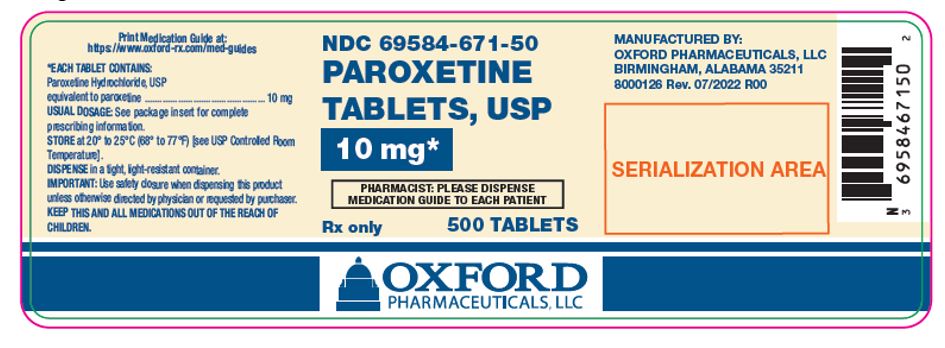
PACKAGE LABEL.PRINCIPAL DISPLAY PANEL NDC 69584-671-50 PAROXETINE TABLETS, USP 10 mg* PHARMACIST: PLEASE DISPENSE MEDICATION GUIDE TO EACH PATIENT Rx only 500 TABLETS Print Medication Guide at: https:/www.oxford-rx.com/med-guides *EACH TABLET CONTAINS: Paroxetine Hydrochloride, USP equivalent to paroxetine..........................10 mg USUAL DOSAGE: See package insert for complete prescribing information. STORE at 20° to 25°(68° to 77°F) [see USP Controlled Room Temperature]. DISPENSE in a tight light-resistant container.
IMPORTANT: Use safety closure when dispensing this product unless otherwise directed by physician or requested by purchaser. KEEP THIS AND ALL MEDICATIONS OUT OF THE REACH OF CHILDREN. MANUFACTURED BY: OXFORD PHARMACEUTICALS, LLC BIRMINGHAM, ALABAMA 35211 8000126 Rev.
07/2022 R00 OXFORD PHARMACEUTICALS, LLC NDC 69584-672-50 PAROXETINE TABLETS, USP 20 mg* PHARMACIST: PLEASE DISPENSE MEDICATION GUIDE TO EACH PATIENT Rx only 500 TABLETS Print Medication Guide at: https:/www.oxford-rx.com/med-guides *EACH TABLET CONTAINS: Paroxetine Hydrochloride, USP equivalent to paroxetine..........................20 mg USUAL DOSAGE: See package insert for complete prescribing information. STORE at 20° to 25°(68° to 77°F) [see USP Controlled Room Temperature]. DISPENSE in a tight light-resistant container.
IMPORTANT: Use safety closure when dispensing this product unless otherwise directed by physician or requested by purchaser. KEEP THIS AND ALL MEDICATIONS OUT OF THE REACH OF CHILDREN. MANUFACTURED BY: OXFORD PHARMACEUTICALS, LLC BIRMINGHAM, ALABAMA 35211 8000131 Rev.
07/2022 R00 OXFORD PHARMACEUTICALS, LLC NDC 69584-673-50 PAROXETINE TABLETS, USP 30 mg* PHARMACIST: PLEASE DISPENSE MEDICATION GUIDE TO EACH PATIENT Rx only 500 TABLETS Print Medication Guide at: https:/www.oxford-rx.com/med-guides *EACH TABLET CONTAINS: Paroxetine Hydrochloride, USP equivalent to paroxetine..........................30 mg USUAL DOSAGE: See package insert for complete prescribing information. STORE at 20° to 25°(68° to 77°F) [see USP Controlled Room Temperature]. DISPENSE in a tight light-resistant container.
IMPORTANT: Use safety closure when dispensing this product unless otherwise directed by physician or requested by purchaser. KEEP THIS AND ALL MEDICATIONS OUT OF THE REACH OF CHILDREN. MANUFACTURED BY: OXFORD PHARMACEUTICALS, LLC BIRMINGHAM, ALABAMA 35211 8000136 Rev.
07/2022 R00 OXFORD PHARMACEUTICALS, LLC NDC 69584-674-50 PAROXETINE TABLETS, USP 40 mg* PHARMACIST: PLEASE DISPENSE MEDICATION GUIDE TO EACH PATIENT Rx only 500 TABLETS Print Medication Guide at: https:/www.oxford-rx.com/med-guides *EACH TABLET CONTAINS: Paroxetine Hydrochloride, USP equivalent to paroxetine..........................40 mg USUAL DOSAGE: See package insert for complete prescribing information. STORE at 20° to 25°(68° to 77°F) [see USP Controlled Room Temperature]. DISPENSE in a tight light-resistant container.
IMPORTANT: Use safety closure when dispensing this product unless otherwise directed by physician or requested by purchaser. KEEP THIS AND ALL MEDICATIONS OUT OF THE REACH OF CHILDREN. MANUFACTURED BY: OXFORD PHARMACEUTICALS, LLC BIRMINGHAM, ALABAMA 35211 8000141 Rev.
07/2022 R00 OXFORD PHARMACEUTICALS, LLC