
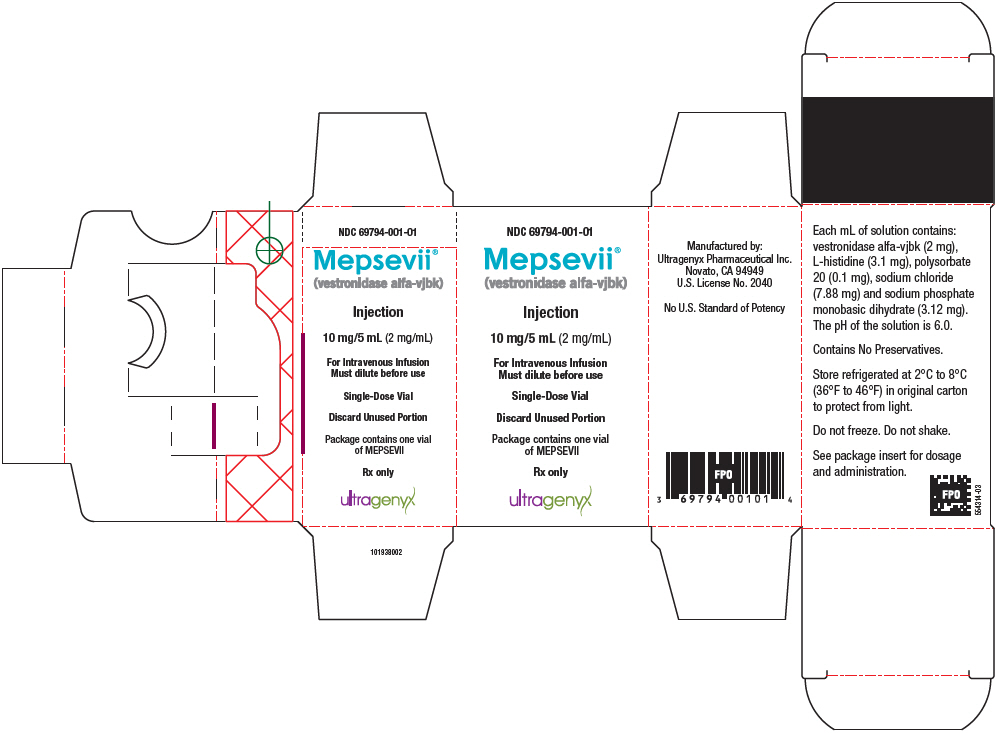
MEPSEVII vestronidase alfa 2 mg/mL Injection — NDC 69794-001-01 (Billing 69794-0001-01)
This is a package of MEPSEVII vestronidase alfa 2 mg/mL Injection from Ultragenyx Pharmaceutical Inc., marketed since Nov 2017 and currently FDA-listed. It is this product's only package size.
NDC database record
One package, one record: these facts belong to NDC 69794-001-01 alone.
- Record
- FDA NDC Directory package listing · Human prescription drug
- Code segments
- 69794 labeler · 001 product · 01 package
- Package marketed since
- Nov 15, 2017
- Sample package
- No — commercial package
- Listing certified through
- Dec 31, 2026
- Barcode (UPC-A, from the NDC)
- 3 6979400101 4
- Medicaid fills, this package
- 41 prescriptions in the last four reported quarters
- FDA record last changed
- Jul 24, 2026
Identity & classification
Regulatory identifiers FDA, NLM and CMS codes for this package
Drug-database identifiers Medi-Span GPI and First Databank GCN / HICL / AHFS classification
- GSN (GCN sequence number): 077957
- GCN: 44130
- GPI-14 (Medi-Span): 30907680202020
- HICL (First Databank): 044653
- AHFS class code: 44:00.00.00
- RxCUI (RxNorm): 1989823
Where does this data come from?
- FDA openFDA NDC Directory · synced Oct 8, 2026
- FDA label on DailyMed · label index refreshed Oct 6, 2026
- RxNorm (NLM RxNav) · catalog refreshed Oct 1, 2026
- Medi-Span GPI (licensed)
- First Databank (licensed) · refreshed Oct 8, 2026
RxNorm drug class
This medicine belongs to the Lysosomal beta Glucuronidase class.
Where does this data come from?
- RxClass (NLM) · catalog refreshed Oct 1, 2026
Clinical
Patient education
Supplement & herbal interactions
Where does this data come from?
- MedlinePlus (NLM) · refreshed Oct 1, 2026
- FDA label on DailyMed · label index refreshed Oct 6, 2026
Ask a licensed pharmacist directly — free, answered by our team.
Pricing
A drug doesn't have one price. Each row is a different public payment system, and none is what you'd pay at the counter — that depends on your insurance. The ⓘ on each row explains what it measures.
| Price system | Per each | Per package |
|---|---|---|
| Retail pharmacies payNADAC · weekly | Not in the retail survey — common for institutional, discontinued, or low-volume packs. | |
| Medicaid paysCMS SDUD · 12 mo | $547.85 | $547.85 / 1 vial |
| Medicare drug plans payPart D · quarterly | No Part D plan price is available for this NDC in our data. | |
| Medicare Part B allowsASP · J3397 | No ASP payment limit on file for J3397 this quarter. | |
Where does this data come from?
- CMS NADAC weekly file
- CMS ASP pricing files · refreshed Sep 20, 2026
- CMS Medicaid State Drug Utilization Data · through Q1 2026
- CMS Part D plan pricing files · refreshed Sep 24, 2026
- VA National Acquisition Center price file
Billing & reimbursement
Where does this data come from?
- CMS ASP NDC-HCPCS crosswalk · refreshed Sep 22, 2026
- DMEPDAC NDC-HCPCS crosswalk
- openFDA NSDE billing units · refreshed Oct 7, 2026
Packaging — all sizes for this product
| Package NDC | Description | Marketing start | Marketing end | Status |
|---|---|---|---|---|
| 69794-0001-01 You're viewing this Main listing | 1 VIAL, SINGLE-USE in 1 CARTON / 5 mL in 1 VIAL, SINGLE-USE | 2017-11-15 | — | Active |
Therapeutic equivalents
| Product | Labeler | Pack | NADAC/unit | TE | Status | Price vs. this |
|---|---|---|---|---|---|---|
| Mepsevii 2 mg/mLthis 69794-0001-01 | Ultragenyx | 1 vial | — | — | FDA listed | — |
Where does this data come from?
- FDA openFDA NDC Directory · synced Oct 8, 2026
- FDA Purple Book · refreshed Oct 5, 2026
- CMS NADAC weekly file
Availability & biosimilar status
Biologics have no small-molecule generics; biosimilar competition is tracked in the FDA Purple Book.
Why the date isn’t exact: Biosimilar timing can change because patents may be challenged, settled, licensed, added or removed, and litigation can move the real date earlier or later.
🛈 What do these terms mean?
- Biologic patent
- A patent the reference product’s maker has publicly listed. A biosimilar generally can’t launch until these expire — unless they’re invalidated or resolved in a settlement.
- Reference-product exclusivity
- A flat 12 years of FDA market protection from the biologic’s first licensure (the BPCIA). No biosimilar can be licensed before it ends, regardless of patents.
- Interchangeable exclusivity
- The first interchangeable biosimilar can earn a period as the only interchangeable version (pharmacists can substitute it without the prescriber).
- Earliest biosimilar (LOE)
- The latest of all the dates above — the soonest a biosimilar can realistically reach the market. Litigation and settlements can move it earlier.
Biologics have no small-molecule “generics” — competition comes from FDA-licensed biosimilars, tracked in the FDA Purple Book.
| Code | What it grants | Expires |
|---|---|---|
| RefProduct | Reference-product exclusivity (12-year, BPCIA) — no biosimilar can be licensed before this date | Nov 15, 2029 |
Is there a biosimilar for MEPSEVII 10 MG/5 ML VIAL?
Why do different websites show different biosimilar dates?
Can a biosimilar launch before the last patent expires?
What does “current Purple Book estimate” mean?
What does “FDA listed” mean?
What does a patent or protection date mean here?
Where does this data come from?
- FDA Purple Book · refreshed Oct 5, 2026
What it looks like
Where does this data come from?
- FDA label on DailyMed · label index refreshed Oct 6, 2026
Inactive Ingredients / Excipients
Inactive ingredients, also called excipients, are components of the drug product other than the active ingredient. They may include fillers, dyes, coatings, preservatives, flavors, or other formulation ingredients.
💡 Tap an ingredient (hover on desktop) to see what it is and why it’s used.
-
3.1 mg / 1 mL
UNII 4QD397987E
An amino acid used as a buffer and stabilizer in medications. It helps maintain the pH balance and protects the active drug from breaking down during storage and use.
-
0.1 mg / 1 mL
UNII 7T1F30V5YH
A synthetic emulsifier derived from sorbitol and oleic acid. It helps mix oil and water-based ingredients together and keeps them from separating in liquid formulations.
-
7.88 mg / 1 mL
UNII 451W47IQ8X
Sodium chloride is common table salt. It's used in medicines as a buffer to maintain proper pH, as a filler to add bulk, or to adjust the osmotic balance in liquid formulations.
-
3.12 mg / 1 mL
UNII 5QWK665956
A salt derived from phosphoric acid and sodium, used primarily as a buffer to control the acidity or pH of a medication, helping keep it stable during storage and use.
4 inactive ingredients listed in the exact product block matched to this NDC.
Where does this data come from?
ingredient classCode="IACT" elements from the exact product block matched by this NDC. Label-section narrative from DailyMed / the openFDA label index is shown separately when available.- FDA label on DailyMed · label index refreshed Oct 6, 2026
- FDA openFDA NDC Directory · synced Oct 8, 2026
Inactive ingredient FAQ
Are inactive ingredients the same for every manufacturer?
Why might an inactive ingredient be missing?
Can inactive ingredients matter?
Manufacturer & labeler
More NDCs from Ultragenyx Pharmaceutical Inc. labeler code 69794
- DOJOLVI Triheptanoin .96 g/mL Liquid NDC 69794-050-50
- GENGLYCOS pariglasgene brecaparvovec-opnr Kit NDC 69794-333-03
- GENGLYCOS pariglasgene brecaparvovec-opnr Kit NDC 69794-334-03
- GENGLYCOS pariglasgene brecaparvovec-opnr Kit NDC 69794-335-03
- GENGLYCOS pariglasgene brecaparvovec-opnr Kit NDC 69794-336-03
- GENGLYCOS pariglasgene brecaparvovec-opnr Kit NDC 69794-337-03
Where does this data come from?
- FDA openFDA NDC Directory · synced Oct 8, 2026
- Drugs@FDA
Full prescribing information FDA SPL
🚨 Boxed Warning ▾
WARNING: ANAPHYLAXIS Anaphylaxis has occurred with MEPSEVII administration, as early as the first dose [see Warnings and Precautions ( 5.1 )] , therefore appropriate medical support should be readily available when MEPSEVII is administered. Closely observe patients during and for 60 minutes after MEPSEVII infusion [see Dosage and Administration ( 2.2 ), Warnings and Precautions ( 5.1 )]. Immediately discontinue the MEPSEVII infusion if the patient experiences anaphylaxis [see Dosage and Administration ( 2.2 ), Warnings and Precautions ( 5.1 )].
WARNING: ANAPHYLAXIS See full prescribing information for complete boxed warning. Anaphylaxis has occurred with MEPSEVII administration, as early as the first dose ( 5.1 ), therefore appropriate medical support should be readily available when MEPSEVII is administered. Closely observe patients during and for 60 minutes after MEPSEVII infusion ( 2.2 , 5.1 ).
Immediately discontinue the MEPSEVII infusion if the patient experiences anaphylaxis ( 2.2 , 5.1 ).
🎯 Indications and Usage ▾
1 INDICATIONS AND USAGE MEPSEVII is indicated in pediatric and adult patients for the treatment of Mucopolysaccharidosis VII (MPS VII, Sly syndrome). Limitations of Use The effect of MEPSEVII on the central nervous system manifestations of MPS VII has not been determined. MEPSEVII is a recombinant human lysosomal beta glucuronidase indicated in pediatric and adult patients for the treatment of Mucopolysaccharidosis VII (MPS VII, Sly syndrome).
Limitations of Use The effect of MEPSEVII on the central nervous system manifestations of MPS VII has not been determined. ( 1 )
⏱️ Dosage and Administration ▾
2 DOSAGE AND ADMINISTRATION The recommended dosage is 4 mg/kg administered every two weeks as an intravenous infusion. ( 2.1 ) Premedication with a non-sedating antihistamine with or without an anti-pyretic is recommended 30 to 60 minutes prior to the start of the infusion. ( 2.2 , 5.1 ) Administer the infusion over approximately 4 hours.
In the first hour of infusion, infuse 2.5% of the total volume. After the first hour, the rate can be increased to infuse the remainder of the volume over 3 hours as tolerated. See Table 1 in the full prescribing information for the rate of infusion by dose and body weight.
( 2.4 ) For additional information on preparation, administration, and storage see the full prescribing information. ( 2.3 , 2.4 )
2.1Recommended Dosage MEPSEVII should be administered under the supervision of a healthcare professional with the capability to manage anaphylaxis. Premedication is recommended 30 to 60 minutes prior to the start of the infusion [see Dosage and Administration ( 2.2 )]. The recommended dosage of MEPSEVII is 4 mg/kg administered by intravenous infusion every two weeks.
Administer the infusion over approximately 4 hours. Infuse the first 2.5% of the total volume over the first hour. After the first hour, increase the infusion rate as tolerated in order to complete infusion over the following 3 hours according to the recommended rate guidelines in Table 1 [see Dosage and Administration ( 2.4 )].
2.2Premedication Administration of a non-sedating antihistamine with or without an anti-pyretic medication is recommended 30 to 60 minutes prior to the start of the infusion for patient comfort. Follow the instructions in Table 1 for the rate of MEPSEVII infusion [see Dosage and Administration ( 2.4 )] . Observe patients closely during the infusion and following the infusion for a minimum of 60 minutes for the development of anaphylaxis [see Warnings and Precautions ( 5.1 )] .
Discontinue the infusion immediately if the patient experiences a severe systemic reaction, including anaphylaxis [see Warnings and Precautions ( 5.1 )]. 2. 3 Preparation Instructions Prepare MEPSEVII according to the following steps using aseptic technique: 1.
Determine the number of vials to be diluted based on the patient's actual weight and the recommended dose of 4 mg/kg, using the following calculations (a-b): a. Total dose (mg) = Patient's weight (kg) x 4 mg/kg (recommended dose) b. Total number of vials = Total dose (mg) divided by 10 mg/vial 2.
Round to the next whole vial and remove the required number of vials from the refrigerator to allow them to reach room temperature. Do not heat, microwave or shake vials. a. Volume (mL) of calculated dose = Total dose (mg) divided by the 2 mg/mL concentration 3.
The final solution will be a 1:1 dilution of MEPSEVII with 0.9% Sodium Chloride Injection, USP. More than 1:1 dilution may be used if the patient can tolerate additional infusion volume, taking into consideration cardiac function and fluid status. 4.
For a 1:1 dilution, prepare the solution at room temperature, as follows: a. Select an empty infusion bag, sized upon the total volume of the final solution. b. Prior to withdrawing MEPSEVII from the vial, visually inspect the solution for particulate matter and discoloration.
Because this is a protein solution, slight flocculation (thin translucent fibers) may occur. The MEPSEVII solution should be colorless to slightly yellow. Discard if the solution is discolored or if there is particulate matter in the solution. c.
Slowly withdraw the volume of the calculated MEPSEVII dose from the appropriate number of vials (step 2a) using caution to avoid excessive agitation and any air or frothing. Use a sufficiently large needle (18 gauge) to minimize bubbles in the solution. d. Slowly add MEPSEVII to the infusion bag using care to avoid agitation, ensuring liquid to liquid contact without generating bubbles or turbulence. e.
Add 0.9% Sodium Chloride Injection, USP equal to the volume of… [Excerpted — this section continues on DailyMed.]
💊 Dosage Forms and Strengths ▾
3 DOSAGE FORMS AND STRENGTHS Injection: 10 mg/5 mL (2 mg/mL) as a colorless to slightly yellow liquid in a single-dose vial. Injection: 10 mg/5 mL (2 mg/mL) in a single-dose vial ( 3 )
⛔ Contraindications ▾
4 CONTRAINDICATIONS None. None ( 4 )
⚠️ Warnings and Cautions ▾
5 WARNINGS AND PRECAUTIONS
5.1Anaphylaxis Anaphylaxis to MEPSEVII was reported in 2 of 20 patients in the clinical program [see Adverse Reactions ( 6.1 )] . These reactions occurred during MEPSEVII infusion and were observed as early as the first dose of MEPSEVII for one patient. Manifestations included respiratory distress, cyanosis, decreased oxygen saturation, and hypotension.
The two patients with anaphylaxis to MEPSEVII during the clinical trials had one occurrence each and tolerated subsequent infusions of MEPSEVII, without recurrence. Anaphylaxis can be life-threatening. MEPSEVII should be administered under the supervision of a healthcare professional with the capability to manage anaphylaxis.
Patients should be observed for 60 minutes after MEPSEVII administration. If severe systemic reactions occur, including anaphylaxis, immediately discontinue the MEPSEVII infusion and provide appropriate medical treatment. Prior to discharge, inform patients of the signs and symptoms of anaphylaxis and instruct them to seek immediate medical care if symptoms occur.
Consider the risks and benefits of re-administering MEPSEVII following anaphylaxis.
🤒 Adverse Reactions ▾
6 ADVERSE REACTIONS The following serious adverse reactions are described below and elsewhere in the labeling: Anaphylaxis [see Warnings and Precautions ( 5.1 )] Most common adverse reactions (≥1 patient) are: Infusion site extravasation, diarrhea, rash, anaphylaxis, infusion site swelling, peripheral swelling and pruritus. ( 6.1 ) To report SUSPECTED ADVERSE REACTIONS, contact Ultragenyx at 1-888-756-8657 or FDA at 1-800-FDA-1088 or www.fda.gov/medwatch.
6.1Clinical Trials Experience Because clinical trials are conducted under widely varying conditions, adverse reaction rates observed in the clinical trials of a drug cannot be directly compared to rates in the clinical trials of another drug and may not reflect the rates observed in practice. The MEPSEVII clinical program included 23 patients aged 5 months to 25 years who received treatment with MEPSEVII at doses up to 4 mg/kg once every two weeks for up to 187 weeks. Nineteen patients were younger than 18 years of age.
Table 2 summarizes the adverse reactions that occurred in Study 301, a randomized start trial in 12 patients with MPS VII between the ages of 8 and 25 years [see Clinical Studies ( 14 )] . Adverse reactions in Table 2 occurred in one or more patients treated with MEPSEVII at a dosage of 4 mg/kg at a higher patient frequency than placebo. Adverse reaction incidence rates are presented in the table below to account for the different duration of exposure to active treatment vs. placebo.
Table 2. Adverse Reactions in Patients with MPS VII in Study 301 Adverse Reaction MEPSEVII N =12 n ( Incidence Rate*) Placebo N= 9 n ( Incidence Rate*) Infusion site extravasation 4 (0.5) 1 (0.4) Diarrhea 3 (0.4) 0 (0.0) Rash 3 (0.4) 2 (0.7) Anaphylaxis 2 (0.2) 0 (0.0) Infusion site swelling 1 (0.1) 0 (0.0) Peripheral swelling 1 (0.1) 0 (0.0) Pruritus 1 (0.1) 0 (0.0) n = number of reactions *Adverse reaction incidence rates calculated per 8.3 patient years for exposure to MEPSEVII, and 2.7 years of exposure for placebo Febrile Convulsion One patient receiving a dose of 4 mg/kg experienced a febrile convulsion during MEPSEVII treatment at Week 66.
The infusion was stopped, the patient received anticonvulsants, antipyretics and antibiotics, and the adverse reaction resolved. The patient subsequently was re-challenged without recurrence and continued on treatment.
6.2Immunogenicity As with all therapeutic proteins, there is potential for immunogenicity. The detection of antibody formation is highly dependent on the sensitivity and specificity of the assay. Additionally, the observed incidence of antibody (including neutralizing antibody) positivity in an assay may be influenced by several factors including assay methodology, sample handling, timing of sample collection, concomitant medications, and underlying disease.
For these reasons, comparison of the incidence of antibodies in the studies described below with the incidence of antibodies in other studies to other vestronidase alfa products may be misleading. Immunogenicity data were available from 23 patients who received MEPSEVII for up to 187 weeks of treatment. Eighteen out of 23 (78%) patients developed anti-vestronidase alfa-vjbk antibodies (ADA).
Ten of the 18 (55.6%) ADA-positive patients were tested positive for neutralizing antibodies (NAb). There is no correlation between ADA titer and NAb development. Six treatment-naïve patients had pre-existing ADA titers at baseline.
ADAs were detected in five of these six patients post-treatment. The post-treatment ADA titers were the same as or below the baseline ADA titer values in two patients, but one of these two patients was positive for NAb. ADA titer values after treatment increased 64-fold, 128-fold, and 364-fold, respectively, in the other three patients.
The presence of ADA titer did not appear to affect reduction in urinary glycosaminoglycans (uGAGs).
👥 Use in Specific Populations ▾
8 USE IN SPECIFIC POPULATIONS
8.1Pregnancy Risk Summary There are no available data on MEPSEVII use in pregnant women to determine a drug-associated risk of adverse developmental outcomes. In embryofetal development studies, vestronidase alfa-vjbk administered intravenously to pregnant rats and rabbits during the period of organogenesis showed no adverse developmental outcomes at doses up to 1.6 and 10 times, respectively for rats and rabbits, the exposure at the recommended human dose. In a pre- and post-natal development study in rats, an increased number of stillbirths were observed at exposures less than the recommended human dose (see Data).
The clinical relevance of these animal findings is uncertain. The estimated background risk of major birth defects and miscarriage for the indicated population is unknown. All pregnancies have a background risk of birth defect, loss, or other adverse outcomes.
In the U.S. general population, the estimated background risk of major birth defects and miscarriage in clinically recognized pregnancies is 2 to 4% and 15 to 20%, respectively. Data Animal Data In embryofetal development studies, vestronidase alfa-vjbk administered intravenously to pregnant rats (once a week) and rabbits (once every 3 days) during the period of organogenesis showed no adverse developmental outcomes at doses up to 20 mg/kg. The 20 mg/kg dose in rats and rabbits provides approximately 1.6 and 10 times the human exposure (AUC) of 57.9 hr*mcg/mL at the 4 mg/kg dose administered once every other week, respectively.
In a pre- and post-natal developmental study in rats, vestronidase alfa-vjbk was administered every 3 days from gestation day 7 through lactation day 20 at doses of 2 mg/kg, 6 mg/kg, and 20 mg/kg. Mortality and adverse clinical signs were observed in the maternal animals at the 20 mg/kg dose (1.6 times the human exposure (AUC) at the recommended human dose of 4 mg/kg). Subsequently, the 20 mg/kg dose was reduced to 12 mg/kg.
Maternal toxicity with mortality in one animal was also observed at the 6 mg/kg dose (0.17 times the AUC at the recommended human dose of 4 mg/kg). At the 2 mg/kg dose (0.01 times the AUC at the recommended human dose of 4 mg/kg), no adverse effects were observed in the maternal animals; however, there was a statistically significant decrease in the number of live births and subsequent increase in the number of stillbirths at this dose.
8.2Lactation Risk Summary There are no data on the presence of vestronidase alfa-vjbk in either human or animal milk, the effects on the breastfed infant, or the effects on milk production. The developmental and health benefits of breastfeeding should be considered along with the mother's clinical need for MEPSEVII and any potential adverse effects on the breastfed infant from vestronidase alfa-vjbk or from the underlying maternal condition. 8.
4 Pediatric Use The safety and effectiveness of MEPSEVII have been established in pediatric patients less than 18 years of age [see Adverse Reactions ( 6 ) , Clinical Studies ( 14 )] . 8. 5 Geriatric Use Clinical trials of MEPSEVII did not include any patients aged 65 and over.
It is not known whether elderly patients respond differently from younger patients.
🤰 Pregnancy ▾
8.1Pregnancy Risk Summary There are no available data on MEPSEVII use in pregnant women to determine a drug-associated risk of adverse developmental outcomes. In embryofetal development studies, vestronidase alfa-vjbk administered intravenously to pregnant rats and rabbits during the period of organogenesis showed no adverse developmental outcomes at doses up to 1.6 and 10 times, respectively for rats and rabbits, the exposure at the recommended human dose. In a pre- and post-natal development study in rats, an increased number of stillbirths were observed at exposures less than the recommended human dose (see Data).
The clinical relevance of these animal findings is uncertain. The estimated background risk of major birth defects and miscarriage for the indicated population is unknown. All pregnancies have a background risk of birth defect, loss, or other adverse outcomes.
In the U.S. general population, the estimated background risk of major birth defects and miscarriage in clinically recognized pregnancies is 2 to 4% and 15 to 20%, respectively. Data Animal Data In embryofetal development studies, vestronidase alfa-vjbk administered intravenously to pregnant rats (once a week) and rabbits (once every 3 days) during the period of organogenesis showed no adverse developmental outcomes at doses up to 20 mg/kg. The 20 mg/kg dose in rats and rabbits provides approximately 1.6 and 10 times the human exposure (AUC) of 57.9 hr*mcg/mL at the 4 mg/kg dose administered once every other week, respectively.
In a pre- and post-natal developmental study in rats, vestronidase alfa-vjbk was administered every 3 days from gestation day 7 through lactation day 20 at doses of 2 mg/kg, 6 mg/kg, and 20 mg/kg. Mortality and adverse clinical signs were observed in the maternal animals at the 20 mg/kg dose (1.6 times the human exposure (AUC) at the recommended human dose of 4 mg/kg). Subsequently, the 20 mg/kg dose was reduced to 12 mg/kg.
Maternal toxicity with mortality in one animal was also observed at the 6 mg/kg dose (0.17 times the AUC at the recommended human dose of 4 mg/kg). At the 2 mg/kg dose (0.01 times the AUC at the recommended human dose of 4 mg/kg), no adverse effects were observed in the maternal animals; however, there was a statistically significant decrease in the number of live births and subsequent increase in the number of stillbirths at this dose.
🧒 Pediatric Use ▾
8. 4 Pediatric Use The safety and effectiveness of MEPSEVII have been established in pediatric patients less than 18 years of age [see Adverse Reactions ( 6 ) , Clinical Studies ( 14 )] .
🧓 Geriatric Use ▾
8. 5 Geriatric Use Clinical trials of MEPSEVII did not include any patients aged 65 and over. It is not known whether elderly patients respond differently from younger patients.
🧬 Clinical Pharmacology ▾
12 CLINICAL PHARMACOLOGY
12.1Mechanism of Action Mucopolysaccharidosis VII (MPS VII or Sly syndrome) is a lysosomal disorder characterized by the deficiency of GUS that results in GAG accumulation in cells throughout the body leading to multisystem tissue and organ damage. Vestronidase alfa-vjbk is a recombinant form of human GUS and is intended to provide exogenous GUS enzyme for uptake into cellular lysosomes. Mannose-6-phosphate (M6P) residues on the oligosaccharide chains allow binding of the enzyme to cell surface receptors, leading to cellular uptake of the enzyme, targeting to lysosomes and subsequent catabolism of accumulated GAGs in affected tissues.
12.2Pharmacodynamics In clinical studies, MEPSEVII treatment resulted in sustained reduction of urinary excretion of GAGs during long-term treatment [see Clinical Studies ( 14 )].
12.3Pharmacokinetics The pharmacokinetics of vestronidase alfa-vjbk were evaluated in a total of 23 MPS VII patients including 19 pediatric patients and 4 adults. Serum exposures of vestronidase alfa-vjbk appeared to increase approximately proportionally from 1 mg/kg (0.25 times the approved recommended dosage) to 2 mg/kg (0.5 times the approved recommended dosage), and 4 mg/kg (the recommended dosage). After repeated dosing of 4 mg/kg every other week, the mean ± standard deviation of maximal concentration (Cmax) was 17.3 ± 9.6 mcg/mL (range: 4.7 to 35.7 mcg/mL); and the mean ± standard deviation of area under the concentration-time curve from time zero to the last measurable concentration (AUC0-t) was 50.9 ± 32.2 mcg*hr/mL (range: 17.4 to 153 mcg*hr/mL).
Vestronidase alfa-vjbk concentrations in pediatric patients less than 5 years of age were similar to the concentrations in older children and adults. Distribution After repeated dosing of 4 mg/kg every other week in MPS VII patients, the mean ± standard deviation of the total volume of distribution (Vss) was 251 ± 140 mL/kg (range: 97 to 598 mL/kg). Elimination After repeated dosing of 4 mg/kg every other week in MPS VII patients, the mean ± standard deviation of the total clearance (CL) was 83.6 ± 43.2 mL/hr/kg (range: 38.3 to 184mL/hr/kg); the mean ± standard deviation of the elimination half-life (t1/2) was 2.33 ± 0.75 hours (range: 0.86 to 3.03 hours).
The inter-subject variability (coefficient of variation) in total clearance (CL) was 52%. Metabolism Vestronidase alfa-vjbk is a recombinant human enzyme and is therefore eliminated by proteolytic degradation into small peptides and amino acids. Excretion No excretion studies have been conducted in humans.
Vestronidase alfa-vjbk is not expected to be eliminated through renal or fecal excretion.
🧬 Mechanism of Action ▾
12.1Mechanism of Action Mucopolysaccharidosis VII (MPS VII or Sly syndrome) is a lysosomal disorder characterized by the deficiency of GUS that results in GAG accumulation in cells throughout the body leading to multisystem tissue and organ damage. Vestronidase alfa-vjbk is a recombinant form of human GUS and is intended to provide exogenous GUS enzyme for uptake into cellular lysosomes. Mannose-6-phosphate (M6P) residues on the oligosaccharide chains allow binding of the enzyme to cell surface receptors, leading to cellular uptake of the enzyme, targeting to lysosomes and subsequent catabolism of accumulated GAGs in affected tissues.
📦 How Supplied / Storage and Handling ▾
16 HOW SUPPLIED/STORAGE AND HANDLING MEPSEVII (vestronidase alfa-vjbk) injection is a colorless to slightly yellow liquid supplied as a carton containing one 10 mg/5 mL (2 mg/mL) single-dose vial (NDC 69794-001-01). Store under refrigeration at 2°C to 8°C (36°F to 46°F). Do not freeze or shake. Protect from light.
📋 Description ▾
11 DESCRIPTION Vestronidase alfa-vjbk is a recombinant human lysosomal beta glucuronidase which is a purified human enzyme produced by recombinant DNA technology in a Chinese hamster ovary cell line. Purified vestronidase alfa-vjbk exists as a homotetramer, with each monomer consisting of 629 amino acids. The calculated isotope average molecular mass of each non-glycosylated peptide chain is 72,562 Da.
The amino acid sequence for vestronidase alfa-vjbk is the same as the amino acid sequence for human beta-glucuronidase (GUS). MEPSEVII (vestronidase alfa-vjbk) injection for intravenous infusion is a sterile, preservative-free, non-pyrogenic, colorless to slightly yellow liquid supplied in a single-dose vial. Each mL of solution contains vestronidase alfa-vjbk (2 mg), L-histidine (3.1 mg), polysorbate 20 (0.1 mg), sodium chloride (7.88 mg) and sodium phosphate monobasic dihydrate (3.12 mg).
The pH of the solution is 6.0.
💬 Information for Patients ▾
17 PATIENT COUNSELING INFORMATION Anaphylaxis Advise patients and caregivers that anaphylaxis has occurred with MEPSEVII administration. Inform patients of the signs and symptoms of anaphylaxis, and have them seek immediate medical care should signs and symptoms occur [see Warnings and Precautions ( 5.1 )] . Manufactured by: Ultragenyx Pharmaceutical Inc. Novato, CA 94949 U.S. License No. 2040
🧬 Pharmacokinetics ▾
12.3Pharmacokinetics The pharmacokinetics of vestronidase alfa-vjbk were evaluated in a total of 23 MPS VII patients including 19 pediatric patients and 4 adults. Serum exposures of vestronidase alfa-vjbk appeared to increase approximately proportionally from 1 mg/kg (0.25 times the approved recommended dosage) to 2 mg/kg (0.5 times the approved recommended dosage), and 4 mg/kg (the recommended dosage). After repeated dosing of 4 mg/kg every other week, the mean ± standard deviation of maximal concentration (Cmax) was 17.3 ± 9.6 mcg/mL (range: 4.7 to 35.7 mcg/mL); and the mean ± standard deviation of area under the concentration-time curve from time zero to the last measurable concentration (AUC0-t) was 50.9 ± 32.2 mcg*hr/mL (range: 17.4 to 153 mcg*hr/mL).
Vestronidase alfa-vjbk concentrations in pediatric patients less than 5 years of age were similar to the concentrations in older children and adults. Distribution After repeated dosing of 4 mg/kg every other week in MPS VII patients, the mean ± standard deviation of the total volume of distribution (Vss) was 251 ± 140 mL/kg (range: 97 to 598 mL/kg). Elimination After repeated dosing of 4 mg/kg every other week in MPS VII patients, the mean ± standard deviation of the total clearance (CL) was 83.6 ± 43.2 mL/hr/kg (range: 38.3 to 184mL/hr/kg); the mean ± standard deviation of the elimination half-life (t1/2) was 2.33 ± 0.75 hours (range: 0.86 to 3.03 hours).
The inter-subject variability (coefficient of variation) in total clearance (CL) was 52%. Metabolism Vestronidase alfa-vjbk is a recombinant human enzyme and is therefore eliminated by proteolytic degradation into small peptides and amino acids. Excretion No excretion studies have been conducted in humans.
Vestronidase alfa-vjbk is not expected to be eliminated through renal or fecal excretion.
🧬 Pharmacodynamics ▾
12.2Pharmacodynamics In clinical studies, MEPSEVII treatment resulted in sustained reduction of urinary excretion of GAGs during long-term treatment [see Clinical Studies ( 14 )].
🔬 Clinical Studies ▾
14 CLINICAL STUDIES The clinical program for MEPSEVII included 23 patients with MPS VII, 17 of whom were evaluable for efficacy, 20 for safety, and 23 for immunogenicity. Patients were enrolled in clinical trials and expanded access protocols receiving treatment at doses up to 4 mg/kg once every two weeks for up to 187 weeks. The patients ranged in age from 5 months to 25 years.
Sixteen patients were younger than 18 years of age. Studies 301 and 202 Study UX003-CL301 (referred to as Study 301, NCT02230566) was a randomized start trial of MEPSEVII 4 mg/kg every two weeks in patients with MPS VII. Twelve patients were randomized to one of four placebo durations before crossing over to active treatment.
Three patients received MEPSEVII immediately for a duration of 48 weeks, 3 patients received placebo for 8 weeks then MEPSEVII for 40 weeks, 3 patients received placebo for 16 weeks then MEPSEVII for 32 weeks, and 3 patients received placebo for 24 weeks then MEPSEVII for 24 weeks. Of the 12 patients enrolled in the trial, 4 were male and 8 were female and ranged in age from 8 to 25 years (median 14 years). Nine patients were younger than 18 years of age.
The majority of the patients were white (75%), with 50% of Hispanic or Latino ethnicity. Patients who were enrolled in Study 301 were eligible to roll over to Study UX003-CL202 (referred to as Study 202, NCT02432144), an open-label extension trial in which patients received additional doses of MEPSEVII at 4 mg/kg intravenously every other week for up to 144 weeks. Ten patients rolled over directly from the end of Study to Week 0 of Study 202, while 2 patients (17%) had treatment gaps before enrolling in Study 202.
In Study 301, motor function, forced vital capacity, and visual acuity were assessed after 24 weeks of MEPSEVII treatment and measured against pre-specified minimal important differences. The extremely small population of patients with MPS VII globally necessitated the enrollment of all patients able to participate resulting in a highly heterogeneous group. Clinical endpoints were not assessable in some patients due to their extent of disease, age or level of cognition.
Repeated assessments of the six minute walk test (6MWT) were feasible in ten of 12 patients and are described further below. Of the three patients who improved on their 6MWT (Figure 1, left panel), two also were noted to have improvement in balance and gross motor proficiency as assessed by the Bruininks-Oseretsky Test of Motor Proficiency (BOT-2). In this trial, the mean difference in 6MWT distance between MEPSEVII and placebo treatment periods in patients able to perform the test at baseline and subsequent visits through Week 24 is shown in Table 3.
The mean difference in 6MWT distance increases with increased treatment duration, however, due to the small size of the trial, standard errors are large. Table 3. Mean Difference in 6MWT Distance (meters) Between MEPSEVII and Placebo Treatment (Study 301) in Patients with MPS VII Duration of MEPSEVII Treatment LS mean 6MW T (m eters ) ( ± S tandard Error )* Number and Treatment Assignment of Patients Included in Analyis ** 8 weeks -11 (± 24) 5 placebo period; 8 MEPSEVII period 16 weeks 13 (± 32) 5 placebo period; 8 MEPSEVII period 24 weeks 18 (± 33) 5 placebo period; 8 MEPSEVII period *ANCOVA analysis of change from baseline in least squares (LS) mean between placebo and MEPSEVII for different periods, after adjusting for study cohort, age, and baseline 6MWT distance.
Patients who used assistive devices were imputed as zeros in the analysis. **Number and treatment assignment of patients included in the analysis was based upon a randomized start trial design and patient ability to complete testing. Due to no placebo period for the three patients who received 48 weeks of MEPSEVII in the first cohort of the randomized start design, more data were available for analyses during the treatment period (n=8) than during the placebo period (n=5). While data from 8 pa… [Excerpted — this section continues on DailyMed.]
🧪 Nonclinical Toxicology ▾
13 NONCLINICAL TOXICOLOGY
13.1Carcinogenesis, Mutagenesis, Impairment of Fertility Long-term studies in animals to evaluate carcinogenic potential or studies to evaluate the mutagenic potential have not been performed with vestronidase alfa-vjbk. Vestronidase alfa-vjbk at intravenous doses up to 20 mg/kg administered weekly to rats prior to mating and after mating on gestation days 6, 9, 12, 15 and 18 (females), [approximately up to 4.5 times (male rats) and 1.6 times (female rats) the human AUC 0-t of 3440 mcg*min/mL at the 4 mg/kg dose administered once every other week] was found to have no adverse effect on fertility and reproductive performance of male and female rats.
📄 Carcinogenesis, Mutagenesis, Impairment of Fertility ▾
13.1Carcinogenesis, Mutagenesis, Impairment of Fertility Long-term studies in animals to evaluate carcinogenic potential or studies to evaluate the mutagenic potential have not been performed with vestronidase alfa-vjbk. Vestronidase alfa-vjbk at intravenous doses up to 20 mg/kg administered weekly to rats prior to mating and after mating on gestation days 6, 9, 12, 15 and 18 (females), [approximately up to 4.5 times (male rats) and 1.6 times (female rats) the human AUC 0-t of 3440 mcg*min/mL at the 4 mg/kg dose administered once every other week] was found to have no adverse effect on fertility and reproductive performance of male and female rats.
📄 Package Label / Principal Display Panel ▾
PRINCIPAL DISPLAY PANEL - 10 mg/5 mL Vial Label NDC 69794-001-01 Rx only Mepsevii ® (vestronidase alfa-vjbk) 10 mg/5 mL (2 mg/mL) For Intravenous Infusion Must dilute before use PRINCIPAL DISPLAY PANEL - 10 mg/5 mL Vial Label
PRINCIPAL DISPLAY PANEL - 10 mg/5 mL Vial Carton NDC 69794-001-01 Mepsevii ® (vestronidase alfa-vjbk) Injection 10 mg/5 mL (2 mg/mL) For Intravenous Infusion Must dilute before use Single-Dose Vial Discard Unused Portion Package contains one vial of MEPSEVII Rx only ultragenyx PRINCIPAL DISPLAY PANEL - 10 mg/5 mL Vial Carton
Medicaid utilization & spend
Medicare Part D spend CMS · PART D · 2025 (Q1-Q4)
Reported adverse events (FAERS)
Top reported reactions
Age at onset
Reporter sex
Serious outcomes
Where does this data come from?
About this NDC listing & data coverage
What data is (and isn’t) available for this NDC — tap to expand
| NDC identity (package / product / labeler codes) | ✓ Available |
| Labeler | ✓ Available |
| Product & package description | ✓ Available |
| Marketing category & status | ✓ Available |
| Active ingredient / dosage form / route | ✓ Available |
| FDA label (SPL via DailyMed) | ✓ Available |
| Package photos | ✓ Available |
| Inactive ingredients (structured) | ✓ Available |
| NADAC pharmacy acquisition price (CMS) | — Not published for this NDC CMS publishes NADAC only for NDCs reported in its retail-pharmacy survey. |
| Orange Book / therapeutic-equivalence data | ✓ Available |
| HCPCS J-code billing crosswalk | ✓ Available |
| Medicaid utilization (CMS SDUD) | ✓ Available |