
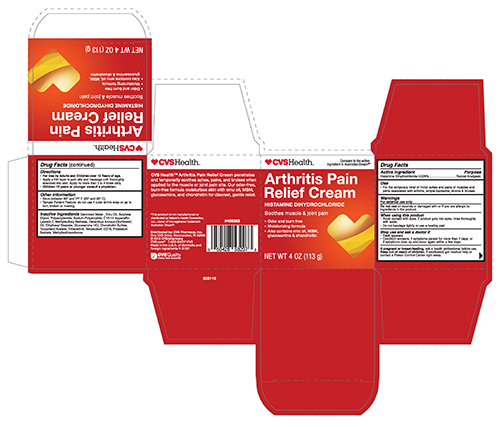
CVS Arthritis Pain Relief .025 g/100g Cream
🆔 Identity & classification
Where does this data come from?
🏷️ RxNorm drug class
This medicine belongs to the Other immunostimulants class.
Where does this data come from?
🏭 Manufacturer & labeler
Where does this data come from?
🩺 Clinical
CVS Arthritis Pain Relief is a topical cream containing histamine dihydrochloride, marketed as an over-the-counter monograph product. Histamine dihydrochloride is typically used in topical pain-relief products and is believed to work by stimulating local blood flow and nerve endings in the skin. This cream is applied directly to the skin over affected joints or muscles and is commonly used as a counterirritant for temporary relief of minor arthritis pain and stiffness.
Patient education
Supplement & herbal interactions
Where does this data come from?
Ask a licensed pharmacist directly — free, answered by our team.
🧪 Inactive Ingredients / Excipients
Inactive ingredients, also called excipients, are components of the drug product other than the active ingredient. They may include fillers, dyes, coatings, preservatives, flavors, or other formulation ingredients.
💡 Tap an ingredient (hover on desktop) to see what it is and why it’s used.
-
UNII 9E8X80D2L0
A synthetic form of vitamin E used as an antioxidant and preservative in medications. It helps prevent the active ingredients from degrading when exposed to oxygen or light.
-
UNII 3XUS85K0RA
Butylene glycol is a clear liquid derived from petroleum or plants that acts as a humectant, solvent, and preservative booster in medicines. It helps keep formulations stable, dissolve active ingredients, and maintain moisture in topical products.
-
UNII E4F12ROE70
A refined mineral oil derived from crude petroleum containing 13 to 14 carbon chains. It acts as a solvent, emollient, and carrier in topical formulations to help dissolve active ingredients and improve product texture and spreadability.
-
UNII 2ZAJ1K50XH
A naturally derived compound extracted from shark cartilage, used as a binder and thickening agent in tablet and capsule formulations to help hold ingredients together and control product texture.
-
UNII 9H4PO4Z4FT
A sulfur-containing organic compound used as a solvent and penetration enhancer in medicines. It helps dissolve active ingredients and improve their absorption through skin or mucous membranes.
-
UNII MP1J8420LU
A salt derived from edetic acid that binds to trace metals in medicines. It serves as a chelating agent and preservative to prevent metal-catalyzed breakdown of the drug and extend shelf life.
-
UNII 344821WD61
Emu oil is a natural fat derived from emu birds, used in some medicines as an emollient and penetration enhancer to help active ingredients absorb through the skin and soften the formulation.
-
UNII EG3PA2K3K5
Ethylhexyl stearate is a waxy oil made from stearic acid and ethylhexyl alcohol. In medicines, it acts as an emollient and thickener to improve texture and help the product spread smoothly on skin or dissolve properly.
-
UNII 750W5330FY
Glucosamine hydrochloride is an amino sugar derived from shellfish or produced synthetically. In medicines, it serves as an active nutritional ingredient rather than a typical inactive excipient, used to support joint and cartilage function.
-
UNII BKJ0J3D1BP
A plant-derived ingredient from sunflower flowers, used as a natural colorant and flavoring agent in medicines. It may help provide color or mild taste to the product.
-
UNII Z95S6G8201
A synthetic surfactant derived from lauryl alcohol and ethylene oxide. It helps dissolve and mix oily and watery ingredients in liquid formulations, and may improve how the medicine spreads or is absorbed.
-
UNII 229D0E1QFA
Methylisothiazolinone is a synthetic chemical preservative that prevents bacterial and fungal growth in liquid medicines and topical products. It helps keep the medication safe and extends shelf life during storage.
-
UNII 5D6TC4BRWV
Polyacrylamide is a synthetic polymer used as a thickener and stabilizer in medicines. It helps maintain consistent texture and prevents separation of ingredients in liquid or semi-solid formulations.
-
UNII 1VPU26JZZ4
Potassium sorbate is a salt derived from sorbic acid, a naturally occurring preservative. It prevents growth of mold, yeast, and some bacteria, extending the medicine's shelf life.
-
UNII 285CYO341L
Sodium polyacrylate is a synthetic polymer that absorbs and holds water. In medicines, it acts as a disintegrant, helping tablets break apart quickly in the stomach, and as a binder, holding tablet ingredients together.
-
UNII 3T5PCR2H0C
A synthetic detergent and emulsifier made from plant-derived materials. It helps mix oil and water components together and improves how the medicine spreads or absorbs in the body.
-
UNII 059QF0KO0R
Water is a liquid solvent that dissolves and mixes ingredients together in liquid medicines, syrups, and injections. It helps distribute the active drug evenly throughout the product.
17 inactive ingredients listed in the exact product block matched to this NDC.
Label-section wording can be broader than the structured product block and may mention additional formulation ingredients.
Where does this data come from?
ingredient classCode="IACT" elements from the exact product block matched by this NDC. Label-section narrative from DailyMed / the openFDA label index is shown separately when available.Inactive ingredient FAQ
Are inactive ingredients the same for every manufacturer?
Why might an inactive ingredient be missing?
Can inactive ingredients matter?
💲 Pricing
A drug doesn't have one price. Each row is a different public payment system, and none is what you'd pay at the counter — that depends on your insurance. The ⓘ on each row explains what it measures.
| Price system | Per g | Per package |
|---|---|---|
| Retail pharmacies payNADAC · weekly | Not in the retail survey — common for institutional, discontinued, or low-volume packs. | |
| Medicaid paysCMS SDUD · 12 mo | No recent Medicaid claims on file for this NDC — rare and low-volume NDCs are suppressed in the public data. | |
| Medicare drug plans payPart D · quarterly | No Part D plan price is available for this NDC in our data. | |
Where does this data come from?
🔁 Therapeutic equivalents
| Product | Labeler | Pack | NADAC/unit | TE | Status | Price vs. this |
|---|---|---|---|---|---|---|
| Walgreens Arthritis Pain Relief Cream .00025 g/g 00363-5301-40 | Walgreens | 113 g | — | — | FDA listed | — |
| Arthritis Pain Relief Cream .00025 g/g 61577-8120-02 | Sombra | 59 g | — | — | Discontinued | — |
| CVS Arthritis Pain Relief .025 g/100gthis 69842-0301-60 | CVS | 1 jar | — | — | FDA listed | — |
| AMINO ACTIVE Topical Analgesic Cream .25 mg/mL 82908-0357-00 | VIREO | 81.33 ml | — | — | FDA listed | — |
Where does this data come from?
⏳ Availability & generic status
We did not find an FDA-approved generic match for this exact strength, form and route.
Where does this data come from?
📦 Packaging — all sizes for this product
| Package NDC | Description | Marketing start | Status |
|---|---|---|---|
| 69842-0301-60 You're viewing this | 1 JAR in 1 CARTON (69842-301-60) / 113 g in 1 JAR | 2016-05-30 | Active |
🧭 About this NDC listing & data coverage
What data is (and isn’t) available for this NDC — tap to expand
| NDC identity (package / product / labeler codes) | ✓ Available |
| Labeler | ✓ Available |
| Product & package description | ✓ Available |
| Marketing category & status | ✓ Available |
| Active ingredient / dosage form / route | ✓ Available |
| FDA label (SPL via DailyMed) | ✓ Available |
| Package photos | ✓ Available |
| Inactive ingredients (structured) | ✓ Available |
| NADAC pharmacy acquisition price (CMS) | — Not published for this NDC CMS publishes NADAC only for NDCs reported in its retail-pharmacy survey. |
| Orange Book / therapeutic-equivalence data | — Not published for this NDC Applies only to products approved under an NDA/ANDA; many listings are out of scope. |
| HCPCS J-code billing crosswalk | — Not published for this NDC Most self-administered / retail products have no J-code — that is normal. |
| Medicaid utilization (CMS SDUD) | — Not published for this NDC CMS reports utilization only for NDCs with Medicaid claims above its privacy threshold. |
Questions about this listing
Is this NDC FDA-approved?
Why is there no price listed?
Is the NDC printed on the package the same as the 11-digit billing NDC?
What do the three segments of this NDC mean?
Is this package still being marketed?
Who lists this product with the FDA?
Do I need a prescription for this product?
Where does this data come from?
📄 FDA label — Drug Facts FDA SPL
🎯 Indications and Usage ▾
Use For temporary relief of minor aches and pains of muscles and joints assited with arthritis, simple backache, strains & bruises.
⏱️ Dosage and Administration ▾
Directions For use by adults and Children over 12 years of age. apply a thin layer tp the pain site and massage until thoroughly absorbed into skin. Apply no more than 3 to 4 times daily. Children 12 years or younger consult a physician.
⚠️ Warnings ▾
Warnings For external use only. Do not use on wounds or damaged skin or if you are allergic to ingredients in the product.
📦 Storage and Handling ▾
Other information Store between 68° and 77° F ( 20° and 25° C) Tamper evident feature:do not use if outer shrink wrap on jar is torn, broken or missing.
🧪 Active Ingredient ▾
Active Ingredient Histamine Dihydrochloride .025%
🧪 Inactive Ingredients ▾
Inactive Ingredients Deoinized Water, Emu Oil, Butylene Glycol, Polyacrylamide, Sodium Polyacrylate, C13-C14 Isoparaffin, Laureth-7, Methylsulfonylmethane, Hellanthus Annuus( Sunflower )Oil, Ethylhexyl Stearate, Glucosamine HCL, Chondroitin Sulfate, Tocopheryl Acetate, Trideceth-6, Tetrasodium EDTA, Potassium Sorbate, Methylisothiazolinone
🎯 Purpose ▾
Purpose Topical Analgesic