
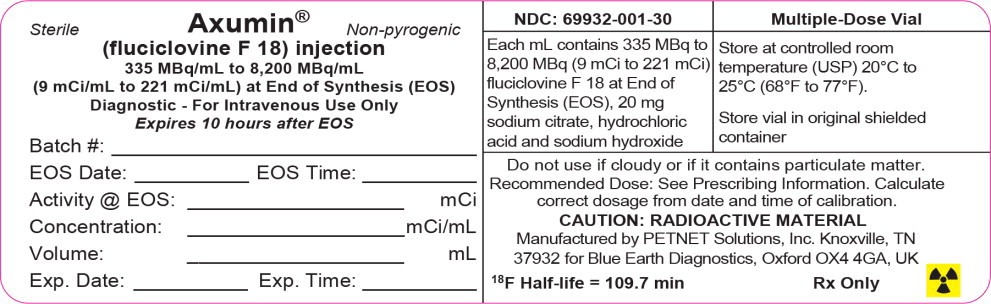
NDC 69932-0001-30: Axumin Fluciclovine F-18 221 mCi/mL Injection, Solution, 30 mL Vial
This is a package of 30 mL of Axumin Fluciclovine F-18 221 mCi/mL Injection, Solution from Blue Earth Diagnostics, first listed with the FDA May 2016 and currently FDA-listed. It is the main listing for this product, which comes in 2 package sizes.
NDC Database Record
One package, one record: these facts belong to NDC 69932-001-30 alone.
- Record
- FDA NDC Directory package listing · Human prescription drug
- Code segments
- 69932 labeler · 001 product · 30 package
- Package marketed since
- May 27, 2016
- Sample package
- No — commercial package
- Listing certified through
- Dec 31, 2026
- Barcode (UPC-A, from the NDC)
- 3 6993200130 2
- FDA record last changed
- Jul 24, 2026
Identity & Classification
Regulatory identifiers FDA, NLM and CMS codes for this package
Drug-database identifiers Medi-Span GPI and First Databank GCN / HICL / AHFS classification
- GSN (GCN sequence number): 076201
- GCN: 41496
- GPI-14 (Medi-Span): 94356535102020
- HICL (First Databank): 043467
- AHFS class code: 36:68.00.00
Where does this data come from?
- FDA openFDA NDC Directory · synced Nov 26, 2026
- FDA label on DailyMed · label index refreshed Nov 26, 2026
- RxNorm (NLM RxNav) · catalog refreshed Nov 26, 2026
- Medi-Span GPI (licensed)
- First Databank (licensed) · refreshed Nov 26, 2026
Clinical
Patient education
Supplement & herbal interactions
Where does this data come from?
- MedlinePlus (NLM) · refreshed Nov 26, 2026
- FDA label on DailyMed · label index refreshed Nov 26, 2026
Ask a licensed pharmacist directly — free, answered by our team.
Pricing
A drug doesn't have one price. Each row is a different public payment system, and none is what you'd pay at the counter — that depends on your insurance. The ⓘ on each row explains what it measures.
| Price system | Per mL | Per package |
|---|---|---|
| Retail pharmacies pay NADAC · weekly | Not in the retail survey — common for institutional, discontinued, or low-volume packs. | |
| Medicaid paysCMS SDUD · 12 mo | No recent Medicaid claims on file for this NDC — rare and low-volume NDCs are suppressed in the public data. | |
| Medicare drug plans payPart D · quarterly | No Part D plan price is available for this NDC in our data. | |
Where does this data come from?
- CMS NADAC weekly file
- CMS ASP pricing files · refreshed Nov 20, 2026
- CMS Medicaid State Drug Utilization Data · refreshed Nov 29, 2026
- CMS Part D plan pricing files · refreshed Nov 24, 2026
- VA National Acquisition Center price file
Packaging — All Sizes for This Product
| Package NDC | Description | Marketing start | Marketing end | Status |
|---|---|---|---|---|
| 69932-0001-30 You're viewing this Main listing | 30 mL in 1 VIAL, MULTI-DOSE | 2016-05-27 | — | Active |
| 69932-0001-50 69932-001-50 | 50 mL in 1 VIAL, MULTI-DOSE | 2016-05-27 | — | Active |
You're viewing the smallest of 2 pack sizes for this product.
Pack size FAQ
What quantity is in this package?
How does this package differ from NDC 69932-0001-50?
What NDC number is used to bill for this package of Axumin Fluciclovine F-18 221 mCi/mL Injection, Solution?
Therapeutic Equivalents
| Product | Labeler | Pack | NADAC/unit | TE | Status | Price vs. this |
|---|---|---|---|---|---|---|
| Axumin 221 mCi/mLthis 69932-0001-30 | Blue | 30 ml | — | — | FDA listed | — |
Where does this data come from?
- FDA openFDA NDC Directory · synced Nov 26, 2026
- FDA Orange Book · refreshed Nov 6, 2026
- CMS NADAC weekly file
Availability & Generic Status
We did not find an FDA-approved generic match for this exact strength, form and route. Patent/protection dates below may affect future generic timing.
Why the date isn’t exact: Generic timing can change because patents may be challenged, settled, licensed, added, removed, or worked around with a narrower label — and FDA approval does not always mean a pharmacy can get the generic today.
Our estimate: April 2042 about 15.5 years away
How sure: Toss-up. Still unsettled. Just as likely to slip as to hold.
Why then: A patent that protects the brand runs out. After that, approved generics can be sold.
See the full forecast for generic Axumin →What do these terms mean?
- Patent
- Legal protection listed in the Orange Book that may delay generic approval or launch. Issued by the U.S. Patent & Trademark Office.
- Substance patent
- Covers the active drug molecule itself — the hardest to design around. A generic generally can’t launch until it expires.
- Formulation (product) patent
- Covers a specific formulation or dosage form. A generic can sometimes work around it with a different formulation.
- Method-of-use patent
- A patent covering one specific approved use of the drug — not necessarily the whole molecule. A generic can sometimes launch with a “skinny label” that carves out the protected use and keeps the others.
- Skinny label
- A generic label that omits a still-patented use when the FDA allows it — letting a generic reach the market for the unprotected uses.
- Exclusivity
- FDA-granted marketing protection, separate from patents — e.g. 5-yr new chemical entity, 7-yr orphan drug, or a +6-month pediatric extension.
- Paragraph IV
- A generic applicant’s formal challenge to a listed patent. It can potentially lead to earlier generic entry, but often involves litigation or a settlement.
- RLD / RS
- Reference Listed Drug — the brand product the FDA uses as the reference for generic applications. Reference Standard — the product the FDA expects generics to compare against in bioequivalence testing.
- TE / AB rating
- FDA therapeutic-equivalence rating. An AB rating generally means the FDA considers a generic therapeutically equivalent to — and substitutable for — the brand.
- LOE (loss of exclusivity)
- The latest patent or exclusivity currently listed — the loss-of-exclusivity / latest-listed-protection date shown on this page. Paragraph-IV challenges and settlements can move the real date earlier; FDA approval and a manufacturer’s decision to market can move it later.
Built from the FDA Orange Book. The bars above are scaled to each protection’s expiry; the red LOE marker is the last one to lapse.
| Patent | Type | Use code | Expires |
|---|---|---|---|
| US 10124079 ↗ | Method of use | U-2450 | Dec 30, 2035 |
| US 9387266 ↗ | Method of use | U-1879 | Nov 28, 2026 |
| US 11980674 ↗ | Method of use | U-2450 | Apr 23, 2042 |
| US 10716868 ↗ | Method of use | U-2450 | Dec 30, 2035 |
| US 10967077 ↗ | Method of use | U-2450 | Dec 30, 2035 |
| US 10953112 ↗ | Method of use | U-1879 | Nov 28, 2026 |
| US 10933147 ↗ | Method of use | U-2450 | Dec 30, 2035 |
| US 10010632 ↗ | Drug product | — | Nov 28, 2026 |
Is there a generic version of AXUMIN VIAL?
The FDA approved a generic — why can’t I get it at my pharmacy yet?
Why do different websites show different generic release dates?
What does “FDA listed” mean?
What does a patent or protection date mean here?
What does “current Orange Book estimate” mean?
Can a generic come out before the last patent expires?
Can a generic come out after the listed dates?
What is the difference between patents and exclusivity?
Why are there multiple patent dates?
Where does this data come from?
- FDA Orange Book · refreshed Nov 6, 2026
Inactive Ingredients / Excipients
Inactive ingredients, also called excipients, are components of the drug product other than the active ingredient. They may include fillers, dyes, coatings, preservatives, flavors, or other formulation ingredients.
Tap an ingredient (hover on desktop) to see what it is and why it’s used.
-
UNII QTT17582CB
A strong acid used to adjust and maintain the proper pH level in liquid medicines, ensuring stability and preventing breakdown of active ingredients.
-
UNII 1Q73Q2JULR
Sodium citrate is a salt derived from citric acid. It works as a buffer to maintain the medicine's pH level and may also help improve taste or act as a preservative in the formulation.
-
UNII 55X04QC32I
A strong alkaline chemical used to adjust and maintain the pH balance of liquid medicines. It helps keep the medicine stable and ensures it stays effective during storage.
-
UNII 059QF0KO0R
Water is a liquid solvent that dissolves and mixes ingredients together in liquid medicines, syrups, and injections. It helps distribute the active drug evenly throughout the product.
4 inactive ingredients listed in the exact product block matched to this NDC.
Where does this data come from?
ingredient classCode="IACT" elements from the exact product block matched by this NDC. Label-section narrative from DailyMed / the openFDA label index is shown separately when available.- FDA label on DailyMed · label index refreshed Nov 26, 2026
- FDA openFDA NDC Directory · synced Nov 26, 2026
Inactive ingredient FAQ
Are inactive ingredients the same for every manufacturer?
Why might an inactive ingredient be missing?
Can inactive ingredients matter?
Manufacturer & Labeler
More NDCs from Blue Earth Diagnostics labeler code 69932
Where does this data come from?
- FDA openFDA NDC Directory · synced Nov 26, 2026
- Drugs@FDA
Full Prescribing Information FDA SPL
Indications and Usage
1 INDICATIONS AND USAGE Axumin is indicated for positron emission tomography (PET) in men with suspected prostate cancer recurrence based on elevated blood prostate specific antigen (PSA) levels following prior treatment. Axumin is a radioactive diagnostic agent indicated for positron emission tomography (PET) imaging in men with suspected prostate cancer recurrence based on elevated blood prostate specific antigen (PSA) levels following prior treatment ( 1 ).
Dosage and Administration
2 DOSAGE AND ADMINISTRATION Use appropriate radiation safety handling measures ( 2.1 ). Aseptically withdraw Axumin from its container and administer 370 MBq (10 mCi) as a bolus intravenous injection. ( 2.2 ).
Initiate imaging 3 minutes to 5 minutes after administration. Scanning should start from mid-thigh and proceed to base of skull, with a total scan time of approximately 20 minutes to 30 minutes ( 2.4 ). The (radiation absorbed) effective dose associated with 370 MBq (10 mCi) of injected activity of Axumin is approximately 8 mSv (0.8 rem) in an adult ( 2.6 ).
2.1Radiation Safety - Drug Handling Axumin is a radioactive drug and should be handled with appropriate safety measures to minimize radiation exposure during administration [see Warnings and Precautions ( 5.3 ) ]. Use waterproof gloves and effective shielding, including syringe shields, when handling and administering Axumin.
2.2Recommended Dose and Administration Instructions The recommended dose is 370 MBq (10 mCi) administered as an intravenous bolus injection. Inspect Axumin visually for particulate matter and discoloration before administration. Do not use the drug if the solution contains particulate matter or is discolored.
Use aseptic technique and radiation shielding when withdrawing and administering Axumin. Calculate the necessary volume to administer based on calibration time and date, using a suitably calibrated instrument. The recommended maximum volume of injection of undiluted Axumin is 5mL.
Axumin may be diluted with 0.9% Sodium Chloride Injection, USP. After the Axumin injection, administer an intravenous flush of sterile 0.9% Sodium Chloride Injection, USP to ensure full delivery of the dose. Dispose of any unused drug in a safe manner in compliance with applicable regulations.
2.3Patient Preparation Prior to PET Imaging Advise the patient to avoid any significant exercise for at least one day prior to PET imaging. Advise patients not to eat or drink for at least 4 hours (other than sips of water for taking medications) prior to administration of Axumin. Advise patients to void approximately 30 minutes to 60 minutes prior to administration of Axumin and then refrain from voiding until after the scan has been completed
2.4Image Acquisition Guidelines Position the patient supine with arms above the head. Begin PET scanning 3 minutes to 5 minutes after completion of the Axumin injection. It is recommended that image acquisition should start from mid-thigh and proceed to the base of the skull. Typical total scan time is between 20 minutes to 30 minutes.
2.5Image Display and Interpretation Localization of prostate cancer recurrence in sites typical for prostate cancer recurrence is based on fluciclovine F 18 uptake in comparison with tissue background. For small lesions (less than 1cm in diameter) focal uptake greater than blood pool should be considered suspicious for prostate cancer recurrence. For larger lesions, uptake equal to or greater than bone marrow is considered suspicious for prostate cancer recurrence.
2.6Radiation Dosimetry The radiation absorbed doses estimated for adult patients following intravenous injection of Axumin are shown in Table 1 . Values were calculated from human biodistribution data using OLINDA/EXM (Organ Level Internal Dose Assessment/Exponential Modeling) software. The (radiation absorbed) effective dose resulting from the administration of the recommended activity of 370 MBq of Axumin is 8 mSv.
For an administered activity of 370 MBq (10 mCi), the highest-magnitude radiation doses are delivered to the pancreas, cardiac wall, and uterine wall: 38 mGy, 19 mGy, and 17 mGy, respectively. If a CT scan is simultaneously performed as part of the PET procedure, exposure to ionizing radiation will increase in an amount dependent on the settings used in the CT acquisition. Table 1: Estimated Radiation Absorbed Doses in Various Organs/Tissues in Adults who Received Axumin Organ/Tissue Mean Absorbed Dose per Unit Administered… [Excerpted — this section continues on DailyMed.]
Dosage Forms and Strengths
3 DOSAGE FORMS AND STRENGTHS Injection: supplied as a clear, colorless solution in a 30 mL or 50 mL multiple-dose vial containing 335 MBq/mL to 8,200 MBq/mL (9 mCi/mL to 221 mCi/mL) fluciclovine F 18 at calibration time and date. Injection: clear, colorless solution in a 30 mL or 50 mL multiple-dose vial containing 335 MBq/mL to 8,200 MBq/mL (9 mCi/mL to 221 mCi/mL) fluciclovine F 18 at calibration time and date ( 3 ).
Contraindications
4 CONTRAINDICATIONS None None ( 4 )
Warnings and Cautions
5 WARNINGS AND PRECAUTIONS Image interpretation errors can occur with Axumin imaging ( 5.1 ). Radiation risk: Axumin contributes to a patient's long-term cumulative radiation exposure. Ensure safe handling to protect patients and health care workers from unintentional radiation exposure ( 2.1 , 5.3 ).
5.1Risk for Image Misinterpretation Image interpretation errors can occur with Axumin PET imaging. A negative image does not rule out the presence of recurrent prostate cancer and a positive image does not confirm the presence of recurrent prostate cancer. The performance of Axumin seems to be affected by PSA levels [See Clinical Studies ( 14 )] .
Fluciclovine F 18 uptake is not specific for prostate cancer and may occur with other types of cancer and benign prostatic hypertrophy in primary prostate cancer. Clinical correlation, which may include histopathological evaluation of the suspected recurrence site, is recommended.
5.2Hypersensitivity Reactions Hypersensitivity reactions including anaphylaxis may occur in patients who receive Axumin. Emergency resuscitation equipment and personnel should be immediately available.
5.3Radiation Risks Axumin use contributes to a patient's overall long-term cumulative radiation exposure. Long-term cumulative radiation exposure is associated with an increased risk for cancer. Ensure safe handling to minimize radiation exposure to the patient and health care providers [see Dosage and Administration ( 2.1 )] .
Adverse Reactions
6 ADVERSE REACTIONS Most commonly reported adverse reactions are injection site pain, erythema, and dysgeusia ( 6.1 ). To report SUSPECTED ADVERSE REACTIONS, contact Blue Earth Diagnostics, Ltd at 1-855-AXUMIN1 (1-855-298-6461) or FDA at 1-800-FDA-1088 or www.fda.gov/medwatch . Clinical Trials Experience Because clinical trials are conducted under widely varying conditions, adverse reaction rates observed in the clinical trials of a drug cannot be directly compared to rates in the clinical trials of another drug and may not reflect the rates observed in practice.
The clinical trial database for Axumin includes data from 877 subjects including 797 males diagnosed with prostate cancer. Most patients received a single administration of Axumin, a small number of subjects (n = 50) received up to five administrations of the drug. The mean administered activity was 370 MBq (range, 163 MBq to 485 MBq).
Adverse reactions were reported in ≤1% of subjects during clinical studies with Axumin. The most common adverse reactions were injection site pain, injection site erythema and dysgeusia.
Use in Specific Populations
8 USE IN SPECIFIC POPULATIONS
8.1Pregnancy Risk Summary Axumin is not indicated for use in females and there is no information on the risk of adverse development outcomes in pregnant women or animals with the use of fluciclovine F 18.
8.2Lactation Risk Summary Axumin is not indicated for use in females and there is no information of the presence of fluciclovine F 18 in human milk.
8.3Pediatric Use Safety and effectiveness have not been established in pediatric patients.
8.4Geriatric Use Of the total number of patients in clinical studies of Axumin, the average age was 66 years with a range of 21 to 90 years. No overall differences in safety or effectiveness were observed between older subjects and younger subjects.
Pregnancy
8.1Pregnancy Risk Summary Axumin is not indicated for use in females and there is no information on the risk of adverse development outcomes in pregnant women or animals with the use of fluciclovine F 18.
Pediatric Use
8.3Pediatric Use Safety and effectiveness have not been established in pediatric patients.
Geriatric Use
8.4Geriatric Use Of the total number of patients in clinical studies of Axumin, the average age was 66 years with a range of 21 to 90 years. No overall differences in safety or effectiveness were observed between older subjects and younger subjects.
Overdosage
10 OVERDOSAGE In case of overdose of Axumin, encourage patients to maintain hydration and to void frequently to minimize radiation exposure.
Clinical Pharmacology
12 CLINICAL PHARMACOLOGY
12.1Mechanism of action Fluciclovine F 18 is a synthetic amino acid transported across mammalian cell membranes by amino acid transporters, such as LAT-1 and ASCT2, which are upregulated in prostate cancer cells. Fluciclovine F 18 is taken up to a greater extent in prostate cancer cells compared with surrounding normal tissues.
12.2Pharmacodynamics Following intravenous administration, the tumor-to-normal tissue contrast is highest between 4 and 10 minutes after injection, with a 61% reduction in mean tumor uptake at 90 minutes after injection.
12.3Pharmacokinetics Distribution Following intravenous administration, fluciclovine F 18 distributes to the liver (14% of administered activity), pancreas (3%), lung (7%), red bone marrow (12%) and myocardium (4%). With increasing time, fluciclovine F 18 distributes to skeletal muscle. Excretion Across the first four hours post-injection, 3% of administered radioactivity was excreted in the urine.
Across the first 24 hours post-injection, 5% of administered radioactivity was excreted in the urine.
Mechanism of Action
12.1Mechanism of action Fluciclovine F 18 is a synthetic amino acid transported across mammalian cell membranes by amino acid transporters, such as LAT-1 and ASCT2, which are upregulated in prostate cancer cells. Fluciclovine F 18 is taken up to a greater extent in prostate cancer cells compared with surrounding normal tissues.
How Supplied / Storage and Handling
16 HOW SUPPLIED/STORAGE AND HANDLING
16.1How Supplied Axumin is supplied as a clear, colorless injection in a 30 mL or 50 mL multiple-dose glass vial containing approximately 26 mL solution of 335 MBq/mL to 8,200 MBq/mL (9 mCi/mL to 221 mCi/mL) fluciclovine F 18 at calibration time and date. 30 mL sterile multiple-dose vial: NDC 69932-001-30 50 mL sterile multiple-dose vial: NDC 69932-001-50
16.2Storage and Handling Store Axumin at controlled room temperature (USP) 20°C to 25°C (68°F to 77°F). Axumin does not contain a preservative. Store Axumin within the original container in radiation shielding.
Do not use Axumin more than 10 hours after end of synthesis and dispose of in accordance with institutional guidelines. This preparation is approved for use by persons under license by the Nuclear Regulatory Commission or the relevant regulatory authority of an Agreement State.
Storage and Handling
16.2Storage and Handling Store Axumin at controlled room temperature (USP) 20°C to 25°C (68°F to 77°F). Axumin does not contain a preservative. Store Axumin within the original container in radiation shielding.
Do not use Axumin more than 10 hours after end of synthesis and dispose of in accordance with institutional guidelines. This preparation is approved for use by persons under license by the Nuclear Regulatory Commission or the relevant regulatory authority of an Agreement State.
Description
11 DESCRIPTION
11.1Chemical Characteristics Axumin contains the fluorine 18 (F 18) labeled synthetic amino acid analog fluciclovine. Fluciclovine F 18 is a radioactive diagnostic agent used with PET imaging. Chemically, fluciclovine F 18 is (1r, 3r)-1-amino-3[ 18 F]fluorocyclobutane-1-carboxylic acid.
The molecular weight is 132.1 and the structural formula is: Axumin is a sterile, non-pyrogenic, clear, colorless, hyperosmolal (approximately 500 mOsm/kg to 540 mOsm/kg) injection for intravenous use. Each milliliter contains up to 2 micrograms of fluciclovine, 335 MBq to 8,200 MBq (9 mCi to 221 mCi) fluciclovine F 18 at calibration time and date, and 20 mg trisodium citrate in water for injection. The solution also contains hydrochloric acid, sodium hydroxide and has a pH between 4 and 6.
Structural Formula
11.2Physical Characteristics Fluorine 18 (F 18) is a cyclotron produced radionuclide that decays by positron emission (ß+ decay, 96.7%) and orbital electron capture (3.3%) to stable oxygen 18 with a physical half-life of 109.7 minutes. The positron can undergo annihilation with an electron to produce two gamma rays; the energy of each gamma ray is 511 keV ( Table 2 ). Table 2: Principal Radiation Produced from Decay of Fluorine 18 Radiation Energy (keV) Abundance (%) Positron 249.8
96.7Gamma 511.0 193.5
11.3External Radiation The point source air-kerma coefficient for F 18 is 3.75 x 10 -17 Gy m 2 /(Bq s). The first half-value thickness of lead (Pb) for F 18 gamma rays is approximately 6 mm. The relative reduction of radiation emitted by F 18 that results from various thicknesses of lead shielding is shown in Table 3 .
The use of 8 cm of Pb will decrease the radiation transmission (i.e., exposure) by a factor of about 10,000. Table 3: Radiation Attenuation of 511 keV Gamma Rays by Lead Shielding Shield Thickness cm of Lead (Pb) Coefficient of Attenuation 0.6 0.5 2 0.1 4 0.01 6 0.001 8 0.0001
Information for Patients
17 PATIENT COUNSELING INFORMATION Instruct patients to avoid significant exercise for at least a day before the PET scan. Instruct patients not to eat or drink for at least 4 hours before the PET scan (other than sips of water for taking medications). Instruct patients to try to urinate approximately 30 minutes to 60 minutes prior to planned start time of the PET scan and to avoid further urination until after the scan has been completed.
Marketed by Blue Earth Diagnostics Ltd. Oxford, UK OX4 4GA Axumin ® is a registered trademark of Blue Earth Diagnostics Ltd. © 2022 Blue Earth Diagnostics Ltd – all rights reserved. Blue Earth Diagnostics Logo
Pharmacokinetics
12.3Pharmacokinetics Distribution Following intravenous administration, fluciclovine F 18 distributes to the liver (14% of administered activity), pancreas (3%), lung (7%), red bone marrow (12%) and myocardium (4%). With increasing time, fluciclovine F 18 distributes to skeletal muscle. Excretion Across the first four hours post-injection, 3% of administered radioactivity was excreted in the urine.
Across the first 24 hours post-injection, 5% of administered radioactivity was excreted in the urine.
Pharmacodynamics
12.2Pharmacodynamics Following intravenous administration, the tumor-to-normal tissue contrast is highest between 4 and 10 minutes after injection, with a 61% reduction in mean tumor uptake at 90 minutes after injection.
Clinical Studies
14 CLINICAL STUDIES The safety and efficacy of Axumin were evaluated in two studies (Study 1 and Study 2) in men with suspected recurrence of prostate cancer based on rising PSA levels following radical prostatectomy and/or radiotherapy. Study 1 evaluated 105 Axumin scans in comparison to histopathology obtained by biopsy of the prostate bed and biopsies of lesions suspicious by imaging. PET/CT imaging generally included the abdomen and pelvic regions.
The Axumin images were originally read by on-site readers. The images were subsequently read by three blinded independent readers. Table 4 shows the performance of Axumin in the detection of recurrence in each patient scan and, specifically, within the prostatic bed and extra-prostatic regions, respectively.
The results of the independent read were generally consistent with one another and confirmed the results of the on-site reads. Table 4: Performance of Axumin in Patients with Biochemically Suspected Recurrent Prostate Cancer, at the Patient Level and at the Prostate Bed and Extraprostatic Region Levels N = number of patient scans evaluated Reader 1 Reader 2 Reader 3 Patient N = 104 N = 105 N = 99 True Positive 75 72 63 False Positive 24 23 13 True Negative 5 7 15 False Negative 0 3 8 Prostate Bed N = 98 N = 97 N = 96 True Positive 58 56 47 False Positive 29 26 15 True Negative 10 12 24 False Negative 1 3 10 Extraprostatic N = 28 N = 28 N = 25 True Positive 25 26 22 False Positive 2 2 2 True Negative 0 0 0 False Negative 1 0 1 The detection rate of Axumin seems to be affected by PSA levels [see Warnings and Precautions ( 5.1 )] .
In general, patients with negative scans had lower PSA values than those with positive scans. The detection rate (number with positive scans/total scanned) for patients with a PSA value of less than or equal to 1.78 ng/mL (1st PSA quartile) was 15/25, of which 11 were histologically confirmed as positive. In the remaining three PSA quartiles, the detection rate was 71/74, of which 58 were histologically confirmed.
Among the 25 patients in the first PSA quartile, there were 4 false positive scans and 1 false negative scan. For the 74 patients with PSA levels greater than1.78 ng/mL, there were 13 false positive scans and no false negative scans. Study 2 evaluated the concordance between 96 Axumin and C11 choline scans in patients with median PSA value of 1.44 ng/mL (interquartile range = 0.78 ng/mL to 2.8 ng/mL).
The C 11 choline scans were read by on-site readers. The Axumin scans were read by the same three blinded independent readers used for Study 1. The agreement values between the Axumin and C11 choline reads were 61%, 67% and 77%, respectively.
Nonclinical Toxicology
13 NONCLINICAL TOXICOLOGY
13.1Carcinogenesis, Mutagenesis, Impairment of Fertility Carcinogenesis No long term studies in animals have been performed to evaluate the carcinogenic potential of fluciclovine. Mutagenesis Fluciclovine was not mutagenic in vitro in reverse mutation assay in bacterial cells and in chromosome aberration test in cultured mammalian cells, and was negative in an in vivo clastogenicity assay in rats after intravenous injection of doses up to 43 mcg/kg. However, fluciclovine F 18 has the potential to be mutagenic because of the F 18 radioisotope.
Impairment of Fertility No studies in animals have been performed to evaluate potential impairment of fertility in males or females.
Carcinogenesis, Mutagenesis, Impairment of Fertility
13.1Carcinogenesis, Mutagenesis, Impairment of Fertility Carcinogenesis No long term studies in animals have been performed to evaluate the carcinogenic potential of fluciclovine. Mutagenesis Fluciclovine was not mutagenic in vitro in reverse mutation assay in bacterial cells and in chromosome aberration test in cultured mammalian cells, and was negative in an in vivo clastogenicity assay in rats after intravenous injection of doses up to 43 mcg/kg. However, fluciclovine F 18 has the potential to be mutagenic because of the F 18 radioisotope.
Impairment of Fertility No studies in animals have been performed to evaluate potential impairment of fertility in males or females.
Package Label / Principal Display Panel
Principal Display Panel - 30 mL Multiple-Dose Vial Label Sterile Axumin™ Non-pyrogenic 335 MBq/mL to 8,200 MBq/mL (9 mCi/mL to 221 mCi/mL) at End of Synthesis (EOS) Diagnostic - For Intravenous Use Only Expires 10 hours after EOS Batch #: ________________________________ EOS Date: __________ EOS Time: __________ Activity @ EOS: ___________________ mCi Concentration: ___________________ mCi/mL Volume: ___________________ mL Exp. Date: __________ Exp. Time: __________ Principal Display Panel - 30 mL Multiple-Dose Vial Label
Reported Adverse Events (FAERS)
Top reported reactions
Age at onset
Reporter sex
Serious outcomes
Where does this data come from?
About This NDC Listing & Data Coverage
What data is (and isn’t) available for this NDC — tap to expand
| NDC identity (package / product / labeler codes) | Available |
| Labeler | Available |
| Product & package description | Available |
| Marketing category & status | Available |
| Active ingredient / dosage form / route | Available |
| FDA label (SPL via DailyMed) | Available |
| Package photos | Available |
| Inactive ingredients (structured) | Available |
| NADAC pharmacy acquisition price (CMS) | — Not published for this NDC CMS publishes NADAC only for NDCs reported in its retail-pharmacy survey. |
| Orange Book / therapeutic-equivalence data | Available |
| HCPCS J-code billing crosswalk | — Not published for this NDC Most self-administered / retail products have no J-code — that is normal. |
| Medicaid utilization (CMS SDUD) | — Not published for this NDC CMS reports utilization only for NDCs with Medicaid claims above its privacy threshold. |