
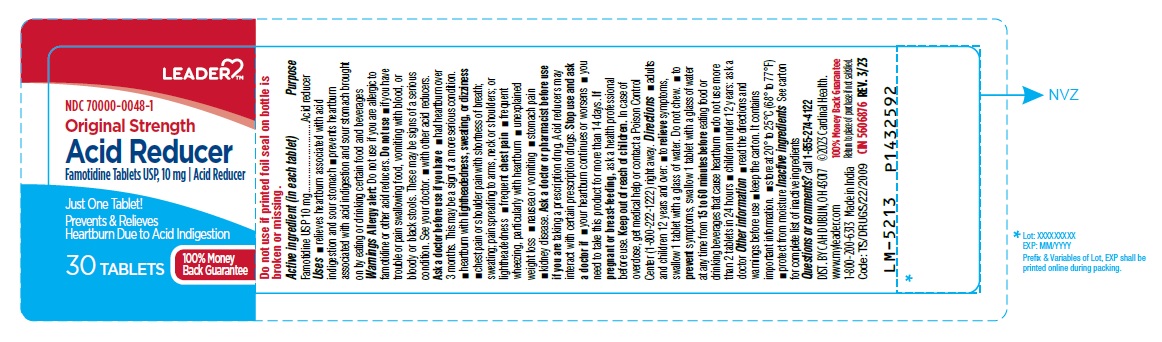
Famotidine 10 mg Tablet, Film Coated, 30-count — NDC 70000-0048-1 (Billing 70000-0048-01)
This is a package of 30 tablets of Famotidine 10 mg Tablet, Film Coated from LEADER/ CARDINAL HEALTH 110, INC., marketed since Apr 2020 and currently FDA-listed; retail pharmacies pay about $0.0923 per tablet (NADAC). It is this product's only package size.
NDC database record
One package, one record: these facts belong to NDC 70000-0048-1 alone.
- Record
- FDA NDC Directory package listing · Human OTC drug
- Code segments
- 70000 labeler · 0048 product · 1 package
- Package marketed since
- Apr 4, 2020
- Sample package
- No — commercial package
- Listing certified through
- Dec 31, 2026
- Billing quantity
- 30 EA per package
- Barcode (UPC-A, from the NDC)
- 3 7000000481 1
- Medicaid fills, this package
- 1,237 prescriptions in the last four reported quarters
- FDA record last changed
- Jul 24, 2026
Other active recalls for Famotidine (different manufacturers) — 2 · tap to view
Identity & classification
Regulatory identifiers FDA, NLM and CMS codes for this package
Drug-database identifiers Medi-Span GPI and First Databank GCN / HICL / AHFS classification
- GSN (GCN sequence number): 021688
- GCN: 46432
- GPI-14 (Medi-Span): 49200030000310
- HICL (First Databank): 004521
- AHFS class code: 04:92.00.00
- RxCUI (RxNorm): 199047
Where does this data come from?
- FDA openFDA NDC Directory · synced Oct 8, 2026
- FDA label on DailyMed · label index refreshed Oct 6, 2026
- RxNorm (NLM RxNav) · catalog refreshed Oct 1, 2026
- Medi-Span GPI (licensed)
- First Databank (licensed) · refreshed Oct 8, 2026
RxNorm drug class
This medicine belongs to the Histamine-2 Receptor Antagonist class.
Where does this data come from?
- RxClass (NLM) · catalog refreshed Oct 1, 2026
Clinical
Prescription famotidine is used to treat ulcers (sores on the lining of the stomach or small intestine); gastroesophageal reflux disease (GERD, a condition in which backward flow of acid from the stomach causes heartburn and injury of the esophagus [tube that connects the mouth and stomach]); and conditions where the stomach produces too much acid, such as Zollinger-Ellison syndrome (tumors in the pancreas or small intestine that cause increased production of stomach acid). Over-the-counter famotidine is used to prevent and treat heartburn due to acid indigestion and sour stomach caused by eat...
Read the full MedlinePlus article ↗- It reduces stomach acid. Over-the-counter versions relieve and prevent heartburn from acid indigestion and sour stomach. Prescription versions treat ulcers, GERD and erosive esopha...
- With the over-the-counter tablets, swallow one with water and do not chew it. To prevent heartburn, take it shortly before a food or drink that triggers it. Do not take more than 2...
- Headache, dizziness, constipation and diarrhea are the most common, and they are usually mild. Call your doctor if you have confusion, hallucinations, seizures, a rash with swellin...
- Not always. Famotidine can lower absorption of some drugs that need stomach acid and can raise tizanidine levels. Tell me or your doctor everything you take before you start.
Patient education
Supplement & herbal interactions
Some supplements/herbs that may interact with Famotidine — tap one for details:
Famotidine may be associated with lower levels of 6 nutrients — worth a chat with your pharmacist, not a cause for alarm.
Where does this data come from?
- MedlinePlus (NLM) · refreshed Oct 1, 2026
- FDA label on DailyMed · label index refreshed Oct 6, 2026
Ask a licensed pharmacist directly — free, answered by our team.
Pricing
A drug doesn't have one price. Each row is a different public payment system, and none is what you'd pay at the counter — that depends on your insurance. The ⓘ on each row explains what it measures.
| Price system | Per ea | Per package |
|---|---|---|
| Retail pharmacies payNADAC · weekly | $0.092 | $2.77 / 30 tablets |
| Medicaid paysCMS SDUD · 12 mo | $0.2468 | $7.40 / 30 tablets |
| Medicare drug plans payPart D · quarterly | No Part D plan price is available for this NDC in our data. | |
Where does this data come from?
- CMS NADAC weekly file · file of Apr 1, 2026
- CMS ASP pricing files · refreshed Sep 20, 2026
- CMS Medicaid State Drug Utilization Data · through Q1 2026
- CMS Part D plan pricing files · refreshed Sep 24, 2026
- VA National Acquisition Center price file
Packaging — all sizes for this product
| Package NDC | Description | Marketing start | Marketing end | Status |
|---|---|---|---|---|
| 70000-0048-01 You're viewing this Main listing | 1 BOTTLE in 1 CARTON / 30 TABLET, FILM COATED in 1 BOTTLE | 2020-04-04 | — | Active |
Therapeutic equivalents
| Product | Labeler | Pack | NADAC/unit | TE | Status | Price vs. this |
|---|---|---|---|---|---|---|
| Famotidine 10 mgthis 70000-0048-01 | LEADER/ | 30 tablets | $0.092 | — | FDA listed | — |
| good sense acid reducer 10 mg 00113-0141-65 | L. | 1 tablet | $0.095 | — | Availability likely | +3% |
| heartburn relief original strength 10 mg 00904-5529-52 | Major | 60 tablets | $0.095 | — | Availability likely | +3% |
| Famotidine 10 mg 46122-0735-65 | Amerisource | 30 tablets | $0.095 | — | Availability likely | +3% |
| Famotidine 10 mg 68001-0494-04 | BluePoint | 30 tablets | $0.095 | — | Availability likely | +3% |
| famotidine 10 mg 69230-0326-01 | Camber | 100 tablets | $0.095 | — | Availability likely | +3% |
| foster and thrive acid reducer 10 mg 70677-1102-01 | Strategic | 1 tablet | $0.095 | — | Availability likely | +3% |
| famotidine 10 mg 83324-0003-30 | CHAIN | 30 tablets | $0.096 | — | Availability likely | +4% |
| Acid Controller Original Strength 10 mg 00363-0141-65 | Walgreen | 1 tablet | — | — | Discontinued | — |
| Famotidine 10 mg 00363-4400-19 | WALGREEN | 90 tablets | — | — | FDA listed | — |
| Famotidine 10 mg 00363-9607-09 | WALGREEN | 30 tablets | — | — | FDA listed | — |
| acid relief 10 mg 11822-6141-00 | Rite | 1 tablet | — | — | Discontinued | — |
| Pepcid AC Original Strength 10 mg 16837-0872-10 | Kenvue | 10 tablets | — | — | Discontinued | — |
| Famotidine 10 mg 21130-0022-30 | Albertsons | 30 tablets | — | — | FDA listed | — |
| Famotidine 10 mg 21130-0039-09 | Better | 30 tablets | — | — | FDA listed | — |
| signature care acid controller 10 mg 21130-0249-65 | Safeway | 1 tablet | — | — | Discontinued | — |
| Acid Controller 10 mg 21130-0771-75 | Safeway | 90 tablets | — | — | FDA listed | — |
| Famotidine 10 mg 25000-0086-03 | MARKSANS | 30 tablets | — | — | FDA listed | — |
| TopCare Acid Reducer 10 mg 36800-0141-65 | Topco | 1 tablet | — | — | FDA listed | — |
| acid controller 10 mg 37808-0301-65 | H | 1 tablet | — | — | FDA listed | — |
| Famotidine 10 mg 37835-0161-50 | Bi-Mart | 50 tablets | — | — | FDA listed | — |
| equaline heartburn prevention 10 mg 41163-0313-65 | United | 1 tablet | — | — | FDA listed | — |
| Original strength heartburn prevention 10 mg 41226-0719-06 | KROGER | 30 tablets | — | — | FDA listed | — |
| heartburn relief 10 mg 41250-0493-65 | Meijer | 1 tablet | — | — | FDA listed | — |
| CareOne Acid Relief 10 mg 41520-0901-65 | American | 1 tablet | — | — | Discontinued | — |
| acid reducer original strength 10 mg 42507-0141-75 | HyVee | 90 tablets | — | — | FDA listed | — |
| Acid Reducer Original Strength 10 mg 43598-0824-18 | Dr.Reddys | 180 tablets | — | — | FDA listed | — |
| Famotidine 10 mg 43602-0511-03 | Ascent | 300 tablets | — | — | FDA listed | — |
| Equate Famotidine 10 mg 49035-0507-75 | Wal-Mart | 90 tablets | — | — | FDA listed | — |
| Famotidine 10 mg 49035-0589-19 | Wal-Mart | 90 tablets | — | — | FDA listed | — |
| Famotidine 10 mg 53943-0100-30 | Discount | 30 tablets | — | — | FDA listed | — |
| Famotidine 10 mg 54257-0180-07 | Magno-Humphries, | 90 tablets | — | — | FDA listed | — |
| Famotidine 10 mg 55111-0118-04 | Dr. | 120 tablets | — | — | FDA listed | — |
| Famotidine 10 mg 55319-0408-01 | FAMILY | 60 tablets | — | — | FDA listed | — |
| Famotidine 10 mg 55319-0426-60 | Family | 60 tablets | — | — | FDA listed | — |
| Famotidine 10 mg 55681-0343-03 | TWIN | 300 tablets | — | — | FDA listed | — |
| dg health heartburn prevention original strength 10 mg 55910-0141-60 | Dolgencorp, | 1 tablet | — | — | FDA listed | — |
| acid reducer 10 mg 56062-0141-65 | Publix | 1 tablet | — | — | FDA listed | — |
| Famotidine 10 mg 57896-0317-03 | GERI-CARE | 30 tablets | — | — | FDA listed | — |
| Famotidine 10 mg 58602-0705-09 | Aurohealth | 10 tablets | — | — | FDA listed | — |
| Famotidine 10 mg 58602-0828-19 | Aurohealth | 90 tablets | — | — | FDA listed | — |
| acid controller original strength 10 mg 59779-0141-39 | CVS | 30 tablets | — | — | FDA listed | — |
| heartburn relief original strength 10 mg 63187-0999-10 | Proficient | 10 tablets | — | — | FDA listed | — |
| Famotidine 10 mg 63868-0583-30 | Chain | 30 tablets | — | — | FDA listed | — |
| Famotidine 10 mg 63941-0009-09 | Best | 30 tablets | — | — | FDA listed | — |
| Famotidine 10 mg 68016-0800-30 | Chain | 30 tablets | — | — | FDA listed | — |
| Famotidine 10 mg 69256-0002-47 | HARRIS | 30 tablets | — | — | FDA listed | — |
| Famotidine 10 mg 69842-0063-19 | CVS | 90 tablets | — | — | FDA listed | — |
| Famotidine 10 mg 69842-0928-84 | CVS | 30 tablets | — | — | FDA listed | — |
| Famotidine 10 mg 71205-0637-30 | Proficient | 30 tablets | — | — | FDA listed | — |
| Famotidine 10 mg 71821-0012-08 | VKT | 288461 tablets | — | — | FDA listed | — |
| basic care acid reducer 10 mg 72288-0141-65 | Amazon.com | 1 tablet | — | — | FDA listed | — |
| Famotidine 10 mg/10mg 72559-0038-23 | Little | 300 mg | — | — | FDA listed | — |
| Famotidine 10 mg 72657-0112-20 | GLENMARK | 200 tablets | — | — | FDA listed | — |
| Welmate Famotidine 10mg 10 mg 73581-0108-09 | YYBA | 90 tablets | — | — | FDA listed | — |
| Heartburn Relief 10 mg 83059-0005-05 | Shield | 50 tablets | — | — | FDA listed | — |
| Heartburn Relief 10 mg 83059-0031-05 | Shield | 50 tablets | — | — | FDA listed | — |
| Famotidine 10 mg 83324-0139-30 | Chain | 30 tablets | — | — | FDA listed | — |
| Acid Reducer 10 mg 51316-0816-39 | CVS | 30 tablets | — | — | FDA listed | — |
| Acid Reducer 10 mg 72288-0756-75 | Amazon.com | 90 tablets | — | — | FDA listed | — |
| Heartburn Relief 10 mg 83059-0185-01 | Shield | 15 tablets | — | — | FDA listed | — |
Where does this data come from?
- FDA openFDA NDC Directory · synced Oct 8, 2026
- FDA Orange Book · refreshed Oct 3, 2026
- CMS NADAC weekly file · file of Apr 1, 2026
Availability & generic status
This product is an FDA-approved generic. Other versions of the same drug are listed under Therapeutic equivalents, least expensive first.
Where does this data come from?
- FDA Orange Book · refreshed Oct 3, 2026
What it looks like
Where does this data come from?
- FDA label on DailyMed · label index refreshed Oct 6, 2026
Inactive Ingredients / Excipients
Inactive ingredients, also called excipients, are components of the drug product other than the active ingredient. They may include fillers, dyes, coatings, preservatives, flavors, or other formulation ingredients.
🧪 Avoiding an ingredient? See Famotidine inactive ingredients by manufacturer: every current product's list side by side, so you can ask your pharmacy for the version that does not list it.
💡 Tap an ingredient (hover on desktop) to see what it is and why it’s used.
-
UNII R12CBM0EIZ
A natural wax derived from a Brazilian palm tree, used as a coating and polish on tablets and capsules. It creates a smooth, shiny finish that protects the medicine and improves appearance.
-
UNII 1K09F3G675
Ferric oxide red is an inorganic iron compound used as a colorant in medicines. It gives tablets, capsules, or other dosage forms a red or reddish tint for identification and appearance.
-
UNII RFW2ET671P
Hydroxypropyl cellulose is a plant-derived thickening agent made from cellulose. It acts as a binder to hold tablet ingredients together and as a film-former to coat tablets or control how fast the medicine releases.
-
UNII R75537T0T4
Hypromellose 2910 is a plant-derived thickening agent made from cellulose. It serves as a binder that holds tablet ingredients together, a film-coating for pills, and a viscosity controller in liquids.
-
UNII 70097M6I30
Magnesium stearate is a salt made from magnesium and stearic acid, a fatty substance. It's used in tablets and capsules as a lubricant and glidant to help ingredients flow smoothly during manufacturing and prevent sticking.
-
UNII OP1R32D61U
Microcrystalline cellulose is a purified form of cellulose, a natural fiber from plant sources. It acts as a binder and filler in tablets and capsules, helping hold ingredients together and give the medicine its shape and size.
-
UNII AG9B65PV6B
A starch derivative made from corn that helps tablets and capsules break apart quickly when swallowed. It acts as a disintegrant, allowing the medicine to dissolve and be absorbed in your stomach and intestines.
-
UNII O8232NY3SJ
A plant-based carbohydrate derived from corn kernels. It acts as a filler to add bulk, a binder to hold ingredients together, and a disintegrant to help the tablet break apart in your stomach for absorption.
-
UNII 7SEV7J4R1U
A powder made from a naturally occurring mineral. In medicines, talc works as a glidant and anti-caking agent, helping tablets and capsules flow smoothly during manufacturing and preventing clumping.
-
UNII 15FIX9V2JP
Titanium dioxide is a bright white mineral powder commonly used as a colorant and opacifying agent. It makes pills and tablets white or lighter in color and helps make coatings non-transparent.
10 inactive ingredients listed in the exact product block matched to this NDC.
Label-section wording can be broader than the structured product block and may mention additional formulation ingredients.
Where does this data come from?
ingredient classCode="IACT" elements from the exact product block matched by this NDC. Label-section narrative from DailyMed / the openFDA label index is shown separately when available.- FDA label on DailyMed · label index refreshed Oct 6, 2026
- FDA openFDA NDC Directory · synced Oct 8, 2026
Inactive ingredient FAQ
Are inactive ingredients the same for every manufacturer?
Why might an inactive ingredient be missing?
Can inactive ingredients matter?
Manufacturer & labeler
More NDCs from LEADER/ CARDINAL HEALTH 110, INC. labeler code 70000
- Acetaminophen 500 mg Tablet NDC 70000-0036-1
- Leader Allergy Relief D Cetirizine hydrochloride, Pseudoephedrine hydrochloride 5 mg; 120 mg Tablet, Film Coated, Extended Release NDC 70000-0042-1
- Stomach Relief Original Strength Bismuth subsalicylate 525 mg/30mL Liquid NDC 70000-0044-1
- Stomach Relief Ultra Bismuth subsalicylate 525 mg/15mL Liquid NDC 70000-0045-1
- Hemorrhoidal Mineral Oil, Petrolatum, Phenylephrine HCI .25 g/100g; 14 g/100g; 74.9 g/100g Ointment NDC 70000-0046-1
- Cetirizine Hydrochloride 10 mg Tablet NDC 70000-0047-1
- Famotidine 20 mg Tablet, Film Coated NDC 70000-0049-1
- Flu HBP Maximum Strength Acetaminophen, Chlorpheniramine maleate, Dextromethorphan HBr 325 mg; 2 mg; 10 mg Tablet, Film Coated NDC 70000-0050-1
- Cardinal Health Infants Gas Relief Simethicone 20 mg/.3mL Suspension/ Drops NDC 70000-0051-1
- Anti Nausea dextrose(glucose),Levulose(fructose),Phosphoric acid 1.87 g/5mL; 1.87 g/5mL; 21.5 mg/5mL Liquid NDC 70000-0052-1
- Eye Allergy Itch Relief Olopatadine HCl 2 mg/mL Solution/ Drops NDC 70000-0053-1
- Eye Allergy Itch and Redness Relief Olopatadine Hydrochloride 1 mg/mL Solution/ Drops NDC 70000-0054-1
Where does this data come from?
- FDA openFDA NDC Directory · synced Oct 8, 2026
- Drugs@FDA
FDA label — Drug Facts FDA SPL
🎯 Indications and Usage ▾
Uses relieves heartburn associated with acid indigestion and sour stomach prevents heartburn associated with acid indigestion and sour stomach brought on by eating or drinking certain food and beverages
⏱️ Dosage and Administration ▾
Directions adults and children 12 years and over: to relieve symptoms, swallow 1 tablet with a glass of water. Do not chew. to prevent symptoms, swallow 1 tablet with a glass of water at any time from 15 to 60 minutes before eating food or drinking beverages that cause heartburn do not use more than 2 tablets in 24 hours children under 12 years: ask a doctor
⚠️ Warnings ▾
Warnings Allergy alert: Do not use if you are allergic to famotidine or other acid reducers
📦 Storage and Handling ▾
Other information read the directions and warnings before use keep the carton. It contains important information. store at 20° to 25°C (68° to 77°F) protect from moisture
🧪 Active Ingredient ▾
Active ingredient (in each tablet) Famotidine USP 10 mg
🧪 Inactive Ingredients ▾
Inactive ingredients carnauba wax, corn starch, hydroxypropyl cellulose, hypromellose, magnesium stearate, microcrystalline cellulose, red iron oxide, sodium starch glycolate, talc and titanium dioxide.
🎯 Purpose ▾
Purpose Acid reducer
📄 Do Not Use ▾
Do not use if you have trouble or pain swallowing food, vomiting with blood, or bloody or black stools. These may be signs of a serious condition. See your doctor. with other acid reducers
📄 Ask a Doctor Before Use If ▾
Ask a doctor before use if you have had heartburn over 3 months. This may be a sign of a more serious condition. heartburn with lightheadedness, sweating, or dizziness chest pain or shoulder pain with shortness of breath; sweating; pain spreading to arms, neck or shoulders; or lightheadedness frequent chest pain frequent wheezing, particularly with heartburn unexplained weight loss nausea or vomiting stomach pain kidney disease
📄 Ask a Doctor or Pharmacist Before Use If ▾
Ask a doctor or pharmacist before use if you are taking a prescription drug. Acid reducers may interact with certain prescription drugs.
📄 Stop Use and Ask a Doctor If ▾
Stop use and ask a doctor if your heartburn continues or worsens you need to take this product for more than 14 days
🤰 If Pregnant or Breast-Feeding ▾
If pregnant or breast-feeding, ask a health professional before use.
📄 Keep Out of Reach of Children ▾
Keep out of reach of children In case of overdose, get medical help or contact a Poison Control Center (1-800-222-1222) right away.
📄 Questions or Comments ▾
Questions or comments? call 1-855-274-4122 Tips for Managing Heartburn Do not lie flat or bend over after eating Do not wear tight-fitting clothing around the stomach Do not eat before bedtime Raise the head of your bed Avoid heartburn-causing foods such as rich, spicy, fatty or fried foods, chocolate, caffeine, alcohol, and certain fruits and vegetables Eat slowly and avoid big meals If overweight, lose weight Quit smoking JUST ONE TABLET prevents and relieves heartburn due to acid indigestion brought on by eating and drinking certain foods and beverages.
Do not use if carton is open or if printed foil seal under bottle cap is open or torn. Dist. by CAH, Dublin, OH 43017 1-800-200-6313 Made in India ©2023 CARDINAL HEALTH, LEADER, and LOGOs are trademarks of Cardinal Health. All other marks are the property of their respective owners.
Code: TS/DRUGS/22/2009
📄 Package Label / Principal Display Panel ▾
PACKAGE LABEL-PRINCIPAL DISPLAY PANEL -10 mg (30 Tablets Container Label) LEADER TM NDC 70000-0048-1 Original Strength Acid Reducer Famotidine Tablets USP, 10 mg | Acid Reducer Just One Tablet! Prevents & Relieves Heartburn Due to Acid Indigestion 30 TABLETS 100% Money Back Guarantee PACKAGE LABEL-PRINCIPAL DISPLAY PANEL -10 mg (90 Tablets Container Label)
PACKAGE LABEL-PRINCIPAL DISPLAY PANEL -10 mg (30 Tablets Container Carton Label) LEADER TM NDC 70000-0048-1 Original Strength Acid Reducer Famotidine Tablets USP, 10 mg Acid Reducer Just One Tablet! Prevents & Relieves Heartburn Due to Acid Indigestion Actual Size COMPARE TO ORIGINAL STRENGTH PEPCID® AC active ingredient 30 TABLETS 100% Money Back Guarantee PACKAGE LABEL-PRINCIPAL DISPLAY PANEL -10 mg (30 Tablets Container Carton Label)