Physiologic effectIncreased Large Intestinal Motility; Stimulation Large Intestine Fluid/Electrolyte Secretion
DEA scheduleNon-controlled
Marketing categoryOTC MONOGRAPH DRUG
Marketing statusOn market
FDA listing statusListed (active directory)
Marketing start2021-05-19
RouteRECTAL
Dosage formSUPPOSITORY
SubstanceBISACODYL
GPI-1446200010005205
GPI classGentle Laxative
GCN Seq No002944
GCN08731
HICL code001301
Ingredient (HICL)Bisacodyl
HIC1 codeQ
Therapeutic class — broad (HIC1)Ear/Eye/Nose/Rectum/Topical/Vagina/Other
HIC2 codeQ3
Therapeutic class — intermediate (HIC2)Anal-Rectal Preparations
HIC3 codeQ3S
Therapeutic class — specific (HIC3)Laxatives, Local/Rectal
AHFS code56:12.00.00
AHFS classCathartics And Laxatives
FDB label nameGENTLE LAXATIVE 10 MG SUPPOSIT
FDB brand nameGentle Laxative
Legend statusO — Over-the-counter (OTC) drug or device
Why two NDCs?
The FDA registers this code as 70000-0573-2 — a 5-4-1 layout, and that's what's printed on the package and shown on DailyMed. For insurance claims, every NDC is standardized to a uniform 11-digit 5-4-2 format by adding a zero to the package segment → 70000-0573-02. Same drug, same package — only the format differs.
Where does this data come from?
Identifiers from the FDA openFDA NDC Directory and Structured Product Labeling; RxCUI from RxNorm (NLM); GPI from Medi-Span; GCN / HIC / AHFS / legend from First Databank.
🏷️RxNorm drug class
This medicine belongs to the Stimulant Laxative class.
Pharmacologic classStimulant Laxative
Drug family (ATC)Contact laxatives, Enemas
Where does this data come from?
Therapeutic classes from RxNorm RxClass (U.S. National Library of Medicine) — Established Pharmacologic Class (FDA), ATC drug family (WHO) and mechanism of action, matched by this product’s RxCUI.
The labeler markets the product; the application holder owns the FDA approval. They’re often the same company but can differ (e.g. a repackager or an authorized generic). A mailing address / phone appears here when the manufacturer includes it in the product’s FDA label (not all do).
Where does this data come from?
Labeler, application holder and registered establishment from the FDA openFDA NDC Directory and Drugs@FDA; address/contact from the product’s FDA label.
🩺 Clinical
Label name GENTLE LAXATIVE 10 MG SUPPOSITIngredient Bisacodyl
📗 Our plain-language guide HelloPharmacist
It depends on which form you're using. Oral tablets (like Dulcolax Stimulant Laxative) usually take 6 to 12 hours, so many people take them at bedtime and get results in the mornin...
No — it's really important not to chew, crush, or break bisacodyl tablets. They have a special protective coating that helps them reach the right part of your gut without irritatin...
Can I chew or crush the tablet if I have trouble swallowing?
Milk and antacids can break down the protective coating on bisacodyl tablets too soon, before the medicine reaches where it needs to work. This can cause stomach irritation and mak...
Plain-language summary from MedlinePlus (U.S. National Library of Medicine); supplement & herbal interactions and nutrient depletion data from the Natural Medicines database; our full guide is HelloPharmacist editorial content.
💬 Questions about Bisacodyl?
Ask a licensed pharmacist directly — free, answered by our team.
Inactive ingredients, also called excipients, are components of the drug product
other than the active ingredient. They may include fillers, dyes, coatings, preservatives, flavors,
or other formulation ingredients.
💡 Tap an ingredient (hover on desktop) to see what it is and why it’s used.
UNII FM8D1RE2VP
A plant-based oil that has been chemically hardened to stay solid at room temperature. It works as a binder and lubricant to hold tablet ingredients together and help them release properly during digestion.
1 inactive ingredient listed in the exact product block matched to this NDC.
The official label also stateshydrogenated vegetable oil
Label-section wording can be broader than the structured product block and may mention additional formulation ingredients.
Where does this data come from?
Data sourced from official FDA Structured Product Labeling (SPL) via DailyMed — ingredient classCode="IACT" elements from the exact product block matched by this NDC. Label-section narrative from DailyMed / the openFDA label index is shown separately when available.
Inactive ingredient FAQ
Are inactive ingredients the same for every manufacturer?
No. Inactive ingredients can differ by manufacturer, dosage form, strength, and package / product version.
Why might an inactive ingredient be missing?
Some SPLs do not provide a complete structured inactive-ingredient list, and older or unusual labels may only include the information in narrative text.
Can inactive ingredients matter?
Yes. They can matter for allergies, intolerances, dyes, gluten / lactose concerns, preservatives, and formulation differences — but confirm with a pharmacist or the manufacturer when it’s clinically important.
💲 Pricing
A drug doesn't have one price. Each row is a different public payment system, and none is what you'd pay at the counter — that depends on your insurance. The ⓘ on each row explains what it measures.
Price system
Per ea
Per package
Retail pharmacies payNADAC · weekly
$0.320
$5.12 / 16 suppositories
Medicaid paysCMS SDUD · 12 mo
$0.7690
$12.30 / 16 suppositories
Medicare drug plans payPart D · quarterly
No Part D plan price is available for this NDC in our data.
NADAC price history (per ea) — tap or hover for the price & month
▲ Up 19% over the last 24 months.
Where does this data come from?
NADAC (National Average Drug Acquisition Cost) is the CMS weekly pharmacy-acquisition-cost survey — what pharmacies pay. ASP (Average Sales Price) is the CMS Medicare Part B drug-payment file, published quarterly. Medicaid pays is computed by us from CMS State Drug Utilization Data (total reimbursed ÷ units, trailing 12 months) — gross of rebates and inclusive of dispensing fees, so it reflects what Medicaid paid, not an acquisition cost. Medicare drug plans pay is the median negotiated point-of-sale unit cost across plans listing this NDC in the CMS quarterly Prescription Drug Plan pricing files, before rebates. The VA pays is the federal contract price (FSS, and the statutory Big 4 ceiling where listed) from the VA National Acquisition Center pharmaceutical price file. All are free public government data; each measures a different payer, so the figures are not directly comparable.
About this product: other versions of the same ingredient, strength and form are listed above, least expensive first, with FDA equivalence ratings where available.
Where does this data come from?
Equivalents are other NDCs of the same ingredient, form and route from the openFDA NDC Directory, ranked least-expensive-first by NADAC. Therapeutic-equivalence (AB) ratings come from the FDA Orange Book; biologics use the FDA Purple Book for biosimilar & interchangeable status.
⏳ Availability & generic status
🏛️
2021
On the market since
May 2021
📍
2026
Currently FDA-listed
5 years listed
🔒
·
No generic listed yet
brand only
ℹ️No FDA-approved generic found
We did not find an FDA-approved generic match for this exact strength, form and route.
Where does this data come from?
Patents and exclusivity from the FDA Orange Book (small-molecule drugs), refreshed from public FDA data. Generic launch timing is an estimate, not a guarantee.
🗺️ Medicaid utilization & spend
📍 This exact package only: Medicaid data is reported per full 11-digit NDC — labeler, product and pack size — so every number here is for 70000-0573-02, not the drug overall. Other pack sizes report separately.
💊 Pharmacy benefit only: These are Medicaid outpatient pharmacy claims, billed by NDC. They exclude the medical benefit — clinic- or hospital-administered drugs billed under HCPCS J-codes — so drugs used mostly that way (e.g. Avastin, Lucentis, Keytruda) can look low or missing here. That’s expected, not an error.
📅 Q1 2025 – Q1 2026 · 5 quarters of data
ⓘ The newest quarter is usually incomplete when first published; states restate recent quarters in later CMS releases, so the latest figures typically revise upward. State coverage-policy changes can also shift quarter-to-quarter totals.
Prescriptions last 4 qtrs
302
Units reimbursed last 4 qtrs
5.7K
Gross reimbursed last 4 qtrs
$4.4K
Avg / prescription
$14.61
Avg / unit
$0.7690
Latest quarter Q1 2026
245Rx
Medicaid pays / ea
$0.7690
gross reimbursed
vs
NADAC / ea
$0.3197
acquisition cost
=
Spread
+$0.4493
+141% vs cost
What Medicaid paid per ea (before rebates; includes the pharmacy’s dispensing fee) compared with NADAC — the average price pharmacies pay to buy the drug. A positive spread means Medicaid reimbursed more than the purchase price, before manufacturer rebates.
Fee-for-service vs managed care ⓘ
78% FFS22% MCO
Fee-for-service · 237 Rx Managed care · 65 Rx
State Medicaid map
Units reimbursed · per 100k residents
1.515.3
gray = no data reported ⓘ
Colors are per 100,000 residents, so big states don’t automatically dominate. Tap or hover a state for its actual totals.
Tap or hover a state
…for its Medicaid breakdown
Prescriptions—
Units—
Reimbursed—
🏆 Top states by units · per 100k residents
1Nebraska15.3 /100k
2New York12.3 /100k
3California5.9 /100k
4Oregon4.7 /100k
5Minnesota3.8 /100k
6Kentucky3.7 /100k
7Washington1.5 /100k
National units — by quarter
💵 About the dollar figures: “reimbursed” is what Medicaid paid pharmacies before confidential manufacturer rebates, so the program’s real net cost is lower than these numbers. Fee-for-service and managed-care claims are combined unless split above. Source: CMS State Drug Utilization Data; per-100k rates use 2023 Census population estimates.
💊 Medicaid utilization by pack size
Medicaid (SDUD) totals over the four most recent reported quarters for every package size of this drug — handy when a specific package (e.g. a starter/titration pack) carries little or no Medicaid volume on its own.
1 BLISTER PACK in 1 CARTON (70000-0573-1) / 4 SUPPOSITORY in 1 BLISTER PACK
$0.3197 / ea
$1.28
2021-05-19
Active
70000-0573-02 You're viewing this
4 BLISTER PACK in 1 CARTON (70000-0573-2) / 4 SUPPOSITORY in 1 BLISTER PACK
$0.3197 / ea
$5.12
2021-05-19
Active
This pack effectively ties for the lowest per-ea cost of the 2 priced pack sizes ($0.3197 NADAC).
In Medicaid, this is the most-dispensed pack of this product — about 79% of fills over the last four reported quarters. See all packs ↓
Pack size FAQ
What quantity is in NDC 70000-0573-02?
NDC 70000-0573-02 contains 16 suppositories — 4 blister pack in 1 carton / 4 suppository in 1 blister pack.
What is the difference between NDC 70000-0573-02 and NDC 70000-0573-01?
Both are Bisacodyl 10 mg Suppository — the drug itself is identical. NDC 70000-0573-02 is the 16 suppositories package, while NDC 70000-0573-01 is the 4 suppositories package.
What NDC number is used to bill for this package of Bisacodyl 10 mg Suppository?
Bill NDC 70000-0573-02 — the 11-digit billing format is 70000057302. Pharmacy and medical claims use the 11-digit form; the FDA label may print a shorter form of the same code.
Prices are the latest CMS NADAC pharmacy acquisition cost per NDC; per-pack figures are per-unit × pack quantity, shown only when the pack is denominated in the same measure NADAC prices.
📄 FDA label — Drug Facts FDA SPL
The complete FDA label for this product — the official Drug Facts labeling, verbatim, section by section. Jump with a chip, search within the label, or expand everything.
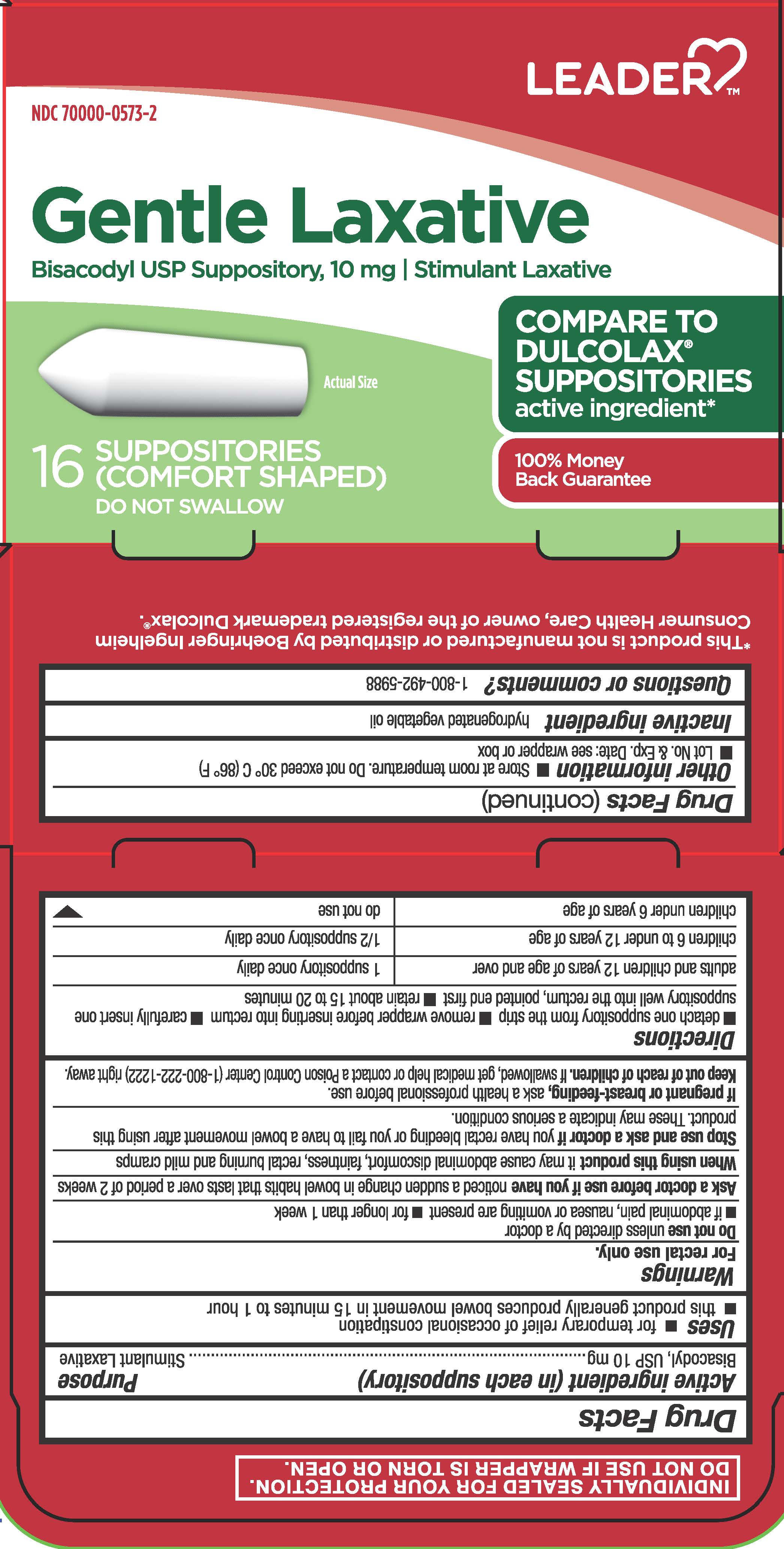
Uses for temporary relief of occasional constipation this product generally produces bowel movement in 15 minutes to 1 hour
⏱️Dosage and Administration64 words▾
Directions detach one suppository from the strip remove wrapper before inserting into rectum carefully insert one suppository well into the rectum, pointed end first retain about 15 to 20 minutes adults and children 12 years of age and over - 1 suppository once daily children 6 to under 12 years of age - 1/2 suppository once daily children under 6 - do not use
⚠️Warnings144 words▾
Warnings For rectal use only. Do not use unless directed by a doctor if abdominal pain, nausea or vomiting are present for longer than 1 week Ask a Doctor before use if you have noticed a sudden change in bowel habits that lasts over a perios of 2 weeks When using this product it may cause abdominal discomfort, faitness, rectal burning and mild cramps Stop use and ask a doctor if you have rectal bleeding or fail to have a bowel movement after using this product. These may indicate a serious condition.
If pregnant or breast feeding, ask a health professional before use. Keep out of reach of children. If swallowed, get medical help or contact a Poison Control Center (1-800-222-1222) right away.
Do not use unless directed by a doctor if abdominal pain, nausea or vomiting are present for longer than 1 week
🧪Active Ingredient8 words▾
Active ingredient (in each suppository) Bisacodyl USP, 10mg
🧪Inactive Ingredients5 words▾
Inactive ingredients hydrogenated vegetable oil
🎯Purpose3 words▾
Purpose Stimulant Laxative
No label section mentions that — try another word, or open the full label on DailyMed below.
Glossary — plain-language definitions of medical terms used in this label:
abdominal pain: Pain, cramping, or discomfort felt anywhere in the belly area.
Active ingredient: The part of a medicine that produces its intended effect on the body.
constipation: Having bowel movements less often than usual, or passing stools that are hard, dry, and difficult to move.
suppository: A solid form inserted into the rectum or vagina, where it melts and is absorbed.
Source: FDA Structured Product Labeling, mirrored from DailyMed / openFDA.
Prefer the government’s original formatting? View this label on DailyMed ↗
For educational and professional reference only — not medical advice. Pricing reflects published
NADAC and CMS ASP (free public data) and may differ from your acquisition cost; always verify before billing or dispensing.