
Lip Clear Lysine Plus Menthol, Unspecified Form 1 mg/g Ointment — NDC 70084-320-07 (Billing 70084-0320-07)
This is a package of Lip Clear Lysine Plus Menthol, Unspecified Form 1 mg/g Ointment from Quantum, Inc., marketed since Oct 1984 and currently FDA-listed. It is this product's only package size.
NDC database record
One package, one record: these facts belong to NDC 70084-320-07 alone.
- Record
- FDA NDC Directory package listing · Human OTC drug
- Code segments
- 70084 labeler · 320 product · 07 package
- Package marketed since
- Oct 1, 1984
- Sample package
- No — commercial package
- Listing certified through
- Dec 31, 2026
- Barcode (UPC-A, from the NDC)
- 3 7008432007 4
- FDA record last changed
- Jul 24, 2026
Identity & classification
Regulatory identifiers FDA, NLM and CMS codes for this package
- RxCUI (RxNorm): 1812680
Where does this data come from?
- FDA openFDA NDC Directory · synced Oct 8, 2026
- FDA label on DailyMed · label index refreshed Oct 8, 2026
- RxNorm (NLM RxNav) · catalog refreshed Oct 1, 2026
- Medi-Span GPI (licensed)
- First Databank (licensed) · refreshed Oct 8, 2026
Clinical
- Mostly for temporary relief of minor aches and pains in muscles and joints, like those from arthritis, backache, strains, sprains and bruises. Some products are for other things, s...
- It depends on the product. Many creams, gels and patches are limited to about 3 to 4 times a day, and patches also have a time limit, often 8 hours. Follow your product label and a...
- A brief burning feeling can happen when you first apply it and usually fades in several days. But if you get severe burning pain, swelling or blistering, stop using it and call you...
- No. Don't use menthol products with a heating pad, and avoid local heat or direct sunlight on the area. Rare cases of serious burns have been reported.
Patient education
Supplement & herbal interactions
Where does this data come from?
- MedlinePlus (NLM) · refreshed Oct 8, 2026
- FDA label on DailyMed · label index refreshed Oct 8, 2026
Ask a licensed pharmacist directly — free, answered by our team.
Pricing
A drug doesn't have one price. Each row is a different public payment system, and none is what you'd pay at the counter — that depends on your insurance. The ⓘ on each row explains what it measures.
| Price system | Per g | Per package |
|---|---|---|
| Retail pharmacies payNADAC · weekly | Not in the retail survey — common for institutional, discontinued, or low-volume packs. | |
| Medicaid paysCMS SDUD · 12 mo | No recent Medicaid claims on file for this NDC — rare and low-volume NDCs are suppressed in the public data. | |
| Medicare drug plans payPart D · quarterly | No Part D plan price is available for this NDC in our data. | |
Where does this data come from?
- CMS NADAC weekly file
- CMS ASP pricing files · refreshed Sep 20, 2026
- CMS Medicaid State Drug Utilization Data · refreshed Oct 8, 2026
- CMS Part D plan pricing files · refreshed Sep 24, 2026
- VA National Acquisition Center price file
Packaging — all sizes for this product
| Package NDC | Description | Marketing start | Marketing end | Status |
|---|---|---|---|---|
| 70084-0320-07 You're viewing this Main listing | 1 TUBE in 1 CARTON / 7 g in 1 TUBE | 1984-10-01 | — | Active |
Therapeutic equivalents
| Product | Labeler | Pack | NADAC/unit | TE | Status | Price vs. this |
|---|---|---|---|---|---|---|
| Lip Clear Lysine Plus 1 mg/gthis 70084-0320-07 | Quantum, | 1 tube | — | — | FDA listed | — |
Where does this data come from?
- FDA openFDA NDC Directory · synced Oct 8, 2026
- FDA Orange Book · refreshed Oct 3, 2026
- CMS NADAC weekly file
Availability & generic status
We did not find an FDA-approved generic match for this exact strength, form and route.
Where does this data come from?
- FDA Orange Book · refreshed Oct 3, 2026
What it looks like
Where does this data come from?
- FDA label on DailyMed · label index refreshed Oct 8, 2026
Inactive Ingredients / Excipients
Inactive ingredients, also called excipients, are components of the drug product other than the active ingredient. They may include fillers, dyes, coatings, preservatives, flavors, or other formulation ingredients.
🧪 Avoiding an ingredient? See Menthol inactive ingredients by manufacturer: every current product's list side by side, so you can ask your pharmacy for the version that does not list it.
💡 Tap an ingredient (hover on desktop) to see what it is and why it’s used.
-
UNII H4N855PNZ1
Alpha-tocopherol is a form of vitamin E, a fat-soluble antioxidant derived from natural or synthetic sources. In medicines, it prevents oils and fats from breaking down and becoming rancid, protecting the product's stability and shelf life.
-
UNII GK21SBA74R
Benzoin resin is a natural plant-derived gum obtained from trees. It acts as a binder to hold tablet ingredients together and may help preserve the medicine by resisting spoilage.
-
UNII P0M7O4Y7YD
A plant extract from calendula flowers, traditionally used in formulations. It typically serves as a botanical ingredient that may provide color, fragrance, or skin-conditioning properties to topical products.
-
UNII 1C6V77QF41
Cholecalciferol is vitamin D3, a fat-soluble vitamin added to medicines as a nutritional supplement or active ingredient fortification. It helps the body absorb calcium and support bone health.
-
UNII QI7G114Y98
Echinacea purpurea is a dried plant extract from the purple coneflower. It's included in some formulations as a botanical ingredient to support the product's intended benefits, though it serves no structural role like binding or coating.
-
UNII ZW3Z11D0JV
A plant extract from goldenseal root, used as a natural colorant and flavoring agent in some medicines. It may also have mild preservative properties in certain formulations.
-
UNII Y9H1V576FH
Honey is a natural sweetener made by bees from flower nectar. In medicines, it adds sweetness to improve taste and may help soothe throat irritation in lozenges or syrups.
-
UNII JNJ23Q2COM
Lysine hydrochloride is an amino acid salt used in medicines as a buffer and pH stabilizer. It helps maintain the acidity level of the product to keep the active ingredient stable and effective.
-
UNII 5O59RMR6DU
A natural essential oil extracted from Melaleuca cajuputi tree leaves. Used in medicines as a flavor, fragrance, and skin-soothing agent in topical and oral formulations.
-
UNII 6UYK2W1W1E
A natural oil extracted from olives. It acts as an emollient and lubricant in formulations, helping to soften ingredients and improve how the medicine spreads or flows.
-
UNII 6Y8XYV2NOF
A waxy substance made by honeybees from plant resins and pollen. In medicines, it acts as a binder and coating agent to hold ingredients together and protect the product.
-
UNII VIF565UC2G
Tea tree oil is an essential oil extracted from the leaves of the Australian tea tree plant. In medicines, it typically serves as a flavoring agent, fragrance, or antimicrobial component in topical formulations.
-
UNII 1D1K0N0VVC
A fat-soluble form of vitamin A used as a colorant and nutritional fortification ingredient. It gives products a yellow or orange tint and increases vitamin A content in the formula.
-
UNII 2ZA36H0S2V
Beeswax is a natural wax produced by honeybees. In medicines, it works as a coating agent and thickener to control how fast the drug dissolves and improve the product's texture and appearance.
-
UNII SOI2LOH54Z
Zinc oxide is a white mineral powder used in medicines as a protective barrier agent and color additive. It helps shield skin in topical products and may also serve as a filler or opacifying ingredient.
15 inactive ingredients listed in the exact product block matched to this NDC.
Label-section wording can be broader than the structured product block and may mention additional formulation ingredients.
Where does this data come from?
ingredient classCode="IACT" elements from the exact product block matched by this NDC. Label-section narrative from DailyMed / the openFDA label index is shown separately when available.- FDA label on DailyMed · label index refreshed Oct 8, 2026
- FDA openFDA NDC Directory · synced Oct 8, 2026
Inactive ingredient FAQ
Are inactive ingredients the same for every manufacturer?
Why might an inactive ingredient be missing?
Can inactive ingredients matter?
Manufacturer & labeler
More NDCs from Quantum, Inc. labeler code 70084
- Lip Clear Lysine Plus Coldstick Octinoxate and Oxybenzone 70 mg/g; 50 mg/g Lipstick NDC 70084-210-01
- Super Lysine Plus Coldstick Octinoxate and Oxybenzone 70 mg/g; 50 mg/g Lipstick NDC 70084-220-01
- Super Lysine Plus Tangerine Lip Treatment Octinoxate and Oxybenzone 70 mg/g; 50 mg/g Lipstick NDC 70084-230-01
- Super Lysine Plus Strawberry Lip Treatment Octinoxate and Oxybenzone 70 mg/g; 50 mg/g Lipstick NDC 70084-240-01
- Canker Care Plus Menthol, Unspecified Form 5 mg/mL Liquid NDC 70084-500-01
- Athletes Foot Tolnaftate 10 mg/g Cream NDC 70084-510-01
- Quantum Health Meyer Lemon and Honey Flavor Menthol, Unspecified Form 5 mg Lozenge NDC 70084-605-18
- Quantum Health Bing Cherry Flavor Menthol, Unspecified Form 5 mg Lozenge NDC 70084-610-18
- Scar Reducer Intensive Herbal and Nutrient Allantoin 1 g/100g Cream NDC 70084-710-01
- Buzz Away Sting Soothe Menthol 5 mg/mL Liquid NDC 70084-810-01
Where does this data come from?
- FDA openFDA NDC Directory · synced Oct 8, 2026
- Drugs@FDA
FDA label — Drug Facts FDA SPL
🎯 Indications and Usage ▾
Uses Relieves tingling, itching, burning, blistering and pain associated with cold sores/fever blisters. / Véase folleto para más información
⏱️ Dosage and Administration ▾
Directions For adults and children 2 and older. Apply liberally as needed. For best results, apply every two hours. Wash hands before and after applying. / Para adultos y niños mayores de dos años. Aplíquese abundantemente según la necesidad. Para mejores resultados repita la aplicación cada dos horas. Lávese las manos antes y después de cada aplicación.
⚠️ Warnings ▾
Warnings For external use only When using this product do not get into eyes. Stop use and ask a doctor if condition worsens symptoms last more than 7 days or clear up and occur again Keep out of reach of children. If swallowed get medical help or contact a Poison Control Center right away.
📦 Storage and Handling ▾
Other Information store at room temperature and avoid excessive heat close cover tightly after each use
🧪 Active Ingredient ▾
Active Ingredient Menthol 0.1%
🧪 Inactive Ingredients ▾
Inactive Ingredients Beeswax, Calendula officinalis extract, Echinacea Purpurea Extract, Gum benzoin tincture, Honey, Hydrastis Canadensis (Goldenseal) Leaf, Lysine, Melaleuca alternifolia oil, Melaleuca cajuputi oil, Olea Europaea (Olive) fruit oil, Propolis extract, Vitamin A (Retinyl palmitate), Vitamin D3, Vitamin E (Tocopherol), Zinc Oxide.
🎯 Purpose ▾
Purpose Cold sore / fever blister treatment / Tratamiento para las ampollas labiales y los herpes labial
📄 When Using This Product ▾
When using this product do not get into eyes.
📄 Stop Use and Ask a Doctor If ▾
Stop use and ask a doctor if condition worsens symptoms last more than 7 days or clear up and occur again
📄 Keep Out of Reach of Children ▾
Keep out of reach of children. If swallowed get medical help or contact a Poison Control Center right away.
📄 Package Label / Principal Display Panel ▾
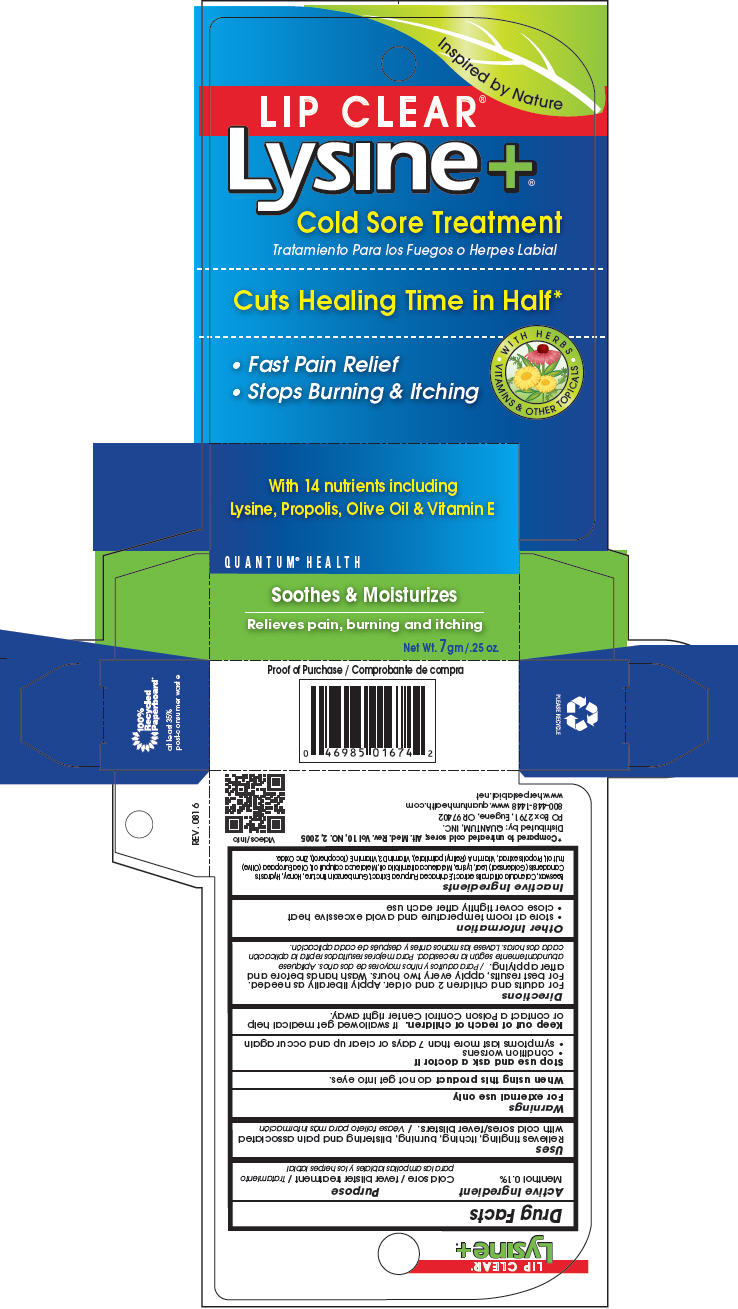
PRINCIPAL DISPLAY PANEL - 7 gm Tube Carton Inspired by Nature LIP CLEAR ® Lysine+ ® Cold Sore Treatment Cuts Healing Time in Half* WITH HERBS VITAMINS & OTHER TOPICALS Fast Pain Relief Stops Burning & Itching With 14 nutrients including Lysine, Propolis, Olive Oil & Vitamin E QUANTUM ® HEALTH Soothes & Moisturizes Relieves pain, burning and itching Net Wt. 7 gm /.25 oz. PRINCIPAL DISPLAY PANEL - 7 gm Tube Carton
About this NDC listing & data coverage
What data is (and isn’t) available for this NDC — tap to expand
| NDC identity (package / product / labeler codes) | ✓ Available |
| Labeler | ✓ Available |
| Product & package description | ✓ Available |
| Marketing category & status | ✓ Available |
| Active ingredient / dosage form / route | ✓ Available |
| FDA label (SPL via DailyMed) | ✓ Available |
| Package photos | ✓ Available |
| Inactive ingredients (structured) | ✓ Available |
| NADAC pharmacy acquisition price (CMS) | — Not published for this NDC CMS publishes NADAC only for NDCs reported in its retail-pharmacy survey. |
| Orange Book / therapeutic-equivalence data | — Not published for this NDC Applies only to products approved under an NDA/ANDA; many listings are out of scope. |
| HCPCS J-code billing crosswalk | — Not published for this NDC Most self-administered / retail products have no J-code — that is normal. |
| Medicaid utilization (CMS SDUD) | — Not published for this NDC CMS reports utilization only for NDCs with Medicaid claims above its privacy threshold. |