
HomeNDC LookupIngredientsMethyl Salicylate › 70211-0704-33
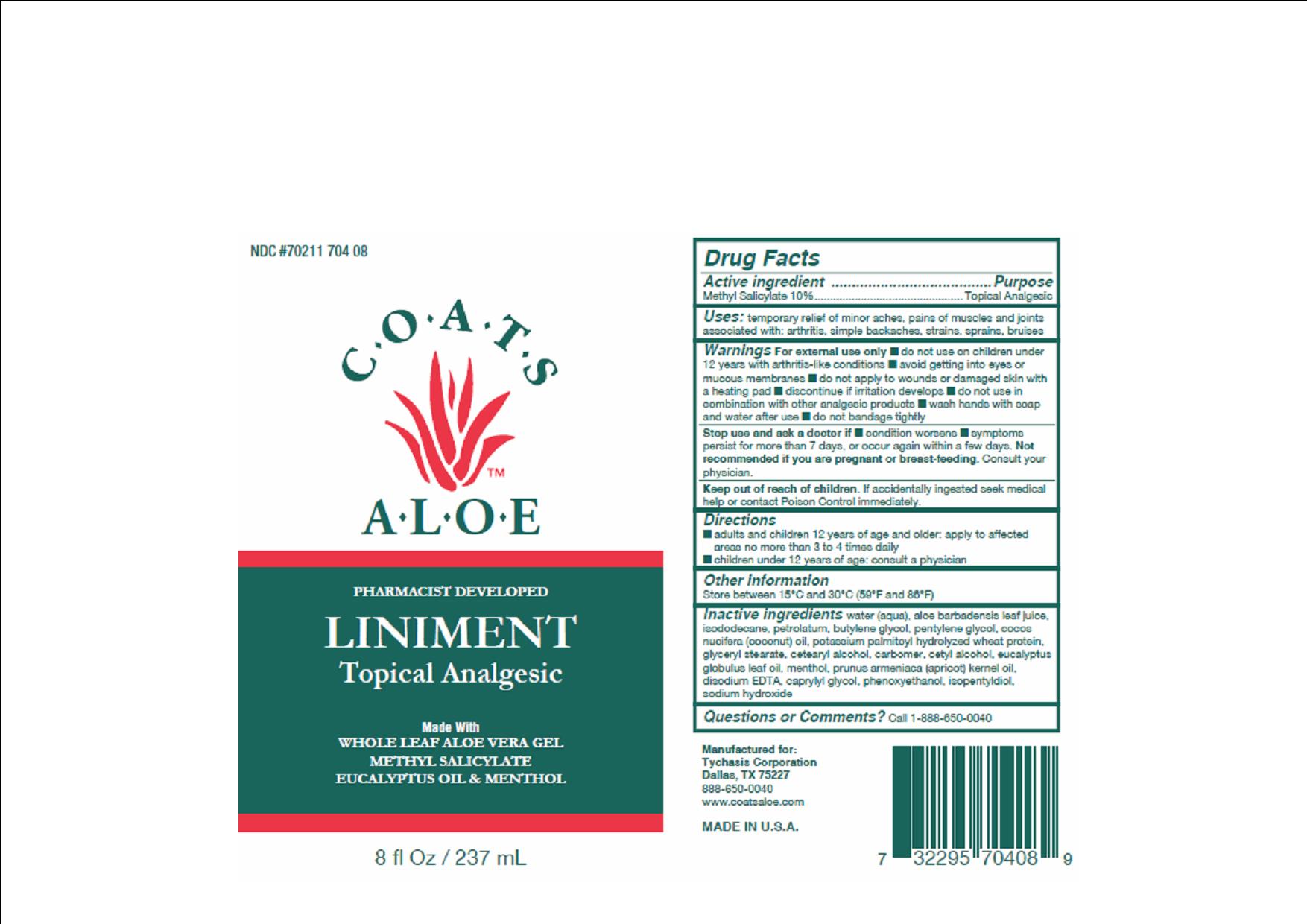
COATS ALOE ANALGESIC METHYL SALICYLATE 10 g/100mL Lotion, 976 mL — NDC 70211-0704-33 package photo

COATS ALOE ANALGESIC METHYL SALICYLATE 10 g/100mL Lotion, 976 mL

by TYCHASIS CORPORATION · 976 mL in 1 BOTTLE, DISPENSING (70211-704-33)
NDC 70211-0704-33
🏷️ FDA NDC (as labeled) 70211-704-33 billing pads the product segment with a zero
This package
Contains976 mL Pack sizes2 compare ↓
Also comes in: 237 ml 70211-0704-08
OTC Discontinued Non-controlled ⚠ Inactivated by FDA
🗂️ Data synced Aug 3, 2026 · sources: openFDA · FDA label (DailyMed) · FDA Orange & Purple Book · First Databank · CMS NADAC, ASP, Medicare & Medicaid · RxNorm
📋 All sources & update times →
⚠️
Excluded from the active FDA NDC Directory. FDA inactivated this product’s listing record, so it is excluded from the active NDC Directory. The listing was last certified through Dec 2025. A label may still appear on DailyMed, but the NDC is no longer in the current FDA NDC Directory. Search the FDA NDC Directory ↗

🆔 Identity & classification

FDA NDC (as labeled) 70211-704-33
Product NDC 70211-704
11-digit billing NDC 70211070433
NCPDP billing unit ML — per mL (volume)
Application # M017
SPL Set ID 2392751d-4025-3a1d-e054-00144ff88e88
DEA schedule Non-controlled
Marketing category OTC MONOGRAPH FINAL
Marketing status Discontinued
FDA listing status Inactivated by FDA (certified through Dec 2025)
Route TOPICAL
Dosage form LOTION
Substance METHYL SALICYLATE
GPI-14 90800050004110
GCN Seq No 075304
GCN 40346
HICL code 042914
Ingredient (HICL) M-Salicy/Aloe/Menthol/Eucalypt
HIC1 code L
Therapeutic class — broad (HIC1) Skin/Subcutaneous Tissue
HIC2 code L6
Therapeutic class — intermediate (HIC2) Irritants
HIC3 code L6A
Therapeutic class — specific (HIC3) Irritants/Counter-Irritants
AHFS code 84:24.04.00
AHFS class Basic Lotions And Liniments
FDB label name COATS ALOE ANALGESIC LINIMENT
FDB brand name Coats Aloe Analgesic
Legend status O — Over-the-counter (OTC) drug or device
Why two NDCs? The FDA registers this code as 70211-704-33 — a 5-3-2 layout, and that's what's printed on the package and shown on DailyMed. For insurance claims, every NDC is standardized to a uniform 11-digit 5-4-2 format by adding a zero to the product segment → 70211-0704-33. Same drug, same package — only the format differs.
Where does this data come from?
Identifiers from the FDA openFDA NDC Directory and Structured Product Labeling; RxCUI from RxNorm (NLM); GPI from Medi-Span; GCN / HIC / AHFS / legend from First Databank.

🏭 Manufacturer & labeler

LabelerTYCHASIS CORPORATION
FDA applicationM017 (OTC MONOGRAPH FINAL)
Labeler code70211
Product typeHuman Otc Drug
The labeler markets the product; the application holder owns the FDA approval. They’re often the same company but can differ (e.g. a repackager or an authorized generic). A mailing address / phone appears here when the manufacturer includes it in the product’s FDA label (not all do).
Where does this data come from?
Labeler, application holder and registered establishment from the FDA openFDA NDC Directory and Drugs@FDA; address/contact from the product’s FDA label.

🩺 Clinical

Label name COATS ALOE ANALGESIC LINIMENT Ingredient M-Salicy/Aloe/Menthol/Eucalypt
📗 Our plain-language guide HelloPharmacist
  • It's a topical pain reliever — you apply it right to the skin where it hurts. It's used for temporary relief of minor aches and pains in your muscles and joints, things like arthri...
  • What is methyl salicylate actually used for?
  • No — and this is really important. You should never use methyl salicylate products with a heating pad, and avoid applying them when you're sweating from exercise or heat. Heat caus...
  • Is it safe to use under a heating pad or wrap?
📖 Read our full Methyl Salicylate guide →
Where does this data come from?
Plain-language summary from MedlinePlus (U.S. National Library of Medicine); supplement & herbal interactions and nutrient depletion data from the Natural Medicines database; our full guide is HelloPharmacist editorial content.

💊 What it looks like

Color white
One label can cover several strengths, so colors may be combined — always confirm a loose pill against the dispensed prescription label or a pharmacist.
Where does this data come from?
Physical description (imprint, shape, color, scoring, coating) from this product’s FDA Structured Product Labeling (SPL), mirrored from DailyMed / openFDA.

🧪 Inactive Ingredients / Excipients

Inactive ingredients, also called excipients, are components of the drug product other than the active ingredient. They may include fillers, dyes, coatings, preservatives, flavors, or other formulation ingredients.

💡 Tap an ingredient (hover on desktop) to see what it is and why it’s used.

  • UNII ZY81Z83H0X
    Aloe vera leaf is a plant extract derived from the aloe plant. It is used in medicines as a natural moisturizer and skin-soothing agent in topical formulations.
  • UNII 54JB35T06A
    A natural oil extracted from apricot pits, used as an emollient and lubricant in topical products. It helps soften the skin and improves the texture and spreadability of creams and lotions.
  • UNII 3XUS85K0RA
    Butylene glycol is a clear liquid derived from petroleum or plants that acts as a humectant, solvent, and preservative booster in medicines. It helps keep formulations stable, dissolve active ingredients, and maintain moisture in topical products.
  • UNII 00YIU5438U
    Caprylyl glycol is a clear liquid derived from coconut oil. In medicines, it acts as a humectant to retain moisture, a preservative booster to prevent microbial growth, and a solvent to help dissolve or mix other ingredients.
  • UNII 936JST6JCN
    Cetyl alcohol is a waxy, fatty substance derived from plant or animal sources. It acts as an emulsifier and thickener in medicines, helping blend oil and water components and giving products a smooth, creamy texture.
  • UNII Q9L0O73W7L
    Coconut oil is a natural fat extracted from coconut fruit. It's used in medicines as a lubricant, emollient, or carrier to help dissolve or deliver active ingredients smoothly through the formulation.
  • UNII 2R04ONI662
    Eucalyptus oil is a fragrant liquid extracted from eucalyptus tree leaves. It's used in medicines as a flavor, scent, or soothing agent in topical products and cough preparations.
  • UNII FCZ5MH785I
    A waxy substance made from glycerin and stearic acid. It works as an emulsifier to help mix oil and water ingredients together, and as a thickener to give the medicine its proper texture and consistency.
  • UNII J2S07SB0YL
    A protein derived from wheat that has been broken down into smaller pieces using enzymes. It's used in formulations as a film-former and texturizer to help bind ingredients together and improve product consistency.
  • UNII 19NOL5474Q
    Isopentyldiol is a synthetic alcohol derived from isoprene. It functions as a humectant and solvent in formulations, helping to retain moisture and dissolve or suspend active ingredients.
  • UNII L7T10EIP3A
    A cooling compound from mint plants used as a flavoring agent and to create a fresh sensation in medicines. It helps mask bitter tastes and improve how the product feels in the mouth.
  • UNII 50C1307PZG
    Pentylene glycol is a humectant and preservative helper derived from petroleum or plant sources. It draws moisture into the product and helps prevent bacterial growth, keeping medicines stable during storage.
  • UNII 4T6H12BN9U
    Petrolatum is a purified mineral oil-based jelly derived from petroleum. In medicines, it acts as an emollient, lubricant, and moisture barrier to soften skin, reduce friction, and help prevent water loss from formulations.
  • UNII HIE492ZZ3T
    Phenoxyethanol is a synthetic preservative and antimicrobial agent used to prevent bacterial and fungal growth in medicines and cosmetic products, extending shelf life and maintaining product safety.
  • UNII 55X04QC32I
    A strong alkaline chemical used to adjust and maintain the pH balance of liquid medicines. It helps keep the medicine stable and ensures it stays effective during storage.
  • UNII 059QF0KO0R
    Water is a liquid solvent that dissolves and mixes ingredients together in liquid medicines, syrups, and injections. It helps distribute the active drug evenly throughout the product.

16 inactive ingredients listed in the exact product block matched to this NDC.

The official label also statesaloe barbadenesis leaf juice, butylene glycol, caprylyl glycol, carbomer, cetearyl alcohol, cetyl alcohol, coconut oil, disodium EDTA, eucalyptus leaf oil, glyceryl stearate, isododecane, isopentylidiol, menthol, pentylene glycol, petrolatum, phenoxyethanol, potassium palmitol hydrolyzed wheat protein, apricot kernel oil, sodium hydroxide, water

Label-section wording can be broader than the structured product block and may mention additional formulation ingredients.

Where does this data come from?
Data sourced from official FDA Structured Product Labeling (SPL) via DailyMedingredient classCode="IACT" elements from the exact product block matched by this NDC. Label-section narrative from DailyMed / the openFDA label index is shown separately when available.

Inactive ingredient FAQ

Are inactive ingredients the same for every manufacturer?
No. Inactive ingredients can differ by manufacturer, dosage form, strength, and package / product version.
Why might an inactive ingredient be missing?
Some SPLs do not provide a complete structured inactive-ingredient list, and older or unusual labels may only include the information in narrative text.
Can inactive ingredients matter?
Yes. They can matter for allergies, intolerances, dyes, gluten / lactose concerns, preservatives, and formulation differences — but confirm with a pharmacist or the manufacturer when it’s clinically important.

💲 Pricing

A drug doesn't have one price. Each row is a different public payment system, and none is what you'd pay at the counter — that depends on your insurance. The ⓘ on each row explains what it measures.

Price systemPer gPer package
Retail pharmacies payNADAC · weekly Not in the retail survey — common for institutional, discontinued, or low-volume packs.
Medicaid paysCMS SDUD · 12 mo No recent Medicaid claims on file for this NDC — rare and low-volume NDCs are suppressed in the public data.
Medicare drug plans payPart D · quarterly No Part D plan price is available for this NDC in our data.
ℹ️
No price is published for this exact package yet. CMS surveys NADAC per package size, so a different pack of the same drug often has one.
Try another pack size: 237 ml
Where does this data come from?
NADAC (National Average Drug Acquisition Cost) is the CMS weekly pharmacy-acquisition-cost survey — what pharmacies pay. ASP (Average Sales Price) is the CMS Medicare Part B drug-payment file, published quarterly. Medicaid pays is computed by us from CMS State Drug Utilization Data (total reimbursed ÷ units, trailing 12 months) — gross of rebates and inclusive of dispensing fees, so it reflects what Medicaid paid, not an acquisition cost. Medicare drug plans pay is the median negotiated point-of-sale unit cost across plans listing this NDC in the CMS quarterly Prescription Drug Plan pricing files, before rebates. The VA pays is the federal contract price (FSS, and the statutory Big 4 ceiling where listed) from the VA National Acquisition Center pharmaceutical price file. All are free public government data; each measures a different payer, so the figures are not directly comparable.

🔁 Therapeutic equivalents

ProductLabelerPackNADAC/unitTEStatusPrice vs. this
Coats Aloe Analgesic 10 g/100mLthis 70211-0704-33 TYCHASIS 976 ml Discontinued
About this product: other versions of the same ingredient, strength and form are listed above, least expensive first, with FDA equivalence ratings where available.
Where does this data come from?
Equivalents are other NDCs of the same ingredient, form and route from the openFDA NDC Directory, ranked least-expensive-first by NADAC. Therapeutic-equivalence (AB) ratings come from the FDA Orange Book; biologics use the FDA Purple Book for biosimilar & interchangeable status.

Availability & generic status

📍
2026
Currently FDA-listed
listed with the FDA
🔒
·
No generic listed yet
brand only
ℹ️No FDA-approved generic found

We did not find an FDA-approved generic match for this exact strength, form and route.

Where does this data come from?
Patents and exclusivity from the FDA Orange Book (small-molecule drugs), refreshed from public FDA data. Generic launch timing is an estimate, not a guarantee.

📦 Packaging — all sizes for this product

Package NDCDescription Marketing startStatus
70211-0704-08 237 mL in 1 BOTTLE, DISPENSING (70211-704-08) 2015-11-02 Inactivated by FDA
70211-0704-33 You're viewing this 976 mL in 1 BOTTLE, DISPENSING (70211-704-33) 2015-11-02 Inactivated by FDA

You're viewing the largest of 2 pack sizes for this product.

Pack size FAQ

What quantity is in NDC 70211-0704-33?
NDC 70211-0704-33 contains 976 mL — 976 ml in 1 bottle, dispensing.
What is the difference between NDC 70211-0704-33 and NDC 70211-0704-08?
Both are COATS ALOE ANALGESIC METHYL SALICYLATE 10 g/100mL Lotion — the drug itself is identical. NDC 70211-0704-33 is the 976 mL package, while NDC 70211-0704-08 is the 237 ml package.
What NDC number is used to bill for this package of COATS ALOE ANALGESIC METHYL SALICYLATE 10 g/100mL Lotion?
Bill NDC 70211-0704-33 — the 11-digit billing format is 70211070433. Pharmacy and medical claims use the 11-digit form; the FDA label may print a shorter form of the same code.

🧭 About this NDC listing & data coverage

Over-the-counter (OTC) product No longer marketed (per FDA listing data)
What data is (and isn’t) available for this NDC — tap to expand
NDC identity (package / product / labeler codes) ✓ Available
Labeler ✓ Available
Product & package description ✓ Available
Marketing category & status ✓ Available
Active ingredient / dosage form / route ✓ Available
FDA label (SPL via DailyMed) ✓ Available
Package photos ✓ Available
Inactive ingredients (structured) ✓ Available
NADAC pharmacy acquisition price (CMS) — Not published for this NDC CMS publishes NADAC only for NDCs reported in its retail-pharmacy survey.
Orange Book / therapeutic-equivalence data — Not published for this NDC Applies only to products approved under an NDA/ANDA; many listings are out of scope.
HCPCS J-code billing crosswalk — Not published for this NDC Most self-administered / retail products have no J-code — that is normal.
Medicaid utilization (CMS SDUD) — Not published for this NDC CMS reports utilization only for NDCs with Medicaid claims above its privacy threshold.
“Not published” reflects what the public FDA / CMS / NLM sources provide for this exact package code — it is a property of the data feeds, not a judgment about the product.

Questions about this listing

Is this NDC FDA-approved?
An NDC listing does not by itself establish FDA approval — the NDC Directory records that a product is listed with FDA, not that it was reviewed and approved. This listing's marketing category is "Otc Monograph Final". Products approved under an application carry an NDA, ANDA, or BLA number.
Why is there no price listed?
The pricing shown on our NDC pages comes from CMS NADAC, a voluntary survey of retail community pharmacy invoices. CMS does not publish a NADAC for every NDC — packages outside the retail survey (institutional and hospital products, bulk packages, discontinued items, and many OTC items) may never receive one. A missing price reflects the survey's scope, not this product's actual cost, and does not mean the product is free or unavailable.
What does the discontinued status mean for this NDC?
The labeler reported a marketing end date (or the listing was delisted), so this specific package is no longer actively marketed. Remaining stock may still be dispensed for a time, and the NDC stays valid for historical records and claims — but data feeds (pricing, labeling) typically stop updating for it. Other package sizes or other manufacturers' versions of the same medication may still be marketed — see the equivalents section where available.
Is the NDC printed on the package the same as the 11-digit billing NDC?
Yes, they identify this exact package in different formats. The FDA registers it as 70211-704-33, which is what is printed on the packaging and shown on DailyMed. Insurance claims use a fixed 11-digit 5-4-2 format, so the short segment is padded with a leading zero: 70211-0704-33, written without dashes as 70211070433. The Identity section at the top of this page lists every form of this code.
What do the three segments of this NDC mean?
In 70211-0704-33, the first segment (70211) is the labeler code FDA assigned to TYCHASIS CORPORATION; the middle segment (0704) identifies this specific product — its ingredient, strength, and dosage form; and the last segment (33) identifies this exact package size and type. Together they name one specific package of one specific product.
Does this product come in other package sizes?
Yes — the FDA directory lists 1 other package presentation of this same product, including 237 ml (70211-0704-08). Each has its own NDC and its own page — see the package list near the top of this page.
Who lists this product with the FDA?
TYCHASIS CORPORATION is the labeler of record for this NDC — the company under whose FDA-assigned code the package is listed. The labeler may be the manufacturer itself or a distributor marketing the product under its own code.
Do I need a prescription for this product?
This NDC is listed with FDA as an over-the-counter product, so it does not require a prescription. Follow the package directions, and ask your pharmacist if you are unsure whether it is right for you.
This page identifies an FDA-listed package (the NDC) and reports public regulatory and pricing data about the listing. It is reference information, not a medical recommendation — talk to your pharmacist or prescriber about your own medication.
Where does this data come from?
Listing facts (marketing category, packager status, marketing dates) from the FDA openFDA NDC Directory; label availability from DailyMed; pricing coverage from CMS NADAC; equivalence scope from the FDA Orange Book.

📄 FDA label — Drug Facts FDA SPL

The complete FDA label for this product — the official Drug Facts labeling, verbatim, section by section. Jump with a chip, search within the label, or expand everything.
🎯 Indications and Usage 22 words

Indications and Usage: Temporary relief of minor aches and pains of muscles and joints associated with: arthritis simple backaches strains sprains bruises

⏱️ Dosage and Administration 29 words

Directions: Adults and children 12 years of age and older: Apply to affected areas no more than 3-4 times daily. Children under 12 years of age: Consult a physician.

⚠️ Warnings 40 words

Warnings: For external use only. Avoid contact with eyes or mucous membranes. Do not apply to wounds or damaged skin with a heating pad. Discontinue if irritation develops. Wash hands with soap and water after use. Do not banadage tightly.

📦 Storage and Handling 18 words

Other information: Store between 15 o C and 30 o C (59 o F and 86 o F).

🧪 Active Ingredient 5 words

Active Ingredient: Methyl Salicylate 10%

🧪 Inactive Ingredients 42 words

Inactive Ingredients: aloe barbadenesis leaf juice, butylene glycol, caprylyl glycol, carbomer, cetearyl alcohol, cetyl alcohol, coconut oil, disodium EDTA, eucalyptus leaf oil, glyceryl stearate, isododecane, isopentylidiol, menthol, pentylene glycol, petrolatum, phenoxyethanol, potassium palmitol hydrolyzed wheat protein, apricot kernel oil, sodium hydroxide, water

🎯 Purpose 9 words

Purpose: Topical analgesic, topical pain relief for intact skin.

Source: FDA Structured Product Labeling, mirrored from DailyMed / openFDA. Prefer the government’s original formatting? View this label on DailyMed ↗
For educational and professional reference only — not medical advice. Pricing reflects published NADAC and CMS ASP (free public data) and may differ from your acquisition cost; always verify before billing or dispensing.