
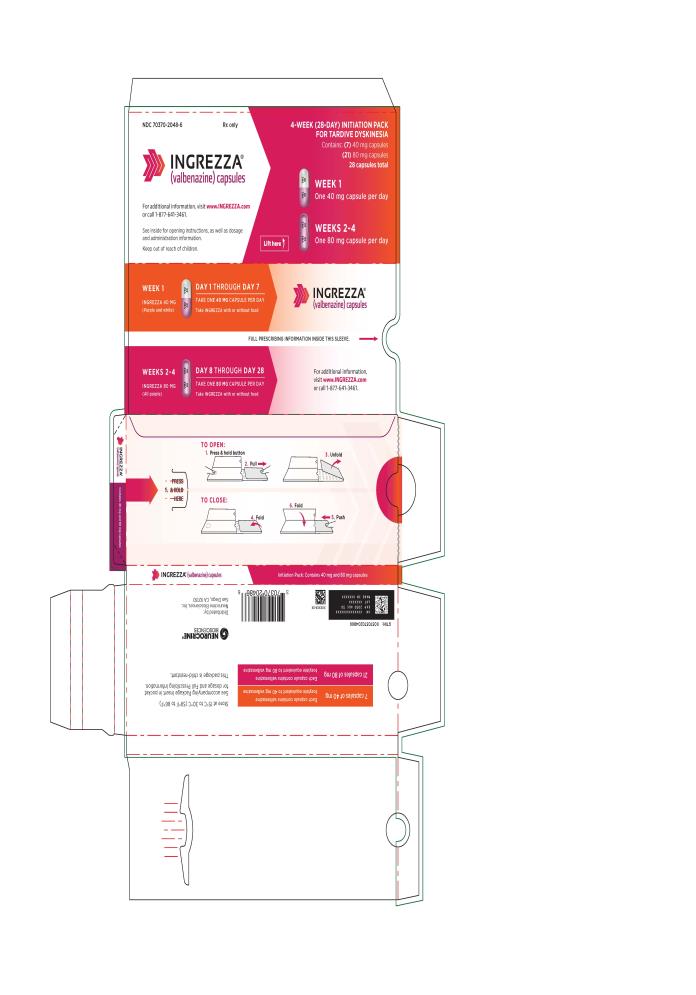
INGREZZA Valbenazine Kit, 1 kit — NDC 70370-2048-6 (Billing 70370-2048-06)
This is a package of 1 kit of INGREZZA Valbenazine Kit from Neurocrine Biosciences, Inc., marketed since Dec 2018 and currently FDA-listed. It is this product's only package size.
NDC database record
One package, one record: these facts belong to NDC 70370-2048-6 alone.
- Record
- FDA NDC Directory package listing · Human prescription drug
- Code segments
- 70370 labeler · 2048 product · 6 package
- Package marketed since
- Dec 14, 2018
- Sample package
- No — commercial package
- Listing certified through
- Dec 31, 2027
- Billing quantity
- 1 EA per package
- Barcode (UPC)
- 0370370408011, 0370370404013, 0370370204019, 0370370108010 +2 more
- Medicaid fills, this package
- 86 prescriptions in the last four reported quarters
- FDA record last changed
- Jul 24, 2026
Identity & classification
Regulatory identifiers FDA, NLM and CMS codes for this package
Drug-database identifiers Medi-Span GPI and First Databank GCN / HICL / AHFS classification
- GSN (GCN sequence number): 079676
- GCN: 46216
- GPI-14 (Medi-Span): 6238008020B220
- HICL (First Databank): 044202
- AHFS class code: 28:56.00.00
- RxCUI (RxNorm): 1918224
Where does this data come from?
- FDA openFDA NDC Directory · synced Oct 8, 2026
- FDA label on DailyMed · label index refreshed Oct 8, 2026
- RxNorm (NLM RxNav) · catalog refreshed Oct 1, 2026
- Medi-Span GPI (licensed)
- First Databank (licensed) · refreshed Oct 8, 2026
RxNorm drug class
This medicine belongs to the Vesicular Monoamine Transporter 2 Inhibitor class.
Where does this data come from?
- RxClass (NLM) · catalog refreshed Oct 1, 2026
Clinical
Valbenazine is used to treat tardive dyskinesia (uncontrollable movement of the face, tongue, or other body parts) and chorea (sudden movements that you cannot control) caused by Huntington's disease (an inherited disease that causes the progressive breakdown of nerve cells in the brain). Valbenazine is in a class of medications called vesicular monoamine transporter 2 (VMAT2) inhibitors. It works by changing the activity of certain natural substances in the brain.
Read the full MedlinePlus article ↗- It treats two conditions in adults: tardive dyskinesia, which causes uncontrolled movements, and chorea from Huntington’s disease. It helps with movement symptoms. It is not a trea...
- You take it by mouth once a day, with or without food. Follow your prescriber’s dosing plan, since the dose is often adjusted over time. If you have Ingrezza Sprinkle, you can open...
- Sleepiness is the most common. Some people also have fatigue, restlessness, dry mouth, dizziness, headache or nausea. Don’t drive until you know how it affects you.
- Call for swelling of the face, lips or throat, trouble breathing, or hives. Also call for new or worsening depression, suicidal thoughts, or unusual behavior changes. High fever wi...
Patient education
Supplement & herbal interactions
Some supplements/herbs that may interact with Valbenazine Tosylate — tap one for details:
Where does this data come from?
- MedlinePlus (NLM) · refreshed Oct 8, 2026
- FDA label on DailyMed · label index refreshed Oct 8, 2026
Ask a licensed pharmacist directly — free, answered by our team.
Pricing
A drug doesn't have one price. Each row is a different public payment system, and none is what you'd pay at the counter — that depends on your insurance. The ⓘ on each row explains what it measures.
| Price system | Per each | Per package |
|---|---|---|
| Retail pharmacies payNADAC · weekly | Not in the retail survey — common for institutional, discontinued, or low-volume packs. | |
| Medicaid paysCMS SDUD · 12 mo | $310.45 | $310.45 / 1 kit |
| Medicare drug plans payPart D · Q2 2026 | $315.20 | $315.20 / 1 kit |
Where does this data come from?
- CMS NADAC weekly file
- CMS ASP pricing files · refreshed Sep 20, 2026
- CMS Medicaid State Drug Utilization Data · through Q1 2026
- CMS Part D plan pricing files · refreshed Sep 24, 2026
- VA National Acquisition Center price file
Packaging — all sizes for this product
| Package NDC | Description | Marketing start | Marketing end | Status |
|---|---|---|---|---|
| 70370-2048-06 You're viewing this Main listing | 1 BLISTER PACK in 1 CARTON / 1 KIT in 1 BLISTER PACK | 2018-12-14 | — | Active |
Therapeutic equivalents
| Product | Labeler | Pack | NADAC/unit | TE | Status | Price vs. this |
|---|---|---|---|---|---|---|
| Ingrezza 70370-2046-01 | Neurocrine | 1 kit | — | AB | FDA listed | — |
| Ingrezzathis 70370-2048-06 | Neurocrine | 1 kit | — | AB | FDA listed | — |
Where does this data come from?
- FDA openFDA NDC Directory · synced Oct 8, 2026
- FDA Orange Book · refreshed Oct 3, 2026
- CMS NADAC weekly file
Availability & generic status
The FDA lists approved generic versions of this medicine, but that does not always mean a pharmacy can get one today. Patent rules, launch agreements, supply and pricing can affect when generics actually arrive.
Why the date isn’t exact: Generic timing can change because patents may be challenged, settled, licensed, added, removed, or worked around with a narrower label — and FDA approval does not always mean a pharmacy can get the generic today.
🛈 What do these terms mean?
- Patent
- Legal protection listed in the Orange Book that may delay generic approval or launch. Issued by the U.S. Patent & Trademark Office.
- Substance patent
- Covers the active drug molecule itself — the hardest to design around. A generic generally can’t launch until it expires.
- Formulation (product) patent
- Covers a specific formulation or dosage form. A generic can sometimes work around it with a different formulation.
- Method-of-use patent
- A patent covering one specific approved use of the drug — not necessarily the whole molecule. A generic can sometimes launch with a “skinny label” that carves out the protected use and keeps the others.
- Skinny label
- A generic label that omits a still-patented use when the FDA allows it — letting a generic reach the market for the unprotected uses.
- Exclusivity
- FDA-granted marketing protection, separate from patents — e.g. 5-yr new chemical entity, 7-yr orphan drug, or a +6-month pediatric extension.
- Paragraph IV
- A generic applicant’s formal challenge to a listed patent. It can potentially lead to earlier generic entry, but often involves litigation or a settlement.
- RLD / RS
- Reference Listed Drug — the brand product the FDA uses as the reference for generic applications. Reference Standard — the product the FDA expects generics to compare against in bioequivalence testing.
- TE / AB rating
- FDA therapeutic-equivalence rating. An AB rating generally means the FDA considers a generic therapeutically equivalent to — and substitutable for — the brand.
- LOE (loss of exclusivity)
- The latest patent or exclusivity currently listed — the loss-of-exclusivity / latest-listed-protection date shown on this page. Paragraph-IV challenges and settlements can move the real date earlier; FDA approval and a manufacturer’s decision to market can move it later.
Built from the FDA Orange Book. The bars above are scaled to each protection’s expiry; the red LOE marker is the last one to lapse.
| Patent | Type | Use code | Expires |
|---|---|---|---|
| US 10065952 ↗ | Drug substance | U-1995 | Oct 28, 2036 |
| US 8357697 ↗ | Method of use | U-1995 | Nov 8, 2027 |
| US 10874648 ↗ | Method of use | U-1995 | Oct 10, 2037 |
| US 10874648 ↗ | Method of use | U-3046 | Oct 10, 2037 |
| US 10874648 ↗ | Method of use | U-1995 | Oct 10, 2037 |
| US 10874648 ↗ | Method of use | U-3046 | Oct 10, 2037 |
| US 11311532 ↗ | Method of use | U-1995 | Sep 18, 2038 |
| US 11311532 ↗ | Method of use | U-1995 | Sep 18, 2038 |
| US 11311532 ↗ | Method of use | U-1995 | Sep 18, 2038 |
| US 10857137 ↗ | Method of use | U-1995 | Oct 10, 2037 |
| US 10857148 ↗ | Method of use | U-1995 | Oct 10, 2037 |
| US 10844058 ↗ | Drug substance | U-1995 | Oct 28, 2036 |
| US 10851103 ↗ | Drug substance | U-1995 | Oct 28, 2036 |
| US 10851104 ↗ | Drug substance | U-1995 | Oct 28, 2036 |
| US 10851104 ↗ | Drug substance | U-1995 | Oct 28, 2036 |
| US 10857148 ↗ | Method of use | U-1995 | Oct 10, 2037 |
| US 10851103 ↗ | Drug substance | U-1995 | Oct 28, 2036 |
| US 10857137 ↗ | Method of use | U-1995 | Oct 10, 2037 |
| US 10844058 ↗ | Drug substance | U-1995 | Oct 28, 2036 |
| US 10952997 ↗ | Method of use | U-1995 | Oct 10, 2037 |
| US 10940141 ↗ | Method of use | U-1995 | Aug 10, 2040 |
| US 10952997 ↗ | Method of use | U-1995 | Oct 10, 2037 |
| US 10940141 ↗ | Method of use | U-1995 | Aug 10, 2040 |
| US 11654142 ↗ | Method of use | U-3055 | Nov 14, 2038 |
| US 11654142 ↗ | Method of use | U-3055 | Nov 14, 2038 |
| US 11654142 ↗ | Method of use | U-3055 | Nov 14, 2038 |
| US 11439629 ↗ | Method of use | U-3055 | Oct 10, 2037 |
| US 11439629 ↗ | Method of use | U-3055 | Oct 10, 2037 |
| US 11439629 ↗ | Method of use | U-3055 | Oct 10, 2037 |
| US 11311532 ↗ | Method of use | U-3055 | Sep 18, 2038 |
| US 11311532 ↗ | Method of use | U-3055 | Sep 18, 2038 |
| US 11311532 ↗ | Method of use | U-3055 | Sep 18, 2038 |
| US 10065952 ↗ | Drug substance | U-1995 | Oct 28, 2036 |
| US 11026939 ↗ | Method of use | U-3055 | Sep 18, 2038 |
| US 11026939 ↗ | Method of use | U-3055 | Sep 18, 2038 |
| US 11026939 ↗ | Method of use | U-3055 | Sep 18, 2038 |
| US 10912771 ↗ | Method of use | U-3055 | Oct 10, 2037 |
| US 10912771 ↗ | Method of use | U-3055 | Oct 10, 2037 |
| US 10912771 ↗ | Method of use | U-3055 | Oct 10, 2037 |
| US 10874648 ↗ | Method of use | U-3055 | Oct 10, 2037 |
| US 10874648 ↗ | Method of use | U-3055 | Oct 10, 2037 |
| US 10874648 ↗ | Method of use | U-3055 | Oct 10, 2037 |
| US 10851104 ↗ | Drug substance | U-3055 | Oct 28, 2036 |
| US 10851104 ↗ | Drug substance | U-3055 | Oct 28, 2036 |
| US 10851104 ↗ | Drug substance | U-3055 | Oct 28, 2036 |
| US 10851103 ↗ | Drug substance | U-3055 | Oct 28, 2036 |
| US 10851103 ↗ | Drug substance | U-3055 | Oct 28, 2036 |
| US 10851103 ↗ | Drug substance | U-3055 | Oct 28, 2036 |
| US 10844058 ↗ | Drug substance | U-3055 | Oct 28, 2036 |
| US 10844058 ↗ | Drug substance | U-3055 | Oct 28, 2036 |
| US 10844058 ↗ | Drug substance | U-3055 | Oct 28, 2036 |
| US 10065952 ↗ | Drug substance | U-3055 | Oct 28, 2036 |
| US 10065952 ↗ | Drug substance | U-3055 | Oct 28, 2036 |
| US 10065952 ↗ | Drug substance | U-3055 | Oct 28, 2036 |
| US 8357697 ↗ | Method of use | U-3055 | Nov 8, 2027 |
| US 8357697 ↗ | Method of use | U-3055 | Nov 8, 2027 |
| US 8357697 ↗ | Method of use | U-3055 | Nov 8, 2027 |
| US 8357697 ↗ | Method of use | U-1995 | Nov 8, 2027 |
| US 10851104 ↗ | Drug substance | U-1995 | Oct 28, 2036 |
| US 10844058 ↗ | Drug substance | U-1995 | Oct 28, 2036 |
| US 10851103 ↗ | Drug substance | U-1995 | Oct 28, 2036 |
| US 10857137 ↗ | Method of use | U-1995 | Oct 10, 2037 |
| US 10065952 ↗ | Drug substance | U-1995 | Oct 28, 2036 |
| US 10857148 ↗ | Method of use | U-1995 | Oct 10, 2037 |
| US 10874648 ↗ | Method of use | U-1995 | Oct 10, 2037 |
| US 10874648 ↗ | Method of use | U-3046 | Oct 10, 2037 |
| US 10912771 ↗ | Method of use | U-3076 | Oct 10, 2037 |
| US 10912771 ↗ | Method of use | U-1995 | Oct 10, 2037 |
| US 10993941 ↗ | Method of use | U-1995 | Oct 10, 2037 |
| US 10940141 ↗ | Method of use | U-1995 | Aug 10, 2040 |
| US 8357697 ↗ | Method of use | U-1995 | Nov 8, 2027 |
| US 10952997 ↗ | Method of use | U-1995 | Oct 10, 2037 |
| US 10993941 ↗ | Method of use | U-1995 | Oct 10, 2037 |
| US 10993941 ↗ | Method of use | U-1995 | Oct 10, 2037 |
| US 11026931 ↗ | Method of use | U-1995 | Aug 14, 2039 |
| US 11026939 ↗ | Method of use | U-1995 | Sep 18, 2038 |
| US 11040029 ↗ | Method of use | U-1995 | Oct 10, 2037 |
| US 11026931 ↗ | Method of use | U-1995 | Aug 14, 2039 |
| US 11026939 ↗ | Method of use | U-1995 | Sep 18, 2038 |
| US 11040029 ↗ | Method of use | U-1995 | Oct 10, 2037 |
| US 11026931 ↗ | Method of use | U-1995 | Aug 14, 2039 |
| US 11040029 ↗ | Method of use | U-1995 | Oct 10, 2037 |
| US 11026939 ↗ | Method of use | U-1995 | Sep 18, 2038 |
| US 10912771 ↗ | Method of use | U-1995 | Oct 10, 2037 |
| US 10912771 ↗ | Method of use | U-3076 | Oct 10, 2037 |
| US 10912771 ↗ | Method of use | U-1995 | Oct 10, 2037 |
| US 10912771 ↗ | Method of use | U-3076 | Oct 10, 2037 |
| US 10906902 ↗ | Drug substance | — | Dec 22, 2036 |
| US 8039627 ↗ | Drug substance | — | Apr 11, 2031 |
| US 10919892 ↗ | Drug substance | — | Dec 22, 2036 |
| US 10919892 ↗ | Drug substance | — | Dec 22, 2036 |
| US 10906903 ↗ | Drug substance | — | Dec 22, 2036 |
| US 10906902 ↗ | Drug substance | — | Dec 22, 2036 |
| US 8039627 ↗ | Drug substance | — | Apr 11, 2031 |
| US 10906902 ↗ | Drug substance | — | Dec 22, 2036 |
| US 10906903 ↗ | Drug substance | — | Dec 22, 2036 |
| US 10919892 ↗ | Drug substance | — | Dec 22, 2036 |
| US 8039627 ↗ | Drug substance | — | Apr 11, 2031 |
| US 10906903 ↗ | Drug substance | — | Dec 22, 2036 |
| Code | What it grants | Expires |
|---|---|---|
| I-925 | New indication (3-year) | Aug 18, 2026 |
| ODE-440 | Orphan Drug Exclusivity (7-year) | Aug 18, 2030 |
| I-925 | New indication (3-year) | Aug 18, 2026 |
| ODE-440 | Orphan Drug Exclusivity (7-year) | Aug 18, 2030 |
| I-925 | New indication (3-year) | Aug 18, 2026 |
| ODE-440 | Orphan Drug Exclusivity (7-year) | Aug 18, 2030 |
Is there a generic version of INGREZZA INITIATION PK(TARDIV)?
The FDA approved a generic — why can’t I get it at my pharmacy yet?
Why do different websites show different generic release dates?
What does “FDA listed” mean?
What does a patent or protection date mean here?
What does “current Orange Book estimate” mean?
Can a generic come out before the last patent expires?
Can a generic come out after the listed dates?
What is the difference between patents and exclusivity?
Why are there multiple patent dates?
Where does this data come from?
- FDA Orange Book · refreshed Oct 3, 2026
What it looks like
Where does this data come from?
- FDA label on DailyMed · label index refreshed Oct 8, 2026
Inactive Ingredients / Excipients
Inactive ingredients, also called excipients, are components of the drug product other than the active ingredient. They may include fillers, dyes, coatings, preservatives, flavors, or other formulation ingredients.
🧪 Avoiding an ingredient? See Valbenazine inactive ingredients by manufacturer: every current product's list side by side, so you can ask your pharmacy for the version that does not list it.
Where does this data come from?
IACT rows and label-wide narrative are kept separate; availability and product-level specificity depend on the submitted label.- FDA label on DailyMed · label index refreshed Oct 8, 2026
- FDA openFDA NDC Directory · synced Oct 8, 2026
Inactive ingredient FAQ
Are inactive ingredients the same for every manufacturer?
Why might an inactive ingredient be missing?
Can inactive ingredients matter?
Manufacturer & labeler
More NDCs from Neurocrine Biosciences, Inc. labeler code 70370
- INGREZZA Valbenazine 60 mg Capsule NDC 70370-1060-1
- INGREZZA Valbenazine 80 mg Capsule NDC 70370-1080-1
- INGREZZA Valbenazine 40 mg Capsule NDC 70370-2040-1
- INGREZZA Valbenazine Kit NDC 70370-2046-1
- INGREZZA Sprinkle Valbenazine 40 mg Capsule NDC 70370-4040-1
- INGREZZA Sprinkle Valbenazine 60 mg Capsule NDC 70370-4060-1
- INGREZZA Sprinkle Valbenazine 80 mg Capsule NDC 70370-4080-1
- Crenessity crinecerfont 25 mg Capsule NDC 70370-5025-1
- Crenessity crinecerfont 50 mg Capsule NDC 70370-5050-1
- Crenessity crinecerfont 100 mg Capsule NDC 70370-5100-1
Where does this data come from?
- FDA openFDA NDC Directory · synced Oct 8, 2026
- Drugs@FDA
Full prescribing information FDA SPL
🚨 Boxed Warning ▾
WARNING: DEPRESSION AND SUICIDAL IDEATION AND BEHAVIOR IN PATIENTS WITH HUNTINGTON’S DISEASE VMAT2 inhibitors, including INGREZZA and INGREZZA SPRINKLE, can increase the risk of depression and suicidal thoughts and behavior in patients with Huntington’s disease. Anyone considering the use of INGREZZA or INGREZZA SPRINKLE must balance the risks of depression and suicidal ideation and behavior with the clinical need for treatment of chorea. Closely monitor patients for the emergence or worsening of depression, suicidal ideation, or unusual changes in behavior.
Inform patients, their caregivers, and families of the risk of depression and suicidal ideation and behavior and instruct them to report behaviors of concern promptly to the treating physician. Particular caution should be exercised in treating patients with a history of depression or prior suicide attempts or ideation, which are increased in frequency in patients with Huntington’s disease [see Warnings and Precautions ( 5.1 )]. WARNING: DEPRESSION AND SUICIDAL IDEATION AND BEHAVIOR IN PATIENTS WITH HUNTINGTON’S DISEASE See full prescribing information for complete boxed warning. • Increases the risk of depression and suicidal thoughts and behavior in patients with Huntington’s disease ( 5.1 ) • Balance risks of depression, and suicidal ideation and behavior with the clinical need for treatment of chorea when considering the use of INGREZZA or INGREZZA SPRINKLE ( 5.1 ) • Monitor patients for the emergence or worsening of depression, suicidal ideation, or unusual changes in behavior ( 5.1 ) • Inform patients, caregivers, and families of the risk of depression and suicidal ideation and behavior and instruct them to report behaviors of concern promptly to the treating physician ( 5.1 ) • Exercise caution when treating patients with a history of depression or prior suicide attempts or ideation ( 5.1 )
🎯 Indications and Usage ▾
1 INDICATIONS AND USAGE INGREZZA and INGREZZA SPRINKLE are indicated for the treatment of adults with: - tardive dyskinesia [see Clinical Studies ( 14.1 )] . - chorea associated with Huntington’s disease [see Clinical Studies ( 14.2 )] . INGREZZA and INGREZZA SPRINKLE are vesicular monoamine transporter 2 (VMAT2) inhibitors indicated for the treatment of adults with: - tardive dyskinesia. ( 1 ) - chorea associated with Huntington’s disease. ( 1 )
⏱️ Dosage and Administration ▾
2 DOSAGE AND ADMINISTRATION Tardive dyskinesia: The initial dosage is 40 mg once daily. After one week, increase the dose to the recommended dosage of 80 mg once daily. ( 2.1 ) Chorea associated with Huntington’s disease: The initial dosage is 40 mg once daily.
Increase the dose in 20 mg increments every two weeks to the recommended dosage of 80 mg once daily. ( 2.1 ) 40 mg or 60 mg once daily may be considered depending on response and tolerability. ( 2.1 ) Can be taken with or without food.
( 2.2 ) INGREZZA SPRINKLE may be opened and sprinkled over soft food (do not use milk or drinking water). INGREZZA SPRINKLE may be swallowed whole with water. Do not crush or chew.
( 2.2 ) The recommended dosage for patients with moderate or severe hepatic impairment is 40 mg once daily. ( 2.3 ) The recommended dosage for known CYP2D6 poor metabolizers is 40 mg once daily. ( 2.4 )
2.1Recommended Dosage Tardive Dyskinesia The initial dosage for INGREZZA and INGREZZA SPRINKLE is 40 mg once daily. After one week, increase the dose to the recommended dosage of 80 mg once daily. A dosage of 40 mg or 60 mg once daily may be considered depending on response and tolerability.
Chorea Associated with Huntington ’s Disease The initial dosage for INGREZZA and INGREZZA SPRINKLE is 40 mg once daily. Increase the dose in 20 mg increments every two weeks to the recommended dosage of 80 mg once daily. A dosage of 40 mg or 60 mg once daily may be considered depending on response and tolerability.
2.2Administrative Information Administer INGREZZA and INGREZZA SPRINKLE orally with or without food [see Clinical Pharmacology ( 12.3 )] . Administration Information for INGREZZA SPRINKLE • Open INGREZZA SPRINKLE and sprinkle the entire contents of the capsule over a bowl containing a small amount (1 tablespoonful) of soft food such as applesauce, yogurt, or pudding. Do not sprinkle the contents of the capsule into milk or drinking water.
Stir the contents of the capsule into the soft food with the tablespoon and swallow the drug/food mixture immediately. If necessary, the mixture can be stored for up to 2 hours at room temperature. Discard of any unused portion after 2 hours.
Following administration of the drug/food mixture, drink a glass (e.g., 240 mL) of water. Do not administer INGREZZA SPRINKLE via nasogastric, gastrostomy, or other enteral tubes because it may cause obstruction of enteral tubes. • INGREZZA SPRINKLE may be swallowed whole with water. Do not crush or chew INGREZZA SPRINKLE.
2. 3 Dosage Recommendations for Patients with Hepatic Impairment The recommended dosage for patients with moderate or severe hepatic impairment (Child-Pugh score 7 to 15) is INGREZZA or INGREZZA SPRINKLE 40 mg once daily [see Use in Specific Populations ( 8.7 ), Clinical Pharmacology ( 12.3 )]. 2.
4 Dosage Recommendations for Known CYP2D6 Poor Metabolizers The recommended dosage for known CYP2D6 poor metabolizers is INGREZZA or INGREZZA SPRINKLE 40 mg once daily [see Use in Specific Populations ( 8.6 ), Clinical Pharmacology ( 12.3 , 12.5 )]. 2. 5 Dosage Recommendations for Concomitant Use with Strong CYP3A4 Inducers and Strong CYP3A4 or CYP2D6 Inhibitors Coadministration with Strong CYP3A4 Inducers Concomitant use of strong CYP3A4 inducers with INGREZZA or INGREZZA SPRINKLE is not recommended [ see Drug Interactions ( 7.1 ) ] .
Coadministration with Strong CYP3A4 Inhibitors The recommended dosage for patients receiving strong CYP3A4 inhibitors is INGREZZA or INGREZZA SPRINKLE 40 mg once daily [see Drug Interactions ( 7.1 )]. Coadministration with Strong CYP2D6 Inhibitors The recommended dosage for patients receiving strong CYP2D6 inhibitors is INGREZZA or INGREZZA SPRINKLE 40 mg once daily [see Drug Interactions ( 7.1 )].
💊 Dosage Forms and Strengths ▾
3 DOSAGE FORMS AND STRENGTHS INGREZZA 40 mg capsule: white opaque body and purple cap, printed with ‘VBZ’ and ‘40’ in black ink. Each capsule contains 40 mg valbenazine. 60 mg capsule: dark red opaque body and purple cap, printed with ‘VBZ’ and ‘60’ in black ink.
Each capsule contains 60 mg valbenazine. 80 mg capsule: purple opaque body and cap, printed with ‘VBZ’ and ‘80’ in black ink. Each capsule contains 80 mg valbenazine.
INGREZZA SPRINKLE 40 mg capsule: pearl white opaque cap and body, printed with a band, directional arrows, and “VBZ 40” in black ink on both the cap and body. Each capsule contains 40 mg valbenazine. 60 mg capsule: pearl white opaque cap and body, printed with a band, directional arrows, and “VBZ 60” in orange to dark red ink on both the cap and body.
Each capsule contains 60 mg valbenazine. 80 mg capsule: pearl white opaque cap and body, printed with a band, directional arrows, and “VBZ 80” in purple ink on both the cap and body. Each capsule contains 80 mg valbenazine.
INGREZZA capsules: 40 mg, 60 mg and 80 mg. ( 3 ) INGREZZA SPRINKLE capsules: 40 mg, 60 mg, and 80 mg. ( 3 )
⛔ Contraindications ▾
4 CONTRAINDICATIONS INGREZZA and INGREZZA SPRINKLE are contraindicated in patients with a history of hypersensitivity to valbenazine or any components of INGREZZA or INGREZZA SPRINKLE. Rash, urticaria, and reactions consistent with angioedema (e.g., swelling of the face, lips, and mouth) have been reported with use of INGREZZA [see Warnings and Precautions ( 5.2 ) and Adverse Reactions ( 6.2 )]. Known hypersensitivity to valbenazine or any components of INGREZZA or INGREZZA SPRINKLE.
( 4 )
⚠️ Warnings and Cautions ▾
5 WARNINGS AND PRECAUTIONS Depression and suicidal ideation and behavior in patients with Huntington’s disease. ( 5.1 ) Hypersensitivity, including angioedema may occur. Discontinue if this occurs.
( 5.2 ) Somnolence/sedation: May impair patient’s ability to drive or operate hazardous machinery. ( 5.3 ) QT Prolongation: May cause an increase in QT interval. Avoid use in patients with congenital long QT syndrome or with arrhythmias associated with a prolonged QT interval.
( 5.4 ) Neuroleptic Malignant Syndrome (NMS): Discontinue if this occurs. ( 5.5 ) Parkinsonism: Cases of parkinson-like symptoms, some of which were severe, have been reported in the postmarketing period. Reduce the dose or discontinue INGREZZA or INGREZZA SPRINKLE treatment in patients who develop clinically significant parkinson-like signs or symptoms.
( 5.6 )
5.1Depression and Suicidal Ideation and Behavior in Patients with Huntington’s Disease Patients with Huntington’s disease are at increased risk for depression, and suicidal ideation or behaviors. VMAT2 inhibitors, including INGREZZA and INGREZZA SPRINKLE, can increase the risk for suicidal ideation and behaviors in patients with Huntington’s disease. In a 14-week, double-blind, placebo-controlled trial [see Clinical Studies ( 14.2 )] , depression or depressed mood was reported in 4.7% of patients taking INGREZZA compared to 1.6% of patients who received placebo, and no patients taking INGREZZA reported suicidal ideation or behavior compared to 1 patient (1.6%) who received placebo.
Patients with significant risk for suicidal behavior or with unstable psychiatric symptoms were excluded from this trial. Suicidal ideation (9 subjects; 7.2%) and suicide attempts (3 subjects; 2.4%) were reported in the longer open-label extension trial (N=125). When considering the use of INGREZZA or INGREZZA SPRINKLE, the risk of suicidal ideation and behaviors must be balanced against the need for treatment of chorea.
All patients treated with INGREZZA and INGREZZA SPRINKLE should be observed for new or worsening depression, suicidal ideation or behaviors. If any of these reactions occur and do not resolve, consider discontinuing treatment with INGREZZA or INGREZZA SPRINKLE.
5.2Hypersensitivity Reactions Hypersensitivity reactions, including cases of angioedema involving the larynx, glottis, lips, and eyelids, have been reported in the postmarketing setting in patients after taking the first or subsequent doses of INGREZZA [see Adverse Reactions ( 6.2 )] . A case of angioedema involving the lips and face, with rash and shortness of breath was reported in a patient with Huntington’s disease taking INGREZZA during a clinical study. Urticaria and rash were also reported during a clinical study in patients with Huntington’s disease.
Angioedema associated with laryngeal edema can be fatal. If any of these reactions occur, discontinue INGREZZA or INGREZZA SPRINKLE. 5.
3 Somnolence and Sedation INGREZZA and INGREZZA SPRINKLE can cause somnolence and sedation, which was the most common adverse reaction in placebo-controlled trials with INGREZZA [see Adverse Reactions ( 6.1 )] . Patients should not perform activities requiring mental alertness such as operating a motor vehicle or operating hazardous machinery until they know how they will be affected by INGREZZA or INGREZZA SPRINKLE . 5.
4 QT Prolongation INGREZZA and INGREZZA SPRINKLE may prolong the QT interval, although the degree of QT prolongation is not clinically significant at concentrations expected with recommended dosing. In patients taking a strong CYP2D6 or CYP3A4 inhibitor, or who are CYP2D6 poor metabolizers, INGREZZA and INGREZZA SPRINKLE concentrations may be higher and QT prolongation clinically significant [see Clinical Pharmacology ( 12.2 )] . For patients who are CYP2D6 poor metabolizers or are taking a strong CYP2D6 inhibitor, dose reduction may be necessary.
For patients taking a strong CYP3A4 inhibitor, reduce the dose of INGREZZA or INGREZZA SPRINKLE to… [Excerpted — this section continues on DailyMed.]
🤒 Adverse Reactions ▾
6 ADVERSE REACTIONS The following clinically significant adverse reactions are discussed in more detail in other sections of the labeling: Depression and Suicidal Ideation and Behavior in Patients with Huntington’s Disease [see Boxed Warning and Warnings and Precautions ( 5.1 )] Hypersensitivity Reactions [see Contraindications ( 4 ) and Warnings and Precautions ( 5.2 ) ] Somnolence and Sedation [see Warnings and Precautions ( 5.3 )] QT Prolongation [see Warnings and Precautions ( 5.4 )] Neuroleptic Malignant Syndrome (NMS) [see Warnings and Precautions ( 5.5 )] Parkinsonism [see Warnings and Precautions ( 5.6 )] Most common adverse reaction (≥5% and twice the rate of placebo): - Tardive dyskinesia: somnolence.
( 6.1 ) - Chorea associated with Huntington’s disease: somnolence/lethargy/sedation, urticaria, rash, insomnia. ( 6.1 ) To report SUSPECTED ADVERSE REACTIONS, contact Neurocrine Biosciences, Inc. at 877-641-3461 or FDA at 1-800-FDA-1088 or www.fda.gov/medwatch.
6.1Clinical Trials Experience Because clinical trials are conducted under widely varying conditions, adverse reaction rates observed in the clinical trials of a drug cannot be directly compared to rates in the clinical trials of another drug and may not reflect the rates observed in practice. The safety of INGREZZA SPRINKLE has been established from adequate and well-controlled studies of INGREZZA [see Clinical Studies ( 14 )] . Below is a display of the adverse reactions of INGREZZA in these adequate and well-controlled studies.
Tardive Dyskinesia Variable and Fixed Dose Placebo-Controlled Trial Experience The safety of INGREZZA was evaluated in 3 placebo-controlled studies, each 6 weeks in duration (fixed dose, dose escalation, dose reduction), including 445 patients. Patients were 26 to 84 years of age with moderate to severe tardive dyskinesia and had concurrent diagnoses of mood disorder (27%) or schizophrenia/ schizoaffective disorder (72%). The mean age was 56 years.
Patients were 57% Caucasian, 39% African-American, and 4% other. With respect to ethnicity, 28% were Hispanic or Latino. All subjects continued previous stable regimens of antipsychotics; 85% and 27% of subjects, respectively, were taking atypical and typical antipsychotic medications at study entry.
Adverse Reactions Leading to Discontinuation of Treatment A total of 3% of INGREZZA-treated patients and 2% of placebo-treated patients discontinued because of adverse reactions. Common Adverse Reactions Adverse reactions that occurred in the 3 placebo-controlled studies at an incidence of ≥2% and greater than placebo are presented in Table 1 . Table 1: Adverse Reactions in 3 Placebo-Controlled Studies of 6-week Treatment Duration Reported at ≥2% and >Placebo – Tardive Dyskinesia Adverse Reaction 1 INGREZZA (n=262) % Placebo (n=183) % General Disorders Somnolence (somnolence, fatigue, sedation) 10.9
4.2Nervous System Disorders Anticholinergic effects 5.4 4.9 (dry mouth, constipation, disturbance in attention, vision blurred, urinary retention) Balance disorders/fall (fall, gait disturbance, dizziness, balance disorder) 4.1
2.2Headache 3.4
2.7Akathisia (akathisia, restlessness) 2.7
0.5Gastrointestinal Disorders Vomiting 2.6
0.6Nausea 2.3
2.1Musculoskeletal Disorders Arthralgia 2.3 0.5 1 Within each adverse reaction category, the observed adverse reactions are listed in order of decreasing frequency. Other Adverse Reactions Observed During the Premarketing Evaluation of INGREZZA Other adverse reactions of ≥1% incidence and greater than placebo are shown below. The following list does not include adverse reactions: 1) already listed in previous tables or elsewhere in the labeling, 2) for which a drug cause was remote, 3) which were so general as to be uninformative, 4) which were not considered to have clinically significant implications, or 5) which occurred at a rate equal to or less than placebo.
Endocrine Disorders: blood glucose increased General Disorders: weight increased Infectious Dis… [Excerpted — this section continues on DailyMed.]
🔄 Drug Interactions ▾
7 DRUG INTERACTIONS Dose adjustments due to drug interactions ( 2.4 , 7.1 ): Factors Dose Adjustments for INGREZZA and INGREZZA SPRINKLE Use of MAOIs with INGREZZA or INGREZZA SPRINKLE Avoid concomitant use with MAOIs. Use of strong CYP3A4 inducers with INGREZZA or INGREZZA SPRINKLE Concomitant use is not recommended. Use of strong CYP3A4 inhibitors with INGREZZA or INGREZZA SPRINKLE Recommended dosage is 40 mg once daily.
Use of strong CYP2D6 inhibitors with INGREZZA or INGREZZA SPRINKLE Recommended dosage is 40 mg once daily.
7.1Drugs Having Clinically Important Interactions with INGREZZA and INGREZZA SPRINKLE Table 3: Clinically Significant Drug Interactions with INGREZZA and INGREZZA SPRINKLE Monoamine Oxidase Inhibitors (MAOIs) Clinical Implication: Concomitant use of INGREZZA or INGREZZA SPRINKLE with MAOIs may increase the concentration of monoamine neurotransmitters in synapses, potentially leading to increased risk of adverse reactions such as serotonin syndrome, or attenuated treatment effect of INGREZZA or INGREZZA SPRINKLE. Prevention or Management: Avoid concomitant use of INGREZZA or INGREZZA SPRINKLE with MAOIs, or within 14 days of discontinuing therapy with an MAOI.
Strong CYP3A4 Inhibitors Clinical Implication: Concomitant use of INGREZZA or INGREZZA SPRINKLE with strong CYP3A4 inhibitors increased the exposure (C max and AUC) to valbenazine and its active metabolite compared with the use of INGREZZA or INGREZZA SPRINKLE alone [see Clinical Pharmacology ( 12.3 )]. Increased exposure of valbenazine and its active metabolite may increase the risk of exposure-related adverse reactions [see Warnings and Precautions ( 5.4 )]. Prevention or Management: Reduce INGREZZA or INGREZZA SPRINKLE dose when INGREZZA or INGREZZA SPRINKLE is coadministered with a strong CYP3A4 inhibitor [see Dosage and Administration ( 2.5 )].
Strong CYP2D6 Inhibitors Clinical Implication: Concomitant use of INGREZZA or INGREZZA SPRINKLE with strong CYP2D6 inhibitors increased the exposure (C max and AUC) to valbenazine’s active metabolite compared with the use of INGREZZA or INGREZZA SPRINKLE alone [see Clinical Pharmacology ( 12.3 , 12.5 )] . Increased exposure of active metabolite may increase the risk of exposure-related adverse reactions [see Warnings and Precautions ( 5.4 )]. Prevention or Management: Reduce INGREZZA or INGREZZA SPRINKLE dose when INGREZZA or INGREZZA SPRINKLE is coadministered with a strong CYP2D6 inhibitor [see Dosage and Administration ( 2.5 )].
Strong CYP3A4 Inducers Clinical Implication: Concomitant use of INGREZZA or INGREZZA SPRINKLE with a strong CYP3A4 inducer decreased the exposure of valbenazine and its active metabolite compared to the use of INGREZZA or INGREZZA SPRINKLE alone. Reduced exposure of valbenazine and its active metabolite may reduce efficacy [see Clinical Pharmacology ( 12.3 )]. Prevention or Management: Concomitant use of strong CYP3A4 inducers with INGREZZA or INGREZZA SPRINKLE is not recommended [see Dosage and Administration ( 2.5 )].
Digoxin Clinical Implication: Concomitant use of INGREZZA or INGREZZA SPRINKLE with digoxin increased digoxin levels because of inhibition of intestinal P-glycoprotein (P-gp) [see Clinical Pharmacology ( 12.3 )] . Prevention or Management: Digoxin concentrations should be monitored when co-administering INGREZZA or INGREZZA SPRINKLE with digoxin. Increased digoxin exposure may increase the risk of exposure-related adverse reactions.
Dosage adjustment of digoxin may be necessary.
👥 Use in Specific Populations ▾
8 USE IN SPECIFIC POPULATIONS Pregnancy: May cause fetal harm. ( 8.1 ) Lactation: Advise not to breastfeed. ( 8.2 )
8.1Pregnancy Risk Summary The limited available data on INGREZZA or INGREZZA SPRINKLE use in pregnant women are insufficient to inform a drug-associated risk. In animal reproductive studies, no malformations were observed when valbenazine was administered orally to rats and rabbits during the period of organogenesis at doses up to 1.8 or 24 times, respectively, the maximum recommended human dose (MRHD) of 80 mg/day based on mg/m 2 body surface area. However, administration of valbenazine to pregnant rats during organogenesis through lactation produced an increase in the number of stillborn pups and postnatal pup mortalities at doses <1 times the MRHD based on mg/m 2 [see Data ].
Advise a pregnant woman of the potential risk to a fetus. The estimated background risk of major birth defects and miscarriage for the indicated population is unknown. All pregnancies have a background risk of birth defect, loss, or other adverse outcomes.
The background risk of major birth defects and miscarriage in the U.S. general population is 2 to 4% and 15 to 20% of clinically recognized pregnancies, respectively. Data Animal Data Valbenazine was administered orally to pregnant rats during the period of organogenesis at 1, 5, and 15 mg/kg/day, which are approximately 0.1, 0.6, and 2 times the MRHD of 80 mg/day based on mg/m 2 body surface area. Valbenazine produced a significant decrease in maternal body weight gain at 0.6 and 2 times the MRHD of 80 mg/day based on mg/m 2 .
No adverse embryo fetal effects were produced when valbenazine was administered at doses up to 2 times the MRHD of 80 mg/day based on mg/m 2 . Valbenazine was administered orally to pregnant rabbits during the period of organogenesis at 20, 50, and 100 mg/kg/day, which are approximately 5, 12, and 24 times the MRHD of 80 mg/day based on mg/m 2 . No malformations were observed at doses up to 24 times the MRHD of 80 mg/day based on mg/m 2 .
However, valbenazine produced a delay in fetal development (decreased fetal weights and delayed ossification) at 24 times the MRHD of 80 mg/day based on mg/m 2 , likely secondary to maternal toxicity (decreased food intake and loss in body weight). Valbenazine was administered orally to pregnant rats during the period of organogenesis through lactation (day 7 of gestation through day 20 postpartum) at 1, 3, and 10 mg/kg/day, which are approximately 0.1, 0.4, and 1.2 times the MRHD of 80 mg/day based on mg/m 2 . Valbenazine produced an increase in the incidence of stillbirths and postnatal pup mortality at 0.4 and 1.2 times the MRHD of 80 mg/day based on mg/m 2 .
Valbenazine did not affect neurobehavioral function including learning and memory and had no effect on sexual maturation at doses <1 times the MRHD of 80 mg/day based on mg/m 2 (because of death in the majority of the high dose group (1.2 times the MRHD), these parameters were not assessed in this group).
8.2Lactation Risk Summary There is no information regarding the presence of valbenazine or its metabolites in human milk, the effects on the breastfed infant, or the effects on milk production. Valbenazine and its metabolites have been detected in rat milk at concentrations higher than in plasma following oral administration of valbenazine at doses 0.1 to 1.2 times the MRHD based on mg/m 2 . Based on animal findings of increased perinatal mortality in exposed fetuses and pups, advise a woman not to breastfeed during treatment with INGREZZA or INGREZZA SPRINKLE and for 5 days after the final dose.
8.4Pediatric Use Safety and effectiveness of INGREZZA and INGREZZA SPRINKLE have not been established in pediatric patients.
8.5Geriatric Use No dose adjustment of INGREZZA or INGREZZA SPRINKLE is required for elderly patients. Tardive Dyskinesia In 3 randomized, placebo-controlled studies of INGREZZA in patients with tardive dyskinesia, 16% of patients were 65 years and ol… [Excerpted — this section continues on DailyMed.]
🤰 Pregnancy ▾
8.1Pregnancy Risk Summary The limited available data on INGREZZA or INGREZZA SPRINKLE use in pregnant women are insufficient to inform a drug-associated risk. In animal reproductive studies, no malformations were observed when valbenazine was administered orally to rats and rabbits during the period of organogenesis at doses up to 1.8 or 24 times, respectively, the maximum recommended human dose (MRHD) of 80 mg/day based on mg/m 2 body surface area. However, administration of valbenazine to pregnant rats during organogenesis through lactation produced an increase in the number of stillborn pups and postnatal pup mortalities at doses <1 times the MRHD based on mg/m 2 [see Data ].
Advise a pregnant woman of the potential risk to a fetus. The estimated background risk of major birth defects and miscarriage for the indicated population is unknown. All pregnancies have a background risk of birth defect, loss, or other adverse outcomes.
The background risk of major birth defects and miscarriage in the U.S. general population is 2 to 4% and 15 to 20% of clinically recognized pregnancies, respectively. Data Animal Data Valbenazine was administered orally to pregnant rats during the period of organogenesis at 1, 5, and 15 mg/kg/day, which are approximately 0.1, 0.6, and 2 times the MRHD of 80 mg/day based on mg/m 2 body surface area. Valbenazine produced a significant decrease in maternal body weight gain at 0.6 and 2 times the MRHD of 80 mg/day based on mg/m 2 .
No adverse embryo fetal effects were produced when valbenazine was administered at doses up to 2 times the MRHD of 80 mg/day based on mg/m 2 . Valbenazine was administered orally to pregnant rabbits during the period of organogenesis at 20, 50, and 100 mg/kg/day, which are approximately 5, 12, and 24 times the MRHD of 80 mg/day based on mg/m 2 . No malformations were observed at doses up to 24 times the MRHD of 80 mg/day based on mg/m 2 .
However, valbenazine produced a delay in fetal development (decreased fetal weights and delayed ossification) at 24 times the MRHD of 80 mg/day based on mg/m 2 , likely secondary to maternal toxicity (decreased food intake and loss in body weight). Valbenazine was administered orally to pregnant rats during the period of organogenesis through lactation (day 7 of gestation through day 20 postpartum) at 1, 3, and 10 mg/kg/day, which are approximately 0.1, 0.4, and 1.2 times the MRHD of 80 mg/day based on mg/m 2 . Valbenazine produced an increase in the incidence of stillbirths and postnatal pup mortality at 0.4 and 1.2 times the MRHD of 80 mg/day based on mg/m 2 .
Valbenazine did not affect neurobehavioral function including learning and memory and had no effect on sexual maturation at doses <1 times the MRHD of 80 mg/day based on mg/m 2 (because of death in the majority of the high dose group (1.2 times the MRHD), these parameters were not assessed in this group).
🧒 Pediatric Use ▾
8.4Pediatric Use Safety and effectiveness of INGREZZA and INGREZZA SPRINKLE have not been established in pediatric patients.
🧓 Geriatric Use ▾
8.5Geriatric Use No dose adjustment of INGREZZA or INGREZZA SPRINKLE is required for elderly patients. Tardive Dyskinesia In 3 randomized, placebo-controlled studies of INGREZZA in patients with tardive dyskinesia, 16% of patients were 65 years and older. The safety and effectiveness were similar in patients older than 65 years compared to younger patients.
Huntington’s Disease In the randomized, placebo-controlled study of INGREZZA in 127 patients with chorea associated with Huntington’s disease, 15% were 65 years and older. This study did not include sufficient numbers of subjects aged 65 and older to determine whether they responded differently from younger subjects [see Clinical Studies ( 14.2 )] .
🆘 Overdosage ▾
10 OVERDOSAGE Human Experience The pre-marketing clinical trials involving INGREZZA in approximately 850 subjects do not provide information regarding symptoms with overdose. Management of Overdosage No specific antidotes for INGREZZA or INGREZZA SPRINKLE are known. In managing overdose, provide supportive care, including close medical supervision and monitoring, and consider the possibility of multiple drug involvement.
Consider contacting the Poison Help line (1-800-222-1222) or a medical toxicologist for additional overdose management recommendations.
🧬 Clinical Pharmacology ▾
12 CLINICAL PHARMACOLOGY Figure 1 Figure 2 Figure 3
12.1Mechanism of Action The mechanism of action of valbenazine for the treatment of tardive dyskinesia and chorea in patients with Huntington’s disease is unclear, but is thought to be mediated through the reversible inhibition of vesicular monoamine transporter 2 (VMAT2), a transporter that regulates monoamine uptake from the cytoplasm to the synaptic vesicle for storage and release.
12.2Pharmacodynamics Valbenazine inhibits human VMAT2 (Ki ~ 150 nM) with no appreciable binding affinity for VMAT1 (Ki > 10 µM). Valbenazine is converted to the active metabolite [+]-α-dihydrotetrabenazine ([+]-α-HTBZ). [+]-α-HTBZ also binds with relatively high affinity to human VMAT2 (Ki ~ 3 nM). Valbenazine and [+]-α-HTBZ have no appreciable binding affinity (Ki > 5000 nM) for dopaminergic (including D2), serotonergic (including 5HT2B), adrenergic, histaminergic or muscarinic receptors.
Cardiac Electrophysiology INGREZZA and INGREZZA SPRINKLE may cause an increase in the corrected QT interval in patients who are CYP2D6 poor metabolizers or who are taking a strong CYP2D6 or CYP3A4 inhibitor. An exposure-response analysis of clinical data from two healthy volunteer studies revealed increased QTc interval with higher plasma concentrations of the active metabolite. Based on this model, patients taking an INGREZZA 60 mg or 80 mg dose with increased exposure to the metabolite (e.g., being a CYP2D6 poor metabolizer) may have a mean (upper bound of double-sided 90% CI) QT prolongation of 9.6 (12.0) msec or 11.7 (14.7) msec, respectively as compared to otherwise healthy volunteers given INGREZZA, who had a respective mean (upper bound of double-sided 90% CI) QT prolongation of 5.3 (6.7) msec or 6.7 (8.4) msec [see Warnings and Precautions ( 5.4 )] .
12.3Pharmacokinetics Valbenazine and its active metabolite ([+]-α-HTBZ) demonstrate approximate proportional increases for the area under the plasma concentration versus time curve (AUC) and maximum plasma concentration (C max ) after single oral doses from 40 mg to 300 mg (i.e., 50% to 375% of the recommended treatment dose). Absorption INGREZZA Following oral administration of INGREZZA, the time to reach maximum valbenazine plasma concentration (t max ) ranges from 0.5 to 1.0 hours. Valbenazine reaches steady state plasma concentrations within 1 week.
The absolute oral bioavailability of valbenazine is approximately 49%. [+]-α-HTBZ gradually forms and reaches C max 4 to 8 hours after administration of INGREZZA. INGREZZA SPRINKLE Following administration of 80 mg INGREZZA SPRINKLE orally as sprinkle on applesauce, the geometric mean peak plasma concentration (C max ) of valbenazine was 512 ng/mL, area under the plasma concentration-time curve (AUC inf ) was 5,600 ng*hr/mL and the median time to reach C max (T max ) was 1.5 hours. For the [+]-α-HTBZ metabolite, the geometric mean C max was 23 ng/mL, AUC inf was 739 ng*hr/mL and the median T max was 6 hours.
Following oral administration of 80 mg INGREZZA, the geometric mean C max , AUC inf and median T max of valbenazine were 744 ng/mL, 6,419 ng*hr/mL and 0.5 hour, respectively. For the [+]-α-HTBZ metabolite, the geometric mean C max was 26 ng/mL, AUC inf was 859 ng*hr/mL and the median T max was 6 hours. When 80 mg INGREZZA SPRINKLE capsules were swallowed whole with water, the geometric mean valbenazine C max , AUC inf and median T max were 685 ng/mL, 5,981 ng*hr/mL and 1 hour, respectively.
For the [+]-α-HTBZ metabolite, the geometric mean C max was 23 ng/mL, AUC inf was 772 ng*hr/mL and the median T max was 6 hours. Effect of Food INGREZZA Ingestion of a high-fat meal decreases valbenazine C max by approximately 47% and AUC by approximately 13%. [+]-α-HTBZ C max and AUC are unaffected. INGREZZA SPRINKLE Ingestion of a high-fat meal decreases valbenazine C max by approximately 15% and did not have an appreciable effect on AUC. [+]-α-HTBZ C max and AUC are unaffected.
Distribution The plasma protein b… [Excerpted — this section continues on DailyMed.]
🧬 Mechanism of Action ▾
12.1Mechanism of Action The mechanism of action of valbenazine for the treatment of tardive dyskinesia and chorea in patients with Huntington’s disease is unclear, but is thought to be mediated through the reversible inhibition of vesicular monoamine transporter 2 (VMAT2), a transporter that regulates monoamine uptake from the cytoplasm to the synaptic vesicle for storage and release.
📦 How Supplied / Storage and Handling ▾
16 HOW SUPPLIED/STORAGE AND HANDLING How Supplied INGREZZA (valbenazine) capsules are available as: 40 mg Capsule: White opaque body with a purple cap, printed with ‘VBZ’ and ‘40’ in black ink. 60 mg Capsule: Dark red opaque body with a purple cap, printed with ‘VBZ’ and ‘60’ in black ink. 80 mg Capsule: Purple opaque body and cap, printed with ‘VBZ’ and ‘80’ in black ink.
INGREZZA SPRINKLE (valbenazine) capsules are available as: 40 mg Capsule: Pearl white opaque cap and body, printed with a band, directional arrows, and “VBZ 40” in black ink on both the cap and body. 60 mg Capsule: Pearl white opaque cap and body, printed with a band, directional arrows, and “VBZ 60” in orange to dark red ink on both the cap and body. 80 mg Capsule: Pearl white opaque cap and body, printed with a band, directional arrows, and “VBZ 80” in purple ink on both the cap and body.
Table 6: INGREZZA and INGREZZA SPRINKLE Configurations and NDC Numbers Package Configuration Capsule Strength NDC Number INGREZZA Bottle of 30 40 mg NDC 70370-2040-1 Bottle of 30 60 mg NDC 70370-1060-1 Bottle of 30 80 mg NDC 70370-1080-1 4-week Initiation Pack for tardive dyskinesia 28-day blister pack containing: 7 x 40 mg and 21 x 80 mg NDC 70370-2048-6 4-week Initiation Pack for chorea associated with Huntington’s disease 28-day blister pack containing: 14 x 40 mg and 14 x 60 mg NDC 70370-2046-1 INGREZZA SPRINKLE Bottle of 30 40 mg NDC 70370-4040-1 Bottle of 30 60 mg NDC 70370-4060-1 Bottle of 30 80 mg NDC 70370-4080-1 Storage INGREZZA: Store at 15°C to 30°C (59°F to 86°F).
INGREZZA SPRINKLE: Store at 20°C to 25°C (68°F to 77°F). Excursions permitted between 15°C and 30°C (59°F and 86°F). Protect from moisture.
Dispense in original container or in a tight container as defined in USP.
📋 Description ▾
11 DESCRIPTION INGREZZA and INGREZZA SPRINKLE contains valbenazine, a vesicular monoamine transporter 2 (VMAT2) inhibitor, present as valbenazine tosylate salt, with the chemical name, L-Valine, ( 2R,3R ,11b R )-1,3,4,6,7,11b-hexahydro-9,10-dimethoxy-3-(2-methylpropyl)-2 H -benzo[ a ]quinolizin-2-yl ester, 4-methylbenzenesulfonate (1:2). Valbenazine tosylate is slightly soluble in water. Its molecular formula is C 38 H 54 N 2 O 10 S 2 , and its molecular weight is 762.97 g/mol (ditosylate salt) with the following structure: The molecular formula of valbenazine free base is C 24 H 38 N 2 O 4 and its molecular weight is 418.57.
INGREZZA is intended for oral administration only. Each capsule contains 73 mg, 109 mg or 146 mg of valbenazine tosylate equivalent to 40 mg, 60 mg or 80 mg of valbenazine free base, respectively. The capsules contain the following inactive ingredients: hypromellose, isomalt, magnesium stearate, pregelatinized starch, and silicified microcrystalline cellulose.
The capsule shells contain candurin silver fine, FD&C Blue#1, FD&C Red#40, and gelatin. INGREZZA SPRINKLE is intended for oral administration. Each capsule contains granules consisting of 73 mg, 109 mg or 146 mg of valbenazine tosylate equivalent to 40 mg, 60 mg or 80 mg of valbenazine free base, respectively.
The oral granules contain the following inactive ingredients: silicified microcrystalline cellulose, isomalt, pregelatinized maize starch, hypromellose, magnesium stearate, polyvinyl alcohol, titanium dioxide, polyethylene glycol, and talc in hard gelatin capsules (contains gelatin and candurin silver fine). INGREZZA contains valbenazine, a vesicular monoamine transporter 2 (VMAT2) inhibitor, present as valbenazine tosylate salt, with the chemical name, L-Valine, (2R,3R,11bR)-1,3,4,6,7,11b-hexahydro-9,10-dimethoxy-3-(2-methylpropyl)-2H-benzo[a]quinolizin-2-yl ester, 4-methylbenzenesulfonate (1:2).
Valbenazine tosylate is slightly soluble in water. Its molecular formula is C38H54N2O10S2, and its molecular weight is 762.97 g/mol (ditosylate salt) with the following structure:
💬 Information for Patients ▾
17 PATIENT COUNSELING INFORMATION Advise the patient to read the FDA-approved patient labeling ( Medication Guide and Instructions for Use ). Depression and Suicidal Ideation and Behavior in Patients with Huntington’s Disease Inform patients, their caregivers, and families of the risks of depression, worsening depression, and suicidal ideation and behavior associated with INGREZZA and INGREZZA SPRINKLE, and instruct them to report behaviors of concern promptly to the treating physician. Patients with Huntington’s disease who express suicidal ideation should be evaluated immediately [see Warnings and Precautions ( 5.1 )] .
Hypersensitivity Reactions Inform patients about the signs and symptoms of hypersensitivity reactions, such as angioedema, including difficulty breathing, swelling of the face, lips, eyelids, tongue or throat. Advise patients to discontinue INGREZZA or INGREZZA SPRINKLE immediately if any of these reactions occur and report to the emergency room if symptoms of angioedema occur [see Warnings and Precautions ( 5.2 )] . Somnolence and Sedation Inform patients that INGREZZA and INGREZZA SPRINKLE may cause somnolence and may impair the ability to perform tasks that require complex motor and mental skills.
Advise patients that until they learn how they respond to INGREZZA or INGREZZA SPRINKLE, they should be careful or avoid doing activities that require them to be alert, such as driving a car or operating machinery [see Warnings and Precautions ( 5.3 )] . Prolongation of the QT Interval Inform patients to consult their physician immediately if they feel faint, lose consciousness, or have heart palpitations [see Warnings and Precautions ( 5.4 )] . Advise patients to inform physicians that they are taking INGREZZA or INGREZZA SPRINKLE before any new drug is taken.
Neuroleptic Malignant Syndrome (NMS) Counsel patients about a potentially fatal adverse reaction – neuroleptic malignant syndrome (NMS) – that has been reported in association with administration of VMAT2 inhibitors, including INGREZZA and INGREZZA SPRINKLE. Advise patients to contact a healthcare provider or report to the emergency room if they experience signs or symptoms of NMS [ see Warnings and Precautions ( 5.5 ) ] . Parkinsonism Inform patients that parkinson-like symptoms may occur while taking INGREZZA or INGREZZA SPRINKLE.
Advise patients to consult their healthcare provider if they experience difficulty moving or loss of ability to move muscles voluntarily, tremor, gait disturbances, or drooling [see Warnings and Precautions ( 5.6 )] . Pregnancy Advise a pregnant patient of the potential risk to a fetus [see Use in Specific Populations ( 8.1 )] . Lactation Advise a woman not to breastfeed during treatment with INGREZZA or INGREZZA SPRINKLE and for 5 days after the final dose [see Use in Specific Populations ( 8.2 )] .
Administration Information for INGREZZA SPRINKLE Advise patients to read and follow the Instructions for Use for INGREZZA SPRINKLE. Advise the patient of the following: INGREZZA SPRINKLE may be opened and the entire contents of the capsule sprinkled over a bowl containing a small amount (1 tablespoonful) of soft food such as applesauce, yogurt, or pudding. Stir the contents of the capsule into the soft food. ○ Do not sprinkle the contents of the capsule into milk or drinking water. ○ Swallow the drug/food mixture immediately. ○ The mixture may be stored for up to 2 hours at room temperature.
Discard any unused portion after 2 hours. ○ Drink a glass (e.g., 240 mL) of water following administration of the drug/food mixture [see Dosage and Administration ( 2.2 )] . INGREZZA SPRINKLE may also be swallowed whole with water [see Dosage and Administration ( 2.2 )] . Do not crush or chew INGREZZA SPRINKLE.
For further information on INGREZZA or INGREZZA SPRINKLE, call 84-INGREZZA (844-647-3992). Distributed by: Neurocrine Biosciences, Inc. 6027 Edgewood Bend Court San Diego, CA 92130 INGREZZA is a registered trademark of Neurocrine Bioscie… [Excerpted — this section continues on DailyMed.]
💬 Medication Guide ▾
MEDICATION GUIDE INGREZZA® (in greh' zah) (valbenazine) capsules INGREZZA® SPRINKLE (in greh' zah spring kuhl) (valbenazine) capsules What is the most important information I should know about INGREZZA or INGREZZA SPRINKLE ? INGREZZA or INGREZZA SPRINKLE can cause serious side effects in people with Huntington’s disease, including: ◦ depression ◦ suicidal thoughts ◦ suicidal actions Tell your healthcare provider before you start taking INGREZZA or INGREZZA SPRINKLE if you have Huntington’s disease and are depressed (have untreated depression or depression that is not well controlled by medicine) or have suicidal thoughts.
Pay close attention to any changes, especially sudden changes, in mood, behaviors, thoughts, or feelings. This is especially important when INGREZZA or INGREZZA SPRINKLE is started and when the dose is changed. Call your healthcare provider right away if you become depressed or have any of the following symptoms, especially if they are new, worse, or worry you: feel sad or have crying spells lose interest in seeing your friends or doing things you used to enjoy sleep a lot more or a lot less than usual feel unimportant feel guilty feel hopeless or helpless feel more irritable, angry or aggressive than usual feel more or less hungry than usual or notice a big change in your body weight have trouble paying attention feel tired or sleepy all the time have thoughts about hurting yourself or ending your life What is INGREZZA or INGREZZA SPRINKLE ?
INGREZZA or INGREZZA SPRINKLE is a prescription medicine used to treat adults with: movements in the face, tongue, or other body parts that cannot be controlled (tardive dyskinesia). the involuntary movements (chorea) of Huntington’s disease. INGREZZA or INGREZZA SPRINKLE does not cure the cause of the involuntary movements, and it does not treat other symptoms of Huntington’s disease, such as problems with thinking or emotions. It is not known if INGREZZA or INGREZZA SPRINKLE is safe and effective in children.
Who should not take INGREZZA or INGREZZA SPRINKLE? Do not take INGREZZA or INGREZZA SPRINKLE if you are allergic to valbenazine, or any of the ingredients in INGREZZA or INGREZZA SPRINKLE. See the end of this Medication Guide for a complete list of ingredients in INGREZZA or INGREZZA SPRINKLE.
Before taking INGREZZA or INGREZZA SPRINKLE , tell your healthcare provider about all of your medical conditions , including if you: have emotional or mental problems (for example, depression, nervousness, anxiety, anger, agitation, psychosis, previous suicidal thoughts or suicide attempts) have liver problems have heart disease that is not stable, have heart failure or recently had a heart attack have an irregular heart rhythm or heartbeat (QT prolongation, heart arrhythmia) are pregnant or plan to become pregnant.
INGREZZA or INGREZZA SPRINKLE may harm your unborn baby. are breastfeeding or plan to breastfeed. It is not known if INGREZZA or INGREZZA SPRINKLE passes into your breast milk. Do not breastfeed during treatment with INGREZZA or INGREZZA SPRINKLE and for 5 days after the final dose.
Talk to your healthcare provider about the best way to feed your baby during treatment with INGREZZA or INGREZZA SPRINKLE. Tell your healthcare provider about all the medicines you take, including prescription and over-the-counter medicines, vitamins and herbal supplements. Make sure you tell all of your healthcare providers that you are taking INGREZZA or INGREZZA SPRINKLE.
Taking INGREZZA or INGREZZA SPRINKLE with certain other medicines may cause serious side effects and may affect the way that INGREZZA or INGREZZA SPRINKLE works. Especially tell your healthcare provider if you: take or have taken a monoamine oxidase inhibitor (MAOI) medicine. You should not take INGREZZA or INGREZZA SPRINKLE if you are taking, or have stopped taking, a MAOI within the last 14 days.
Ask your healthcare provider if you are not sure if you take a MAOI. take digoxin Do not start any new medicines duri… [Excerpted — this section continues on DailyMed.]
🧬 Pharmacokinetics ▾
12.3Pharmacokinetics Valbenazine and its active metabolite ([+]-α-HTBZ) demonstrate approximate proportional increases for the area under the plasma concentration versus time curve (AUC) and maximum plasma concentration (C max ) after single oral doses from 40 mg to 300 mg (i.e., 50% to 375% of the recommended treatment dose). Absorption INGREZZA Following oral administration of INGREZZA, the time to reach maximum valbenazine plasma concentration (t max ) ranges from 0.5 to 1.0 hours. Valbenazine reaches steady state plasma concentrations within 1 week.
The absolute oral bioavailability of valbenazine is approximately 49%. [+]-α-HTBZ gradually forms and reaches C max 4 to 8 hours after administration of INGREZZA. INGREZZA SPRINKLE Following administration of 80 mg INGREZZA SPRINKLE orally as sprinkle on applesauce, the geometric mean peak plasma concentration (C max ) of valbenazine was 512 ng/mL, area under the plasma concentration-time curve (AUC inf ) was 5,600 ng*hr/mL and the median time to reach C max (T max ) was 1.5 hours. For the [+]-α-HTBZ metabolite, the geometric mean C max was 23 ng/mL, AUC inf was 739 ng*hr/mL and the median T max was 6 hours.
Following oral administration of 80 mg INGREZZA, the geometric mean C max , AUC inf and median T max of valbenazine were 744 ng/mL, 6,419 ng*hr/mL and 0.5 hour, respectively. For the [+]-α-HTBZ metabolite, the geometric mean C max was 26 ng/mL, AUC inf was 859 ng*hr/mL and the median T max was 6 hours. When 80 mg INGREZZA SPRINKLE capsules were swallowed whole with water, the geometric mean valbenazine C max , AUC inf and median T max were 685 ng/mL, 5,981 ng*hr/mL and 1 hour, respectively.
For the [+]-α-HTBZ metabolite, the geometric mean C max was 23 ng/mL, AUC inf was 772 ng*hr/mL and the median T max was 6 hours. Effect of Food INGREZZA Ingestion of a high-fat meal decreases valbenazine C max by approximately 47% and AUC by approximately 13%. [+]-α-HTBZ C max and AUC are unaffected. INGREZZA SPRINKLE Ingestion of a high-fat meal decreases valbenazine C max by approximately 15% and did not have an appreciable effect on AUC. [+]-α-HTBZ C max and AUC are unaffected.
Distribution The plasma protein binding of valbenazine and [+]-α-HTBZ are greater than 99% and approximately 64%, respectively. The mean steady state volume of distribution of valbenazine is 92 L. Nonclinical data in Long-Evans rats show that valbenazine can bind to melanin-containing structures of the eye such as the uveal tract.
The relevance of this observation to clinical use of INGREZZA or INGREZZA SPRINKLE is unknown. Elimination Valbenazine has a mean total plasma systemic clearance value of
7.2L/hr. Valbenazine and [+]-α-HTBZ have half-lives of 15 to 22 hours. Metabolism Valbenazine is extensively metabolized after oral administration by hydrolysis of the valine ester to form the active metabolite ([+]-α-HTBZ) and by oxidative metabolism, primarily by CYP3A4/5, to form mono-oxidized valbenazine and other minor metabolites. [+]-α-HTBZ appears to be further metabolized in part by CYP2D6.
Excretion Following the administration of a single 50-mg oral dose of radiolabeled C-valbenazine (i.e., ~63% of the recommended treatment dose), approximately 60% and 30% of the administered radioactivity was recovered in the urine and feces, respectively. Less than 2% was excreted as unchanged valbenazine or [+]-α-HTBZ in either urine or feces. Specific Populations Exposures of valbenazine in patients with hepatic and severe renal impairment are summarized in Figure 1 .
Figure 1: Effects of Hepatic and Severe Renal Impairment on Valbenazine Pharmacokinetics AUC inf =area under the plasma concentration versus time curve from 0 hours extrapolated to infinity [+]-α-HTBZ=[+]-α-dihydrotetrabenazine (active metabolite) Drug Interaction Studies In Vivo Drug Interactions The effects of paroxetine, ketoconazole and rifampin on the exposure of valbenazine are summarized in Figure 2 . Figure 2: Effects of Strong CYP2D6 and CYP3A4… [Excerpted — this section continues on DailyMed.]
🧬 Pharmacodynamics ▾
12.2Pharmacodynamics Valbenazine inhibits human VMAT2 (Ki ~ 150 nM) with no appreciable binding affinity for VMAT1 (Ki > 10 µM). Valbenazine is converted to the active metabolite [+]-α-dihydrotetrabenazine ([+]-α-HTBZ). [+]-α-HTBZ also binds with relatively high affinity to human VMAT2 (Ki ~ 3 nM). Valbenazine and [+]-α-HTBZ have no appreciable binding affinity (Ki > 5000 nM) for dopaminergic (including D2), serotonergic (including 5HT2B), adrenergic, histaminergic or muscarinic receptors.
Cardiac Electrophysiology INGREZZA and INGREZZA SPRINKLE may cause an increase in the corrected QT interval in patients who are CYP2D6 poor metabolizers or who are taking a strong CYP2D6 or CYP3A4 inhibitor. An exposure-response analysis of clinical data from two healthy volunteer studies revealed increased QTc interval with higher plasma concentrations of the active metabolite. Based on this model, patients taking an INGREZZA 60 mg or 80 mg dose with increased exposure to the metabolite (e.g., being a CYP2D6 poor metabolizer) may have a mean (upper bound of double-sided 90% CI) QT prolongation of 9.6 (12.0) msec or 11.7 (14.7) msec, respectively as compared to otherwise healthy volunteers given INGREZZA, who had a respective mean (upper bound of double-sided 90% CI) QT prolongation of 5.3 (6.7) msec or 6.7 (8.4) msec [see Warnings and Precautions ( 5.4 )] .
🔬 Clinical Studies ▾
14 CLINICAL STUDIES Figure 4 Figure 5 Figure6 Figure7
14.1Tardive Dyskinesia INGREZZA SPRINKLE The effectiveness of INGREZZA SPRINKLE has been established from adequate and well-controlled studies of INGREZZA for the treatment of tardive dyskinesia. Presented below is a display of the efficacy results of the adequate and well-controlled studies of INGREZZA in patients with tardive dyskinesia. INGREZZA A randomized, double-blind, placebo-controlled trial of INGREZZA was conducted in patients with moderate to severe tardive dyskinesia as determined by clinical observation.
Patients had underlying schizophrenia, schizoaffective disorder, or a mood disorder. Individuals at significant risk for suicidal or violent behavior and individuals with unstable psychiatric symptoms were excluded. The Abnormal Involuntary Movement Scale (AIMS) was the primary efficacy measure for the assessment of tardive dyskinesia severity.
The AIMS is a 12-item scale; items 1 to 7 assess the severity of involuntary movements across body regions and these items were used in this study. Each of the 7 items was scored on a 0 to 4 scale, rated as: 0=no dyskinesia; 1=low amplitude, present during some but not most of the exam; 2=low amplitude and present during most of the exam (or moderate amplitude and present during some of the exam); 3=moderate amplitude and present during most of exam; or 4=maximal amplitude and present during most of exam. The AIMS dyskinesia total score (sum of items 1 to 7) could thus range from 0 to 28, with a decrease in score indicating improvement.
The AIMS was scored by central raters who interpreted the videos blinded to subject identification, treatment assignment, and visit number. The primary efficacy endpoint was the mean change from baseline in the AIMS dyskinesia total score at the end of Week 6. The change from baseline for two fixed doses of INGREZZA (40 mg or 80 mg) was compared to placebo.
At the end of Week 6, subjects initially assigned to placebo were re-randomized to receive INGREZZA 40 mg or 80 mg. Subjects originally randomized to INGREZZA continued INGREZZA at their randomized dose. Follow-up was continued through Week 48 on the assigned drug, followed by a 4-week period off-drug (subjects were not blind to withdrawal).
A total of 234 subjects were enrolled, with 29 (12%) discontinuing prior to completion of the placebo-controlled period. Mean age was 56 (range 26 to 84). Patients were 54% male and 46% female.
Patients were 57% Caucasian, 38% African-American, and 5% other. Concurrent diagnoses included schizophrenia/schizoaffective disorder (66%) and mood disorder (34%). With respect to concurrent antipsychotic use, 70% of subjects were receiving atypical antipsychotics, 14% were receiving typical or combination antipsychotics, and 16% were not receiving antipsychotics.
Results are presented in Table 4 , with the distribution of responses shown in Figure 4 . The change from baseline in the AIMS total dyskinesia score in the 80 mg INGREZZA group was statistically significantly different from the change in the placebo group. Subgroup analyses by gender, age, racial subgroup, underlying psychiatric diagnostic category, and concomitant antipsychotic medication did not suggest any clear evidence of differential responsiveness.
The mean changes in the AIMS dyskinesia total score by visit are shown in Figure 5 . Among subjects remaining in the study at the end of the 48-week treatment (N=123 [52.6%]), following discontinuation of INGREZZA, the mean AIMS dyskinesia total score appeared to return toward baseline (there was no formal hypothesis testing for the change following discontinuation). Table 4: Primary Efficacy Endpoint – Severity of Tardive Dyskinesia at Baseline and the End of Week 6 Endpoint Treatment Group Mean Baseline Score (SD) LS Mean Change from Baseline (SEM) ** Placebo-subtracted Difference (95% CI) AIMS Dyskinesia Total Score INGREZZA 40 mg 9.8 (4.1) -1.9 (0.4) -1.8 (-3.0, -0.7) INGREZZA 80 mg* 10.4… [Excerpted — this section continues on DailyMed.]
🧪 Nonclinical Toxicology ▾
13 NONCLINICAL TOXICOLOGY
13.1Carcinogenesis, Mutagenesis, Impairment of Fertility Carcinogenesis Valbenazine did not increase tumors in rats treated orally for 91 weeks at 0.5, 1, and 2 mg/kg/day. These doses are <1 times (0.06, 0.1, and 0.24 times, respectively) the MRHD of 80 mg/day based on mg/m 2 . Valbenazine did not increase tumors in hemizygous Tg.rasH2 mice treated orally for 26 weeks at 10, 30 and 75 mg/kg/day, which are 0.6, 1.9 and 4.6 times the MRHD of 80 mg/day based on mg/m 2 .
Mutagenesis Valbenazine was not mutagenic in the in vitro bacterial reverse mutation test (Ames) or clastogenic in the in vitro mammalian chromosomal aberrations assay in human peripheral blood lymphocytes or in the in vivo rat bone marrow micronucleus assay. Impairment of Fertility In a fertility study, rats were treated orally with valbenazine at 1, 3, and 10 mg/kg/day prior to mating and through mating, for a minimum of 10 weeks (males) or through Day 7 of gestation (females). These doses are 0.1, 0.4, and 1.2 times the MRHD of 80 mg/day based on mg/m 2 , respectively.
Valbenazine delayed mating in both sexes, which led to lower number of pregnancies and disrupted estrous cyclicity at the high dose, 1.2 times the MRHD of 80 mg/day based on mg/m 2 . Valbenazine had no effects on sperm parameters (motility, count, density) or on uterine parameters (corpora lutea, number of implants, viable implants, pre-implantation loss, early resorptions and post-implantation loss) at any dose.
📄 Carcinogenesis, Mutagenesis, Impairment of Fertility ▾
13.1Carcinogenesis, Mutagenesis, Impairment of Fertility Carcinogenesis Valbenazine did not increase tumors in rats treated orally for 91 weeks at 0.5, 1, and 2 mg/kg/day. These doses are <1 times (0.06, 0.1, and 0.24 times, respectively) the MRHD of 80 mg/day based on mg/m 2 . Valbenazine did not increase tumors in hemizygous Tg.rasH2 mice treated orally for 26 weeks at 10, 30 and 75 mg/kg/day, which are 0.6, 1.9 and 4.6 times the MRHD of 80 mg/day based on mg/m 2 .
Mutagenesis Valbenazine was not mutagenic in the in vitro bacterial reverse mutation test (Ames) or clastogenic in the in vitro mammalian chromosomal aberrations assay in human peripheral blood lymphocytes or in the in vivo rat bone marrow micronucleus assay. Impairment of Fertility In a fertility study, rats were treated orally with valbenazine at 1, 3, and 10 mg/kg/day prior to mating and through mating, for a minimum of 10 weeks (males) or through Day 7 of gestation (females). These doses are 0.1, 0.4, and 1.2 times the MRHD of 80 mg/day based on mg/m 2 , respectively.
Valbenazine delayed mating in both sexes, which led to lower number of pregnancies and disrupted estrous cyclicity at the high dose, 1.2 times the MRHD of 80 mg/day based on mg/m 2 . Valbenazine had no effects on sperm parameters (motility, count, density) or on uterine parameters (corpora lutea, number of implants, viable implants, pre-implantation loss, early resorptions and post-implantation loss) at any dose.
📖 Instructions for Use ▾
INSTRUCTIONS FOR USE INGREZZA ® SPRINKLE (in greh ' zah spring kuhl) (valbenazine) capsules This Instructions for Use contains information on how to take INGREZZA SPRINKLE. Important Information You Need to Know Before Taking INGREZZA SPRINKLE You can open the INGREZZA SPRINKLE capsule and sprinkle the contents (granules) on soft food such as applesauce, yogurt, or pudding before you take it. You can also swallow the INGREZZA SPRINKLE capsule whole with water with or without food.
Do not add the granules to milk or water before you take INGREZZA SPRINKLE. Do not take INGREZZA SPRINKLE through a nasogastric tube (NG Tube), gastrostomy tube (G Tube), or other feeding tube because it may clog the tube. Do not crush or chew INGREZZA SPRINKLE.
Check to make sure that you have received your prescribed strength of INGREZZA SPRINKLE before taking your dose. Check the expiration date on the INGREZZA SPRINKLE bottle. Do not take INGREZZA SPRINKLE if it is expired.
Call your healthcare provider or pharmacist if your medicine is expired. P repar ing to Take INGREZZA S PRINKLE Step 1 Gather your supplies. You will need (see Figure A): The prescribed number of INGREZZA SPRINKLE capsules.
Soft food such as applesauce, yogurt, or pudding. You will need 1 tablespoonful of soft food. A clean tablespoon.
A clean container such as a small cup or bowl. Figure A. Step 2 Wash and dry your hands (see Figure B).
Figure B. Step 3 Place the following items on a clean flat surface: A tablespoon. A container of soft food such as applesauce, yogurt, or pudding.
The number of capsules you will need for your prescribed dose. A small cup or bowl. Step 4 Place 1 tablespoonful of soft food into a small cup or bowl (see Figure C).
Figure C. Step 5 Open ing the INGREZZA SPRINKLE capsule and sprinkl ing the granules on the soft food Hold the INGREZZA SPRINKLE capsule carefully over the soft food (see Figure D). Gently pull the INGREZZA SPRINKLE capsule apart, empty the capsule contents (granules) onto the soft food (see Figure E).
Figure D. Figure E. Check the capsule to make sure that you did not miss any granules.
Tap the capsule to remove any remaining granules. Stir the granules into the soft food with the tablespoon (see Figure F). Do not crush the granules while stirring them into the soft food.
Figure F. Step 6 Tak ing the soft food and INGREZZA S PRINKLE mixture Eat all of the food right away after adding the granules. Do no t chew the granules.
After eating all of the INGREZZA SPRINKLE soft food mixture, drink a glass of water (about 8 ounces or 240 mL) to make sure that all of the medicine is swallowed. If you need to, you can store the mixture for up to 2 hours at room temperature between 68°F to 77°F (20°C to 25°C). After 2 hours, throw away any unused portion of the mixture.
Step 7 Cleaning Up and Disposing of INGREZZA SPRINKLE Throw away (dispose of) the empty capsule shells in your household trash (see Figure G). Wash your hands and all the items used to prepare and take INGREZZA SPRINKLE. Ask your pharmacist how to dispose of expired medicines or medicines you no longer use.
Figure G. Storing INGREZZA SPRINKLE Store INGREZZA SPRINKLE between 68°F to 77°F (20°C to 25°C). Protect INGREZZA SPRINKLE from moisture to help keep the capsules dry.
INGREZZA SPRINKLE granules added to soft food can be stored for up 2 hours at room temperature between 68°F to 77°F (20°C to 25°C). After 2 hours, throw away any unused portion. Keep INGREZZA SPRINKLE and all medicines out of the reach of children.
Distributed by: Neurocrine Biosciences, Inc., San Diego, CA 92130 For more information, go to www.INGREZZA.com or call 84-INGREZZA (844-647-3992). This Instructions for Use has been approved by the U.S. Food and Drug Administration.
Approved: 4/2024 Figure A Figure B Figure C Figure D Figure E Figure F Figure G
📄 Package Label / Principal Display Panel ▾
PRINCIPAL DISPLAY PANEL NDC 70370-2040-1 INGREZZA (valbenazine) capsules 40 mg 30 Capsules Rx Only NDC 70370-2040-1 INGREZZA (valbenazine) capsules 40 mg 30 Capsules Rx Only
PRINCIPAL DISPLAY PANEL NDC 70370-1060-1 INGREZZA (valbenazine) capsules 60 mg 30 Capsules Rx Only NDC 70370-1060-1 INGREZZA (valbenazine) capsules 60 mg 30 Capsules Rx Only
PRINCIPAL DISPLAY PANEL NDC 70370-1080-1 INGREZZA (valbenazine) capsules 80 mg 30 Capsules Rx Only NDC 70370-1080-1 INGREZZA (valbenazine) capsules 80 mg 30 Capsules Rx Only
PRINCIPAL DISPLAY PANEL NDC 70370-2048-6 INGREZZA (valbenazine) capsules 7 x 40 mg / 21 x 80 mg capsules 28-day Initiation Pack Rx Only NDC 70370-2048-6 INGREZZA (valbenazine) capsules 7 x 40 mg / 21 x 80 mg capsules 28-day Initiation Pack Rx Only
PRINCIPAL DISPLAY PANEL NDC 70370-2046-1 INGREZZA (valbenazine) capsules 14 x 40 mg / 14 x 60 mg capsules 28-day Initiation Pack Rx Only NDC 70370-2046-1 INGREZZA (valbenazine) capsules 14 x 40 mg / 14 x 60 mg capsules 28-day Initiation Pack Rx Only
PRINCIPAL DISPLAY PANEL NDC 70370-4040-1 INGREZZA SPRINKLE (valbenazine) capsules 40 mg 30 capsules Rx Only NDC 70370-4040-1 INGREZZA SPRINKLE (valbenazine) capsules 40 mg 30 capsules Rx Only
PRINCIPAL DISPLAY PANEL NDC 70370-4060-1 INGREZZA SPRINKLE (valbenazine) capsules 60 mg 30 capsules Rx Only NDC 70370-4060-1 INGREZZA SPRINKLE (valbenazine) capsules 60 mg 30 capsules Rx Only
PRINCIPAL DISPLAY PANEL NDC 70370-4080-1 INGREZZA SPRINKLE (valbenazine) capsules 80 mg 30 capsules Rx Only NDC 70370-4080-1 INGREZZA SPRINKLE (valbenazine) capsules 80 mg 30 capsules Rx Only
Medicaid utilization & spend
Medicare Part D spend CMS · PART D · 2026 (Q1)
About this NDC listing & data coverage
Kit / multi-component package
This NDC identifies a kit — a package containing more than one component. Structured data (pricing, ingredients, equivalents) is often reported per component rather than for the kit NDC itself, which can make this page look thinner than the components' own pages.
What data is (and isn’t) available for this NDC — tap to expand
| NDC identity (package / product / labeler codes) | ✓ Available |
| Labeler | ✓ Available |
| Product & package description | ✓ Available |
| Marketing category & status | ✓ Available |
| Active ingredient / dosage form / route | ✓ Available |
| FDA label (SPL via DailyMed) | ✓ Available |
| Package photos | ✓ Available |
| Inactive ingredients (structured) | — Not published for this NDC The labeler did not submit a structured excipient list, or no SPL is available. |
| NADAC pharmacy acquisition price (CMS) | — Not published for this NDC CMS publishes NADAC only for NDCs reported in its retail-pharmacy survey. |
| Orange Book / therapeutic-equivalence data | ✓ Available |
| HCPCS J-code billing crosswalk | — Not published for this NDC Most self-administered / retail products have no J-code — that is normal. |
| Medicaid utilization (CMS SDUD) | ✓ Available |