
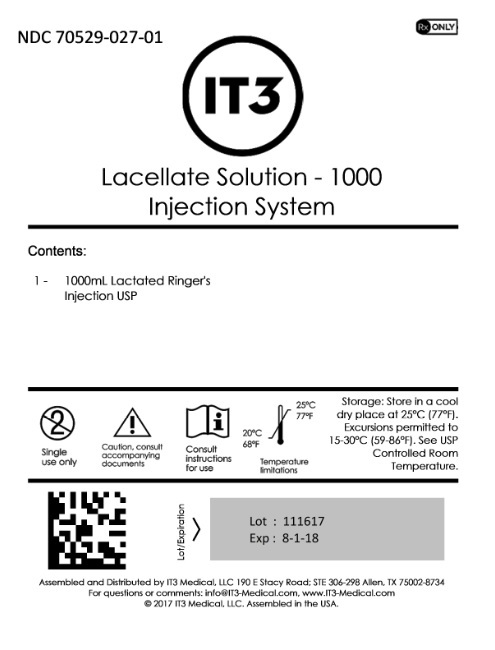
Lacellate Solution - 1000 Sodium chloride, potassium chloride, sodium lactate and calcium chloride 20; 30; 600; 310 mg/100mL; mg/100mL; mg/100mL; mg/100mL Injection, Solution, 1000 mL
🆔 Identity & classification
Where does this data come from?
🏭 Manufacturer & labeler
Where does this data come from?
🩺 Clinical
Patient education
Supplement & herbal interactions
Where does this data come from?
Ask a licensed pharmacist directly — free, answered by our team.
🧪 Inactive Ingredients / Excipients
Inactive ingredients, also called excipients, are components of the drug product other than the active ingredient. They may include fillers, dyes, coatings, preservatives, flavors, or other formulation ingredients.
💡 Tap an ingredient (hover on desktop) to see what it is and why it’s used.
-
UNII 059QF0KO0R
Water is a liquid solvent that dissolves and mixes ingredients together in liquid medicines, syrups, and injections. It helps distribute the active drug evenly throughout the product.
1 inactive ingredient listed in the exact product block matched to this NDC.
Where does this data come from?
ingredient classCode="IACT" elements from the exact product block matched by this NDC. Label-section narrative from DailyMed / the openFDA label index is shown separately when available.Inactive ingredient FAQ
Are inactive ingredients the same for every manufacturer?
Why might an inactive ingredient be missing?
Can inactive ingredients matter?
💲 Pricing
A drug doesn't have one price. Each row is a different public payment system, and none is what you'd pay at the counter — that depends on your insurance. The ⓘ on each row explains what it measures.
| Price system | Per mL | Per package |
|---|---|---|
| Retail pharmacies payNADAC · weekly | Not in the retail survey — common for institutional, discontinued, or low-volume packs. | |
| Medicaid paysCMS SDUD · 12 mo | No recent Medicaid claims on file for this NDC — rare and low-volume NDCs are suppressed in the public data. | |
| Medicare drug plans payPart D · quarterly | No Part D plan price is available for this NDC in our data. | |
Where does this data come from?
🔁 Therapeutic equivalents
| Product | Labeler | Pack | NADAC/unit | TE | Status | Price vs. this |
|---|---|---|---|---|---|---|
| Lacellate Solution - 1000 20; 30; 600; 310 mg/100mL; mg/100mL; mg/100mL; mg/100mLthis 70529-0027-01 | IT3 | 1000 ml | — | AP | Discontinued | — |
Where does this data come from?
⏳ Availability & generic status
The FDA lists approved generic versions of this medicine, but that does not always mean a pharmacy can get one today. Patent rules, launch agreements, supply and pricing can affect when generics actually arrive.
Where does this data come from?
📦 Packaging — all sizes for this product
| Package NDC | Description | Marketing start | Status |
|---|---|---|---|
| 70529-0027-01 You're viewing this | 1 BAG in 1 PACKAGE (70529-027-01) / 1000 mL in 1 BAG | 2017-03-01 | Inactivated by FDA |
🧭 About this NDC listing & data coverage
What data is (and isn’t) available for this NDC — tap to expand
| NDC identity (package / product / labeler codes) | ✓ Available |
| Labeler | ✓ Available |
| Product & package description | ✓ Available |
| Marketing category & status | ✓ Available |
| Active ingredient / dosage form / route | ✓ Available |
| FDA label (SPL via DailyMed) | ✓ Available |
| Package photos | ✓ Available |
| Inactive ingredients (structured) | ✓ Available |
| NADAC pharmacy acquisition price (CMS) | — Not published for this NDC CMS publishes NADAC only for NDCs reported in its retail-pharmacy survey. |
| Orange Book / therapeutic-equivalence data | ✓ Available |
| HCPCS J-code billing crosswalk | — Not published for this NDC Most self-administered / retail products have no J-code — that is normal. |
| Medicaid utilization (CMS SDUD) | — Not published for this NDC CMS reports utilization only for NDCs with Medicaid claims above its privacy threshold. |
Questions about this listing
Why is there no price listed?
What does the discontinued status mean for this NDC?
Is the NDC printed on the package the same as the 11-digit billing NDC?
What do the three segments of this NDC mean?
Who lists this product with the FDA?
Do I need a prescription for this product?
Where does this data come from?
📄 Full prescribing information FDA SPL
🎯 Indications and Usage ▾
INDICATIONS AND USAGE Lactated Ringer’s Injection, USP is indicated as a source of water and electrolytes or as an alkalinizing agent.
⏱️ Dosage and Administration ▾
DOSAGE AND ADMINISTRATION As directed by a physician. Dosage, rate and duration of administration are to be individualized and dependent upon the indication for use, the patient’s age, weight, concomitant treatment and clinical condition of the patient as well as laboratory determinations. All injections in VIAFLEX plastic containers are intended for intravenous administration using sterile and nonpyrogenic equipment.
After opening the container, the contents should be used immediately and should not be stored for a subsequent infusion. Do not reconnect any partially used containers. Parenteral drug products should be inspected visually for particulate matter and discoloration prior to administration whenever solution and container permit.
Do not administer unless the solution is clear and seal is intact. When making additions to Lactated Ringer’s Injection, USP, aseptic technique must be used. Mix the solution thoroughly when additives have been introduced.
Do not store solutions containing additives. Additives may be incompatible with Lactated Ringer’s Injection, USP. As with all parenteral solutions, compatibility of the additives with the solution must be assessed before addition, by checking for a possible color change and/or the appearance of precipitates, insoluble complexes, or crystals.
Before adding a substance or medication, verify that it is soluble and/or stable in water and that the pH range of Lactated Ringer’s Injection, USP is appropriate. The instructions for use of the medication to be added and other relevant literature must be consulted. Additives known or determined to be incompatible should not be used.
⛔ Contraindications ▾
CONTRAINDICATIONS As for other calcium-containing infusion solutions, concomitant administration of ceftriaxone and Lactated Ringer’s Injection, USP is contraindicated in newborns (≤ 28 days of age), even if separate infusion lines are used (risk of fatal ceftriaxone-calcium salt precipitation in the neonate’s bloodstream). In patients older than 28 days (including adults), ceftriaxone must not be administered simultaneously with intravenous calcium-containing solutions, including Lactated Ringer’s Injection, USP, through the same infusion line (e.g., via Y-connector).
If the same infusion line is used for sequential administration, the line must be thoroughly flushed between infusions with a compatible fluid. Lactated Ringer’s Injection, USP is contraindicated in patients with a known hypersensitivity to sodium lactate.
⚠️ Warnings ▾
WARNINGS Although Lactated Ringer’s Injection, USP has a potassium concentration similar to the concentration in plasma, it is insufficient to produce a useful effect in case of severe potassium deficiency; therefore, it should not be used for this purpose. Lactated Ringer’s Injection, USP is not for use for the treatment of lactic acidosis or severe metabolic acidosis. Lactated Ringer’s Injection, USP should not be administered simultaneously with citrate anticoagulated/preserved blood through the same administration set because of the likelihood of coagulation.
The infusion must be stopped immediately if any signs or symptoms of a suspected hypersensitivity reaction develop. Appropriate therapeutic countermeasures must be instituted as clinically indicated. Hypersensitivity reactions are reported more frequently during pregnancy.
Depending on the volume and the rate of infusion, the intravenous administration of Lactated Ringer’s Injection, USP can cause fluid and/or solute overloading resulting in dilution of serum electrolyte concentrations, overhydration, congested states, pulmonary edema or acid-base imbalance. The risk of dilutional states is inversely proportional to the electrolyte concentrations of the injections. The risk of solute overload causing congested states with peripheral and pulmonary edema is directly proportional to the electrolyte concentrations of the injections.
Clinical evaluation and periodic laboratory determinations may be necessary to monitor changes in fluid balance, electrolyte concentrations, and acid base balance during prolonged parenteral therapy or whenever the condition of the patient or the rate of administration warrants such evaluation. Lactated Ringer’s Injection, USP should be administered with particular caution, if at all, to patients with hyperkalemia or conditions predisposing to hyperkalemia (such as severe renal impairment or adrenocortical insufficiency, acute dehydration, or extensive tissue injury or burns) and in patients with cardiac disease.
Lactated Ringer’s Injection, USP should be administered with particular caution, if at all, to patients with alkalosis or at risk for alkalosis. Because lactate is metabolized to bicarbonate, administration may result in, or worsen, metabolic alkalosis. Lactated Ringer’s Injection, USP should be administered with particular caution, if at all, to patients with severe renal impairment, hypervolemia, overhydration, or conditions that may cause sodium and/or potassium retention, fluid overload, or edema.
🤒 Adverse Reactions ▾
ADVERSE REACTIONS Post-Marketing Adverse Reactions The following adverse reactions have been reported in the post-marketing experience, listed by MedDRA System Organ Class (SOC). Immune System Disorders: Hypersensitivity/infusion reactions, including anaphylactic/anaphylactoid reactions, and the following manifestations: angioedema, chest pain, chest discomfort, decreased heart rate, tachycardia, blood pressure decreased, respiratory distress, bronchospasm, dyspnea, cough, urticaria, rash, pruritus, erythema, flushing, throat irritation, paresthesias, hypoesthesia oral, dysgeusia, nausea, anxiety, pyrexia, headache Metabolism and Nutrition Disorders: Hyperkalemia General Disorders and Administration Site Conditions: Infusion site reactions, including phlebitis, infusion site inflammation, infusion site swelling, infusion site rash, infusion site pruritus, infusion site erythema, infusion site pain, infusion site burning Class Reactions Hypersensitivity reactions, including, laryngeal edema and sneezing Hypervolemia Infusion site reactions, including Infection at the site of injection, extravasation, and infusion site anesthesia (numbness) Overdose An excessive volume or too high a rate of administration of Lactated Ringer’s Injection, USP may lead to fluid and sodium overload with a risk of edema (peripheral and/or pulmonary), particularly when renal sodium excretion is impaired.
Excessive administration of lactate may lead to metabolic alkalosis. Metabolic alkalosis may be accompanied by hypokalemia. Excessive administration of potassium may lead to the development of hyperkalemia, especially in patients with severe renal impairment.
Excessive administration of calcium salts may lead to hypercalcemia. When assessing an overdose, any additives in the solution must also be considered. The effects of an overdose may require immediate medical attention and treatment.
🔄 Drug Interactions ▾
Drug Interactions Ceftriaxone – see CONTRAINDICATIONS Caution is advised when administering Lactated Ringer’s Injection, USP to patients treated with drugs that may increase the risk of sodium and fluid retention, such as corticosteroids. Caution is advised when administering Lactated Ringer’s Injection, USP to patients treated with drugs for which renal elimination is pH dependent. Due to the alkalinizing action of lactate (formation of bicarbonate), Lactated Ringer’s Injection, USP may interfere with the elimination of such drugs. • Renal clearance of acidic drugs such as salicylates and barbiturates may be increased. • Renal clearance of alkaline drugs, such as sympathomimetics (e.g., ephedrine, pseudoephedrine) and dextroamphetamine (dexamphetamine) sulfate, may be decreased.
Renal clearance of lithium may also be increased. Caution is advised when administering Lactated Ringer’s Injection, USP to patients treated with lithium. Because of its potassium content, Lactated Ringer’s Injection, USP should be administered with caution in patients treated with agents or products that can cause hyperkalemia or increase risk of hyperkalemia, such as potassium sparing diuretics (amiloride, spironolactone, triamterene), with ACE inhibitors, angiotensin II receptor antagonists, or the immunosuppressants tacrolimus and cyclosporine.
Caution is advised when administering Lactated Ringer’s Injection, USP to patients treated with thiazide diuretics or vitamin D, as these can increase the risk of hypercalcemia.
🤰 Pregnancy ▾
Pregnancy Teratogenic Effects Animal reproduction studies have not been conducted with Lactated Ringer’s Injection, USP. It is also not known whether Lactated Ringer’s Injection, USP can cause fetal harm when administered to a pregnant woman or can affect reproduction capacity. Lactated Ringer’s Injection, USP should be given to a pregnant woman only if clearly needed. For Hypersensitivity Reactions During Pregnancy – see WARNINGS
🧒 Pediatric Use ▾
Pediatric Use Safety and effectiveness of Lactated Ringer’s Injection, USP in pediatric patients have not been established by adequate and well controlled trials, however, the use of electrolyte solutions in the pediatric population is referenced in the medical literature. The warnings, precautions and adverse reactions identified in the label copy should be observed in the pediatric population. Lactate-containing solutions should be administered with particular caution to neonates and infants less than 6 months of age.
🧓 Geriatric Use ▾
Geriatric Use Clinical studies of Lactated Ringer’s Injection, USP did not include sufficient numbers of subjects aged 65 and over to determine whether they respond differently from younger subjects. Other reported clinical experience has not identified differences in responses between the elderly and younger patients. In general, dose selection for an elderly patient should be cautious, usually starting at the low end of the dosing range, reflecting the greater frequency of decreased hepatic, renal, or cardiac function, and of concomitant disease or other drug therapy.
🆘 Overdosage ▾
Overdose An excessive volume or too high a rate of administration of Lactated Ringer’s Injection, USP may lead to fluid and sodium overload with a risk of edema (peripheral and/or pulmonary), particularly when renal sodium excretion is impaired. Excessive administration of lactate may lead to metabolic alkalosis. Metabolic alkalosis may be accompanied by hypokalemia.
Excessive administration of potassium may lead to the development of hyperkalemia, especially in patients with severe renal impairment. Excessive administration of calcium salts may lead to hypercalcemia. When assessing an overdose, any additives in the solution must also be considered.
The effects of an overdose may require immediate medical attention and treatment.
🧬 Clinical Pharmacology ▾
CLINICAL PHARMACOLOGY Lactated Ringer’s Injection, USP has value as a source of water and electrolytes. It is capable of inducing diuresis depending on the clinical condition of the patient. Lactated Ringer’s Injection, USP produces a metabolic alkalinizing effect. Lactate ions are metabolized ultimately to carbon dioxide and water, which requires the consumption of hydrogen cations.
📦 How Supplied / Storage and Handling ▾
HOW SUPPLIED Lactated Ringer’s Injection, USP in VIAFLEX plastic container is available as follows: Code Size (mL) NDC 2B2324 1000 70529-027-01 Exposure of pharmaceutical products to heat should be minimized. Avoid excessive heat. It is recommended the product be stored at room temperature (25°C); brief exposure up to 40°C does not adversely affect the product.
📋 Description ▾
DESCRIPTION Lactated Ringer’s Injection, USP is a sterile, nonpyrogenic solution for fluid and electrolyte replenishment in single dose containers for intravenous administration. It contains no antimicrobial agents. Composition, osmolarity, pH, ionic concentration and caloric content are shown in Table 1.
Table 1 Composition (g/L) Ionic Composition (mEq/L) Size (mL) Sodium Chloride, USP, (NaCl) Sodium Lactate, (C 3 H 5 NaO 3 ) Potassium Chloride, USP, (KCl) Calcium Chloride, USP (CaCl 2 ·2H 2 O) Osmolarity (mOsmol/L) (calc) pH Sodium Potassium Calcium Chloride Lactate Caloric Content (kcal/L) Lactated Ringer’s Injection, USP 250 500 1000 6 3.1 0.3 0.2 273 6.5 (6.0 to 7.5) 130 4 2.7 109 28 9 The VIAFLEX plastic container is fabricated from a specially formulated polyvinyl chloride (PL 146 Plastic). The amount of water that can permeate from inside the container into the overwrap is insufficient to affect the solution significantly.
Solutions in contact with the plastic container can leach out certain of its chemical components in very small amounts within the expiration period, e.g., di-2-ethylhexyl phthalate (DEHP), up to 5 parts per million. However, the safety of the plastic has been confirmed in tests in animals according to USP biological tests for plastic containers as well as by tissue culture toxicity studies.