
Home › NDC Lookup › Ingredients › Polyethylene Glycol 400 › 70677-1157-01
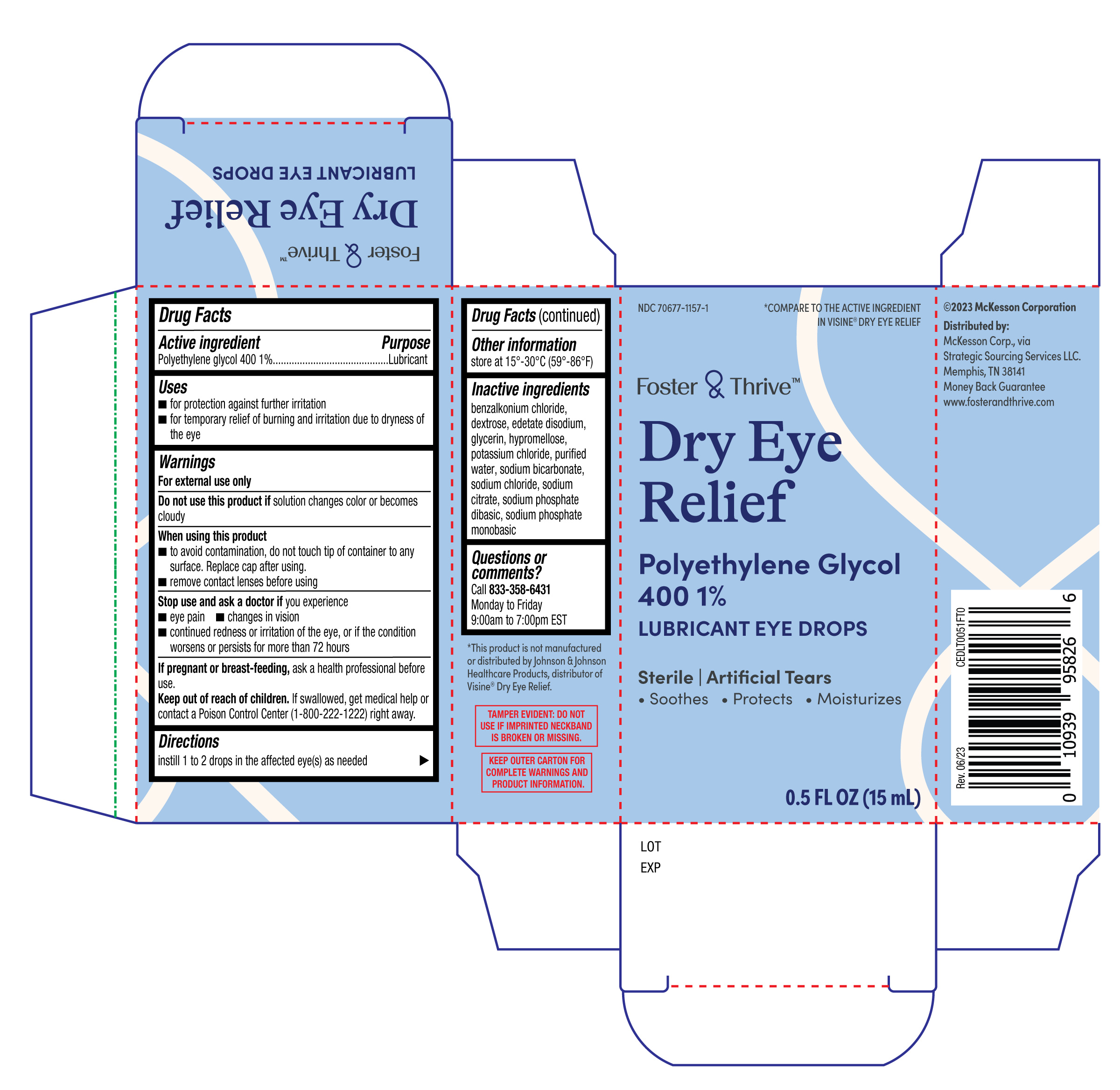
Foster and Thrive Dry Eye Relief Polyethylene glycol 400 400 1 g/100mL Solution/ Drops — NDC 70677-1157-01 package photo

Foster and Thrive Dry Eye Relief Polyethylene glycol 400 400 1 g/100mL Solution/ Drops

by Strategic Sourcing Services LLC · 1 BOTTLE, DROPPER in 1 BOX (70677-1157-1) / 15 mL in 1 BOTTLE, DROPPER
NDC 70677-1157-01
🏷️ FDA NDC (as labeled) 70677-1157-1 billing pads the package segment with a zero
OTC On market Non-controlled
🗂️ Data synced Jul 24, 2026 · sources: openFDA · FDA label (DailyMed) · FDA Orange & Purple Book · First Databank · CMS NADAC, ASP, Medicare & Medicaid · RxNorm
📋 All sources & update times →

🆔 Identity & classification

FDA NDC (as labeled) 70677-1157-1
Product NDC 70677-1157
11-digit billing NDC 70677115701
NCPDP billing unit ML — per mL (volume)
RxCUI 2360899
UNII B697894SGQ
UPC 0010939958266
Application # M018
SPL Set ID 0018ade9-5856-db6c-e063-6394a90a2ccf
DEA schedule Non-controlled
Marketing category OTC MONOGRAPH DRUG
Marketing status On market
FDA listing status Listed (active directory)
Marketing start 2023-07-09
Route OPHTHALMIC
Dosage form SOLUTION/ DROPS
Substance POLYETHYLENE GLYCOL 400
GCN Seq No 082620
GCN 50305
HICL code 022820
Ingredient (HICL) Polyethylene Glycol 400
HIC1 code Q
Therapeutic class — broad (HIC1) Ear/Eye/Nose/Rectum/Topical/Vagina/Other
HIC2 code Q6
Therapeutic class — intermediate (HIC2) Ophthalmic Preparations
HIC3 code Q6T
Therapeutic class — specific (HIC3) Artificial Tears
AHFS code 52:92.00.00
AHFS class Eent Drugs, Miscellaneous
FDB label name FT DRY EYE RELIEF 1% DROP
FDB brand name Dry Eye Relief
Legend status O — Over-the-counter (OTC) drug or device
Why two NDCs? The FDA registers this code as 70677-1157-1 — a 5-4-1 layout, and that's what's printed on the package and shown on DailyMed. For insurance claims, every NDC is standardized to a uniform 11-digit 5-4-2 format by adding a zero to the package segment → 70677-1157-01. Same drug, same package — only the format differs.
Where does this data come from?
Identifiers from the FDA openFDA NDC Directory and Structured Product Labeling; RxCUI from RxNorm (NLM); GPI from Medi-Span; GCN / HIC / AHFS / legend from First Databank.

🏭 Manufacturer & labeler

LabelerStrategic Sourcing Services LLC
FDA applicationM018 (OTC MONOGRAPH DRUG)
Labeler code70677
First marketedJul 2023
Product typeHuman Otc Drug
Portfolio316 products on file
The labeler markets the product; the application holder owns the FDA approval. They’re often the same company but can differ (e.g. a repackager or an authorized generic). A mailing address / phone appears here when the manufacturer includes it in the product’s FDA label (not all do).
Where does this data come from?
Labeler, application holder and registered establishment from the FDA openFDA NDC Directory and Drugs@FDA; address/contact from the product’s FDA label.

🩺 Clinical

Label name FT DRY EYE RELIEF 1% DROP Ingredient Polyethylene Glycol 400
🧪 What is this product?

Foster and Thrive Dry Eye Relief is an over-the-counter eye drop solution containing polyethylene glycol 400. This product is marketed as an OTC monograph drug, meaning it follows FDA's established rules for this category rather than individual approval. Polyethylene glycol 400 is a lubricant commonly used in eye drops to help relieve dryness and irritation of the eye surface by providing moisture and a protective film.

Where does this data come from?
Plain-language summary from MedlinePlus (U.S. National Library of Medicine); supplement & herbal interactions and nutrient depletion data from the Natural Medicines database; our full guide is HelloPharmacist editorial content.

🧪 Inactive Ingredients / Excipients

Inactive ingredients, also called excipients, are components of the drug product other than the active ingredient. They may include fillers, dyes, coatings, preservatives, flavors, or other formulation ingredients.

💡 Tap an ingredient (hover on desktop) to see what it is and why it’s used.

  • UNII F5UM2KM3W7
    Benzalkonium chloride is a chemical compound that works as a preservative and antimicrobial agent in medications. It prevents bacterial and fungal growth in liquid formulations to keep the product safe during storage and use.
  • UNII IY9XDZ35W2
    Dextrose is a simple sugar derived from corn or other sources. It serves as a filler and sweetener in medicines to add bulk, improve taste, and help stabilize the medication's form.
  • UNII 7FLD91C86K
    Edetate disodium is a chemical compound that binds and removes certain metal ions. In medicines, it acts as a preservative and stabilizer by preventing metals like calcium from interfering with the product's shelf life and consistency.
  • UNII PDC6A3C0OX
    Glycerin is a clear, thick liquid derived from plant oils or fats. It acts as a humectant to retain moisture, a sweetener, and a solvent in medications.
  • UNII 3NXW29V3WO
    Hypromellose is a plant-based thickener made from cellulose. It's used in medicines as a binder to hold ingredients together, a coating for tablets, and a thickener for liquids.
  • UNII 660YQ98I10
    Potassium chloride is a mineral salt used in medicines as a buffer and to help maintain the proper pH balance and stability of the formulation during storage and use.
  • UNII 8MDF5V39QO
    A white powder form of baking soda that acts as a buffer and pH regulator in medicines. It helps maintain the right acid-base balance and may aid tablet disintegration.
  • UNII 451W47IQ8X
    Sodium chloride is common table salt. It's used in medicines as a buffer to maintain proper pH, as a filler to add bulk, or to adjust the osmotic balance in liquid formulations.
  • UNII 1Q73Q2JULR
    Sodium citrate is a salt derived from citric acid. It works as a buffer to maintain the medicine's pH level and may also help improve taste or act as a preservative in the formulation.
  • UNII GR686LBA74
    Sodium phosphate, dibasic is a salt derived from phosphoric acid. It acts as a buffer to help maintain the medicine's pH balance and may serve as a binder or filler in tablets and capsules.
  • UNII KH7I04HPUU
    A salt compound made from sodium and phosphoric acid, used as a buffer to help maintain a stable pH level in the medicine, and sometimes as a binder or filler in tablets and capsules.
  • UNII 059QF0KO0R
    Water is a liquid solvent that dissolves and mixes ingredients together in liquid medicines, syrups, and injections. It helps distribute the active drug evenly throughout the product.

12 inactive ingredients listed in the exact product block matched to this NDC.

The official label also statesbenzalkonium chloride, dextrose, edetate disodium, glycerin, hypromellose, potassium chloride, purified water, sodium bicarbonate, sodium chloride, sodium citrate, sodium phosphate dibasic, sodium phosphate monobasic

Label-section wording can be broader than the structured product block and may mention additional formulation ingredients.

Where does this data come from?
Data sourced from official FDA Structured Product Labeling (SPL) via DailyMed — ingredient classCode="IACT" elements from the exact product block matched by this NDC. Label-section narrative from DailyMed / the openFDA label index is shown separately when available.

Inactive ingredient FAQ

Are inactive ingredients the same for every manufacturer?
No. Inactive ingredients can differ by manufacturer, dosage form, strength, and package / product version.
Why might an inactive ingredient be missing?
Some SPLs do not provide a complete structured inactive-ingredient list, and older or unusual labels may only include the information in narrative text.
Can inactive ingredients matter?
Yes. They can matter for allergies, intolerances, dyes, gluten / lactose concerns, preservatives, and formulation differences — but confirm with a pharmacist or the manufacturer when it’s clinically important.

💲 Pricing

A drug doesn't have one price. Each row is a different public payment system, and none is what you'd pay at the counter — that depends on your insurance. The ⓘ on each row explains what it measures.

Price systemPer mLPer package
Retail pharmacies payNADAC · weekly $0.169 $2.54 / 15 ml
Medicaid paysCMS SDUD · 12 mo $0.2327 $3.49 / 15 ml
Medicare drug plans payPart D · quarterly No Part D plan price is available for this NDC in our data.
NADAC price history (per mL) — tap or hover for the price & month
Dec 2025 Jan 2026 $0.169 $0.169
Flat over the last 2 months.
Where does this data come from?
NADAC (National Average Drug Acquisition Cost) is the CMS weekly pharmacy-acquisition-cost survey — what pharmacies pay. ASP (Average Sales Price) is the CMS Medicare Part B drug-payment file, published quarterly. Medicaid pays is computed by us from CMS State Drug Utilization Data (total reimbursed ÷ units, trailing 12 months) — gross of rebates and inclusive of dispensing fees, so it reflects what Medicaid paid, not an acquisition cost. Medicare drug plans pay is the median negotiated point-of-sale unit cost across plans listing this NDC in the CMS quarterly Prescription Drug Plan pricing files, before rebates. The VA pays is the federal contract price (FSS, and the statutory Big 4 ceiling where listed) from the VA National Acquisition Center pharmaceutical price file. All are free public government data; each measures a different payer, so the figures are not directly comparable.

🔁 Therapeutic equivalents

ProductLabelerPackNADAC/unitTEStatusPrice vs. this
Foster and Thrive Dry Eye Relief 400 1 g/100mLthis 70677-1157-01 Strategic 1 bottle $0.169 — Availability likely —
Visine Dry Eye Relief 400 10 mg/mL 69968-0363-01 Kenvue 1 bottle — — FDA listed —
Visine Dry Eye Relief Eye Drops 400 10 mg/mL 69968-0364-01 Kenvue 1 bottle — — FDA listed —
Visine Dry Eye Relief 400 10 mg/mL 69968-0365-01 Kenvue 1 bottle — — FDA listed —
About this product: other versions of the same ingredient, strength and form are listed above, least expensive first, with FDA equivalence ratings where available.
Where does this data come from?
Equivalents are other NDCs of the same ingredient, form and route from the openFDA NDC Directory, ranked least-expensive-first by NADAC. Therapeutic-equivalence (AB) ratings come from the FDA Orange Book; biologics use the FDA Purple Book for biosimilar & interchangeable status.

⏳ Availability & generic status

🏛️
2023
On the market since
Jul 2023
📍
2026
Currently FDA-listed
3 years listed
🔒
·
No generic listed yet
brand only
ℹ️No FDA-approved generic found

We did not find an FDA-approved generic match for this exact strength, form and route.

Where does this data come from?
Patents and exclusivity from the FDA Orange Book (small-molecule drugs), refreshed from public FDA data. Generic launch timing is an estimate, not a guarantee.

🗺️ Medicaid utilization & spend

📍 This exact package only: Medicaid data is reported per full 11-digit NDC — labeler, product and pack size — so every number here is for 70677-1157-01, not the drug overall. Other pack sizes report separately.
💊 Pharmacy benefit only: These are Medicaid outpatient pharmacy claims, billed by NDC. They exclude the medical benefit — clinic- or hospital-administered drugs billed under HCPCS J-codes — so drugs used mostly that way (e.g. Avastin, Lucentis, Keytruda) can look low or missing here. That’s expected, not an error.
📅 Q1 2025 – Q4 2025 · 4 quarters of data
ⓘ The newest quarter is usually incomplete when first published; states restate recent quarters in later CMS releases, so the latest figures typically revise upward. State coverage-policy changes can also shift quarter-to-quarter totals.
Prescriptions last 4 qtrs
15
Units reimbursed last 4 qtrs
225
Gross reimbursed last 4 qtrs
$52.35
Avg / prescription
$3.49
Avg / unit
$0.2327
Latest quarter Q4 2025
0Rx
Medicaid pays / mL
$0.2327
gross reimbursed
vs
NADAC / mL
$0.1693
acquisition cost
=
Spread
+$0.0634
+37% vs cost
What Medicaid paid per mL (before rebates; includes the pharmacy’s dispensing fee) compared with NADAC — the average price pharmacies pay to buy the drug. A positive spread means Medicaid reimbursed more than the purchase price, before manufacturer rebates.
Fee-for-service vs managed care ⓘ
100% MCO
Fee-for-service · 0 Rx Managed care · 15 Rx
State Medicaid map
Alaska: no data reported AK Maine: no data reported ME Washington: no data reported WA Idaho: no data reported ID Montana: no data reported MT North Dakota: no data reported ND Minnesota: no data reported MN Wisconsin: no data reported WI Michigan: no data reported MI New York: no data reported NY Vermont: no data reported VT New Hampshire: no data reported NH Oregon: no data reported OR Nevada: no data reported NV Wyoming: no data reported WY South Dakota: no data reported SD Iowa: no data reported IA Illinois: no data reported IL Indiana: no data reported IN Ohio: no data reported OH Pennsylvania: no data reported PA New Jersey: 225 units · 2.4 per 100k residents NJ Massachusetts: no data reported MA California: no data reported CA Utah: no data reported UT Colorado: no data reported CO Nebraska: no data reported NE Missouri: no data reported MO Kentucky: no data reported KY West Virginia: no data reported WV Virginia: no data reported VA Maryland: no data reported MD Connecticut: no data reported CT Rhode Island: no data reported RI Arizona: no data reported AZ New Mexico: no data reported NM Kansas: no data reported KS Arkansas: no data reported AR Tennessee: no data reported TN North Carolina: no data reported NC South Carolina: no data reported SC Delaware: no data reported DE Oklahoma: no data reported OK Louisiana: no data reported LA Mississippi: no data reported MS Alabama: no data reported AL Georgia: no data reported GA D.C.: no data reported DC Hawaii: no data reported HI Texas: no data reported TX Florida: no data reported FL
Units reimbursed · per 100k residents
2.42.4
gray = no data reported ⓘ
Colors are per 100,000 residents, so big states don’t automatically dominate. Tap or hover a state for its actual totals.
Tap or hover a state
…for its Medicaid breakdown
🏆 Top states by units · per 100k residents
1 New Jersey 2.4 /100k
National units — by quarter
💵 About the dollar figures: “reimbursed” is what Medicaid paid pharmacies before confidential manufacturer rebates, so the program’s real net cost is lower than these numbers. Fee-for-service and managed-care claims are combined unless split above. Source: CMS State Drug Utilization Data; per-100k rates use 2023 Census population estimates.

🔬 Reported adverse events (FAERS)

Read carefully: FAERS reports are voluntary and unverified. Counts are not incidence, do not establish causation, are subject to reporting bias, and cannot be used to compare one drug to another. Shown for signal context only. Reports for Foster and Thrive Dry Eye Relief (this brand).

Top reported reactions

Incorrect Product Administration Duration1,267
Nausea950
Diarrhoea891
Constipation721
Vomiting641
Incorrect Drug Administration Duration625
Abdominal Pain609

Reporter sex

0 reports

Serious outcomes

Disabling414
Reports over time (by year) — tap or hover for the count & year
2021 2022 2024 2026 1,746 0
Most recent year is provisional (FAERS lags ~3 months).
Where does this data come from?
Adverse-event reports from the FDA Adverse Event Reporting System (FAERS) via openFDA. FAERS reports are voluntary and unverified — counts are not incidence and don’t establish causation.

📦 Packaging — all sizes for this product

Package NDCDescription Marketing startStatus
70677-1157-01 You're viewing this 1 BOTTLE, DROPPER in 1 BOX (70677-1157-1) / 15 mL in 1 BOTTLE, DROPPER 2023-07-09 Active

📄 FDA label — Drug Facts FDA SPL

The complete FDA label for this product — the official Drug Facts labeling, verbatim, section by section. Jump with a chip, search within the label, or expand everything.
🎯 Indications and Usage 19 words ▾

Uses for protection against further irritation for temporary relief of burning and irritation due to dryness of the eye

⏱️ Dosage and Administration 12 words ▾

Directions instill 1 to 2 drops in the affected eye(s) as needed

⚠️ Warnings 105 words ▾

Warnings For external use only Do not use this product if solution changes color or becomes cloudy When using this product to avoid contamination, do not touch tip of container to any surface. Replace cap after using. remove contact lenses before using Stop use and ask a doctor if you experience eye pain changes in vision continued redness or irritation of the eye, or if the condition worsens or persists for more than 72 hours If pregnant or breast-feeding, ask a health professional before use. Keep out of reach of children.

If swallowed, get medical help or contact a Poison Control Center (1-800-222-1222) right away.

🧪 Active Ingredient 6 words ▾

Active ingredient Polyethylene glycol 400 1%

🧪 Inactive Ingredients 25 words ▾

Inactive ingredients benzalkonium chloride, dextrose, edetate disodium, glycerin, hypromellose, potassium chloride, purified water, sodium bicarbonate, sodium chloride, sodium citrate, sodium phosphate dibasic, sodium phosphate monobasic

🎯 Purpose 2 words ▾

Purpose Lubricant

Source: FDA Structured Product Labeling, mirrored from DailyMed / openFDA. Prefer the government’s original formatting? View this label on DailyMed ↗
For educational and professional reference only — not medical advice. Pricing reflects published NADAC and CMS ASP (free public data) and may differ from your acquisition cost; always verify before billing or dispensing.