
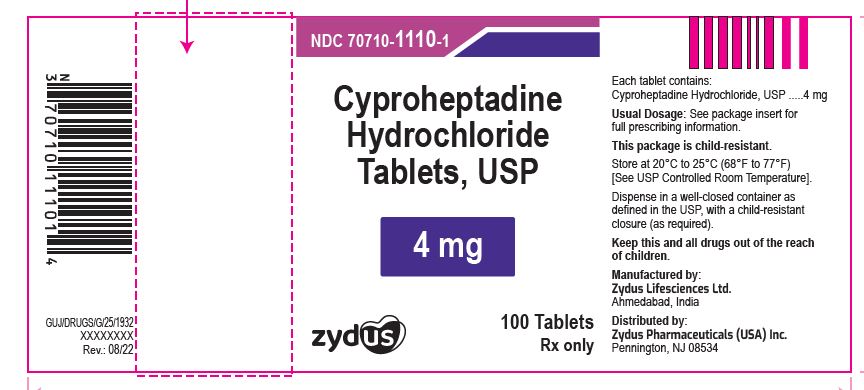
Cyproheptadine Hydrochloride 4 mg Tablet, 100-count — NDC 70710-1110-1 (Billing 70710-1110-01)
This is a package of 100 tablets of Cyproheptadine Hydrochloride 4 mg Tablet from Zydus Pharmaceuticals USA Inc., marketed since Jul 2017 and currently FDA-listed; retail pharmacies pay about $0.0679 per tablet (NADAC). It is the main listing for this product, which comes in 2 package sizes.
NDC database record
One package, one record: these facts belong to NDC 70710-1110-1 alone.
- Record
- FDA NDC Directory package listing · Human prescription drug
- Code segments
- 70710 labeler · 1110 product · 1 package
- Package marketed since
- Jul 20, 2017
- Sample package
- No — commercial package
- Listing certified through
- Dec 31, 2026
- Billing quantity
- 100 EA per package
- Barcode (UPC)
- 0370710111014
- Medicaid fills, this package
- 202,574 prescriptions in the last four reported quarters
- FDA record last changed
- Jul 24, 2026
Other active recalls for Cyproheptadine Hydrochloride (different manufacturers) — 1 · tap to view
Identity & classification
Regulatory identifiers FDA, NLM and CMS codes for this package
Drug-database identifiers Medi-Span GPI and First Databank GCN / HICL / AHFS classification
- GSN (GCN sequence number): 004011
- GCN: 15811
- GPI-14 (Medi-Span): 41500020100305
- HICL (First Databank): 001672
- AHFS class code: 04:04.00.00
- RxCUI (RxNorm): 866144
Where does this data come from?
- FDA openFDA NDC Directory · synced Oct 1, 2026
- FDA label on DailyMed · label index refreshed Oct 6, 2026
- RxNorm (NLM RxNav) · catalog refreshed Oct 1, 2026
- Medi-Span GPI (licensed)
- First Databank (licensed) · refreshed Oct 1, 2026
RxNorm drug class
This medicine belongs to the Other antihistamines for systemic use class.
Where does this data come from?
- RxClass (NLM) · catalog refreshed Oct 1, 2026
Clinical
Cyproheptadine is used to treat allergy symptoms: runny nose sneezing tching of the nose or throat red, itchy, or watery eyes It may also be used to relieve the itching of allergic skin conditions and to treat hives. Cyproheptadine is also used to treat severe or life-threatening allergic reactions. Cyproheptadine is in a class of medications called antihistamines. It works by blocking the action of histamine, a substance in the body that causes allergic symptoms.
Read the full MedlinePlus article ↗- It's an antihistamine for allergy problems like hay fever, allergic eye irritation, hives and swelling. It can also be used after a severe allergic reaction is under control, along...
- It often does, though the sleepiness may fade over time. Be careful driving or using machinery until you know how it affects you. Skip alcohol, since it adds to the drowsiness.
- Be careful. Sleep aids, sedatives, tranquilizers and anti-anxiety medicines can add to the sedation. Please check with me or your doctor first.
- Can I take it with my sleep or anxiety medicine?
Patient education
Supplement & herbal interactions
Where does this data come from?
- MedlinePlus (NLM) · refreshed Oct 1, 2026
- FDA label on DailyMed · label index refreshed Oct 6, 2026
Ask a licensed pharmacist directly — free, answered by our team.
Pricing
A drug doesn't have one price. Each row is a different public payment system, and none is what you'd pay at the counter — that depends on your insurance. The ⓘ on each row explains what it measures.
| Price system | Per ea | Per package |
|---|---|---|
| Retail pharmacies payNADAC · weekly | $0.068 | $6.79 / 100 tablets |
| Medicaid paysCMS SDUD · 12 mo | $0.2229 | $22.29 / 100 tablets |
| Medicare drug plans payPart D · Q2 2026 | $0.2730 | $27.30 / 100 tablets |
Where does this data come from?
- CMS NADAC weekly file · file of Sep 30, 2026
- CMS ASP pricing files · refreshed Sep 20, 2026
- CMS Medicaid State Drug Utilization Data · through Q1 2026
- CMS Part D plan pricing files · refreshed Sep 24, 2026
- VA National Acquisition Center price file
Packaging — all sizes for this product
| Package NDC | Description | Per unit | Per pack | Marketing start | Marketing end | Status |
|---|---|---|---|---|---|---|
| 70710-1110-00 70710-1110-0 | 1000 TABLET in 1 BOTTLE | $0.0679 / ea | $67.87 | 2017-07-20 | — | Active |
| 70710-1110-01 You're viewing this Main listing | 100 TABLET in 1 BOTTLE | $0.0679 / ea | $6.79 | 2017-07-20 | — | Active |
You're viewing the smallest of 2 pack sizes for this product.
This pack effectively ties for the lowest per-ea cost of the 2 priced pack sizes ($0.0679 NADAC).
In Medicaid, this is the most-dispensed pack of this product — about 90% of fills over the last four reported quarters. See all packs ↓
Pack size FAQ
What quantity is in this package?
How does this package differ from NDC 70710-1110-00?
What NDC number is used to bill for this package of Cyproheptadine Hydrochloride 4 mg Tablet?
Prices are the latest CMS NADAC pharmacy acquisition cost per NDC; per-pack figures are per-unit × pack quantity, shown only when the pack is denominated in the same measure NADAC prices.
Therapeutic equivalents
| Product | Labeler | Pack | NADAC/unit | TE | Status | Price vs. this |
|---|---|---|---|---|---|---|
| Cyproheptadine Hydrochloride 4 mg 00115-1757-01 | Amneal | 100 tablets | $0.068 | AA | Availability likely | — |
| Cyproheptadine Hydrochloride 4 mg 16571-0805-01 | Rising | 100 tablets | $0.068 | AA | Availability likely | — |
| Cyproheptadine Hydrochloride 4 mg 50268-0201-15 | AvPAK | 50 tablets | $0.068 | AA | Availability likely | — |
| Cyproheptadine Hydrochloride 4 mg 50742-0190-01 | Ingenus | 100 tablets | $0.068 | AA | Availability likely | — |
| Cyproheptadine Hydrochloride 4 mg 52817-0210-10 | TRUPHARMA, | 100 tablets | $0.068 | AA | Availability likely | — |
| Cyproheptadine Hydrochloride 4 mg 62135-0236-90 | Chartwell | 90 tablets | $0.068 | AA | Availability likely | — |
| Cyproheptadine Hydrochloride 4 mg 64380-0795-06 | Strides | 100 tablets | $0.068 | AA | Availability likely | — |
| Cyproheptadine Hydrochloride 4 mgthis 70710-1110-01 | Zydus | 100 tablets | $0.068 | AA | Availability likely | — |
| Cyproheptadine Hydrochloride 4 mg 70752-0107-10 | QUAGEN | 100 tablets | $0.068 | AA | Availability likely | — |
| Cyproheptadine Hydrochloride 4 mg 76385-0130-01 | UNICHEM | 100 tablets | $0.068 | AA | Availability likely | — |
| Cyproheptadine Hydrochloride 4 mg 42708-0177-21 | QPharma | 21 tablets | — | AA | FDA listed | — |
| Cyproheptadine Hydrochloride 4 mg 42708-0187-21 | QPharma | 21 tablets | — | AA | FDA listed | — |
| Cyproheptadine Hydrochloride 4 mg 50090-5491-01 | A-S | 30 tablets | — | AA | FDA listed | — |
| Cyproheptadine Hydrochloride 4 mg 50090-6129-01 | A-S | 30 tablets | — | AA | FDA listed | — |
| Cyproheptadine Hydrochloride 4 mg 51407-0272-10 | Golden | 1000 tablets | — | AA | FDA listed | — |
| Cyproheptadine Hydrochloride 4 mg 70518-3517-00 | REMEDYREPACK | 30 tablets | — | AA | FDA listed | — |
| Cyproheptadine Hydrochloride 4 mg 70518-4667-00 | REMEDYREPACK | 50 tablets | — | AA | FDA listed | — |
| Cyproheptadine Hydrochloride 4 mg 70771-1076-00 | Zydus | 1000 tablets | — | AA | FDA listed | — |
| Cyproheptadine Hydrochloride 4 mg 71335-1107-01 | Bryant | 30 tablets | — | AA | FDA listed | — |
| Cyproheptadine Hydrochloride 4 mg 71335-2368-01 | Bryant | 30 tablets | — | AA | FDA listed | — |
| Cyproheptadine Hydrochloride 4 mg 71335-2453-01 | Bryant | 30 tablets | — | AA | FDA listed | — |
| Cyproheptadine Hydrochloride 4 mg 71335-2964-01 | Bryant | 90 tablets | — | AA | FDA listed | — |
| Cyproheptadine Hydrochloride 4 mg 72162-2066-00 | Bryant | 1000 tablets | — | AA | FDA listed | — |
| Cyproheptadine Hydrochloride 4 mg 72789-0102-01 | PD-Rx | 100 tablets | — | AA | FDA listed | — |
| Cyproheptadine Hydrochloride 4 mg 52817-0415-10 | TRUPHARMA, | 100 tablets | — | AA | FDA listed | — |
| Cyproheptadine Hydrochloride 4 mg 71335-0211-01 | Bryant | 30 tablets | — | AA | FDA listed | — |
Where does this data come from?
- FDA openFDA NDC Directory · synced Oct 1, 2026
- FDA Orange Book · refreshed Oct 3, 2026
- CMS NADAC weekly file · file of Sep 30, 2026
Availability & generic status
This product is an FDA-approved generic. Other versions of the same drug are listed under Therapeutic equivalents, least expensive first.
Where does this data come from?
- FDA Orange Book · refreshed Oct 3, 2026
What it looks like
Where does this data come from?
- FDA label on DailyMed · label index refreshed Oct 6, 2026
Inactive Ingredients / Excipients
Inactive ingredients, also called excipients, are components of the drug product other than the active ingredient. They may include fillers, dyes, coatings, preservatives, flavors, or other formulation ingredients.
🧪 Avoiding an ingredient? See Cyproheptadine inactive ingredients by manufacturer: every current product's list side by side, so you can ask your pharmacy for the version that does not list it.
💡 Tap an ingredient (hover on desktop) to see what it is and why it’s used.
-
UNII OP1R32D61U
Microcrystalline cellulose is a purified form of cellulose, a natural fiber from plant sources. It acts as a binder and filler in tablets and capsules, helping hold ingredients together and give the medicine its shape and size.
-
UNII EWQ57Q8I5X
Lactose monohydrate is a natural sugar derived from milk. It serves as a filler and binder in tablets and capsules, helping create the proper size, texture, and consistency of the medicine.
-
UNII 70097M6I30
Magnesium stearate is a salt made from magnesium and stearic acid, a fatty substance. It's used in tablets and capsules as a lubricant and glidant to help ingredients flow smoothly during manufacturing and prevent sticking.
-
UNII 5856J3G2A2
A starch-based powder made from potatoes and processed with sodium. It acts as a disintegrant, helping the tablet or capsule break apart quickly in the stomach so the medicine can be absorbed.
4 inactive ingredients listed in the exact product block matched to this NDC.
Where does this data come from?
ingredient classCode="IACT" elements from the exact product block matched by this NDC. Label-section narrative from DailyMed / the openFDA label index is shown separately when available.- FDA label on DailyMed · label index refreshed Oct 6, 2026
- FDA openFDA NDC Directory · synced Oct 1, 2026
Inactive ingredient FAQ
Are inactive ingredients the same for every manufacturer?
Why might an inactive ingredient be missing?
Can inactive ingredients matter?
Manufacturer & labeler
More NDCs from Zydus Pharmaceuticals USA Inc. labeler code 70710
- Albuterol 2 mg Tablet NDC 70710-1061-1
- Albuterol 4 mg Tablet NDC 70710-1062-1
- Vardenafil 2.5 mg Tablet, Film Coated NDC 70710-1068-1
- Vardenafil 5 mg Tablet, Film Coated NDC 70710-1069-1
- Vardenafil 10 mg Tablet, Film Coated NDC 70710-1070-1
- Vardenafil 20 mg Tablet, Film Coated NDC 70710-1071-1
- tizanidine hydrochloride 2 mg Capsule NDC 70710-1111-4
- tizanidine hydrochloride 4 mg Capsule NDC 70710-1112-4
- tizanidine hydrochloride 6 mg Capsule NDC 70710-1113-4
- Teriflunomide 7 mg Tablet, Film Coated NDC 70710-1114-3
- Teriflunomide 14 mg Tablet, Film Coated NDC 70710-1115-3
- Doxycycline 50 mg Tablet, Film Coated NDC 70710-1121-1
Where does this data come from?
- FDA openFDA NDC Directory · synced Oct 1, 2026
- Drugs@FDA
Full prescribing information FDA SPL
🎯 Indications and Usage ▾
INDICATIONS AND USAGE Perennial and seasonal allergic rhinitis Vasomotor rhinitis Allergic conjunctivitis due to inhalant allergens and foods Mild, uncomplicated allergic skin manifestations of urticaria and angioedema Amelioration of allergic reactions to blood or plasma Cold urticaria Dermatographism As therapy for anaphylactic reactions adjunctive to epinephrine and other standard measures after the cute manifestations have been controlled.
⏱️ Dosage and Administration ▾
DOSAGE AND ADMINISTRATION DOSAGE SHOULD BE INDIVIDUALIZED ACCORDING TO THE NEEDS AND THE RESPONSE OF THE PATIENT. Each tablet contains 4 mg of cyproheptadine hydrochloride. Pediatric Patients Age 2 to 6 years The total daily dosage for pediatric patients may be calculated on the basis of body weight or body area using approximately 0.25 mg /kg /day or 8 mg per square meter of body surface (8 mg/m 2 ).
The usual dose is 2 mg (½ tablet) two or three times a day, adjusted as necessary to the size and response of the patient. The dose is not to exceed 12 mg a day. Age 7 to 14 years The usual dose is 4 mg (1 tablet) two or three times a day adjusted as necessary to the size and response of the patient.
The dose is not to exceed 16 mg a day. Adults The total daily dose for adults should not exceed 0.5 mg /kg /day. The therapeutic range is 4 to 20 mg a day, with the majority of patients requiring 12 to 16 mg a day.
An occasional patient may require as much as 32 mg a day for adequate relief. It is suggested that dosage be initiated with 4 mg (1 tablet) three times a day and adjusted according to the size and response of the patient.
⛔ Contraindications ▾
CONTRAINDICATIONS Newborn or Premature Infants This drug should not be used in newborn or premature infants. Nursing Mothers Because of the higher risk of antihistamines for infants generally and for newborns and prematures in particular, antihistamine therapy is contraindicated in nursing mothers. Other Conditions Hypersensitivity to cyproheptadine and other drugs of similar chemical structure.
Monoamine oxidase inhibitor therapy (See DRUG INT ERACT IONS. ) Angle-closure glaucoma Stenosing peptic ulcer Symptomatic prostatic hypertrophy Bladder neck obstruction Pyloroduodenal obstruction Elderly, debilitated patients
⚠️ Warnings ▾
WARNINGS Pediatric Patients Overdosage of antihistamines, particularly in infants and young children, may produce hallucinations, central nervous system depression, convulsions, respiratory and cardiac arrest, and death. Antihistamines may diminish mental alertness; conversely, particularly, in the young child, they may occasionally produce excitation. CNS Depressants Antihistamines may have additive effects with alcohol and other CNS depressants, e.g., hypnotics, sedatives, tranquilizers, antianxiety agents.
Activities Requiring Mental Alertness Patients should be warned about engaging in activities requiring mental alertness and motor coordination, such as driving a car or operating machinery. Antihistamines are more likely to cause dizziness, sedation, and hypotension in elderly patients (see PRECAUTIONS, Geriatric Use ).
🤒 Adverse Reactions ▾
ADVERSE REACTIONS Adverse reactions which have been reported with the use of antihistamines are as follows: Central Nervous System Sedation and sleepiness (often transient), dizziness, disturbed coordination, confusion, restlessness, excitation, nervousness, tremor, irritability, insomnia, paresthesias, neuritis, convulsions, euphoria, hallucinations, hysteria, faintness. Integumentary Allergic manifestation of rash and edema, excessive perspiration, urticaria, photo sensitivity. Special Senses Acute labyrinthitis, blurred vision, diplopia, vertigo, tinnitus.
Cardio vascular Hypotension, palpitation, tachycardia, extrasystoles, anaphylactic shock. Hematologic Hemolytic anemia, leukopenia, agranulocytosis, thrombocytopenia. Digestive System Cholestasis, hepatic failure, hepatitis, hepatic function abnormality, dryness of mouth, epigastric distress, anorexia, nausea, vomiting, diarrhea, constipation, jaundice.
Genitourinary Urinary frequency, difficult urination, urinary retention, early menses. Respiratory Dryness of nose and throat, thickening of bronchial secretions, tightness of chest and wheezing, nasal stuffiness. Miscellaneous Fatigue, chills, headache, increased appetite/weight gain.
🔄 Drug Interactions ▾
Drug Interactions MAO inhibitors prolong and intensify the anticholinergic effects of antihistamines. Antihistamines may have additive effects with alcohol and other CNS depressants, e.g., hypnotics, sedatives, tranquilizers, antianxiety agents.
🤰 Pregnancy ▾
Pregnancy Pregnancy Category B Reproduction studies have been performed in rabbits, mice, and rats at oral or subcutaneous doses up to 32 times the maximum recommended human oral dose and have revealed no evidence of impaired fertility or harm to the fetus due to cyproheptadine. Cyproheptadine has been shown to be fetotoxic in rats when given by intraperitoneal injection in doses four times the maximum recommended human oral dose. Two studies in pregnant women, however, have not shown that cyproheptadine increases the risk of abnormalities when administered during the first, second and third trimesters of pregnancy.
No teratogenic effects were observed in any of the newborns. Nevertheless, because the studies in humans cannot rule out the possibility of harm, cyproheptadine should be used during pregnancy only if clearly needed.
🧒 Pediatric Use ▾
Pediatric Use Safety and effectiveness in pediatric patients below the age of two have not been established (see CONTRAINDICATIONS, Newborn or Premature Infants , and WARNINGS, Pediatric Patients ).
🧓 Geriatric Use ▾
Geriatric Use Clinical studies of cyproheptadine hydrochloride tablets did not include sufficient numbers of subjects aged 65 and over to determine whether they respond differently from younger subjects. Other reported clinical experience has not identified differences in responses between the elderly and younger patients. In general, dose selection for an elderly patient should be cautious, usually starting at the low end of the dosing range, reflecting the greater frequency of decreased hepatic, renal, or cardiac function, and of concomitant disease or other drug therapy (see WARNINGS, Activities Requiring Mental Alertness ).
🆘 Overdosage ▾
OVERDOSAGE Antihistamine overdosage reactions may vary from central nervous system depression to stimulation especially in pediatric patients. Also, atropine-like signs and symptoms (dry mouth; fixed, dilated pupils; flushing, etc.) as well as gastrointestinal symptoms may occur. If vomiting has not occurred spontaneously , the patient should be induced to vomit with syrup of ipecac.
If patient is unable to vomit , perform gastric lavage followed by activated charcoal. Isotonic or ½ isotonic saline is the lavage of choice. Precautions against aspiration must be taken especially in infants and children.
When life threatening CNS signs and symptoms are present, intravenous physostigmine salicylate may be considered. Dosage and frequency of administration are dependent on age, clinical response, and recurrence after response (See package circulars for physostigmine products.) Saline cathartics , as milk of magnesia, by osmosis draw water into the bowel and, therefore, are valuable for their action in rapid dilution of bowel content. Stimulants should not be used .
Vasopressors may be used to treat hypotension. The oral LD 50 of cyproheptadine is 123 mg/kg, and 295 mg/kg in the mouse and rat, respectively.
🧬 Clinical Pharmacology ▾
CLINICAL PHARMACOLOGY Cyproheptadine is a serotonin and histamine antagonist with anticholinergic and sedative effects. Antiserotonin and antihistamine drugs appear to compete with serotonin and histamine, respectively, for receptor sites. Pharmacokinetics and Metabolism After a single 4 mg oral dose of 14 C-labelled cyproheptadine hydrochloride in normal subjects, given as tablets, 2 to 20 % of the radio activity was excreted in the stools.
Only about 34 % of the stool radio activity was unchanged drug, corresponding to less than 5.7% of the dose. At least 40% of the administered radio activity was excreted in the urine. No detectable amounts of unchanged drug were present in the urine of patients on chronic 12 to 20 mg daily doses.
The principle metabolite found in human urine has been identified as a quaternary ammonium glucuronide conjugate of cyproheptadine. Elimination is diminished in renal insufficiency.
📦 How Supplied / Storage and Handling ▾
HOW SUPPLIED Cyproheptadine Hydrochloride Tablets USP, 4 mg are available as white, round, flat-faced, beveled- edged tablets, bisected on one side and debossed with "11 10" on the other side, and are supplied as: NDC 70710-1110-1 in bottle of 100 tablets with child-resistant closure NDC 70710-1110-0 in bottle of 1,000 tablets PHARMACIST: Dispense in a well-closed container as defined in the USP, with a child-resistant closure (as required). Storage Store at 20°C to 25°C (68°F to 77°F) [See USP Controlled Room Temperature].
Call your doctor for medical advice about side effects. You may report side effects to FDA at 1-800-FDA-1088. Please address medical inquiries to, ([email protected]) Tel.: 1-877-993-8779.
Package insert available at www.zydususa.com/products or call 1-877-993-8779.
📋 Description ▾
DESCRIPTION Cyproheptadine hydrochloride, USP is an antihistaminic and antiserotonergic agent. Cyproheptadine hydrochloride, USP is a white to slightly yellow, odorless or practically odorless, crystalline powder, with a molecular weight of 350.89, which is slightly soluble in water, freely soluble in methanol, soluble in chloroform, sparingly soluble in alcohol, practically insoluble in ether. It is the sesquihydrate of 4-(5H-dibenzo [a, d] cyclohepten-5-ylidene)-1-methylpiperidine hydrochloride.
The molecular formula of the anhydrous salt is C 21 H 21 N•HCl and the structural formula of the anhydrous salt is: Molecular Formula: C 21 H 21 N• HCl Molecular Weight: 350.89 Cyproheptadine hydrochloride, USP is available for oral administration in 4 mg tablets. Inactive ingredients include: lactose monohydrate, magnesium stearate, microcrystalline cellulose, and sodium starch glycolate (botanical source: potato). Cyproheptadine HCl tablet
💬 Information for Patients ▾
Information for Patients Antihistamines may diminish mental alertness; conversely, particularly, in the young child, they may occasionally produce excitation. Patients should be warned about engaging in activities requiring mental alertness and motor coordination, such as driving a car or operating machinery.
⚠️ Precautions ▾
PRECAUTIONS General Cyproheptadine has an atropine-like action and, therefore, should be used with caution in patients with: History of bronchial asthma Increased intraocular pressure Hyperthyroidism Cardiovascular disease Hypertension Information for Patients Antihistamines may diminish mental alertness; conversely, particularly, in the young child, they may occasionally produce excitation. Patients should be warned about engaging in activities requiring mental alertness and motor coordination, such as driving a car or operating machinery.
Drug Interactions MAO inhibitors prolong and intensify the anticholinergic effects of antihistamines. Antihistamines may have additive effects with alcohol and other CNS depressants, e.g., hypnotics, sedatives, tranquilizers, antianxiety agents. Carcinogenesis, Mutagenesis, Impairment of Fertility Long -term carcinogenic studies have not been done with cyproheptadine.
Cyproheptadine had no effect on fertility in a two -litter study in rats or a two generation study in mice at about 10 times the human dose. Cyproheptadine did not produce chromosome damage in human lymphocytes or fibro blasts invitro ; high doses (10 -4 M) were cytotoxic. Cyproheptadine did not have any mutagenic effect in the Ames microbial mutagen test; concentrations of above 500 mcg/plate inhibited bacterial growth.
Pregnancy Pregnancy Category B Reproduction studies have been performed in rabbits, mice, and rats at oral or subcutaneous doses up to 32 times the maximum recommended human oral dose and have revealed no evidence of impaired fertility or harm to the fetus due to cyproheptadine. Cyproheptadine has been shown to be fetotoxic in rats when given by intraperitoneal injection in doses four times the maximum recommended human oral dose. Two studies in pregnant women, however, have not shown that cyproheptadine increases the risk of abnormalities when administered during the first, second and third trimesters of pregnancy.
No teratogenic effects were observed in any of the newborns. Nevertheless, because the studies in humans cannot rule out the possibility of harm, cyproheptadine should be used during pregnancy only if clearly needed. Nursing Mothers It is not known whether this drug is excreted in human milk.
Because many drugs are excreted in human milk, and because of the potential for serious adverse reactions in nursing infants from cyproheptadine, a decision should be made whether to discontinue nursing or to discontinue the drug, taking into account the importance of the drug to the mother (see CONTRAINDICATIONS ). Pediatric Use Safety and effectiveness in pediatric patients below the age of two have not been established (see CONTRAINDICATIONS, Newborn or Premature Infants , and WARNINGS, Pediatric Patients ). Geriatric Use Clinical studies of cyproheptadine hydrochloride tablets did not include sufficient numbers of subjects aged 65 and over to determine whether they respond differently from younger subjects.
Other reported clinical experience has not identified differences in responses between the elderly and younger patients. In general, dose selection for an elderly patient should be cautious, usually starting at the low end of the dosing range, reflecting the greater frequency of decreased hepatic, renal, or cardiac function, and of concomitant disease or other drug therapy (see WARNINGS, Activities Requiring Mental Alertness ).
🍼 Nursing Mothers ▾
Nursing Mothers Because of the higher risk of antihistamines for infants generally and for newborns and prematures in particular, antihistamine therapy is contraindicated in nursing mothers.
Nursing Mothers It is not known whether this drug is excreted in human milk. Because many drugs are excreted in human milk, and because of the potential for serious adverse reactions in nursing infants from cyproheptadine, a decision should be made whether to discontinue nursing or to discontinue the drug, taking into account the importance of the drug to the mother (see CONTRAINDICATIONS ).
📄 Package Label / Principal Display Panel ▾
PACKAGE LABEL.PRINCIPAL DISPLAY PANEL NDC 70710-1110-1 Cyproheptadine Hydrochloride Tablets USP, 4 mg 100 Tablets R x only ZYDUS Cyproheptadine Hydrochloride Tablets USP, 4 mg