
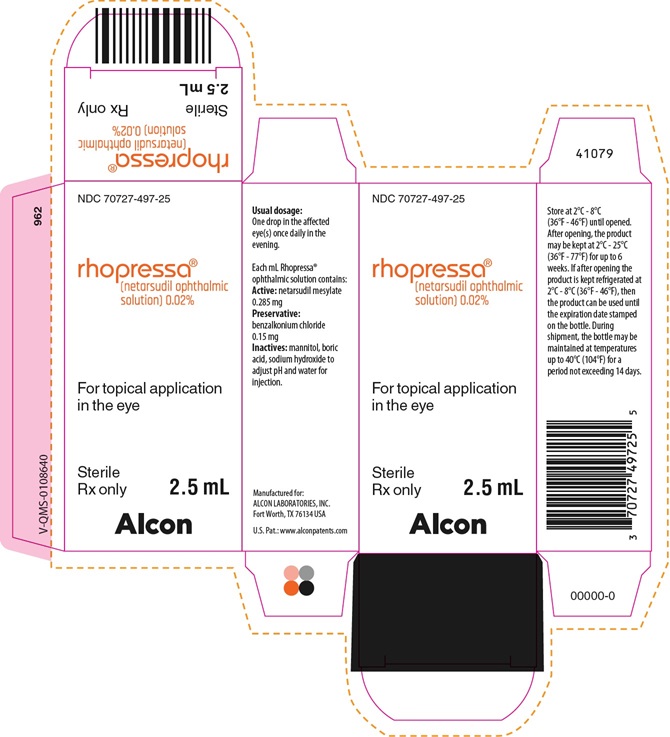
Rhopressa netarsudil .2 mg/mL Solution/ Drops, 1 bottle — NDC 70727-497-25 (Billing 70727-0497-25)
This is a package of 1 bottle of Rhopressa netarsudil .2 mg/mL Solution/ Drops from Alcon Laboratories, Inc., marketed since Dec 2017 and currently FDA-listed; retail pharmacies pay about $131.68 per mL (NADAC). It is the main listing for this product, which comes in 2 package sizes.
Identity & classification
Regulatory identifiers FDA, NLM and CMS codes for this package
Drug-database identifiers Medi-Span GPI and First Databank GCN / HICL / AHFS classification
- GSN (GCN sequence number): 078066
- GCN: 44308
- GPI-14 (Medi-Span): 86527040202020
- HICL (First Databank): 044724
- AHFS class code: 52:40.32.00
- RxCUI (RxNorm): 1992868
Where does this data come from?
- FDA openFDA NDC Directory · synced Oct 1, 2026
- FDA label on DailyMed · label index refreshed Oct 1, 2026
- RxNorm (NLM RxNav) · catalog refreshed Oct 1, 2026
- Medi-Span GPI (licensed)
- First Databank (licensed) · refreshed Oct 1, 2026
RxNorm drug class
This medicine belongs to the Rho Kinase Inhibitor class.
Where does this data come from?
- RxClass (NLM) · catalog refreshed Oct 1, 2026
Clinical
Netarsudil ophthalmic is used to treat glaucoma (a condition in which increased pressure in the eye can lead to gradual loss of vision) and ocular hypertension (a condition which causes increased pressure in the eye). Netarsudil is in a class of medications called rho kinase inhibitors. It works by lowering the pressure in the eye by increasing the flow of natural eye fluids out of the eye.
Read the full MedlinePlus article ↗- Rhopressa lowers high pressure inside your eye. It is used for open-angle glaucoma and ocular hypertension. Keeping eye pressure down is the goal of treatment.
- Put one drop in the affected eye or eyes once a day in the evening. Don't use it twice a day, since that isn't well tolerated. If you miss a dose, just use the next evening dose.
- Quite possibly. Redness was the most common side effect, in about half of patients, and about 6% stopped because of it. Other common effects include eye pain when the drop goes in,...
- Take your contact lenses out before using the drops. You can put them back in 15 minutes later.
Patient education
Supplement & herbal interactions
Where does this data come from?
- MedlinePlus (NLM) · refreshed Oct 1, 2026
- FDA label on DailyMed · label index refreshed Oct 1, 2026
Ask a licensed pharmacist directly — free, answered by our team.
Pricing
A drug doesn't have one price. Each row is a different public payment system, and none is what you'd pay at the counter — that depends on your insurance. The ⓘ on each row explains what it measures.
| Price system | Per mL | Per package |
|---|---|---|
| Retail pharmacies payNADAC · weekly | $131.676 | $329.19 / 2.5 ml |
| Medicaid paysCMS SDUD · 12 mo | $131.96 | $329.90 / 2.5 ml |
| Medicare drug plans payPart D · Q2 2026 | $132.31 | $330.76 / 2.5 ml |
Where does this data come from?
- CMS NADAC weekly file · file of Sep 30, 2026
- CMS ASP pricing files · refreshed Sep 20, 2026
- CMS Medicaid State Drug Utilization Data · through Q1 2026
- CMS Part D plan pricing files · refreshed Sep 24, 2026
- VA National Acquisition Center price file
Packaging — all sizes for this product
| Package NDC | Description | Per unit | Per pack | Marketing start | Marketing end | Status |
|---|---|---|---|---|---|---|
| 70727-0497-25 You're viewing this Main listing | 1 BOTTLE in 1 CARTON / 2.5 mL in 1 BOTTLE | $131.68 / mL | $329.19 | 2017-12-18 | — | Active |
| 70727-0497-99 70727-497-99 | 1 BOTTLE in 1 CARTON / 2.5 mL in 1 BOTTLE Sample | — | — | 2017-12-18 | — | Active |
In Medicaid, this is the most-dispensed pack of this product — about 100% of fills over the last four reported quarters. See all packs ↓
Pack size FAQ
What quantity is in this package?
How does this package differ from NDC 70727-0497-99?
What NDC number is used to bill for this package of Rhopressa netarsudil .2 mg/mL Solution/ Drops?
Prices are the latest CMS NADAC pharmacy acquisition cost per NDC; per-pack figures are per-unit × pack quantity, shown only when the pack is denominated in the same measure NADAC prices.
Therapeutic equivalents
| Product | Labeler | Pack | NADAC/unit | TE | Status | Price vs. this |
|---|---|---|---|---|---|---|
| Rhopressa .2 mg/mLthis 70727-0497-25 | Alcon | 1 bottle | $131.676 | — | Availability likely | — |
Where does this data come from?
- FDA openFDA NDC Directory · synced Oct 1, 2026
- FDA Orange Book · refreshed Sep 3, 2026
- CMS NADAC weekly file · file of Sep 30, 2026
Availability & generic status
We did not find an FDA-approved generic match for this exact strength, form and route. Patent/protection dates below may affect future generic timing.
Why the date isn’t exact: Generic timing can change because patents may be challenged, settled, licensed, added, removed, or worked around with a narrower label — and FDA approval does not always mean a pharmacy can get the generic today.
🛈 What do these terms mean?
- Patent
- Legal protection listed in the Orange Book that may delay generic approval or launch. Issued by the U.S. Patent & Trademark Office.
- Substance patent
- Covers the active drug molecule itself — the hardest to design around. A generic generally can’t launch until it expires.
- Formulation (product) patent
- Covers a specific formulation or dosage form. A generic can sometimes work around it with a different formulation.
- Method-of-use patent
- A patent covering one specific approved use of the drug — not necessarily the whole molecule. A generic can sometimes launch with a “skinny label” that carves out the protected use and keeps the others.
- Skinny label
- A generic label that omits a still-patented use when the FDA allows it — letting a generic reach the market for the unprotected uses.
- Exclusivity
- FDA-granted marketing protection, separate from patents — e.g. 5-yr new chemical entity, 7-yr orphan drug, or a +6-month pediatric extension.
- Paragraph IV
- A generic applicant’s formal challenge to a listed patent. It can potentially lead to earlier generic entry, but often involves litigation or a settlement.
- RLD / RS
- Reference Listed Drug — the brand product the FDA uses as the reference for generic applications. Reference Standard — the product the FDA expects generics to compare against in bioequivalence testing.
- TE / AB rating
- FDA therapeutic-equivalence rating. An AB rating generally means the FDA considers a generic therapeutically equivalent to — and substitutable for — the brand.
- LOE (loss of exclusivity)
- The latest patent or exclusivity currently listed — the loss-of-exclusivity / latest-listed-protection date shown on this page. Paragraph-IV challenges and settlements can move the real date earlier; FDA approval and a manufacturer’s decision to market can move it later.
Built from the FDA Orange Book. The bars above are scaled to each protection’s expiry; the red LOE marker is the last one to lapse.
| Patent | Type | Use code | Expires |
|---|---|---|---|
| US 8450344 ↗ | Drug substance | U-1524 | Jul 11, 2026 |
| US 9096569 ↗ | Drug substance | U-1524 | Jul 11, 2026 |
| US 10174017 ↗ | Drug substance | U-1524 | Jan 27, 2030 |
| US 10882840 ↗ | Method of use | U-1524 | Jul 11, 2026 |
| US 8394826 ↗ | Drug substance | U-1524 | Nov 10, 2030 |
| US 11618748 ↗ | Method of use | U-1524 | Jan 27, 2030 |
| US 9931336 ↗ | Drug substance | U-1524 | Mar 14, 2034 |
| US 11020385 ↗ | Method of use | U-1524 | Mar 14, 2034 |
| US 10532993 ↗ | Method of use | U-1524 | Jul 11, 2026 |
| US 10654844 ↗ | Drug substance | U-1524 | Jan 27, 2030 |
| US 10588901 ↗ | Drug substance | U-1524 | Mar 14, 2034 |
| US 11021456 ↗ | Method of use | U-1524 | Jul 11, 2026 |
| US 11028081 ↗ | Method of use | U-1524 | Jan 27, 2030 |
| US 9415043 ↗ | Drug substance | — | Mar 14, 2034 |
| US 11185538 ↗ | Drug product | — | Mar 14, 2034 |
Is there a generic version of RHOPRESSA 0.02% OPHTH SOLUTION?
The FDA approved a generic — why can’t I get it at my pharmacy yet?
Why do different websites show different generic release dates?
What does “FDA listed” mean?
What does a patent or protection date mean here?
What does “current Orange Book estimate” mean?
Can a generic come out before the last patent expires?
Can a generic come out after the listed dates?
What is the difference between patents and exclusivity?
Why are there multiple patent dates?
Where does this data come from?
- FDA Orange Book · refreshed Sep 3, 2026
Inactive Ingredients / Excipients
Inactive ingredients, also called excipients, are components of the drug product other than the active ingredient. They may include fillers, dyes, coatings, preservatives, flavors, or other formulation ingredients.
💡 Tap an ingredient (hover on desktop) to see what it is and why it’s used.
-
UNII F5UM2KM3W7
Benzalkonium chloride is a chemical compound that works as a preservative and antimicrobial agent in medications. It prevents bacterial and fungal growth in liquid formulations to keep the product safe during storage and use.
-
UNII R57ZHV85D4
Boric acid is a weak acid derived from boron. In medicines, it typically serves as a buffer to help maintain the product's pH level and may act as a preservative in certain formulations.
-
UNII 3OWL53L36A
A natural sugar alcohol derived from seaweed or synthesized in the lab. It's used as a filler to add bulk, a sweetener in sugar-free formulas, and a disintegrant to help tablets break apart in the stomach.
-
UNII 55X04QC32I
A strong alkaline chemical used to adjust and maintain the pH balance of liquid medicines. It helps keep the medicine stable and ensures it stays effective during storage.
-
UNII 059QF0KO0R
Water is a liquid solvent that dissolves and mixes ingredients together in liquid medicines, syrups, and injections. It helps distribute the active drug evenly throughout the product.
5 inactive ingredients listed in the exact product block matched to this NDC.
Where does this data come from?
ingredient classCode="IACT" elements from the exact product block matched by this NDC. Label-section narrative from DailyMed / the openFDA label index is shown separately when available.- FDA label on DailyMed · label index refreshed Oct 1, 2026
- FDA openFDA NDC Directory · synced Oct 1, 2026
Inactive ingredient FAQ
Are inactive ingredients the same for every manufacturer?
Why might an inactive ingredient be missing?
Can inactive ingredients matter?
Manufacturer & labeler
Where does this data come from?
- FDA openFDA NDC Directory · synced Oct 1, 2026
- Drugs@FDA
Full prescribing information FDA SPL
🎯 Indications and Usage ▾
1 INDICATIONS AND USAGE RHOPRESSA is indicated for the reduction of elevated intraocular pressure (IOP) in patients with open-angle glaucoma or ocular hypertension. RHOPRESSA ® is a Rho kinase inhibitor indicated for the reduction of elevated intraocular pressure in patients with open-angle glaucoma or ocular hypertension. ( 1 )
⏱️ Dosage and Administration ▾
2 DOSAGE AND ADMINISTRATION The recommended dosage is one drop in the affected eye(s) once daily in the evening. If one dose is missed, treatment should continue with the next dose in the evening. Twice a day dosing is not well tolerated and is not recommended.
If RHOPRESSA is to be used concomitantly with other topical ophthalmic drug products to lower IOP, administer each drug product at least 5 minutes apart [see Patient Counseling Information ( 17 )]. One drop into the affected eye(s) once daily in the evening. ( 2 )
💊 Dosage Forms and Strengths ▾
3 DOSAGE FORMS AND STRENGTHS Ophthalmic solution containing netarsudil 0.02% (0.2 mg/mL). Ophthalmic solution containing netarsudil 0.02%. ( 3 )
⛔ Contraindications ▾
4 CONTRAINDICATIONS None. None. ( 4 )
⚠️ Warnings and Cautions ▾
5 WARNINGS AND PRECAUTIONS
5.1Epithelial Corneal Edema Epithelial corneal edema, described as honeycomb or bullous, has been reported in some patients with pre-existing corneal stromal edema or following ocular procedures that could affect corneal endothelial function. Epithelial corneal edema typically resolves upon discontinuation of RHOPRESSA. Advise patients to notify their physician if they experience eye pain or decreased vision while using RHOPRESSA [see Adverse Reactions ( 6.2 ) and Patient Counselling Information ( 17 )] .
5.2Bacterial Keratitis There have been reports of bacterial keratitis associated with the use of multiple-dose containers of topical ophthalmic products. These containers had been inadvertently contaminated by patients who, in most cases, had a concurrent corneal disease or a disruption of the ocular epithelial surface [see Patient Counseling Information ( 17 )].
5.3Use with Contact Lenses Contact lenses should be removed prior to instillation of RHOPRESSA and may be reinserted 15 minutes following its administration.
🤒 Adverse Reactions ▾
6 ADVERSE REACTIONS The most common adverse reaction is conjunctival hyperemia (53%). Other common adverse reactions, approximately 20% include: corneal verticillata, instillation site pain, and conjunctival hemorrhage. ( 6.1 ) To report SUSPECTED ADVERSE REACTIONS, contact Alcon Laboratories, Inc. at 1‑800-757-9195, or FDA at 1-800-FDA-1088 or www.fda.gov/medwatch .
6.1Clinical Trials Experience Because clinical studies are conducted under widely varying conditions, adverse reaction rates observed in the clinical studies of a drug cannot be directly compared to rates in the clinical studies of another drug and may not reflect the rates observed in practice. The most common ocular adverse reaction observed in controlled clinical studies with RHOPRESSA dosed once daily was conjunctival hyperemia which was reported in 53% of patients. Six percent of patients discontinued therapy due to conjunctival hyperemia.
Other common (approximately 20%) ocular adverse reactions reported were: corneal verticillata, instillation site pain, and conjunctival hemorrhage. Instillation site erythema, corneal staining, blurred vision, increased lacrimation, erythema of eyelid, and reduced visual acuity were reported in 5-10% of patients. Corneal Verticillata Corneal verticillata occurred in approximately 20% of the patients in controlled clinical studies.
The corneal verticillata seen in RHOPRESSA-treated patients were first noted at 4 weeks of daily dosing. This reaction did not result in any apparent visual functional changes in patients. Most corneal verticillata resolved upon discontinuation of treatment.
6.2Postmarketing Experience The following adverse reactions have been identified during postmarketing use of RHOPRESSA. Because these reactions are reported voluntarily from a population of uncertain size, it is not always possible to reliably estimate their frequency or establish a causal relationship to drug exposure. Eye disorders : Epithelial corneal edema has been reported in some patients with pre-existing corneal stromal edema or following ocular procedures (that could affect corneal endothelial function) [see Warnings and Precautions ( 5.1 )] .
👥 Use in Specific Populations ▾
8 USE IN SPECIFIC POPULATIONS
8.1Pregnancy Risk Summary There are no available data on RHOPRESSA use in pregnant women to inform any drug associated risk; however, systemic exposure to netarsudil from ocular administration is low [see Clinical Pharmacology ( 12.3 ) ] . Intravenous administration of netarsudil to pregnant rats and rabbits during organogenesis did not produce adverse embryofetal effects at clinically relevant systemic exposures [see Data] . Data Animal Data Netarsudil administered daily by intravenous injection to rats during organogenesis caused abortions and embryofetal lethality at doses ≥0.3 mg/kg/day (126-fold the plasma exposure at the recommended human ophthalmic dose [RHOD], based on C max ).
The no-observed-adverse-effect-level (NOAEL) for embryofetal development toxicity was 0.1 mg/kg/day (40-fold the plasma exposure at the RHOD, based on C max ). Netarsudil administered daily by intravenous injection to rabbits during organogenesis caused embryofetal lethality and decreased fetal weight at 5 mg/kg/day (1480-fold the plasma exposure at the RHOD, based on C max ). Malformations were observed at ≥3 mg/kg/day (1330-fold the plasma exposure at the RHOD, based on C max ), including thoracogastroschisis, umbilical hernia and absent intermediate lung lobe.
The NOAEL for embryofetal development toxicity was 0.5 mg/kg/day (214-fold the plasma exposure at the RHOD, based on C max ).
8.2Lactation Risk Summary There are no data on the presence of RHOPRESSA in human milk, the effects on the breastfed infant, or the effects on milk production. However, systemic exposure to netarsudil following topical ocular administration is low [see Clinical Pharmacology ( 12.3 )] , and it is not known whether measurable levels of netarsudil would be present in maternal milk following topical ocular administration. The developmental and health benefits of breastfeeding should be considered along with the mother’s clinical need for RHOPRESSA and any potential adverse effects on the breast-fed child from RHOPRESSA.
8.4Pediatric Use Safety and effectiveness in pediatric patients below the age of 18 years have not been established.
8.5Geriatric Use No overall differences in safety or effectiveness have been observed between elderly and other adult patients.
🤰 Pregnancy ▾
8.1Pregnancy Risk Summary There are no available data on RHOPRESSA use in pregnant women to inform any drug associated risk; however, systemic exposure to netarsudil from ocular administration is low [see Clinical Pharmacology ( 12.3 ) ] . Intravenous administration of netarsudil to pregnant rats and rabbits during organogenesis did not produce adverse embryofetal effects at clinically relevant systemic exposures [see Data] . Data Animal Data Netarsudil administered daily by intravenous injection to rats during organogenesis caused abortions and embryofetal lethality at doses ≥0.3 mg/kg/day (126-fold the plasma exposure at the recommended human ophthalmic dose [RHOD], based on C max ).
The no-observed-adverse-effect-level (NOAEL) for embryofetal development toxicity was 0.1 mg/kg/day (40-fold the plasma exposure at the RHOD, based on C max ). Netarsudil administered daily by intravenous injection to rabbits during organogenesis caused embryofetal lethality and decreased fetal weight at 5 mg/kg/day (1480-fold the plasma exposure at the RHOD, based on C max ). Malformations were observed at ≥3 mg/kg/day (1330-fold the plasma exposure at the RHOD, based on C max ), including thoracogastroschisis, umbilical hernia and absent intermediate lung lobe.
The NOAEL for embryofetal development toxicity was 0.5 mg/kg/day (214-fold the plasma exposure at the RHOD, based on C max ).
🧒 Pediatric Use ▾
8.4Pediatric Use Safety and effectiveness in pediatric patients below the age of 18 years have not been established.
🧓 Geriatric Use ▾
8.5Geriatric Use No overall differences in safety or effectiveness have been observed between elderly and other adult patients.
🧬 Clinical Pharmacology ▾
12 CLINICAL PHARMACOLOGY
12.1Mechanism of Action Netarsudil is a rho kinase inhibitor, which is believed to reduce IOP by increasing the outflow of aqueous humor through the trabecular meshwork. The exact mechanism is unknown.
12.3Pharmacokinetics Absorption The systemic exposures of netarsudil and its active metabolite, AR-13503, were evaluated in 18 healthy subjects after topical ocular administration of RHOPRESSA 0.02% once daily (one drop bilaterally in the morning) for 8 days. There were no quantifiable plasma concentrations of netarsudil (lower limit of quantitation (LLOQ) 0.100 ng/mL) post dose on Day 1 and Day 8. Only one plasma concentration at 0.11 ng/mL for the active metabolite was observed for one subject on Day 8 at 8 hours post-dose.
Metabolism After topical ocular dosing, netarsudil is metabolized by esterases in the eye.
🧬 Mechanism of Action ▾
12.1Mechanism of Action Netarsudil is a rho kinase inhibitor, which is believed to reduce IOP by increasing the outflow of aqueous humor through the trabecular meshwork. The exact mechanism is unknown.
📦 How Supplied / Storage and Handling ▾
16 HOW SUPPLIED/STORAGE AND HANDLING RHOPRESSA ® (netarsudil ophthalmic solution) 0.02% (0.2 mg per mL) is supplied sterile in opaque white low density polyethylene bottles and tips with white polypropylene caps. 2.5 mL fill in a 4 mL container NDC # 70727-497-25 Storage: Store at 2°C to 8°C (36°F to 46°F) until opened. After opening, the product may be kept at 2°C to 25°C (36°F to 77°F) for up to 6 weeks.
If after opening the product is kept refrigerated at 2°C to 8°C (36°F to 46°F), then the product can be used until the expiration date stamped on the bottle. During shipment, the bottle may be maintained at temperatures up to 40°C (104°F) for a period not exceeding 14 days.
📋 Description ▾
11 DESCRIPTION Netarsudil is a Rho kinase inhibitor. Its chemical name is (S)-4-(3-amino-1-(isoquinolin-6-yl-amino)-1-oxopropan-2-yl) benzyl 2,4-dimethylbenzoate dimesylate. The molecular formula of the free base is C 28 H 27 N 3 O 3 and the molecular formula of the dimesylate is C 30 H 35 N 3 O 9 S 2 .
The molecular weight of the free base is 453.54 and the molecular weight of the dimesylate is 645.74. The chemical structure is: Netarsudil dimesylate is a light yellow-to-white powder that is freely soluble in water, soluble in methanol, sparingly soluble in dimethyl formamide, and practically insoluble in dichloromethane and heptane. RHOPRESSA (netarsudil ophthalmic solution) 0.02% is supplied as a sterile, isotonic, buffered aqueous solution of netarsudil dimesylate with a pH of approximately 5 and an osmolality of approximately 295 mOsmol/kg.
It is intended for topical application in the eye. Each mL of RHOPRESSA contains 0.2 mg of netarsudil (equivalent to 0.28 mg of netarsudil dimesylate). Benzalkonium chloride, 0.015%, is added as a preservative.
The inactive ingredients are: boric acid, mannitol, sodium hydroxide to adjust pH, and water for injection. Netarsudil structural formula
💬 Information for Patients ▾
17 PATIENT COUNSELING INFORMATION Handling the Container Instruct patients to avoid allowing the tip of the dispensing container to contact the eye, surrounding structures, fingers, or any other surface in order to minimize contamination of the solution. Serious damage to the eye and subsequent loss of vision may result from using contaminated solutions [see Warnings and Precautions ( 5.2 )]. When to Seek Physician Advice Advise patients that if they develop an intercurrent ocular condition (e.g., trauma, infection, or decreased vision with or without eye pain), have ocular surgery, or develop any ocular reactions, particularly conjunctivitis and eyelid reactions, they should immediately seek their physician’s advice concerning the continued use of RHOPRESSA.
Use with Contact Lenses Advise patients that RHOPRESSA contains benzalkonium chloride, which may be absorbed by soft contact lenses. Contact lenses should be removed prior to instillation of RHOPRESSA and may be reinserted 15 minutes following its administration. Use with Other Ophthalmic Drugs Advise patients that if more than one topical ophthalmic drug is being used, the drugs should be administered at least 5 minutes between applications.
Missed Dose Advise patients that if one dose is missed, treatment should continue with the next dose in the evening. © 2024 Alcon Inc. U.S. Pat.: www.alconpatents.com ALCON LABORATORIES, INC.
6201 South Freeway Fort Worth, Texas 76134 USA 1-800-757-9195 [email protected]
🧬 Pharmacokinetics ▾
12.3Pharmacokinetics Absorption The systemic exposures of netarsudil and its active metabolite, AR-13503, were evaluated in 18 healthy subjects after topical ocular administration of RHOPRESSA 0.02% once daily (one drop bilaterally in the morning) for 8 days. There were no quantifiable plasma concentrations of netarsudil (lower limit of quantitation (LLOQ) 0.100 ng/mL) post dose on Day 1 and Day 8. Only one plasma concentration at 0.11 ng/mL for the active metabolite was observed for one subject on Day 8 at 8 hours post-dose.
Metabolism After topical ocular dosing, netarsudil is metabolized by esterases in the eye.
🔬 Clinical Studies ▾
14 CLINICAL STUDIES RHOPRESSA 0.02% was evaluated in three randomized and controlled clinical trials, namely AR-13324-CS301 (NCT 02207491, referred to as Study 301), AR-13324-CS302 (NCT 02207621, referred to as Study 302), and AR-13324-CS304 (NCT 02558374, referred to as Study 304), in patients with open-angle glaucoma or ocular hypertension. Studies 301 and 302 enrolled subjects with baseline IOP lower than 27 mmHg and Study 304 enrolled subjects with baseline IOP lower than 30 mmHg. The treatment duration was 3 months in Study 301, 12 months in Study 302, and 6 months in Study 304.
The three studies demonstrated up to 5 mmHg reductions in IOP for subjects treated with RHOPRESSA 0.02% once daily in the evening. For patients with baseline IOP < 25 mmHg, the IOP reductions with RHOPRESSA 0.02% dosed once daily were similar to those with timolol 0.5% dosed twice daily (see Table 1). For patients with baseline IOP equal to or above 25 mmHg, however, RHOPRESSA 0.02% resulted in smaller mean IOP reductions at the morning time points than timolol 0.5% for study visits on Days 43 and 90; the difference in mean IOP reduction between the two treatment groups was as high as 3 mmHg, favoring timolol.
Table 1: Mean IOP Change from Baseline of Study Eye (mmHg) by Visit and Time This table was produced based on the observed data from all randomized subjects who did not have major protocol violations. The treatment differences and two-sided CIs for comparing Rhopressa QD vs Timolol BID 0.5% were based on Analysis of Covariance (ANCOVA) adjusted for baseline IOP. Study 301: Subjects with Baseline IOP < 25 mmHg Study 301: Subjects with Baseline IOP >= 25 and < 27 mmHg Study 302: Subjects with Baseline IOP < 25 mmHg Study 302: Subjects with Baseline IOP >= 25 and < 27 mmHg Study 304: Subjects with Baseline IOP < 25 mmHg Study 304: Subjects with Baseline IOP >= 25 and < 30 mmHg
🧪 Nonclinical Toxicology ▾
13 NONCLINICAL TOXICOLOGY
13.1Carcinogenesis, Mutagenesis, Impairment of Fertility Long-term studies in animals have not been performed to evaluate the carcinogenic potential of netarsudil. Netarsudil was not mutagenic in the Ames test, in the mouse lymphoma test, or in the in vivo rat micronucleus test. Studies to evaluate the effects of netarsudil on male or female fertility in animals have not been performed.
📄 Carcinogenesis, Mutagenesis, Impairment of Fertility ▾
13.1Carcinogenesis, Mutagenesis, Impairment of Fertility Long-term studies in animals have not been performed to evaluate the carcinogenic potential of netarsudil. Netarsudil was not mutagenic in the Ames test, in the mouse lymphoma test, or in the in vivo rat micronucleus test. Studies to evaluate the effects of netarsudil on male or female fertility in animals have not been performed.
📄 Recent Major Changes ▾
Warnings and Precautions, Epithelial Corneal Edema ( 5.1 ) 9/2024
📄 Package Label / Principal Display Panel ▾
PACKAGE/LABEL PRINCIPAL DISPLAY PANEL NDC 70727-497-25 rhopressa ® (netarsudil ophthalmic solution) 0.02% For topical application in the eye Sterile Rx only 2.5 mL Alcon Usual dosage: One drop in the affected eye(s) once daily in the evening. Each mL Rhopressa ® ophthalmic solution contains: Active: netarsudil mesylate 0.285 mg Preservative: benzalkonium chloride 0.15 mg Inactives: mannitol, boric acid, sodium hydroxide to adjust pH and water for injection. Manufactured for: ALCON LABORATORIES, INC.
Fort Worth, TX 76134 USA U.S. Pat: www.alconpatents.com Store at 2°C - 8°C (36°F - 46°F) until opened. After opening, the product may be kept at 2°C - 25°C (36°F - 77°F) for up to 6 weeks.
If after opening the product is kept refrigerated at 2°C - 8°C (36°F - 46°F), then the product can be used until the expiration date stamped on the bottle. During shipment, the bottle may be maintained at temperatures up to 40°C (104°F) for a period not exceeding 14 days. 41079 NDC 70727-497-25 For topical application in the eye. rhopressa ® (netarsudil ophthalmic solution) 0.02% Rx only Sterile 2.5 mL Alcon 41077 See carton for storage conditions.
Manufactured for: Alcon Laboratories, Inc. Fort Worth, TX 76134 LOT: EXP: NDC 70727-497-99 SAMPLE - Not for Resale rhopressa ® (netarsudil ophthalmic solution) 0.02% For topical application in the eye Sterile Rx only 2.5 mL Alcon Usual dosage: One drop in the affected eye(s) once daily in the evening. Each mL Rhopressa ® ophthalmic solution contains: Active: netarsudil mesylate 0.285 mg Preservative: benzalkonium chloride 0.15 mg Inactives: mannitol, boric acid, sodium hydroxide to adjust pH and water for injection.
Manufactured for: ALCON LABORATORIES, INC. Fort Worth, TX 76134 USA U.S. Pat: www.alconpatents.com Store at 2°C - 8°C (36°F - 46°F) until opened.
After opening, the product may be kept at 2°C - 25°C (36°F - 77°F) for up to 6 weeks. If after opening the product is kept refrigerated at 2°C - 8°C (36°F - 46°F), then the product can be used until the expiration date stamped on the bottle. During shipment, the bottle may be maintained at temperatures up to 40°C (104°F) for a period not exceeding 14 days.
41080 NDC 70727-497-99 SAMPLE - Not for Resale For topical application in the eye. rhopressa ® (netarsudil ophthalmic solution) 0.02% Rx only Sterile 2.5 mL Alcon 41078 See carton for storage conditions. Manufactured for: Alcon Laboratories, Inc. Fort Worth, TX 76134 LOT: EXP: NDC 70727-497-25 rhopressa ® (netarsudil ophthalmic solution) 0.02% For topical application in the eye Sterile Rx only 2.5 mL Alcon Usual dosage: One drop in the affected eye(s) once daily in the evening.
Each mL Rhopressa ® ophthalmic solution contains: Active: netarsudil mesylate 0.285 mg Preservative: benzalkonium chloride 0.15 mg Inactives: mannitol, boric acid, sodium hydroxide toadjust pH and water for injection. ALCON LABORATORIES, INC. Fort Worth, TX 76134 USA U.S.
Pat: www.alconpatents.com Store at 2°C - 8°C (36°F - 46°F) until opened. After opening, the product may be kept at 2°C - 25°C (36°F - 77°F) for up to 6 weeks. If after opening the product is kept refrigerated at 2°C - 8°C (36°F - 46°F), then the product can be used until the expiration date stamped on the bottle.
During shipment, the bottle may be maintained at temperatures up to 40°C (104°F) for a period not exceeding 14 days. 300069021-1224 NDC 70727-497-25 For topical application in the eye. rhopressa ® (netarsudil ophthalmic solution) 0.02% Rx only Sterile 2.5 mL Alcon See carton for storage conditions. Alcon Laboratories, Inc.
Fort Worth, TX 76134 LOT: EXP.: 300069075 1224 Carton Label
PACKAGE/LABEL PRINCIPAL DISPLAY PANEL NDC 70727-497-99 SAMPLE - Not for Resale rhopressa ® (netarsudil ophthalmic solution) 0.02% For topical application in the eye Sterile Rx only 2.5 mL Alcon Usual dosage: One drop in the affected eye(s) once daily in the evening. Each mL Rhopressa ® ophthalmic solution contains: Active: netarsudil mesylate 0.285 mg Preservative: b… [Excerpted — this section continues on DailyMed.]