
Albuterol 4 mg Tablet, 100-count — NDC 70771-1512-1 (Billing 70771-1512-01)
This is a package of 100 tablets of Albuterol 4 mg Tablet from Zydus Lifesciences Limited, marketed since Oct 2020 and currently FDA-listed. It is the main listing for this product, which comes in 2 package sizes.
NDC database record
One package, one record: these facts belong to NDC 70771-1512-1 alone.
- Record
- FDA NDC Directory package listing · Human prescription drug
- Code segments
- 70771 labeler · 1512 product · 1 package
- Package marketed since
- Oct 23, 2020
- Sample package
- No — commercial package
- Listing certified through
- Dec 31, 2026
- Barcode (UPC-A, from the NDC)
- 3 7077115121 9
- FDA record last changed
- Jul 24, 2026
Identity & classification
Regulatory identifiers FDA, NLM and CMS codes for this package
- RxCUI (RxNorm): 197316
Where does this data come from?
- FDA openFDA NDC Directory · synced Oct 1, 2026
- FDA label on DailyMed · label index refreshed Oct 5, 2026
- RxNorm (NLM RxNav) · catalog refreshed Oct 1, 2026
- Medi-Span GPI (licensed)
- First Databank (licensed) · refreshed Oct 1, 2026
RxNorm drug class
This medicine belongs to the beta2-Adrenergic Agonist class.
Where does this data come from?
- RxClass (NLM) · catalog refreshed Oct 1, 2026
Clinical
Albuterol is used to prevent and treat wheezing, difficulty breathing, chest tightness, and coughing caused by lung diseases such as asthma and chronic obstructive pulmonary disease (COPD; a group of diseases that affect the lungs and airways). Albuterol is in a class of medications called bronchodilators. It works by relaxing and opening the air passages to the lungs to make breathing easier.
Read the full MedlinePlus article ↗- Albuterol opens up your airways when the muscles around them tighten (bronchospasm), as in asthma. Inhalers and powders are also used before exercise to prevent exercise-induced br...
- It is breathed in through your mouth. The usual pattern for bronchospasm is a couple of puffs every 4 to 6 hours, and before exercise it is used 15 to 30 minutes ahead. Some inhale...
- The most common are throat irritation, cough, upper respiratory irritation, viral respiratory infections and muscle or bone aches. These are usually manageable. Call me or your doc...
- Get help right away if your breathing gets worse after a dose, or if you have hives, swelling of the face or throat, or chest pain or a racing heartbeat. Also call your doctor if y...
Patient education
Supplement & herbal interactions
Some supplements/herbs that may interact with Albuterol — tap one for details:
Albuterol may be associated with lower levels of 2 nutrients — worth a chat with your pharmacist, not a cause for alarm.
Where does this data come from?
- MedlinePlus (NLM) · refreshed Oct 1, 2026
- FDA label on DailyMed · label index refreshed Oct 5, 2026
Ask a licensed pharmacist directly — free, answered by our team.
Pricing
A drug doesn't have one price. Each row is a different public payment system, and none is what you'd pay at the counter — that depends on your insurance. The ⓘ on each row explains what it measures.
| Price system | Per each | Per package |
|---|---|---|
| Retail pharmacies payNADAC · weekly | Not in the retail survey — common for institutional, discontinued, or low-volume packs. | |
| Medicaid paysCMS SDUD · 12 mo | No recent Medicaid claims on file for this NDC — rare and low-volume NDCs are suppressed in the public data. | |
| Medicare drug plans payPart D · Q2 2026 | $0.6733 | $67.33 / 100 tablets |
Where does this data come from?
- CMS NADAC weekly file
- CMS ASP pricing files · refreshed Sep 20, 2026
- CMS Medicaid State Drug Utilization Data · refreshed Oct 5, 2026
- CMS Part D plan pricing files · refreshed Sep 24, 2026
- VA National Acquisition Center price file
Packaging — all sizes for this product
| Package NDC | Description | Marketing start | Marketing end | Status |
|---|---|---|---|---|
| 70771-1512-01 You're viewing this Main listing | 100 TABLET in 1 BOTTLE | 2020-10-23 | — | Active |
| 70771-1512-05 70771-1512-5 | 500 TABLET in 1 BOTTLE | 2020-10-23 | — | Active |
You're viewing the smallest of 2 pack sizes for this product.
Pack size FAQ
What quantity is in this package?
How does this package differ from NDC 70771-1512-05?
What NDC number is used to bill for this package of Albuterol 4 mg Tablet?
Therapeutic equivalents
| Product | Labeler | Pack | NADAC/unit | TE | Status | Price vs. this |
|---|---|---|---|---|---|---|
| albuterol sulfate 4 mg 53489-0177-01 | Sun | 100 tablets | $0.404 | AB | Availability likely | — |
| Albuterol Sulfate 4 mg 62135-0672-90 | Chartwell | 90 tablets | $0.404 | — | Availability likely | — |
| Albuterol 4 mg 64980-0443-01 | Rising | 100 tablets | $0.404 | AB | Availability likely | — |
| Albuterol 4 mg 70710-1062-01 | Zydus | 100 tablets | $0.404 | AB | Availability likely | — |
| Albuterol 4 mg 75834-0274-01 | Nivagen | 100 tablets | $0.435 | — | Discontinued | — |
| albuterol sulfate 4 mg 51407-0368-01 | Golden | 100 tablets | — | AB | FDA listed | — |
| Albuterol 4 mg 59651-0334-01 | Aurobindo | 100 tablets | — | — | FDA listed | — |
| Albuterol 4 mg 63629-2611-01 | Bryant | 20 tablets | — | AB | FDA listed | — |
| Albuterol 4 mg 69238-1345-05 | Amneal | 500 tablets | — | AB | FDA listed | — |
| Albuterol 4 mgthis 70771-1512-01 | Zydus | 100 tablets | — | AB | FDA listed | — |
| Albuterol 4 mg 71205-0899-00 | Proficient | 100 tablets | — | AB | FDA listed | — |
Where does this data come from?
- FDA openFDA NDC Directory · synced Oct 1, 2026
- FDA Orange Book · refreshed Oct 3, 2026
- CMS NADAC weekly file
Availability & generic status
This product is an FDA-approved generic. Other versions of the same drug are listed under Therapeutic equivalents, least expensive first.
Where does this data come from?
- FDA Orange Book · refreshed Oct 3, 2026
What it looks like
Where does this data come from?
- FDA label on DailyMed · label index refreshed Oct 5, 2026
Inactive Ingredients / Excipients
Inactive ingredients, also called excipients, are components of the drug product other than the active ingredient. They may include fillers, dyes, coatings, preservatives, flavors, or other formulation ingredients.
💡 Tap an ingredient (hover on desktop) to see what it is and why it’s used.
-
UNII EWQ57Q8I5X
Lactose monohydrate is a natural sugar derived from milk. It serves as a filler and binder in tablets and capsules, helping create the proper size, texture, and consistency of the medicine.
-
UNII 70097M6I30
Magnesium stearate is a salt made from magnesium and stearic acid, a fatty substance. It's used in tablets and capsules as a lubricant and glidant to help ingredients flow smoothly during manufacturing and prevent sticking.
-
UNII OP1R32D61U
Microcrystalline cellulose is a purified form of cellulose, a natural fiber from plant sources. It acts as a binder and filler in tablets and capsules, helping hold ingredients together and give the medicine its shape and size.
-
UNII U725QWY32X
Povidone K30 is a synthetic polymer made from petroleum. It acts as a binder to hold tablet ingredients together and as a disintegrant to help the tablet break apart in the stomach so the medicine can be absorbed.
-
UNII ETJ7Z6XBU4
Silicon dioxide is a naturally occurring mineral used as a glidant and anti-caking agent. It helps powder ingredients flow smoothly and prevents clumping during manufacturing and storage.
-
UNII 5856J3G2A2
A starch-based powder made from potatoes and processed with sodium. It acts as a disintegrant, helping the tablet or capsule break apart quickly in the stomach so the medicine can be absorbed.
-
UNII O8232NY3SJ
A plant-based carbohydrate derived from corn kernels. It acts as a filler to add bulk, a binder to hold ingredients together, and a disintegrant to help the tablet break apart in your stomach for absorption.
7 inactive ingredients listed in the exact product block matched to this NDC.
Where does this data come from?
ingredient classCode="IACT" elements from the exact product block matched by this NDC. Label-section narrative from DailyMed / the openFDA label index is shown separately when available.- FDA label on DailyMed · label index refreshed Oct 5, 2026
- FDA openFDA NDC Directory · synced Oct 1, 2026
Inactive ingredient FAQ
Are inactive ingredients the same for every manufacturer?
Why might an inactive ingredient be missing?
Can inactive ingredients matter?
Manufacturer & labeler
More NDCs from Zydus Lifesciences Limited labeler code 70771
- Chlorpromazine hydrochloride 10 mg Tablet, Film Coated NDC 70771-1506-1
- Chlorpromazine hydrochloride 25 mg Tablet, Film Coated NDC 70771-1507-1
- Chlorpromazine hydrochloride 50 mg Tablet, Film Coated NDC 70771-1508-1
- Chlorpromazine hydrochloride 100 mg Tablet, Film Coated NDC 70771-1509-1
- Chlorpromazine hydrochloride 200 mg Tablet, Film Coated NDC 70771-1510-1
- Albuterol 2 mg Tablet NDC 70771-1511-1
- Mesalamine 1000 mg Suppository NDC 70771-1513-7
- Lamotrigine Lamotirigine 25 mg Tablet, Extended Release NDC 70771-1514-3
- Lamotrigine Lamotirigine 50 mg Tablet, Extended Release NDC 70771-1515-3
- Lamotrigine Lamotirigine 100 mg Tablet, Extended Release NDC 70771-1516-3
- Lamotrigine Lamotirigine 200 mg Tablet, Extended Release NDC 70771-1517-3
- Lamotrigine Lamotirigine 250 mg Tablet, Extended Release NDC 70771-1518-3
Where does this data come from?
- FDA openFDA NDC Directory · synced Oct 1, 2026
- Drugs@FDA
Full prescribing information FDA SPL
📄 Package Label / Principal Display Panel ▾
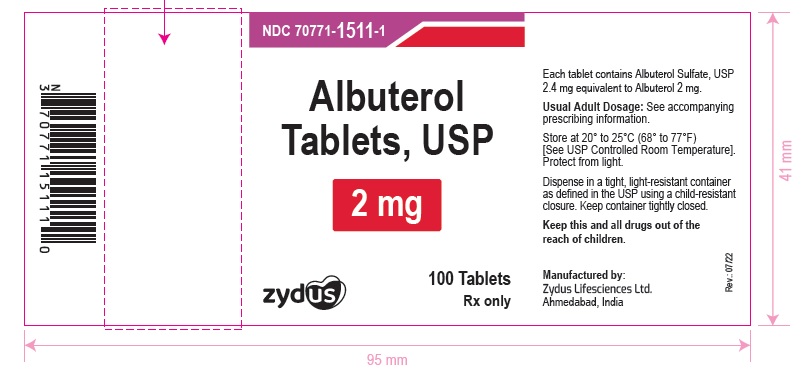
PACKAGE LABEL.PRINCIPAL DISPLAY PANEL NDC 70771-1511-1 in bottle of 100 tablets Albuterol tablets USP, 2 mg Rx only 100 Tablets NDC 70771-1512-1 in bottle of 100 tablets Albuterol tablets USP, 4 mg Rx only 100 Tablets label label
Reported adverse events (FAERS)
Top reported reactions
Age at onset
Reporter sex
Serious outcomes
Where does this data come from?
About this NDC listing & data coverage
What data is (and isn’t) available for this NDC — tap to expand
| NDC identity (package / product / labeler codes) | ✓ Available |
| Labeler | ✓ Available |
| Product & package description | ✓ Available |
| Marketing category & status | ✓ Available |
| Active ingredient / dosage form / route | ✓ Available |
| FDA label (SPL via DailyMed) | ✓ Available |
| Package photos | ✓ Available |
| Inactive ingredients (structured) | ✓ Available |
| NADAC pharmacy acquisition price (CMS) | — Not published for this NDC CMS publishes NADAC only for NDCs reported in its retail-pharmacy survey. |
| Orange Book / therapeutic-equivalence data | ✓ Available |
| HCPCS J-code billing crosswalk | — Not published for this NDC Most self-administered / retail products have no J-code — that is normal. |
| Medicaid utilization (CMS SDUD) | — Not published for this NDC CMS reports utilization only for NDCs with Medicaid claims above its privacy threshold. |