
dimethyl fumarate 240 mg Capsule, Delayed Release, 46-count — NDC 70771-1531-8 (Billing 70771-1531-08)
This is a package of 46 capsules of dimethyl fumarate 240 mg Capsule, Delayed Release from Zydus Lifesciences Limited, marketed since Sep 2020 and currently FDA-listed.
NDC database record
One package, one record: these facts belong to NDC 70771-1531-8 alone.
- Record
- FDA NDC Directory package listing · Human prescription drug
- Code segments
- 70771 labeler · 1531 product · 8 package
- Package marketed since
- Sep 28, 2020
- Sample package
- Yes — professional sample, not for sale
- Listing certified through
- Dec 31, 2026
- Barcode (UPC-A, from the NDC)
- 3 7077115318 3
- FDA record last changed
- Jul 24, 2026
Identity & classification
Regulatory identifiers FDA, NLM and CMS codes for this package
- RxCUI (RxNorm): 1373483
Where does this data come from?
- FDA openFDA NDC Directory · synced Oct 1, 2026
- FDA label on DailyMed · label index refreshed Oct 5, 2026
- RxNorm (NLM RxNav) · catalog refreshed Oct 1, 2026
- Medi-Span GPI (licensed)
- First Databank (licensed) · refreshed Oct 1, 2026
RxNorm drug class
This medicine belongs to the Other immunosuppressants class.
Where does this data come from?
- RxClass (NLM) · catalog refreshed Oct 1, 2026
Clinical
- The oral capsules are for relapsing forms of multiple sclerosis in adults. That includes clinically isolated syndrome, relapsing-remitting disease and active secondary progressive...
- You take them by mouth twice a day. Most people start on a lower dose for the first week and then move up. Swallow them whole, and do not crush, chew or sprinkle them on food. Take...
- Flushing is the most common, along with stomach pain, diarrhea and nausea. Taking the capsules with food can help the flushing. Your doctor may also suggest a non-enteric coated as...
- Get emergency help for swelling of the face, lips or throat or trouble breathing, and do not take another dose. Call right away for new neurologic symptoms, signs of a serious infe...
Patient education
Supplement & herbal interactions
Some supplements/herbs that may interact with Dimethyl Fumarate — tap one for details:
Where does this data come from?
- MedlinePlus (NLM) · refreshed Oct 1, 2026
- FDA label on DailyMed · label index refreshed Oct 5, 2026
Ask a licensed pharmacist directly — free, answered by our team.
Pricing
A drug doesn't have one price. Each row is a different public payment system, and none is what you'd pay at the counter — that depends on your insurance. The ⓘ on each row explains what it measures.
| Price system | Per each | Per package |
|---|---|---|
| Retail pharmacies payNADAC · weekly | Not in the retail survey — common for institutional, discontinued, or low-volume packs. | |
| Medicaid paysCMS SDUD · 12 mo | No recent Medicaid claims on file for this NDC — rare and low-volume NDCs are suppressed in the public data. | |
| Medicare drug plans payPart D · Q2 2026 | $1.89 | $86.71 / 46 capsules |
Where does this data come from?
- CMS NADAC weekly file
- CMS ASP pricing files · refreshed Sep 20, 2026
- CMS Medicaid State Drug Utilization Data · refreshed Oct 5, 2026
- CMS Part D plan pricing files · refreshed Sep 24, 2026
- VA National Acquisition Center price file
Packaging — all sizes for this product
| Package NDC | Description | Marketing start | Marketing end | Status |
|---|---|---|---|---|
| 70771-1531-06 70771-1531-6 Main listing | 60 CAPSULE, DELAYED RELEASE in 1 BOTTLE Sample | 2020-09-28 | — | Active |
| 70771-1531-08 You're viewing this | 46 CAPSULE, DELAYED RELEASE in 1 BOTTLE Sample | 2020-09-28 | — | Active |
You're viewing the smallest of 2 pack sizes for this product.
Pack size FAQ
What quantity is in this package?
How does this package differ from NDC 70771-1531-06?
What NDC number is used to bill for this package of dimethyl fumarate 240 mg Capsule, Delayed Release?
Therapeutic equivalents
| Product | Labeler | Pack | NADAC/unit | TE | Status | Price vs. this |
|---|---|---|---|---|---|---|
| Dimethyl Fumarate 240 mg 16729-0417-12 | Accord | 60 capsules | $0.456 | AB | Availability likely | — |
| Dimethyl Fumarate 240 mg 33342-0350-09 | Macleods | 60 capsules | $0.467 | AB | Availability likely | — |
| Dimethyl Fumarate 240 mg 43547-0025-06 | Solco | 60 capsules | $0.467 | AB | Availability likely | — |
| Dimethyl Fumarate 240 mg 43598-0430-60 | Dr. | 60 capsules | $0.467 | AB | Availability likely | — |
| Dimethyl Fumarate 240 mg 59651-0084-60 | Aurobindo | 60 capsules | $0.467 | AB | Availability likely | — |
| Dimethyl Fumarate 240 mg 69097-0323-03 | Cipla | 60 capsules | $0.467 | — | Availability likely | — |
| Dimethyl Fumarate 240 mg 69238-1319-06 | Amneal | 60 capsules | $0.467 | AB | Availability likely | — |
| Dimethyl Fumarate 240 mg 70512-0853-60 | SOLA | 60 capsules | $0.467 | AB | Availability likely | — |
| Dimethyl Fumarate 240 mg 82009-0138-60 | Quallent | 60 capsules | $0.467 | AB | Availability likely | — |
| Dimethyl fumarate 240 mg 82249-0747-60 | CivicaScript | 60 capsules | $0.467 | AB | Availability likely | — |
| dimethyl fumarate 240 mg 24979-0128-02 | Upsher-Smith | 500 capsules | — | AB | FDA listed | — |
| Dimethyl Fumarate 240 mg 31722-0658-31 | Camber | 46 capsules | — | AB | FDA listed | — |
| Dimethyl Fumarate 240 mg 50090-5288-00 | A-S | 1 capsule | — | AB | FDA listed | — |
| dimethyl fumarate 240 mg 51407-0441-60 | Golden | 60 capsules | — | AB | FDA listed | — |
| Tecfidera 240 mg 64406-0006-02 | Biogen | 60 capsules | — | AB | FDA listed | — |
| Dimethyl fumarate 240 mg 67877-0556-10 | Ascend | 1000 capsules | — | AB | FDA listed | — |
| Dimethyl Fumarate 240 mg 68462-0308-05 | Glenmark | 500 capsules | — | AB | FDA listed | — |
| Dimethyl Fumarate 240 mg 69539-0043-05 | MSN | 500 capsules | — | AB | FDA listed | — |
| dimethyl fumarate 240 mg 70710-1205-06 | Zydus | 60 capsules | — | — | FDA listed | — |
| dimethyl fumarate 240 mgthis 70771-1531-08 | Zydus | 46 capsules | — | — | FDA listed | — |
| Dimethyl Fumarate 240 mg 84677-0030-60 | Golden | 60 capsules | — | AB | FDA listed | — |
Where does this data come from?
- FDA openFDA NDC Directory · synced Oct 1, 2026
- FDA Orange Book · refreshed Oct 3, 2026
- CMS NADAC weekly file
Availability & generic status
This product is an FDA-approved generic. Other versions of the same drug are listed under Therapeutic equivalents, least expensive first.
Where does this data come from?
- FDA Orange Book · refreshed Oct 3, 2026
What it looks like
Where does this data come from?
- FDA label on DailyMed · label index refreshed Oct 5, 2026
Inactive Ingredients / Excipients
Inactive ingredients, also called excipients, are components of the drug product other than the active ingredient. They may include fillers, dyes, coatings, preservatives, flavors, or other formulation ingredients.
🧪 Avoiding an ingredient? See Dimethyl Fumarate inactive ingredients by manufacturer: every current product's list side by side, so you can ask your pharmacy for the version that does not list it.
💡 Tap an ingredient (hover on desktop) to see what it is and why it’s used.
-
UNII 5138Q19F1X
Ammonia is a colorless gas made from nitrogen and hydrogen. It's used in medicines as a pH buffer to maintain the correct acidity level and help keep the product stable.
-
UNII OP1R32D61U
Microcrystalline cellulose is a purified form of cellulose, a natural fiber from plant sources. It acts as a binder and filler in tablets and capsules, helping hold ingredients together and give the medicine its shape and size.
-
UNII M28OL1HH48
Croscarmellose sodium is a plant-based substance derived from cellulose. It acts as a disintegrant, helping tablets and capsules break down quickly in the digestive system so the medicine can be absorbed.
-
UNII 35SW5USQ3G
A synthetic yellow dye used to color medicines. It helps make tablets, capsules, and liquids visually distinct so patients can easily identify their medication.
-
UNII H3R47K3TBD
FD&C Blue No. 1 is a synthetic blue dye approved for use in foods and medicines. It serves as a colorant to give the medication its distinctive appearance and help with product identification.
-
UNII WZB9127XOA
A synthetic red dye used to color medications and make them easier to identify. It serves as a colorant in tablets, capsules, and liquid formulations.
-
UNII 1K09F3G675
Ferric oxide red is an inorganic iron compound used as a colorant in medicines. It gives tablets, capsules, or other dosage forms a red or reddish tint for identification and appearance.
-
UNII EX438O2MRT
Ferric oxide yellow is a naturally occurring iron compound used as a colorant in medications. It gives tablets, capsules, and other forms a yellow or golden hue for identification and appearance.
-
UNII XM0M87F357
A dark iron oxide compound that gives medicines their black or dark color. It's used as a colorant in tablets and capsules to help identify the product and make it visually distinctive.
-
UNII 2G86QN327L
Gelatin is a protein derived from animal collagen, commonly used in medicines as a gelling agent and capsule material. It helps create soft or hard capsule shells that hold and release medication, and can also thicken liquid formulations.
-
UNII 34966F76M6
A manufactured fat derived from glycerin and caprylic acid (a medium-chain fatty acid). It acts as an emulsifier and solubilizer to help mix oil and water-based ingredients and improve how the body absorbs the active drug.
-
UNII 70097M6I30
Magnesium stearate is a salt made from magnesium and stearic acid, a fatty substance. It's used in tablets and capsules as a lubricant and glidant to help ingredients flow smoothly during manufacturing and prevent sticking.
-
UNII 74G4R6TH13
A synthetic polymer made by combining two plastic-like chemicals. It forms a coating on tablets or capsules that dissolves at a specific point in the digestive tract, controlling where and when the medicine releases.
-
UNII NX76LV5T8J
A synthetic plastic polymer made from methacrylic acid and ethyl acrylate. It's used as a coating or binder to control how and where the medicine dissolves in your digestive system.
-
UNII 6OZP39ZG8H
Polysorbate 80 is a synthetic emulsifier derived from sorbitol and oleic acid. It helps mix oil and water-based ingredients together in medications and improves how the product disperses in the body.
-
UNII WZH3C48M4T
Potassium hydroxide is a strong alkaline chemical used in medicines to adjust and maintain the pH level of liquid formulations, helping keep the product stable and the active ingredients effective.
-
UNII U725QWY32X
Povidone K30 is a synthetic polymer made from petroleum. It acts as a binder to hold tablet ingredients together and as a disintegrant to help the tablet break apart in the stomach so the medicine can be absorbed.
-
UNII 6DC9Q167V3
Propylene glycol is a clear liquid derived from petroleum or vegetable sources. It acts as a solvent, humectant, and preservative in medicines, helping dissolve active ingredients and maintain product stability.
-
UNII 46N107B71O
Shellac is a natural resin secreted by the lac beetle. It's used as a coating on tablets and capsules to control how quickly the medicine dissolves and to improve appearance and stability.
-
UNII ETJ7Z6XBU4
Silicon dioxide is a naturally occurring mineral used as a glidant and anti-caking agent. It helps powder ingredients flow smoothly and prevents clumping during manufacturing and storage.
-
UNII 368GB5141J
A detergent and foaming agent derived from coconut or palm oil. In medications, it helps break down and mix oil and water-based ingredients, aids in tablet disintegration, and improves how the drug dissolves and spreads in the mouth or digestive system.
-
UNII 7SEV7J4R1U
A powder made from a naturally occurring mineral. In medicines, talc works as a glidant and anti-caking agent, helping tablets and capsules flow smoothly during manufacturing and preventing clumping.
-
UNII 15FIX9V2JP
Titanium dioxide is a bright white mineral powder commonly used as a colorant and opacifying agent. It makes pills and tablets white or lighter in color and helps make coatings non-transparent.
-
UNII 8Z96QXD6UM
Triethyl citrate is a clear liquid derived from citric acid. It acts as a plasticizer and solvent in tablet coatings and film formulations, helping the coating remain flexible and adhere properly to the medicine.
24 inactive ingredients listed in the exact product block matched to this NDC.
Where does this data come from?
ingredient classCode="IACT" elements from the exact product block matched by this NDC. Label-section narrative from DailyMed / the openFDA label index is shown separately when available.- FDA label on DailyMed · label index refreshed Oct 5, 2026
- FDA openFDA NDC Directory · synced Oct 1, 2026
Inactive ingredient FAQ
Are inactive ingredients the same for every manufacturer?
Why might an inactive ingredient be missing?
Can inactive ingredients matter?
Manufacturer & labeler
More NDCs from Zydus Lifesciences Limited labeler code 70771
- Propafenone Hydrochloride 225 mg Capsule, Extended Release NDC 70771-1525-5
- Propafenone Hydrochloride 325 mg Capsule, Extended Release NDC 70771-1526-5
- Propafenone Hydrochloride 425 mg Capsule, Extended Release NDC 70771-1527-5
- doxepin 3 mg Tablet NDC 70771-1528-0
- doxepin 6 mg Tablet NDC 70771-1529-0
- dimethyl fumarate 120 mg Capsule, Delayed Release NDC 70771-1530-7
- Dapsone 75 mg/g Gel NDC 70771-1538-2
- Meclizine Hydrochloride 12.5 mg Tablet NDC 70771-1539-0
- Meclizine Hydrochloride 25 mg Tablet NDC 70771-1540-0
- Erythromycin 250 mg Tablet, Film Coated NDC 70771-1548-1
- Erythromycin 500 mg Tablet, Film Coated NDC 70771-1549-1
- betamethasone dipropionate .5 mg/g Ointment NDC 70771-1550-1
Where does this data come from?
- FDA openFDA NDC Directory · synced Oct 1, 2026
- Drugs@FDA
Full prescribing information FDA SPL
📄 Package Label / Principal Display Panel ▾
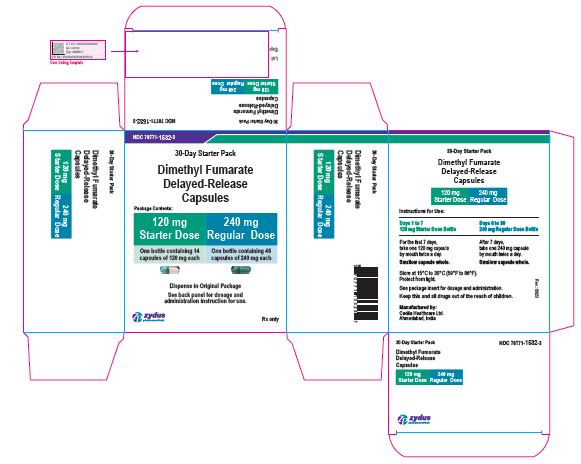
PACKAGE LABEL.PRINCIPAL DISPLAY PANEL NDC 70771-1532-3 30-Day Starter Pack Carton Label Dimethyl Fumarate Delayed-release Capsules 120 mg Starter Dose: 14 Capsules 240 mg Regular Dose: 46 Capsules Rx only NDC 70771-1530-7 Dimethyl Fumarate Delayed-release Capsules, 120 mg 14 Capsules Rx only NDC 70771-1531-6 Dimethyl Fumarate Delayed-release Capsules, 240 mg 60 Capsules Rx only label label label
Medicare Part D spend CMS · PART D · 2026 (Q1)
About this NDC listing & data coverage
What data is (and isn’t) available for this NDC — tap to expand
| NDC identity (package / product / labeler codes) | ✓ Available |
| Labeler | ✓ Available |
| Product & package description | ✓ Available |
| Marketing category & status | ✓ Available |
| Active ingredient / dosage form / route | ✓ Available |
| FDA label (SPL via DailyMed) | ✓ Available |
| Package photos | ✓ Available |
| Inactive ingredients (structured) | ✓ Available |
| NADAC pharmacy acquisition price (CMS) | — Not published for this NDC CMS publishes NADAC only for NDCs reported in its retail-pharmacy survey. |
| Orange Book / therapeutic-equivalence data | — Not published for this NDC Applies only to products approved under an NDA/ANDA; many listings are out of scope. |
| HCPCS J-code billing crosswalk | — Not published for this NDC Most self-administered / retail products have no J-code — that is normal. |
| Medicaid utilization (CMS SDUD) | — Not published for this NDC CMS reports utilization only for NDCs with Medicaid claims above its privacy threshold. |