
Erythromycin 500 mg Tablet, Film Coated, 100-count — NDC 70771-1549-1 (Billing 70771-1549-01)
This is a package of 100 tablets of Erythromycin 500 mg Tablet, Film Coated from Zydus Lifesciences Limited, marketed since Jun 2023 and currently FDA-listed. It is the main listing for this product, which comes in 3 package sizes.
NDC database record
One package, one record: these facts belong to NDC 70771-1549-1 alone.
- Record
- FDA NDC Directory package listing · Human prescription drug
- Code segments
- 70771 labeler · 1549 product · 1 package
- Package marketed since
- Jun 30, 2023
- Sample package
- No — commercial package
- Listing certified through
- Dec 31, 2026
- Barcode (UPC)
- 0370771154913
- FDA record last changed
- Jul 24, 2026
Other active recalls for Erythromycin (different manufacturers) — 2 · tap to view
Identity & classification
Regulatory identifiers FDA, NLM and CMS codes for this package
- RxCUI (RxNorm): 197650
Where does this data come from?
- FDA openFDA NDC Directory · synced Oct 8, 2026
- FDA label on DailyMed · label index refreshed Oct 6, 2026
- RxNorm (NLM RxNav) · catalog refreshed Oct 1, 2026
- Medi-Span GPI (licensed)
- First Databank (licensed) · refreshed Oct 8, 2026
RxNorm drug class
This medicine belongs to the Macrolide class.
Where does this data come from?
- RxClass (NLM) · catalog refreshed Oct 1, 2026
Clinical
Erythromycin is used to treat certain infection caused by bacteria including infections of the ears, lungs, sinuses, skin, throat, and reproductive organs. Erythromycin is in a class of medications called macrolide antibiotics. It works by stopping the growth of bacteria. Antibiotics such as erythromycin will not work for colds, flu, or other viral infections. Taking antibiotics when they are not needed increases your risk of getting an infection later that resists antibiotic treatment.
Read the full MedlinePlus article ↗- It’s an antibiotic for infections caused by susceptible bacteria. By mouth, it’s used for mild to moderate upper respiratory tract infections. The IV form covers additional infecti...
- It depends on the product. Ery-tab delayed-release tablets can be taken with or without meals, but work best on an empty stomach. Erythromycin ethylsuccinate tablets and suspension...
- Stomach upset is the most common. That includes nausea, vomiting, belly pain, diarrhea and loss of appetite. These tend to be more likely at higher doses. Call your doctor if they...
- Call for severe or lasting diarrhea, hives or swelling, a severe skin rash, a racing or irregular heartbeat, fainting, yellow skin or eyes, or hearing changes. These can signal ser...
Patient education
Supplement & herbal interactions
Some supplements/herbs that may interact with Erythromycin — tap one for details:
Erythromycin may be associated with lower levels of 7 nutrients — worth a chat with your pharmacist, not a cause for alarm.
Where does this data come from?
- MedlinePlus (NLM) · refreshed Oct 1, 2026
- FDA label on DailyMed · label index refreshed Oct 6, 2026
Ask a licensed pharmacist directly — free, answered by our team.
Pricing
A drug doesn't have one price. Each row is a different public payment system, and none is what you'd pay at the counter — that depends on your insurance. The ⓘ on each row explains what it measures.
| Price system | Per each | Per package |
|---|---|---|
| Retail pharmacies payNADAC · weekly | Not in the retail survey — common for institutional, discontinued, or low-volume packs. | |
| Medicaid paysCMS SDUD · 12 mo | No recent Medicaid claims on file for this NDC — rare and low-volume NDCs are suppressed in the public data. | |
| Medicare drug plans payPart D · Q2 2026 | $3.39 | $338.81 / 100 tablets |
Where does this data come from?
- CMS NADAC weekly file
- CMS ASP pricing files · refreshed Sep 20, 2026
- CMS Medicaid State Drug Utilization Data · refreshed Oct 8, 2026
- CMS Part D plan pricing files · refreshed Sep 24, 2026
- VA National Acquisition Center price file
Packaging — all sizes for this product
| Package NDC | Description | Marketing start | Marketing end | Status |
|---|---|---|---|---|
| 70771-1549-01 You're viewing this Main listing | 100 TABLET, FILM COATED in 1 BOTTLE | 2023-06-30 | — | Active |
| 70771-1549-03 70771-1549-3 | 30 TABLET, FILM COATED in 1 BOTTLE | 2023-06-30 | — | Active |
| 70771-1549-05 70771-1549-5 | 500 TABLET, FILM COATED in 1 BOTTLE | 2023-06-30 | — | Active |
You're viewing one of 3 pack sizes for this product.
Pack size FAQ
What quantity is in this package?
How does this package differ from NDC 70771-1549-03?
What NDC number is used to bill for this package of Erythromycin 500 mg Tablet, Film Coated?
Therapeutic equivalents
| Product | Labeler | Pack | NADAC/unit | TE | Status | Price vs. this |
|---|---|---|---|---|---|---|
| Erythromycin 500 mg 00093-5572-01 | Teva | 100 tablets | $2.510 | — | Availability likely | — |
| Erythromycin 500 mg 13668-0607-01 | Torrent | 100 tablets | $2.510 | AB | Availability likely | — |
| Erythromycin 500 mg 52536-0105-03 | Wilshire | 30 tablets | $2.510 | AB | Availability likely | — |
| Erythromycin 500 mg 70710-1048-01 | Zydus | 100 tablets | $2.510 | AB | Availability likely | — |
| Erythromycin 500 mg 75834-0243-01 | Nivagen | 100 tablets | $2.510 | AB | Discontinued | — |
| Erythromycin 500 mg 24338-0104-03 | Arbor | 30 tablets | $6.270 | AB | FDA listed | — |
| Erythromycin 500 mg 46708-0398-30 | Alembic | 30 tablets | — | AB | FDA listed | — |
| Erythromycin 500 mg 51407-0856-30 | Golden | 30 tablets | — | AB | FDA listed | — |
| Erythromycin 500 mg 62332-0398-30 | Alembic | 30 tablets | — | AB | FDA listed | — |
| Erythromycin 500 mg 67877-0763-01 | Ascend | 100 tablets | — | AB | FDA listed | — |
| Erythromycin 500 mgthis 70771-1549-01 | Zydus | 100 tablets | — | AB | FDA listed | — |
| Erythromycin 500 mg 71209-0101-01 | Cadila | 30 tablets | — | AB | FDA listed | — |
| Erythromycin 500 mg 72241-0037-05 | Modavar | 100 tablets | — | AB | FDA listed | — |
| Erythromycin 500 mg 73082-0020-01 | Orange | 100 tablets | — | AB | FDA listed | — |
Where does this data come from?
- FDA openFDA NDC Directory · synced Oct 8, 2026
- FDA Orange Book · refreshed Oct 3, 2026
- CMS NADAC weekly file
Availability & generic status
This product is an FDA-approved generic. Other versions of the same drug are listed under Therapeutic equivalents, least expensive first.
Where does this data come from?
- FDA Orange Book · refreshed Oct 3, 2026
What it looks like
Where does this data come from?
- FDA label on DailyMed · label index refreshed Oct 6, 2026
Inactive Ingredients / Excipients
Inactive ingredients, also called excipients, are components of the drug product other than the active ingredient. They may include fillers, dyes, coatings, preservatives, flavors, or other formulation ingredients.
🧪 Avoiding an ingredient? See Erythromycin inactive ingredients by manufacturer: every current product's list side by side, so you can ask your pharmacy for the version that does not list it.
💡 Tap an ingredient (hover on desktop) to see what it is and why it’s used.
-
UNII LMI26O6933
Alumina is a white powder form of aluminum oxide. It's used as a filler to add bulk to tablets and capsules, and sometimes as a thickening or anti-caking agent in powdered formulations.
-
UNII OP1R32D61U
Microcrystalline cellulose is a purified form of cellulose, a natural fiber from plant sources. It acts as a binder and filler in tablets and capsules, helping hold ingredients together and give the medicine its shape and size.
-
UNII M28OL1HH48
Croscarmellose sodium is a plant-based substance derived from cellulose. It acts as a disintegrant, helping tablets and capsules break down quickly in the digestive system so the medicine can be absorbed.
-
UNII 2S7830E561
Crospovidone is a synthetic polymer derived from povidone. It acts as a disintegrant, helping the tablet or capsule break apart quickly in the stomach so the active ingredient can be absorbed.
-
UNII 2S42T2808B
A synthetic red dye used as a colorant to give the medicine its red color. It helps make pills or liquids visually distinct and easier to identify.
-
UNII 1K09F3G675
Ferric oxide red is an inorganic iron compound used as a colorant in medicines. It gives tablets, capsules, or other dosage forms a red or reddish tint for identification and appearance.
-
UNII UKE75GEA7F
Hydroxypropyl cellulose is a plant-based polymer used as a binder and thickener. It helps hold tablet ingredients together, controls how fast the medicine dissolves, and improves the texture of liquid formulations.
-
UNII 0WZ8WG20P6
Hypromellose 2910 is a plant-based cellulose derivative that acts as a thickener, binder, and film-coating agent. It helps control how quickly the medicine dissolves and protects the tablet or capsule from moisture and light.
-
UNII G4U024CQK6
Hypromellose phthalate is a plant-derived polymer coating material. It's used to coat tablets or capsules so the medicine dissolves in the intestines rather than the stomach, protecting it from stomach acid or reducing stomach irritation.
-
UNII 70097M6I30
Magnesium stearate is a salt made from magnesium and stearic acid, a fatty substance. It's used in tablets and capsules as a lubricant and glidant to help ingredients flow smoothly during manufacturing and prevent sticking.
-
UNII 30IQX730WE
Polyethylene glycol 6000 is a synthetic polymer made from ethylene glycol units. It acts as a binder, filler, and solubilizer in medicines to help hold ingredients together, add bulk, and improve how well active drugs dissolve and absorb.
-
UNII U725QWY32X
Povidone K30 is a synthetic polymer made from petroleum. It acts as a binder to hold tablet ingredients together and as a disintegrant to help the tablet break apart in the stomach so the medicine can be absorbed.
-
UNII RDH86HJV5Z
Povidone K90 is a synthetic polymer made from a chemical called vinyl pyrrolidone. It acts as a binder to hold pill ingredients together and as a dispersant to help the medicine break down and dissolve properly in your body.
-
UNII 6DC9Q167V3
Propylene glycol is a clear liquid derived from petroleum or vegetable sources. It acts as a solvent, humectant, and preservative in medicines, helping dissolve active ingredients and maintain product stability.
-
UNII ETJ7Z6XBU4
Silicon dioxide is a naturally occurring mineral used as a glidant and anti-caking agent. It helps powder ingredients flow smoothly and prevents clumping during manufacturing and storage.
-
UNII 55X04QC32I
A strong alkaline chemical used to adjust and maintain the pH balance of liquid medicines. It helps keep the medicine stable and ensures it stays effective during storage.
-
UNII X045WJ989B
Sorbic acid is a preservative derived from berries that prevents mold, yeast, and bacterial growth in medicines. It keeps the product stable and safe during storage.
-
UNII 06XEA2VD56
Sorbitan oleate is an emulsifier derived from sorbitol and oleic acid. It helps mix oil and water-based ingredients together and keeps them from separating in the medicine.
-
UNII 7SEV7J4R1U
A powder made from a naturally occurring mineral. In medicines, talc works as a glidant and anti-caking agent, helping tablets and capsules flow smoothly during manufacturing and preventing clumping.
-
UNII 15FIX9V2JP
Titanium dioxide is a bright white mineral powder commonly used as a colorant and opacifying agent. It makes pills and tablets white or lighter in color and helps make coatings non-transparent.
-
UNII B22547B95K
A salt derived from citric acid that helps maintain the proper acid-base balance in the medicine. It's used as a buffer to keep the product stable and at the right pH level.
21 inactive ingredients listed in the exact product block matched to this NDC.
Where does this data come from?
ingredient classCode="IACT" elements from the exact product block matched by this NDC. Label-section narrative from DailyMed / the openFDA label index is shown separately when available.- FDA label on DailyMed · label index refreshed Oct 6, 2026
- FDA openFDA NDC Directory · synced Oct 8, 2026
Inactive ingredient FAQ
Are inactive ingredients the same for every manufacturer?
Why might an inactive ingredient be missing?
Can inactive ingredients matter?
Manufacturer & labeler
More NDCs from Zydus Lifesciences Limited labeler code 70771
- dimethyl fumarate 120 mg Capsule, Delayed Release NDC 70771-1530-7
- dimethyl fumarate 240 mg Capsule, Delayed Release NDC 70771-1531-6
- Dapsone 75 mg/g Gel NDC 70771-1538-2
- Meclizine Hydrochloride 12.5 mg Tablet NDC 70771-1539-0
- Meclizine Hydrochloride 25 mg Tablet NDC 70771-1540-0
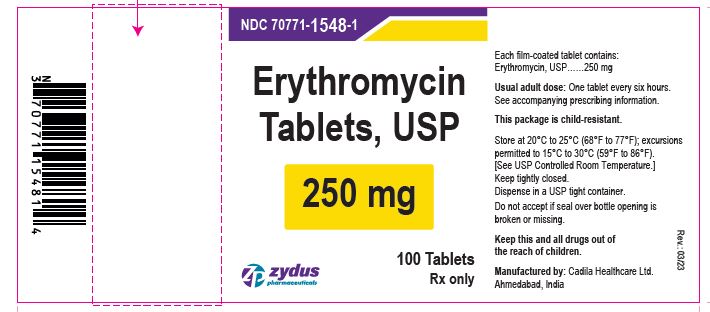
- Erythromycin 250 mg Tablet, Film Coated NDC 70771-1548-1
- betamethasone dipropionate .5 mg/g Ointment NDC 70771-1550-1
- febuxostat 40 mg Tablet NDC 70771-1552-0
- febuxostat 80 mg Tablet NDC 70771-1553-0
- Isotretinoin 10 mg Capsule NDC 70771-1557-4
- Isotretinoin 20 mg Capsule NDC 70771-1558-4
- Isotretinoin 30 mg Capsule NDC 70771-1559-8
Where does this data come from?
- FDA openFDA NDC Directory · synced Oct 8, 2026
- Drugs@FDA
Full prescribing information FDA SPL
📄 Package Label / Principal Display Panel ▾
PACKAGE LABEL.PRINCIPAL DISPLAY PANEL NDC 70771-1548-1 in bottle of 100 tablets Erythromycin Tablets USP, 250 mg Rx only 100 tablets NDC 70771-1549-1 in bottle of 100 tablets Erythromycin Tablets USP, 500 mg Rx only 100 tablets 250 mg label 500 mg label
Medicare Part D spend CMS · PART D · 2026 (Q1)
Reported adverse events (FAERS)
Top reported reactions
Age at onset
Reporter sex
Serious outcomes
Where does this data come from?
About this NDC listing & data coverage
What data is (and isn’t) available for this NDC — tap to expand
| NDC identity (package / product / labeler codes) | ✓ Available |
| Labeler | ✓ Available |
| Product & package description | ✓ Available |
| Marketing category & status | ✓ Available |
| Active ingredient / dosage form / route | ✓ Available |
| FDA label (SPL via DailyMed) | ✓ Available |
| Package photos | ✓ Available |
| Inactive ingredients (structured) | ✓ Available |
| NADAC pharmacy acquisition price (CMS) | — Not published for this NDC CMS publishes NADAC only for NDCs reported in its retail-pharmacy survey. |
| Orange Book / therapeutic-equivalence data | ✓ Available |
| HCPCS J-code billing crosswalk | — Not published for this NDC Most self-administered / retail products have no J-code — that is normal. |
| Medicaid utilization (CMS SDUD) | — Not published for this NDC CMS reports utilization only for NDCs with Medicaid claims above its privacy threshold. |