
Home › NDC Lookup › Ingredients › Ivabradine › 70771-1863-06
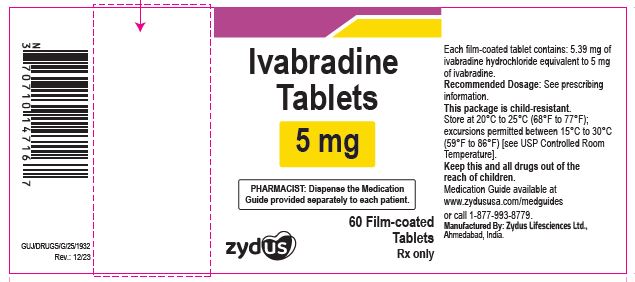
ivabradine 5 mg Tablet, 60-count — NDC 70771-1863-06 package photo

ivabradine 5 mg Tablet, 60-count

by Zydus Lifesciences Limited · 60 TABLET in 1 BOTTLE (70771-1863-6)
NDC 70771-1863-06
🏷️ FDA NDC (as labeled) 70771-1863-6 billing pads the package segment with a zero
This package
Contains60-count Pack sizes2 compare ↓
Also priced by: Part D plans $3.27/unit — full pricing hub ↓
Also comes in: 180 tablets 70771-1863-08
Rx only Generic On market Non-controlled
🗂️ Data synced Jul 24, 2026 · sources: openFDA · FDA label (DailyMed) · FDA Orange & Purple Book · First Databank · CMS NADAC, ASP, Medicare & Medicaid · RxNorm
📋 All sources & update times →
⚠️
Other active recalls for Ivabradine (different manufacturers) — 2 · tap to view
These affect other manufacturers’ products for the same ingredient — not necessarily the exact NDC on this page.
Class II · Jun 4, 2026 — Presence of Foreign Substance. (Amgen, Inc.) · FDA recall D-0615-2026
Class II · Jun 4, 2026 — Presence of Foreign Substance. (Amgen, Inc.) · FDA recall D-0612-2026
Each entry is an official FDA enforcement report — look up any recall number in the FDA recall database ↗

🆔 Identity & classification

FDA NDC (as labeled) 70771-1863-6
Product NDC 70771-1863
11-digit billing NDC 70771186306
RxCUI 1649485, 1649493
UNII TP19837BZK
Application # ANDA213442
SPL Set ID 246b495a-ea7b-4cbe-9a5f-87c2c0a59cb3
Established class (EPC) Hyperpolarization-activated Cyclic Nucleotide-gated Channel Blocker
Mechanism of action Hyperpolarization-activated Cyclic Nucleotide-gated Channel Antagonists
DEA schedule Non-controlled
Marketing category ANDA
Marketing status On market
FDA listing status Listed (active directory)
Marketing start 2024-07-02
Route ORAL
Dosage form TABLET
Substance IVABRADINE HYDROCHLORIDE
TE code (Orange Book) AB · RLD · RS
Why two NDCs? The FDA registers this code as 70771-1863-6 — a 5-4-1 layout, and that's what's printed on the package and shown on DailyMed. For insurance claims, every NDC is standardized to a uniform 11-digit 5-4-2 format by adding a zero to the package segment → 70771-1863-06. Same drug, same package — only the format differs.
Where does this data come from?
Identifiers from the FDA openFDA NDC Directory and Structured Product Labeling; RxCUI from RxNorm (NLM); GPI from Medi-Span; GCN / HIC / AHFS / legend from First Databank.

🏷️ RxNorm drug class

This medicine belongs to the Hyperpolarization-activated Cyclic Nucleotide-gated Channel Blocker class.

Pharmacologic class Hyperpolarization-activated Cyclic Nucleotide-gated Channel Blocker
Drug family (ATC) Other cardiac preparations
How it works Hyperpolarization-activated Cyclic Nucleotide-gated Channel Antagonists
Where does this data come from?
Therapeutic classes from RxNorm RxClass (U.S. National Library of Medicine) — Established Pharmacologic Class (FDA), ATC drug family (WHO) and mechanism of action, matched by this product’s RxCUI.

🏭 Manufacturer & labeler

LabelerZydus Lifesciences Limited
Application holderZYDUS PHARMACEUTICALS USA INC
FDA applicationANDA213442 (ANDA)
Labeler code70771
First marketedJul 2024
Product typeHuman Prescription Drug
Portfolio717 products on file
The labeler markets the product; the application holder owns the FDA approval. They’re often the same company but can differ (e.g. a repackager or an authorized generic). A mailing address / phone appears here when the manufacturer includes it in the product’s FDA label (not all do).
Where does this data come from?
Labeler, application holder and registered establishment from the FDA openFDA NDC Directory and Drugs@FDA; address/contact from the product’s FDA label.

🩺 Clinical

📖 What it is MedlinePlus · NLM

Ivabradine is used to treat certain adults with heart failure (condition in which the heart is unable to pump enough blood to the other parts of the body) to decrease the risk that their condition will worsen and need to be treated in a hospital. It is also used to treat a certain type of heart failure in children 6 months of age and older due to cardiomyopathy (a condition in which the heart muscle becomes weakened and enlarged). Ivabradine is in a class of medications called hyperpolarization-activated cyclic nucleotide-gated (HCN) channel blockers. It works by slowing the heart rate so the...

Read the full MedlinePlus article ↗
📗 Our plain-language guide HelloPharmacist
  • Ivabradine slows your heart rate by acting directly on your heart's natural pacemaker. When your heart is beating too fast, it has to work harder, which can worsen heart failure sy...
  • What exactly is ivabradine supposed to do for my heart failure?
  • Yes, it does matter. You should take ivabradine with food every time. Food increases the amount of the drug your body absorbs, which is actually part of how the standard dose is de...
  • Those brief flashes or areas of extra brightness are called phosphenes, and they're a known side effect of ivabradine. The drug affects a channel in the eye's retina that is simila...
📖 Read our full Ivabradine guide →
Where does this data come from?
Plain-language summary from MedlinePlus (U.S. National Library of Medicine); supplement & herbal interactions and nutrient depletion data from the Natural Medicines database; our full guide is HelloPharmacist editorial content.

💊 What it looks like

Color Orange
ShapeRound
Imprint1472
Size7 mm
ScoringNot scored
One label can cover several strengths, so colors may be combined — always confirm a loose pill against the dispensed prescription label or a pharmacist.
Where does this data come from?
Physical description (imprint, shape, color, scoring, coating) from this product’s FDA Structured Product Labeling (SPL), mirrored from DailyMed / openFDA.

🧪 Inactive Ingredients / Excipients

Inactive ingredients, also called excipients, are components of the drug product other than the active ingredient. They may include fillers, dyes, coatings, preservatives, flavors, or other formulation ingredients.

💡 Tap an ingredient (hover on desktop) to see what it is and why it’s used.

  • UNII LMI26O6933
    Alumina is a white powder form of aluminum oxide. It's used as a filler to add bulk to tablets and capsules, and sometimes as a thickening or anti-caking agent in powdered formulations.
  • UNII 3SY5LH9PMK
    Anhydrous lactose is a milk sugar with no water content. It acts as a filler and binder in tablets and capsules, adding bulk and helping ingredients stick together.
  • UNII ZK64F7XSTX
    A red synthetic colorant made by combining D&C Red No. 27 dye with aluminum salts. It's used to give tablets, capsules, or other medicines their red or pink color.
  • UNII 35SW5USQ3G
    A synthetic yellow dye used to color medicines. It helps make tablets, capsules, and liquids visually distinct so patients can easily identify their medication.
  • UNII 1K09F3G675
    Ferric oxide red is an inorganic iron compound used as a colorant in medicines. It gives tablets, capsules, or other dosage forms a red or reddish tint for identification and appearance.
  • UNII 0WZ8WG20P6
    Hypromellose 2910 is a plant-based cellulose derivative that acts as a thickener, binder, and film-coating agent. It helps control how quickly the medicine dissolves and protects the tablet or capsule from moisture and light.
  • UNII 70097M6I30
    Magnesium stearate is a salt made from magnesium and stearic acid, a fatty substance. It's used in tablets and capsules as a lubricant and glidant to help ingredients flow smoothly during manufacturing and prevent sticking.
  • UNII OP1R32D61U
    Microcrystalline cellulose is a purified form of cellulose, a natural fiber from plant sources. It acts as a binder and filler in tablets and capsules, helping hold ingredients together and give the medicine its shape and size.
  • UNII 4R4HFI6D95
    Polyethylene glycol 4000 is a synthetic polymer derived from petroleum. It serves as a binder, filler, and lubricant in solid dosage forms, and helps control how quickly the medicine dissolves.
  • UNII ETJ7Z6XBU4
    Silicon dioxide is a naturally occurring mineral used as a glidant and anti-caking agent. It helps powder ingredients flow smoothly and prevents clumping during manufacturing and storage.
  • UNII 5856J3G2A2
    A starch-based powder made from potatoes and processed with sodium. It acts as a disintegrant, helping the tablet or capsule break apart quickly in the stomach so the medicine can be absorbed.
  • UNII 15FIX9V2JP
    Titanium dioxide is a bright white mineral powder commonly used as a colorant and opacifying agent. It makes pills and tablets white or lighter in color and helps make coatings non-transparent.

12 inactive ingredients listed in the exact product block matched to this NDC.

Where does this data come from?
Data sourced from official FDA Structured Product Labeling (SPL) via DailyMed — ingredient classCode="IACT" elements from the exact product block matched by this NDC. Label-section narrative from DailyMed / the openFDA label index is shown separately when available.

Inactive ingredient FAQ

Are inactive ingredients the same for every manufacturer?
No. Inactive ingredients can differ by manufacturer, dosage form, strength, and package / product version.
Why might an inactive ingredient be missing?
Some SPLs do not provide a complete structured inactive-ingredient list, and older or unusual labels may only include the information in narrative text.
Can inactive ingredients matter?
Yes. They can matter for allergies, intolerances, dyes, gluten / lactose concerns, preservatives, and formulation differences — but confirm with a pharmacist or the manufacturer when it’s clinically important.

💲 Pricing

A drug doesn't have one price. Each row is a different public payment system, and none is what you'd pay at the counter — that depends on your insurance. The ⓘ on each row explains what it measures.

Price systemPer eachPer package
Retail pharmacies payNADAC · weekly Not in the retail survey — common for institutional, discontinued, or low-volume packs.
Medicaid paysCMS SDUD · 12 mo No recent Medicaid claims on file for this NDC — rare and low-volume NDCs are suppressed in the public data.
Medicare drug plans payPart D · Q2 2026 $3.27 $196.11 / 60 tablets
Where does this data come from?
NADAC (National Average Drug Acquisition Cost) is the CMS weekly pharmacy-acquisition-cost survey — what pharmacies pay. ASP (Average Sales Price) is the CMS Medicare Part B drug-payment file, published quarterly. Medicaid pays is computed by us from CMS State Drug Utilization Data (total reimbursed ÷ units, trailing 12 months) — gross of rebates and inclusive of dispensing fees, so it reflects what Medicaid paid, not an acquisition cost. Medicare drug plans pay is the median negotiated point-of-sale unit cost across plans listing this NDC in the CMS quarterly Prescription Drug Plan pricing files, before rebates. The VA pays is the federal contract price (FSS, and the statutory Big 4 ceiling where listed) from the VA National Acquisition Center pharmaceutical price file. All are free public government data; each measures a different payer, so the figures are not directly comparable.

🔁 Therapeutic equivalents

ProductLabelerPackNADAC/unitTEStatusPrice vs. this
Ivabradine 5 mg 31722-0053-60 Camber 60 tablets $0.761 AB Availability likely —
Ivabradine 5 mg 50742-0362-60 Ingenus 60 tablets $0.761 AB Availability likely —
Ivabradine 5 mg 60687-0862-21 American 1 tablet $0.761 AB Availability likely —
ivabradine 5 mg 69452-0190-17 Bionpharma 60 tablets $0.761 AB Availability likely —
ivabradine 5 mg 70710-1471-06 Zydus 60 tablets $0.761 AB Availability likely —
Ivabradine 5 mg 72603-0934-01 Northstar 60 tablets $0.761 AB Availability likely —
Corlanor 5 mg 55513-0800-60 Amgen 60 tablets $10.011 — Availability likely —
Ivabradine 5 mg 46708-0679-45 Alembic 180 tablets — AB FDA listed —
Ivabradine 5 mg 51407-0592-60 Golden 60 tablets — AB FDA listed —
Ivabradine 5 mg 62332-0679-45 Alembic 180 tablets — AB FDA listed —
ivabradine 5 mgthis 70771-1863-06 Zydus 60 tablets — AB FDA listed —
Ivabradine 5 mg 72205-0336-18 Novadoz 180 tablets — AB FDA listed —
About this product: this is a generic version of the medicine. FDA equivalence ratings are shown when available, and other versions are listed above, least expensive first.
Where does this data come from?
Equivalents are other NDCs of the same ingredient, form and route from the openFDA NDC Directory, ranked least-expensive-first by NADAC. Therapeutic-equivalence (AB) ratings come from the FDA Orange Book; biologics use the FDA Purple Book for biosimilar & interchangeable status.

⏳ Availability & generic status

🏛️
2024
On the market since
Jul 2024
📍
2026
Currently FDA-listed
2 years listed
🔓
·
Generic on the market
this product is a generic
✅This is a generic drug

This product is an FDA-approved generic. Other versions of the same drug are listed under Therapeutic equivalents, least expensive first.

Where does this data come from?
Patents and exclusivity from the FDA Orange Book (small-molecule drugs), refreshed from public FDA data. Generic launch timing is an estimate, not a guarantee.

📦 Packaging — all sizes for this product

Package NDCDescription Marketing startStatus
70771-1863-06 You're viewing this 60 TABLET in 1 BOTTLE (70771-1863-6) 2024-07-02 Active
70771-1863-08 180 TABLET in 1 BOTTLE (70771-1863-8) 2024-07-02 Active

You're viewing the smallest of 2 pack sizes for this product.

Pack size FAQ

What quantity is in NDC 70771-1863-06?
NDC 70771-1863-06 is a 60-count package — 60 tablet in 1 bottle.
What is the difference between NDC 70771-1863-06 and NDC 70771-1863-08?
Both are ivabradine 5 mg Tablet — the drug itself is identical. NDC 70771-1863-06 is the 60-count package, while NDC 70771-1863-08 is the 180 tablets package.
What NDC number is used to bill for this package of ivabradine 5 mg Tablet?
Bill NDC 70771-1863-06 — the 11-digit billing format is 70771186306. Pharmacy and medical claims use the 11-digit form; the FDA label may print a shorter form of the same code.

🧭 About this NDC listing & data coverage

Finished prescription product
What data is (and isn’t) available for this NDC — tap to expand
NDC identity (package / product / labeler codes) ✓ Available
Labeler ✓ Available
Product & package description ✓ Available
Marketing category & status ✓ Available
Active ingredient / dosage form / route ✓ Available
FDA label (SPL via DailyMed) ✓ Available
Package photos ✓ Available
Inactive ingredients (structured) ✓ Available
NADAC pharmacy acquisition price (CMS) — Not published for this NDC CMS publishes NADAC only for NDCs reported in its retail-pharmacy survey.
Orange Book / therapeutic-equivalence data ✓ Available
HCPCS J-code billing crosswalk — Not published for this NDC Most self-administered / retail products have no J-code — that is normal.
Medicaid utilization (CMS SDUD) — Not published for this NDC CMS reports utilization only for NDCs with Medicaid claims above its privacy threshold.
“Not published” reflects what the public FDA / CMS / NLM sources provide for this exact package code — it is a property of the data feeds, not a judgment about the product.

Questions about this listing

Why is there no price listed?
The pricing shown on our NDC pages comes from CMS NADAC, a voluntary survey of retail community pharmacy invoices. CMS does not publish a NADAC for every NDC — packages outside the retail survey (institutional and hospital products, bulk packages, discontinued items, and many OTC items) may never receive one. A missing price reflects the survey's scope, not this product's actual cost, and does not mean the product is free or unavailable.
Is the NDC printed on the package the same as the 11-digit billing NDC?
Yes, they identify this exact package in different formats. The FDA registers it as 70771-1863-6, which is what is printed on the packaging and shown on DailyMed. Insurance claims use a fixed 11-digit 5-4-2 format, so the short segment is padded with a leading zero: 70771-1863-06, written without dashes as 70771186306. The Identity section at the top of this page lists every form of this code.
What do the three segments of this NDC mean?
In 70771-1863-06, the first segment (70771) is the labeler code FDA assigned to Zydus Lifesciences Limited; the middle segment (1863) identifies this specific product — its ingredient, strength, and dosage form; and the last segment (06) identifies this exact package size and type. Together they name one specific package of one specific product.
Is this package still being marketed?
Yes, per the latest FDA NDC Directory data on this page: this package is listed as actively marketed, with no marketing end date reported by Zydus Lifesciences Limited. Listing status can change — the directory data on this page refreshes weekly.
Does this product come in other package sizes?
Yes — the FDA directory lists 1 other package presentation of this same product, including 180 tablets (70771-1863-08). Each has its own NDC and its own page — see the package list near the top of this page.
Who lists this product with the FDA?
Zydus Lifesciences Limited is the labeler of record for this NDC — the company under whose FDA-assigned code the package is listed. The labeler may be the manufacturer itself or a distributor marketing the product under its own code.
Do I need a prescription for this product?
This NDC is listed with FDA as a prescription product, so it is dispensed under a prescriber's order. Your pharmacist can tell you whether any over-the-counter forms of the same medication exist.
This page identifies an FDA-listed package (the NDC) and reports public regulatory and pricing data about the listing. It is reference information, not a medical recommendation — talk to your pharmacist or prescriber about your own medication.
Where does this data come from?
Listing facts (marketing category, packager status, marketing dates) from the FDA openFDA NDC Directory; label availability from DailyMed; pricing coverage from CMS NADAC; equivalence scope from the FDA Orange Book.

📄 Full prescribing information FDA SPL

The complete FDA label for this product — the official prescribing information, verbatim, section by section. Jump with a chip, search within the label, or expand everything.
💬 Medication Guide 2 words ▾

SPL MEDGUIDE

Source: FDA Structured Product Labeling, mirrored from DailyMed / openFDA. Prefer the government’s original formatting? View this label on DailyMed ↗
For educational and professional reference only — not medical advice. Pricing reflects published NADAC and CMS ASP (free public data) and may differ from your acquisition cost; always verify before billing or dispensing.