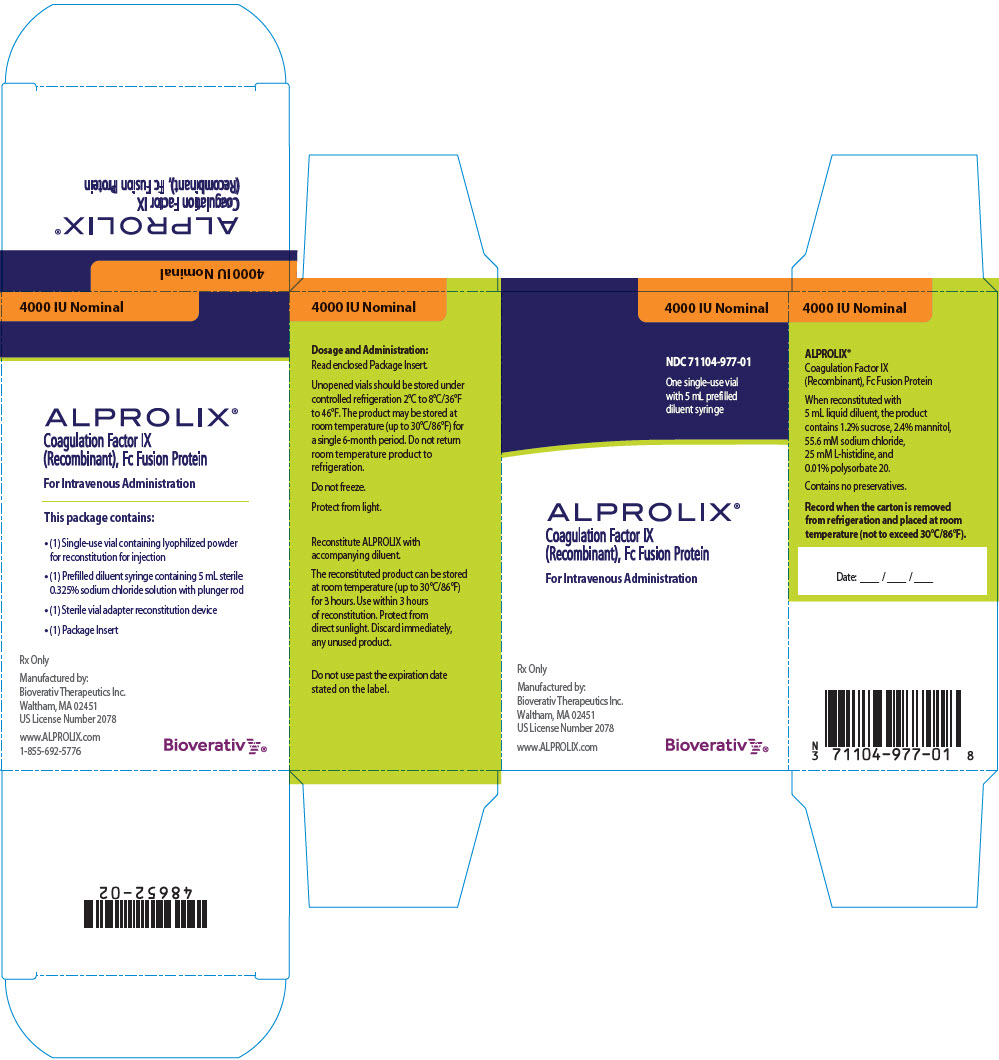
Label image from the product's FDA listing (DailyMed) — may show a different pack size or an older label revision.
ALPROLIX Coagulation Factor IX (Recombinant), Fc Fusion Protein Kit — NDC 71104-977-01 (Billing 71104-0977-01)
by Bioverativ Therapeutics Inc. · 1 KIT in 1 CARTON * 5 mL in 1 VIAL * 5 mL in 1 VIAL
This is a package of ALPROLIX Coagulation Factor IX (Recombinant), Fc Fusion Protein Kit from Bioverativ Therapeutics Inc., marketed since May 2014 and currently FDA-listed. It is this product's only package size.
NDC 71104-0977-01
🏷️ FDA NDC (as labeled)71104-977-01billing pads the product segment with a zero
🗂️ FDA directory synced Oct 1, 2026 · this listing last changed Oct 1, 2026 · sources: openFDA · FDA label (DailyMed) · FDA Orange & Purple Book · First Databank · CMS NADAC, ASP, Medicare & Medicaid · RxNorm
Compiled from public FDA, CMS, DailyMed, NADAC, and related drug data sources. Editorial policy
NDC database record
One package, one record: these facts belong to NDC 71104-977-01 alone.
Record
FDA NDC Directory package listing · Plasma derivative
Code segments
71104 labeler · 977 product · 01 package
Package marketed since
May 5, 2014
Sample package
No — commercial package
Listing certified through
Dec 31, 2026
Barcode (UPC-A, from the NDC)
3 7110497701 8
Medicaid fills, this package
346 prescriptions in the last four reported quarters
FDA record last changed
Oct 1, 2026
Identity & classification
Regulatory identifiers FDA, NLM and CMS codes for this package
FDA NDC (as labeled)71104-977-01
Product NDC71104-977
11-digit billing NDC71104097701
NCPDP billing unitEA — each (per item)
Application #BLA125444
SPL Set ID2fb3fb92-379d-4683-80d6-b06c0a7dc063
DEA scheduleNon-controlled
Marketing categoryBLA
Marketing statusOn market
FDA listing statusListed (active directory)
Marketing start2014-05-05
Dosage formKIT
Biologic (Purple Book)351(a)
Drug-database identifiers Medi-Span GPI and First Databank GCN / HICL / AHFS classification
GPI-1485100028402150
GPI classAlprolix
GCN Seq No076768
GCN42556
HICL code041044
Ingredient (HICL)Factor Ix Rec, Fc Fusion Protn
HIC1 codeM
Therapeutic class — broad (HIC1)Blood
HIC2 codeM0
Therapeutic class — intermediate (HIC2)Blood And Blood Replacement Preparations
HIC3 codeM0F
Therapeutic class — specific (HIC3)Factor Ix Preparations
AHFS code20:28.16.00
AHFS classHemostatics
FDB label nameALPROLIX 4,000 UNIT NOMINAL
FDB brand nameAlprolix
Legend statusF — Federal legend — prescription drug or device
Quick answers
GSN (GCN sequence number):076768
GCN:42556
GPI-14 (Medi-Span):85100028402150
HICL (First Databank):041044
AHFS class code:20:28.16.00
Why two NDCs?
The FDA registers this code as 71104-977-01 — a 5-3-2 layout, and that's what's printed on the package and shown on DailyMed. For insurance claims, every NDC is standardized to a uniform 11-digit 5-4-2 format by adding a zero to the product segment → 71104-0977-01. Same drug, same package — only the format differs.
Where does this data come from?
Identifiers from the FDA openFDA NDC Directory and Structured Product Labeling; RxCUI from RxNorm (NLM); GPI from Medi-Span; GCN / HIC / AHFS / legend from First Databank.
Plain-language summary from MedlinePlus (U.S. National Library of Medicine); supplement & herbal interactions and nutrient depletion data from the Natural Medicines database; our full guide is HelloPharmacist editorial content.
A drug doesn't have one price. Each row is a different public payment system, and none is what you'd pay at the counter — that depends on your insurance. The ⓘ on each row explains what it measures.
Price system
Per each
Per package
Retail pharmacies payNADAC · weekly
Not in the retail survey — common for institutional, discontinued, or low-volume packs.
Medicaid paysCMS SDUD · 12 mo
$3.68
—
Medicare drug plans payPart D · quarterly
No Part D plan price is available for this NDC in our data.
Medicare Part B allowsASP · J7201
$3.711 / J7201 unit
—
Where does this data come from?
NADAC (National Average Drug Acquisition Cost) is the CMS weekly pharmacy-acquisition-cost survey — what pharmacies pay. ASP (Average Sales Price) is the CMS Medicare Part B drug-payment file, published quarterly. Medicaid pays is computed by us from CMS State Drug Utilization Data (total reimbursed ÷ units, trailing 12 months) — gross of rebates and inclusive of dispensing fees, so it reflects what Medicaid paid, not an acquisition cost. Medicare drug plans pay is the median negotiated point-of-sale unit cost across plans listing this NDC in the CMS quarterly Prescription Drug Plan pricing files, before rebates. The VA pays is the federal contract price (FSS, and the statutory Big 4 ceiling where listed) from the VA National Acquisition Center pharmaceutical price file. All are free public government data; each measures a different payer, so the figures are not directly comparable.
DescriptorInjection, factor ix, fc fusion protein, (recombinant), alprolix, 1 i.u.
Billing units / pkg1 units
How the units are derivedThis package is 1; the HCPCS unit is 1 IU, so one package = 1 billing unit.
Medicare Part B spend (2026 (Q1))$15,582,345 · 317 claims · $49,155.66 per claim (all NDCs under J7201)
Crosswalk sourceCMS ASP NDC-HCPCS Crosswalk
Where does this data come from?
The HCPCS J-code crosswalk comes from the CMS ASP NDC-HCPCS crosswalk and the DMEPDAC (DME MAC) NDC-HCPCS crosswalk — free public CMS data. Billing units are derived from the code’s descriptor and the package amount.
About this product: this is a biologic. Biologics don't have small-molecule generics — competition comes from FDA-licensed biosimilars (shown above), not generics.
Where does this data come from?
Equivalents are other NDCs of the same ingredient, form and route from the openFDA NDC Directory, ranked least-expensive-first by NADAC. Therapeutic-equivalence (AB) ratings come from the FDA Orange Book; biologics use the FDA Purple Book for biosimilar & interchangeable status.
Biologics have no small-molecule generics; biosimilar competition is tracked in the FDA Purple Book.
🛡️ Latest patent/protection date listed: The latest listed FDA patent/protection lapsed Mar 2026 — those protections no longer apply, though a biosimilar still needs FDA licensure and a manufacturer to market it.
📅 FDA approved Mar 28, 2014
Why the date isn’t exact: Biosimilar timing can change because patents may be challenged, settled, licensed, added or removed, and litigation can move the real date earlier or later.
FDA Purple Book — biosimilars & interchangeables
ⓘ
🔒 No FDA-licensed biosimilars or interchangeable biosimilars are listed yet for this biologic. It currently has no biosimilar competition in the FDA Purple Book.
Source: FDA Purple Book (purplebooksearch.fda.gov), matched on the reference product’s active ingredient.
Patents & exclusivity — FDA Purple Book
Exclusivity RefProduct
2014201620182020202220242026
Today
LOE
Biologic patentExclusivity
🏛️Reference-product exclusivity
A flat 12 years of FDA market protection from first licensure. No biosimilar can be licensed before it ends — regardless of patents.
🧪Listed biologic patents
Patents the reference maker lists covering the molecule, formulation, or manufacturing. A biosimilar generally can’t launch until these resolve.
🔁Interchangeability
An interchangeable biosimilar may be substituted at the pharmacy (state laws vary). The first one can earn its own exclusivity period.
🛈 What do these terms mean?
Biologic patent
A patent the reference product’s maker has publicly listed. A biosimilar generally can’t launch until these expire — unless they’re invalidated or resolved in a settlement.
Reference-product exclusivity
A flat 12 years of FDA market protection from the biologic’s first licensure (the BPCIA). No biosimilar can be licensed before it ends, regardless of patents.
Interchangeable exclusivity
The first interchangeable biosimilar can earn a period as the only interchangeable version (pharmacists can substitute it without the prescriber).
Earliest biosimilar (LOE)
The latest of all the dates above — the soonest a biosimilar can realistically reach the market. Litigation and settlements can move it earlier.
Biologics have no small-molecule “generics” — competition comes from FDA-licensed biosimilars, tracked in the FDA Purple Book.
FDA exclusivity
Code
What it grants
Expires
RefProduct
Reference-product exclusivity (12-year, BPCIA) — no biosimilar can be licensed before this date
Mar 28, 2026
Common questions
Is there a biosimilar for ALPROLIX 4,000 UNIT NOMINAL?
No FDA-licensed biosimilar is currently listed for this biologic in the FDA Purple Book.
Why do different websites show different biosimilar dates?
Biosimilar availability isn’t based on one single date. Some sources use the reference-product exclusivity, some use the last listed patent, and patent litigation, settlements, and licenses can all change the real-world launch date. This page shows the underlying Purple Book dates so you can see why estimates differ.
Can a biosimilar launch before the last patent expires?
Sometimes. A biosimilar maker may settle with the reference manufacturer or receive a license to launch earlier. In other cases, the last listed protection delays competition.
What does “current Purple Book estimate” mean?
It means we’re using the latest patent and exclusivity dates currently listed in the FDA Purple Book. It is not a guaranteed launch date.
What does “FDA listed” mean?
It means the product appears in the FDA’s official directory. That’s a good sign a product exists for the U.S. market, but on its own it does not confirm a pharmacy can get it today. Where we have recent retail pricing data, we label it “Availability likely” instead.
What does a patent or protection date mean here?
It’s the latest date currently listed in the FDA Purple Book for a patent or exclusivity on the reference biologic. It can affect when a biosimilar becomes widely available — but it is not a guaranteed launch date. Settlements and licenses can move the real date earlier or later.
Built from the FDA Purple Book Patent List (patents the reference-product sponsor has publicly listed under the BPCIA) plus reference-product exclusivity. Biosimilars cannot launch until these clear; patent litigation and settlements can shift the real date. Biologics have no small-molecule generics — competition comes from FDA-licensed biosimilars, not the Orange Book.
Where does this data come from?
Patents and exclusivity from the FDA Purple Book (biologics), refreshed from public FDA data. Biosimilar launch timing is an estimate, not a guarantee.
Inactive ingredients, also called excipients, are components of the drug product
other than the active ingredient. They may include fillers, dyes, coatings, preservatives, flavors,
or other formulation ingredients.
Loading inactive ingredients from the official FDA label in the background. No external source is being called by this page request.
Where does this data come from?
Source: official FDA Structured Product Labeling (SPL) via DailyMed and the openFDA label index. Structured IACT rows and label-wide narrative are kept separate; availability and product-level specificity depend on the submitted label.
Are inactive ingredients the same for every manufacturer?
No. Inactive ingredients can differ by manufacturer, dosage form, strength, and package / product version.
Why might an inactive ingredient be missing?
Some SPLs do not provide a complete structured inactive-ingredient list, and older or unusual labels may only include the information in narrative text.
Can inactive ingredients matter?
Yes. They can matter for allergies, intolerances, dyes, gluten / lactose concerns, preservatives, and formulation differences — but confirm with a pharmacist or the manufacturer when it’s clinically important.
Manufacturer & labeler
LabelerBioverativ Therapeutics Inc.
FDA applicationBLA125444 (BLA)
Labeler code71104
First marketedMay 2014
Product typePlasma Derivative
Portfolio22 products on file
More NDCs from Bioverativ Therapeutics Inc. labeler code 71104
The labeler markets the product; the application holder owns the FDA approval. They’re often the same company but can differ (e.g. a repackager or an authorized generic). A mailing address / phone appears here when the manufacturer includes it in the product’s FDA label (not all do).
Where does this data come from?
Labeler, application holder and registered establishment from the FDA openFDA NDC Directory and Drugs@FDA; address/contact from the product’s FDA label.
No FDA label is on file for this product yet. Labels load from openFDA / DailyMed and refresh weekly.
No label section mentions that — try another word, or open the full label on DailyMed below.
Source: FDA Structured Product Labeling, mirrored from DailyMed / openFDA.
Prefer the government’s original formatting? View this label on DailyMed ↗
Medicaid utilization & spend
📍 This exact package only: Medicaid data is reported per full 11-digit NDC — labeler, product and pack size — so every number here is for this package alone, not the drug overall. Other pack sizes report separately.
💊 Pharmacy benefit only: These are Medicaid outpatient pharmacy claims, billed by NDC. They exclude the medical benefit — clinic- or hospital-administered drugs billed under HCPCS J-codes — so drugs used mostly that way (e.g. Avastin, Lucentis, Keytruda) can look low or missing here. That’s expected, not an error.
📅 Q1 2025 – Q1 2026 · 5 quarters of data
ⓘ The newest quarter is usually incomplete when first published; states restate recent quarters in later CMS releases, so the latest figures typically revise upward. State coverage-policy changes can also shift quarter-to-quarter totals.
Prescriptions last 4 qtrs
346
Units reimbursed last 4 qtrs
5.2M
Gross reimbursed last 4 qtrs
$19M
Avg / prescription
$54,921.71
Avg / unit
$3.6832
Latest quarter Q1 2026
68Rx
Fee-for-service vs managed care ⓘ
63% FFS37% MCO
Fee-for-service · 218 Rx Managed care · 128 Rx
State Medicaid map
Units reimbursed · per 100k residents
1,06920,357
gray = no data reported ⓘ
Colors are per 100,000 residents, so big states don’t automatically dominate. Tap or hover a state for its actual totals.
Tap or hover a state
…for its Medicaid breakdown
Prescriptions—
Units—
Reimbursed—
🏆 Top states by units · per 100k residents
1Indiana20,357 /100k
2Pennsylvania5,220 /100k
3New York3,815 /100k
4California3,057 /100k
5Florida2,280 /100k
6Utah1,943 /100k
7Texas1,470 /100k
8Georgia1,069 /100k
National units — by quarter
💵 About the dollar figures: “reimbursed” is what Medicaid paid pharmacies before confidential manufacturer rebates, so the program’s real net cost is lower than these numbers. Fee-for-service and managed-care claims are combined unless split above. Source: CMS State Drug Utilization Data; per-100k rates use 2023 Census population estimates.
About this NDC listing & data coverage
Kit / multi-component package
Kit / multi-component package
This NDC identifies a kit — a package containing more than one component. Structured data (pricing, ingredients, equivalents) is often reported per component rather than for the kit NDC itself, which can make this page look thinner than the components' own pages.
What data is (and isn’t) available for this NDC — tap to expand
NDC identity (package / product / labeler codes)
✓ Available
Labeler
✓ Available
Product & package description
✓ Available
Marketing category & status
✓ Available
Active ingredient / dosage form / route
✓ Available
FDA label (SPL via DailyMed)
✓ Available
Package photos
✓ Available
Inactive ingredients (structured)
— Not published for this NDCThe labeler did not submit a structured excipient list, or no SPL is available.
NADAC pharmacy acquisition price (CMS)
— Not published for this NDCCMS publishes NADAC only for NDCs reported in its retail-pharmacy survey.
Orange Book / therapeutic-equivalence data
✓ Available
HCPCS J-code billing crosswalk
✓ Available
Medicaid utilization (CMS SDUD)
✓ Available
“Not published” reflects what the public FDA / CMS / NLM sources provide for this exact package code — it is a property of the data feeds, not a judgment about the product.
Questions about this listing
Why is there no price listed?
The pricing shown on our NDC pages comes from CMS NADAC, a voluntary survey of retail community pharmacy invoices. CMS does not publish a NADAC for every NDC — packages outside the retail survey (institutional and hospital products, bulk packages, discontinued items, and many OTC items) may never receive one. A missing price reflects the survey's scope, not this product's actual cost, and does not mean the product is free or unavailable.
Is the NDC printed on the package the same as the 11-digit billing NDC?
Yes, they identify this exact package in different formats. The form printed on the packaging and shown on DailyMed is the one the FDA registered. Insurance claims use a fixed 11-digit 5-4-2 format, so the short segment is padded with a leading zero and the dashes are dropped. The Identity section at the top of this page lists each form of this code.
Is this package still being marketed?
Yes, per the latest FDA NDC Directory data on this page: this package is listed as actively marketed, with no marketing end date reported by Bioverativ Therapeutics Inc.. Listing status can change — the directory data on this page refreshes weekly.
Who lists this product with the FDA?
Bioverativ Therapeutics Inc. is the labeler of record for this NDC — the company under whose FDA-assigned code the package is listed. The labeler may be the manufacturer itself or a distributor marketing the product under its own code.
Does this product have a billing J-code?
Yes — this NDC cross-references HCPCS code J7201 for medical-claim billing (typically used when a product is administered in a clinical setting rather than dispensed at a retail pharmacy). See the Billing section on this page.
This page identifies an FDA-listed package (the NDC) and reports public regulatory and pricing data about the listing. It is reference information, not a medical recommendation — talk to your pharmacist or prescriber about your own medication.
Where does this data come from?
Listing facts (marketing category, packager status, marketing dates) from the FDA openFDA NDC Directory; label availability from DailyMed; pricing coverage from CMS NADAC; equivalence scope from the FDA Orange Book.
For educational and professional reference only — not medical advice. Pricing reflects published
NADAC and CMS ASP (free public data) and may differ from your acquisition cost; always verify before billing or dispensing.